

|
시장보고서
상품코드
2123583
상처 치료용 생물학적 제제 시장 : 시장 점유율 분석, 업계 동향 및 통계, 성장 예측(2026-2031년)Global Wound Care Biologics - Market Share Analysis, Industry Trends & Statistics, Growth Forecasts (2026 - 2031) |
||||||
 Mordor Intelligence
Mordor Intelligence에 의하면, 2026년 상처 치료용 생물학적 제제 시장 규모는 25억 3,000만 달러로 추정되고, 2025년 23억 4,000만 달러에서 확대해, 2031년에는 37억 1,000만 달러에 이를 것으로 예측됩니다.
2026-2031년 연평균 성장률(CAGR) 8.02%로 성장할 것으로 전망됩니다.

본 보고서는 제품별(생체 유래 피부 대체재·외용제), 상처 유형별(궤양, 외과적·외상성 상처, 화상), 최종 사용자별(병원 및 클리닉, 외래수술센터(ASC), 기타 최종 사용자), 지역별(북미, 유럽, 아시아태평양, 중동 및 아프리카, 남미)로 분류되어 있습니다.
세계의 상처 치료용 생물학적 제제 시장 동향 및 인사이트
당뇨병성 족부 궤양의 유병률 증가
당뇨병 유병률 증가에 따라 만성 궤양은 보험사 및 의료 제공업체에게 최우선 과제가 되고 있습니다. CMS(미국 의료보험서비스센터)는 현재, 생물학적 상처 피복재의 보험 적용 시, 표준 치료를 4주간 실시한 후 환부 면적이 50% 감소했음을 문서로 증명할 것을 요건으로 하고 있으며, 이에 따라 생물학적 제제는 단계적 치료 프로토콜에 임베디드되고, 무작위 대조 임상시험 데이터를 보유한 제제가 우대받고 있습니다. 혈소판 유래 성장 인자(PDGF) 겔은 기존 드레싱의 25%에 비해 48%의 완전 치료율을 보이고 있으며, 이 차이는 가치 기반 구매(VBP)에 큰 영향을 미치고 있습니다. 일본에서 염기성 섬유아세포 증식 인자의 조기 도입은 규제와 보험 급여 제도가 조화를 이룰 때 얻을 수 있는 상업적 이익을 입증하고 있습니다. 아시아태평양에서는 인구 고령화가 진행되고 있으며, 당뇨병 유병률의 급증으로 수요 곡선이 더욱 가파르게 상승하고 있습니다. 외래 상처 치료 센터의 병행적인 확대로 인해 치료 속도가 빠른 생체 유래 제품에 대한 구매가 촉진되고 있으며, 외래 진료 현장의 처방약 목록에 등재되는 것이 확실해지고 있습니다.
화상 및 교통사고로 인한 부상 발생률 증가
산업 재해 및 기후 변화와 관련된 재해 증가로 인해, 화상은 2030년까지 연평균 성장률(CAGR) 9.75%로 가장 빠르게 증가하는 상처 유형이 되었습니다. 응급 의료 분야에서는 감염 위험을 줄이고 육아 조직 형성을 촉진하는 바이오매트릭스로의 전환이 진행되고 있습니다. 전장 외상 치료용으로 식물 유래 ‘Traumagel’이 FDA 승인을 받은 것은 국방 부문 주도의 생명공학 기술이 민간 분야에서도 채택되고 있음을 보여줍니다. 구리가 함침된 매트릭스는 상처 봉합 속도 면에서 기존의 은 드레싱을 능가하며, 25개국 이상에서 승인을 받았습니다. 신흥 시장의 외상 치료 부문에서는 콜드체인 물류의 부담을 최소화하면서도 높은 상피화율을 실현하는 비용 대비 효과가 높은 이종 이식편이 선호되고 있습니다.
높은 시술비와 제품 비용
미국에서는 만성 상처 치료에 매년 968억 달러가 지출되고 있지만, 보상 상한선으로 인해 임상의들은 환자별로 생체 재료의 사용을 제한할 수밖에 없는 상황에 처해 있습니다. LCD(보상 기준)에 따라 12-16주 치료 기간 내 사용은 8회로 제한되어 있으며, 해당 기간 내에 완전한 상처 폐쇄가 달성될 확률을 바탕으로 제품을 선정할 수밖에 없는 상황입니다. 콤바텍(Combatec)사의 2024년 상반기 상처 관리 매출이 6.7% 증가한 것은 예산 압박 속에서도 경쟁사 수준의 가격을 책정한 생물의약품이 여전히 시장 점유율을 확보할 수 있음을 보여줍니다. 신흥 시장에서는 현지 구매력에 맞춘 단계적 가격 책정 모델이 시장 진입에 있어 필수 요소가 되어가고 있습니다.
부문별 분석
무세포 진피 매트릭스는 외과의들 사이에서 인지도가 널리 확산되어 있고, 재건 수술에 대한 보험 적용이 뒷받침되어 2025년에도 상처 치료용 바이오로직스 시장에서 37.12%의 점유율을 유지했습니다. 케레시스(Kerecis) 등 어피를 원료로 사용하는 선구 기업들에 힘입어 이종 이식편 시장은 연평균 성장률(CAGR) 10.23%로 확대되며, 다른 모든 카테고리를 능가하는 성장을 이루고 있습니다. 조직 은행에 대한 모니터링이 엄격해짐에 따라 태반과 양막은 간헐적인 공급 부족에 직면하고 있으며, 이에 따라 배합 위원회는 안정적인 공급이 기대되는 합성 스캐폴드로 방향을 전환하고 있습니다. FDA 승인을 받은 성장 인자 제품은 Regranex뿐이므로, 민감한 단백질을 안정화시키면서 새로운 항균 기준을 충족할 수 있는 차세대 캐리어 시장에는 아직 개발되지 않은 부분이 남아 있습니다.
성장 인자 스프레이는 삼출성 상처에서 생물학적 활성을 오래 유지하기 위해 폴리머 마이크로캡슐을 이용한 재제형이 진행되고 있습니다. 하이브리드 생합성 드레싱은 실리콘 안감과 어피 이식편을 결합하여 수분 균형을 해치지 않으면서 신속한 배액을 가능하게 합니다. 병원의 비용 분석 위원회에서는 총 치료비 계산 도구를 통해 생물학적 매트릭스를 조기에 도입함으로써 입원 일수가 단축된다는 사실이 밝혀졌으며, 이를 통해 더 높은 구매 가격을 정당화하는 데 기여하고 있습니다. 이종 이식편 공급업체들은 당뇨병성 족부 궤양, 욕창, 종양 절제술과 같은 질환별 프로토콜을 강조하며, 근거 기반 구매 활동에 부합하는 대상에 초점을 맞춘 임상 채널을 제공합니다. 보험사의 감사가 엄격해지는 가운데, 4주 이내에 병변 면적이 50% 감소한 것이 입증된 제품은 코딩 우선순위를 확보하고, 상처 치료용 바이오로직스 시장 내 부문의 계층 구조를 강화하게 될 것입니다.
2025년, 궤양은 상처 치료용 바이오의약품 시장 규모의 62.15%를 차지했으며, 해당 시장에서 주도적인 위치를 공고히 했습니다. 그중에서도 전 세계 당뇨병 환자 증가에 따라 당뇨병성 족부 궤양이 가장 큰 환자층을 차지하고 있습니다. CMS의 LCD(지역 보장 결정)에서는 기존 표준 치료가 효과를 보이지 않았다는 증거를 요구하고 있으며, 이로 인해 바이오의약품 지출은 사실상 난치성 궤양 환자 집단으로 유도되고 있습니다. 대조적으로, 화상 시장은 연평균 성장률(CAGR) 9.21%의 궤도에 올라 있으며, 이는 상처 치료 바이오의약품 산업 내에서 가장 빠른 성장률입니다. 이는 아시아 지역의 공장 사고 증가와 중동 및 아프리카의 기타 열 관련 재해 증가에 힘입은 결과입니다.
외상 센터들이 바이오의약품을 1차 치료 프로토콜에 포함함에 따라, 화상 적응증을 위한 상처 치료 바이오의약품 시장 규모는 2031년까지 2배로 증가할 것으로 예측됩니다. 구리가 함유된 매트릭스는 은 드레싱에 비해 상피화 시간이 짧은 것으로 확인되었으며, 이 결과는 현재 25개 규제 관할 구역에서 재현되고 있습니다. 가혹한 환경에 적합한 군용 하이드로겔이 지역 응급실에도 도입되면서 화상 부문의 성장세가 더욱 가속화되고 있습니다. 한편, 장기 요양 시설에서의 욕창 치료에는 비용을 절감한 바이오의약품이 요구되고 있으며, 공급업체들은 요양 시설 네트워크와 수량 기준 계약을 모색하고 있습니다.
지역별 분석
2025년 상처 치료용 바이오의약품 시장 규모에서 북미가 차지하는 44.38%의 점유율은 성숙한 지불 체계와 바이오의약품에 대한 임상 현장의 폭넓은 인지도에 기인합니다. 그러나 시장 침투율이 상한선에 가까워짐에 따라 예상 성장률은 연평균 성장률(CAGR) 7.78%로 둔화되고 있습니다. 미국 재향군인부(VA)가 KCI USA와 체결한 3억 4,000만 달러 규모의 계약은 조달 풀 형성 과정에서 정부가 미치는 영향력이 얼마나 큰지를 여실히 보여주고 있습니다. 캐나다는 캐나다 보건부(Health Canada)와 미국 식품의약국(FDA) 간의 상호 승인 제도를 활용하여 승인을 신속하게 처리하고 있는 반면, 멕시코의 민간 병원에서는 본인 부담 환자를 대응하기 위해 미국에서 이미 승인된 어피 이식편을 수입하고 있습니다.
유럽에서는 CE 마크의 조화를 통해 제조업체가 통일된 신청 서류를 사용하여 27개국에서 판매할 수 있게 된 점이 뒷받침되어 연평균 성장률(CAGR)이 8.07%로 성장을 지속하고, 있습니다. 독일과 영국이 여전히 판매량의 주축을 이루고 있지만, 긴축 재정 정책이 완화됨에 따라 남유럽 국가들에서는 더 빠른 성장률을 보이고 있습니다. 가치 기반 조달 컨소시엄은 단가가 아닌 상처 폐쇄의 총 비용을 비교 대상으로 삼고 있으며, 임상시험을 통해 입증된 치료율을 가진 생물학적 제제를 우선적으로 선정하고 있습니다. 스칸디나비아 국가들의 의료 제도는 2년마다 환급액 재조정의 근거가 되는 실세계 레지스트리 구축을 주도하고 있습니다.
아시아태평양은 연평균 성장률(CAGR) 9.84%로 성장을 주도하고 있습니다. 중국은 ‘건강 중국 2030’ 계획의 일환으로, 이종 이식이 가능한 화상 치료 부서를 갖춘 수백 개의 현립 병원을 구축하고 있습니다. 일본에서는 염기성 섬유아세포 증식 인자(bFGF)의 오랜 사용 실적 덕분에 새로운 생물학적 제제의 수용이 용이해지고 있습니다. 한편, 인도에서는 다단계 가격 책정을 통해 콜라겐 매트릭스의 국내 생산이 촉진되고 있습니다. 호주의 메디케어 급여 일정에서는 외래 환자용 생물학적 드레싱이 새롭게 급여 대상에 포함되어 지방 지역에서의 이용이 확대되고 있습니다. 이러한 요인들이 복합적으로 작용하여 향후 수익의 비중이 아시아로 이동하고 있으며, 상처 치료용 생물학적 제제 시장의 지리적 분포가 다양화되고 있습니다.
기타 혜택
- 엑셀 형식 시장 예측(ME) 시트
- 3개월간의 애널리스트 지원
자주 묻는 질문
목차
제1장 서론
제2장 조사 방법
제3장 주요 요약
제4장 시장 구도
제5장 시장 규모 및 성장 예측
제6장 경쟁 구도
제7장 시장 기회 및 향후 전망
AJY 26.09.11According to Mordor Intelligence, wound care biologics market size in 2026 is estimated at USD 2.53 billion, growing from 2025 value of USD 2.34 billion with 2031 projections showing USD 3.71 billion, growing at 8.02% CAGR over 2026-2031.
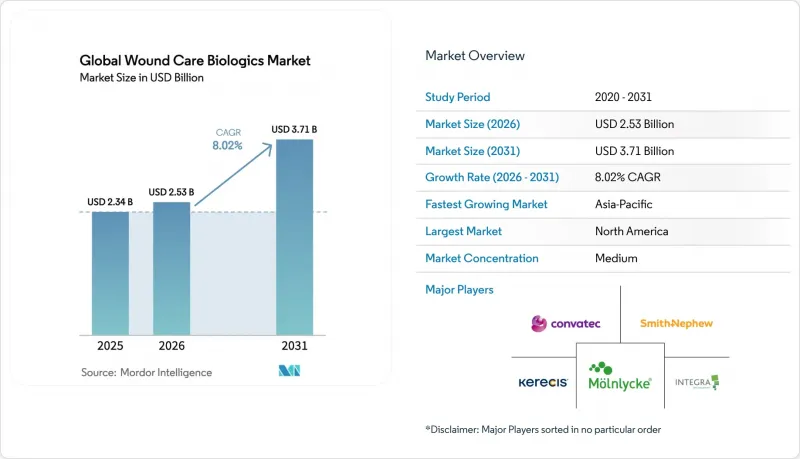
This report is Segmented by Product (Biological Skin Substitutes and Topical Agents), Wound Type (Ulcers, Surgical and Traumatic Wounds and Burns), End User (Hospitals/Clinics, Ambulatory Surgical Centers and Other End Users), and Geography (North America, Europe, Asia-Pacific, Middle East & Africa, and South America).
Global Wound Care Biologics Market Trends and Insights
Growing Prevalence of Diabetic Foot Ulcers
Escalating diabetes incidence keeps chronic ulcers front-of-mind for payers and providers. CMS now requires a documented 50% area reduction after four weeks of standard care before covering biologic dressings, anchoring biologics in step-therapy protocols, and rewarding formulations with randomized-trial data. Platelet-derived growth-factor gels show 48% complete-healing rates versus 25% with conventional dressings, a difference that resonates in value-based purchasing. Japan's early adoption of basic fibroblast growth factor reinforces the commercial payoff when regulation and reimbursement converge. Asia-Pacific's population is aging, and surging diabetes prevalence intensifies demand curves. Parallel growth of outpatient wound centers channels purchasing toward biologics with quick-healing properties, ensuring formulary placement in ambulatory settings.
Increasing Incidence of Burns & Road-Traffic Injuries
Rising industrial accidents and climate-related disasters have pushed burns to the fastest-growing wound type at a 9.75% CAGR to 2030. Emergency departments are moving toward biologic matrices that lower infection risk and accelerate granulation. FDA clearance of plant-based Traumagel for battlefield trauma underscores civilian adoption of defense-driven biotech. Copper-impregnated matrices outpace traditional silver dressings in wound-closure speed and have earned approvals in more than 25 countries. Emerging-market trauma units favor cost-efficient xenografts that require minimal cold-chain logistics yet deliver high epithelialization rates.
High Procedure & Product Cost
The United States spends USD 96.8 billion each year treating chronic wounds, yet reimbursement caps force clinicians to ration biologics across patients. LCDs restrict usage to eight applications within 12-to-16-week episodes, compelling product selection based on probability of full closure within that window. ConvaTec's 6.7% wound-care revenue growth in the first half of 2024 shows that competitively priced biologics can still win share amid budget pressure. In emerging markets, tiered-pricing models that align with local purchasing power are becoming critical for market entry.
Other drivers and restraints analyzed in the detailed report include:
- Government Reimbursement Expansions for Advanced Wound Care
- Surge in Battlefield & Disaster-Response Procurement of Biologics
- Stringent Tissue-Bank Regulations
For complete list of drivers and restraints, kindly check the Table Of Contents.
Segment Analysis
Acellular dermal matrices retained a 37.12% wound care biologics market share in 2025, buoyed by widespread surgeon familiarity and payer coverage for reconstructive needs. Xenografts-propelled by fish-skin pioneers such as Kerecis-are expanding at a 10.23% CAGR, outpacing all other categories. Placental and amniotic membranes face episodic shortages as tissue-bank scrutiny intensifies, steering formulary committees toward synthetic scaffolds that promise consistent supply. FDA clearance of only one growth-factor product (Regranex) leaves a white space for next-generation carriers able to stabilize sensitive proteins while meeting new antimicrobial standards.
Growth-factor sprays are being reformulated with polymer micro-capsules to prolong bioactivity in exudative wounds. Hybrid biosynthetic dressings combine silicone backings with fish-skin grafts, enabling rapid drainage without sacrificing moisture balance. Within hospital value-analysis committees, total cost-of-care calculators highlight shorter length-of-stay when biologic matrices are deployed early, helping justify higher acquisition prices. Xenograft suppliers emphasize disease-specific protocols-diabetic foot ulcers, pressure injuries, and oncology excisions-providing targeted clinical pathways that resonate with evidence-based purchasing. As payer audits intensify, products capable of delivering documented 50% area reduction within four weeks will secure coding priority, reinforcing the segment hierarchy inside the wound care biologics market.
Ulcers represented 62.15% of the wound care biologics market size in 2025, confirming their primacy in the wound care biologics market. Within that group, diabetic foot ulcers account for the largest patient pool owing to global diabetes escalation. CMS's LCD requires proof of prior standard-care failure, effectively channeling biologic spend toward refractory ulcer cohorts. In contrast, burns are on a 9.21% CAGR trajectory-the swiftest within the wound care biologics industry-driven by rising factory incidents in Asia and heat-related disasters elsewhere.
The wound care biologics market size for burn indications is expected to double by 2031 as trauma centers integrate biologics into first-line protocols. Copper-infused matrices deliver shorter epithelialization times against silver dressings, a finding now replicated across 25 regulatory jurisdictions. Military-origin hydrogels suitable for austere settings have migrated to community ERs, reinforcing the burn segment's momentum. Conversely, pressure ulcers in long-term care settings require cost-attenuated biologics, pushing suppliers toward volume-based contracts with nursing-home networks.
Complete Report Scope:
- By Product
- Acellular Dermal Matrices
- Amniotic & Placental Membranes
- Xenografts
- Synthetic & Biosynthetic Scaffolds
- Growth-Factor & Cell-based Topical Agents
- Other Products
- By Wound Type
- Ulcers
- Diabetic Foot Ulcers
- Venous Ulcers
- Pressure Ulcers
- Other Ulcers
- Surgical & Traumatic Wounds
- Burns
- Ulcers
- By Distribution Channel
- Online
- Offline
- By End-User
- Hospitals & Clinics
- Ambulatory Surgical Centers
- Home-Care Settings
- Other End-Users
- By Geography
- North America
- United States
- Canada
- Mexico
- Europe
- Germany
- United Kingdom
- France
- Italy
- Spain
- Rest of Europe
- Asia-Pacific
- China
- Japan
- India
- Australia
- South Korea
- Rest of Asia-Pacific
- Middle East and Africa
- GCC
- South Africa
- Rest of Middle East and Africa
- South America
- Brazil
- Argentina
- Rest of South America
- North America
Geography Analysis
North America's 44.38% of the wound care biologics market size in 2025 rested on mature payer frameworks and broad clinical familiarity with biologics. Yet forecast growth moderates to an 7.78% CAGR as penetration approaches ceiling levels. The VA's USD 340 million contract with KCI USA underscores government muscle in shaping formularies. Canada leverages Health Canada-FDA reciprocity to accelerate approvals, while Mexico's private hospitals import U.S.-cleared fish-skin grafts to serve self-pay patients.
Europe is tracking an 8.07% CAGR, supported by CE-mark harmonization that lets manufacturers sell across 27 states using a unified dossier. Germany and the United Kingdom remain volume anchors, but Southern Europe shows quicker percentage growth as austerity budgets loosen. Value-based procurement consortia compare total cost of closure rather than unit price, favoring biologics with trial-backed healing rates. Scandinavian health systems spearhead real-world registries that feed reimbursement recalibration every two years.
Asia-Pacific leads on growth at 9.84% CAGR. China upgrades hundreds of county hospitals with burn units equipped for xenograft application as part of its Healthy China 2030 plan. Japan's long history with basic fibroblast growth factor eases acceptance of new biologics, while India's multi-tier price corridors encourage domestic production of collagen matrices. Australia's Medicare Benefits Schedule newly covers outpatient biologic dressing reviews, expanding rural uptake. Collectively, these forces shift future revenue weight toward Asia, diversifying the wound care biologics market's geographic footprint.
- Avita Medical
- B. Braun
- Bioventus Inc.
- Coloplast
- Convatec Group plc
- Essity
- Grifols
- Integra LifeSciences
- Kerecis Ehf
- Lynch Biologics
- Marine Polymer Technologies
- Medline Industries
- MiMedx Group Inc.
- Molnlycke AB
- MTF Biologics
- Organogenesis Holdings
- Skye Biologics Holdings
- Smiths Group
- Solventum Corporation
- Stryker
Additional Benefits:
- The market estimate (ME) sheet in Excel format
- 3 months of analyst support
TABLE OF CONTENTS
1 Introduction
- 1.1 Study Assumptions & Market Definition
- 1.2 Scope of the Study
2 Research Methodology
3 Executive Summary
4 Market Landscape
- 4.1 Market Overview
- 4.2 Market Drivers
- 4.2.1 Growing Prevalence of Diabetic Foot Ulcers
- 4.2.2 Government Reimbursement Expansions for Advanced Wound Care
- 4.2.3 Increasing Incidence of Burns & Road-Traffic Injuries
- 4.2.4 Rising Adoption of Fish-Skin Xenografts
- 4.2.5 Surge in Battlefield & Disaster-Response Procurement of Biologics
- 4.2.6 Shift from Inpatient to Outpatient Wound Centers Driving Biologic Formulary Inclusion
- 4.3 Market Restraints
- 4.3.1 High Procedure & Product Cost
- 4.3.2 Stringent Tissue-Bank Regulations
- 4.3.3 Supply-Chain Fragility For Placental / Amniotic Raw Material
- 4.3.4 Growing Antimicrobial-Resistance Scrutiny on Biologic Dressings
- 4.4 Supply Chain Analysis
- 4.5 Regulatory Landscape
- 4.6 Technological Outlook
- 4.7 Porter's Five Forces Analysis
- 4.7.1 Threat of New Entrants
- 4.7.2 Bargaining Power of Buyers
- 4.7.3 Bargaining Power of Suppliers
- 4.7.4 Threat of Substitutes
- 4.7.5 Competitive Rivalry
5 Market Size & Growth Forecasts (Value)
- 5.1 By Product
- 5.1.1 Acellular Dermal Matrices
- 5.1.2 Amniotic & Placental Membranes
- 5.1.3 Xenografts
- 5.1.4 Synthetic & Biosynthetic Scaffolds
- 5.1.5 Growth-Factor & Cell-based Topical Agents
- 5.1.6 Other Products
- 5.2 By Wound Type
- 5.2.1 Ulcers
- 5.2.1.1 Diabetic Foot Ulcers
- 5.2.1.2 Venous Ulcers
- 5.2.1.3 Pressure Ulcers
- 5.2.1.4 Other Ulcers
- 5.2.2 Surgical & Traumatic Wounds
- 5.2.3 Burns
- 5.2.1 Ulcers
- 5.3 By Distribution Channel
- 5.3.1 Online
- 5.3.2 Offline
- 5.4 By End-User
- 5.4.1 Hospitals & Clinics
- 5.4.2 Ambulatory Surgical Centers
- 5.4.3 Home-Care Settings
- 5.4.4 Other End-Users
- 5.5 By Geography
- 5.5.1 North America
- 5.5.1.1 United States
- 5.5.1.2 Canada
- 5.5.1.3 Mexico
- 5.5.2 Europe
- 5.5.2.1 Germany
- 5.5.2.2 United Kingdom
- 5.5.2.3 France
- 5.5.2.4 Italy
- 5.5.2.5 Spain
- 5.5.2.6 Rest of Europe
- 5.5.3 Asia-Pacific
- 5.5.3.1 China
- 5.5.3.2 Japan
- 5.5.3.3 India
- 5.5.3.4 Australia
- 5.5.3.5 South Korea
- 5.5.3.6 Rest of Asia-Pacific
- 5.5.4 Middle East and Africa
- 5.5.4.1 GCC
- 5.5.4.2 South Africa
- 5.5.4.3 Rest of Middle East and Africa
- 5.5.5 South America
- 5.5.5.1 Brazil
- 5.5.5.2 Argentina
- 5.5.5.3 Rest of South America
- 5.5.1 North America
6 Competitive Landscape
- 6.1 Market Concentration
- 6.2 Competitive Benchmarking
- 6.3 Market Share Analysis
- 6.4 Company Profiles (includes Global level Overview, Market level overview, Core Segments, Financials as available, Strategic Information, Market Rank/Share for key companies, Products & Services, and Recent Developments)
- 6.4.1 Avita Medical
- 6.4.2 B. Braun Melsungen AG
- 6.4.3 Bioventus Inc.
- 6.4.4 Coloplast A/S
- 6.4.5 Convatec Group plc
- 6.4.6 Essity AB
- 6.4.7 Grifols S.A.
- 6.4.8 Integra LifeSciences
- 6.4.9 Kerecis Ehf
- 6.4.10 Lynch Biologics
- 6.4.11 Marine Polymer Technologies
- 6.4.12 Medline Industries
- 6.4.13 MiMedx Group Inc.
- 6.4.14 Molnlycke AB
- 6.4.15 MTF Biologics
- 6.4.16 Organogenesis Holdings
- 6.4.17 Skye Biologics Holdings
- 6.4.18 Smith & Nephew plc
- 6.4.19 Solventum Corporation
- 6.4.20 Stryker Corporation
7 Market Opportunities & Future Outlook
- 7.1 White-space & Unmet-need Assessment


