

|
시장보고서
상품코드
2099981
항균 재생 상처 매트릭스 시장 : 시장 점유율 분석, 업계 동향 및 통계, 성장 예측(2026-2031년)Antimicrobial Regenerative Wound Matrix - Market Share Analysis, Industry Trends & Statistics, Growth Forecasts (2026 - 2031) |
||||||
 Mordor Intelligence
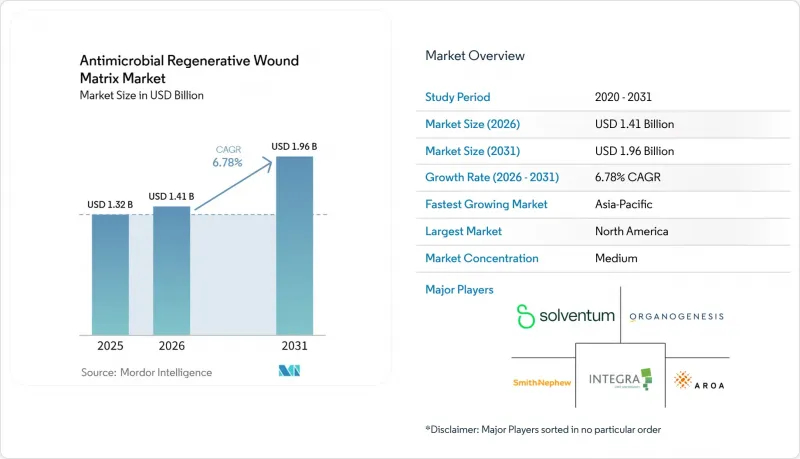
항균 재생 상처 매트릭스 시장 규모는 2025년 13억 2,000만 달러로 평가되었고, 2026년에는 14억 1,000만 달러로 확대될 것으로 추정되고, 2031년까지 19억 6,000만 달러에 이를 것으로 예상되며, 2026-2031년 CAGR 6.78%로 성장할 전망입니다.
본 보고서는 소재별(천연 고분자, 합성 고분자), 상처 유형별(급성 상처, 만성 상처), 용도별(당뇨병성 족부 궤양, 욕창 등), 최종 사용자별(병원, 외래수술센터(ASC) 등), 기술별(동결 건조, 일렉트로스피닝 등), 지역별(북미 등)로 분류되어 있습니다. 예측치는 금액(달러)으로 표시되어 있습니다.
세계의 항균 재생 상처 매트릭스 시장 동향 및 인사이트
만성 상처의 유병률 및 감염 부담 증가
당뇨병성 족부 궤양, 정맥성 하퇴 궤양, 욕창은 장기간에 걸쳐 치유되지 않는 경우가 많기 때문에 만성 상처의 유병률은 항균 재생 상처 매트릭스 시장에 지속적인 치료 기반을 마련해 주고 있습니다. 당뇨병을 앓고 있는 성인을 대상으로 한 전 세계 당뇨병성 족부 궤양의 유병률은 6.3%이며, 북미에서는 13%에 육박하여 지역별로는 가장 높은 비율을 기록했습니다. 초기 치유 후 3-5년 이내에 재발률이 65%에 달하는 경우도 있어, 환자가 고도의 상처 관리 과정에 진입하면 반복적인 치료 수요가 높은 수준을 유지합니다. 이 경향이 중요한 이유는 만성 상처 관리에서 감염 관리가 부차적인 요소가 아니며, 항균 관리의 지연이 치유를 장기화시키고 재처치의 필요성을 높일 가능성이 있기 때문입니다. 2025년 여러 병원을 대상으로 한 분석에 따르면, 수술 부위 감염은 1건당 11.6일의 추가 입원 일수와 병원 보고 비용 기준 3만 689달러의 추가 비용과 관련이 있었기 때문에 병원의 비용 절감 압박도 이 접근 방식을 뒷받침하고 있습니다. 이러한 비용 프로파일은 봉합 시간을 단축하고 재시술을 줄일 수 있는 경우, 병원의 가치 분석 위원회가 프리미엄 매트릭스를 검토할 수 있는 명확한 근거가 됩니다.
외래 및 재택 상처 관리로의 전환
외래 및 재택 관리로의 전환은 특히 미국에서 항균 재생 상처 매트릭스 시장에 접근하는 방식을 변화시키고 있습니다. CMS는 2026년 1월 1일, 대부분의 피부 대체재에 대한 지급 방식을 변경하여 전국적으로 통일된 '인시던트 투(incident-to)' 공급 요금으로 전환했으나, 섹션 351에 해당하는 생물학적 제제에 대해서는 평균 판매 가격(ASP) +6%라는 처리 방식을 유지했습니다. Vizient사는 1제곱센티미터당 127.28달러라는 전국 통일 요율로는 많은 진료소에서 적용 시 수익성을 확보할 수 없어, 이미 일부 이동형 상처 치료 제공업체들이 영향을 받는 현장에서 철수할 수밖에 없는 상황이라고 지적하고 있습니다. 이로 인해 임상적 차별화보다는 제품 보급에 의존하던 진료소 모델에서 병원 외래 상처 관리 센터로 상처 관리 수요가 더욱 이동하고 있습니다. 시술 전 복잡한 준비가 필요한 제품보다 더 간편하고 진료 현장에서 즉시 사용할 수 있는 형태의 제품이 이러한 환경에 더 적합합니다. 각 제조업체들은 여전히 분산형 유통 채널 개척을 추진하고 있으며, 그 일례로 MTF Biologics사가 2026년 5월, 급성기 후 시장 및 외래 시장을 대상으로 한 ‘AmnioBand Membrane’의 독점 유통업체으로 New Horizon Medical Solutions사를 지정한 것을 들 수 있습니다.
복합 제품 개발 및 멸균에 드는 높은 비용
높은 개발 비용과 멸균 비용이 여전히 항균 재생 상처 매트릭스 시장의 추가 확장을 저해하고 있습니다. 항균제와 생물학적 활성을 지닌 스캐폴드를 결합하는 기업은 의료기기·의약품 또는 의료기기·생물학적 제제의 각 개발 과정에 자금을 투입해야 하며, 이로 인해 개발 기간과 검증 비용이 모두 증가합니다. 동결건조, 감마선 조사, 전자선 처리 등의 최종 멸균 방법에서는 항균제의 안정성을 유지하면서 스캐폴드의 구조를 보존해야 하므로, 이는 상용화 전의 기술적 위험을 높이고 있습니다. 또한, 유효 성분이 콜라겐이나 합성 매트릭스에 통합되는 경우, 이러한 프로그램에서는 추가적인 생체적합성 시험 및 재료 시험이 필요합니다. MPM Medical사는 텍사스주 메스키토에 위치한 10,000제곱피트 규모의 등록 시설로 확장하여 첨단 콜라겐 가공 능력과 여러 대의 동결건조기를 도입했으나, 이 회사는 이번 이전의 배경으로 공급망의 불안정화와 제조 비용 상승을 꼽고 있습니다. 소규모 개발 기업의 경우, 이러한 비용 구조는 이익률을 압박하게 되며, 본격적인 복합 제품 개발은 기존 바이오 제조 자산을 보유한 기업이나 강력한 자본적 지원을 받는 기업으로 한정될 것입니다.
부문 분석
2025년, 천연 폴리머는 항균 재생 상처 매트릭스 시장에서 63.31%의 점유율을 차지했으며 소재로서의 주도적 지위를 유지했습니다. 이러한 우위는 오랜 기간에 걸친 임상 실적, 확립된 생산 워크플로우, 그리고 임상의와 조달 팀이 불확실성을 최소화하며 해석할 수 있는 규제상의 실적에서 비롯됩니다. 콜라겐, 히알루론산 및 세포외 기질을 기반으로 한 기질은 섬유아세포의 부착을 촉진하고, 성장 인자를 유지하며, 임상 현장에서 이미 친숙한 3차원 상처 침대 구조를 제공하기 때문에 여전히 중심적인 위치를 차지하고 있습니다. 이러한 특징은 병원 및 상처 전문의들이 만성 상처나 복잡한 외과 사례에서 상처 봉합 지원을 평가하는 방식과 잘 부합합니다. 그 결과, 이 카테고리의 대부분에서 천연 기질은 여전히 제품 성능, 취급 편의성 및 기대되는 치유 지원의 기준이 되고 있습니다.
합성 폴리머는 2026-2031년 연평균 성장률(CAGR) 7.38%를 나타낼 것으로 예측되며, 항균 재생 상처 매트릭스 시장에서 가장 빠르게 성장하는 소재 카테고리가 되고 있습니다. 2025년 12월 Solventum사가 Acera Surgical사를 7억 2,500만 달러에 인수한 것은 완벽하게 설계된 합성 조직 매트릭스가 현재의 매출 규모를 훨씬 뛰어넘는 전략적 가치를 창출하고 있음을 보여줍니다. 합성 소재에 대한 관심은 설계를 통한 균일성, 차별화된 기계적 특성, 그리고 동물 유래 원료에 대한 의존도가 낮다는 점 등의 매력도 반영하고 있습니다. 조달 팀은 소나 돼지 유래 콜라겐공급 집중 현상에 주목하고 있습니다. 이는 가축 질병 발생, 관세 변동, 수출 규제로 인해 원료 확보가 어려워질 가능성이 있기 때문입니다. 이러한 위험에 대한 우려로 인해, 특히 임상 성과와 병행하여 공급의 회복탄력성을 평가하는 의료 기관을 중심으로, 복수 공급처로부터의 조달 및 합성 소재로의 단계적 다각화가 진행되고 있습니다.
2025년에는 만성 상처가 58.44%의 점유율을 차지한 것으로 평가되었으며, 2026-2031년 8.52%라는 가장 높은 연평균 성장률(CAGR)을 기록하며 성장할 것으로 예측됩니다. 이 두 가지 범주가 시장을 주도하고 있다는 사실은 항균 재생 상처 매트릭스 시장이 치료에 많은 수고가 들고 치유에 시간이 오래 걸리는 상처 범주에 의해 가장 크게 형성되고 있음을 보여줍니다. 당뇨병성 족부 궤양, 정맥성 하퇴 궤양, 욕창은 생물막의 형성, 성장 인자의 활성 저하, 치유 기간의 장기화 등 공통된 임상적 특징을 가지고 있습니다. 이러한 부담으로 인해 대부분의 경우 반복적인 항균 관리, 고도의 드레싱, 데브리드먼트, 그리고 여러 차례의 내원 기간 동안 스캐폴드(scaffold)를 통한 지원이 필요합니다. 이러한 상황에서는 항균 보호와 재생 지원을 결합한 제품이 개별 제품을 조합한 순차적 치료 방식보다 더 명확한 임상적 차별화를 이룰 수 있습니다.
임상시험 설계도 이러한 수요 패턴에 부합하며, Organogenesis사와 Aroa Biosurgery사는 모두 2026년 프로그램에서 만성 비치유성 당뇨병성 족부 궤양을 주요 적응증으로 선정하고, 주요 평가 지표를 달성했습니다. 급성 상처는 2025년에 나머지 41.56%의 점유율을 차지하며, 외과적 상처의 재개방이나 외상 사례에 집중된 상태를 유지했습니다. 급성기 의료에서의 사용은 중증도가 높은 환경에서는 가격에 대한 민감도가 낮은 제품, 보다 단순한 드레싱 형태, 또는 처치 중심의 구매 결정에 따른 경쟁에 노출되어 있습니다. 따라서 급성 상처 분야의 성장은 생체 재료의 혁신에만 기인하기보다는 임상 사례 수의 추이에 좌우되는 경향이 있습니다. 그 결과, 항균·재생 상처 매트릭스 시장 전체에서 만성 상처 관리는 제품 개발, 임상시험 비용 및 보험 적용 목록을 둘러싼 경쟁에서 계속해서 큰 비중을 차지하고 있습니다.
지역별 분석
2025년, 북미는 항균 재생 상처 매트릭스 시장의 36.61% 점유율을 차지하며 계속해서 최대 지역 블록으로서의 지위를 유지했습니다. 이 지역은 병원 외래 상처 치료 인프라가 잘 갖춰져 있고, 만성 질환의 부담이 크며, 오랫동안 첨단 상처 치료 도입을 지원해 온 보험 환급 제도를 갖추고 있습니다. 2025년 당뇨병성 족부 궤양에 관한 조사에 따르면, 북미 당뇨병 환자의 유병률이 13%에 육박하여 지역별로는 가장 높은 수준을 기록했으며, 이는 이 지역에서 치료가 집중되고 있음을 뒷받침합니다. 2026년 1월 CMS의 재설정은 단기적인 가격 압박을 초래했지만, 한편으로는 근거 기반 매트릭스가 더욱 확고한 입지를 차지하는 병원 기반 상처 치료 센터로의 통합을 가속화했습니다.
유럽은 고령화, 견고한 다직종 협력을 통한 상처 치료 경로, 그리고 영국이나 독일 등 시장에서 정맥성 하퇴 궤양의 높은 유병률에 힘입어 여전히 2위 규모의 지역 블록으로 자리매김하고 있습니다. 또한, 이 지역은 확고한 임상 데이터 세트를 갖춘 첨단 상처 치료 제품에 있어 중요한 초기 검증의 장으로도 기능하고 있습니다. 스미스 앤 네퓨(Smith & Nephew)는 2026년 3월 ‘ALLEVYN COMPLETE CARE 폼 드레싱’을 출시하고, 2026년 한 해 동안 유럽 내 확장을 지속하며 프리미엄 상처 관리 제품에 대한 지속적인 투자를 보여주고 있습니다. 콤바텍(Combatec)은 2025년 4월 ‘ConvaNiox’에 대해 EU 및 영국에서 승인을 획득했으며, 이를 바탕으로 2026년 미국에서의 승인을 추진하고 있습니다. 독일, 프랑스, 영국, 스칸디나비아 국가들이 지역 수요를 지탱하는 반면, 남유럽 및 동유럽에서는 생산 능력 제약과 가격 민감성으로 인해 시장 확대 속도가 완만합니다.
항균 재생 상처 매트릭스 시장에서 아시아태평양은 2026-2031년 8.65%라는 가장 높은 연평균 성장률(CAGR)을 나타낼 전망입니다. 이 지역의 성장은 당뇨병 부담 증가, 병원 수용 능력 확대, 그리고 중국 및 인도 등 주요 시장의 규제 현대화에 힘입고 있습니다. 중국과 인도는 가장 큰 환자층을 보유하고 있지만, 일본은 여전히 성숙한 상처 치료 시장이며, 한국과 호주에서는 고급 재생 의료 제품에 대한 수요가 증가하고 있습니다. 중동 및 아프리카에서는 GCC 국가들이 3차 의료에 대한 투자와 조달 체계의 현대화를 통해 도입을 주도하고 있지만, 남아프리카공화국에서는 접근성 및 자금 조달의 불균형이 지속되고 있어 진전이 더딘 임베디드니다. 남미는 브라질과 아르헨티나를 중심으로 대규모 도시 병원 시스템이 이용을 주도하고 있으나, 고도의 상처 치료에 대한 보험 환급 지원 체계는 북미나 유럽에 비해 여전히 미발달된 상황입니다.
기타 혜택 :
- 엑셀 형식 시장 예측(ME) 시트
- 3개월간의 애널리스트 지원
자주 묻는 질문
목차
제1장 서론
제2장 조사 방법
제3장 주요 요약
제4장 시장 구도
제5장 시장 규모 및 성장 예측
제6장 경쟁 구도
제7장 시장 기회 및 향후 전망
AJY 26.08.11According to Mordor Intelligence, the antimicrobial regenerative wound matrix market size is expected to increase from USD 1.32 billion in 2025 to USD 1.41 billion in 2026 and reach USD 1.96 billion by 2031, growing at a CAGR of 6.78% over 2026-2031.
This report is Segmented by Material (Natural Polymer, Synthetic Polymer), Wound Type (Acute Wounds, Chronic Wounds), Application (Diabetic Foot Ulcers, Pressure Ulcers, and More), End User (Hospitals, Ambulatory Surgical Centers, and More), Technology (Lyophilization, Electrospinning, and More), and Geography (North America and More). Forecasts are Provided in Terms of Value (USD).
Global Antimicrobial Regenerative Wound Matrix Market Trends and Insights
Rising Chronic Wound Prevalence and Infection Burden
Chronic wound prevalence continues to create a durable treatment base for the antimicrobial regenerative wound matrix market because diabetic foot ulcers, venous leg ulcers, and pressure injuries often remain open for long periods. Global diabetic foot ulcer prevalence among adults with diabetes stands at 6.3%, and North America recorded the highest regional rate near 13%. Recurrence can reach 65% within 3 to 5 years after initial healing, which keeps repeat treatment demand high once a patient enters advanced wound care pathways. This pattern matters because infection control is not a secondary feature in chronic wound care, and delayed antimicrobial management can prolong healing and increase the need for repeat procedures. Hospital cost pressure reinforces that approach because surgical site infections were associated with 11.6 additional length-of-stay days and USD 30,689 in added hospital-reported cost per case in a 2025 multi-hospital analysis. That cost profile gives hospital value analysis committees a clear basis to consider premium matrices when they can shorten closure time and reduce repeat intervention.
Shift Toward Outpatient and Home-Based Wound Care
The shift toward outpatient and home-based care is changing how the antimicrobial regenerative wound matrix market is accessed, especially in the United States. CMS changed payment for most skin substitutes on January 1, 2026, moving them to a flat national incident-to supply rate while Section 351 biologics kept ASP+6% treatment. Vizient noted that the national rate of USD 127.28 per square centimeter does not support the economics of many physician office applications, which has already pushed some mobile wound providers out of affected settings. This is sending more wound care volume toward hospital outpatient wound centers and away from office models that relied on product spread rather than clinical differentiation. Products that arrive in simpler, point-of-care-ready formats fit this environment better than products that need more complex preparation before application. Manufacturers are still pursuing decentralized channels, as shown by MTF Biologics naming New Horizon Medical Solutions as exclusive distributor of AmnioBand Membrane for post-acute and outpatient markets in May 2026.
High Cost of Combination Product Development and Sterilization
High development and sterilization costs continue to slow broader expansion in the antimicrobial regenerative wound matrix market. Companies that combine antimicrobials with biologically active scaffolds must fund device-drug or device-biologic workstreams, which raises both development time and validation cost. Terminal sterilization options such as lyophilization, gamma irradiation, and electron beam processing must preserve scaffold structure while maintaining antimicrobial stability, which adds technical risk before commercialization. These programs also require added biocompatibility and material testing when active agents are built into collagen or synthetic matrices. MPM Medical expanded into a registered 10,000 sq ft facility in Mesquite, Texas, with advanced collagen processing capacity and multiple lyophilizers, and the company linked that move to supply chain instability and rising manufacturing costs. For smaller developers, this cost structure narrows margins and limits serious combination product development to firms with existing biomanufacturing assets or strong capital backing.
Other drivers and restraints analyzed in the detailed report include:
- Demand for Dual-Function, Infection-Controlling Regenerative Products
- Faster Adoption of Advanced Biomaterials and Nanofiber Scaffolds
- Regulatory Complexity for Biologic-Device and Antimicrobial Claims
For complete list of drivers and restraints, kindly check the Table Of Contents.
Segment Analysis
Natural polymers held 63.31% of antimicrobial regenerative wound matrix market share in 2025, which kept them in the leading material position. Their lead comes from long clinical familiarity, established production workflows, and a regulatory history that clinicians and procurement teams can interpret with less uncertainty. Collagen, hyaluronic acid, and extracellular matrix-based substrates remain central because they support fibroblast adhesion, retain growth factors, and provide a three-dimensional wound bed structure that is already familiar in clinical use. These features align well with how hospitals and wound specialists evaluate closure support in chronic wounds and complex surgical cases. As a result, natural scaffolds still set the reference point for product performance, handling, and expected healing support across much of the category.
Synthetic polymers are projected to grow at a 7.38% CAGR from 2026 to 2031, which makes them the faster-moving material category in the antimicrobial regenerative wound matrix market. Solventum's USD 725 million acquisition of Acera Surgical in December 2025 showed that fully engineered synthetic tissue matrices are attracting strategic value well beyond current revenue scale. Interest in synthetics also reflects the appeal of engineered consistency, differentiated mechanics, and lower dependence on animal-derived inputs. Procurement teams are watching the supply concentration of bovine and porcine collagen because livestock disease events, tariff shifts, and export restrictions can tighten input availability. That exposure is encouraging multisource purchasing and gradual synthetic diversification, especially in institutions that now evaluate supply resilience alongside clinical outcomes.
Chronic wounds held a 58.44% share in 2025 and are projected to grow at the fastest CAGR of 8.52% from 2026 to 2031. This dual leadership shows that the antimicrobial regenerative wound matrix market is being shaped most heavily by wound categories that are treatment intensive and slow to close. Diabetic foot ulcers, venous leg ulcers, and pressure injuries share a common clinical profile with biofilm colonization, impaired growth factor activity, and prolonged healing. That burden often requires repeated antimicrobial management, advanced dressings, debridement, and scaffold support across multiple care visits. In that setting, a product that combines antimicrobial protection with regenerative support has clearer clinical differentiation than a sequential treatment pattern built around separate products.
Trial design has followed that demand pattern, with Organogenesis and Aroa Biosurgery both selecting chronic non-healing diabetic foot ulcers as core indications in 2026 programs that met primary endpoints. Acute wounds held the remaining 41.56% share in 2025 and remained concentrated in surgical wound dehiscence and trauma cases. Acute care use is less sensitive to price in high-acuity settings, but it also faces stronger competition from simpler dressing formats and procedure-led purchasing decisions. Growth in acute wounds therefore tracks clinical volume more than biomaterial innovation alone. For that reason, chronic wound management continues to absorb a larger share of product development, trial spending, and formulary competition across the antimicrobial regenerative wound matrix market.
Complete Report Scope:
- By Material
- Natural Polymer
- Synthetic Polymer
- By Wound Type
- Acute Wounds
- Chronic Wounds
- By Application
- Diabetic Foot Ulcers
- Pressure Ulcers
- Venous Leg Ulcers
- Burns
- Surgical Wounds
- Other Applications
- By End User
- Hospitals
- Ambulatory Surgical Centers
- Clinics and Specialty Clinics
- Home Healthcare
- Other End Users
- By Technology
- Lyophilization
- Electrospinning
- Nanofibers
- 3D Bioprinting
- By Geography
- North America
- United States
- Canada
- Mexico
- Europe
- Germany
- United Kingdom
- France
- Italy
- Spain
- Rest of Europe
- Asia-Pacific
- China
- Japan
- India
- Australia
- South Korea
- Rest of Asia-Pacific
- Middle East and Africa
- GCC
- South Africa
- Rest of Middle East and Africa
- South America
- Brazil
- Argentina
- Rest of South America
- North America
Geography Analysis
North America held 36.61% of antimicrobial regenerative wound matrix market share in 2025, which kept it as the largest regional block. The region combines dense hospital outpatient wound care infrastructure, high chronic disease burden, and a reimbursement system that supported advanced wound care adoption for years. A 2025 diabetic foot ulcer review placed North America at the highest regional prevalence level near 13% among people with diabetes, which reinforces the region's treatment intensity. The January 2026 CMS reset created short-term pricing pressure, but it also accelerated consolidation toward hospital-based wound centers where higher-evidence matrices hold a stronger position.
Europe remained the second-largest regional block, supported by aging populations, strong multidisciplinary wound pathways, and a high burden of venous leg ulcers in markets such as the United Kingdom and Germany. The region also serves as an important early validation setting for advanced wound products with robust clinical packages. Smith+Nephew launched ALLEVYN COMPLETE CARE Foam Dressing in March 2026 and continued its European rollout through 2026, showing continued investment in premium wound care formats. ConvaTec received EU and UK approval for ConvaNiox in April 2025 and is using that base to support a U.S. submission in 2026. Germany, France, the United Kingdom, and Scandinavia anchor regional demand, while Southern and Eastern Europe are moving at a slower pace because of capacity limits and price sensitivity.
Asia-Pacific is projected to grow at the fastest CAGR of 8.65% from 2026 to 2031 in the antimicrobial regenerative wound matrix market. Growth in the region is being supported by rising diabetes burden, hospital capacity expansion, and regulatory modernization across major markets such as China and India. China and India offer the largest patient pools, while Japan remains a mature wound care market and South Korea and Australia are developing demand for premium regenerative products. In the Middle East and Africa, GCC countries are leading adoption through tertiary care investment and procurement modernization, while South Africa faces slower progress because access and funding remain uneven. South America is centered on Brazil and Argentina, where large urban hospital systems are driving use, but reimbursement support for advanced wound care remains less developed than in North America and Europe.
- AdMedSol
- Aroa Biosurgery Ltd.
- B. Braun
- Baxter
- ConvaTec Group plc
- DeRoyal Industries
- DSM Biomedical
- Harbor Medtech Inc.
- Integra LifeSciences
- Medline Industries
- MIMEDX Group
- Molnlycke Health Care
- MTF Biologics
- Omeza LLC
- Organogenesis
- ProgenaCare Global
- RenovoDerm
- Smiths Group
- Solventum Corporation
Additional Benefits:
- The market estimate (ME) sheet in Excel format
- 3 months of analyst support
TABLE OF CONTENTS
1 Introduction
- 1.1 Study Assumptions and Market Definition
- 1.2 Scope of the Study
2 Research Methodology
3 Executive Summary
4 Market Landscape
- 4.1 Market Overview
- 4.2 Market Drivers
- 4.2.1 Rising Chronic Wound Prevalence and Infection Burden
- 4.2.2 Shift Toward Outpatient and Home-Based Wound Care
- 4.2.3 Demand for Dual-Function, Infection-Controlling Regenerative Products
- 4.2.4 Faster Adoption of Advanced Biomaterials and Nanofiber Scaffolds
- 4.2.5 Hospital Efforts to Reduce Readmissions and Rework From Wound Infections
- 4.2.6 Expanding Reimbursement Support for Advanced Wound Care in Mature Markets
- 4.3 Market Restraints
- 4.3.1 High Cost of Combination Product Development and Sterilization
- 4.3.2 Regulatory Complexity for Biologic-Device and Antimicrobial Claims
- 4.3.3 Collagen and Bioactive Raw Material Supply Concentration
- 4.3.4 Limited Clinical Evidence for Some Next-Generation Matrices
- 4.4 Supply-Chain Analysis
- 4.5 Regulatory Landscape
- 4.6 Technological Outlook
- 4.7 Porter's Five Forces Analysis
- 4.7.1 Bargaining Power of Suppliers
- 4.7.2 Bargaining Power of Buyers
- 4.7.3 Threat of New Entrants
- 4.7.4 Threat of Substitutes
- 4.7.5 Competitive Rivalry
5 Market Size & Growth Forecasts (Value, USD)
- 5.1 By Material
- 5.1.1 Natural Polymer
- 5.1.2 Synthetic Polymer
- 5.2 By Wound Type
- 5.2.1 Acute Wounds
- 5.2.2 Chronic Wounds
- 5.3 By Application
- 5.3.1 Diabetic Foot Ulcers
- 5.3.2 Pressure Ulcers
- 5.3.3 Venous Leg Ulcers
- 5.3.4 Burns
- 5.3.5 Surgical Wounds
- 5.3.6 Other Applications
- 5.4 By End User
- 5.4.1 Hospitals
- 5.4.2 Ambulatory Surgical Centers
- 5.4.3 Clinics and Specialty Clinics
- 5.4.4 Home Healthcare
- 5.4.5 Other End Users
- 5.5 By Technology
- 5.5.1 Lyophilization
- 5.5.2 Electrospinning
- 5.5.3 Nanofibers
- 5.5.4 3D Bioprinting
- 5.6 By Geography
- 5.6.1 North America
- 5.6.1.1 United States
- 5.6.1.2 Canada
- 5.6.1.3 Mexico
- 5.6.2 Europe
- 5.6.2.1 Germany
- 5.6.2.2 United Kingdom
- 5.6.2.3 France
- 5.6.2.4 Italy
- 5.6.2.5 Spain
- 5.6.2.6 Rest of Europe
- 5.6.3 Asia-Pacific
- 5.6.3.1 China
- 5.6.3.2 Japan
- 5.6.3.3 India
- 5.6.3.4 Australia
- 5.6.3.5 South Korea
- 5.6.3.6 Rest of Asia-Pacific
- 5.6.4 Middle East and Africa
- 5.6.4.1 GCC
- 5.6.4.2 South Africa
- 5.6.4.3 Rest of Middle East and Africa
- 5.6.5 South America
- 5.6.5.1 Brazil
- 5.6.5.2 Argentina
- 5.6.5.3 Rest of South America
- 5.6.1 North America
6 Competitive Landscape
- 6.1 Market Concentration
- 6.2 Market Share Analysis
- 6.3 Company Profiles (includes Global Level Overview, Market Level Overview, Core Segments, Financials as available, Strategic Information, Market Rank/Share, Products and Services, Recent Developments)
- 6.3.1 AdMedSol
- 6.3.2 Aroa Biosurgery Ltd.
- 6.3.3 B. Braun Melsungen AG
- 6.3.4 Baxter International Inc.
- 6.3.5 ConvaTec Group plc
- 6.3.6 DeRoyal Industries, Inc.
- 6.3.7 DSM Biomedical
- 6.3.8 Harbor Medtech Inc.
- 6.3.9 Integra LifeSciences Holdings Corporation
- 6.3.10 Medline Industries LP
- 6.3.11 MiMedx Group, Inc.
- 6.3.12 Molnlycke Health Care AB
- 6.3.13 MTF Biologics
- 6.3.14 Omeza LLC
- 6.3.15 Organogenesis Inc.
- 6.3.16 ProgenaCare Global
- 6.3.17 RenovoDerm
- 6.3.18 Smith and Nephew plc
- 6.3.19 Solventum Corporation
7 Market Opportunities and Future Outlook
- 7.1 White-Space and Unmet-Need Assessment


