

|
시장보고서
상품코드
2038654
믹서 시장 : 시장 기회, 성장요인, 업계 동향 분석 및 예측(2026-2035년)Mixer Market Opportunity, Growth Drivers, Industry Trend Analysis, and Forecast 2026 - 2035 |
||||||

세계의 믹서 시장은 2025년에 26억 달러로 평가되었고, CAGR 4.8%로 성장할 전망이며, 2035년까지 41억 달러에 이를 것으로 추정되고 있습니다.
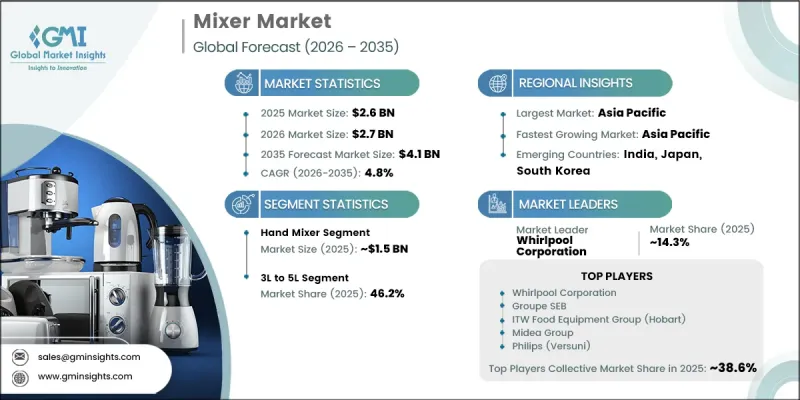
시장 성장은 상업용 식품 생산과 주거용 주방 모두에서 효율적인 믹싱 솔루션에 대한 수요가 증가함에 따라 주도되고 있습니다. 대규모 식품 가공 환경에서 고성능 믹서는 대량 생산에서 균일한 혼합, 일관된 질감 및 제품 품질을 보장하는 데 중요한 역할을 합니다. 가공식품 및 즉석식품에 대한 수요가 증가함에 따라 기업들은 내구성이 높고 대용량의 장비에 대한 투자를 진행하고 있습니다. 동시에 가정에서 요리와 베이킹의 인기가 높아진 것도 소비자들의 주방 가전 도입 확대에 기여하고 있습니다. 또한, 식사 준비를 간소화하는 편리하고 다기능 가전제품으로의 전환도 시장을 촉진하고 있습니다. 믹서는 사용 편의성과 합리적인 가격을 유지하면서 다양한 조리 작업에 대응할 수 있다는 점에서 널리 평가받고 있습니다. 상업시설과 일반 가정의 지속적인 수요와 다기능 가전제품에 대한 소비자 선호도 변화로 인해 전 세계 믹서기 산업은 꾸준한 성장세를 보이고 있습니다.
| 시장 범위 | |
|---|---|
| 개시 연도 | 2025년 |
| 예측 기간 | 2026-2035년 |
| 개시 연도 시장 규모 | 26억 달러 |
| 예측 시장 규모 | 41억 달러 |
| CAGR | 4.8% |
핸드믹서 시장은 2025년 15억 달러 규모를 기록할 것으로 예상되며, 2026-2035년 연평균 복합 성장률(CAGR) 3.6%를 나타낼 것으로 예측됩니다. 이 부문은 실용성과 일상적인 주방의 요구와 밀접한 관련이 있기 때문에 선도적인 지위를 유지하고 있습니다. 핸드 믹서는 일상적인 조리 과정에서 널리 사용되고 있으며, 다양한 혼합 작업에서 편리함과 효율성을 제공합니다. 컴팩트한 디자인, 가벼운 구조, 사용하기 쉬운 기능성은 효율성과 공간 최적화가 필수적인 현대 생활공간에 매우 적합합니다. 또한, 대형 장비에 비해 가격이 저렴해 다양한 소비자층이 쉽게 접근할 수 있는 장점이 있습니다. 가정에서의 요리 활동에 대한 관심이 높아지면서 이 부문 수요가 계속 증가하고 있습니다.
2025년에는 3L-5L 용량의 부문이 시장 점유율의 46.2%를 차지했으며, 2035년까지 연평균 4.4%의 성장률을 보일 것으로 전망됩니다. 이 부문은 용량과 사용 편의성의 균형이 잘 잡혀 있어 가정용과 소규모 상업용 모두에 적합하기 때문에 시장을 선도하고 있습니다. 이 용량 범위는 적당한 양의 요리를 효율적으로 할 수 있어 일상적인 요리 요구에 부합합니다. 공간 효율성을 유지하면서 여러 조리 공정에 대응할 수 있는 다재다능함이 보급에 기여하고 있습니다. 성능과 편의성을 모두 갖춘 가전제품에 대한 소비자 수요가 증가하면서 이 카테고리의 성장을 더욱 촉진하고 있습니다.
중국의 믹서 시장은 2025년 4억 7,130만 달러에 달했으며, 2026-2035년 연평균 4.9% 성장할 것으로 예측됩니다. 시장의 성장은 소비자의 라이프스타일 변화, 소득 수준 상승, 그리고 최신 주방 기술의 보급에 의해 뒷받침되고 있습니다. 특히 공간을 중시하는 주거환경에 잘 어울리는 소형, 다기능 가전제품에 대한 수요가 활발합니다. 국내 제조업체들은 경쟁력 있는 가격의 제품을 제공함으로써 계속해서 중요한 역할을 하고 있으며, 고급 기능을 원하는 소비자층 사이에서는 프리미엄 제품이 인기를 끌고 있습니다. 기능 향상과 안전성 강화와 같은 기술적 진보가 이 분야의 제품 혁신을 점차적으로 형성하고 있습니다.
자주 묻는 질문
목차
제1장 조사 방법과 범위
제2장 주요 요약
제3장 업계 인사이트
제4장 경쟁 구도
제5장 시장 추산 및 예측 : 제품 유형별(2022-2035년)
제6장 시장 추산 및 예측 : 용량별(2022-2035년)
제7장 시장 추산 및 예측 : 출력별(2022-2035년)
제8장 시장 추산 및 예측 : 가격별(2022-2035년)
제9장 시장 추산 및 예측 : 최종 사용자별(2022-2035년)
제10장 시장 추산 및 예측 : 유통 채널별(2022-2035년)
제11장 시장 추산 및 예측 : 지역별(2022-2035년)
제12장 기업 개요
AJY 26.06.11The Global Mixer Market was valued at USD 2.6 billion in 2025 and is estimated to grow at a CAGR of 4.8% to reach USD 4.1 billion by 2035.
Market growth is driven by rising demand for efficient mixing solutions across both commercial food production and residential kitchens. In large-scale food processing environments, high-performance mixers play a critical role in ensuring uniform blending, consistent texture, and product quality during mass production. Expanding demand for processed and ready-to-consume food products is encouraging businesses to invest in durable and high-capacity equipment. At the same time, the growing popularity of home cooking and baking is contributing to increased adoption of kitchen appliances among consumers. The market is also benefiting from a shift toward convenient and versatile appliances that simplify meal preparation. Mixers are widely valued for their ability to handle a variety of food preparation tasks while maintaining ease of use and affordability. Continuous demand from both commercial establishments and households, combined with evolving consumer preferences for multifunctional appliances, is supporting steady growth across the global mixer industry.
| Market Scope | |
|---|---|
| Start Year | 2025 |
| Forecast Year | 2026-2035 |
| Start Value | $2.6 Billion |
| Forecast Value | $4.1 Billion |
| CAGR | 4.8% |
The hand mixer segment generated USD 1.5 billion in 2025 and is expected to grow at a CAGR of 3.6% from 2026 to 2035. This segment maintains its leading position due to its practicality and strong alignment with everyday kitchen requirements. Hand mixers are widely adopted for routine food preparation processes, offering convenience and efficiency for various mixing tasks. Their compact design, lightweight structure, and user-friendly functionality make them highly suitable for modern living spaces where efficiency and space optimization are essential. In addition, their affordability compared to larger equipment increases accessibility across a broad range of consumers. Rising interest in home-based cooking activities continues to support demand for this segment.
The 3L to 5L capacity segment accounted for 46.2% share in 2025 and is projected to grow at a CAGR of 4.4% through 2035. This segment leads the market as it offers a balanced combination of capacity and usability, making it suitable for both household and small-scale commercial applications. The size range supports efficient preparation of moderate quantities, aligning well with daily cooking needs. Its versatility in handling multiple food preparation processes while maintaining space efficiency contributes to its widespread adoption. Increasing consumer demand for appliances that deliver both performance and convenience is further strengthening growth within this category.
China Mixer Market reached USD 471.3 million in 2025 and is anticipated to grow at a CAGR of 4.9% from 2026 to 2035. Market growth is supported by evolving consumer lifestyles, rising income levels, and increasing adoption of modern kitchen technologies. Demand is particularly strong for compact and multifunctional appliances that fit well within space-conscious living environments. Domestic manufacturers continue to play a significant role by offering competitively priced products, while premium offerings are gaining traction among consumers seeking advanced features. Technological advancements, including improved functionality and safety enhancements, are gradually shaping product innovation in the region.
Key players operating in the Global Mixer Market include Whirlpool Corporation, Groupe SEB, Electrolux AB, Philips (Versuni), Breville Group, De'Longhi Group, Stanley Black & Decker, Midea Group, Hamilton Beach Brands, Bajaj Electricals, Smeg S.p.A., Conair Corporation, Glen Dimplex (Morphy Richards), Panasonic Corporation, ITW Food Equipment Group (Hobart), SharkNinja Inc., Globe Food Equipment Company, Univex Corporation, Ankarsrum, Wonderchef Home Appliances, and Newell Brands (Oster). Companies in the Mixer Market are strengthening their market presence through continuous innovation, product diversification, and strategic expansion initiatives. Manufacturers are focusing on developing multifunctional and energy-efficient appliances that cater to evolving consumer preferences. Investment in research and development is enabling the introduction of advanced features such as improved performance controls and enhanced safety mechanisms. Businesses are also expanding their distribution networks through partnerships and online channels to reach a wider customer base. Competitive pricing strategies and product differentiation are being used to target both mass and premium segments.
Table of Contents
Chapter 1 Methodology & Scope
- 1.1 Market scope and definition
- 1.2 Research design
- 1.2.1 Research approach
- 1.2.2 Data collection methods
- 1.3 Data mining sources
- 1.3.1 Global
- 1.3.2 Regional/Country
- 1.4 Base estimates and calculations
- 1.4.1 Base year calculation
- 1.4.2 Key trends for market estimation
- 1.5 Primary research and validation
- 1.5.1 Primary sources
- 1.6 Forecast model
- 1.7 Research assumptions and limitations
Chapter 2 Executive Summary
- 2.1 Industry 360° synopsis
- 2.2 Key market trends
- 2.2.1 Regional
- 2.2.2 Product Type
- 2.2.3 Capacity
- 2.2.4 Power
- 2.2.5 Price
- 2.2.6 End User
- 2.2.7 Distribution channel
Chapter 3 Industry Insights
- 3.1 Industry ecosystem analysis
- 3.1.1 Supplier landscape
- 3.1.2 Profit margin
- 3.1.3 Value addition at each stage
- 3.1.4 Factor affecting the value chain
- 3.2 Industry impact forces
- 3.2.1 Growth drivers
- 3.2.1.1 Growing demand from food processing and bakery industries
- 3.2.1.2 Rising adoption of household kitchen appliances
- 3.2.1.3 Expansion of ready-to-eat and packaged food consumption
- 3.2.2 Pitfalls & Challenges
- 3.2.2.1 High competition from low-cost and unbranded products
- 3.2.2.2 Frequent maintenance and wear of mechanical components
- 3.2.3 Opportunities
- 3.2.3.1 Growing demand for smart and automated mixing systems
- 3.2.3.2 Expansion of commercial foodservice and bakery chains
- 3.2.1 Growth drivers
- 3.3 Growth potential analysis
- 3.4 Future market trends
- 3.5 Technology and innovation landscape
- 3.5.1 Current technological trends
- 3.5.2 Emerging technologies
- 3.6 Regulatory landscape
- 3.6.1 Standards and compliance requirements
- 3.6.2 Regional regulatory frameworks
- 3.6.3 Certification standards
- 3.7 Porter's analysis
- 3.8 PESTEL analysis
- 3.9 Pricing analysis (driven by primary research)
- 3.9.1 Historical price trend analysis (driven by primary research)
- 3.9.2 Pricing strategy by player type (premium / value / cost-plus) (driven by primary research)
- 3.10 Trade data analysis (driven by paid database)
- 3.10.1 Import/export volume and value trends
- 3.10.2 Key trade corridors and tariff impact
- 3.11 Impact of AI and generative AI on the market
- 3.11.1 AI-driven disruption of existing business models
- 3.11.2 GenAI use cases and adoption roadmap by segment
- 3.11.3 Risks, limitations and regulatory considerations
- 3.12 Distribution infrastructure and channel penetration landscape (driven by primary research)
- 3.12.1 Channel coverage by region and format (modern vs. traditional trade) (driven by primary research)
- 3.12.2 Last-mile infrastructure gaps and emerging channel shifts (driven by primary research)
Chapter 4 Competitive Landscape, 2025
- 4.1 Introduction
- 4.2 Company market share analysis
- 4.2.1 By Region
- 4.2.1.1 North America
- 4.2.1.2 Europe
- 4.2.1.3 Asia Pacific
- 4.2.1.4 Latin America
- 4.2.1.5 Middle East & Africa
- 4.2.1 By Region
- 4.3 Company matrix analysis
- 4.4 Competitive analysis of major market players
- 4.5 Competitive positioning matrix
- 4.6 Key developments
- 4.6.1 Mergers & acquisitions
- 4.6.2 Partnerships & collaborations
- 4.6.3 New product launches
- 4.6.4 Expansion plans
Chapter 5 Market Estimates & Forecast, By Product Type, 2022 - 2035, (USD Billion) (Thousand Units)
- 5.1 Key trends
- 5.2 Hand mixer
- 5.3 Stand mixer
- 5.3.1 Bowl-lift
- 5.3.2 Tilt-head
Chapter 6 Market Estimates & Forecast, By Capacity, 2022 - 2035, (USD Billion) (Thousand Units)
- 6.1 Key trends
- 6.2 Below 3L
- 6.3 3L to 5L
- 6.4 5L to 7L
- 6.5 Above 7L
Chapter 7 Market Estimates & Forecast, By Power, 2022 - 2035, (USD Billion) (Thousand Units)
- 7.1 Key trends
- 7.2 Up to 300W
- 7.3 300 to 700W
- 7.4 700 to 1000W
- 7.5 Above 100W
Chapter 8 Market Estimates & Forecast, By Price, 2022 - 2035, (USD Billion) (Thousand Units)
- 8.1 Key trends
- 8.2 Low
- 8.3 Medium
- 8.4 High
Chapter 9 Market Estimates & Forecast, By End User, 2022 - 2035, (USD Billion) (Thousand Units)
- 9.1 Key trends
- 9.2 Residential
- 9.3 Commercial
- 9.3.1 HoReCa
- 9.3.2 Catering services
- 9.3.3 Juice bars
- 9.3.4 Others
Chapter 10 Market Estimates & Forecast, By Distribution Channel, 2022 - 2035, (USD Billion) (Thousand Units)
- 10.1 Key trends
- 10.2 Online
- 10.2.1 E-commerce
- 10.2.2 Company websites
- 10.3 Offline
- 10.3.1 Mega retail store
- 10.3.2 Specialty stores
- 10.3.3 Others
Chapter 11 Market Estimates & Forecast, By Region, 2022 - 2035, (USD Billion) (Thousand Units)
- 11.1 Key trends
- 11.2 North America
- 11.2.1 U.S.
- 11.2.2 Canada
- 11.3 Europe
- 11.3.1 Germany
- 11.3.2 UK
- 11.3.3 France
- 11.3.4 Italy
- 11.3.5 Spain
- 11.4 Asia Pacific
- 11.4.1 China
- 11.4.2 India
- 11.4.3 Japan
- 11.4.4 South Korea
- 11.4.5 Australia
- 11.5 Latin America
- 11.5.1 Brazil
- 11.5.2 Mexico
- 11.5.3 Argentina
- 11.6 MEA
- 11.6.1 Saudi Arabia
- 11.6.2 UAE
- 11.6.3 South Africa
Chapter 12 Company Profiles
- 12.1 Top Global Players
- 12.1.1 Whirlpool Corporation
- 12.1.2 Groupe SEB
- 12.1.3 Electrolux AB
- 12.1.4 Philips (Versuni)
- 12.1.5 Breville Group
- 12.1.6 De'Longhi Group
- 12.1.7 Stanley Black & Decker
- 12.2 Regional Champions
- 12.2.1 Midea Group
- 12.2.2 Hamilton Beach Brands
- 12.2.3 Bajaj Electricals
- 12.2.4 Smeg S.p.A.
- 12.2.5 Conair Corporation
- 12.2.6 Glen Dimplex (Morphy Richards)
- 12.2.7 Panasonic Corporation
- 12.3 Emerging & Specialized Players
- 12.3.1 ITW Food Equipment Group (Hobart)
- 12.3.2 SharkNinja Inc.
- 12.3.3 Globe Food Equipment Company
- 12.3.4 Univex Corporation
- 12.3.5 Ankarsrum
- 12.3.6 Wonderchef Home Appliances
- 12.3.7 Newell Brands (Oster)


