|
시장보고서
상품코드
2038663
재조합 단백질 시장 : 시장 비즈니스 기회, 성장요인, 업계 동향 분석 및 예측(2026-2035년)Recombinant Proteins Market Opportunity, Growth Drivers, Industry Trend Analysis, and Forecast 2026 - 2035 |
||||||

세계의 재조합 단백질 시장은 2025년에 25억 달러로 평가되었고, CAGR 9.3%로 성장할 전망이며, 2035년까지 57억 달러에 이를 것으로 추정되고 있습니다.
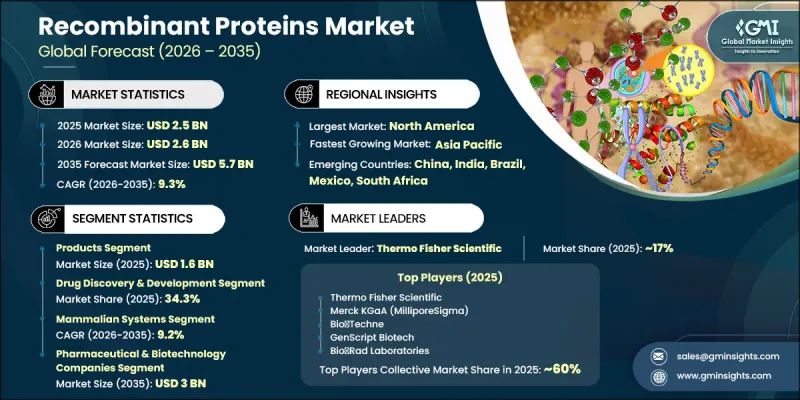
이러한 성장은 암, 당뇨병, 자가면역질환 등 만성질환 및 생명을 위협하는 질환의 치료에 치료용 단백질의 사용이 증가함에 따라 성장세를 주도하고 있습니다. 전 세계적으로 고령화가 진행되면서 만성질환의 부담이 증가함에 따라 혁신적인 치료법에 대한 수요가 더욱 가속화되고 있습니다. 재조합 단백질은 DNA 재조합 기술을 통해 설계되고 박테리아, 효모 또는 포유류 세포와 같은 숙주 시스템을 사용하여 생산됩니다. 이를 통해 자연계에서는 추출하기 어려운 표적 단백질을 대규모로 생산할 수 있습니다. 이들 단백질은 정확성, 확장성, 신뢰성으로 인해 치료, 진단 및 연구 활동에 광범위하게 적용되고 있습니다. 바이오기술의 끊임없는 발전과 의약품 개발 및 맞춤형 의료에 대한 활용이 확대되면서 현대 의료 시스템에서 바이오기술의 중요성이 커지고 있습니다. 연구 인프라에 대한 투자 증가와 바이오의약품의 채택 확대가 시장 성장을 더욱 촉진하고 있습니다.
| 시장 범위 | |
|---|---|
| 개시 연도 | 2025년 |
| 예측 기간 | 2026-2035년 |
| 개시 연도 시장 규모 | 25억 달러 |
| 예측 시장 규모 | 57억 달러 |
| CAGR | 9.3% |
제품 부문은 2025년 16억 달러에 달했습니다. 제약, 생명공학 및 연구 분야에서 재조합 단백질을 광범위하게 사용하면서 견조한 수요를 뒷받침하고 있습니다. 생물학적 제제 기반 치료법에 대한 의존도가 높아지는 것도 제품 채택을 더욱 촉진하고 있습니다. 또한, 단백질 공학의 지속적인 발전으로 보다 안정적이고 기능성이 향상된 단백질 제품 개발이 가능해져 시장에서 지속적인 우위를 점할 수 있게 되었습니다.
신약개발 부문은 2025년 34.3%의 점유율을 차지했습니다. 이 부문에는 바이오 의약품, 백신, 세포 및 유전자 치료 용도 분야가 포함됩니다. 재조합 단백질은 표적 발굴, 검증, 임상 평가 등 신약 개발 과정의 여러 단계에서 광범위하게 사용되고 있습니다. 생물학적 기전 규명 및 치료법 혁신을 뒷받침하는 역할이 강력한 수요를 견인하고 있습니다. 맞춤형 치료에 대한 관심이 높아지고, 만성질환의 유병률이 증가함에 따라 제약 연구개발 활동에서 재조합 단백질의 중요성이 더욱 커지고 있습니다.
북미의 재조합 단백질 시장은 2025년 48.4%의 점유율을 차지하며, 1위를 유지했습니다. 이 지역은 단백질 기반 치료법의 혁신을 뒷받침하는 강력한 생명공학 및 제약 생태계의 혜택을 누리고 있습니다. 탄탄한 의료 인프라와 만성질환의 높은 유병률은 첨단 치료 솔루션에 대한 수요를 지속적으로 견인하고 있습니다. 강력한 규제 체계와 더불어 연구개발에 대한 막대한 투자가 시장 확대를 더욱 촉진하고 있습니다. 또한, 정밀의학에 대한 관심이 높아지고 있는 것도 이 지역의 지속적인 성장에 기여하고 있습니다.
자주 묻는 질문
목차
제1장 조사 방법 및 범위
제2장 주요 요약
제3장 업계 인사이트
제4장 경쟁 구도
제5장 시장 추산 및 예측 : 제품 및 서비스별(2022-2035년)
제6장 시장 추산 및 예측 : 용도별(2022-2035년)
제7장 시장 추산 및 예측 : 숙주 세포별(2022-2035년)
제8장 시장 추산 및 예측 : 최종 용도별(2022-2035년)
제9장 시장 추산 및 예측 : 지역별(2022-2035년)
제10장 기업 개요
AJY 26.06.11The Global Recombinant Proteins Market was valued at USD 2.5 billion in 2025 and is estimated to grow at a CAGR of 9.3% to reach USD 5.7 billion by 2035.
Growth is driven by the increasing use of therapeutic proteins in treating chronic and life-threatening conditions, including cancer, diabetes, and autoimmune diseases. A rising global geriatric population, along with a higher burden of chronic illnesses, is further accelerating demand for innovative treatment approaches. Recombinant proteins are engineered through DNA recombination techniques and produced using host systems such as bacterial, yeast, or mammalian cells, enabling large-scale production of targeted proteins that are otherwise difficult to extract naturally. These proteins are widely applied across therapeutics, diagnostics, and research activities due to their precision, scalability, and reliability. Continuous advancements in biotechnology, combined with expanding applications in drug development and personalized medicine, are strengthening their importance in modern healthcare systems. Increasing investment in research infrastructure and growing adoption of biologics are further reinforcing market growth.
| Market Scope | |
|---|---|
| Start Year | 2025 |
| Forecast Year | 2026-2035 |
| Start Value | $2.5 Billion |
| Forecast Value | $5.7 Billion |
| CAGR | 9.3% |
The products segment reached USD 1.6 billion in 2025. Strong demand is supported by the widespread use of recombinant proteins across pharmaceutical, biotechnology, and research applications. Growing reliance on biologic-based therapies is further driving product adoption. Continuous improvements in protein engineering are also enabling the development of more stable and functionally enhanced protein products, supporting sustained market dominance.
The drug discovery and development segment held 34.3% share in 2025. This segment includes biologics, vaccines, and cell and gene therapy applications. Recombinant proteins are widely used in multiple stages of drug development, including target identification, validation, and clinical evaluation. Their role in studying biological mechanisms and supporting therapeutic innovation is driving strong demand. Increasing focus on personalized treatment approaches, along with rising chronic disease prevalence, is further strengthening the importance of recombinant proteins in pharmaceutical research and development activities.
North America Recombinant Proteins Market accounted for 48.4% share in 2025, maintaining its leading position. The region benefits from a strong biotechnology and pharmaceutical ecosystem that supports innovation in protein-based therapies. A well-established healthcare infrastructure and high prevalence of chronic diseases continue to drive demand for advanced treatment solutions. Strong regulatory systems, along with significant investment in research and development, further support market expansion. Growing emphasis on precision medicine is also contributing to sustained regional growth.
Key companies operating in the Global Recombinant Proteins Market include Thermo Fisher Scientific, Merck KGaA (MilliporeSigma), GenScript Biotech, Bio-Techne, Sino Biological, ACROBiosystems Group, Abnova, Proteintech Group, RayBiotech, Creative BioMart, BPS Bioscience, ProteoGenix, Bio-Rad Laboratories, and Miltenyi Biotec. Companies in the Recombinant Proteins Market are strengthening their position through continuous innovation in protein engineering and expansion of product portfolios. They are investing in advanced manufacturing technologies to improve production efficiency and scalability. Strategic collaborations with pharmaceutical and biotechnology firms are enhancing research capabilities and accelerating product development. Many players are focusing on expanding their global distribution networks to improve market access. In addition, companies are increasing investment in GMP-compliant production facilities to ensure product quality and regulatory compliance.
Table of Contents
Chapter 1 Methodology and Scope
- 1.1 Market scope and definition
- 1.2 Research approach
- 1.3 Quality commitments
- 1.3.1 GMI AI policy and data integrity commitment
- 1.3.1.1 Source consistency protocol
- 1.3.1 GMI AI policy and data integrity commitment
- 1.4 Research trail and confidence scoring
- 1.4.1 Research trail components
- 1.4.2 Scoring components
- 1.5 Data collection
- 1.5.1 Partial list of primary sources
- 1.6 Data mining sources
- 1.6.1 Paid sources
- 1.6.1.1 Sources, by region
- 1.6.1 Paid sources
- 1.7 Base estimates and calculations
- 1.7.1 Revenue share analysis
- 1.7.2 Base year calculation
- 1.8 Forecast model
- 1.9 Research transparency addendum
- 1.9.1 Source attribution framework
- 1.9.2 Quality assurance metrics
- 1.9.3 Our commitment to trust
Chapter 2 Executive Summary
- 2.1 Industry 360° synopsis
- 2.2 Key market trends
- 2.2.1 Regional trends
- 2.2.2 Products & services trends
- 2.2.3 Application trends
- 2.2.4 Host-cell trends
- 2.2.5 End use trends
- 2.3 CXO perspectives: Strategic imperatives
Chapter 3 Industry Insights
- 3.1 Industry ecosystem analysis
- 3.2 Industry impact forces
- 3.2.1 Growth drivers
- 3.2.1.1 Increasing demand for biopharmaceuticals and therapeutic proteins
- 3.2.1.2 Advancements in protein engineering
- 3.2.1.3 Growing prevalence of chronic and infectious diseases
- 3.2.2 Industry pitfalls & challenges
- 3.2.2.1 High production costs
- 3.2.2.2 Stringent regulatory requirements
- 3.2.3 Market opportunities
- 3.2.3.1 Expansion of personalized medicine and precision protein therapeutics
- 3.2.3.2 Growing outsourcing to specialized protein service providers
- 3.2.1 Growth drivers
- 3.3 Growth potential analysis
- 3.4 Regulatory landscape (Driven by Primary Research)
- 3.4.1 North America
- 3.4.1.1 U.S.
- 3.4.1.2 Canada
- 3.4.2 Europe
- 3.4.3 Asia Pacific
- 3.4.1 North America
- 3.5 Technology and innovation landscape (Driven by Primary Research)
- 3.5.1 Current technologies
- 3.5.2 Emerging technologies
- 3.6 Investment and funding landscape (Driven by Primary Research)
- 3.7 Impact of AI/ gen AI on the market (Driven by Primary Research)
- 3.8 Patent analysis (Driven by Primary Research)
- 3.9 Pricing analysis (Driven by Primary Research)
- 3.10 Porter's analysis
- 3.11 PESTEL analysis
Chapter 4 Competitive Landscape, 2025
- 4.1 Introduction
- 4.2 Company market share analysis
- 4.3 Company matrix analysis
- 4.4 Competitive analysis of major market players
- 4.5 Competitive positioning matrix
- 4.6 Key developments
- 4.6.1 Merger and acquisition
- 4.6.2 Partnership and collaboration
- 4.6.3 New product launches
- 4.6.4 Expansion plans
Chapter 5 Market Estimates and Forecast, By Products & Services, 2022 - 2035 ($ Mn)
- 5.1 Key trends
- 5.2 Products
- 5.2.1 Cytokines & growth factors
- 5.2.1.1 Interferons (IFNs)
- 5.2.1.2 Interleukins (ILs)
- 5.2.1.3 Other cytokines & growth factors
- 5.2.2 Antibodies
- 5.2.3 Immune checkpoint proteins
- 5.2.4 Virus antigens
- 5.2.5 Enzymes
- 5.2.5.1 Kinases
- 5.2.5.2 Metabolic enzymes
- 5.2.5.3 Other enzymes
- 5.2.6 Recombinant regulatory proteins
- 5.2.7 Hormones
- 5.2.8 Other products
- 5.2.1 Cytokines & growth factors
- 5.3 Production services
Chapter 6 Market Estimates and Forecast, By Application, 2022 - 2035 ($ Mn)
- 6.1 Key trends
- 6.2 Drug discovery & development
- 6.2.1 Biologics
- 6.2.2 Vaccines
- 6.2.3 Cell & gene therapies
- 6.3 Research
- 6.4 Diagnostics
- 6.5 Other applications
Chapter 7 Market Estimates and Forecast, By Host-cell, 2022 - 2035 ($ Mn)
- 7.1 Key trends
- 7.2 Mammalian systems
- 7.3 Insect cells
- 7.4 Yeast & fungi
- 7.5 Bacterial cells
- 7.6 Other host-cells
Chapter 8 Market Estimates and Forecast, By End Use, 2022 - 2035 ($ Mn)
- 8.1 Key trends
- 8.2 Pharmaceutical & biotechnology companies
- 8.3 Academic & research institutes
- 8.4 Contract research organizations (CRO's)
- 8.5 Other end users
Chapter 9 Market Estimates and Forecast, By Region, 2022 - 2035 ($ Mn)
- 9.1 Key trends
- 9.2 North America
- 9.2.1 U.S.
- 9.2.2 Canada
- 9.3 Europe
- 9.3.1 Germany
- 9.3.2 UK
- 9.3.3 France
- 9.3.4 Spain
- 9.3.5 Italy
- 9.3.6 Netherlands
- 9.4 Asia Pacific
- 9.4.1 China
- 9.4.2 Japan
- 9.4.3 India
- 9.4.4 Australia
- 9.4.5 South Korea
- 9.5 Latin America
- 9.5.1 Brazil
- 9.5.2 Mexico
- 9.5.3 Argentina
- 9.6 Middle East and Africa
- 9.6.1 South Africa
- 9.6.2 Saudi Arabia
- 9.6.3 UAE
Chapter 10 Company Profiles
- 10.1 Abnova
- 10.2 ACROBiosystems Group
- 10.3 Bio Rad Laboratories
- 10.4 Bio Techne
- 10.5 BPS Bioscience
- 10.6 Creative BioMart
- 10.7 GenScript Biotech
- 10.8 Merck KGaA (MilliporeSigma)
- 10.9 Miltenyi Biotec
- 10.10 Proteintech Group
- 10.11 ProteoGenix
- 10.12 RayBiotech
- 10.13 Sino Biological
- 10.14 Thermo Fisher Scientific