

|
시장보고서
상품코드
2114165
재조합 단백질 : 시장 점유율 분석, 업계 동향과 통계, 성장 예측(2026-2031년)Recombinant Protein - Market Share Analysis, Industry Trends & Statistics, Growth Forecasts (2026 - 2031) |
||||||
 Mordor Intelligence
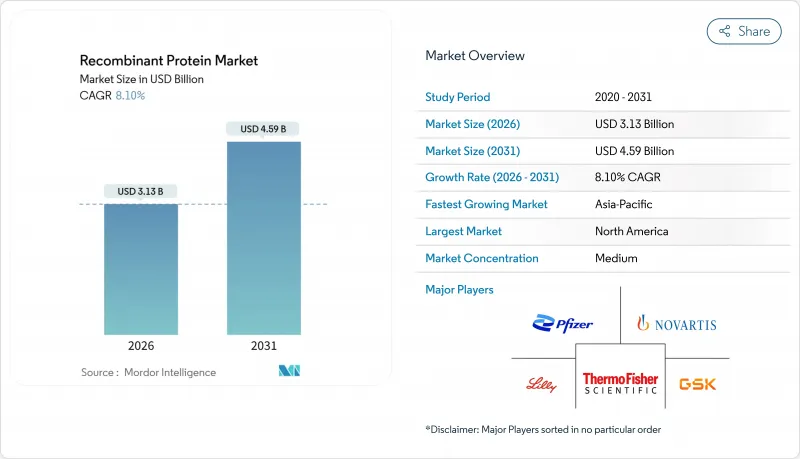
Mordor Intelligence에 따르면 재조합 단백질 시장 규모는 2026년에 31억 3,000만 달러로 추정되고 있으며, 예측 기간(2026-2031년)에 CAGR 8.10%로 추이하며, 2031년까지 45억 9,000만 달러에 달할 것으로 전망되고 있습니다.
이 보고서는 제품별(호르몬, 사이토카인·성장인자, 기타), 발현 시스템별(포유류, 세균, 효모, 기타), 용도별(치료, 연구, 산업),최종사용자별(제약·바이오기술 기업, CRO·CDMO, 기타) 및 지역별(북미, 유럽, 아시아태평양, 기타)로 분류되어 있습니다. 시장 예측은 금액(달러) 기준으로 제시되어 있습니다.
세계 재조합 단백질 시장의 동향 및 인사이트
만성질환 부담 증가가 바이오의약품 수요를 견인
당뇨병, 암, 자가면역질환의 유병률 증가로 인해 재조합 치료제의 대상 환자층이 확대되고 있습니다. 세계보건기구(WHO)는 2024년 세마글루티드를 ‘필수 의약품 모델 리스트’에 추가하고, 글루카곤 유사 펩티드-1 수용체 작용제를 비만 및 제2형 당뇨병 관리의 기반으로 인정했습니다. 노보노르디스크의 ‘웨고비’와 일라이 릴리의 ‘제프바운드’는 2025년에 각각 수십억 달러의 매출을 창출할 전망이며, 이는 임상적 성과가 비용을 정당화할 경우 지불 주체가 고가의 바이오의약품에 대해 보험 급여를 제공할 의향이 있음을 여실히 보여주었습니다. 종양학 분야의 파이프라인은 인터류킨 기반 면역요법과 T세포를 활성화하는 이중특이성 항체로 전환되고 있으며, 다발성골수종에 대한 테크리스타맙 및 탈케타맙의 FDA 승인은 이중 표적 치료 패러다임을 지원하는 계기가 되었습니다. 이러한 추세는 부유한 국가 시장에만 국한되지 않습니다. 인도와 중국에서는 국내 환자에게 공급하기 위해 바이오시밀러 인슐린 및 에리스로포이에틴의 생산을 확대하고 있으며, 이로 인해 비용 효율적인 발현 시스템과 현지 충전 및 마무리 능력을 지원하는 병행적인 수요 흐름이 발생하고 있습니다.
고수율 발현·정제 플랫폼의 획기적인 진전
현재 포유류 세포주에서는 퍼퓨전 배양에서 1리터당 10그램에서 15그램의 역가가 일상적으로 달성되고 있으며, 이를 통해 바이오리액터의 설치 면적을 절반으로 줄이고 임상 공급까지의 기간을 단축하고 있습니다. CRISPR를 이용한 세포 사멸 경로의 노크아웃 및 샤페론의 과발현을 도입한 중국 햄스터 난소(CHO) 세포 공학은 최상위 CDMO들 사이에서 표준 기법이 되었으며, 이를 통해 고객은 공정 개발 기간을 18개월에서 12개월로 단축할 수 있게 되었습니다. 바인드-엘루트 모드와 플로우스루 모드를 통합한 연속 크로마토그래피 시스템은 수지 소비량을 30% 절감하고 정제 사이클 시간을 대폭 단축함으로써 대량 생산 제품의 제조 원가 절감으로 이어지고 있습니다. 박테리아 플랫폼에서는 코돈 최적화 및 페리플라스마 분비 전략의 활용을 통해 용해성이 향상되고 내독소 부하가 감소하여, 대장균(Escherichia coli)을 이용한 단순한 사이토카인 및 성장인자의 제조가 가능해졌습니다. 이러한 진보를 통해 비용과 품질의 균형이 개선되어, 소규모 생명공학 기업도 지적 재산이라는 ‘성곽’에만 의존하지 않고 제조 효율 면에서 경쟁할 수 있게 되었습니다.
복잡한 당단백질의 제조원가(COGS)는 여전히 높다
고도로 당화된 단백질의 다운스트림 공정은 수지 및 공정의 발전에도 불구하고 여전히 제조 비용의 60%-70%를 차지하고 있습니다. 리터당 10,000-15,000달러에 달하는 친화성 수지는 빈번한 교체가 필요하며, 배양 기간의 장기화로 인해 간접비가 상승하고 있습니다. 당사슬이 변형된 효모 균주에 대한 기대가 높지만, 규제상의 선례가 부족하여 비교 시험에 12-18개월이 소요되어 단기적인 도입을 방해하고 있습니다. 참조 의약품의 가격이 하락하면, 이러한 고비용 구조가 바이오시밀러에 불리하게 작용하여 규모의 경제를 유지할 수 있는 소수의 업체에 생산이 집중될 것입니다. 당사슬 제어 및 정제 비용 측면에서 획기적인 개선이 없다면, 이익률에 대한 압박은 지속될 것이며, 재조합 단백질 시장의 성장 속도는 둔화될 것입니다.
부문 분석
2025년, 사이토카인 및 성장인자는 재조합 단백질 시장 점유율의 25.2%를 차지할 것으로 보이며, 이는 종양학 및 면역학 분야에서 인터류킨, 콜로니 자극인자, 인터페론의 광범위한 사용에 힘입은 것입니다. 특히 인터류킨-15 프로그램은 T 세포 치료를 확대하고 있으며, 차세대 인터류킨-2 변이체는 독성을 줄이면서 더 강력한 종양 침윤을 가져오고 있습니다. 융합 단백질은 아직 신흥 분야이지만, 앰젠의 ‘Uplizna’로 대표되는 반감기 연장 및 이중 표적 기전의 혜택을 받아 2031년까지 연평균 성장률(CAGR) 8.82%로 성장할 것으로 예측됩니다. 인슐린, 에리스로포이에틴, 인간성장호르몬 등 호르몬에 대한 수요는 견고한 추세를 보이고 있지만, Semglee나 Rezvoglar와 같은 바이오시밀러의 출시로 인해 가격 하락 압력이 발생하고 있습니다. 모노클로널 항체 및 그 단편은 자가면역 질환 및 종양학 치료 분야에서 계속해서 주도적인 위치를 차지하고 있지만, 한편으로는 지속가능성에 대한 요구로 인해 석유화학계 촉매에서 벗어나려는 전환이 진행되는 가운데, 산업용 효소는 안정적인 현금 흐름을 창출하고 있습니다. AI로 설계된 스캐폴드나 합성생물학을 통한 산출물이 초기 파이프라인에 다수 등장하고 있으며, 규제가 명확해지고 제조 체계가 정비되면 장기적인 성장이 기대됩니다.
2025년에는 포유류 숙주가 시장 점유율의 46.1%를 차지할 것으로 예상되며, 이는 면역글로불린 및 Fc 융합 구조체에 필수적인, 인간과 유사한 당사슬 부착을 실현하는 독보적인 능력을 반영합니다. 퍼퓨전법이나 페드배치법을 이용한 공정이 10 g/L를 초과하는 역가를 생성하고, 1그램당 비용을 절감하고 있으므로 포유류 시스템에 의존하는 재조합 단백질 시장의 규모는 계속 확대되고 있습니다. 한편, 무세포 플랫폼은 연평균 성장률(CAGR) 8.54%로 가장 빠르게 성장하고 있으며, 48시간의 생산 주기와 Sutro Biopharma사의 XpressCF가 입증한 부위 특이적 결합의 범용성을 제공합니다.
비당화 분자 생산에서는 재접힘 비용을 절반으로 줄여주는 코돈 최적화 기술에 힘입어, 박테리아 발현이 여전히 주류를 이루고 있습니다. 효모 시스템은 진핵생물의 접힘 특성과 박테리아의 확장성 사이의 균형을 실현하고 있으며, Pichia pastoris는 산업용 효소에 적합한 고밀도 발효를 가능하게 합니다. 곤충 세포는 백신이나 바이러스 유사 입자와 같은 틈새 용도로 이용되고 있지만, 생산 규모가 제한적이기 때문에 재조합 단백질 시장에서의 점유율 확대는 제약받고 있습니다.
지역별 분석
북미는 2025년에 전 세계 매출의 42.1%를 차지할 것으로 예상되며, 이는 집중된 벤처 자금, FDA의 규제 측면에서의 리더십, 그리고 보스턴과 샌프란시스코 베이 지역에 뿌리내린 바이오 클러스터에 힘입은 결과입니다. FDA는 2024-2025년에 68건의 획기적 치료제(Breakthrough Therapy) 지정을 통해 상품화까지의 기간을 최대 1년 단축했습니다. 캐나다가 9억 5,000만 캐나다 달러를 투자하는 ‘전 캐나다 생물제제·바이오시밀러 구상’는 국내 생산을 확대하고 수입 의존도를 낮추는 동시에, 지역 재조합 단백질 시장의 규모를 확대할 전망입니다.
유럽은 아일랜드, 스위스, 덴마크에 구축된 생산 능력을 활용하고 있습니다. 론자(Lonza)의 비스프 및 포츠머스 거점은 포유류 유래 생산 용량으로 20만 리터를 공급하고 있는 반면, 후지필름(Fujifilm)의 덴마크에 위치한 신공장(생산 용량 12만 리터)은 복잡한 당단백질을 생산 대상으로 하고 있습니다. EMA의 PRIME 프로그램은 개발 효율화를 지속하고 있으며, 인플릭시맙 및 리툭시맙 바이오시밀러의 시장 침투율은 80%를 넘어, 가치 기반 조달을 실천하는 유럽의 명성을 더욱 공고히 하고 있습니다.
중국과 인도가 CDMO 사업 규모를 확대함에 따라 아시아태평양은 연평균 성장률(CAGR) 8.81%의 궤도에 올라섰습니다. WuXi Biologics는 400 kL 이상의 생산 능력을 보유하고 있으며, 그 비용 구조는 유럽 및 미국의 동종 업체보다 최대 30% 낮습니다. 삼성바이오로직스의 인천에 위치한 784 kL 규모의 시설은 이 지역내 삼성바이오로직스의 입지를 더욱 공고히 하고 있습니다. 또한 인도내 바이오시밀러 인슐린 및 에리스로포이에틴에 대한 국내 수요도 생산량을 끌어올리고 있으며, 신흥 시장 전체에서 재조합 단백질 시장의 침투를 확대하고 있습니다.
중동 및 아프리카 및 남미는 여전히 발전 단계에 있지만, 전략적으로 중요한 시장입니다. ‘사우디 비전 2030’에서는 수입 의존도를 낮추기 위해 바이오 제조에 20억 달러를 배정하고 있습니다. 브라질에서는 2025년에 바이오시밀러 시장이 인상적인 성장을 기록했으나, 규제 조화는 미국이나 EU 기준에 비해 뒤처져 있습니다. 남아프리카의 Biovac Institute는 충전 및 마무리 공정의 생산 능력을 확대하고 있으며, WHO 사전 인증을 획득하면 해당 지역의 재조합 단백질 위탁 제조의 발판이 될 것입니다.
기타 혜택:
- 엑셀 형식의 시장 예측(ME) 시트
- 3개월간의 애널리스트 지원
자주 묻는 질문
목차
제1장 서론
제2장 조사 방법
제3장 개요
제4장 시장 구도
제5장 시장 규모와 성장 예측
제6장 경쟁 구도
제7장 시장 기회와 향후 전망
KSA 26.08.26According to Mordor Intelligence, the recombinant protein market size is estimated at USD 3.13 billion in 2026, and is expected to reach USD 4.59 billion by 2031, at a CAGR of 8.10% during the forecast period (2026-2031).
This report is Segmented by Product (Hormones, Cytokines & Growth Factors, and More), Expression System (Mammalian, Bacterial, Yeast, and More), Application (Therapeutic, Research, Industrial), End User (Pharmaceutical & Biotechnology Companies, Cros & CDMOs and More), and Geography (North America, Europe, Asia-Pacific, and More). Market Forecasts are Provided in Terms of Value (USD).
Global Recombinant Protein Market Trends and Insights
Chronic Disease Burden Elevates Demand for Biologics
Rising prevalence of diabetes, cancer, and autoimmune disorders is expanding the addressable patient pool for recombinant therapeutics. The World Health Organization added semaglutide to its Model List of Essential Medicines in 2024, recognizing glucagon-like peptide-1 receptor agonists as a cornerstone of obesity and type 2 diabetes management . Novo Nordisk's Wegovy and Eli Lilly's Zepbound collectively generated multi-billion-dollar revenues in 2025, underscoring payer willingness to reimburse high-cost biologics when clinical outcomes justify expenditure. Oncology pipelines are shifting toward interleukin-based immunotherapies and bispecific antibodies that engage T cells, with FDA approvals for teclistamab and talquetamab in multiple myeloma validating the dual-targeting paradigm. This trend extends beyond wealthy markets; India and China are scaling biosimilar insulin and erythropoietin production to serve domestic populations, creating a parallel demand stream that favors cost-efficient expression systems and local fill-finish capacity.
Breakthroughs In High-Yield Expression & Purification Platforms
Mammalian cell lines now routinely achieve titers of 10 grams per liter to 15 grams per liter in perfusion culture, halving bioreactor footprint and accelerating clinical supply timelines. Chinese hamster ovary (CHO) cell engineering incorporating CRISPR-mediated knockout of apoptosis pathways and overexpression of chaperones has become standard practice among top-tier CDMOs, enabling clients to compress process development from 18 months to 12 months. Continuous chromatography systems, which integrate bind-elute and flow-through modes, reduce resin consumption by 30% and cut purification cycle time significantly, translating into lower cost-of-goods for high-volume products. Bacterial platforms are benefiting from codon optimization and periplasmic secretion strategies that improve solubility and reduce endotoxin burden, making Escherichia coli viable for simpler cytokines and growth factors. These advances compress the cost-quality frontier, allowing smaller biotechs to compete on manufacturing efficiency rather than relying solely on intellectual property moats.
Persistent High COGS for Complex Glycoproteins
Downstream processing for heavily glycosylated proteins still represents 60%-70% of manufacturing outlay, despite resin and process advances. Affinity resins priced at USD 10,000-15,000 per liter require frequent replacement, and extended culture durations inflate overhead costs. Glyco-engineered yeast strains offer promise, but sparse regulatory precedent adds 12-18 months of comparability work, restraining near-term adoption. High cost structures disadvantage biosimilars once reference prices fall, concentrating production among the few players that maintain scale efficiencies. Without step-change gains in glycan control or purification economy, margin pressure will persist and temper recombinant protein market acceleration.
Other drivers and restraints analyzed in the detailed report include:
- Expansion Of Bioclusters & CDMO Capacity Worldwide
- Favorable Biologics Reimbursement & Fast-Track Approvals
- Intensifying Biosimilar-Driven Price Erosion
For complete list of drivers and restraints, kindly check the Table Of Contents.
Segment Analysis
Cytokines and growth factors accounted for 25.2% of the recombinant protein market share in 2025, sustained by widespread use of interleukins, colony-stimulating factors, and interferons across oncology and immunology. Interleukin-15 programs in particular are expanding T-cell therapies, while next-generation interleukin-2 variants deliver stronger tumor infiltration with lower toxicity. Fusion proteins, though only emerging, are projected to grow at an 8.82% CAGR through 2031, benefiting from half-life extension and dual-targeting mechanisms exemplified by Amgen's Uplizna . Demand for hormones such as insulin, erythropoietin, and human growth hormone remains steady, yet biosimilar launches like Semglee and Rezvoglar exert downward price pressure. Monoclonal antibodies and fragments continue to dominate autoimmune and oncology care, while industrial enzymes provide reliable cash flow as sustainability mandates drive the switch from petrochemical catalysts. AI-designed scaffolds and synthetic biology outputs populate early pipelines, suggesting longer-term upside once regulatory clarity and manufacturing readiness mature.
Mammalian hosts held 46.1% of the market share in 2025, reflecting an unrivaled ability to deliver human-like glycosylation essential for immunoglobulins and Fc-fusion constructs. Recombinant protein market size tied to mammalian systems continues to expand as perfusion and fed-batch processes yield titers above 10 g/L, lowering per-gram costs. Cell-free platforms, however, grow fastest at an 8.54% CAGR, offering 48-hour production cycles and site-specific conjugation versatility showcased by Sutro Biopharma's XpressCF.
Bacterial expression remains a workhorse for non-glycosylated molecules, aided by codon optimization that halves refolding expense. Yeast systems deliver a balance of eukaryotic folding and bacterial scalability, with Pichia pastoris enabling dense fermentations suited for industrial enzymes. Insect cells occupy niche vaccine and viral-like-particle uses, but limited scale constrains their broader stake in the recombinant protein market.
Complete Report Scope:
- By Product
- Hormones (Insulin, EPO, hGH, FSH)
- Cytokines & Growth Factors (ILs, CSFs, IFNs)
- Monoclonal Antibodies & Fragments
- Enzymes
- Fusion Proteins & Others
- By Expression System
- Mammalian (CHO, HEK293)
- Bacterial (E. coli)
- Yeast (Pichia, Saccharomyces)
- Insect (Sf9, Sf21)
- Cell-Free / Synthetic
- By Application
- Therapeutic
- Research
- Industrial (Agro-biotech, Food, Detergents)
- By End User
- Pharmaceutical & Biotechnology Companies
- Academic & Research Institutes
- CROs & CDMOs
- By Geography
- North America
- United States
- Canada
- Mexico
- Europe
- Germany
- United Kingdom
- France
- Italy
- Spain
- Rest of Europe
- Asia-Pacific
- China
- Japan
- India
- South Korea
- Australia
- Rest of APAC
- Middle East & Africa
- GCC
- South Africa
- Rest of Middle East & Africa
- South America
- Brazil
- Argentina
- Rest of South America
- North America
Geography Analysis
North America held 42.1% of global revenue in 2025, buoyed by concentrated venture funding, FDA regulatory leadership, and entrenched bioclusters in Boston and the San Francisco Bay Area. The FDA issued 68 breakthrough therapy designations across 2024-2025, shaving up to a year off commercialization timelines. Canada's CAD 950 million Pan-Canadian Biologics and Biosimilars Initiative is set to boost domestic output, reducing import reliance and enlarging the regional recombinant protein market size.
Europe leverages established capacity in Ireland, Switzerland, and Denmark. Lonza's Visp and Portsmouth sites contribute 200 kL of mammalian volume, while Fujifilm's new 120 kL Danish plant targets complex glycoproteins. EMA's PRIME program continues to streamline development, and biosimilar penetration across infliximab and rituximab surpasses 80%, reinforcing Europe's reputation for value-based procurement.
Asia-Pacific is on an 8.81% CAGR trajectory as China and India escalate CDMO footprints. WuXi Biologics exceeds 400 kL capacity with cost structures undercutting Western peers by up to 30%. Samsung Biologics' 784 kL site in Incheon further cements regional prominence. Domestic demand for biosimilar insulin and erythropoietin in India also adds volume, broadening recombinant protein market penetration across emerging economies.
Middle East & Africa and South America remain nascent but strategic. Saudi Vision 2030 earmarks USD 2 billion for biomanufacturing to lower import dependency. Brazil recorded significant biosimilar market growth in 2025, although regulatory harmonization lags U.S. and EU benchmarks. South Africa's Biovac Institute expanded fill-finish output, offering a springboard for regional recombinant protein contracts once WHO prequalification is secured.
- Abbvie
- Amgen
- Bio-Rad Laboratories
- Eli Lilly and Company
- Merck
- Novo Nordisk
- Sanofi
- Thermo Fisher Scientific
- Novartis
- GlaxoSmithKline
- Novavax
- Pfizer
- Sino Biological
- Bio-Techne Corp.
- GenScript Biotech Corp.
- Lonza Group
- Agilent Technologies
- Takara Bio
- Roche
- Regeneron Pharmaceuticals
- CSL Behring
Additional Benefits:
- The market estimate (ME) sheet in Excel format
- 3 months of analyst support
TABLE OF CONTENTS
1 Introduction
- 1.1 Study Assumptions & Market Definition
- 1.2 Scope of the Study
2 Research Methodology
3 Executive Summary
4 Market Landscape
- 4.1 Market Overview
- 4.2 Market Drivers
- 4.2.1 Chronic-Disease Burden Elevates Demand For Biologics
- 4.2.2 Breakthroughs In High-Yield Expression & Purification Platforms
- 4.2.3 Expansion Of Bioclusters & CDMO Capacity Worldwide
- 4.2.4 Favorable Biologics Reimbursement & Fast-Track Approvals
- 4.2.5 AI-Driven De Novo Protein Design Unlocks Novel Pipelines
- 4.2.6 Single-Use, Low-Capex Bioreactors Democratize Manufacturing
- 4.3 Market Restraints
- 4.3.1 Persistent High COGS For Complex Glycoproteins
- 4.3.2 Intensifying Biosimilar-Driven Price Erosion
- 4.3.3 Cold-Chain & Fill-Finish Bottlenecks in Emerging Markets
- 4.3.4 Regulatory Ambiguity for Cell-Free Synthesis Platforms
- 4.4 Value Chain Analysis
- 4.5 Regulatory Landscape
- 4.6 Technological Outlook
- 4.7 Porter's Five Forces
- 4.7.1 Threat of New Entrants
- 4.7.2 Bargaining Power of Buyers
- 4.7.3 Bargaining Power of Suppliers
- 4.7.4 Threat of Substitutes
- 4.7.5 Intensity of Competitive Rivalry
5 Market Size & Growth Forecasts (Value)
- 5.1 By Product
- 5.1.1 Hormones (Insulin, EPO, hGH, FSH)
- 5.1.2 Cytokines & Growth Factors (ILs, CSFs, IFNs)
- 5.1.3 Monoclonal Antibodies & Fragments
- 5.1.4 Enzymes
- 5.1.5 Fusion Proteins & Others
- 5.2 By Expression System
- 5.2.1 Mammalian (CHO, HEK293)
- 5.2.2 Bacterial (E. coli)
- 5.2.3 Yeast (Pichia, Saccharomyces)
- 5.2.4 Insect (Sf9, Sf21)
- 5.2.5 Cell-Free / Synthetic
- 5.3 By Application
- 5.3.1 Therapeutic
- 5.3.2 Research
- 5.3.3 Industrial (Agro-biotech, Food, Detergents)
- 5.4 By End User
- 5.4.1 Pharmaceutical & Biotechnology Companies
- 5.4.2 Academic & Research Institutes
- 5.4.3 CROs & CDMOs
- 5.5 By Geography
- 5.5.1 North America
- 5.5.1.1 United States
- 5.5.1.2 Canada
- 5.5.1.3 Mexico
- 5.5.2 Europe
- 5.5.2.1 Germany
- 5.5.2.2 United Kingdom
- 5.5.2.3 France
- 5.5.2.4 Italy
- 5.5.2.5 Spain
- 5.5.2.6 Rest of Europe
- 5.5.3 Asia-Pacific
- 5.5.3.1 China
- 5.5.3.2 Japan
- 5.5.3.3 India
- 5.5.3.4 South Korea
- 5.5.3.5 Australia
- 5.5.3.6 Rest of APAC
- 5.5.4 Middle East & Africa
- 5.5.4.1 GCC
- 5.5.4.2 South Africa
- 5.5.4.3 Rest of Middle East & Africa
- 5.5.5 South America
- 5.5.5.1 Brazil
- 5.5.5.2 Argentina
- 5.5.5.3 Rest of South America
- 5.5.1 North America
6 Competitive Landscape
- 6.1 Market Concentration
- 6.2 Market Share Analysis
- 6.3 Company Profiles (includes Global-level Overview, Market-level Overview, Core Segments, Financials as available, Strategic Information, Market Rank/Share for key companies, Products & Services, and Recent Developments)
- 6.3.1 AbbVie Inc.
- 6.3.2 Amgen Inc.
- 6.3.3 Bio-Rad Laboratories Inc.
- 6.3.4 Eli Lilly and Company
- 6.3.5 Merck KGaA
- 6.3.6 Novo Nordisk A/S
- 6.3.7 Sanofi SA
- 6.3.8 Thermo Fisher Scientific Inc.
- 6.3.9 Novartis AG
- 6.3.10 GlaxoSmithKline plc
- 6.3.11 Novavax Inc.
- 6.3.12 Pfizer Inc.
- 6.3.13 Sino Biological Inc.
- 6.3.14 Bio-Techne Corp.
- 6.3.15 GenScript Biotech Corp.
- 6.3.16 Lonza Group AG
- 6.3.17 Agilent Technologies Inc.
- 6.3.18 Takara Bio Inc.
- 6.3.19 F. Hoffmann-La Roche AG
- 6.3.20 Regeneron Pharmaceuticals Inc.
- 6.3.21 CSL Limited
7 Market Opportunities & Future Outlook
- 7.1 White-Space & Unmet-Need Assessment


