

|
시장보고서
상품코드
2045743
화재 진압 시장 : 기회, 성장 촉진요인, 업계 동향 분석 및 예측(2026-2035년)Fire Suppression Market Opportunity, Growth Drivers, Industry Trend Analysis, and Forecast 2026 - 2035 |
||||||

세계의 화재 진압 시장은 2025년에 262억 달러로 평가되었고 CAGR 7.1%를 나타내 2035년까지 509억 달러에 이를 것으로 예측됩니다.
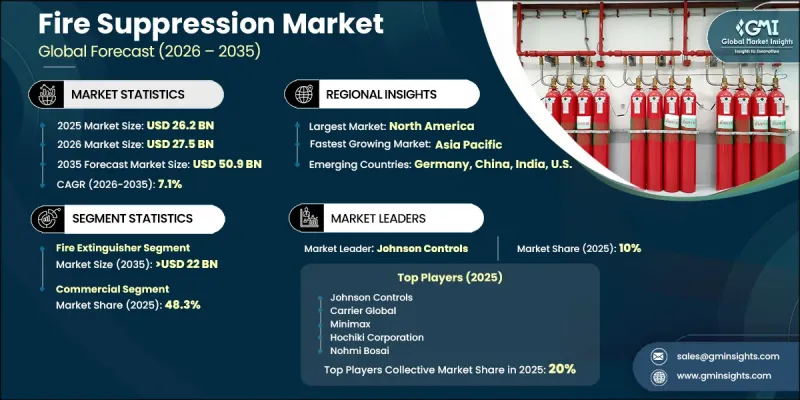
이 시장의 성장은 인명, 자산, 인프라 보호가 최우선 과제인 주거, 상업, 산업 환경에서 화재 안전에 대한 관심이 높아진 것에 영향을 받았습니다. 소방 시스템은 스프링클러, 물분무, 가스 소화, 거품 소화, 휴대용 소화기 등의 기술을 통해 화재 위험을 감지, 제어 및 제거하기 위해 널리 도입되고 있습니다. 이 산업은 전통적인 소화 도구에서 감지, 모니터링, 자동 소화 기능을 결합한 통합 솔루션으로 진화하고 있습니다. 규제 강화와 엄격한 건축 안전 기준의 강화로 인해 기존 시스템에서 첨단 화재 방지 기술로 업데이트 및 업그레이드가 가속화되고 있습니다. 도시 인프라, 산업시설, 고밀도 상업 공간의 확장도 신뢰할 수 있는 소방 시스템에 대한 수요를 더욱 강화하고 있습니다. 작업장 안전에 대한 인식 증가, 보험사 주도의 컴플라이언스 요건, 스마트 빌딩 기술에 대한 투자 확대 등도 시장의 지속적인 성장에 기여하고 있습니다. 또한, 선진국 및 신흥국의 소방 인프라 현대화가 장기적인 도입 추세를 견인하고 있습니다. 커넥티드 시스템과 빌딩 자동화 플랫폼의 통합으로 대응 효율성과 시스템 신뢰성이 더욱 향상되고 있으며, 소방 솔루션은 현대 인프라 개발에서 필수적인 요소로 자리 잡고 있습니다.
| 시장 범위 | |
|---|---|
| 시작 연도 | 2025년 |
| 예측 기간 | 2026-2035년 |
| 시작 연도 시장 규모 | 262억 달러 |
| 예측 금액 | 509억 달러 |
| CAGR | 7.1% |
소화기 부문은 화재 초기 진압을 위한 주요 대응 수단으로서의 역할에 힘입어 2035년까지 220억 달러 규모에 달할 것으로 예측됩니다. 이 부문에는 휴대용 소화기, 바퀴가 달린 산업용 소화기, 클린 에이전트, 이산화탄소, 건조 화학물질을 사용하는 고정식 시스템이 포함됩니다. 이 장비들은 화재가 확대되기 전에 자동소화시스템과 연계하여 화재가 확대되기 전에 신속하게 진압할 수 있는 1차 대응 장비로 널리 도입되고 있습니다. 규제 기준 및 건축 안전 요구사항은 다양한 최종 사용 환경에서 제품 도입을 지속적으로 촉진하고 있으며, 예측 기간 동안 일관된 수요 증가를 보장하고 있습니다.
상업용 용도 부문은 2025년 48.3%의 점유율을 차지했으며, 2035년까지 연평균 6.6%의 성장률을 나타낼 것으로 전망됩니다. 이 부문 수요는 급속한 상업용 건축, 기존 건물의 개보수, 화재 예방 시설에 대한 보다 엄격한 규정 준수 요건에 의해 주도되고 있습니다. 비즈니스 연속성 계획, 보험 컴플라이언스, 거주자 안전에 대한 관심이 높아짐에 따라 도입이 더욱 가속화되고 있습니다. 또한, 스마트 빌딩 기술의 통합으로 소방 시스템과 자동화된 시설 관리 플랫폼과의 원활한 연계가 가능해져 안전의 전반적인 효율성이 향상되었습니다.
미국의 화재 진압 시장은 엄격한 안전 규정의 시행과 소방 시스템에 대한 광범위한 인식에 힘입어 2025년 75억 달러 규모로 성장했습니다. 오피스 단지, 리테일 공간, 호텔 프로젝트, 복합용도 빌딩 등 상업용 부동산의 지속적인 인프라 개발이 성장을 견인하고 있습니다. 또한, 제조, 물류, 에너지 분야에서의 산업 확장도 고위험 환경을 위해 설계된 특수 소화 시스템에 대한 수요를 증가시키고 있습니다. 선진 건축 기준의 도입 확대와 안전 인프라의 지속적인 업그레이드도 장기적인 시장 확대를 더욱 뒷받침하고 있습니다.
자주 묻는 질문
목차
제1장 조사 방법과 범위
제2장 주요 요약
제3장 업계 인사이트
제4장 경쟁 구도
제5장 시장 규모 및 예측 : 제품별(2022-2035년)
제6장 시장 규모 및 예측 : 최종 용도별(2022-2035년)
제7장 시장 규모 및 예측 : 지역별(2022-2035년)
제8장 기업 개요
KTH 26.06.10The Global Fire Suppression Market was valued at USD 26.2 billion in 2025 and is estimated to grow at a CAGR of 7.1% to reach USD 50.9 billion by 2035.
Growth in this market is influenced by the increasing focus on fire safety across residential, commercial, and industrial environments, where protecting lives, assets, and infrastructure remains a top priority. Fire suppression systems are widely deployed to detect, control, and eliminate fire risks through technologies such as sprinklers, water mist, gas-based suppression, foam-based systems, and handheld extinguishers. The industry is evolving beyond traditional firefighting tools toward integrated solutions that combine detection, monitoring, and automated suppression capabilities. Rising regulatory enforcement and strict building safety codes are accelerating the replacement and upgrading of legacy systems with advanced fire protection technologies. Expanding urban infrastructure, industrial facilities, and high-density commercial spaces are further strengthening demand for reliable suppression systems. Increasing awareness about workplace safety, insurance-driven compliance requirements, and growing investments in smart building technologies are also contributing to sustained market expansion. Additionally, modernization of fire safety infrastructure across developed and emerging economies is reinforcing long-term adoption trends. The integration of connected systems with building automation platforms is further improving response efficiency and system reliability, making fire suppression solutions an essential component of modern infrastructure development.
| Market Scope | |
|---|---|
| Start Year | 2025 |
| Forecast Year | 2026-2035 |
| Start Value | $26.2 Billion |
| Forecast Value | $50.9 Billion |
| CAGR | 7.1% |
The fire extinguisher segment is projected to reach USD 22 billion by 2035, supported by its role as a primary response tool for early-stage fire control. This segment includes portable extinguishers, wheeled industrial units, and fixed systems using clean agents, CO2, and dry chemical formulations. These devices are widely deployed as first-response equipment and operate alongside automated suppression systems to quickly contain fire incidents before escalation. Regulatory standards and building safety requirements continue to shape product adoption across multiple end-use environments, ensuring consistent demand growth over the forecast period.
The commercial application segment accounted for a 48.3% share in 2025 and is expected to grow at a CAGR of 6.6% through 2035. Demand in this segment is driven by rapid commercial construction, refurbishment of existing properties, and stricter compliance requirements for fire safety installations. Increasing emphasis on business continuity planning, insurance compliance, and occupant safety is further strengthening adoption. The integration of smart building technologies is also enabling seamless coordination between fire protection systems and automated facility management platforms, improving overall safety efficiency.
U.S. Fire Suppression Market was valued at USD 7.5 billion in 2025, supported by strong enforcement of safety regulations and widespread awareness regarding fire prevention systems. Growth is reinforced by ongoing infrastructure development across commercial real estate, including office complexes, retail spaces, hospitality projects, and mixed-use buildings. Industrial expansion across manufacturing, logistics, and energy sectors is also increasing demand for specialized suppression systems designed for high-risk environments. Rising adoption of advanced building codes and continuous upgrades to safety infrastructure further support long-term market expansion.
Key companies operating in the Global Fire Suppression Industry include Johnson Controls (Tyco), Siemens, Honeywell, Robert Bosch, Halma, Carrier Global, API Group, Kidde, Hochiki Corporation, Minimax, Ansul, Amerex Corporation, Ceasefire Industries, JL Industries, Britannia Fire, Flamex, Feuerschutz Jockel, Kanex Fire, Nohmi Bosai, and Safex Fire Services. Companies in the fire suppression market are focusing on expanding integrated safety portfolios that combine detection, control, and suppression into unified systems. They are investing heavily in smart and connected technologies that enable real-time monitoring and remote diagnostics. Strategic emphasis is placed on compliance-driven product development aligned with evolving safety regulations across regions. Firms are also strengthening R&D capabilities to introduce more efficient, environmentally friendly suppression agents. Partnerships with construction firms and facility managers are helping expand deployment in large-scale infrastructure projects.
Table of Contents
Chapter 1 Methodology & Scope
- 1.1 Research design
- 1.2 Quality commitments
- 1.2.1 GMI AI policy & data integrity commitment
- 1.2.1.1 Source consistency protocol
- 1.2.1 GMI AI policy & data integrity commitment
- 1.3 Research trail & confidence scoring
- 1.3.1 Research trail components
- 1.3.2 Scoring components
- 1.4 Data collection
- 1.4.1 Partial list of primary sources
- 1.5 Data mining sources
- 1.5.1 Paid sources
- 1.5.1.1 Sources, by region
- 1.5.1 Paid sources
- 1.6 Base estimates and calculations
- 1.6.1 Base year calculation for any one approach
- 1.7 Market estimates and forecasts parameters
- 1.8 Forecast model
- 1.8.1 Quantified market impact analysis
- 1.8.1.1 Mathematical impact of growth parameters on forecast
- 1.8.1 Quantified market impact analysis
- 1.9 Research transparency addendum
- 1.9.1 Source attribution framework
- 1.9.2 Quality assurance metrics
- 1.9.3 Our commitment to trust
- 1.10 Market definitions
Chapter 2 Executive Summary
- 2.1 Industry synopsis, 2022 - 2035
- 2.1.1 Business trends
- 2.1.2 Product trends
- 2.1.3 End use trends
- 2.1.4 Regional trends
Chapter 3 Industry Insights
- 3.1 Industry ecosystem analysis
- 3.1.1 Raw material availability & sourcing analysis
- 3.1.2 Manufacturing capacity assessment
- 3.1.3 Supply chain resilience & risk factors
- 3.1.4 Distribution network analysis
- 3.2 Industry impact forces
- 3.2.1 Growth drivers
- 3.2.2 Industry pitfalls & challenges
- 3.3 Regulatory landscape
- 3.4 Growth potential analysis
- 3.5 Porter's analysis
- 3.5.1 Bargaining power of suppliers
- 3.5.2 Bargaining power of buyers
- 3.5.3 Threat of new entrants
- 3.5.4 Threat of substitutes
- 3.6 PESTEL analysis
- 3.6.1 Political factors
- 3.6.2 Economic factors
- 3.6.3 Social factors
- 3.6.4 Technological factors
- 3.6.5 Legal factors
- 3.6.6 Environmental factors
- 3.7 Cost structure analysis of fire suppression system
- 3.8 Pricing analysis (Driven by Primary Research)
- 3.8.1 By product
- 3.8.2 By region
- 3.9 Trade data analysis (Driven by Primary Research)
- 3.9.1 Import/export value trends (Driven by Primary Research)
- 3.9.2 Key trade corridors & tariff impact (Driven by Primary Research)
- 3.10 Impact of AI & Generative AI on the industry (Core Solution)
- 3.10.1 AI-Driven production optimization
- 3.10.2 Predictive maintenance & fault detection
- 3.11 Emerging opportunities & trends
- 3.11.1 Digitalization & IoT integration
- 3.11.2 Growth in untapped markets & applications
- 3.12 Investment analysis & future prospects
Chapter 4 Competitive Landscape, 2026
- 4.1 Introduction
- 4.2 Company market share analysis, by region, 2025
- 4.2.1 North America
- 4.2.2 Europe
- 4.2.3 Asia Pacific
- 4.2.4 Middle East & Africa
- 4.2.5 Latin America
- 4.3 Competitive positioning matrix
- 4.4 Key developments
- 4.4.1 Mergers & acquisitions
- 4.4.2 Partnerships & collaborations
- 4.4.3 New product launches
- 4.4.4 Expansion plans & funding
Chapter 5 Market Size and Forecast, By Product, 2022 - 2035 (USD Million & Million Units)
- 5.1 Key trends
- 5.2 Fire extinguishers
- 5.2.1 By capacity
- 5.2.1.1 <5
- 5.2.1.2 5 to 15
- 5.2.1.3 >15
- 5.2.2 By chemical
- 5.2.2.1 Dry Chemical
- 5.2.2.2 Foam
- 5.2.2.3 Carbon dioxide
- 5.2.2.4 Others
- 5.2.1 By capacity
- 5.3 Fire sprinkler
Chapter 6 Market Size and Forecast, By End Use, 2022 - 2035 (USD Million & Million Units)
- 6.1 Key trends
- 6.2 Residential
- 6.3 Commercial
- 6.3.1 Education Institutions
- 6.3.2 Healthcare
- 6.3.3 Retail
- 6.3.4 Officies
- 6.3.5 Logistics & Transportation
- 6.3.6 Hospitality
- 6.3.7 Others
- 6.4 Industrial
Chapter 7 Market Size and Forecast, By Region, 2022 - 2035 (USD Million & Million Units)
- 7.1 Key trends
- 7.2 North America
- 7.2.1 U.S.
- 7.2.2 Canada
- 7.3 Europe
- 7.3.1 Germany
- 7.3.2 France
- 7.3.3 UK
- 7.3.4 Italy
- 7.3.5 Spain
- 7.3.6 Russia
- 7.4 Asia Pacific
- 7.4.1 China
- 7.4.2 Japan
- 7.4.3 South Korea
- 7.4.4 India
- 7.4.5 Australia
- 7.5 Middle East & Africa
- 7.5.1 Saudi Arabia
- 7.5.2 UAE
- 7.5.3 South Africa
- 7.6 Latin America
- 7.6.1 Brazil
- 7.6.2 Argentina
Chapter 8 Company Profiles
- 8.1 Amerex Corporation
- 8.2 API Group
- 8.3 Ansul
- 8.4 Britannia Fire
- 8.5 Carrier Global
- 8.6 Ceasefire Industries
- 8.7 Feuerschutz Jockel
- 8.8 Flamex
- 8.9 Halma
- 8.10 Hochiki Corporation
- 8.11 Honeywell
- 8.12 Johnson Controls (Tyco)
- 8.13 JL Industries
- 8.14 Kidde
- 8.15 Kanex Fire
- 8.16 Minimax
- 8.17 Nohmi Bosai
- 8.18 Robert Bosch
- 8.19 Siemens
- 8.20 Safex Fire Services
- 8.21 United Technologies Corporation


