
|
시장보고서
상품코드
2045772
클린 라벨 곰팡이 억제제 시장 : 시장 기회, 성장요인, 업계 동향 분석 및 예측(2026-2035년)Clean Label Mold Inhibitors Market Opportunity, Growth Drivers, Industry Trend Analysis, and Forecast 2026 - 2035 |
||||||

세계의 클린 라벨 곰팡이 억제제 시장은 2025년에 31억 달러로 평가되었고, CAGR 6.6%로 성장할 전망이며, 2035년까지 58억 달러에 이를 것으로 예측됩니다.
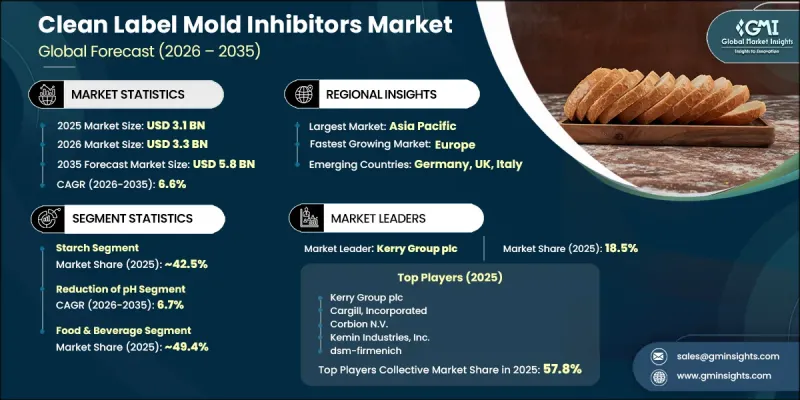
소비자들이 점점 더 자연에서 유래하고 성분이 명확하고 투명한 식품을 요구함에 따라 클린 라벨 곰팡이 억제제 산업은 강한 추진력을 보이고 있습니다. 건강한 소비 패턴으로의 전환으로 제조업체들은 합성 방부제를 안전성과 제품 품질을 모두 유지할 수 있는 천연 유래 대체품으로 대체하고 있습니다. 이러한 방지제는 미생물의 증식을 방지하여 품질을 유지하고 유통기한을 연장하며 공급망 전체에서 식품 폐기물을 줄이는 데 중요한 역할을 합니다. 제품의 신선도를 유지하면서 엄격한 규제 기준을 충족시킬 수 있기 때문에 다양한 산업 분야에서 매우 높은 가치를 지니고 있습니다. 식음료 분야 외에도 미생물 억제 및 제품 안정성이 요구되는 분야에서도 이러한 솔루션이 채택되고 있습니다. 지속적인 혁신을 통해 성능과 깨끗한 라벨에 대한 기대치 사이의 균형을 유지하면서 보다 효과적인 배합을 개발할 수 있게 되었습니다. 소비자의 인식이 높아지고 규제 프레임워크가 강화됨에 따라 안전한 천연 유래 보존 솔루션에 대한 수요는 더욱 강화되고 있으며, 전 세계적으로 지속적이고 꾸준한 시장 확대가 예상되고 있습니다.
| 시장 범위 | |
|---|---|
| 개시 연도 | 2025년 |
| 예측 기간 | 2026-2035년 |
| 개시 연도 시장 규모 | 31억 달러 |
| 예측 시장 규모 | 58억 달러 |
| CAGR | 6.6% |
전분 부문은 2025년 42.5%의 점유율을 차지했으며, 2035년까지 연평균 6.7%의 성장률을 보일 것으로 예측됩니다. 이 부문은 천연 유래, 생분해성, 그리고 다양한 제형과 잘 어울린다는 점에서 주목을 받고 있습니다. 지속적인 기술 발전으로 전분 기반 솔루션의 항균 효율이 향상되어 클린 라벨 기준을 유지하면서 보존 성능을 향상시킬 수 있게 되었습니다. 이 부문의 다재다능함은 다양한 제품 카테고리에서 폭넓은 채택을 계속 촉진하고 있습니다.
pH 감소 부문은 2025년에 74%의 점유율을 차지했으며, 2026-2035년 연평균 6.7%의 성장률을 보일 것으로 예측됩니다. 이 방법은 미생물의 증식에 부적절한 환경을 조성하여 제품의 안전성과 안정성을 보장하기 때문에 여전히 높은 효과를 발휘하고 있습니다. 천연 산성화 기법과 다양한 원료 유래의 생리활성 화합물을 결합하여 제품의 품질을 유지하면서 항진균 효과를 높일 수 있습니다. 이 메커니즘은 폭넓은 적용이 가능하며, 자연 보존 기술에 대한 수요 증가와도 부합합니다.
북미의 클린 라벨 곰팡이 억제제 시장은 2025년 19.3%의 점유율을 차지했으며, 이는 이 지역의 강력한 수요와 빠른 성장을 반영합니다. 이 지역에서는 가공을 최소화한 천연 유래 제품에 대한 소비자 선호도가 높아지면서 시장이 지속적으로 확대되고 있습니다. 엄격한 규제 기준과 식품 안전에 대한 인식이 높아짐에 따라 제조업체들이 클린 라벨 솔루션을 채택하고 있습니다. 지속적인 혁신과 업계의 적극적인 참여가 시장의 발전을 더욱 뒷받침하고 있으며, 고품질 천연 보존 시스템에 대한 수요는 여러 분야에 걸쳐 지속적으로 증가하고 있습니다.
자주 묻는 질문
목차
제1장 조사 방법 및 범위
제2장 주요 요약
제3장 업계 인사이트
제4장 경쟁 구도
제5장 시장 추산 및 예측 : 유형별(2022-2035년)
제6장 시장 추산 및 예측 : 기능별(2022-2035년)
제7장 시장 추산 및 예측 : 용도별(2022-2035년)
제8장 시장 추산 및 예측 : 지역별(2022-2035년)
제9장 기업 개요
AJY 26.06.15The Global Clean Label Mold Inhibitors Market was valued at USD 3.1 billion in 2025 and is estimated to grow at a CAGR of 6.6% to reach USD 5.8 billion by 2035.
The clean label mold inhibitors industry is gaining strong momentum as consumers increasingly demand food products made with natural, recognizable, and transparent ingredients. The shift toward healthier consumption patterns is encouraging manufacturers to replace synthetic preservatives with naturally derived alternatives that maintain both safety and product integrity. These inhibitors play a critical role in preventing microbial growth, thereby preserving quality, extending shelf life, and reducing food waste across supply chains. Their ability to meet strict regulatory standards while maintaining product freshness makes them highly valuable across multiple industries. Beyond food and beverages, these solutions are also being adopted in applications requiring microbial control and product stability. Continuous innovation is enabling the development of more effective formulations that balance performance with clean label expectations. As consumer awareness grows and regulatory frameworks tighten, the demand for safe, natural preservation solutions continues to strengthen, positioning the market for sustained and consistent expansion globally.
| Market Scope | |
|---|---|
| Start Year | 2025 |
| Forecast Year | 2026-2035 |
| Start Value | $3.1 Billion |
| Forecast Value | $5.8 Billion |
| CAGR | 6.6% |
The starch segment held a 42.5% share in 2025 and is expected to grow at a CAGR of 6.7% through 2035. This segment is gaining traction due to its natural origin, biodegradability, and compatibility with a wide range of formulations. Ongoing advancements are improving the antimicrobial efficiency of starch-based solutions, enabling enhanced preservation performance while maintaining clean label standards. The versatility of this segment continues to support its widespread adoption across various product categories.
The pH reduction segment held a 74% share in 2025 and is projected to grow at a CAGR of 6.7% between 2026 and 2035. This approach remains highly effective as it creates an unfavorable environment for microbial growth, ensuring product safety and stability. Natural acidification methods, combined with bioactive compounds derived from various sources, enhance antifungal effectiveness while maintaining product integrity. This mechanism supports broad applicability and aligns well with the increasing demand for natural preservation techniques.
North America Clean Label Mold Inhibitors Market held 19.3% share in 2025, reflecting strong regional demand and rapid growth. The region continues to expand due to increasing consumer preference for minimally processed and naturally derived products. Strict regulatory standards and heightened awareness around food safety are encouraging manufacturers to adopt clean label solutions. Ongoing innovation and strong industry participation are further supporting market development, while the demand for high-quality, natural preservation systems continues to rise across multiple sectors.
Key companies operating in the Global Clean Label Mold Inhibitors Market include Cargill, Incorporated, Archer Daniels Midland Company (ADM), BASF SE, Brenntag AG, Corbion N.V., DSM-Firmenich, Ingredion Incorporated, Kemin Industries, Inc., Kerry Group plc, Lallemand Inc., Puratos Group, and Tate & Lyle PLC. Companies in the clean label mold inhibitors market are adopting strategic initiatives to strengthen their market position and expand their global footprint. Organizations are investing in advanced research and development to create innovative, high-performance natural preservation solutions that meet evolving consumer expectations. Product portfolio diversification is a key focus, enabling companies to cater to a wider range of applications and industries. Strategic partnerships and collaborations are being leveraged to enhance technological capabilities and accelerate innovation. Companies are also prioritizing sustainable sourcing and environmentally responsible production practices to align with regulatory requirements and market trends.
Table of Contents
Chapter 1 Methodology & Scope
- 1.1 Market scope and definition
- 1.2 Research design
- 1.2.1 Research approach
- 1.2.2 Data collection methods
- 1.3 Data mining sources
- 1.3.1 Global
- 1.3.2 Regional/Country
- 1.4 Base estimates and calculations
- 1.4.1 Base year calculation
- 1.4.2 Key trends for market estimation
- 1.5 Primary research and validation
- 1.5.1 Primary sources
- 1.6 Forecast model
- 1.7 Research assumptions and limitations
Chapter 2 Executive Summary
- 2.1 Industry 360° synopsis
- 2.2 Key market trends
- 2.2.1 Regional
- 2.2.2 Type
- 2.2.3 Function
- 2.2.4 Application
- 2.3 TAM Analysis, 2026-2035
- 2.4 CXO perspectives: Strategic imperatives
- 2.4.1 Executive decision points
Chapter 3 Industry Insights
- 3.1 Industry ecosystem analysis
- 3.1.1 Supplier landscape
- 3.1.2 Profit margin
- 3.1.3 Value addition at each stage
- 3.1.4 Factor affecting the value chain
- 3.1.5 Disruptions
- 3.2 Industry impact forces
- 3.2.1 Growth drivers
- 3.2.2 Industry pitfalls and challenges
- 3.2.3 Market opportunities
- 3.3 Growth potential analysis
- 3.4 Regulatory landscape
- 3.4.1 North America
- 3.4.2 Europe
- 3.4.3 Asia Pacific
- 3.4.4 Latin America
- 3.4.5 Middle East & Africa
- 3.5 Porter's analysis
- 3.6 PESTEL analysis
- 3.7 Price trends
- 3.7.1 By region
- 3.7.2 By type
- 3.8 Future market trends
- 3.9 Technology and Innovation landscape
- 3.9.1 Current technological trends
- 3.9.2 Emerging technologies
- 3.10 Patent Landscape
- 3.11 Trade statistics (HS code)
- 3.11.1 Major importing countries
- 3.11.2 Major exporting countries
- 3.12 Sustainability and environmental aspects
- 3.12.1 Sustainable practices
- 3.12.2 Waste reduction strategies
- 3.12.3 Energy efficiency in production
- 3.12.4 Eco-friendly initiatives
- 3.13 Carbon footprint consideration
Chapter 4 Competitive Landscape, 2025
- 4.1 Introduction
- 4.2 Company market share analysis
- 4.2.1 By region
- 4.2.1.1 North America
- 4.2.1.2 Europe
- 4.2.1.3 Asia Pacific
- 4.2.1.4 LATAM
- 4.2.1.5 MEA
- 4.2.1 By region
- 4.3 Company matrix analysis
- 4.4 Competitive analysis of major market players
- 4.5 Competitive positioning matrix
- 4.6 Key developments
- 4.6.1 Mergers & acquisitions
- 4.6.2 Partnerships & collaborations
- 4.6.3 New Product Launches
- 4.6.4 Expansion Plans
Chapter 5 Market Estimates and Forecast, By Type, 2022-2035 (USD Billion) (Kilo Tons)
- 5.1 Key trends
- 5.2 Starch
- 5.3 Vinegar
- 5.4 Cultured flour
- 5.5 Whey
- 5.6 Others
Chapter 6 Market Estimates and Forecast, By Function, 2022-2035 (USD Billion) (Kilo Tons)
- 6.1 Key trends
- 6.2 Reduction of pH
- 6.3 Disruption of mold cellular membranes
Chapter 7 Market Estimates and Forecast, By Application, 2022-2035 (USD Billion) (Kilo Tons)
- 7.1 Key trends
- 7.2 Food & beverages
- 7.2.1 Bakery products
- 7.2.2 Confectionery
- 7.2.3 Dairy & dairy alternatives
- 7.2.4 Beverages
- 7.2.5 Meat & poultry products
- 7.2.6 Snacks & prepared foods
- 7.2.7 Sauces, dressings & condiments
- 7.2.8 Pharmaceuticals
- 7.2.9 Oral formulations
- 7.2.10 Topical formulations
- 7.2.11 Nutraceuticals & dietary supplements
- 7.3 Animal feed
- 7.3.1 Poultry feed
- 7.3.2 Ruminant feed
- 7.3.3 Aquaculture feed
- 7.3.4 Pet food
- 7.4 Personal care & cosmetics
- 7.4.1 Skincare products
- 7.4.2 Haircare products
- 7.4.3 Oral care products
- 7.4.4 Color cosmetics
- 7.5 Others
Chapter 8 Market Estimates and Forecast, By Region, 2022-2035 (USD Billion) (Kilo Tons)
- 8.1 Key trends
- 8.2 North America
- 8.2.1 U.S.
- 8.2.2 Canada
- 8.3 Europe
- 8.3.1 Germany
- 8.3.2 UK
- 8.3.3 France
- 8.3.4 Spain
- 8.3.5 Italy
- 8.3.6 Rest of Europe
- 8.4 Asia Pacific
- 8.4.1 China
- 8.4.2 India
- 8.4.3 Japan
- 8.4.4 Australia
- 8.4.5 South Korea
- 8.4.6 Rest of Asia Pacific
- 8.5 Latin America
- 8.5.1 Brazil
- 8.5.2 Mexico
- 8.5.3 Argentina
- 8.5.4 Rest of Latin America
- 8.6 Middle East and Africa
- 8.6.1 Saudi Arabia
- 8.6.2 South Africa
- 8.6.3 UAE
- 8.6.4 Rest of Middle East and Africa
Chapter 9 Company Profiles
- 9.1 Archer Daniels Midland Company (ADM)
- 9.2 BASF SE
- 9.3 Brenntag AG
- 9.4 Cargill, Incorporated
- 9.5 Corbion N. V.
- 9.6 dsm-firmenich
- 9.7 Ingredion Incorporated
- 9.8 Kemin Industries, Inc.
- 9.9 Kerry Group plc
- 9.10 Lallemand Inc.
- 9.11 Puratos Group
- 9.12 Tate & Lyle PLC