

|
시장보고서
상품코드
2154506
클린 라벨 곰팡이 억제제 : 시장 점유율 분석, 업계 동향과 통계, 성장 예측(2026-2031년)Clean Label Mold Inhibitors - Market Share Analysis, Industry Trends & Statistics, Growth Forecasts (2026 - 2031) |
||||||
 Mordor Intelligence
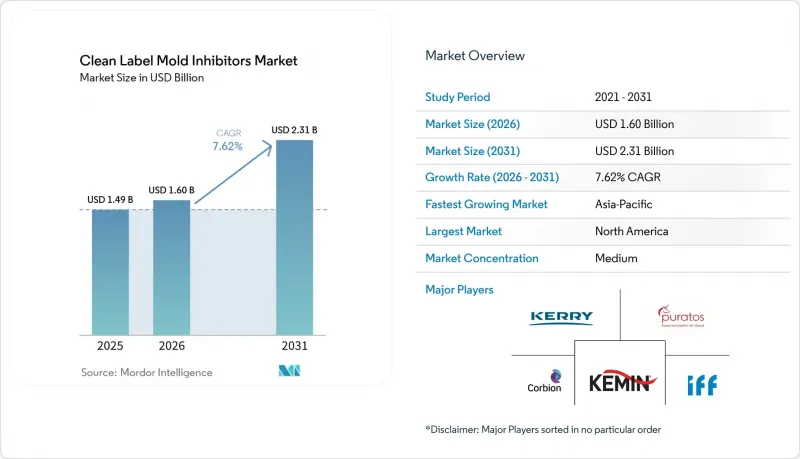
에 따르면 클린 라벨 곰팡이 방지제 시장 규모는 2025년에 14억 9,000만 달러, 2026년에 16억 달러에 달하고, 2031년까지 23억 1,000만 달러에 달할 것으로 예측되며, 2026년부터 2031년까지 CAGR 7.62%로 성장할 것으로 전망됩니다.
전 세계 클린 라벨용 곰팡이 방지제 시장의 동향 및 인사이트
클린 라벨 식품 원료에 대한 수요 증가
소매업체 주도의 클린 라벨 요건으로 인해, 특히 자체 브랜드 제빵 제품에서 곰팡이 억제 성분의 도입이 가속화되고 있습니다. 합성 방부제를 배제하기 위한 배합 변경 요건은 공급업체 전반에 걸쳐 협력적인 수요를 창출하며, 정해진 조달 및 계약 주기 내에서 대규모 변화를 주도하고 있습니다. 북미 및 유럽에서는 원재료의 투명성이 브랜드 소유주에게 있어 조달 및 제품 개발의 핵심 기준이 되고 있습니다. 그 결과, 클린 라벨용 방곰팡이제는 산업용 빵, 토르티야, 포장 스낵 등의 용도에서 프리미엄 가치를 지닌 배합 옵션에서 주류 요건으로 전환되고 있습니다. 이러한 추세는 식품 폐기물 감축을 위한 노력에 의해 더욱 가속화되고 있습니다. 효과적인 천연 방부제는 제품의 유통기한을 연장하고, 유통 및 소매 채널 전반에 걸친 손실을 줄이는 데 도움이 되기 때문입니다.
합성 방부제에서 천연 방부제로의 전환
클린 라벨의 곰팡이 방지 성분 시장은 합성 식품 첨가물에 대한 가시성과 심사를 강화하는, 진화하는 규제 및 표시 환경에 의해 뒷받침되고 있습니다. EU 규정 1169/2011에서는 식품 정보의 명확한 표시를 의무화하고 있으며, 유럽식품안전청(EFSA)은 승인된 식품 첨가물에 대한 재검토를 계속하고 있습니다. 2026년 8월, 미국 보건복지부(HHS)는 자발적으로 ‘일반적으로 안전하다고 인정되는(GRAS)’ 것으로 결론지어진 식품에 사용되는 물질에 대해 신고 의무를 부과할 것을 제안했습니다. 이러한 환경 속에서 완충 식초 및 배양 밀 시스템은 제조업체가 규제 준수 및 상품화 경로를 평가하는 데 도움이 되는 확립된 문서를 제공합니다. 제안된 미국의 요건은 종합적인 안전성 자료로 뒷받침되는 원료의 경쟁력을 강화할 가능성이 있는 반면, 새로운 배양 추출물의 경우 시장 진입 전에 추가 신고나 규제상 검증이 필요할 수 있습니다. 그 결과, 규제 대비 및 규정 준수 관련 문서는 제품 선정 기준으로 점점 더 중요해지고 있으며, 규제 관련 고려 사항이 배합 및 조달에 관한 의사결정에 직접 반영되고 있습니다.
기존 방부제에 비해 높은 비용
클린 라벨 방부제는 프로피온산 칼슘이나 소르빈산칼륨과 같은 기존 방부제에 비해 일반적으로 사용 비용이 1.5-3.0배 더 높기 때문에 특히 가격에 민감한 시장에서 도입에 큰 장벽이 되고 있습니다. 또한, 배양 밀이나 배양 덱스트로스 등의 원재료에 영향을 미치는 농산물 가격 변동은, 보다 표준화된 석유화학 유래 대체품에 비해 조달의 불확실성을 높일 가능성이 있습니다. 이러한 비용 문제를 해결하기 위해 AB Mauri는 베이커리 업계를 위한 비용 대비 효율이 높은 클린 라벨 보존 솔루션으로 자리매김한, 건조 식초와 배양 밀가루를 혼합한 ‘BakeGard Ultra CL’을 출시했습니다. 이러한 하이브리드 시스템은 시장 진입을 용이하게 하고 더 광범위한 채택을 촉진할 가능성이 있지만, 경쟁력 있는 가격 책정은 공급업체의 이익률에 추가적인 압박을 가할 수 있습니다. 또한, 첨가량이 증가할 경우 관능적 특성에 미치는 영향은 여전히 중요한 배합상의 제약요인으로 남아 있어, 제조업체는 풍미, 산미, 첨가량 및 곰팡이 방지 성능 간의 균형을 최적화해야 합니다.
부문 분석
2025년, 클린 라벨 방균 원료 시장에서 식초 기반 제품은 38.40%를 차지했습니다. 이는 규제 측면에서의 높은 인지도와 산업용 빵 및 토르티야 제조 분야에서 확립된 사용 실적이 뒷받침한 결과입니다. 완충 식초 시스템은 기존 제빵 설비에 큰 변경을 가하지 않고도 고속 혼합 공정에 통합할 수 있습니다. 또한 건조 및 액체 형태로 모두 구할 수 있어 생산 라인 전반에 유연성을 제공합니다. 발효 밀가루는 2031년까지 연평균 성장률(CAGR) 8.02%로 성장할 것으로 예측되며, 클린 라벨형 곰팡이 억제 원료 시장에서 가장 빠르게 성장하는 원료 유형이 될 전망입니다. 사워도우형 발효물에 대한 연구에 따르면, 특정 배양균을 0.5%의 배합 비율로 첨가함으로써 빵 내의 아스페르길루스 니거(Aspergillus niger) 및 페니실리움 코뮤네(Penicillium commune)를 10일간 억제할 수 있는 것으로 밝혀졌습니다. 코비온(Corbion)과 라레만드 베이킹(Lalemande Baking)은 상업용 제빵 용도를 위한 배양 밀 솔루션을 제공하고 있는 반면, 케민(Kemin)은 빵 및 토르티야 제조업체를 대상으로 농축 발효물 ‘SHIELD Pure’를 판매하고 있습니다. 전분 기반 시스템은 특히 무글루텐임을 표방해야 하는 경우, 케이크, 머핀, 토르티야를 위한 대체재가 됩니다.
지역별 분석
2025년, 북미는 클린 라벨 곰팡이 억제 원료 시장의 36.20%를 차지하며, 배양 밀 및 식초 기반 곰팡이 억제제에 있어 가장 확고하게 자리 잡은 지역 시장이 되었습니다. 대규모 빵 및 토르티야 제조업체들은 수년 전부터 이러한 솔루션을 상업 생산 시스템에 도입해 왔습니다. 확립된 천연 보존 시스템은 식품 용도에 관한 문서 및 규제적 위치에 대한 제조업체의 이해가 깊어짐에 따라 혜택을 볼 가능성이 있습니다. 소매업체 주도의 원재료 기준으로 인해 인지도가 높은 보존 솔루션에 대한 수요는 더욱 증가하고 있는 반면, 캐나다에서는 ‘식품·의약품 규정’의 현대화에 따라 규정 준수와 관련된 새로운 고려 사항이 도입되고 있습니다.
유럽은 성숙한 산업용 제빵 산업과 식품 첨가물의 투명성에 대한 지속적인 중점을 바탕으로 2위 지역 시장이 되었습니다. 독일, 영국, 프랑스는 확립된 제빵 제품 재조성 프로그램을 바탕으로 계속해서 주요 국내 시장을 형성하고 있습니다. 이러한 시장에서 사업을 전개하는 공급업체들은 관능적 특성, 유통기한 요건, 깨끗한 원재료 표시를 동시에 충족해야 하며, 이는 기존 생산 공정과 호환되는 배양 밀가루, 식초, 유기산 기반 보존 시스템에 대한 수요를 뒷받침하고 있습니다.
남미는 주로 브라질과 아르헨티나의 수요 증가에 힘입어 2031년까지 연평균 성장률(CAGR) 8.46%로 확대될 것으로 예측됩니다. 포장된 제빵 제품의 확대, 도시화, 그리고 원재료 표시에 대한 소비자의 관심 증가는 더 광범위한 유통 네트워크 전반에 걸쳐 신뢰할 수 있는 상온 보존 솔루션에 대한 수요를 강화하고 있습니다. 또한, 브라질의 생물 유래 원료 부문도 2025년에 현저한 활기를 띠며, 생물 유래 및 천연 유래 솔루션의 추가적인 보급을 뒷받침하고 있습니다. 아시아태평양에서도 도시화와 구매 패턴의 변화에 따라 상온 보관이 가능한 포장 베이커리 제품에 대한 수요가 증가하고 있어, 유사한 성장 기회가 예상됩니다. 중동 및 아프리카는 여전히 신흥 시장이며, 베이커리 체인의 확장, 국제적인 소매업체의 진출, 그리고 할랄 인증을 받은 발효 유래 보존 원료의 채택을 통해 향후 수요가 뒷받침될 전망입니다.
기타 혜택:
- 엑셀 형식의 시장 예측(ME) 시트
- 3개월간의 애널리스트 지원
자주 묻는 질문
목차
제1장 소개
- 조사 가정과 시장 정의
- 조사 범위
제2장 조사 방법
제3장 주요 요약
제4장 시장 구도
- 시장 개요
- 시장 성장 촉진요인
- 시장 성장 억제요인
- 공급망 분석
- 규제 상황
- Porter's Five Forces 분석
제5장 시장 규모와 성장 예측
- 성분 유형별
- 형태별
- 용도별
- 지역별
- 북미
- 미국
- 캐나다
- 멕시코
- 기타 북미 국가
- 유럽
- 독일
- 영국
- 프랑스
- 스페인
- 이탈리아
- 네덜란드
- 기타 유럽 국가
- 아시아태평양
- 중국
- 인도
- 일본
- 호주
- 기타 아시아태평양 국가
- 남미
- 브라질
- 아르헨티나
- 기타 남미 국가
- 중동 및 아프리카
- 아랍에미리트
- 남아프리카공화국
- 사우디아라비아
- 기타 중동 및 아프리카 국가
- 북미
제6장 경쟁 구도
- 시장 집중도
- 전략적 동향
- 시장 순위 분석
- 기업 개요
- Corbion N.V.
- Kemin Industries
- Kerry Group
- Puratos
- DSM-Firmenich
- Cain Food Industries
- Sunson Biotechnology
- BioVeritas
- Associated British Foods plc
- BDF Natural Ingredients
- Lallemand LLC
- International Flavors & Fragrance, Inc.
- Lesaffre Corporation
- Cargill, Incorporated
- Tate & Lyle PLC
- Galactic SA
- J&K Ingredients Inc.
- Ribus, Inc.
- Sacco System
- BASF SE
제7장 시장 기회와 향후 전망
KSM 26.10.29According to Mordor Intelligence, the clean label mold ingredients market size is projected to be USD 1.49 billion in 2025, USD 1.60 billion in 2026, and reach USD 2.31 billion by 2031, growing at a CAGR of 7.62% from 2026 to 2031.
Global Clean Label Mold Inhibitors Market Trends and Insights
Rising Demand for Clean-Label Food Ingredients
Retailer-led clean label mandates are accelerating the adoption of mold control ingredients, particularly across private-label bakery programs. Reformulation requirements to eliminate synthetic preservatives create coordinated demand across suppliers, driving large-scale changes within defined procurement and contract cycles. In North America and Europe, ingredient transparency is increasingly becoming a core sourcing and product-development criterion for brand owners. As a result, clean label mold inhibitors are transitioning from a premium-value formulation option to a mainstream requirement across industrial bread, tortillas, and packaged snack applications. The trend is further supported by food-waste reduction initiatives, as effective natural mold control helps extend product shelf life and reduce losses across distribution and retail channels.
Shift from Synthetic to Natural Preservatives
The clean label mold ingredients market is supported by an evolving regulatory and labeling environment that increases the visibility and scrutiny of synthetic food additives. EU Regulation 1169/2011 requires food information to be presented clearly, while the European Food Safety Authority (EFSA) continues to review permitted food additives . In August 2026, the U.S. Department of Health and Human Services (HHS) proposed mandatory notification requirements for substances used in food under self-affirmed Generally Recognized as Safe (GRAS) conclusions . Within this environment, buffered vinegar and cultured wheat systems offer established documentation that can support manufacturers in assessing regulatory compliance and commercialization pathways. The proposed U.S. requirements could strengthen the competitive position of ingredients supported by comprehensive safety dossiers, while newer cultured extracts may require additional notification and regulatory validation before market entry. Consequently, regulatory readiness and compliance documentation are becoming increasingly important product-selection criteria, integrating regulatory considerations directly into formulation and procurement decisions.
Higher Cost Versus Conventional Preservatives
Clean label mold inhibitors typically carry a 1.5-3.0x cost-in-use premium compared with conventional preservatives such as calcium propionate and potassium sorbate, creating a significant adoption barrier, particularly in price-sensitive markets. In addition, agricultural commodity volatility affecting inputs such as cultured wheat and cultured dextrose can increase procurement uncertainty relative to more standardized petrochemical-derived alternatives. To address this cost challenge, AB Mauri introduced BakeGard Ultra CL, a dried vinegar and cultured wheat flour blend positioned as a more cost-effective clean label preservation solution for bakeries. Such hybrid systems can improve market accessibility and support wider adoption, although competitive pricing may place additional pressure on supplier margins. Furthermore, sensory impact at higher inclusion levels remains a key formulation constraint, requiring manufacturers to optimize the balance between flavor, acidity, dosage levels, and mold inhibition performance.
Other drivers and restraints analyzed in the detailed report include:
- Expansion of Fermentation-Based Preservation Technologies
- Growing Packaged Bakery Product Consumption
- Variable Efficacy Across Food Applications
For complete list of drivers and restraints, kindly check the Table Of Contents.
Segment Analysis
Vinegar-based products accounted for 38.40% of the clean-label mold ingredients market in 2025, supported by regulatory familiarity and established use across industrial bread and tortilla production. Buffered vinegar systems can be integrated into high-speed mixing processes without significant modifications to existing bakery equipment, while availability in both dry and liquid formats provides flexibility across production lines. Fermented flour is projected to grow at an 8.02% CAGR through 2031, making it the fastest-growing ingredient type in the clean-label mold ingredients market. Research on sourdough-type fermentates found that selected cultures inhibited Aspergillus niger and Penicillium commune in bread for 10 days at a 0.5% inclusion rate. Corbion and Lallemand Baking offer cultured wheat solutions for commercial bakery applications, while Kemin markets SHIELD Pure as a concentrated fermentate for bread and tortilla producers. Starch-based systems provide an alternative for cakes, muffins, and tortillas, particularly where gluten-free positioning is required.
Complete Report Scope:
- By Ingredient Type
- Fermented Flour
- Vinegar-Based
- Starch-Based
- Organic-Acid Based
- Others
- By Form
- Powder
- Liquid
- By Application
- Food and Beverages
- Bakery and Confectionery
- Dairy and Dairy Alternatives
- Beverages
- Ready-To-Cook/Ready-To-Eat Foods
- Others
- Animal Feed
- Pharmaceuticals
- Personal Care and Cosmetics
- Food and Beverages
- By Geography
- North America
- United States
- Canada
- Mexico
- Rest of North America
- Europe
- Germany
- United Kingdom
- France
- Spain
- Italy
- Netherlands
- Rest of Europe
- Asia-Pacific
- China
- India
- Japan
- Australia
- Rest of Asia-Pacific
- South America
- Brazil
- Argentina
- Rest of South America
- Middle East and Africa
- United Arab Emirates
- South Africa
- Saudi Arabia
- Rest of Middle East and Africa
- North America
Geography Analysis
North America accounted for 36.20% of the clean-label mold ingredients market in 2025, making it the most established regional market for cultured wheat and vinegar-based mold inhibitors. Large-scale bread and tortilla manufacturers have incorporated these solutions into commercial production systems for several years. Established natural preservation systems may benefit from greater manufacturer familiarity with their food-use documentation and regulatory positioning. Retailer-driven ingredient standards further strengthen demand for recognizable preservation solutions, while Canada introduces additional compliance considerations through modernization of its Food and Drug Regulations.
Europe represents the second-largest regional market, supported by mature industrial bakery industries and continued emphasis on food additive transparency. Germany, the United Kingdom, and France remain key national markets, supported by established bakery reformulation programs. Suppliers operating across these markets must simultaneously address sensory performance, shelf-life requirements, and clean ingredient declarations, supporting demand for cultured flour, vinegar, and organic-acid-based preservation systems compatible with existing production processes.
South America is projected to expand at an 8.46% CAGR through 2031, driven primarily by demand growth in Brazil and Argentina. Packaged bakery expansion, urbanization, and increasing consumer attention to ingredient labels are strengthening demand for reliable ambient shelf-life solutions across broader distribution networks. Brazil's biological inputs sector also recorded significant activity in 2025, supporting wider acceptance of biological and naturally derived solutions. Asia-Pacific presents a similar growth opportunity as urbanization and changing purchasing patterns increase demand for shelf-stable packaged bakery products. Middle East and Africa remains an emerging market, with future demand supported by expanding bakery chains, international retail formats, and adoption of halal-compatible, fermentation-derived preservation ingredients.
- Corbion N.V.
- Kemin Industries
- Kerry Group
- Puratos
- DSM-Firmenich
- Cain Food Industries
- Sunson Biotechnology
- BioVeritas
- Associated British Foods plc
- BDF Natural Ingredients
- Lallemand LLC
- International Flavors & Fragrance, Inc.
- Lesaffre Corporation
- Cargill, Incorporated
- Tate & Lyle PLC
- Galactic SA
- J&K Ingredients Inc.
- Ribus, Inc.
- Sacco System
- BASF SE
Additional Benefits:
- The market estimate (ME) sheet in Excel format
- 3 months of analyst support
TABLE OF CONTENTS
1 INTRODUCTION
- 1.1 Study Assumptions and Market Definition
- 1.2 Scope of the Study
2 RESEARCH METHODOLOGY
3 EXECUTIVE SUMMARY
4 MARKET LANDSCAPE
- 4.1 Market Overview
- 4.2 Market Drivers
- 4.2.1 Rising demand for clean-label food ingredients
- 4.2.2 Shift from synthetic to natural preservatives
- 4.2.3 Increasing demand for extended shelf life
- 4.2.4 Growing packaged bakery product consumption
- 4.2.5 Expansion of fermentation-based preservation technologies
- 4.2.6 Rising focus on food waste reduction
- 4.3 Market Restraints
- 4.3.1 Higher cost versus conventional preservatives
- 4.3.2 Variable efficacy across food applications
- 4.3.3 Potential sensory impacts at higher dosages
- 4.3.4 Complex formulation and regulatory requirements
- 4.4 Supply-Chain Analysis
- 4.5 Regulatory Landscape
- 4.6 Porter's Five Forces Analysis
- 4.6.1 Bargaining Power of Buyers/Consumers
- 4.6.2 Bargaining Power of Suppliers
- 4.6.3 Threat of New Entrants
- 4.6.4 Threat of Substitute Products
- 4.6.5 Intensity of Competitive Rivalry
5 MARKET SIZE AND GROWTH FORECASTS (VALUE & VOLUME)
- 5.1 By Ingredient Type
- 5.1.1 Fermented Flour
- 5.1.2 Vinegar-Based
- 5.1.3 Starch-Based
- 5.1.4 Organic-Acid Based
- 5.1.5 Others
- 5.2 By Form
- 5.2.1 Powder
- 5.2.2 Liquid
- 5.3 By Application
- 5.3.1 Food and Beverages
- 5.3.1.1 Bakery and Confectionery
- 5.3.1.2 Dairy and Dairy Alternatives
- 5.3.1.3 Beverages
- 5.3.1.4 Ready-To-Cook/Ready-To-Eat Foods
- 5.3.1.5 Others
- 5.3.2 Animal Feed
- 5.3.3 Pharmaceuticals
- 5.3.4 Personal Care and Cosmetics
- 5.3.1 Food and Beverages
- 5.4 By Geography
- 5.4.1 North America
- 5.4.1.1 United States
- 5.4.1.2 Canada
- 5.4.1.3 Mexico
- 5.4.1.4 Rest of North America
- 5.4.2 Europe
- 5.4.2.1 Germany
- 5.4.2.2 United Kingdom
- 5.4.2.3 France
- 5.4.2.4 Spain
- 5.4.2.5 Italy
- 5.4.2.6 Netherlands
- 5.4.2.7 Rest of Europe
- 5.4.3 Asia-Pacific
- 5.4.3.1 China
- 5.4.3.2 India
- 5.4.3.3 Japan
- 5.4.3.4 Australia
- 5.4.3.5 Rest of Asia-Pacific
- 5.4.4 South America
- 5.4.4.1 Brazil
- 5.4.4.2 Argentina
- 5.4.4.3 Rest of South America
- 5.4.5 Middle East and Africa
- 5.4.5.1 United Arab Emirates
- 5.4.5.2 South Africa
- 5.4.5.3 Saudi Arabia
- 5.4.5.4 Rest of Middle East and Africa
- 5.4.1 North America
6 COMPETITIVE LANDSCAPE
- 6.1 Market Concentration
- 6.2 Strategic Moves
- 6.3 Market Ranking Analysis
- 6.4 Company Profiles (includes Global level Overview, Market level overview, Core Segments, Financials as available, Strategic Information, Market Rank/Share for key companies, Products and Services, and Recent Developments)
- 6.4.1 Corbion N.V.
- 6.4.2 Kemin Industries
- 6.4.3 Kerry Group
- 6.4.4 Puratos
- 6.4.5 DSM-Firmenich
- 6.4.6 Cain Food Industries
- 6.4.7 Sunson Biotechnology
- 6.4.8 BioVeritas
- 6.4.9 Associated British Foods plc
- 6.4.10 BDF Natural Ingredients
- 6.4.11 Lallemand LLC
- 6.4.12 International Flavors & Fragrance, Inc.
- 6.4.13 Lesaffre Corporation
- 6.4.14 Cargill, Incorporated
- 6.4.15 Tate & Lyle PLC
- 6.4.16 Galactic SA
- 6.4.17 J&K Ingredients Inc.
- 6.4.18 Ribus, Inc.
- 6.4.19 Sacco System
- 6.4.20 BASF SE


