
|
시장보고서
상품코드
2124448
미국의 벽면 마감재 및 벽 장식 시장 : 점유율 분석, 업계 동향과 통계, 성장 예측(2026-2031년)United States Wall Covering And Wall Decor - Market Share Analysis, Industry Trends & Statistics, Growth Forecasts (2026 - 2031) |
||||||
 Mordor Intelligence
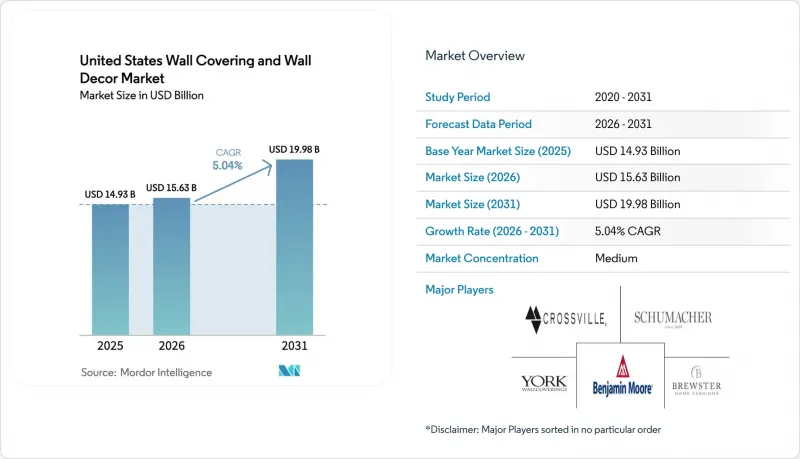
Mordor Intelligence에 의하면, 미국 벽면 마감재 및 벽 장식 시장 규모는 2025년 149억 3,000만 달러에서 2026년에는 156억 3,000만 달러로 확대되어 2031년까지 199억 8,000만 달러에 이를 것으로 예측됩니다.
2026년부터 2031년까지 연평균 성장률(CAGR) 5.04%로 성장할 것으로 전망됩니다.
본 보고서는 제품 유형(벽장식재·벽면 장식), 소재(종이 계열, 직물·섬유 계열 등), 최종 이용 산업(호텔 및 레스토랑, 헬스케어, 소매, 기업 사무실 등), 유통 채널(전문점, 프랜차이즈 매장 등)별로 분류되어 있습니다. 시장 전망은 금액(달러) 기준으로 제시되어 있습니다.
미국 벽면 마감재 및 벽 장식 시장 동향 및 인사이트
주택 건설 활동의 회복
2025년에는 주택 착공 건수가 143만 호로 증가할 전망이며, 프로젝트가 골조 공사에서 인테리어 공사로 전환됨에 따라 이러한 증가 추세가 마감재 수요에도 파급되고 있습니다. 단독주택 건설이 여전히 주류를 이루고 있지만, 공동주택 프로젝트는 공급량이 집중되어 있으며, 그 중 상당수가 유형 II 상업용 벽장식을 지정하고 있습니다. 2025년 리모델링 지출은 5,090억 달러에 달할 것으로 예상되며, 자산 여유가 있는 주택 소유자들이 부동산에 재투자하고 있는 것이 이러한 점진적인 증가를 주도하고 있습니다. 선벨트 지역 각 주에서는 유리한 인구 이동 및 고용 동향으로 인해 더욱 탄력을 받고 있습니다. 따라서 미국의 벽면 마감재 및 벽 장식 시장은 주택 준공 건수에 비례하여 확대되고 있으며, 착공 건수는 출하량의 선행 지표가 되고 있습니다.
디지털 프린팅 솔루션 및 벽 장식 제품의 온라인 조달에 대한 수요 증가
대형 잉크젯 시스템의 발전으로 각 브랜드는 며칠 만에 맞춤형 제품을 인쇄할 수 있게 되었으며, 소비자 수준의 가격대에서 대량 맞춤화가 가능해졌습니다. 2025년 3분기에 Wayfair가 기록한 27억 2,800만 달러의 국내 매출 중 63%가 모바일을 통해 이루어졌습니다는 사실은 디지털 채널이 구매 행동을 어떻게 재정의하고 있는지를 여실히 보여줍니다. 모바일용 증강현실(AR) 도구는 디자인 선택에 따른 불안을 완화하고, 구매자의 평균 구매 금액을 끌어올리고 있습니다. API 기반 주문 포털을 통합할 수 있는 제조업체는 전문점이 재고 확보에 어려움을 겪던 틈새 디자인 수요에도 대응할 수 있게 되었습니다. 그 결과, 미국의 벽면 마감재 및 벽 장식 시장에서는 오프라인 매장 규모를 확대하지 않고도 온라인 판매량이 꾸준히 증가하고 있습니다.
도료 부문의 치열한 경쟁
페인트는 보급형 벽지 시공 비용의 약 3분의 1 수준이며, 시공에 특별한 기술이 필요하지 않기 때문에 판매량 측면에서는 여전히 우위를 유지하고 있습니다. 인플레이션으로 인해 리모델링 예산이 부족해지면, 예산을 중시하는 리모델링 업체들은 무늬가 있는 벽지보다는 벽을 다시 칠하는 것을 선택하는 경우가 많습니다. 또한, 페인트 브랜드들은 질감 마감 처리나 온라인 시각화 도구를 도입하고 있어, 이로 인해 벽지와의 미적 차이가 좁혀지고 있습니다. 이러한 경쟁은 1인당 소득이 해안 지역 평균보다 낮은 지방 카운티에서 가장 치열하며, 미국 벽면 마감재 및 벽 장식 시장에 지속적인 걸림돌이 되고 있습니다.
부문 분석
2025년 매출 중 벽장식이 78.42%를 차지했습니다. 이는 호텔 및 의료시설을 위한 엄격한 내구성 기준을 충족하는 비닐 벽장식, 라미네이트 패널, 세라믹 타일이 주도한 결과입니다. 벽지의 풍부한 디자인 라이브러리와 저VOC 잉크의 접근성 향상으로 인해, 유동 인구가 많은 공간에서의 지속적인 채택이 보장되고 있습니다. 대조적으로, 벽 장식 시장은 2031년까지 연평균 성장률(CAGR) 6.42%로 확대될 것으로 예측됩니다. 이는 디자인에 민감한 임대 거주자들에게 인기를 끌고 있는 맞춤형 캔버스 아트, 액자형 거울, 제거 가능한 데칼이 주도하고 있습니다. 이커머스 브랜드들이 벽면 아트를 시각화 앱과 세트로 판매하는 사례가 늘어나면서, 구매 장벽이 낮아지고 1회당 구매 금액이 증가하고 있습니다. 이처럼 미국의 벽면 마감재 및 벽 장식 시장은 판매량이 많은 핵심 부문와 성장 속도가 빠른 부수적 카테고리가 공존하는 구조를 띠고 있습니다.
디지털 인테리어의 성장 또한 ‘필 앤 스틱(peel-and-stick)’ 방식의 벽화에 대한 수요를 뒷받침하고 있으며, 주택 소유자는 영구적인 시공 없이도 대담한 모티프를 시도해 볼 수 있습니다. 액센트 월과 조화를 이루는 아트웍을 조합한 하이브리드형 공간은 카테고리 간 판매가 어떻게 융합되고 있는지를 보여줍니다. 조화로운 컬렉션을 엄선하는 공급업체들은 온라인으로 주문하는 소비자들에게 스타일의 일관성을 제공함으로써 시장 점유율을 확대되고 있습니다. 이러한 세트 상품의 보급에 따라 미국의 벽면 마감재 및 벽 장식 시장에서는 벽지와 장식의 연계성이 강화되며, 프로젝트당 총 잠재 가치(TAV)가 증가하고 있습니다.
비닐은 2025년 소재 매출의 38.43%를 차지하며, 세척 가능한 표면이 요구되는 복도, 객실, 공용 구역에서 수십 년에 걸친 설치 실적을 바탕으로 그 혜택을 누리고 있습니다. 프탈레이트 무함유 가소제 기술 혁신은 캘리포니아주 공중보건국(CDPH)의 01350 기준을 충족하면서 이러한 선도적 위치를 유지하는 것을 목표로 하고 있습니다. 종이 및 부직포 기판은 통기성이 내마모성의 부족을 보완해 주는 주택 리모델링 분야에서 인기를 얻고 있습니다. 현재 시장 점유율은 적지만, 건축가들이 WELL v2 음향 기준을 충족하기 위해 흡음 안감이 부착된 구리 및 알루미늄 패널을 지정하는 추세에 힘입어, 금속 벽재 시장은 2031년까지 연평균 성장률(CAGR) 6.64%를 달성할 것으로 예측됩니다.
0.75-0.95의 소음 저감 계수를 가진 ‘Symphony’ 패널 등의 제품은 오픈 플랜 사무실을 위한 턴키 솔루션으로 자리매김하고 있습니다. 동시에, 2시간 이내에 99.9%의 세균 저감 효과를 보이는 항균 구리 타일은 병원 및 장기 요양 시설에서 채택이 확대되고 있습니다. 이러한 성능상의 강점은 제조업체가 도료 대체로 인한 이익률 하락을 방지하고, 미국 벽면 마감재 및 벽 장식 시장에서 프리미엄화를 뒷받침하고 있습니다.
기타 혜택:
- 엑셀 형식 시장 예측(ME) 시트
- 3개월간의 애널리스트 지원
자주 묻는 질문
목차
제1장 서론
제2장 조사 방법
제3장 주요 요약
제4장 시장 구도
제5장 시장 규모와 성장 예측
제6장 경쟁 구도
제7장 시장 기회와 향후 전망
JHS 26.09.11According to Mordor Intelligence, the United States wall covering and wall decor market size is expected to increase from USD 14.93 billion in 2025 to USD 15.63 billion in 2026 and reach USD 19.98 billion by 2031, growing at a CAGR of 5.04% over 2026-2031.
This report is Segmented by Product Type (Wall Covering and Wall Decor), Material (Paper-Based, Fabric/Textile, and More), End-Use Industry (Hospitality, Healthcare, Retail, Corporate Offices, and More), and Distribution Channel (Specialty Store, Franchise Store, and More). The Market Forecasts are Provided in Terms of Value (USD).
United States Wall Covering And Wall Decor Market Trends and Insights
Rebounding Residential Construction Activity
Housing starts climbed to 1.43 million units in 2025, an uptick that is filtering into finish-material demand as projects move from framing to interiors. Single-family construction again dominates but multifamily projects supply concentrated volumes that often specify Type II commercial wallcoverings. Remodel spending touched USD 509 billion in 2025, an incremental lift driven by equity-rich homeowners reinvesting in properties. Sun Belt states add extra momentum through favorable migration and employment patterns. The United States wall covering and wall decor market therefore scales with housing completions, making construction starts a leading indicator of unit shipments.
Growing Demand for Digitally Printed Solutions and Online Procurement of Wall Arts
Advances in large-format inkjet systems allow brands to print bespoke runs within days, enabling mass customization at consumer-level price points. Wayfair's USD 2.728 billion domestic revenue in Q3 2025, with 63% of orders placed via mobile, underscores how digital channels redefine purchase behavior.Mobile augmented-reality tools reduce style uncertainty, nudging buyers to higher basket values. Manufacturers able to integrate API-driven ordering portals now reach the long-tail of design preferences that specialty stores struggled to stock. As a result, the United States wall covering and wall decor market finds incremental volume online without widening brick-and-mortar footprints.
Strong Competition from the Paint Segment
Paint maintains dominance in volume terms because it costs roughly one-third of an entry-level wallpaper installation and requires no specialty skills for application. Budget-conscious renovators often opt for a fresh coat over a patterned wallcovering when inflation stretches project budgets. Paint brands have also launched textured finishes and online visualization tools that narrow wallcovering's aesthetic gap. This rivalry is acutest in rural counties where per-capita income trails coastal averages, creating a steady drag on the United States wall covering and wall decor market.
Other drivers and restraints analyzed in the detailed report include:
- Rising Disposable Incomes and Home Remodeling Spending
- Surge in Short-Term Rentals Fueling Rapid Refresh Cycles of Interior Aesthetics
- Impact of Recent Macro-Economic Volatility on Customer Spending
For complete list of drivers and restraints, kindly check the Table Of Contents.
Segment Analysis
Wall covering held 78.42% of 2025 revenue, anchored by vinyl wallpaper, laminated panels, and ceramic tile that meet stringent durability codes for hospitality and healthcare installations. Wallpaper's breadth of print libraries and growing availability in low-VOC inks continue to secure repeat specifications for high-traffic spaces. In contrast, wall decor is forecast to expand at a 6.42% CAGR through 2031, propelled by custom canvas art, framed mirrors, and removable decals that appeal to design-savvy renters. E-commerce brands increasingly bundle wall art with visualization apps, lowering decision friction and lifting basket sizes. The United States wall covering and wall decor market thus shows a volume-heavy core segment coupled with a faster-moving ancillary category.
Growth in digital interiors also fuels demand for peel-and-stick murals, allowing homeowners to trial bold motifs without permanent commitment. Hybrid rooms where a statement wall pairs with coordinating artwork illustrate how cross-category sales converge. Suppliers that curate coordinated collections gain share because they simplify style coherence for consumers ordering online. As these bundles proliferate, the United States wall covering and wall decor market tightens the link between covering and decor, increasing total addressable value per project.
Vinyl represented 38.43% of 2025 material revenue, benefiting from decades of installed base across corridors, guest rooms, and public areas that require scrubbable surfaces. Innovations in phthalate-free plasticizers aim to preserve this leadership while meeting California CDPH 01350 thresholds.Paper and non-woven substrates gain popularity in residential makeovers where breathability offsets lower abrasion resistance. Metal wall coverings, though a smaller slice today, are forecast to achieve a 6.64% CAGR through 2031 as architects specify copper or aluminum panels with acoustic backings to satisfy WELL v2 sound criteria.
Noise reduction coefficients between 0.75 and 0.95 position products like Symphony panels as turnkey solutions for open-plan offices. Simultaneously, antimicrobial copper tiles demonstrating 99.9% bacterial reduction within two hours expand uptake in hospitals and long-term care. These performance overlays help manufacturers defend margins against paint substitutions and underpin premiumization inside the United States wall covering and wall decor market.
Complete Report Scope:
- By Product Type
- Wall Covering
- Wall Panel
- Wallpaper
- Vinyl Wallpaper
- Non-woven Wallpaper
- Paper-based Wallpaper
- Fabric Wallpaper
- Other Wallpaper Types
- Tile
- Metal Wall Covering
- Other Product Types
- Wall Decor
- Wall Art
- Wall Decal
- Wall Frames (Mirrors, etc.)
- Other Wall Decors
- Wall Covering
- By Material
- Paper-Based
- Fabric/Textile
- Wood-Based
- Vinyl
- Metal
- Plastic
- Other Materials
- By End-use Industry
- Hospitality
- Healthcare
- Retail
- Corporate Offices
- Education
- Domestic Housing
- Industrial Facilities
- Other End-use Industries
- By Distribution Channel
- Specialty Store
- Franchise store
- E-commerce
- Other Distribution Channels
List of Companies Covered in this Report:
- Brewster Home Fashions LLC
- Benjamin Moore & Co.
- York Wallcoverings, Inc.
- F. Schumacher & Co.
- Crossville Inc.
- J. Josephson Inc.
- Wallquest Inc.
- The Sherwin-Williams Company
- Koroseal Interior Products, LLC
- Len-Tex Corporation
- Graham & Brown Ltd.
- Tempaper, LLC
- Chasing Paper, LLC
- Spoonflower, Inc.
- Walls Need Love, LLC
- Astek Wallcoverings, Inc.
- Mohawk Industries, Inc.
- Walls Republic
- Saint-Gobain S.A.
Additional Benefits:
- The market estimate (ME) sheet in Excel format
- 3 months of analyst support
TABLE OF CONTENTS
1 INTRODUCTION
- 1.1 Study Assumptions and Market Definition
- 1.2 Scope of the Study
2 RESEARCH METHODOLOGY
3 EXECUTIVE SUMMARY
4 MARKET LANDSCAPE
- 4.1 Market Overview
- 4.2 Market Drivers
- 4.2.1 Rebounding Residential Construction Activity
- 4.2.2 Growing Demand for Digitally Printed Solutions and Online Procurement of Wall Arts
- 4.2.3 Rising Disposable Incomes and Home Remodeling Spending
- 4.2.4 Surge in Short-Term Rentals Fueling Rapid Refresh Cycles of Interior Aesthetics
- 4.2.5 Growth of Peel-and-Stick, Low-VOC Substrates Meeting Renter-Friendly and Sustainability Rules
- 4.2.6 Integration of Antimicrobial and Acoustic Functionalities into Wall Coverings for Post-Pandemic Healthy Buildings
- 4.3 Market Restraints
- 4.3.1 Strong Competition from the Paint Segment
- 4.3.2 Impact of Recent Macro-Economic Volatility on Customer Spending
- 4.3.3 US Tariff Expansion on Specialty Pigments and Vinyl Compounds Elevating Input Costs
- 4.3.4 Skilled Installer Shortage Escalating Total Cost and Delaying Commercial Projects
- 4.4 Industry Value Chain Analysis
- 4.5 Regulatory Landscape
- 4.6 Technological Outlook
- 4.7 Porter's Five Forces Analysis
- 4.7.1 Bargaining Power of Suppliers
- 4.7.2 Bargaining Power of Buyers
- 4.7.3 Threat of New Entrants
- 4.7.4 Threat of Substitute Products
- 4.7.5 Intensity of Competitive Rivalry
- 4.8 Impact of Macroeconomic Factors on the Market
- 4.9 Investment Analysis
5 MARKET SIZE AND GROWTH FORECASTS (VALUE)
- 5.1 By Product Type
- 5.1.1 Wall Covering
- 5.1.1.1 Wall Panel
- 5.1.1.2 Wallpaper
- 5.1.1.2.1 Vinyl Wallpaper
- 5.1.1.2.2 Non-woven Wallpaper
- 5.1.1.2.3 Paper-based Wallpaper
- 5.1.1.2.4 Fabric Wallpaper
- 5.1.1.2.5 Other Wallpaper Types
- 5.1.1.3 Tile
- 5.1.1.4 Metal Wall Covering
- 5.1.1.5 Other Product Types
- 5.1.2 Wall Decor
- 5.1.2.1 Wall Art
- 5.1.2.2 Wall Decal
- 5.1.2.3 Wall Frames (Mirrors, etc.)
- 5.1.2.4 Other Wall Decors
- 5.1.1 Wall Covering
- 5.2 By Material
- 5.2.1 Paper-Based
- 5.2.2 Fabric/Textile
- 5.2.3 Wood-Based
- 5.2.4 Vinyl
- 5.2.5 Metal
- 5.2.6 Plastic
- 5.2.7 Other Materials
- 5.3 By End-use Industry
- 5.3.1 Hospitality
- 5.3.2 Healthcare
- 5.3.3 Retail
- 5.3.4 Corporate Offices
- 5.3.5 Education
- 5.3.6 Domestic Housing
- 5.3.7 Industrial Facilities
- 5.3.8 Other End-use Industries
- 5.4 By Distribution Channel
- 5.4.1 Specialty Store
- 5.4.2 Franchise store
- 5.4.3 E-commerce
- 5.4.4 Other Distribution Channels
6 COMPETITIVE LANDSCAPE
- 6.1 Market Concentration
- 6.2 Strategic Moves
- 6.3 Market Share Analysis
- 6.4 Company Profiles (Includes Global Level Overview, Market Level Overview, Core Segments, Financials as Available, Strategic Information, Market Rank/Share, Products and Services, and Recent Developments)
- 6.4.1 Brewster Home Fashions LLC
- 6.4.2 Benjamin Moore & Co.
- 6.4.3 York Wallcoverings, Inc.
- 6.4.4 F. Schumacher & Co.
- 6.4.5 Crossville Inc.
- 6.4.6 J. Josephson Inc.
- 6.4.7 Wallquest Inc.
- 6.4.8 The Sherwin-Williams Company
- 6.4.9 Koroseal Interior Products, LLC
- 6.4.10 Len-Tex Corporation
- 6.4.11 Graham & Brown Ltd.
- 6.4.12 Tempaper, LLC
- 6.4.13 Chasing Paper, LLC
- 6.4.14 Spoonflower, Inc.
- 6.4.15 Walls Need Love, LLC
- 6.4.16 Astek Wallcoverings, Inc.
- 6.4.17 Mohawk Industries, Inc.
- 6.4.18 Walls Republic
- 6.4.19 Saint-Gobain S.A.
7 MARKET OPPORTUNITIES AND FUTURE OUTLOOK
- 7.1 White-Space and Unmet-Need Assessment