

|
시장보고서
상품코드
2045862
황 기반 미량영양소 시장 : 시장 비즈니스 기회, 성장요인, 업계 동향 분석 및 예측(2026-2035년)Sulfur-Based Micronutrients Market Opportunity, Growth Drivers, Industry Trend Analysis, and Forecast 2026 - 2035 |
||||||

세계의 황 기반 미량영양소 시장은 2025년에 4억 8,150만 달러로 평가되었고, CAGR 9%로 성장할 전망이며, 2035년까지 11억 달러에 이를 것으로 추정되고 있습니다.
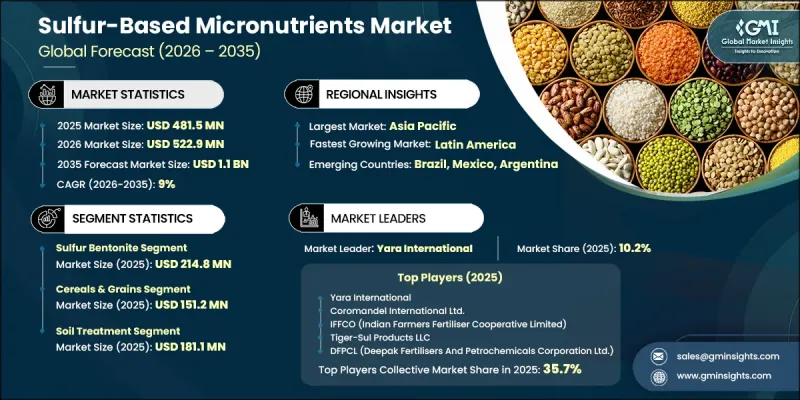
이 시장의 성장은 유황 결핍을 해결하고 토양의 전반적인 생산성을 향상시키는 효율적인 작물 영양 솔루션에 대한 수요 증가에 힘입어 성장하고 있습니다. 황 기반 미량영양소는 단백질 형성과 엽록소 합성을 지원함으로써 식물 성장에 중요한 역할을 하며, 작물의 수확량과 품질 향상에 필수적입니다. 이 영양소들은 토양처리나 엽면살포를 통해 적용되며, 다양한 작물 유형에 걸쳐 영양 부족을 정확하게 보완할 수 있습니다. 지속 가능한 농업, 토양 건강 관리 및 균형 잡힌 시비 방법에 대한 관심이 높아지면서 시장 수요가 더욱 증가하고 있습니다. 또한 현대 농업 시스템에서는 비료 사용을 최적화하고 영양소 손실을 줄이기 위해 정밀 영양 관리 기술을 점점 더 많이 채택하고 있습니다. 농업의 지속적인 집약화, 일부 지역의 토양 비옥도 감소, 유기물 재활용이 제한적이라는 점도 황 기반 미량영양소 솔루션에 대한 지속적인 수요에 기여하고 있습니다. 세계 식량 생산 수요가 증가함에 따라 개발도상국과 선진국 농업 시장 모두 다양한 기후와 토양 조건에서 안정적인 생산성을 유지하고 작물의 생육을 개선하기 위해 이러한 투입물에 대한 의존도가 높아지고 있습니다.
| 시장 범위 | |
|---|---|
| 개시 연도 | 2025년 |
| 예측 기간 | 2026-2035년 |
| 개시 시점 시장 규모 | 4억 8,150만 달러 |
| 예측 시장 규모 | 11억 달러 |
| CAGR | 9% |
황 기반 미량영양소 산업은 농부들이 토양 검사, 정밀 농업 및 효율적인 영양분 적용 방법을 점점 더 중요시함에 따라 진화하고 있습니다. 토양 내 미량 영양소 결핍에 대한 인식이 높아짐에 따라 여러 작물 카테고리에서 유황 강화 비료의 채택이 확대되고 있습니다. 또한, 토양의 비옥도와 작물의 생산성을 높이기 위해 여러 필수 요소를 결합한 통합 영양소 관리 시스템으로의 전환도 시장을 촉진하고 있습니다. 비료 배합 기술의 발전으로 영양소의 이용 효율과 흡수율이 향상되어 농업 생산성을 더욱 뒷받침하고 있습니다. 농업 조사 확대와 토양 건강 개선 프로그램에 대한 정부 지원 강화도 산업 성장을 가속하고 있습니다. 또한, 고품질 식품 생산과 지속 가능한 농업 관행에 대한 수요가 증가함에 따라 현대 농업 시스템에서 미량 영양소 기반 솔루션의 장기적인 활용이 촉진되고 있습니다.
유황 벤토나이트 부문은 2025년 2억 1,480만 달러를 차지했습니다. 이 부문은 농업 생산자들이 토양 비옥도를 개선하고 특정 미량 영양소의 결핍을 보완하도록 설계된 다영양소 비료 시스템으로 전환함에 따라 채택이 확대되고 있습니다. 유황 벤토나이트에 추가 미량 영양소를 결합한 제품은 유황 방출을 제어하고 전반적인 영양소 효율을 향상시킬 수 있기 때문에 주목을 받고 있습니다. 단일 영양소 적용보다 통합 영양 솔루션에 대한 선호도가 높아지면서 이 부문이 더욱 확대되고 있습니다. 농부들은 토양 구조를 개선하고, 영양 흡수를 개선하며, 다양한 농업 조건에서 보다 안정적인 작물 수확량을 달성하기 위해 이러한 첨단 배합 제품을 점점 더 많이 사용하고 있습니다.
곡물 부문은 2025년 1억 5,120만 달러 시장 규모를 기록했습니다. 이 부문에서 황 함유 미량 원소 비료에 대한 수요는 곡물 작물의 높은 영양 요구량과 황 결핍에 대한 민감성으로 인해 증가하고 있습니다. 이러한 작물은 생산성을 유지하고 효율적인 성장 주기를 유지하기 위해 균형 잡힌 영양소 공급에 크게 의존하고 있습니다. 현대식 농법 및 집약적 재배 방식의 도입은 곡물 생산에 있어 고도의 영양 관리의 필요성을 더욱 부추기고 있습니다. 농부들은 수확량 안정성과 곡물 품질 향상에 점점 더 집중하고 있으며, 이는 이 작물 카테고리에서 황 기반 미량영양소 솔루션의 적용 확대에 기여하고 있습니다.
북미의 황 기반 미량영양소 시장은 2025년 1억 1,760만 달러로 평가되었고, 2035년까지 2억 7,190만 달러로 성장할 것으로 예측됩니다. 이 지역의 성장은 토양 검사와 영양소 최적화에 중점을 둔 첨단 작물 관리 시스템을 광범위하게 도입한 덕분입니다. 고밀도 농업의 실천과 토양 내 황 결핍에 대한 인식이 높아지면서 미량 영양소 비료의 활용이 더욱 촉진되고 있습니다. 미국 농업 부문은 특히 데이터 기반 영양 관리 접근법을 통해 토양 비옥도의 균형을 유지하는 데 중점을 두고 있으며, 이는 곡물, 종자 및 상업용 작물 생산 시스템 전반에 걸쳐 시장 수요를 강화하고 있습니다.
자주 묻는 질문
목차
제1장 조사 방법 및 범위
제2장 주요 요약
제3장 업계 인사이트
제4장 경쟁 구도
제5장 시장 추산 및 예측 : 유형별(2022-2035년)
제6장 시장 추산 및 예측 : 작물 유형별(2022-2035년)
제7장 시장 추산 및 예측 : 용도별(2022-2035년)
제8장 시장 추산 및 예측 : 지역별(2022-2035년)
제9장 기업 개요
AJY 26.06.15The Global Sulfur-Based Micronutrients Market was valued at USD 481.5 million in 2025 and is estimated to grow at a CAGR of 9% to reach USD 1.1 billion by 2035.
The market growth is driven by the increasing need for efficient crop nutrition solutions that address sulfur deficiencies and improve overall soil productivity. Sulfur-based micronutrients play a vital role in plant development by supporting protein formation and chlorophyll synthesis, making them essential for improving crop yield and quality. These nutrients are applied through soil treatment and foliar spray methods, enabling targeted correction of nutrient deficiencies across diverse crop types. Rising focus on sustainable agriculture, soil health management, and balanced fertilization practices is further strengthening market demand. In addition, modern farming systems are increasingly adopting precision nutrient management techniques to optimize fertilizer usage and reduce nutrient loss. Continuous agricultural intensification, declining soil fertility in several regions, and limited organic matter recycling are also contributing to sustained demand for sulfur-based micronutrient solutions. As global food production requirements increase, both developing and developed agricultural markets are increasingly relying on these inputs to maintain consistent productivity and improve crop performance under varying climatic and soil conditions.
| Market Scope | |
|---|---|
| Start Year | 2025 |
| Forecast Year | 2026-2035 |
| Start Value | $481.5 Million |
| Forecast Value | $1.1 Billion |
| CAGR | 9% |
The sulfur-based micronutrients industry is evolving as farmers increasingly prioritize soil testing, precision agriculture, and efficient nutrient application methods. Growing awareness of micronutrient deficiencies in soils is encouraging wider adoption of sulfur-enriched fertilizers across multiple crop categories. The market is also benefiting from a shift toward integrated nutrient management systems that combine multiple essential elements to enhance soil fertility and crop efficiency. Advancements in fertilizer formulation technologies are improving nutrient availability and uptake, further supporting agricultural productivity. Expanding agricultural research and increasing government support for soil health improvement programs are also reinforcing industry growth. In addition, rising demand for high-quality food production and sustainable farming practices is encouraging long-term use of micronutrient-based solutions in modern agriculture systems.
The sulfur bentonite segment accounted for USD 214.8 million in 2025. This segment is witnessing increasing adoption as agricultural producers shift toward multi-nutrient fertilizer systems designed to improve soil fertility and correct specific micronutrient deficiencies. Products combining sulfur bentonite with additional micronutrients are gaining traction due to their ability to provide controlled sulfur release and enhance overall nutrient efficiency. The growing preference for integrated nutrient solutions over single-nutrient applications is further supporting segment expansion. Farmers are increasingly using these advanced formulations to improve soil structure, enhance nutrient uptake, and achieve more stable crop yields across varying agricultural conditions.
The cereals and grains segment captured USD 151.2 million in 2025. Demand for sulfur-based micronutrients in this segment is rising due to the high nutrient requirements of cereal crops and their sensitivity to sulfur deficiency. These crops depend heavily on balanced nutrient availability to maintain productivity and support efficient growth cycles. Increasing adoption of modern farming practices and intensive cultivation methods is further driving the need for enhanced nutrient management in cereal production. Farmers are increasingly focusing on improving yield stability and grain quality, which is contributing to the growing application of sulfur-based micronutrient solutions in this crop category.
North America Sulfur-Based Micronutrients Market is expected to grow from USD 117.6 million in 2025 to USD 271.9 million by 2035. The region's growth is supported by widespread adoption of soil testing practices and advanced crop management systems that emphasize nutrient optimization. High-intensity farming practices and increasing awareness of sulfur deficiencies in soil are encouraging greater use of micronutrient-based fertilizers. The agricultural sector in the United States is particularly focused on maintaining balanced soil fertility through data-driven nutrient management approaches, which is strengthening market demand across cereal, oilseed, and commercial crop production systems.
Key companies operating in the Global Sulfur-Based Micronutrients Market include Yara International, Coromandel International Ltd., Aries Agro Limited, Deepak Fertilisers and Petrochemicals Corporation Ltd., IFFCO, Hindustan Bio Tec India Pvt. Ltd., Tiger-Sul Products LLC, Agroasia, Sohar Sulphur Fertilizers LLC, and Mirabelle Agro Manufacturing Pvt Ltd. Companies operating in the sulfur-based micronutrients market are adopting multiple strategic approaches to strengthen their competitive position and expand global presence. Leading players are investing in research and development to improve product formulations, enhance nutrient efficiency, and develop controlled-release technologies that improve crop absorption. Many companies are expanding their product portfolios to include multi-nutrient combinations that address multiple soil deficiencies simultaneously. Strategic partnerships with agricultural distributors, cooperatives, and government-backed farming programs are helping companies improve market penetration. In addition, firms are increasing their focus on region-specific product development tailored to local soil conditions and crop requirements. Expansion of manufacturing capacity and strengthening of supply chain networks are further supporting market reach. Companies are also investing in farmer education initiatives and precision agriculture solutions to promote efficient fertilizer use, which is helping to build long-term demand and strengthen market footholds in the global agricultural sector.
Table of Contents
Chapter 1 Methodology & Scope
- 1.1 Market scope and definition
- 1.2 Research design
- 1.2.1 Research approach
- 1.2.2 Data collection methods
- 1.3 Data mining sources
- 1.3.1 Global
- 1.3.2 Regional/Country
- 1.4 Base estimates and calculations
- 1.4.1 Base year calculation
- 1.4.2 Key trends for market estimation
- 1.5 Primary research and validation
- 1.5.1 Primary sources
- 1.6 Forecast model
- 1.7 Research assumptions and limitations
Chapter 2 Executive Summary
- 2.1 Industry 360° synopsis
- 2.2 Key market trends
- 2.2.1 Type
- 2.2.2 Crop Type
- 2.2.3 Application
- 2.2.4 Regional
- 2.3 TAM Analysis, 2026-2035
- 2.4 CXO perspectives: Strategic imperatives
- 2.5 Future outlook and strategic recommendations
Chapter 3 Industry Insights
- 3.1 Industry ecosystem analysis
- 3.1.1 Supplier landscape
- 3.1.2 Profit margin
- 3.1.3 Value addition at each stage
- 3.1.4 Factor affecting the value chain
- 3.1.5 Disruptions
- 3.2 Industry impact forces
- 3.2.1 Growth drivers
- 3.2.1.1 Rising sulfur deficiency in cultivated soils
- 3.2.1.2 Increased focus on balanced crop nutrition
- 3.2.1.3 Expansion of high nutrient-demand crops globally
- 3.2.2 Pitfalls/challenge
- 3.2.2.1 Variability in sulfur availability across soils
- 3.2.2.2 Improper application affecting nutrient utilization efficiency
- 3.2.3 Opportunities
- 3.2.3.1 Adoption of precision agriculture nutrient practices
- 3.2.3.2 Development of advanced sulfur formulations systems
- 3.2.1 Growth drivers
- 3.3 Growth potential analysis
- 3.4 Regulatory landscape
- 3.4.1 North America
- 3.4.2 Europe
- 3.4.3 Asia Pacific
- 3.4.4 Latin America
- 3.4.5 Middle East & Africa
- 3.5 Porter's analysis
- 3.6 PESTEL analysis
- 3.7 Price trends
- 3.7.1 By region
- 3.7.2 By type
- 3.8 Future market trends
- 3.9 Technology and innovation landscape
- 3.9.1 Current technological trends
- 3.9.2 Emerging technologies
- 3.10 Patent landscape
- 3.11 Trade statistics (HS code)
- 3.11.1 Major importing countries
- 3.11.2 Major exporting countries
- 3.12 Sustainability and environmental aspects
- 3.12.1 Sustainable practices
- 3.12.2 Waste reduction strategies
- 3.12.3 Energy efficiency in production
- 3.12.4 Eco-friendly initiatives
- 3.13 Carbon footprint consideration
Chapter 4 Competitive Landscape, 2025
- 4.1 Introduction
- 4.2 Company market share analysis
- 4.2.1 By region
- 4.2.1.1 North America
- 4.2.1.2 Europe
- 4.2.1.3 Asia Pacific
- 4.2.1.4 LATAM
- 4.2.1.5 MEA
- 4.2.1 By region
- 4.3 Company matrix analysis
- 4.4 Competitive analysis of major market players
- 4.5 Competitive positioning matrix
- 4.6 Key developments
- 4.6.1 Mergers & acquisitions
- 4.6.2 Partnerships & collaborations
- 4.6.3 New product launches
- 4.6.4 Expansion plans
Chapter 5 Market Estimates and Forecast, By Type, 2022-2035 (USD Million) (Kilo Tons)
- 5.1 Key trends
- 5.2 Sulfur-bentonite
- 5.3 Sulfur-bentonite-zinc
- 5.4 Sulfur-bentonite-molybdenum
- 5.5 Sulfur-bentonite-manganese
- 5.6 Sulfur-bentonite-iron
- 5.7 Other
Chapter 6 Market Estimates and Forecast, By Crop Type, 2022-2035 (USD Million) (Kilo Tons)
- 6.1 Key trends
- 6.2 Cereals & grains
- 6.3 Fruit & vegetables
- 6.4 Oilseeds & pulses
- 6.5 Commercial crops
- 6.6 Others
Chapter 7 Market Estimates and Forecast, By Application, 2022-2035 (USD Million) (Kilo Tons)
- 7.1 Key trends
- 7.2 Soil treatment
- 7.3 Foliar spray
- 7.4 Fertigation
- 7.5 Hydroponics
- 7.6 Others
Chapter 8 Market Estimates and Forecast, By Region, 2022-2035 (USD Million) (Kilo Tons)
- 8.1 Key trends
- 8.2 North America
- 8.2.1 U.S.
- 8.2.2 Canada
- 8.3 Europe
- 8.3.1 Germany
- 8.3.2 UK
- 8.3.3 France
- 8.3.4 Spain
- 8.3.5 Italy
- 8.3.6 Rest of Europe
- 8.4 Asia Pacific
- 8.4.1 China
- 8.4.2 India
- 8.4.3 Japan
- 8.4.4 Australia
- 8.4.5 South Korea
- 8.4.6 Rest of Asia Pacific
- 8.5 Latin America
- 8.5.1 Brazil
- 8.5.2 Mexico
- 8.5.3 Argentina
- 8.5.4 Rest of Latin America
- 8.6 Middle East and Africa
- 8.6.1 Saudi Arabia
- 8.6.2 South Africa
- 8.6.3 UAE
- 8.6.4 Rest of Middle East and Africa
Chapter 9 Company Profiles
- 9.1 Yara International
- 9.2 Coromandel International Ltd.
- 9.3 Aries Agro Limited
- 9.4 DFPCL (Deepak Fertilisers And Petrochemicals Corporation Ltd.)
- 9.5 IFFCO (Indian Farmers Fertiliser Cooperative Limited)
- 9.6 HBT India (Hindustan Bec Tec India Pvt. Ltd.)
- 9.7 Tessenderlo Kerley Inc.
- 9.8 Agroasia
- 9.9 Sohar Sulphur Fertilizers LLC
- 9.10 Mirabelle Agro Manufacturing Pvt Ltd


