

|
시장보고서
상품코드
2071208
작물 영양용 합성생물학 미생물 시장 : 기회, 성장요인, 업계 동향 분석 및 예측(2026-2035년)Synthetic Biology Microbes for Crop Nutrition Market Opportunity, Growth Drivers, Industry Trend Analysis, and Forecast 2026 - 2035 |
||||||

세계의 작물 영양용 합성생물학 미생물 시장은 2025년에 2억 3,400만 달러로 평가되었고 CAGR 15.5%로 성장하여 2035년까지 10억 달러에 이를 것으로 추정되고 있습니다.
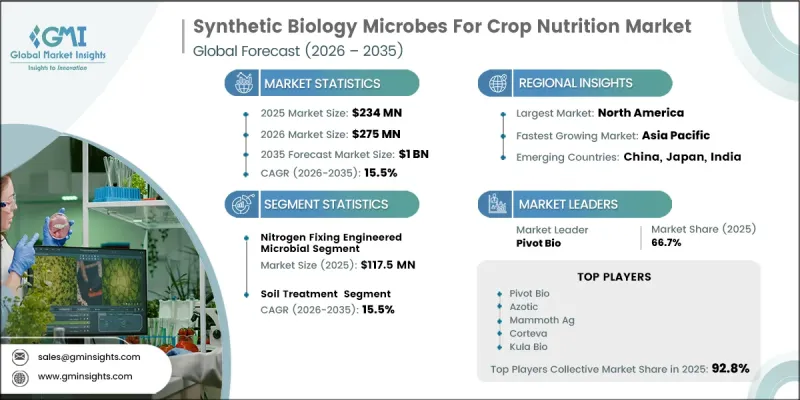
작물 영양용 합성생물학 미생물 산업의 성장은 주요 농업 지역의 긍정적인 규제 동향, 유전자 변형 미생물 기술의 상용화 진전, 그리고 기존 비료 가격의 지속적인 변동으로 인한 농업 투입재의 경제성 변화에 힘입어 이루어지고 있습니다. 경제적 이익 외에도, 농업 가치사슬 전반에 걸쳐 설정된 지속가능성 목표를 통해 환경 성과 목표를 뒷받침하는 동시에, 비료 의존도를 낮추는 기술의 도입이 촉진되고 있습니다. 이러한 추세에 따라 더 폭넓은 농업 이해관계자들 사이에서 수요가 발생하고 있으며, 당초 비용을 중시하던 도입자층을 넘어 시장 기회가 확대되고 있습니다. 그 기세는 강력하지만, 다양한 환경 및 토양 조건에서 미생물의 성능 일관성에 관해서는 여전히 기술적 과제가 남아 있습니다. 또한, 첨단 유전자 변형 기술을 활용해 개발된 제품은 상업적 농업 용도로 도입되기 전에 규제 당국의 승인 요건을 충족해야 합니다. 혁신이 계속해서 가속화되는 가운데, 작물 영양용 합성생물학 미생물 시장은 전 세계의 지속 가능한 작물 생산 시스템에서 점점 더 중요한 위치를 차지할 것으로 예측됩니다.
| 시장 범위 | |
|---|---|
| 시작 연도 | 2025 |
| 예측 기간 | 2026-2035년 |
| 시작 연도 시장 규모 | 2억 3,400만 달러 |
| 예측 금액 | 10억 달러 |
| CAGR | 15.5% |
질소 고정용 유전자 변형 미생물 부문은 2025년에 1억 1,750만 달러의 매출을 기록하며 시장 점유율 50.2%를 차지했습니다. 향후 연평균 성장률(CAGR) 16.5%로 성장하여 2035년까지 5억 4,110만 달러에 달할 것으로 전망됩니다. 이 부문의 상업적 매력은 첨단 미생물 공학적 기법을 통해 생물학적 질소 이용 가능성을 높이는 능력에서 비롯됩니다. 이러한 기술은 보다 광범위한 농업 조건에서 질소 고정 활성을 유지하도록 설계되어, 생산자에게 대체적인 영양 관리 솔루션을 제공하는 동시에, 비료 이용 효율 및 작물의 종합적인 생산성 향상을 위한 노력을 지원합니다.
용도별로는 2025년에 토양 처리 부문이 1억 1,700만 달러를 차지했습니다. 이러한 성장은 미생물 제제를 뿌리의 생장 영역에 직접 투여하는 방식이 널리 채택되고 있는 데 힘입은 것입니다. 이를 통해 신속한 정착과 성장 과정에 있는 식물 시스템과의 상호작용이 가능해집니다. 이 시비 방법은 현대 농업 기계 및 정밀 농업의 실천과 효과적으로 조화를 이루고 있어, 생산자는 큰 운영상의 조정 없이도 생물학적 작물 영양 기술을 기존의 밭 관리 프로그램에 통합할 수 있습니다.
북미의 작물 영양용 합성생물학 미생물 시장은 2025년에 1억 4,300만 달러 규모에 달하며, 시장 점유율의 61.1%를 차지했습니다. 시장 확대는 명확한 규제 환경, 농업 생명공학에 대한 투자 증가, 그리고 생물학적 영양 관리 솔루션이 가져다주는 양호한 경제적 수익에 힘입어 이루어지고 있습니다. 상업적 도입의 진전, 선진적인 농업 기법, 그리고 지속 가능한 작물 생산 방식에 대한 관심의 고조가 이 지역의 선도적 지위를 더욱 공고히 하고, 장기적인 시장 발전을 위한 유리한 여건을 지속적으로 조성하고 있습니다.
자주 묻는 질문
목차
제1장 조사 방법과 범위
제2장 주요 요약
제3장 업계 인사이트
제4장 경쟁 구도
제5장 시장 추산 및 예측 : 제품 유형별, 2022-2035년
제6장 시장 추산 및 예측 : 용도별, 2022-2035년
제7장 시장 추산 및 예측 : 최종 사용 산업별, 2022-2035년
제8장 시장 추산 및 예측 : 지역별, 2022-2035년
제9장 기업 개요
JHS 26.07.01The Global Synthetic Biology Microbes for Crop Nutrition Market was valued at USD 234 million in 2025 and is estimated to grow at a CAGR of 15.5% to reach USD 1 billion by 2035.
Growth across the synthetic biology microbes for crop nutrition industry is being supported by favorable regulatory developments in key agricultural regions, increasing commercialization of engineered microbial technologies, and changing farm input economics influenced by ongoing volatility in conventional fertilizer costs. In addition to economic benefits, sustainability targets established throughout agricultural value chains are encouraging the adoption of technologies that help reduce fertilizer dependency while supporting environmental performance goals. These trends are creating demand from a broader range of agricultural stakeholders and expanding market opportunities beyond the initial group of cost-focused adopters. Despite strong momentum, technical challenges remain associated with microbial performance consistency across varying environmental and soil conditions. Furthermore, products developed using advanced genetic modification techniques must satisfy regulatory approval requirements before being introduced for commercial agricultural use. As innovation continues to accelerate, the synthetic biology microbes for crop nutrition market is expected to gain increasing importance within sustainable crop production systems worldwide.
| Market Scope | |
|---|---|
| Start Year | 2025 |
| Forecast Year | 2026-2035 |
| Start Value | $234 Million |
| Forecast Value | $1 Billion |
| CAGR | 15.5% |
The nitrogen-fixing engineered microbes segment generated USD 117.5 million in 2025, accounting for a 50.2% share, and is projected to reach USD 541.1 million by 2035 while advancing at a CAGR of 16.5%. The commercial attractiveness of this segment is linked to its ability to enhance biological nitrogen availability through advanced microbial engineering approaches. These technologies are designed to maintain nitrogen fixation activity under a wider range of agricultural conditions, providing growers with an alternative nutrient management solution while supporting efforts to improve fertilizer-use efficiency and overall crop productivity.
Based on the application, the soil treatment segment accounted for USD 117 million in 2025. Growth is supported by the widespread adoption of application methods that position microbial solutions directly within the root development zone, enabling rapid establishment and interaction with emerging plant systems. This delivery approach aligns effectively with modern agricultural equipment and precision farming practices, allowing growers to incorporate biological crop nutrition technologies into existing field management programs without major operational adjustments.
North America Synthetic Biology Microbes for Crop Nutrition Market generated USD 143 million in 2025, accounting for 61.1% share. Market expansion is supported by a well-defined regulatory environment, increasing investment in agricultural biotechnology, and favorable economic returns associated with biological nutrient management solutions. Strong commercial adoption, advanced farming practices, and growing interest in sustainable crop production methods continue to reinforce the region's leadership position and create favorable conditions for long-term market development.
Key companies operating in the Global Synthetic Biology Microbes for Crop Nutrition Market include Corteva Agriscience, Kula Bio, Pivot Bio, Mammoth Ag, and Azotic Technologies. Companies participating in the synthetic biology microbes for crop nutrition industry focus on research and development, product commercialization, strategic collaborations, and geographic expansion to strengthen their market position. Significant investments are being directed toward enhancing microbial performance, improving nutrient delivery efficiency, and increasing product consistency under diverse agricultural conditions. Industry participants are also establishing partnerships with agricultural distributors, crop input suppliers, and farming organizations to accelerate market penetration and broaden customer reach. Regulatory engagement and compliance initiatives remain a priority as companies work to secure approvals for advanced biological products. In addition, firms are expanding demonstration programs, field validation activities, and grower education efforts to increase technology adoption. These strategies collectively support brand differentiation, strengthen competitive positioning, and create long-term growth opportunities within the evolving agricultural biotechnology landscape.
Table of Contents
Chapter 1 Methodology & Scope
- 1.1 Research approach
- 1.2 Quality Commitments
- 1.2.1 GMI AI policy & data integrity commitment
- 1.2.1.1 Source consistency protocol
- 1.2.1 GMI AI policy & data integrity commitment
- 1.3 Research Trail & Confidence Scoring
- 1.3.1 Research Trail Components
- 1.3.2 Scoring Components
- 1.4 Data Collection
- 1.4.1 Partial list of primary sources
- 1.5 Data mining sources
- 1.5.1 Paid sources
- 1.5.1.1 Sources, by region
- 1.5.1 Paid sources
- 1.6 Base estimates and calculations
- 1.6.1 Base year calculation for any one approach
- 1.7 Forecast model
- 1.7.1 Quantified market impact analysis
- 1.7.1.1 Mathematical impact of growth parameters on forecast
- 1.7.1 Quantified market impact analysis
- 1.8 Research transparency addendum
- 1.8.1 Source attribution framework
- 1.8.2 Quality assurance metrics
- 1.8.3 Our commitment to trust
Chapter 2 Executive Summary
- 2.1 Industry 360° synopsis
- 2.2 Key market trends
- 2.2.1 Regional
- 2.2.2 By Microbial Type
- 2.2.3 By Application
- 2.2.4 By Crop Type
- 2.3 TAM Analysis, 2026 2035
- 2.4 CXO perspectives: Strategic imperatives
Chapter 3 Industry Insights
- 3.1 Industry ecosystem analysis
- 3.1.1 Supplier landscape
- 3.1.2 Profit margin
- 3.1.3 Value addition at each stage
- 3.1.4 Factor affecting the value chain
- 3.1.5 Disruptions
- 3.2 Industry impact forces
- 3.2.1 Growth drivers
- 3.2.2 Industry pitfalls and challenges
- 3.2.3 Market opportunities
- 3.3 Growth potential analysis
- 3.4 Regulatory landscape
- 3.4.1 North America
- 3.4.2 Europe
- 3.4.3 Asia Pacific
- 3.4.4 Latin America
- 3.4.5 Middle East & Africa
- 3.5 Porter's analysis
- 3.6 PESTEL analysis
- 3.7 Price trends
- 3.7.1 By region
- 3.7.2 By product type
- 3.8 Future market trends
- 3.9 Technology and Innovation landscape
- 3.9.1 Current technological trends
- 3.9.2 Emerging technologies
- 3.10 Patent Landscape
- 3.11 Trade statistics (HS code)
- 3.11.1 Major importing countries
- 3.11.2 Major exporting countries
- 3.12 Sustainability and environmental aspects
- 3.12.1 Sustainable practices
- 3.12.2 Waste reduction strategies
- 3.12.3 Energy efficiency in production
- 3.12.4 Eco friendly initiatives
Chapter 4 Competitive Landscape, 2025
- 4.1 Introduction
- 4.2 Company market share analysis
- 4.2.1 By region
- 4.2.1.1 North America
- 4.2.1.2 Europe
- 4.2.1.3 Asia Pacific
- 4.2.1.4 LATAM
- 4.2.1.5 MEA
- 4.2.1 By region
- 4.3 Company matrix analysis
- 4.4 Competitive analysis of major market players
- 4.5 Competitive positioning matrix
- 4.6 Key developments
- 4.6.1 Mergers & acquisitions
- 4.6.2 Partnerships & collaborations
- 4.6.3 New Product Launches
- 4.6.4 Expansion Plans
Chapter 5 Market Estimates and Forecast, By Product Type, 2022 to 2035 (USD Million) (Tons)
- 5.1 Key trends
- 5.2 Nitrogen Fixing Microbes
- 5.2.1 Rhizobium (Symbiotic)
- 5.2.2 Azotobacter (Non Symbiotic)
- 5.2.3 Azospirillum
- 5.2.4 Engineered Nitrogen Fixers
- 5.2.5 Other Nitrogen Fixing Bacteria
- 5.3 Phosphate Solubilizing Microbes
- 5.3.1 Phosphate Solubilizing Bacteria (PSB)
- 5.3.2 Mycorrhizal Fungi (AMF & ECM)
- 5.4 Potassium & Micronutrient Mobilizing Microbes
- 5.4.1 Iron Mobilizing Bacteria
- 5.4.2 Zinc Solubilizing Microbes
- 5.4.3 Potassium Solubilizing Bacteria
- 5.5 Synthetic Microbial Communities (SynComs)
- 5.5.1 Dual Organism Blends
- 5.5.2 Multi Strain Consortia
- 5.5.3 Adaptive Intelligent Consortia
- 5.6 Others
- 5.6.1 Phytohormone Producing Microbes
- 5.6.2 Stress Tolerance Enhancers
- 5.6.3 Novel Engineered Strains
Chapter 6 Market Estimates and Forecast, By Application, 2022 to 2035 (USD Million) (Tons)
- 6.1 Key trends
- 6.2 Seed Treatment
- 6.3 Soil Treatment
- 6.4 Foliar Application
Chapter 7 Market Estimates and Forecast, By End User Industry, 2022 to 2035 (USD Million) (Tons)
- 7.1 Key trends
- 7.2 Cereals & Grains
- 7.2.1 Corn/Maize
- 7.2.2 Wheat
- 7.2.3 Rice
- 7.2.4 Barley, Sorghum, Oats, Millet
- 7.3 Oilseeds & Pulses
- 7.3.1 Soybeans
- 7.3.2 Peanuts
- 7.3.3 Canola/Rapeseed, Sunflower
- 7.3.4 Chickpeas, Lentils
- 7.4 Fruits & Vegetables
- 7.4.1 Fruits (Strawberries, Tree Fruits, Others)
- 7.4.2 Vegetables (Tomatoes, Leafy Greens, Cucurbits, Others)
- 7.5 Cash Crops & Others
- 7.5.1 Cotton
- 7.5.2 Sugarcane
- 7.5.3 Plantation Crops (Coffee, Tea, Palm, Rubber)
- 7.5.4 Turf & Ornamentals
Chapter 8 Market Estimates and Forecast, By Region, 2022 to 2035 (USD Million) (Tons)
- 8.1 Key trends
- 8.2 North America
- 8.2.1 U.S.
- 8.2.2 Canada
- 8.3 Europe
- 8.3.1 Germany
- 8.3.2 UK
- 8.3.3 France
- 8.3.4 Spain
- 8.3.5 Italy
- 8.3.6 Rest of Europe
- 8.4 Asia Pacific
- 8.4.1 China
- 8.4.2 India
- 8.4.3 Japan
- 8.4.4 Australia
- 8.4.5 South Korea
- 8.4.6 Rest of Asia Pacific
- 8.5 Latin America
- 8.5.1 Brazil
- 8.5.2 Mexico
- 8.5.3 Argentina
- 8.5.4 Rest of Latin America
- 8.6 Middle East and Africa
- 8.6.1 Saudi Arabia
- 8.6.2 South Africa
- 8.6.3 UAE
- 8.6.4 Rest of Middle East and Africa
Chapter 9 Company Profiles
- 9.1 Pivot Bio
- 9.2 Azotic
- 9.3 Mammoth Ag
- 9.4 Corteva
- 9.5 Kula Bio
- 9.6 Novonesis
- 9.7 BASF SE
- 9.8 Synthia Bio
- 9.9 Jord BioScience
- 9.10 Switch Bioworks


