

|
시장보고서
상품코드
2061400
지혈대 시스템 시장 기회, 성장요인, 업계 동향 분석 및 예측(2026-2035년)Tourniquet Systems Market Opportunity, Growth Drivers, Industry Trend Analysis, and Forecast 2026 - 2035 |
||||||

세계의 지혈대 시스템 시장은 2025년에 5억 4,970만 달러로 평가되고 CAGR 8.2%로 성장하며, 2035년까지 12억 달러에 달할 것으로 예측됩니다.
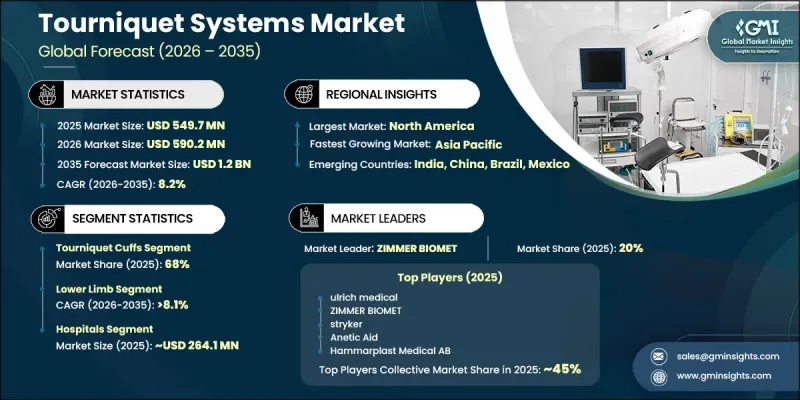
외과수술 및 응급 처치에서 효과적인 혈류 관리에 대한 수요가 증가함에 따라 전 세계 시장의 성장이 계속해서 촉진되고 있습니다. 외상, 응급 수술, 정형외과수술 사례의 증가가 의료 시설 전반에 걸쳐 첨단 지혈대 시스템의 도입 확대에 크게 기여하고 있습니다. 지혈대 시스템은 수술이나 응급 처치시 사지에 조절된 압력을 가해 일시적으로 혈액 순환을 제한하도록 설계되었습니다. 신속한 출혈 통제에 대한 인식이 높아지고 외상 치료 인프라가 발전함에 따라 병원, 외래 진료 센터, 군 의료 부대, 응급 대응 서비스 분야에서 제품에 대한 수요가 더욱 가속화되고 있습니다. 근골격계 질환 및 노화에 따른 정형외과적 질환의 발생률 증가로 인해 전 세계에서 재건 수술 및 인공관절 치환술 건수가 늘어나고 있으며, 이에 따라 신뢰성 높은 지혈대 솔루션에 대한 수요가 높아지고 있습니다. 또한 수술 기기의 지속적인 혁신, 의료 투자 증가, 그리고 환자 안전에 대한 관심 고조로 인해 의료진은 수술의 정확도를 높이고, 출혈을 최소화하며, 시술 중 업무 효율을 높이는 기술적으로 진보된 지혈대 시스템의 도입을 촉진하고 있습니다.
| 시장 범위 | |
|---|---|
| 시작연도 | 2025년 |
| 예측 기간 | 2026-2035년 |
| 개시 금액 | 5억 4,970만 달러 |
| 예측액 | 12억 달러 |
| CAGR | 8.2% |
지혈대 커프 시장 부문은 의료 시술 중 일관되고 제어된 압력을 공급하는 데 필수적인 역할을 수행하고 있으며, 2025년에는 68%의 시장 점유율을 차지했습니다. 이러한 커프는 다양한 임상적 요구 사항과 환자의 해부학적 구조에 맞춰 여러 가지 구성, 크기, 재질로 제공되므로, 외과수술 현장에서 계속해서 널리 사용되고 있습니다. 압력 균일성 향상, 환자의 편안함 증진, 조직 관련 합병증 감소 등 커프 기술의 발전은 의료 현장 전반에 걸친 도입을 더욱 촉진하고 있습니다. 또한 수술의 정밀도와 환자의 안전성이 점점 더 중요시되고 있는 점도 기술적으로 개선된 커프 시스템에 대한 수요 증가에 기여하고 있습니다.
2025년, 병원 부문 시장 규모는 2억 6,410만 달러에 달했습니다. 첨단 수술 시설에서 시행되는 정형외과, 외상, 혈관, 재건 수술 건수가 증가하고 있으며, 병원은 여전히 지혈대 시스템의 최대 사용처로 자리 잡고 있습니다. 숙련된 의료진의 존재, 현대적인 수술 인프라, 그리고 첨단 수술 기술의 통합이 진행되고 있는 점이 병원 환경에서의 제품 활용을 강화하고 있습니다. 수술 워크플로우의 효율화와 수술 중 합병증 감소를 위한 노력의 강화 역시 이 부문의 장기적인 시장 성장을 지원하고 있습니다.
북미의 지혈대 시스템 시장은 2025년에 39.3%의 점유율을 차지하며, 예측 기간 중 상당한 성장이 전망됩니다. 이 지역 시장은 외상 관련 환자 수의 증가, 수술 건수의 증가, 그리고 첨단 혈액 관리 기술에 대한 강력한 수요에 힘입어 성장하고 있습니다. 고도로 발달한 의료 인프라, 혁신적인 수술 기기의 급속한 도입, 그리고 유서 깊은 의료 기술 기업의 강력한 존재감이 지역 전체의 시장 확대를 지속적으로 지원하고 있습니다. 의료진은 시술 결과 개선, 수술 효율 향상, 그리고 수술 중 위험 감소에 점점 더 주력하고 있으며, 이는 임상 분야 전반에 걸쳐 지혈대 시스템의 광범위한 도입을 더욱 촉진하고 있습니다.
자주 묻는 질문
목차
제1장 조사 방법
제2장 개요
제3장 업계 인사이트
제4장 경쟁 구도
제5장 시장 추산·예측 : 컴포넌트별, 2022-2035년
제6장 시장 추산·예측 : 용도별, 2022-2035년
제7장 시장 추산·예측 : 최종 사용별, 2022-2035년
제8장 시장 추산·예측 : 지역별, 2022-2035년
제9장 기업 개요
KSA 26.06.24The Global Tourniquet Systems Market was valued at USD 549.7 million in 2025 and is estimated to grow at a CAGR of 8.2% to reach USD 1.2 billion by 2035.
Rising demand for effective blood flow management during surgical and emergency procedures continues to support market expansion worldwide. Increasing cases of traumatic injuries, emergency surgeries, and orthopedic procedures are significantly contributing to the growing adoption of advanced tourniquet systems across healthcare facilities. A tourniquet system is designed to apply controlled pressure to an extremity to temporarily restrict blood circulation during surgeries or emergency treatment procedures. Growing awareness regarding rapid hemorrhage control and advancements in trauma care infrastructure are further accelerating product demand across hospitals, ambulatory care centers, military medical units, and emergency response services. The increasing incidence of musculoskeletal conditions and age-related orthopedic disorders has also elevated the number of reconstructive and joint replacement surgeries globally, strengthening the need for reliable tourniquet solutions. In addition, continuous innovation in surgical equipment, rising healthcare investments, and increasing focus on patient safety are encouraging healthcare providers to adopt technologically advanced tourniquet systems that improve surgical precision, minimize blood loss, and enhance operational efficiency during procedures.
| Market Scope | |
|---|---|
| Start Year | 2025 |
| Forecast Year | 2026-2035 |
| Start Value | $549.7 Million |
| Forecast Value | $1.2 Billion |
| CAGR | 8.2% |
The tourniquet cuffs segment held a share of 68% in 2025 due to its essential role in delivering consistent and controlled pressure during medical procedures. These cuffs remain widely used across surgical settings because they are available in multiple configurations, sizes, and material compositions to suit varying clinical requirements and patient anatomies. Advancements in cuff engineering, including improved pressure uniformity, enhanced patient comfort, and reduced tissue-related complications, have further supported strong adoption across healthcare environments. The growing emphasis on surgical accuracy and patient safety is also contributing to increased demand for technologically improved cuff systems.
The hospitals segment generated USD 264.1 million in 2025. Hospitals continue to account for the highest usage of tourniquet systems due to rising volumes of orthopedic, trauma, vascular, and reconstructive surgeries performed within advanced surgical facilities. The presence of skilled healthcare professionals, modern operating infrastructure, and growing integration of advanced surgical technologies has strengthened product utilization in hospital settings. Increasing efforts to improve surgical workflow efficiency and reduce intraoperative complications are also supporting long-term market growth in this segment.
North America Tourniquet Systems Market accounted for 39.3% share in 2025 and is expected to witness notable growth throughout the forecast period. The regional market is supported by a high volume of trauma-related cases, increasing surgical procedures, and strong demand for advanced blood management technologies. A highly developed healthcare infrastructure, rapid adoption of innovative surgical devices, and strong presence of established medical technology companies continue to reinforce market expansion across the region. Healthcare providers are increasingly focusing on improving procedural outcomes, enhancing surgical efficiency, and reducing operative risks, which is further encouraging widespread deployment of tourniquet systems across clinical applications.
Key companies operating in the Tourniquet Systems Market include Anetic Aid, ATMOS Medizintechnik, CAT Resources, LLC, Delfi, DESSILLIONS & DUTRILLAUX, Hammarplast Medical AB, OHK Medical Devices, REVMED X, Rudolf Riester GmbH, SAM MEDICAL, Stryker, TACMED Solutions, Teleflex Incorporated, ulrich medical, VBM Medizintechnik GmbH, and ZIMMER BIOMET. Companies participating in the global tourniquet systems market are focusing on multiple strategic initiatives to strengthen their competitive position and expand market reach. Manufacturers are heavily investing in product innovation to develop advanced tourniquet systems with improved pressure control, enhanced safety features, and greater patient comfort. Many companies are also emphasizing lightweight and portable designs to support emergency care, military applications, and ambulatory surgical settings. Strategic collaborations with hospitals, surgical centers, and healthcare distributors are helping businesses improve product accessibility and strengthen customer relationships. In addition, organizations are increasing investments in research and development to integrate digital monitoring technologies and automated pressure management systems into their product portfolios.
Table of Contents
Chapter 1 Research Methodology
- 1.1 Research approach
- 1.2 Quality commitments
- 1.2.1 GMI AI policy & data integrity commitment
- 1.2.1.1 Source consistency protocol
- 1.2.1 GMI AI policy & data integrity commitment
- 1.3 Research trail & confidence scoring
- 1.3.1 Research trail components
- 1.3.2 Scoring components
- 1.4 Data collection
- 1.4.1 Partial list of primary sources
- 1.5 Data mining sources
- 1.5.1 Paid sources
- 1.5.1.1 Sources, by region
- 1.5.1 Paid sources
- 1.6 Base estimates and calculations
- 1.6.1 Base year calculation
- 1.7 Forecast model
- 1.7.1 Quantified market impact analysis
- 1.7.1.1 Mathematical impact of growth parameters on forecast
- 1.7.1 Quantified market impact analysis
- 1.8 Research transparency addendum
- 1.8.1 Source attribution framework
- 1.8.2 Quality assurance metrics
- 1.8.3 Our commitment to trust
Chapter 2 Executive Summary
- 2.1 Industry 360° synopsis
- 2.2 Key market trends
- 2.2.1 Regional trends
- 2.2.2 Component trends
- 2.2.3 Application trends
- 2.2.4 End use trends
- 2.3 CXO perspectives: Strategic imperatives
Chapter 3 Industry Insights
- 3.1 Industry ecosystem analysis
- 3.2 Industry impact forces
- 3.2.1 Growth drivers
- 3.2.1.1 Increasing number of trauma and accident cases.
- 3.2.1.2 Rising number of joint replacement surgeries.
- 3.2.1.3 Increasing prevalence of degenerative bone disorders and musculoskeletal diseases among adult population.
- 3.2.1.4 Rising awareness of blood loss management.
- 3.2.1.5 Technological advancements in tourniquet systems.
- 3.2.2 Industry pitfalls and challenges
- 3.2.2.1 Dearth of skilled professionals.
- 3.2.2.2 Transmission of infectious diseases associated with increasing use of reusable cuffs.
- 3.2.3 Opportunities
- 3.2.3.1 Development of smart tourniquets with real-time pressure monitoring
- 3.2.3.2 Integration of AI and IoT for automated pressure control systems
- 3.2.1 Growth drivers
- 3.3 Growth potential analysis
- 3.4 Regulatory landscape
- 3.5 Pricing trend analysis
- 3.6 Technology and innovation landscape (Driven by Primary Research)
- 3.6.1 Current technological trends
- 3.6.2 Emerging technologies
- 3.7 Future market trends (Driven by Primary Research)
- 3.8 Patent analysis
- 3.9 Impact of AI & Generative AI on the Market (Driven by Primary Research)
- 3.10 Porter's analysis
- 3.11 PESTEL analysis
Chapter 4 Competitive Landscape, 2025
- 4.1 Introduction
- 4.2 Company matrix analysis
- 4.3 Company market share analysis (Driven by Primary Research)
- 4.3.1 Global
- 4.3.2 North America
- 4.3.3 Europe
- 4.3.4 Asia Pacific
- 4.3.5 LAMEA
- 4.4 Competitive analysis of major market players
- 4.5 Competitive positioning matrix
- 4.6 Key developments
- 4.6.1 Mergers & acquisitions
- 4.6.2 Partnerships & collaborations
- 4.6.3 New product launches
- 4.6.4 Expansion plans
Chapter 5 Market Estimates and Forecast, By Component, 2022 - 2035 ($ Mn)
- 5.1 Key trends
- 5.2 Tourniquet instruments
- 5.3 Tourniquet cuffs
- 5.3.1 Pneumatic
- 5.3.1.1 Disposable
- 5.3.1.2 Reusable
- 5.3.2 Non-pneumatic
- 5.3.1 Pneumatic
Chapter 6 Market Estimates and Forecast, By Application, 2022 - 2035 ($ Mn)
- 6.1 Key trends
- 6.2 Upper limb
- 6.3 Lower limb
Chapter 7 Market Estimates and Forecast, By End Use, 2022 - 2035 ($ Mn)
- 7.1 Key trends
- 7.2 Hospitals
- 7.3 Ambulatory surgical centers
- 7.4 Other end users
Chapter 8 Market Estimates and Forecast, By Region, 2022 - 2035 ($ Mn)
- 8.1 Key trends
- 8.2 North America
- 8.2.1 U.S.
- 8.2.2 Canada
- 8.3 Europe
- 8.3.1 Germany
- 8.3.2 UK
- 8.3.3 France
- 8.3.4 Spain
- 8.3.5 Italy
- 8.3.6 Netherlands
- 8.4 Asia Pacific
- 8.4.1 China
- 8.4.2 Japan
- 8.4.3 India
- 8.4.4 Australia
- 8.4.5 South Korea
- 8.5 Latin America
- 8.5.1 Brazil
- 8.5.2 Mexico
- 8.5.3 Argentina
- 8.6 MEA
- 8.6.1 South Africa
- 8.6.2 Saudi Arabia
- 8.6.3 UAE
Chapter 9 Company Profiles
- 9.1 Anetic Aid
- 9.2 ATMOS Medizintechnik
- 9.3 CAT Resources, LLC
- 9.4 Delfi
- 9.5 DESSILLIONS & DUTRILLAUX
- 9.6 Hammarplast Medical AB
- 9.7 OHK Medical Devices
- 9.8 REVMED X
- 9.9 Rudolf Riester GmbH
- 9.10 SAM MEDICAL
- 9.11 stryker
- 9.12 TACMED Solutions
- 9.13 Teleflex Incorporated
- 9.14 ulrich medical
- 9.15 VBM Medizintechnik GmbH
- 9.16 ZIMMER BIOMET


