

|
시장보고서
상품코드
2061491
작물 보호용 화학제품 시장 기회, 성장 촉진요인, 업계 동향 분석, 예측(2026-2035년)Crop Protection Chemicals Market Opportunity, Growth Drivers, Industry Trend Analysis, and Forecast 2026 - 2035 |
||||||

세계의 작물 보호용 화학제품 시장은 2025년에 993억 달러로 평가되고 CAGR 4.2%로 성장하며, 2035년까지 1,498억 달러에 달할 것으로 추정되고 있습니다.
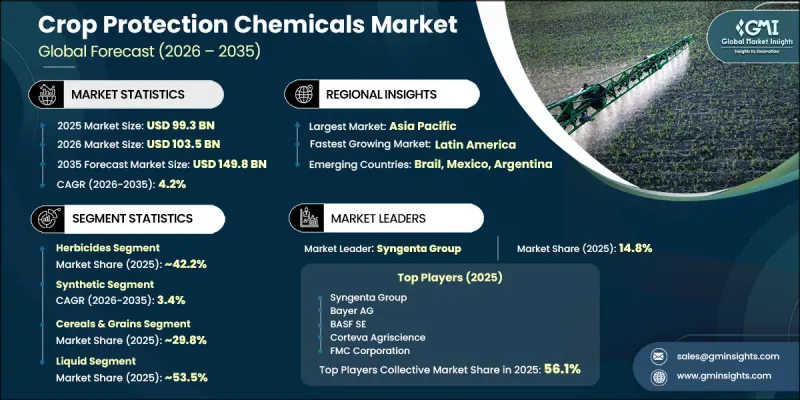
세계 농업 분야에서 수확량 보호, 식량안보, 그리고 지속가능한 농업 실천이 점점 더 중요시됨에 따라 해당 시장은 꾸준히 성장하고 있습니다. 농가와 농업 관련 기업은 다양한 기후 조건에서도 생산성을 유지하면서 해충, 잡초, 병해로 인한 손실을 줄이기 위해 첨단 작물 보호 솔루션을 점차 도입하고 있습니다. 정밀농업으로의 전환에 따라 효율성을 높이고 화학 약품의 낭비를 줄이는 표적형 살포 방식에 대한 수요가 증가하고 있습니다. 동시에, 환경에 미치는 영향에 대한 인식이 높아짐에 따라 친환경 제제 및 저독성 솔루션의 개발이 가속화되고 있습니다. 주요 경제권에서 규제가 지속적으로 강화됨에 따라 제조사들은 더욱 안전하고 규정을 준수하는 제품을 개발하도록 촉진되고 있습니다. 나노테크놀러지을 활용한 솔루션과 생물학적 대체물을 포함한 제제 과학의 기술적 진보는 제품 개발 전략을 더욱 혁신하고 있습니다. 세계 식량 수요의 증가와 경작지 감소가 맞물리면서, 현대 농업에서 중요한 투입 자재로서 효과적인 작물 보호 시스템의 중요성이 더욱 커지고 있습니다.
| 시장 범위 | |
|---|---|
| 시작연도 | 2025 |
| 예측 기간 | 2026-2035년 |
| 개시 금액 | 993억 달러 |
| 예측액 | 1,498억 달러 |
| CAGR | 4.2% |
제초제 부문은 2025년에 42.2%의 시장 점유율을 차지하며, 2035년까지 연평균 성장률(CAGR) 3.5%로 성장할 것으로 전망됩니다. 잡초 관리는 농업 생산에서 여전히 주요 과제로 남아 있으며, 작물의 건전성을 유지하면서 불필요한 식물을 제거하기 위해 선택성이 있는 제제가 널리 사용되고 있습니다. 살균제 솔루션은 주요 작물의 곰팡이병 방제에 있으며, 필수적인 역할을 수행하며, 더 건전한 수확량 확보와 수확 후 손실 감소를 지원하고 있습니다. 유기인계, 피레스로이드계, 네오니코티노이드계를 포함한 살충제는 규제 체계의 변화가 사용량상에 영향을 미치고 있음에도 불구하고 여전히 농업 시스템 전반에 걸쳐 널리 사용되고 있습니다. 선충 구제제의 수요는 서서히 증가하고 있으며, 특히 고부가가치 농업 분야에서 토양의 건전성을 보호하는 데서 그 증가세가 두드러집니다.
합성 작물 보호용 화학제품 부문은 2025년에 80.5%의 시장 점유율을 차지하며, 2026-2035년 연평균 성장률(CAGR) 3.4%로 성장할 것으로 전망됩니다. 이러한 우위는 높은 효능, 비용 효율성, 사용 편의성, 그리고 주요 산업 지역에 구축된 생산 인프라에 의해 지원되고 있습니다. 그러나 농업 시스템이 유기적이고 지속가능한 생산 모델로 전환됨에 따라 특히 규제가 엄격하고 잔류물이 없는 식품을 선호하는 소비자가 늘고 있는 지역에서, 생물 유래 및 천연 유래 대체재들이 주목을 받고 있습니다.
북미의 작물 보호용 화학제품 시장은 2025년에 21.8%의 점유율을 기록했습니다. 이 지역은 높은 기술 도입률, 엄격한 규제 체계, 그리고 친환경 농자재에 대한 수요 증가가 특징입니다. 유기농 식품이나 잔류물이 적은 식품에 대한 소비자의 수요가 증가함에 따라 통합 해충 관리(IPM)가 널리 시행되고 있습니다. 정밀 살포 시스템이나 무인 항공기를 이용한 살포 방법 등, 살포 기술의 혁신이 해당 지역의 시장 발전을 더욱 지원하고 있습니다. 제품 안전성과 환경 규정 준수에 대한 규제 당국의 중점은 계속해서 제형 및 채택 동향을 주도하고 있습니다.
자주 묻는 질문
목차
제1장 조사 방법과 범위
제2장 개요
제3장 업계 인사이트
제4장 경쟁 구도
제5장 시장 추산·예측 : 제품 유형별, 2022-2035년
제6장 시장 추산·예측 : 소스별, 2022-2035년
제7장 시장 추산·예측 : 작물 유형별, 2022-2035년
제8장 시장 추산·예측 : 폼별, 2022-2035년
제9장 시장 추산·예측 : 시용 방법별, 2022-2035년
제10장 시장 추산·예측 : 지역별, 2022-2035년
제11장 기업 개요
KSA 26.06.24The Global Crop Protection Chemicals Market was valued at USD 99.3 billion in 2025 and is estimated to grow at a CAGR of 4.2% to reach USD 149.8 billion by 2035.
The market is experiencing steady expansion as global agriculture increasingly prioritizes yield protection, food security, and sustainable farming practices. Farmers and agribusinesses are progressively adopting advanced crop protection solutions to reduce losses caused by pests, weeds, and diseases while maintaining productivity across diverse climatic conditions. The shift toward precision agriculture is strengthening demand for targeted application methods that improve efficiency and reduce chemical wastage. At the same time, rising awareness regarding environmental impact is accelerating the development of eco-friendly formulations and reduced-toxicity solutions. Continuous regulatory tightening across major economies is pushing manufacturers toward safer and more compliant products. Technological progress in formulation science, including nano-enabled solutions and biological alternatives, is further reshaping product development strategies. Growing global food demand, coupled with shrinking arable land, is reinforcing the importance of effective crop protection systems as a critical input in modern agriculture.
| Market Scope | |
|---|---|
| Start Year | 2025 |
| Forecast Year | 2026-2035 |
| Start Value | $99.3 Billion |
| Forecast Value | $149.8 Billion |
| CAGR | 4.2% |
The herbicides segment accounted for 42.2% share in 2025 and is projected to grow at a CAGR of 3.5% through 2035. Weed management continues to be a primary concern in agricultural production, and selective formulations are widely used to eliminate unwanted vegetation while preserving crop integrity. Fungicide solutions play an essential role in controlling fungal infections across key crops, supporting healthier yields and reduced post-harvest losses. Insect control products, including organophosphates, pyrethroids, and neonicotinoids, remain widely applied across farming systems, although evolving regulatory frameworks are influencing usage patterns. Demand for nematicides is gradually increasing, particularly for protecting soil health in high-value agricultural segments.
The synthetic crop protection chemicals segment held a share of 80.5% in 2025 and is expected to grow at a CAGR of 3.4% from 2026 to 2035. Their dominance is supported by strong efficacy, cost efficiency, ease of application, and well-established production infrastructure across major industrial regions. However, biological and naturally derived alternatives are gaining traction as agricultural systems shift toward organic and sustainable production models, particularly in regions with stringent regulatory oversight and rising consumer preference for residue-free food products.
North America Crop Protection Chemicals Market held a 21.8% share in 2025. The region is characterized by high technological adoption, stringent regulatory frameworks, and increasing demand for environmentally responsible agricultural inputs. Integrated pest management practices are widely implemented, supported by rising consumer demand for organic and low-residue food products. Innovation in application technologies, including precision spraying systems and unmanned aerial application methods, is further strengthening regional market development. Regulatory emphasis on product safety and environmental compliance continues to guide formulation and adoption trends.
Key companies operating in the Crop Protection Chemicals Market include Corteva Agriscience, Bayer AG, Syngenta Group, BASF SE, FMC Corporation, UPL Limited, Sumitomo Chemical Co., Ltd., ADAMA Ltd., Nufarm Limited, American Vanguard Corporation, Albaugh LLC, Sipcam Oxon S.p.A., Certis USA LLC, Marrone Bio Innovations, and Valent BioSciences LLC. Companies in the crop protection chemicals market are strengthening their position through sustained investment in research and development aimed at improving product efficacy while reducing environmental impact. Many players are expanding portfolios to include biological and low-toxicity solutions in response to evolving regulatory frameworks and sustainability expectations. Strategic collaborations with agricultural technology providers are enabling integration of precision farming tools and digital agriculture platforms. Firms are also focusing on advanced formulation technologies such as nano-based delivery systems to enhance performance efficiency. Geographic expansion into emerging agricultural markets is helping companies diversify revenue streams.
Table of Contents
Chapter 1 Methodology & Scope
- 1.1 Market scope and definition
- 1.2 Research design
- 1.2.1 Research approach
- 1.2.2 Data collection methods
- 1.3 Data mining sources
- 1.3.1 Global
- 1.3.2 Regional/Country
- 1.4 Base estimates and calculations
- 1.4.1 Base year calculation
- 1.4.2 Key trends for market estimation
- 1.5 Primary research and validation
- 1.5.1 Primary sources
- 1.6 Forecast model
- 1.7 Research assumptions and limitations
Chapter 2 Executive Summary
- 2.1 Industry 360° synopsis
- 2.2 Key market trends
- 2.2.1 Regional
- 2.2.2 Product type
- 2.2.3 Source
- 2.2.4 Crop type
- 2.2.5 Form
- 2.2.6 Mode of application
- 2.3 TAM Analysis, 2026-2035
- 2.4 CXO perspectives: Strategic imperatives
- 2.4.1 Executive decision points
Chapter 3 Industry Insights
- 3.1 Industry ecosystem analysis
- 3.1.1 Supplier landscape
- 3.1.2 Profit margin
- 3.1.3 Value addition at each stage
- 3.1.4 Factor affecting the value chain
- 3.1.5 Disruptions
- 3.2 Industry impact forces
- 3.2.1 Growth drivers
- 3.2.2 Industry pitfalls and challenges
- 3.2.3 Market opportunities
- 3.3 Growth potential analysis
- 3.4 Regulatory landscape
- 3.4.1 North America
- 3.4.2 Europe
- 3.4.3 Asia Pacific
- 3.4.4 Latin America
- 3.4.5 Middle East & Africa
- 3.5 Porter's analysis
- 3.6 PESTEL analysis
- 3.7 Price trends
- 3.7.1 By region
- 3.7.2 By type
- 3.8 Future market trends
- 3.9 Technology and Innovation landscape
- 3.9.1 Current technological trends
- 3.9.2 Emerging technologies
- 3.10 Patent Landscape
- 3.11 Trade statistics (HS code)
- 3.11.1 Major importing countries
- 3.11.2 Major exporting countries
- 3.12 Sustainability and environmental aspects
- 3.12.1 Sustainable practices
- 3.12.2 Waste reduction strategies
- 3.12.3 Energy efficiency in production
- 3.12.4 Eco-friendly initiatives
- 3.13 Carbon footprint consideration
Chapter 4 Competitive Landscape, 2025
- 4.1 Introduction
- 4.2 Company market share analysis
- 4.2.1 By region
- 4.2.1.1 North America
- 4.2.1.2 Europe
- 4.2.1.3 Asia Pacific
- 4.2.1.4 LATAM
- 4.2.1.5 MEA
- 4.2.1 By region
- 4.3 Company matrix analysis
- 4.4 Competitive analysis of major market players
- 4.5 Competitive positioning matrix
- 4.6 Key developments
- 4.6.1 Mergers & acquisitions
- 4.6.2 Partnerships & collaborations
- 4.6.3 New Product Launches
- 4.6.4 Expansion Plans
Chapter 5 Market Estimates and Forecast, By Product Type, 2022-2035 (USD Billion) (Kilo Tons)
- 5.1 Key trends
- 5.2 Herbicides
- 5.2.1 Selective herbicides
- 5.2.2 Non-selective herbicides
- 5.3 Fungicides
- 5.3.1 Systemic fungicides
- 5.3.2 Contact fungicides
- 5.4 Insecticides
- 5.4.1 Organophosphates
- 5.4.2 Pyrethroids
- 5.4.3 Neonicotinoids
- 5.4.4 Others
- 5.5 Nematicides
- 5.5.1 Fumigant nematicides
- 5.5.2 Non-fumigant nematicides
- 5.6 Molluscicides
- 5.7 Others
Chapter 6 Market Estimates and Forecast, By Source, 2022-2035 (USD Billion) (Kilo Tons)
- 6.1 Key trends
- 6.2 Synthetic
- 6.3 Natural/Biological
Chapter 7 Market Estimates and Forecast, By Crop Type, 2022-2035 (USD Billion) (Kilo Tons)
- 7.1 Key trends
- 7.2 Cereals & grains
- 7.2.1 Wheat
- 7.2.2 Rice
- 7.2.3 Corn/maize
- 7.2.4 Barley
- 7.2.5 Others
- 7.3 Fruits & vegetables
- 7.3.1 Fruits (citrus, apple, grapes, others)
- 7.3.2 Vegetables (tomato, potato, leafy greens, others)
- 7.4 Oilseeds & pulses
- 7.4.1 Soybean
- 7.4.2 Canola/rapeseed
- 7.4.3 Sunflower
- 7.4.4 Pulses (lentils, chickpeas, others)
- 7.5 Commercial crops
- 7.5.1 Cotton
- 7.5.2 Sugarcane
- 7.5.3 Tobacco
- 7.5.4 Others
- 7.6 Turf & ornamental
- 7.6.1 Golf courses & sports turf
- 7.6.2 Residential lawns & landscapes
- 7.6.3 Ornamental plants & nurseries
- 7.7 Others
Chapter 8 Market Estimates and Forecast, By Form, 2022-2035 (USD Billion) (Kilo Tons)
- 8.1 Key trends
- 8.2 Liquid
- 8.2.1 Emulsifiable concentrate (EC)
- 8.2.2 Suspension concentrate (SC)
- 8.2.3 Soluble liquid (SL)
- 8.3 Dry/powder
- 8.3.1 Wettable powder (WP)
- 8.3.2 Water dispersible granules (WDG)
- 8.3.3 Soluble powder (SP)
- 8.4 Granular
- 8.4.1 Dispersible granules
- 8.4.2 Controlled release granules
Chapter 9 Market Estimates and Forecast, By Mode of Application, 2022-2035 (USD Billion) (Kilo Tons)
- 9.1 Key trends
- 9.2 Foliar spray
- 9.3 Seed treatment
- 9.4 Soil treatment
- 9.5 Chemigation
- 9.6 Fumigation
- 9.7 Others
Chapter 10 Market Estimates and Forecast, By Region, 2022-2035 (USD Billion) (Kilo Tons)
- 10.1 Key trends
- 10.2 North America
- 10.2.1 U.S.
- 10.2.2 Canada
- 10.3 Europe
- 10.3.1 Germany
- 10.3.2 UK
- 10.3.3 France
- 10.3.4 Spain
- 10.3.5 Italy
- 10.3.6 Rest of Europe
- 10.4 Asia Pacific
- 10.4.1 China
- 10.4.2 India
- 10.4.3 Japan
- 10.4.4 Australia
- 10.4.5 South Korea
- 10.4.6 Rest of Asia Pacific
- 10.5 Latin America
- 10.5.1 Brazil
- 10.5.2 Mexico
- 10.5.3 Argentina
- 10.5.4 Rest of Latin America
- 10.6 Middle East and Africa
- 10.6.1 Saudi Arabia
- 10.6.2 South Africa
- 10.6.3 UAE
- 10.6.4 Rest of Middle East and Africa
Chapter 11 Company Profiles
- 11.1 BASF SE
- 11.2 ADAMA Ltd.
- 11.3 Albaugh LLC
- 11.4 American Vanguard Corporation
- 11.5 Bayer AG
- 11.6 Certis USA LLC
- 11.7 Corteva Agriscience
- 11.8 FMC Corporation
- 11.9 Marrone Bio Innovations
- 11.10 Nufarm Limited
- 11.11 Sipcam Oxon S.p.A.
- 11.12 Sumitomo Chemical Co., Ltd.
- 11.13 Syngenta Group
- 11.14 UPL Limited
- 11.15 Valent BioSciences LLC


