

|
시장보고서
상품코드
2071372
화물 포워딩 시장 기회, 성장 촉진요인, 산업 동향 분석, 예측(2026-2035년)Freight Forwarding Market Opportunity, Growth Drivers, Industry Trend Analysis, and Forecast 2026 - 2035 |
||||||

세계의 화물 포워딩 시장은 2025년에 1,662억 달러 규모에 달하고, CAGR 5.2%로 성장하여 2035년까지 2,678억 달러에 달할 것으로 추정됩니다.
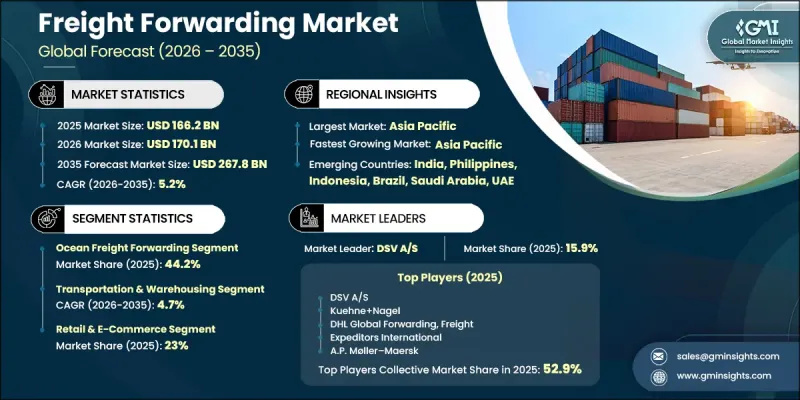
시장의 성장은 국제 무역 활동의 활성화와 세계 공급망의 복잡화에 힘입어 계속해서 뒷받침되고 있습니다. 화물 포워딩 업체는 운송 네트워크 조정, 통관 절차 관리, 운송 경로 최적화, 그리고 여러 지역에 걸친 적시 배송 확보에 있어 매우 중요한 역할을 수행하고 있습니다. 기업들이 제조 및 조달 업무를 다각화함에 따라, 세계 시장 전반에서 효율적인 물류 조정에 대한 수요가 높아지고 있습니다. 현재 진행 중인 공급망 재구축으로 인해 화물의 출발지 및 무역 패턴이 변화하고 있으며, 이는 포워딩 서비스에 대한 전반적인 수요를 감소시키지 않으면서 화물 포워딩 기업에 새로운 기회를 창출하고 있습니다. 기업들은 다자간 조달 전략과 변화하는 무역 요건을 관리할 수 있는 유연한 물류 솔루션을 점점 더 많이 요구하고 있습니다. 동시에, 변동하는 운송 비용과 연료 관련 비용은 계속해서 시장 역학에 영향을 미치고 있으며, 가격 투명성과 리스크 관리에 대한 중요성이 커지고 있습니다. 또한 디지털화는 업계를 변화시키고 있으며, 첨단 화물 관리 플랫폼은 조달 및 물류 업무에서 필수적인 요소가 되고 있습니다. 고객들이 가시성, 업무 효율성, 실시간 화물 추적을 점점 더 요구함에 따라, 기술을 활용한 화물 포워딩 대행 서비스는 전 세계 운송 네트워크 전반에서 그 중요성이 날로 커지고 있습니다.
| 시장 범위 | |
|---|---|
| 시작 연도 | 2025년 |
| 예측 기간 | 2026-2035년 |
| 시작 시점 시장 규모 | 1,662억 달러 |
| 예측액 | 2,678억 달러 |
| CAGR | 5.2% |
2025년, 운송·창고 부문은 1,034억 달러의 매출을 기록하며 전체 시장의 62.2%를 차지했습니다. 성장률은 시장 전체 평균보다 약간 낮지만, 이는 핵심 운송 업무의 부진이 아니라 고부가가치 물류 솔루션으로의 전환이 진행되고 있음을 반영한 것입니다. 각 서비스 제공업체들은 운송 관리, 보관 기능, 재고 관리, 물류 조정을 결합한 통합형 서비스 제공을 확대하고 있으며, 이를 통해 건당 출하 시 더 큰 부가가치를 창출하는 동시에 고객 관계 강화와 업무 효율 향상을 도모하고 있습니다.
중국의 화물 포워딩 시장은 2025년에 414억 달러 규모를 기록했으며, 2035년까지 711억 달러에 달할 것으로 전망됩니다. 이 시장의 성장은 해당 국가의 활발한 수출 활동, 광범위한 물류 인프라, 그리고 국제 무역 네트워크에서 차지하는 전략적 역할에 힘입어 이루어지고 있습니다. 이 지역은 제조, 조달 및 세계 유통의 주요 허브로서의 역할을 계속 수행하고 있으며, 화물 포워딩 대행 서비스에 대한 지속적인 수요를 창출하고 있습니다. 무역량 증가, 국경을 초월한 물류 수요 확대, 그리고 공급망의 복잡화 심화는 중국 전역은 물론 더 광범위한 아시아태평양 전체에서 장기적인 시장 기회를 지속적으로 뒷받침하고 있습니다.
자주 묻는 질문
목차
제1장 조사 방법과 범위
제2장 주요 요약
제3장 업계 인사이트
제4장 경쟁 구도
제5장 시장 추정 및 예측 : 운송 수단별, 2022-2035년
제6장 시장 추정 및 예측 : 서비스별, 2022-2035년
제7장 시장 추정 및 예측 : 최종사용별, 2022-2035년
제8장 시장 추정 및 예측 : 고객별, 2022-2035년
제9장 시장 추정 및 예측 : 기업 규모별, 2022-2035년
제10장 시장 추정 및 예측 : 지역별, 2022-2035년
제11장 기업 개요
KSM 26.07.03The Global Freight Forwarding Market was valued at USD 166.2 billion in 2025 and is estimated to grow at a CAGR of 5.2% to reach USD 267.8 billion by 2035.
Growth in the market continues to be supported by rising international trade activity and the increasing complexity of global supply chains. Freight forwarding providers play a critical role in coordinating transportation networks, managing customs requirements, optimizing shipping routes, and ensuring timely delivery across multiple regions. As companies diversify manufacturing and sourcing operations, demand for efficient logistics coordination is increasing across global markets. The ongoing reconfiguration of supply chains is changing shipment origins and trade patterns, creating new opportunities for freight forwarding companies without reducing overall demand for forwarding services. Businesses are increasingly seeking flexible logistics solutions capable of managing multi-country sourcing strategies and evolving trade requirements. At the same time, fluctuating transportation costs and fuel-related expenses continue to influence market dynamics, encouraging greater emphasis on pricing transparency and risk management. Digitalization is also transforming the industry, with advanced freight management platforms becoming an essential component of procurement and logistics operations. As customers demand greater visibility, operational efficiency, and real-time shipment tracking, technology-enabled freight forwarding services are becoming increasingly important across global transportation networks.
| Market Scope | |
|---|---|
| Start Year | 2025 |
| Forecast Year | 2026-2035 |
| Start Value | $166.2 Billion |
| Forecast Value | $267.8 Billion |
| CAGR | 5.2% |
The transportation and warehousing segment generated USD 103.4 billion in 2025, accounting for 62.2% share. Although growth remains slightly below the overall market average, this reflects an evolving service mix that increasingly favors higher-value logistics solutions rather than weakness in core transportation activities. Service providers are expanding integrated offerings that combine transportation management, storage capabilities, inventory control, and logistics coordination, enabling them to generate greater value per shipment while strengthening customer relationships and improving operational efficiency.
China Freight Forwarding Market accounted for USD 41.4 billion in 2025 and is expected to reach USD 71.1 billion by 2035. Market growth is supported by the country's strong export activity, extensive logistics infrastructure, and strategic role within international trade networks. The region continues to serve as a major hub for manufacturing, sourcing, and global distribution, creating sustained demand for freight forwarding services. Growing trade volumes, expanding cross-border logistics requirements, and increasing supply chain complexity continue to support long-term market opportunities throughout the country and the broader Asia Pacific region.
Key participants operating in the global freight forwarding market include DHL Global, Kuehne+Nagel International, DSV A/S, CEVA Logistics, Sinotrans, GEODIS, Expeditors International, Nippon Express, A.P. Moller - Maersk, and C.H. Robinson. Companies operating in the freight forwarding market are adopting a variety of strategic initiatives to strengthen their market position and expand their global presence. Investments in digital transformation remain a primary focus, with providers implementing advanced logistics platforms, real-time shipment visibility tools, data analytics, and automation technologies to improve service efficiency. Market participants are also expanding integrated logistics capabilities by combining transportation, warehousing, inventory management, and value-added supply chain services into comprehensive solutions. Strategic acquisitions, regional expansion initiatives, and partnerships with carriers and logistics providers are helping companies broaden their geographic reach and service offerings. In addition, businesses are prioritizing sustainability initiatives, operational optimization, and customer-centric service models to enhance competitiveness.
Table of Contents
Chapter 1 Methodology & Scope
- 1.1 Research approach
- 1.2 Quality Commitments
- 1.2.1 GMI AI policy & data integrity commitment
- 1.2.1.1 Source consistency protocol
- 1.2.1 GMI AI policy & data integrity commitment
- 1.3 Research Trail & Confidence Scoring
- 1.3.1 Research Trail Components
- 1.3.2 Scoring Components
- 1.4 Data Collection
- 1.4.1 Partial list of primary sources
- 1.5 Data mining sources
- 1.5.1 Paid sources
- 1.5.1.1 Sources, by region
- 1.5.1 Paid sources
- 1.6 Base estimates and calculations
- 1.6.1 Base year calculation
- 1.7 Forecast model
- 1.7.1 Quantified market impact analysis
- 1.7.1.1 Mathematical impact of growth parameters on forecast
- 1.7.1 Quantified market impact analysis
- 1.8 Research transparency addendum
- 1.8.1 Source attribution framework
- 1.8.2 Quality assurance metrics
- 1.8.3 Our commitment to trust
Chapter 2 Executive Summary
- 2.1 Industry 360° synopsis
- 2.2 Key market trends
- 2.2.1 Mode of Transport
- 2.2.2 Service
- 2.2.3 End Use
- 2.2.4 Customer
- 2.2.5 Enterprise Size
- 2.2.6 Region
- 2.3 TAM Analysis, 2026-2035
- 2.4 CXO perspectives: Strategic imperatives
Chapter 3 Industry Insights
- 3.1 Industry ecosystem analysis
- 3.1.1 Supplier landscape
- 3.1.1.1 Raw material suppliers
- 3.1.1.2 Component suppliers
- 3.1.1.3 Manufacturers
- 3.1.1.4 Service providers
- 3.1.1.5 Distribution channel
- 3.1.1.6 End Use
- 3.1.2 Cost structure
- 3.1.3 Profit margin
- 3.1.4 Value addition at each stage
- 3.1.5 Vertical integration trends
- 3.1.6 Disruptors
- 3.1.1 Supplier landscape
- 3.2 Industry impact forces
- 3.2.1 Growth drivers
- 3.2.1.1 Expansion of Global Trade and Cross-Border Commerce
- 3.2.1.2 Growth of E-Commerce and Omnichannel Retail Logistics
- 3.2.1.3 Supply Chain Diversification and Nearshoring Initiatives
- 3.2.1.4 Increasing Outsourcing of Logistics and Transportation Functions
- 3.2.1.5 Rising Demand for High-Value and Time-Sensitive Shipments
- 3.2.2 Industry pitfalls & challenges
- 3.2.2.1 Geopolitical Tensions and Trade Uncertainties
- 3.2.2.2 Volatility in Freight Rates and Fuel Prices
- 3.2.3 Market opportunities
- 3.2.3.1 Expansion of Emerging Trade Corridors
- 3.2.3.2 Adoption of Digital Freight and Logistics Platforms
- 3.2.3.3 Growth of Cold Chain and Temperature-Controlled Logistics
- 3.2.3.4 Increasing Demand for Sustainable and Green Logistics Solutions
- 3.2.3.5 Expansion of Integrated End-to-End Supply Chain Services
- 3.2.1 Growth drivers
- 3.3 Growth potential analysis
- 3.4 Pricing Analysis (Driven by Primary Research)
- 3.4.1 Historical Price Trend Analysis
- 3.4.2 Pricing Strategy by Player Type (Premium / Value / Cost-plus)
- 3.5 Regulatory landscape
- 3.5.1 North America
- 3.5.1.1 U.S.: Federal Maritime Commission (FMC) - Ocean Transportation Intermediary (OTI) Regulations
- 3.5.1.2 U.S.: Transportation Security Administration (TSA) Air Cargo Security Requirements
- 3.5.1.3 U.S.: Customs and Border Protection (CBP) Customs Trade Partnership Against Terrorism (CTPAT)
- 3.5.1.4 Canada: Canada Border Services Agency (CBSA) Customs Regulations
- 3.5.1.5 Canada: Partners in Protection (PIP) Supply Chain Security Program
- 3.5.1.6 Canada: Provincial E-Bike Regulations
- 3.5.2 Europe
- 3.5.2.1 European Union Customs Code (UCC)
- 3.5.2.2 Authorized Economic Operator (AEO) Program
- 3.5.2.3 EU Import Control System 2 (ICS2)
- 3.5.2.4 EU Mobility Package for Road Freight Transport
- 3.5.2.5 EU Emissions Trading System (ETS) for Maritime Transport
- 3.5.3 Asia-Pacific
- 3.5.3.1 China Customs Advanced Certified Enterprise (ACE) Program
- 3.5.3.2 China Regulations on International Freight Forwarding Enterprises
- 3.5.3.3 Japan Authorized Economic Operator (AEO) Framework
- 3.5.3.4 Australia Trusted Trader Program (ATT)
- 3.5.3.5 Singapore Customs TradeFIRST & Secure Trade Partnership (STP)
- 3.5.4 Latin America
- 3.5.4.1 Brazil Authorized Economic Operator (AEO) Program
- 3.5.4.2 Brazil National Land Transport Agency (ANTT) Freight Regulations
- 3.5.4.3 Mexico Authorized Economic Operator (OEA) Program
- 3.5.4.4 Mexico Customs Law and Foreign Trade Regulations
- 3.5.5 Middle East & Africa
- 3.5.5.1 GCC Unified Customs Law
- 3.5.5.2 UAE Authorized Economic Operator (AEO) Program
- 3.5.5.3 Saudi Arabia Zakat, Tax and Customs Authority (ZATCA) Logistics Regulations
- 3.5.5.4 South Africa Customs and Excise Act
- 3.5.5.5 African Continental Free Trade Area (AfCFTA) Trade Facilitation Framework
- 3.5.1 North America
- 3.6 Technology and Innovation landscape
- 3.6.1 Current technologies
- 3.6.2 Emerging technologies
- 3.7 Porter's analysis
- 3.8 PESTEL analysis
- 3.9 Patent analysis (Driven by Primary Research)
- 3.10 Impact of AI & generative AI on the market
- 3.10.1 AI-Driven Disruption of Existing Business Models
- 3.10.2 Automated design optimization
- 3.10.3 Supply chain AI for demand forecasting
- 3.10.4 GenAI use cases & adoption roadmap by segment
- 3.10.5 Risks, Limitations & Regulatory Considerations
- 3.11 Sustainability and environmental aspects
- 3.11.1 Sustainable practices
- 3.11.2 Waste reduction strategies
- 3.11.3 Energy efficiency in production
- 3.11.4 Eco-friendly Initiatives
- 3.11.5 Carbon footprint considerations
- 3.12 Customer & Shipper Analysis
- 3.12.1 Freight Procurement Behavior by Enterprise Size
- 3.12.2 Key Vendor Selection Criteria by Industry
- 3.12.3 Customer Pain Point Analysis
- 3.12.4 Freight Forwarder Switching Trends & Retention Factors
- 3.12.5 Digital Adoption Preferences Among Shippers
- 3.13 Capacity & Utilization Analysis
- 3.13.1 Air Freight Capacity Utilization Trends
- 3.13.2 Ocean Container Capacity Utilization Trends
- 3.13.3 Trucking Capacity Availability & Utilization
- 3.13.4 Regional Capacity Imbalances
- 3.14 Global Trade Lane Analysis
- 3.14.1 Asia-North America Corridor
- 3.14.2 Asia-Europe Corridor
- 3.14.3 Intra-Asia Corridor
- 3.14.4 Europe-North America Corridor
- 3.14.5 Middle East-Africa Corridor
- 3.14.6 Emerging South-South Trade Corridors
- 3.15 Market Risk Assessment
- 3.15.1 Geopolitical Risk Matrix
- 3.15.2 Port Disruption Risk Assessment
- 3.15.3 Cybersecurity Risk Exposure
- 3.15.4 Regulatory & Compliance Risks
- 3.15.5 Climate & Extreme Weather Risks
- 3.16 Forecast assumptions & scenario analysis (Driven by Primary Research)
- 3.16.1 Base Case - key macro & industry variables driving CAGR
- 3.16.2 Optimistic Scenarios - Favorable Macro and Industry Tailwinds
- 3.16.3 Pessimistic Scenario - Macroeconomic slowdown or industry headwinds
Chapter 4 Competitive Landscape, 2025
- 4.1 Introduction
- 4.2 Company market share analysis
- 4.2.1 North America
- 4.2.2 Europe
- 4.2.3 Asia-Pacific
- 4.2.4 Latin America
- 4.2.5 Middle East & Africa
- 4.3 Competitive positioning matrix
- 4.4 Key developments
- 4.4.1 Mergers & acquisitions
- 4.4.2 Partnerships & collaborations
- 4.4.3 New product launches
- 4.4.4 Expansion plans and funding
- 4.5 Company tier benchmarking
- 4.5.1 Tier classification criteria & qualifying thresholds
- 4.5.2 Tier positioning matrix by revenue, geography & innovation
Chapter 5 Market Estimates & Forecast, By Mode of Transport, 2022 - 2035 ($Mn, 000'Tons)
- 5.1 Key trends
- 5.2 Ocean freight forwarding
- 5.3 Air freight forwarding
- 5.4 Road freight forwarding
- 5.5 Rail freight forwarding
- 5.6 Multimodal/Intermodal Freight Forwarding
Chapter 6 Market Estimates & Forecast, By Service, 2022 - 2035 ($Mn)
- 6.1 Key trends
- 6.2 Transportation & warehousing
- 6.3 Value-added services
- 6.4 Packaging
- 6.5 Others
Chapter 7 Market Estimates & Forecast, By End Use, 2022 - 2035 ($Mn, 000'Tons)
- 7.1 Key trends
- 7.2 Manufacturing & Industrial
- 7.3 Retail & E-Commerce
- 7.4 Healthcare & Pharmaceuticals
- 7.5 Automotive
- 7.6 Oil, Gas & Energy
- 7.7 Food & Beverages
- 7.8 Others
Chapter 8 Market Estimates & Forecast, By Customer, 2022 - 2035 ($Mn, 000'Tons)
- 8.1 Key trends
- 8.2 B2B
- 8.3 B2C
Chapter 9 Market Estimates & Forecast, By Enterprise Size, 2022 - 2035 ($Mn, 000'Tons)
- 9.1 Key trends
- 9.2 Small and Medium Enterprises
- 9.3 Large Enterprises
Chapter 10 Market Estimates & Forecast, By Region, 2022 - 2035 ($Mn, 000'Tons)
- 10.1 North America
- 10.1.1 US
- 10.1.2 Canada
- 10.2 Europe
- 10.2.1 UK
- 10.2.2 Germany
- 10.2.3 France
- 10.2.4 Italy
- 10.2.5 Spain
- 10.2.6 Belgium
- 10.2.7 Netherlands
- 10.2.8 Sweden
- 10.2.9 Russia
- 10.3 Asia Pacific
- 10.3.1 China
- 10.3.2 India
- 10.3.3 Japan
- 10.3.4 Australia
- 10.3.5 Singapore
- 10.3.6 South Korea
- 10.3.7 Vietnam
- 10.3.8 Indonesia
- 10.3.9 Thailand
- 10.4 Latin America
- 10.4.1 Brazil
- 10.4.2 Mexico
- 10.4.3 Argentina
- 10.5 MEA
- 10.5.1 South Africa
- 10.5.2 Saudi Arabia
- 10.5.3 UAE
- 10.5.4 Turkey
Chapter 11 Company Profiles
- 11.1 Global players:
- 11.1.1 A.P. Moller - Maersk
- 11.1.2 C.H. Robinson Worldwide
- 11.1.3 CEVA Logistics
- 11.1.4 DHL Global Forwarding
- 11.1.5 DSV
- 11.1.6 Expeditors International
- 11.1.7 GEODIS
- 11.1.8 Kuehne+Nagel International
- 11.1.9 Nippon Express
- 11.1.10 Sinotrans
- 11.2 Regional Players
- 11.2.1 Agility Logistics
- 11.2.2 Aramex
- 11.2.3 Bollore Logistics
- 11.2.4 DACHSER
- 11.2.5 Hellmann Worldwide Logistics
- 11.2.6 Kerry Logistics Network (KLN)
- 11.2.7 Morrison Express
- 11.2.8 Savino Del Bene
- 11.2.9 Toll
- 11.2.10 Yusen Logistics
- 11.3 Emerging Players
- 11.3.1 Flexport
- 11.3.2 Forto
- 11.3.3 Freights
- 11.3.4 iContainers
- 11.3.5 Zencargo


