

|
시장보고서
상품코드
2071380
털세포 백혈병 시장 : 비즈니스 기회, 성장요인, 업계 동향 분석 및 예측(2026-2035년)Hairy Cell Leukemia Market Opportunity, Growth Drivers, Industry Trend Analysis, and Forecast 2026 - 2035 |
||||||

세계의 털세포 백혈병 시장은 2025년에 1억 7,560만 달러로 평가되었고 CAGR 4.4%로 성장하여 2035년까지 2억 6,820만 달러에 이를 것으로 추정되고 있습니다.
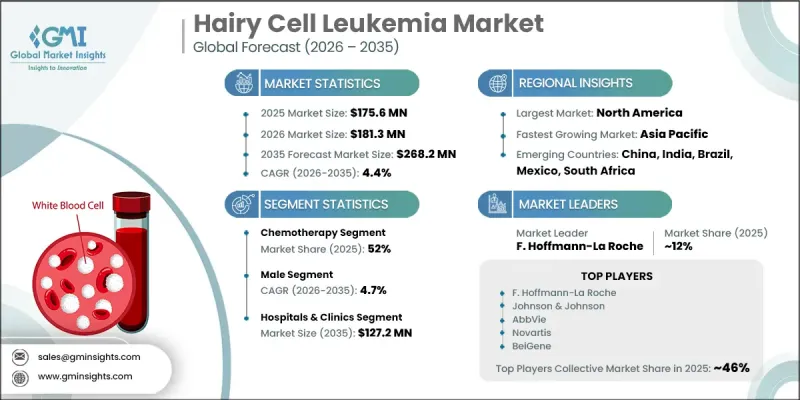
시장 확대는 혈액암 발병률 증가, 진단 기술의 지속적인 발전, 그리고 희귀암에 대한 인식 제고에 힘입어 이루어지고 있습니다. 또한, 주요 의료 시스템 내 환자 수의 안정화와 털세포 백혈병(HCL)에 대한 임상적 인식 제고 역시 성장을 뒷받침하고 있습니다. 전문 암 센터에 대한 접근성이 향상되고 조기 진단 및 개입이 이루어짐에 따라, 적시에 치료를 시작할 수 있게 되었으며, 더 나은 질환 관리 성과를 거두고 있습니다. 또한, 희귀질환 치료제에 대한 유리한 보험급여 지원과 희귀질환 연구에 대한 투자 확대가 시장 발전을 더욱 뒷받침하는 환경을 조성하고 있습니다. 정밀 의학의 보급이 확대되고 표적 치료의 활용 기회가 늘어남에 따라, 치료 효과 향상과 환자에게 제공되는 치료 선택지의 확대도 진행되고 있습니다. 분자진단 기술의 지속적인 발전과 선진국 및 신흥 지역의 의료 인프라 강화 역시 시장의 장기적인 안정성과 성장 모멘텀을 더욱 뒷받침하고 있습니다.
| 시장 범위 | |
|---|---|
| 시작 연도 | 2025년 |
| 예측 기간 | 2026-2035년 |
| 시작 연도 시장 규모 | 1억 7,560만 달러 |
| 예측 금액 | 2억 6,820만 달러 |
| CAGR | 4.4% |
털세포 백혈병은 골수, 비장 및 말초혈액에 비정상적인 B 림프구가 축적되는 것을 특징으로 하는 드문 만성 B세포 림프증식성 질환입니다. 이 질환은 현미경 검사에서 털과 같은 돌기가 확인되는 악성 세포의 존재에 의해 정의됩니다. 일반적으로 진행 속도는 완만하며, 피로, 재발성 감염, 무력감, 빈혈, 멍이 잘 드는 증상, 비장 비대 등의 증상을 동반하는 것이 일반적입니다. 진행 속도는 완만하지만, 합병증을 관리하고 질환의 진행을 막기 위해서는 장기적인 경과 관찰이나 의학적 개입이 필요한 경우가 많습니다.
화학요법 부문은 2025년에 52%의 시장 점유율을 차지하며 9,130만 달러에 달하고, 2035년까지 연평균 성장률(CAGR) 4.2%로 성장할 것으로 전망됩니다. 이 치료법은 확립된 임상적 유효성과 신규 진단 환자에서 지속적인 관해 달성을 위한 오랜 사용 실적을 바탕으로 여전히 주요 치료법으로 자리 잡고 있습니다. 프린 아날로그 요법, 특히 클라드리빈과 펜토스타틴은 주요 의료 시장에서 여전히 핵심적인 치료 옵션으로 자리 잡고 있습니다. 이러한 입증된 임상 성과, 의료진 사이에서 높은 인지도, 그리고 지속적인 유효성이 치료 분야에서 이 약제들의 지속적인 우위를 뒷받침하고 있습니다.
남성 부문은 2025년에 76.3%의 점유율을 기록하며 시장 규모는 1억 3,400만 달러였으나, 2035년까지 2억 990만 달러에 달할 것으로 예상되며 연평균 성장률(CAGR) 4.7%를 나타낼 것으로 전망됩니다. 이러한 우위는 주로 전 세계 인구 전체에서 여성에 비해 남성의 모발세포 백혈병 유병률이 현저히 높다는 사실에서 기인합니다. 그 결과, 진단, 지속적인 치료 및 장기적인 질환 관리가 필요한 환자 집단 중 남성이 가장 큰 비중을 차지하고 있습니다. 이러한 일관된 성별 차이는 치료 이용률을 지속적으로 높여, 기존 치료법과 신흥 치료법 모두에 대한 수요를 촉진하고 있습니다.
북미의 털세포 백혈병 시장은 2025년에 6,830만 달러 규모를 기록하고, 2035년까지 9,950만 달러에 달할 것으로 전망됩니다. 이 지역이 시장을 주도하고 있는 배경에는 확립된 종양 의료 시스템, 첨단 진단 능력, 그리고 희귀 혈액암에 대한 승인된 치료법과 신흥 치료법에 대한 충분한 접근성이 있습니다. 또한, 이 지역은 주요 학술 기관, 제약 기업, 환자 지원 네트워크의 지원을 받아 희귀질환 연구에 적극적으로 참여함으로써 그 혜택을 누리고 있습니다. 분자진단, 정밀의료 접근법 및 표적 치료 전략의 도입이 확대됨에 따라 환자의 예후가 더욱 개선되고 있으며, 이는 북미 전역에서 시장 성장을 가속하고 있습니다.
자주 묻는 질문
목차
제1장 조사 방법과 범위
제2장 주요 요약
제3장 업계 인사이트
제4장 경쟁 구도
제5장 시장 추산 및 예측 : 치료별, 2022-2035년
제6장 시장 추산 및 예측 : 성별, 2022-2035년
제7장 시장 추산 및 예측 : 치료 제공업체별, 2022-2035년
제8장 시장 추산 및 예측 : 지역별, 2022-2035년
제9장 기업 개요
JHS 26.07.01The Global Hairy Cell Leukemia Market was valued at USD 175.6 million in 2025 and is estimated to grow at a CAGR of 4.4% to reach USD 268.2 million by 2035.
Market expansion is supported by the rising incidence of hematologic cancers, ongoing improvements in diagnostic technologies, and increasing awareness of rare oncology conditions. Growth is further reinforced by a steady patient population across major healthcare systems and improved clinical recognition of hairy cell leukemia (HCL). Enhanced access to specialized oncology centers and earlier diagnostic interventions are contributing to timely treatment initiation and better disease management outcomes. In addition, favorable reimbursement support for orphan drugs and rising investment in rare disease research are creating a more supportive environment for market development. The increasing adoption of precision medicine, along with broader availability of targeted therapies, is also improving treatment effectiveness and expanding therapeutic options for patients. Continuous advancements in molecular diagnostics and strengthening healthcare infrastructure across developed and emerging regions are further supporting long-term market stability and growth momentum.
| Market Scope | |
|---|---|
| Start Year | 2025 |
| Forecast Year | 2026-2035 |
| Start Value | $175.6 Million |
| Forecast Value | $268.2 Million |
| CAGR | 4.4% |
Hairy cell leukemia is a rare chronic B-cell lymphoproliferative disorder characterized by abnormal B lymphocyte accumulation in the bone marrow, spleen, and peripheral blood. The condition is defined by the presence of malignant cells with hair-like projections visible under microscopic examination. It typically progresses slowly and is commonly associated with symptoms such as fatigue, recurrent infections, weakness, anemia, easy bruising, and splenic enlargement. Despite its slow progression, long-term monitoring and medical intervention are often required to manage complications and prevent disease advancement.
The chemotherapy segment accounted for 52% share in 2025, representing USD 91.3 million, and is projected to grow at a CAGR of 4.2% through 2035. This segment remains the primary treatment approach due to its well-established clinical efficacy and long-standing use in achieving durable remission in newly diagnosed patients. Purine analog therapies, particularly cladribine and pentostatin, continue to serve as core treatment options across major healthcare markets. Their proven clinical outcomes, strong physician familiarity, and sustained effectiveness support their continued dominance in the therapeutic landscape.
The male segment held a share of 76.3% in 2025, valued at USD 134 million, and is projected to reach USD 209.9 million by 2035, growing at a CAGR of 4.7%. This dominance is primarily linked to the significantly higher prevalence of hairy cell leukemia in men compared to women across global populations. As a result, males represent the largest patient group requiring diagnosis, ongoing treatment, and long-term disease management. This consistent gender-based disparity continues to drive higher treatment utilization and reinforces demand for both established and emerging therapeutic options.
North America Hairy Cell Leukemia Market accounted for USD 68.3 million in 2025 and is expected to reach USD 99.5 million by 2035. Regional leadership is driven by a well-established oncology care system, advanced diagnostic capabilities, and strong access to approved and emerging therapies for rare blood cancers. The region also benefits from active participation in rare disease research supported by leading academic institutions, pharmaceutical companies, and patient advocacy networks. Increasing adoption of molecular diagnostics, precision medicine approaches, and targeted treatment strategies is further improving patient outcomes and strengthening market expansion across North America.
Key companies operating in the global hairy cell leukemia industry include Roche, Novartis, Pfizer, AbbVie, Johnson & Johnson, Sanofi, Amgen, AstraZeneca, Gilead Sciences, Takeda Pharmaceutical, Astellas Pharma, Merck KGaA, BeiGene, and F. Hoffmann-La Roche. Companies in the hairy cell leukemia market are focusing on expanding their oncology portfolios through targeted therapy development and next-generation treatment innovations. Many players are investing heavily in research and clinical trials aimed at improving remission rates and reducing relapse risks. Strategic collaborations with research institutions and biotech firms are being used to accelerate drug discovery and expand pipeline capabilities. Firms are also strengthening their presence in rare disease segments by pursuing regulatory designations that support faster approvals and extended market exclusivity. In addition, increasing emphasis on precision medicine, biomarker-driven therapies, and improved diagnostic integration is helping companies enhance treatment personalization and strengthen competitive positioning in the rare hematologic oncology space.
Table of Contents
Chapter 1 Methodology and Scope
- 1.1 Market scope and definition
- 1.2 Research approach
- 1.3 Quality commitments
- 1.3.1 GMI AI policy and data integrity commitment
- 1.3.1.1 Source consistency protocol
- 1.3.1 GMI AI policy and data integrity commitment
- 1.4 Research trail and confidence scoring
- 1.4.1 Research trail components
- 1.4.2 Scoring components
- 1.5 Data collection
- 1.5.1 Partial list of primary sources
- 1.6 Data mining sources
- 1.6.1 Paid sources
- 1.6.1.1 Sources, by region
- 1.6.1 Paid sources
- 1.7 Base estimates and calculations
- 1.7.1 Revenue share analysis
- 1.7.2 Base year calculation
- 1.8 Forecast model
- 1.9 Research transparency addendum
- 1.9.1 Source attribution framework
- 1.9.2 Quality assurance metrics
- 1.9.3 Our commitment to trust
Chapter 2 Executive Summary
- 2.1 Industry 360° synopsis
- 2.2 Key market trends
- 2.2.1 Regional trends
- 2.2.2 Therapy trends
- 2.2.3 Gender trends
- 2.2.4 Treatment providers trends
- 2.2.5 End use trends
- 2.3 CXO perspectives: Strategic imperatives
Chapter 3 Industry Insights
- 3.1 Industry ecosystem analysis
- 3.2 Industry impact forces
- 3.2.1 Growth drivers
- 3.2.1.1 Increasing adoption of targeted therapies
- 3.2.1.2 Increasing prevalence of leukemia
- 3.2.1.3 Increased research and development activities related to hairy cell leukemia
- 3.2.1.4 Expanding use of combination immunotherapy regimens
- 3.2.2 Industry pitfalls and challenges
- 3.2.2.1 High treatment and biologic therapy costs
- 3.2.2.2 Limited availability of approved HCL-specific drugs
- 3.2.3 Market opportunities
- 3.2.3.1 Development of chemo-free treatment approaches
- 3.2.3.2 Emerging opportunities in relapse/refractory HCL treatment
- 3.2.1 Growth drivers
- 3.3 Growth potential analysis
- 3.4 Technology landscape
- 3.4.1 Current technology
- 3.4.2 Emerging technologies
- 3.5 Pricing Analysis (Driven by Primary Research)
- 3.6 Regulatory landscape (Driven by primary research)
- 3.6.1 North America
- 3.6.2 Europe
- 3.6.3 Asia Pacific
- 3.6.4 Latin America
- 3.6.5 Middle East and Africa
- 3.7 Reimbursement scenario
- 3.8 Porter's analysis
- 3.9 PESTEL analysis
- 3.10 Pipeline analysis
- 3.11 Future market trends (Driven by primary research)
- 3.12 Impact of AI and generative AI on the market
Chapter 4 Competitive Landscape, 2025
- 4.1 Introduction
- 4.2 Company market share analysis
- 4.2.1 North America
- 4.2.2 Europe
- 4.2.3 Asia Pacific
- 4.3 Company matrix analysis
- 4.4 Competitive analysis of major market players
- 4.5 Competitive positioning matrix
- 4.6 Key developments
- 4.6.1 Merger and acquisition
- 4.6.2 Partnership and collaboration
- 4.6.3 New product launches
- 4.6.4 Expansion plans
Chapter 5 Market Estimates and Forecast, By Therapy, 2022 - 2035 ($ Mn)
- 5.1 Key trends
- 5.2 Chemotherapy
- 5.3 Targeted therapy
- 5.4 Immunotherapy
- 5.5 Other therapies
Chapter 6 Market Estimates and Forecast, By Gender, 2022 - 2035 ($ Mn)
- 6.1 Key trends
- 6.2 Male
- 6.3 Female
Chapter 7 Market Estimates and Forecast, By Treatment Providers, 2022 - 2035 ($ Mn)
- 7.1 Key trends
- 7.2 Hospitals & clinics
- 7.3 Cancer care centers
- 7.4 Academic and research institutes
Chapter 8 Market Estimates and Forecast, By Region, 2022 - 2035 ($ Mn)
- 8.1 Key trends
- 8.2 North America
- 8.2.1 U.S.
- 8.2.2 Canada
- 8.3 Europe
- 8.3.1 Germany
- 8.3.2 UK
- 8.3.3 France
- 8.3.4 Spain
- 8.3.5 Italy
- 8.3.6 Netherlands
- 8.4 Asia Pacific
- 8.4.1 China
- 8.4.2 Japan
- 8.4.3 India
- 8.4.4 Australia
- 8.4.5 South Korea
- 8.5 Latin America
- 8.5.1 Brazil
- 8.5.2 Mexico
- 8.5.3 Argentina
- 8.6 Middle East and Africa
- 8.6.1 South Africa
- 8.6.2 Saudi Arabia
- 8.6.3 UAE
Chapter 9 Company Profiles
- 9.1 AbbVie
- 9.2 Amgen
- 9.3 Astellas Pharma
- 9.4 AstraZeneca
- 9.5 BeiGene
- 9.6 F. Hoffmann-La Roche
- 9.7 Gilead Sciences
- 9.8 Johnson & Johnson
- 9.9 Merck KGaA
- 9.10 Novartis
- 9.11 Pfizer
- 9.12 Takeda Pharmaceutical
- 9.13 Sanofi


