

|
시장보고서
상품코드
2071416
계란 포장 시장 성장 기회, 성장 촉진요인, 업계 동향 분석 및 예측(2026-2035년)Egg Packaging Market Opportunity, Growth Drivers, Industry Trend Analysis, and Forecast 2026 - 2035 |
||||||

세계의 계란 포장 시장은 2025년에 82억 1,000만 달러 규모로 평가되었고, 2035년까지 연평균 복합 성장률(CAGR) 6.4%로 성장하여 152억 6,000만 달러에 이를 것으로 추정되고 있습니다.
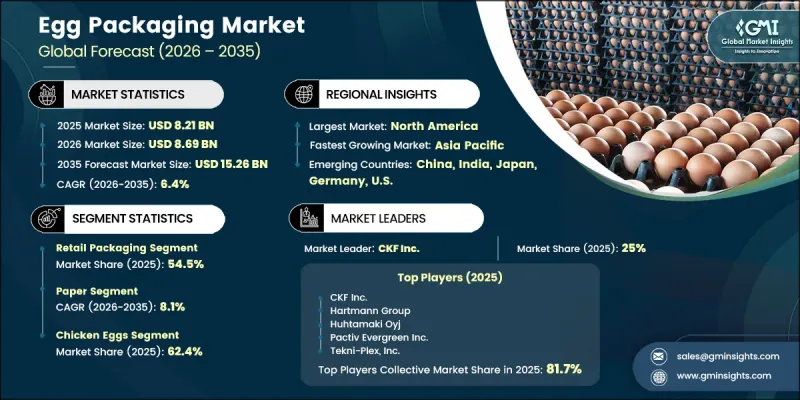
이 시장의 성장은 전 세계 계란 소비량 증가, 가금류 생산 시스템의 확대, 그리고 체계화된 공급망의 지속적인 발전에 힘입어 이루어지고 있습니다. 또한, 안전하고 위생적이며 효율적인 포장 형태에 대한 선호도가 높아지면서 소매 업계 및 외식 산업 전반 수요를 뒷받침하고 있습니다. 계란 포장은 취급, 보관 및 운송 과정에서 제품을 보호하는 데 있어 매우 중요한 역할을 하며, 유통망 전반에 걸친 파손 및 오염 위험을 대폭 줄여줍니다. 비용 대비 효과가 뛰어난 단백질 공급원에 대한 수요가 증가함에 따라, 가정 및 상업 소비 채널 모두에서 계란은 주식으로서의 입지를 더욱 공고히 하고 있습니다. 동시에, 대규모 양계 사업의 확장에 따라 효율적인 물류와 장거리 운송을 뒷받침하는 표준화되고 확장성이 뛰어난 포장 시스템에 대한 수요가 높아지고 있습니다. 또한, 지속가능성에 대한 고려도 점점 더 중요해지고 있으며, 각 제조업체들은 세계 시장의 환경 관련 기대와 규제 동향에 대응하기 위해 재활용이 가능하고 생분해성인 포장 솔루션 개발에 주력하고 있습니다.
| 시장 범위 | |
|---|---|
| 시작 연도 | 2025년 |
| 예측 기간 | 2026-2035년 |
| 시작 연도 시장 규모 | 82억 1,000만 달러 |
| 예측 금액 | 152억 6,000만 달러 |
| CAGR | 6.4% |
소매용 포장 부문은 54.5%의 시장 점유율을 차지하고 있으며, 2035년까지 연평균 성장률(CAGR) 7.3%로 성장할 것으로 전망됩니다. 이러한 압도적인 시장 점유율은 슈퍼마켓, 대형마트, 온라인 식료품 플랫폼에서의 활발한 수요에 힘입은 것으로, 이러한 분야에서는 포장이 제품의 안전성, 진열 시의 매력도, 소비자의 편의성 측면에서 매우 중요한 역할을 하고 있습니다. 카톤 등 소매용 포장 형태는 유통 과정 전반에 걸쳐 보호 기능, 위생성, 취급 편의성을 제공할 수 있기 때문에 널리 채택되고 있습니다.
종이 포장 부문은 2025년에 53%의 시장 점유율을 차지했으며, 2026년부터 2035년까지 8.1%라는 가장 높은 연평균 성장률(CAGR)을 보일 것으로 전망됩니다. 이러한 성장은 소매 및 외식 산업 전반에 걸쳐 친환경적이고 생분해성인 대체 포장재에 대한 수요가 증가하고 있기 때문입니다. 성형 섬유와 종이 상자는 재활용 가능성, 비용 효율성, 그리고 운송 중 깨지기 쉬운 달걀을 보호하는 효과적인 완충 특성 덕분에 점점 더 선호되고 있습니다. 환경 문제에 대한 관심이 높아지고, 플라스틱 사용량 감축을 목표로 한 규제 조치가 도입되면서 종이 포장 솔루션의 채택이 더욱 가속화되고 있습니다.
2025년, 북미의 계란 포장 시장은 29.9%의 점유율을 차지했습니다. 이 지역은 체계화된 소매 채널, 외식 산업 및 대규모 양계 생산 시스템에서 발생하는 견조한 수요의 혜택을 누리고 있습니다. 확립된 공급망과 첨단 포장 기술이 효율적인 유통과 제품의 안전성에 기여하고 있습니다. 지속 가능한 포장 솔루션에 대한 관심이 높아지고 있는 데다, 대형 포장 제조업체들의 존재까지 더해져 해당 지역 시장 확대를 더욱 뒷받침하고 있습니다.
자주 묻는 질문
목차
제1장 조사 방법과 범위
제2장 주요 요약
제3장 업계 인사이트
제4장 경쟁 구도
제5장 시장 추정 및 예측 : 소재 유형별(2022-2035년)
제6장 시장 추정 및 예측 : 포장 유형별(2022-2035년)
제7장 시장 추정 및 예측 : 용도별(2022-2035년)
제8장 시장 추정 및 예측 : 계란 유형별(2022-2035년)
제9장 시장 추정 및 예측 : 지역별(2022-2035년)
제10장 기업 개요
KTH 26.07.03The Global Egg Packaging Market was valued at USD 8.21 billion in 2025 and is estimated to grow at a CAGR of 6.4% to reach USD 15.26 billion by 2035.
Market growth is supported by rising global egg consumption, expansion of poultry production systems, and continuous development of organized supply chains. Increasing preference for safe, hygienic, and efficient packaging formats is also strengthening demand across retail and food service industries. Egg packaging plays a critical role in ensuring product protection during handling, storage, and transportation, significantly reducing breakage and contamination risks across the distribution chain. Growing demand for cost-effective protein sources has further reinforced eggs as a staple food across both household and commercial consumption channels. At the same time, the expansion of large-scale poultry farming operations is driving the need for standardized and scalable packaging systems that support efficient logistics and long-distance transportation. Sustainability considerations are also becoming increasingly important, with manufacturers focusing on recyclable and biodegradable packaging solutions to align with environmental expectations and regulatory developments across global markets.
| Market Scope | |
|---|---|
| Start Year | 2025 |
| Forecast Year | 2026-2035 |
| Start Value | $8.21 Billion |
| Forecast Value | $15.26 Billion |
| CAGR | 6.4% |
The retail packaging segment held a 54.5% share and is projected to grow at a CAGR of 7.3% through 2035. This dominance is supported by strong demand from supermarkets, hypermarkets, and online grocery platforms, where packaging plays a vital role in product safety, shelf appeal, and consumer convenience. Retail packaging formats such as cartons are widely adopted due to their ability to provide protection, hygiene, and ease of handling throughout the distribution process.
The paper segment accounted for 53% share in 2025 and is projected to register the highest CAGR of 8.1% during 2026-2035. This growth is driven by rising demand for environmentally friendly and biodegradable packaging alternatives across retail and food service sectors. Molded fiber and paper-based cartons are increasingly preferred due to their recyclability, cost efficiency, and effective cushioning properties that protect fragile eggs during transportation. Growing environmental concerns and regulatory initiatives aimed at reducing plastic usage are further accelerating the adoption of paper-based packaging solutions.
North America Egg Packaging Market held 29.9% share in 2025. The region benefits from strong demand across organized retail channels, food service industries, and large-scale poultry production systems. Well-established supply chains and advanced packaging technologies contribute to efficient distribution and product safety. Increasing emphasis on sustainable packaging solutions, along with the presence of major packaging manufacturers, further supports regional market expansion.
Key companies operating in the Global Egg Packaging Market include Huhtamaki Oyj, Sonoco Products, Hartmann Group, Pactiv Evergreen Inc., Sabert Corporation, CKF Inc., Tekni-Plex, Inc., Mauser Packaging Solutions, Omni-Pac Group, Dispak UK, Greenlink Packaging, Keyes Packaging Group, Packman Packaging, Uno Plast, and Wellington Produce Packaging. Companies in the egg packaging market focus on material innovation, sustainability integration, and production efficiency improvements to strengthen their competitive position. Manufacturers are increasingly investing in recyclable and biodegradable packaging materials, particularly molded fiber and paper-based solutions, to align with environmental regulations and consumer preferences. Strategic expansion of production capacities and optimization of supply chains are enabling companies to meet rising demand from the retail and poultry sectors. Firms are also enhancing product design to improve durability, stacking efficiency, and branding potential for retail packaging applications. Partnerships with poultry producers, retailers, and food service providers are supporting long-term supply agreements and market penetration. In addition, companies are adopting automation and advanced manufacturing technologies to reduce production costs and improve scalability.
Table of Contents
Chapter 1 Methodology and Scope
- 1.1 Market scope and definition
- 1.2 Research design
- 1.2.1 Research approach
- 1.2.2 Data collection methods
- 1.3 Data mining sources
- 1.3.1 Global
- 1.3.2 Regional/Country
- 1.4 Base estimates and calculations
- 1.4.1 Base year calculation
- 1.4.2 Key trends for market estimation
- 1.5 Primary research and validation
- 1.5.1 Primary sources
- 1.6 Forecast model
- 1.7 Research assumptions and limitations
Chapter 2 Executive Summary
- 2.1 Industry 360° synopsis, 2022 - 2035
- 2.2 Key market trends
- 2.2.1 Material trends
- 2.2.2 Packaging type trends
- 2.2.3 Application trends
- 2.2.4 Egg Type industry trends
- 2.2.5 Regional trends
- 2.3 TAM Analysis, 2026-2035
- 2.4 CXO perspectives: Strategic imperatives
Chapter 3 Industry Insights
- 3.1 Industry ecosystem analysis
- 3.1.1 Supplier Landscape
- 3.1.2 Profit Margin
- 3.1.3 Cost structure
- 3.1.4 Value addition at each stage
- 3.1.5 Factor affecting the value chain
- 3.1.6 Disruptions
- 3.2 Industry impact forces
- 3.2.1 Growth drivers
- 3.2.1.1 Rising global egg consumption
- 3.2.1.2 Expansion of poultry farming and supply chains
- 3.2.1.3 Increasing demand for sustainable packaging
- 3.2.1.4 Growth of retail, e-commerce, and food service sectors
- 3.2.1.5 Advancements in packaging technology
- 3.2.2 Industry pitfalls and challenges
- 3.2.2.1 High cost of sustainable packaging materials
- 3.2.2.2 Fragility and risk of product damage
- 3.2.3 Market opportunities
- 3.2.3.1 Rising demand for eco-friendly and biodegradable packaging
- 3.2.3.2 Expansion of organized retail and e-commerce grocery platforms
- 3.2.1 Growth drivers
- 3.3 Growth potential analysis
- 3.4 Regulatory landscape
- 3.4.1 North America
- 3.4.2 Europe
- 3.4.3 Asia Pacific
- 3.4.4 Latin America
- 3.4.5 Middle East & Africa
- 3.5 Porter's analysis
- 3.6 PESTEL analysis
- 3.7 Technology and Innovation landscape
- 3.7.1 Current technological trends
- 3.7.2 Emerging technologies
- 3.8 Price trends
- 3.8.1 By region
- 3.8.2 By product
- 3.9 Pricing Strategies
- 3.10 Emerging Business Models
- 3.11 Compliance Requirements
- 3.12 Patent and IP analysis
Chapter 4 Competitive Landscape, 2025
- 4.1 Introduction
- 4.2 Company market share analysis
- 4.2.1 By region
- 4.2.1.1 North America
- 4.2.1.2 Europe
- 4.2.1.3 Asia Pacific
- 4.2.1.4 Latin America
- 4.2.1.5 Middle East & Africa
- 4.2.2 Market concentration analysis
- 4.2.1 By region
- 4.3 Competitive benchmarking of key players
- 4.3.1 Financial performance comparison
- 4.3.1.1 Revenue
- 4.3.1.2 Profit margin
- 4.3.1.3 R&D
- 4.3.2 Product portfolio comparison
- 4.3.2.1 Product range breadth
- 4.3.2.2 Technology
- 4.3.2.3 Innovation
- 4.3.3 Geographic presence comparison
- 4.3.3.1 Global footprint analysis
- 4.3.3.2 Service network coverage
- 4.3.3.3 Market penetration by region
- 4.3.4 Competitive positioning matrix
- 4.3.4.1 Leaders
- 4.3.4.2 Challengers
- 4.3.4.3 Followers
- 4.3.4.4 Niche players
- 4.3.5 Strategic outlook matrix
- 4.3.1 Financial performance comparison
- 4.4 Key developments
- 4.4.1 Mergers and acquisitions
- 4.4.2 Partnerships and collaborations
- 4.4.3 Technological advancements
- 4.4.4 Expansion and investment strategies
- 4.4.5 Digital transformation initiatives
- 4.5 Emerging/ startup competitors landscape
Chapter 5 Market Estimates and Forecast, By Material Type, 2022 - 2035 (USD Billion)
- 5.1 Key trends
- 5.2 Plastic
- 5.2.1 Polyethylene Terephthalate
- 5.2.2 Polystyrene
- 5.2.3 Others
- 5.3 Paper
- 5.3.1 Paperboard
- 5.3.2 Molded Pulp
- 5.4 Others
Chapter 6 Market Estimates and Forecast, By Packaging Type, 2022 - 2035 (USD Billion)
- 6.1 Key trends
- 6.2 Cartons
- 6.3 Trays
- 6.4 Boxes
- 6.5 Clamshells
- 6.6 Others
Chapter 7 Market Estimates and Forecast, By Application, 2022 - 2035 (USD Billion)
- 7.1 Key trends
- 7.2 Retail Packaging
- 7.2.1 Supermarkets
- 7.2.2 Hypermarkets
- 7.2.3 Online Grocery Stores
- 7.3 Transportation Packaging
- 7.4 Others
Chapter 8 Market Estimates and Forecast, By Egg Type, 2022 - 2035 (USD Billion)
- 8.1 Key trends
- 8.2 Chicken Eggs
- 8.3 Duck Eggs
- 8.4 Quail Eggs
- 8.5 Other Poultry Eggs
- 8.6 Others
Chapter 9 Market Estimates and Forecast, By Region, 2022 - 2035 (USD Billion)
- 9.1 Key trends
- 9.2 North America
- 9.2.1 U.S.
- 9.2.2 Canada
- 9.3 Europe
- 9.3.1 Germany
- 9.3.2 UK
- 9.3.3 France
- 9.3.4 Spain
- 9.3.5 Italy
- 9.4 Asia Pacific
- 9.4.1 China
- 9.4.2 India
- 9.4.3 Japan
- 9.4.4 Australia
- 9.4.5 South Korea
- 9.5 Latin America
- 9.5.1 Brazil
- 9.5.2 Mexico
- 9.5.3 Argentina
- 9.6 Middle East and Africa
- 9.6.1 South Africa
- 9.6.2 Saudi Arabia
- 9.6.3 UAE
Chapter 10 Company Profiles
- 10.1 Global Key Players
- 10.1.1 CKF Inc.
- 10.1.2 Hartmann Group
- 10.1.3 Huhtamaki Oyj
- 10.1.4 Pactiv Evergreen Inc.
- 10.1.5 Tekni-Plex, Inc.
- 10.2 Regional key players
- 10.2.1 North America
- 10.2.1.1 Sonoco Products
- 10.2.1.2 Pactiv Evergreen Inc.
- 10.2.1.3 CFK Inc.
- 10.2.2 Asia Pacific
- 10.2.2.1 Omni-Pac Group
- 10.2.2.2 Uno Plast
- 10.2.2.3 Packman Packaging
- 10.2.3 Europe
- 10.2.3.1 Hartmann Group
- 10.2.3.2 Huhtamaki Oyj
- 10.2.1 North America
- 10.3 Niche Players/Disruptors
- 10.3.1 Dispak UK
- 10.3.2 Greenlink Packaging


