

|
시장보고서
상품코드
2064524
성형 섬유 계란 카톤 시장 : 시장 점유율 분석, 산업 동향 및 통계 데이터, 성장 예측(2026-2031년)Molded Fiber Egg Carton - Market Share Analysis, Industry Trends & Statistics, Growth Forecasts (2026 - 2031) |
||||||
 Mordor Intelligence
Mordor Intelligence에 의하면, 성형 섬유 계란 카톤 시장 규모는 2025년 17억 7,000만 달러로 평가되었고, 2026년 19억 8,000만 달러로 추정되고, 2031년까지 27억 7,000만 달러로 확대될 전망이며, 2026-2031년 연평균 복합 성장률(CAGR)은 6.97%를 나타낼 것으로 예측됩니다.
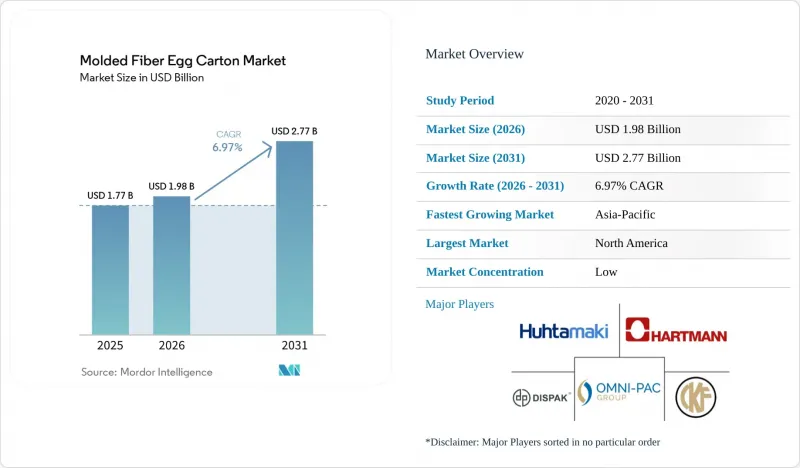
본 보고서는 제품 유형별(표준형 달걀 팩, 특수형 달걀 팩), 용량별(6개 이하, 7-12개, 13-18개, 19-30개), 성형 섬유 유형별(트랜스퍼 성형, 열성형 섬유, 두꺼운 성형 섬유), 용도별(소매용, 상업용, 산업용), 지역별로 분류되어 있습니다. 시장 전망은 금액(달러) 기준으로 제시되어 있습니다.
세계의 성형 섬유 계란 카톤 시장 동향 및 인사이트
플라스틱 사용의 단계적 폐지와 순환형 포장 의무화의 진전
규정(EU) 2025/40은 2026년 8월 12일에 전면 시행되며, EU 전역의 식품 접촉용 포장재에 대해 재활용 가능성 및 PFAS와 관련된 구속력 있는 규정을 정하고 있습니다. 해당 규정에 따르면, 재활용 적합 등급이 C 미만인 포장재는 2030년 1월 1일 이후 EU 시장에 유통할 수 없도록 규정되어 있습니다. 이 기한으로 인해 현재 전환 여부를 결정해야 하는 시점이 다가오고 있습니다. 왜냐하면 생산자들은 일반적인 설비 수명 주기 내에서 시장 접근성을 상실할 가능성이 있는 형태에 계속 투자할 여유가 없기 때문입니다. 북미의 규제 방향도 발포재 및 기타 재활용 적합성이 낮은 소재에 대한 제한을 강화하는 쪽으로 나아가고 있으며, 이로 인해 계란 포장 분야에서 이러한 소재의 실질적인 사용 기간이 단축되고 있습니다. 성형 섬유 재질의 달걀 포장재 시장에서 그 장점은 환경적 측면에서의 우위뿐만이 아닙니다. PFAS 관련 규제가 강화될 경우, 섬유 소재 포장은 일반적으로 플라스틱이나 코팅지 소재에 비해 재설계가 덜 필요합니다. 따라서, 특히 시행일이 임박한 시기에 패키지 변경 위험을 감수할 수 없는 소매업체나 브랜드 소유자에게 제품을 공급하는 공급업체의 경우, 규제 대응 준비 상황이 성형 섬유 계란 카톤 시장에서 직접적인 구매 결정 요인으로 작용하고 있습니다.
계란 소비량과 가금류 생산량 증가
성형 섬유 계란 카톤 시장은 상업용 포장 시스템이 확대되고 있는 주요 생산국의 달걀 생산량 증가에 힘입어 계속해서 호조를 보이고 있습니다. 인도의 계란 생산량은 2026년도에 5% 증가할 것으로 예상되며, 브라질도 같은 기간 동안 3%의 생산 증가가 전망됩니다. 전 세계 가금류 생산량은 2026년에 1억 1,070만 톤에 달할 것으로 예상되며, 2025년 대비 3% 증가할 것으로 전망됩니다. 이는 중국이나 브라질 등 여러 국가에서 가금류 생산 능력이 광범위하게 확대된 것을 반영한 것입니다. 양계 사업의 규모 확대에 따라, 표준화된 적재, 취급 및 포장의 완벽성이 요구되는 슈퍼마켓 및 수출 공급망에서 비공식적인 포장재 재사용은 더 이상 실용적이지 않게 되었습니다. 이러한 변화로 인해 성형 섬유 계란 카톤 시장의 기초 수요가 증가하고 있습니다. 특히, 통합형 계란 생산 사업으로 인해 처리 능력이 증가하고 있는 남아시아와 남미에서 이러한 현상이 두드러집니다. 성형 섬유 계란 카톤 시장에서 양계 사업의 확대는 계란 생산량 증가뿐만 아니라 공식적인 포장 기준의 도입을 통해 포장재 수요를 뒷받침하고 있습니다.
변동이 심한 재생 섬유와 건조 에너지 비용
성형 섬유 계란 카톤 시장은 재생 섬유공급 상황과 건조 에너지 비용 변동의 영향을 지속적으로 받고 있습니다. 기존의 습식 성형 생산은 안정적인 펄프 공급과 열을 대량으로 소비하는 건조 공정에 의존하고 있기 때문에 단기적인 이익률은 최종 수요보다 급격하게 변동할 가능성이 있습니다. PulPac과 일본 성형이 주도하는 상업적 전개는 기존의 습식 성형에 비해 에너지 사용량이 대폭 낮다는 점을 강점으로 내세우고 있으며, 이는 현재의 전체 생산 기반에서 에너지 집약도가 여전히 얼마나 중요한지를 여실히 보여주고 있습니다. 장기적으로 재생 섬유를 확보하지 못한 제조업체는 원자재 시장이 압박받거나 운송 비용이 상승할 때 더 큰 영향을 받기 쉽습니다. 이러한 압력은 계란 생산자들이 카톤당 단가에 중점을 두는 대량 계약에서 가장 극복하기 어렵습니다. 그 결과, 규제나 소매 환경이 판매량 증가를 지속적으로 뒷받침하고 있는 경우에도, 성형 섬유 계란 카톤 시장은 이익률 압박에 직면할 가능성이 있습니다.
부문별 분석
2025년 기준으로, 표준형 달걀 팩은 성형 섬유 계란 카톤 시장 점유율의 64.83%를 차지했으며, 이는 단가와 기존 포장 라인과의 호환성이 가장 중요시되는 범용 달걀 유통 채널에서 해당 제품이 확고한 입지를 차지하고 있음을 반영합니다. 트랜스퍼 성형 및 열성형 두 가지 생산 공정에 모두 적합할 뿐만 아니라, 이미 잘 정립된 재생 섬유 조달 경로를 통해 체계화된 소매 업계 전반에 걸쳐 안정적인 판매량을 유지하고 있습니다. 케이지 프리, 유기농, 방목, 목초 사육 달걀용 특수 달걀 팩 시장은 2026년부터 2031년까지 연평균 성장률(CAGR) 7.73%를 나타낼 것으로 예측되며, 이는 제품 구성이 개선되고 있는 분야임을 보여줍니다.
번브레이 팜스의 ‘아일랜드 골드’ 패키지에서 하트만 사가 보여준 뛰어난 노력은 특수 성형 섬유로 만든 골판지 상자가 단순한 범용 자재가 아니라 브랜드 자산으로서 점점 더 많이 활용되고 있음을 보여줍니다. 또한, 케이지 프리 방식으로의 전환은 단순히 생산량 증가뿐만 아니라, 카톤에 대한 기본 요건의 향상도 촉진하고 있습니다. 이러한 생산 시스템에서 생산되는 달걀은 크기와 껍데기 외관에 편차가 생기기 쉬우므로, 카톤의 내충격성과 밀폐 성능 향상이 요구되고 있습니다. 이러한 요구에 부응하기 위해서는 제품을 보호하면서도 포장지의 홍보 효과를 높일 수 있는 더 고기능성 성형지 상자가 적합합니다.
19-30개입 부문은 2026-2031년 연평균 성장률(CAGR) 8.12%를 나타낼 것으로 예측되며, 성형 섬유 계란 카톤 시장에서 가장 빠르게 확대되고 있는 용량대입니다. 이 부문은 아시아태평양과 남미에서 산업용 포장 시장이 확대됨에 힘입어 성장하고 있으며, 이들 지역에서는 통합형 가금류 업체들이 높은 처리 능력을 갖춘 생산 라인을 가동하고 있습니다. Big Herdsman사는 시간당 36,000-7만 2,000개의 계란을 처리할 수 있는 지능형 트레이 포장기를 판매하고 있으며, 이는 현재 대형 포장 시스템이 어느 정도 규모로 도입되고 있는지를 보여줍니다. 이 회사는 2026년 1월, 시간당 5,000 유닛을 생산하는 자동 계란 트레이 생산 라인을 인도로 출하하며, 남아시아 지역의 포장 인프라 투자 속도를 높였습니다.
6개 이하 부문은 북미 및 유럽의 1인 가구와 소규모 가구의 구매 패턴에 힘입어 2025년 시장 가치의 56.75%를 차지했습니다. '7-12개' 규격은 소매 및 외식 산업에서 여전히 주류 포장 형태로 자리 잡고 있으며, '13-18개' 규격은 대가족이나 회원제 소매점 수요를 충족시키고 있습니다. 또한, 대용량 포장은 달걀 1개당 섬유 원가 효율도 높기 때문에 가공업체의 경제성과 증가하는 산업 수요가 서로 부합하고 있습니다. 이러한 시너지 효과로 인해 성형 섬유 계란 카톤 시장은 계속해서 대용량 형태로 기울고 있으며, 규모, 자동화, 운송 효율이 구매 결정에 점점 더 큰 영향을 미치고 있습니다.
지역별 분석
북미는 2025년 시장 가치의 34.91%를 차지했으며, 같은 해 성형 섬유 계란 카톤 시장에서 가장 큰 점유율을 기록했습니다. 하트만사에 따르면, 2024-2027년 미주리주 로라와 온타리오주 브랜트퍼드에서 북미에 대한 누적 투자액은 1억 달러를 넘어섰으며, 1단계는 완료되었고, 2단계는 2026년 초에 진행 중입니다. 후타마키는 2025년 4월, 1,800만 달러에 젤윈 팜스 컴퍼니를 인수하여 연간 순매출 약 2,000만 달러 규모의 사업을 추가함으로써 미국 남동부 지역에서의 입지를 강화했습니다. 고병원성 조류인플루엔자(HPAI)와 관련된 닭 사육군 손실로 인해 2025년까지 계획에 변동이 발생했으나, 타겟사는 2026년 말까지 케이지 프리 달걀의 판매 비율을 57-61%로 늘리겠다는 목표를 유지하고 있으며, 멕시코의 계란 생산량은 2026년 마케팅 연도에 660억 개에 달할 것으로 예측되며, 이로 인해 해당 지역의 계란 포장 상자 수요가 뒷받침되고 있습니다.
유럽은 막대한 계란 소비량과 함께, 카톤 가공업체들에게 가장 까다로운 규정 준수 환경을 동시에 갖추고 있습니다. 독일에서는 2024년에 208억 개의 달걀이 소비되었으며, 같은 해 방목 사육이 5.4% 확대되어 63만 4,000마리 분량의 새로운 사육 정원이 추가되었습니다. 규정(EU) 2025/40은 2026년 8월 12일에 전면 시행되었으며, 이 규정의 재활용 가능성 및 PFAS 관련 조항은 해당 지역 전체에서 규정을 준수하지 않는 포장재에 대한 장벽이 되고 있습니다. 남미에서는 브라질의 계란 생산량이 2026년도에 3% 증가할 것으로 예상되며, 이는 가금류 생산 확대에 따른 성형 펄프 계란 포장재에 대한 현지 수요를 뒷받침하고 있습니다.
아시아태평양은 가장 빠르게 성장하는 지역으로, 성형 섬유 계란 카톤 시장에서 2026-2031년 연평균 성장률(CAGR)은 7.66%로 전망됩니다. 2026년도 마케팅 연도에는 중국의 계란 생산량이 6,820억 개, 인도는 5% 증가한 1,560억 개에 달할 것으로 예상되며, 이 지역은 향후 계란 포장 용기 수요에 있어 주요 공급 거점이 될 것입니다. 일본 몰딩이 일본 국내에서 DMF(성형 펄프)를 출시한 것은 아시아의 선진 시장에서 자원 효율이 높은 섬유 포장재에 대한 수요가 증가하고 있음을 보여줍니다. MyPak사는 호주 및 뉴질랜드 전역에 PFAS가 포함되지 않고 BRC 인증을 획득한 성형 섬유 포장재를 공급하고 있으며, 이는 오세아니아 지역에서도 고품질 및 규정 준수를 중시하는 수요가 증가하고 있음을 보여줍니다. 중동 및 아프리카는 여전히 초기 단계 시장이지만, 가금 산업의 정상화, 도시 지역의 소매업 성장, 그리고 콜드체인 시스템의 고도화에 힘입어 표준화된 성형 섬유 상자의 도입이 꾸준히 진행되고 있습니다.
기타 혜택 :
- Excel 형식 시장 예측(ME) 시트
- 3개월간의 애널리스트 지원
자주 묻는 질문
목차
제1장 서론
제2장 분석 방법
제3장 주요 요약
제4장 시장 구도
제5장 시장 규모 및 성장률 예측
제6장 경쟁 구도
제7장 시장 기회 및 향후 전망
AJY 26.06.26According to Mordor Intelligence, the molded fiber egg carton market size is projected to expand from USD 1.77 billion in 2025 and USD 1.98 billion in 2026 to USD 2.77 billion by 2031, registering a CAGR of 6.97% between 2026 to 2031.
This report is Segmented by Product Type (Standard Egg Cartons, and Specialty Egg Cartons), Capacity (Up To 6 Eggs, 7 To 12 Eggs, 13 To 18 Eggs, and 19 To 30 Eggs), Molded Fiber Type (Transfer Molded, Thermoformed Fiber, and Thick-Wall Molded Fiber), Application (Retail, Commercial, and Industrial), and Geography. The Market Forecasts are Provided in Terms of Value (USD).
Global Molded Fiber Egg Carton Market Trends and Insights
Rising Plastic Phaseout and Circular Packaging Mandates
Regulation (EU) 2025/40 enters into full force on August 12, 2026, and establishes binding recyclability and PFAS rules for food-contact packaging across the EU. The same regulation states that packaging with a recyclability grade below C cannot be placed on the EU market from January 1, 2030. That deadline is changing conversion decisions now because producers cannot afford to keep investing in formats that may lose market access within a normal equipment cycle. The direction of regulation in North America has also moved toward tighter limits on foam and other low-recyclability materials, which shortens the practical runway for those formats in egg packaging. In the molded fiber egg carton market, the advantage is not only environmental positioning; fiber formats usually require less reformulation than plastic or coated paperboard when PFAS-related rules tighten. This is making compliance readiness a direct purchasing factor in the molded fiber egg carton market, especially for suppliers serving retailers and brand owners that cannot risk packaging changes close to enforcement dates.
Growing Egg Consumption and Poultry Output
The molded fiber egg carton market continues to benefit from rising egg output in major producing countries where commercial packing systems are expanding. India's egg production is forecast to grow 5% in marketing year 2026, while Brazil is projected to add 3% output in the same period. Global poultry meat production is forecast to reach 110.7 million metric tons in 2026, up 3% from 2025, reflecting broader poultry capacity expansion in countries such as China and Brazil. As poultry operations scale, informal reuse packaging becomes less workable in supermarket and export supply chains that need standardized stacking, handling, and pack integrity. That shift raises baseline demand in the molded fiber egg carton market, especially in South Asia and South America, where integrated egg operations are adding throughput. In the molded fiber egg carton market, poultry expansion supports carton demand not only by increasing egg production but also by advancing formal packing standards.
Volatile Recovered Fiber and Drying Energy Costs
The molded fiber egg carton market remains exposed to swings in recovered fiber availability and drying energy costs. Traditional wet-process production depends on steady pulp input and heat-intensive drying, so short-term margins can move more sharply than end demand. PulPac's commercial rollout with Nippon Molding was positioned on materially lower energy use than conventional wet forming, underscoring how important energy intensity remains across the current production base. Producers without long-term recycled fiber coverage are more vulnerable when raw material markets tighten or freight costs rise. These pressures are hardest to overcome in high-volume contracts, where egg producers focus on carton cost per unit. As a result, the molded fiber egg carton market can face margin compression even when regulatory and retail conditions continue to support volume growth.
Other drivers and restraints analyzed in the detailed report include:
- Premiumization of Organic, Free-Range, and Cage-Free Eggs
- Retail Preference for Recyclable and Compostable Shelf-Ready Packs
- Competition from Low-Cost Plastic, foam, and Corrugated Alternatives
For complete list of drivers and restraints, kindly check the Table Of Contents.
Segment Analysis
Standard Egg Cartons held 64.83% of the molded fiber egg carton market share in 2025, reflecting their strong position in commodity egg channels where cost per unit and compatibility with legacy packing lines matter most. Their fit with both transfer-molded and thermoformed production, along with familiar recycled-fiber sourcing, keeps volumes steady across organized retail. Specialty Egg Cartons for cage-free, organic, free-range, and pasture-raised eggs are projected to grow at a 7.73% CAGR through 2026-2031, indicating where mix improvement is developing.
Hartmann's premium work on Burnbrae Farms' Island Gold packaging illustrates how specialty molded fiber cartons are increasingly being used as brand assets rather than simple commodity inputs. The cage-free transition is also pushing higher baseline carton requirements, not only more units. Eggs from these systems can show greater variation in size and shell appearance, underscoring the need for better nest tolerance and more secure closure performance. That gap favors higher-specification fiber formats that can protect the product while carrying stronger on-pack communication.
The 19 to 30 Eggs segment is projected to grow at 8.12% CAGR through 2026-2031, making it the fastest-rising capacity band in the molded fiber egg carton market. The segment is supported by industrial packing expansion in Asia-Pacific and South America, where integrated poultry operators are running higher-throughput lines. Big Herdsman markets intelligent tray packers capable of 36,000 to 72,000 eggs per hour, which shows the scale at which large-format packing systems are now being deployed. Shipped a 5,000-units-per-hour automated egg tray production line to India in January 2026, reinforcing the pace of packaging infrastructure investment in South Asia.
The Up to 6 Eggs segment held 56.75% of the 2025 market value, supported by single-serve and small-household purchasing patterns in North America and Europe. The 7 to 12 Eggs format remains the mainstream retail and foodservice pack, while 13 to 18 Eggs serves larger households and club retail needs. Larger pack sizes also offer better fiber cost efficiency per egg, which aligns converter economics with rising industrial demand. That combination keeps the molded fiber egg carton market tilted toward bulk formats, where scale, automation, and freight efficiency increasingly shape purchasing decisions.
Geography Analysis
North America held 34.91% of the 2025 market value, giving it the largest share of the molded fiber egg carton market that year. Hartmann said its cumulative North American investments exceeded USD 100 million across Rolla, Missouri, and Brantford, Ontario, from 2024 through 2027, with Phase 1 completed and Phase 2 underway in early 2026. Huhtamaki strengthened its southeastern US position through the April 2025 acquisition of Zellwin Farms Company for USD 18 million, adding a business with annual net sales of around USD 20 million. HPAI-related flock losses created planning volatility through 2025, while Target maintained a 57-61% cage-free unit egg sales goal for end-2026, and Mexico's egg production is forecast to reach 66 billion units in marketing year 2026, which keeps regional carton demand supported.
Europe combines large-volume egg consumption with the most demanding compliance environment for carton converters. Germany consumed 20.8 billion eggs in 2024, and free-range housing expanded by 5.4% that year, adding 634,000 new places. Regulation (EU) 2025/40 takes full effect on August 12, 2026, and its recyclability and PFAS provisions are creating barriers to non-compliant packaging across the region. In South America, Brazil's egg production is projected to grow 3% in marketing year 2026, which supports local demand for molded pulp cartons tied to expanding poultry output.
Asia-Pacific is the fastest-growing region, with a projected CAGR of 7.66% from 2026 to 2031 in the molded fiber egg carton market. China's egg production is forecast at 682 billion units in marketing year 2026, while India is forecast at 156 billion units with 5% growth, making the region the main volume base for future carton demand. Nippon Molding's DMF rollout in Japan points to rising demand for more resource-efficient fiber packaging in advanced Asian markets. MyPak supplies PFAS-free and BRC-certified molded fiber packs across Australia and New Zealand, which shows how premium and compliance-led demand is also deepening in Oceania. Middle East and Africa remain earlier-stage opportunities where poultry formalization, urban retail growth, and upgraded cold-chain systems are steadily improving the case for standardized molded fiber cartons.
- Hartmann Packaging A/S
- Huhtamaki Oyj
- CKF Inc.
- Nippon Molding Co., Ltd.
- Omni-Pac Ekco GmbH
- Dispak Ltd.
- Dentas Kagit Sanayi A.S.
- Henry Molded Products, Inc.
- Claridge Moulded Fibre Limited
- Berkley International Packaging, LLC
- Qingdao Xinya Molded Pulp Packaging Products Co., Ltd.
- Best Plus Pulp Co., Ltd.
- Celluloses de la Loire
- Pacific Pulp Molding, Inc.
- Kpack UK Ltd.
- World Centric, Inc.
- MyPak Packaging Pty Ltd.
- Al Ghadir Group
Additional Benefits:
- The market estimate (ME) sheet in Excel format
- 3 months of analyst support
TABLE OF CONTENTS
1 INTRODUCTION
- 1.1 Study Assumptions and Market Definition
- 1.2 Scope of the Study
2 RESEARCH METHODOLOGY
3 EXECUTIVE SUMMARY
4 MARKET LANDSCAPE
- 4.1 Market Overview
- 4.2 Market Drivers
- 4.2.1 Rising Plastic Phaseout and Circular Packaging Mandates
- 4.2.2 Growing Egg Consumption and Poultry Output
- 4.2.3 Premiumization of Organic, Free-Range, and Cage-Free Eggs
- 4.2.4 Retail Preference for Recyclable and Compostable Shelf-Ready Packs
- 4.2.5 Auto-packer Compatibility Becomes a Procurement Criterion
- 4.2.6 Forever-chemical-free Food-Contact Compliance Favors Qualified Fiber Formats
- 4.3 Market Restraints
- 4.3.1 Volatile Recovered Fiber and Drying Energy Costs
- 4.3.2 Competition from Low-Cost Plastic, Foam, and Corrugated Alternatives
- 4.3.3 Recycled-Fiber Chemical Migration and Traceability Burden
- 4.3.4 Avian Influenza-led Layer Flock Volatility Distorts Carton Demand Planning
- 4.4 Industry Value Chain Analysis
- 4.5 Regulatory Landscape
- 4.6 Technological Outlook
- 4.7 Porter's Five Forces Analysis
- 4.7.1 Threat of New Entrants
- 4.7.2 Bargaining Power of Suppliers
- 4.7.3 Bargaining Power of Buyers
- 4.7.4 Threat of Substitutes
- 4.7.5 Competitive Rivalry
5 MARKET SIZE AND GROWTH FORECASTS (VALUE)
- 5.1 By Product Type
- 5.1.1 Standard Egg Cartons
- 5.1.2 Specialty Egg Cartons
- 5.2 By Capacity
- 5.2.1 Up to 6 Eggs
- 5.2.2 7 to 12 Eggs
- 5.2.3 13 to 18 Eggs
- 5.2.4 19 to 30 Eggs
- 5.3 By Molded Fiber Type
- 5.3.1 Transfer Molded
- 5.3.2 Thermoformed Fiber
- 5.3.3 Thick-wall Molded Fiber
- 5.4 By Application
- 5.4.1 Retail
- 5.4.2 Commercial
- 5.4.3 Industrial
- 5.5 By Geography
- 5.5.1 North America
- 5.5.1.1 United States
- 5.5.1.2 Canada
- 5.5.1.3 Mexico
- 5.5.2 South America
- 5.5.2.1 Brazil
- 5.5.2.2 Argentina
- 5.5.2.3 Rest of South America
- 5.5.3 Europe
- 5.5.3.1 Germany
- 5.5.3.2 United Kingdom
- 5.5.3.3 France
- 5.5.3.4 Italy
- 5.5.3.5 Spain
- 5.5.3.6 Russia
- 5.5.3.7 Rest of Europe
- 5.5.4 Asia-Pacific
- 5.5.4.1 China
- 5.5.4.2 Japan
- 5.5.4.3 South Korea
- 5.5.4.4 India
- 5.5.4.5 Australia and New Zealand
- 5.5.4.6 Rest of Asia-Pacific
- 5.5.5 Middle East and Africa
- 5.5.5.1 Middle East
- 5.5.5.1.1 Saudi Arabia
- 5.5.5.1.2 United Arab Emirates
- 5.5.5.1.3 Turkey
- 5.5.5.1.4 Rest of Middle East
- 5.5.5.2 Africa
- 5.5.5.2.1 South Africa
- 5.5.5.2.2 Nigeria
- 5.5.5.2.3 Rest of Africa
- 5.5.5.1 Middle East
- 5.5.1 North America
6 COMPETITIVE LANDSCAPE
- 6.1 Market Concentration
- 6.2 Strategic Moves
- 6.3 Market Share Analysis
- 6.4 Company Profiles (includes Global level Overview, Market level overview, Core Segments, Financials as available, Strategic Information, Market Rank/Share for key companies, Products and Services, and Recent Developments)
- 6.4.1 Hartmann Packaging A/S
- 6.4.2 Huhtamaki Oyj
- 6.4.3 CKF Inc.
- 6.4.4 Nippon Molding Co., Ltd.
- 6.4.5 Omni-Pac Ekco GmbH
- 6.4.6 Dispak Ltd.
- 6.4.7 Dentas Kagit Sanayi A.S.
- 6.4.8 Henry Molded Products, Inc.
- 6.4.9 Claridge Moulded Fibre Limited
- 6.4.10 Berkley International Packaging, LLC
- 6.4.11 Qingdao Xinya Molded Pulp Packaging Products Co., Ltd.
- 6.4.12 Best Plus Pulp Co., Ltd.
- 6.4.13 Celluloses de la Loire
- 6.4.14 Pacific Pulp Molding, Inc.
- 6.4.15 Kpack UK Ltd.
- 6.4.16 World Centric, Inc.
- 6.4.17 MyPak Packaging Pty Ltd.
- 6.4.18 Al Ghadir Group
7 MARKET OPPORTUNITIES AND FUTURE OUTLOOK
- 7.1 White-Space and Unmet-Need Assessment


