|
시장보고서
상품코드
2083044
자동차 애플리케이션 수명주기 관리(ALM) 소프트웨어 시장 기회, 성장 촉진요인, 업계 동향 분석 및 예측(2026-2035년)Automotive Application Lifecycle Management (ALM) Software Market Opportunity, Growth Drivers, Industry Trend Analysis, and Forecast 2026 - 2035 |
||||||

세계의 자동차 애플리케이션 수명주기 관리(ALM) 소프트웨어 시장은 2025년에 3억 5,570만 달러로 평가되었으며, CAGR 12.7%로 성장하여 2035년까지 11억 4,000만 달러에 달할 것으로 추정됩니다.
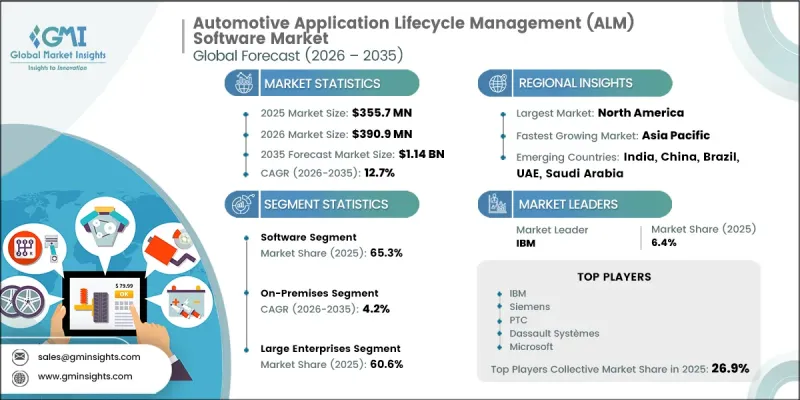
시장 확대는 차량 개발 프로세스의 디지털화 진전과 현대 자동차에서 소프트웨어 통합의 복잡성 증가에 힘입어 이루어지고 있습니다. 자동차 제조사, 엔지니어링 기업 및 소프트웨어 기술 제공업체들은 혁신을 지원하고, 업무 효율을 높이며, 제품 개발 워크플로우를 간소화하기 위해 공동 개발 생태계를 강화하고 있습니다. 소프트웨어 중심의 차량, 지능형 모빌리티 솔루션 및 첨단 자동차 기술의 급속한 발전으로 인해, 고도화된 애플리케이션 수명주기 관리 플랫폼에 대한 수요가 크게 증가하고 있습니다. 차량 내 소프트웨어 콘텐츠가 지속적으로 확대됨에 따라, 제조사들은 소프트웨어 품질을 향상시키고 개발 주기를 단축하며, 차량의 전체 수명 주기 동안 일관된 성능을 뒷받침하는 디지털 엔지니어링 환경에 대한 투자를 점점 더 늘리고 있습니다. 최신 ALM 솔루션을 통해 조직은 협업 강화, 개발 프로세스 자동화, 추적성 향상 및 규제 준수 관리 강화를 실현할 수 있습니다. 또한, 이러한 플랫폼은 소프트웨어 팀과 엔지니어링 팀 간의 원활한 협력을 촉진하여, 기업이 점점 더 복잡해지는 개발 프로그램을 보다 효과적으로 관리할 수 있도록 지원합니다. 애자일 조사 기법, 소프트웨어 신뢰성, 사이버 보안 관리 및 라이프사이클 가시성에 대한 중요성이 부각되고 있는 점도, 자동차 관련 기업들이 차세대 차량 개발 이니셔티브를 지원할 종합적인 솔루션을 모색함에 따라 시장 성장에 더욱 기여하고 있습니다.
| 시장 범위 | |
|---|---|
| 시작 연도 | 2025년 |
| 예측 기간 | 2026-2035년 |
| 시작 시점 시장 규모 | 3억 5,570만 달러 |
| 예측액 | 11억 4,000만 달러 |
| CAGR | 12.7% |
소프트웨어 부문은 65.3%의 점유율을 차지하고 있으며, 2026년부터 2035년까지 연평균 성장률(CAGR) 11.7%로 성장할 것으로 전망됩니다. 이 부문이 주도적인 위치를 차지하고 있는 주요 요인은, 점점 더 고도화되는 차량 소프트웨어 환경을 관리하기 위해 설계된 첨단 소프트웨어 플랫폼의 도입이 확대되고 있기 때문입니다. 이러한 솔루션을 통해 조직은 소프트웨어 요구 사항, 개발 워크플로우, 테스트 절차, 구성 관리 및 규정 준수 활동을 소프트웨어 수명 주기 전반에 걸쳐 관리할 수 있게 됩니다. 현대 차량의 소프트웨어가 점점 더 복잡해지는 가운데, 견고한 ALM 소프트웨어 플랫폼에 대한 수요는 계속해서 견조할 것으로 예상됩니다.
2025년에는 승용차 부문이 78.5%의 점유율을 차지했습니다. 이 부문의 성장은 승용차 플랫폼 전반에 걸쳐 디지털 기술, 첨단 전자 시스템, 지능형 차량 기능 및 커넥티드 모빌리티 기능의 통합이 확대됨에 따라 주도되고 있습니다. 각 제조사들은 개발의 복잡성에 대응하고, 현대 차량에서 점점 더 늘어나는 소프트웨어 요구 사항을 지원하기 위해 소프트웨어 관리 솔루션에 막대한 투자를 하고 있습니다. 고도로 연결되고 소프트웨어 중심의 승용차로의 전환이 진행되는 가운데, 지속적인 개발, 테스트, 배포 및 라이프사이클 관리 활동을 촉진하는 ALM 플랫폼의 도입이 더욱 가속화되고 있습니다.
미국의 자동차 애플리케이션 수명주기 관리(ALM) 소프트웨어 시장은 2025년에 9,860만 달러 규모를 기록했으며, 2035년까지 연평균 성장률(CAGR) 10.8%로 성장할 것으로 전망됩니다. 미국은 자동차 기술 혁신 기업, 자동차 제조사, 소프트웨어 개발 기관이 집중되어 있어 북미에서 가장 큰 시장을 형성하고 있습니다. 고도의 소프트웨어 엔지니어링 역량, 차량 개발 프로그램, 그리고 디지털 전환(DX) 이니셔티브에 대한 투자 확대가 시장 성장을 뒷받침하고 있습니다. 현대 차량 플랫폼에서 소프트웨어의 복잡성이 점차 증가하고 있으며, 차세대 자동차 기술 분야의 지속적인 혁신으로 인해 예측 기간 동안 애플리케이션 수명주기 관리 솔루션에 대한 수요가 유지될 것으로 전망됩니다.
자주 묻는 질문
목차
제1장 조사 방법
제2장 주요 요약
제3장 업계 인사이트
제4장 경쟁 구도
제5장 시장 추정 및 예측 : 구성요소별, 2022-2035년
제6장 시장 추정 및 예측 : 전개 방식별, 2022-2035년
제7장 시장 추정 및 예측 : 기업 규모별, 2022-2035년
제8장 시장 추정 및 예측 : 용도별, 2022-2035년
제9장 시장 추정 및 예측 : 차량별, 2022-2035년
제10장 시장 추정 및 예측 : 지역별, 2022-2035년
제11장 기업 개요
KSM 26.07.15The Global Automotive Application Lifecycle Management Software Market was valued at USD 355.7 million in 2025 and is estimated to grow at a CAGR of 12.7% to reach USD 1.14 billion by 2035.
Market expansion is driven by the increasing digitalization of vehicle development processes and the growing complexity of software integration within modern automobiles. Automotive manufacturers, engineering organizations, and software technology providers are strengthening collaborative development ecosystems to support innovation, improve operational efficiency, and streamline product development workflows. The rapid evolution of software-centric vehicles, intelligent mobility solutions, and advanced vehicle technologies is creating strong demand for sophisticated application lifecycle management platforms. As software content within vehicles continues to expand, manufacturers are increasingly investing in digital engineering environments that improve software quality, accelerate development cycles, and support consistent performance throughout the vehicle lifecycle. Modern ALM solutions enable organizations to enhance collaboration, automate development processes, improve traceability, and strengthen regulatory compliance management. These platforms also facilitate seamless coordination between software and engineering teams, allowing companies to manage increasingly complex development programs more effectively. Growing emphasis on agile methodologies, software reliability, cybersecurity management, and lifecycle visibility is further contributing to market growth as automotive organizations seek comprehensive solutions to support next-generation vehicle development initiatives.
| Market Scope | |
|---|---|
| Start Year | 2025 |
| Forecast Year | 2026-2035 |
| Start Value | $355.7 Million |
| Forecast Value | $1.14 Billion |
| CAGR | 12.7% |
The software segment accounted for 65.3% share and is projected to grow at a CAGR of 11.7% from 2026 to 2035. The segment's leadership is primarily attributed to the growing adoption of advanced software platforms designed to manage increasingly sophisticated vehicle software environments. These solutions enable organizations to oversee software requirements, development workflows, testing procedures, configuration management, and compliance activities across the entire software lifecycle. As software complexity continues to increase within modern vehicles, demand for robust ALM software platforms is expected to remain strong.
The passenger vehicles segment held 78.5% share in 2025. Growth within the segment is driven by the expanding integration of digital technologies, advanced electronic systems, intelligent vehicle functions, and connected mobility capabilities across passenger vehicle platforms. Manufacturers are making significant investments in software management solutions to address increasing development complexity and support the growing software requirements of modern vehicles. The ongoing transition toward highly connected and software-centric passenger vehicles is further accelerating the adoption of ALM platforms that facilitate continuous development, testing, deployment, and lifecycle management activities.
U.S. Automotive Application Lifecycle Management Software Market generated USD 98.6 million in 2025 and is anticipated to grow at a CAGR of 10.8% through 2035. The United States represents the largest market within North America due to its strong concentration of automotive technology innovators, vehicle manufacturers, and software development organizations. Increasing investments in advanced software engineering capabilities, vehicle development programs, and digital transformation initiatives are supporting market growth. Rising software complexity across modern vehicle platforms and continued innovation in next-generation automotive technologies are expected to sustain demand for application lifecycle management solutions throughout the forecast period.
Leading companies operating in the global automotive application lifecycle management software market include Siemens, Microsoft, Dassault Systemes, IBM, SAP, Atlassian, PTC, Broadcom, Codebeamer, and Polarion. Companies operating in the automotive application lifecycle management software market are pursuing a variety of strategic initiatives to strengthen their market position and expand their competitive advantage. Significant investments in research and development remain a key priority as vendors focus on enhancing platform capabilities, automation features, analytics tools, and lifecycle management functionalities. Strategic partnerships with automotive manufacturers, technology providers, and engineering organizations are helping companies broaden their customer base and accelerate innovation. Many market participants are expanding cloud-based offerings and integrating advanced technologies to improve collaboration, software quality, and operational efficiency. Acquisitions, product portfolio expansion, and continuous platform modernization are also being utilized to strengthen market presence.
Table of Contents
Chapter 1 Methodology
- 1.1 Research approach
- 1.2 Quality Commitments
- 1.2.1 GMI AI policy & data integrity commitment
- 1.2.1.1 Source consistency protocol
- 1.2.1 GMI AI policy & data integrity commitment
- 1.3 Research Trail & Confidence Scoring
- 1.3.1 Research Trail Components
- 1.3.2 Scoring Components
- 1.4 Data Collection
- 1.4.1 Partial list of primary sources
- 1.5 Data mining sources
- 1.5.1 Paid sources
- 1.5.1.1 Sources, by region
- 1.5.1 Paid sources
- 1.6 Base estimates and calculations
- 1.6.1 Base year calculation
- 1.7 Forecast
- 1.7.1 Quantified market impact analysis
- 1.7.1.1 Mathematical impact of growth parameters on forecast
- 1.7.1 Quantified market impact analysis
- 1.8 Research transparency addendum
- 1.8.1 Source attribution framework
- 1.8.2 Quality assurance metrics
- 1.8.3 Our commitment to trust
Chapter 2 Executive Summary
- 2.1 Industry 360° synopsis
- 2.2 Key market trends
- 2.2.1 Regional
- 2.2.2 Component
- 2.2.3 Deployment Mode
- 2.2.4 Organization Size
- 2.2.5 Application
- 2.2.6 Vehicle
- 2.3 TAM analysis, 2026-2035
- 2.4 CXO perspectives: Strategic imperatives
Chapter 3 Industry Insights
- 3.1 Industry ecosystem analysis
- 3.1.1 Supplier landscape
- 3.1.2 Profit margin
- 3.1.3 Cost structure
- 3.1.4 Value addition at each stage
- 3.1.5 Factor affecting the value chain
- 3.1.6 Disruptions
- 3.2 Industry impact forces
- 3.2.1 Growth drivers
- 3.2.1.1 Integrated ALM for Speed and Agility
- 3.2.1.2 Cloud ALM Appeals to SMEs and Remotes
- 3.2.1.3 ALM Ensures Compliance in Regulated Sectors
- 3.2.1.4 AI Enhances ALM Quality and Speed
- 3.2.2 Industry pitfalls & challenges
- 3.2.2.1 Complexity in Aligning ALM with Tools
- 3.2.2.2 Cloud ALM Raises Data Security Concerns
- 3.2.3 Market Opportunities
- 3.2.3.1 Rising adoption of DevOps and Agile
- 3.2.3.2 Growth of remote and hybrid workforces
- 3.2.3.3 AI and Automation Integration
- 3.2.3.4 Demand for Scalable, Customizable Solutions
- 3.2.1 Growth drivers
- 3.3 Growth potential analysis
- 3.4 Technology and innovation landscape
- 3.4.1 Current technological trends
- 3.4.2 Emerging technologies
- 3.5 Pricing Analysis (Driven by Primary Research)
- 3.5.1 Historical Price Trend Analysis
- 3.5.2 Pricing Strategy by Player Type
- 3.6 Regulatory landscape
- 3.6.1 North America
- 3.6.1.1 National Highway Traffic Safety Administration (NHTSA)
- 3.6.1.2 SAE International
- 3.6.2 Europe
- 3.6.2.1 European Union Agency for Cybersecurity (ENISA)
- 3.6.2.2 UNECE WP.29 Automotive Cybersecurity Regulations
- 3.6.3 Asia Pacific
- 3.6.3.1 Ministry of Industry and Information Technology (MIIT), China
- 3.6.3.2 Automotive Research Association of India (ARAI)
- 3.6.4 LATAM
- 3.6.4.1 Brazilian National Traffic Department (DENATRAN)
- 3.6.4.2 National Institute of Industrial Technology (INTI), Argentina
- 3.6.5 MEA
- 3.6.5.1 Saudi Standards, Metrology and Quality Organization (SASO)
- 3.6.5.2 Emirates Authority for Standardization and Metrology (ESMA)
- 3.6.1 North America
- 3.7 Porter’s analysis
- 3.8 PESTEL analysis
- 3.9 Patent analysis (Driven by Primary Research)
- 3.10 Impact of AI & Generative AI on the Market
- 3.10.1 AI-driven disruption of existing business models
- 3.10.2 Gen AI use cases & adoption roadmap by segment
- 3.10.3 Risks, limitations & regulatory considerations
- 3.11 Sustainability and environmental aspects
- 3.11.1 Sustainable practices
- 3.11.2 Waste reduction strategies
- 3.11.3 Energy efficiency in production
- 3.11.4 Eco-friendly initiatives
- 3.11.5 Carbon footprint considerations
- 3.12 Forecast assumptions & scenario analysis (Driven by primary research)
- 3.12.1 Base Case - key macro & industry variables driving CAGR
- 3.12.2 Optimistic Scenarios - Favorable macro and industry tailwinds
- 3.12.3 Pessimistic Scenario - Macroeconomic slowdown or industry headwinds
Chapter 4 Competitive Landscape, 2025
- 4.1 Introduction
- 4.2 Company market share analysis
- 4.2.1 North America
- 4.2.2 Europe
- 4.2.3 Asia Pacific
- 4.2.4 LATAM
- 4.2.5 MEA
- 4.3 Competitive analysis of major market players
- 4.4 Competitive positioning matrix
- 4.5 Key developments
- 4.5.1 Mergers & acquisitions
- 4.5.2 Partnerships & collaborations
- 4.5.3 New product launches
- 4.5.4 Expansion plans and funding
- 4.6 Company tier benchmarking
- 4.6.1 Tier classification criteria & qualifying thresholds
- 4.6.2 Tier positioning matrix by revenue, geography & innovation
Chapter 5 Market Estimates & Forecast, By Component, 2022 - 2035 ($Mn)
- 5.1 Key trends
- 5.2 Software
- 5.2.1 Agile Centric ALM
- 5.2.2 Process Centric
- 5.3 Services
- 5.3.1 Professional services
- 5.3.1.1 Consulting
- 5.3.1.2 Deployment & integration
- 5.3.1.3 Support & maintenance
- 5.3.2 Managed services
- 5.3.1 Professional services
Chapter 6 Market Estimates & Forecast, By Deployment mode, 2022 - 2035 ($Mn)
- 6.1 Key trends
- 6.2 On-Premises
- 6.3 Cloud-Based
- 6.4 Hybrid
Chapter 7 Market Estimates & Forecast, By Enterprise size, 2022 - 2035 ($Mn)
- 7.1 Key trends
- 7.2 Large enterprises
- 7.3 SMEs
Chapter 8 Market Estimates & Forecast, By Application, 2022 - 2035 ($Mn)
- 8.1 Key trends
- 8.2 Design & Development
- 8.3 Testing
- 8.4 Deployment
- 8.5 Maintenance & Updates
- 8.6 Other
Chapter 9 Market Estimates & Forecast, By Vehicle, 2022 - 2035 ($Mn)
- 9.1 Key trends
- 9.2 Passenger Vehicles
- 9.2.1 SUV
- 9.2.2 Sedan
- 9.2.3 Hatchback
- 9.3 Commercial Vehicles
- 9.3.1 LCV
- 9.3.2 MCV
- 9.3.3 HCV
Chapter 10 Market Estimates & Forecast, By Region, 2022 - 2035 ($Mn)
- 10.1 Key trends
- 10.2 North America
- 10.2.1 U.S.
- 10.2.2 Canada
- 10.3 Europe
- 10.3.1 Germany
- 10.3.2 UK
- 10.3.3 France
- 10.3.4 Italy
- 10.3.5 Spain
- 10.3.6 Russia
- 10.3.7 Nordic
- 10.4 Asia Pacific
- 10.4.1 China
- 10.4.2 India
- 10.4.3 Japan
- 10.4.4 South Korea
- 10.4.5 Australia
- 10.4.6 Vietnam
- 10.4.7 Indonesia
- 10.4.8 Singapore
- 10.5 Latin America
- 10.5.1 Brazil
- 10.5.2 Mexico
- 10.5.3 Argentina
- 10.6 MEA
- 10.6.1 South Africa
- 10.6.2 Saudi Arabia
- 10.6.3 UAE
Chapter 11 Company Profiles
- 11.1 Global players
- 11.1.1 IBM
- 11.1.2 Siemens
- 11.1.3 PTC
- 11.1.4 Dassault Systemes
- 11.1.5 Atlassian
- 11.1.6 Microsoft
- 11.1.7 SAP
- 11.1.8 Broadcom
- 11.1.9 Codebeamer
- 11.1.10 Polarion
- 11.2 Regional players
- 11.2.1 KPIT Technologies
- 11.2.2 Tata Elxsi
- 11.2.3 HCLTech
- 11.2.4 Infosys
- 11.2.5 AVL
- 11.2.6 ETAS
- 11.2.7 Vector Informatik
- 11.2.8 TTTech Auto
- 11.2.9 Elektrobit
- 11.2.10 Sonatus