
|
시장보고서
상품코드
2083089
탄소 네거티브 비료 시장 기회, 성장요인, 업계 동향 분석 및 예측(2026-2035년)Carbon-Negative Fertilizers (Biochar-Based) Market Opportunity, Growth Drivers, Industry Trend Analysis, and Forecast 2026 - 2035 |
||||||

세계의 탄소 네거티브 비료(바이오숯 기반) 시장은 2025년에 33억 달러로 평가되었고, CAGR 16.6%로 성장하여 2035년까지 184억 달러에 달할 것으로 예측됩니다.
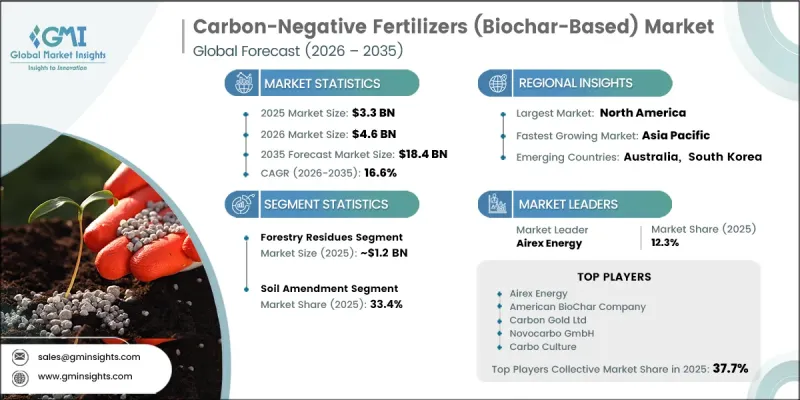
탄소 네거티브 비료(바이오숯 기반) 시장의 성장은 첨단 농업 기술의 융합, 유리한 탄소 관리 정책, 그리고 주요 농업 경제권에서 재생형 농업 기법의 채택 확대에 힘입어 이루어지고 있습니다. 탄소 회계 및 인증에 관한 규제 체계가 지속적으로 발전함에 따라, 바이오차 기반 비료는 농업적 이점뿐만 아니라 장기적인 탄소 격리 목표 달성에 기여한다는 점에서도 그 인지도가 높아지고 있습니다. 환경 친화적인 농업 생산에 대한 수요가 증가하고, 지속 가능한 공급망에 대한 관심이 확대되면서 시장 내 보급이 더욱 가속화되고 있습니다. 식품, 사료, 에너지 관련 업계에서는 탄소 감축 목표에 부합하는 농업 자재를 요구하는 움직임이 점점 더 강해지고 있으며, 바이오숯 계열 제품에 새로운 비즈니스 기회가 생겨나고 있습니다. 한편, 업계는 막대한 설비 투자, 에너지 집약적인 가공, 원료 관리, 엄격한 품질 보증 기준 등 대규모 생산에 수반되는 운영상의 과제에 직면해 있습니다. 이러한 요인들이 있음에도 불구하고, 기후 스마트 농업과 측정 가능한 탄소 감축 성과에 대한 관심이 높아지고 있는 것이 세계 시장의 성장세를 계속해서 뒷받침하고 있습니다.
| 시장 범위 | |
|---|---|
| 개시연도 | 2025년 |
| 예측 기간 | 2026-2035년 |
| 초기 시장 규모 | 33억 달러 |
| 예측액 | 184억 달러 |
| CAGR | 16.6% |
임업 유래 원료 부문은 36.2%의 점유율을 차지했으며, 2025년에는 12억 달러의 매출을 올렸습니다. 이 부문이 주도적인 위치를 차지하고 있는 것은 뛰어난 성능 특성을 지닌, 매우 안정성이 높은 탄소 함량이 높은 바이오숯을 생산할 수 있는 능력 덕분입니다. 비용 대비 효과가 높은 바이오매스 자원을 활용할 수 있고, 대규모 가공에 적합하기 때문에 상업적 바이오숯 생산 사업에서의 도입이 계속해서 견조한 추세를 보이고 있습니다.
2025년, 토양 개량 부문은 33.4%의 시장 점유율을 차지했습니다. 바이오숯 기반 비료는 수분 보유력 향상, 균형 잡힌 토양 상태 유지, 유익한 생물학적 활성 촉진, 그리고 영양소 이용 효율 향상과 같은 특성 덕분에 토양 개량을 목적으로 계속해서 널리 이용되고 있습니다. 이러한 성능상의 이점은 토양 생산성 향상과 장기적인 토지 관리 성과에 중점을 두는 농업 사업에서 바이오숯의 보급을 촉진하고 있습니다.
2025년, 북미의 탄소 네거티브 비료(바이오숯 기반) 시장은 48.8%의 점유율을 차지했습니다. 이 지역은 상업적 생산자들의 강력한 존재감, 확립된 탄소 크레딧 생태계, 그리고 지속 가능한 농업 이니셔티브에 대한 중요한 제도적 지원의 혜택을 누리고 있습니다. 정부가 지원하는 보전 프로그램과 환경 지속가능성 관련 노력은 농업 부문 전반에 걸쳐 계속해서 도입을 촉진하고 있습니다. 경제적으로 매력적인 탄소 크레딧 기회를 활용할 수 있다는 점은 시장의 성장 잠재력을 더욱 높여주고 있으며, 한편 바이오숯 기반 제품이 일반적인 농업 관행에 점점 더 통합되고 있는 것은 이 지역 시장 개발이 상당히 진전된 단계에 있음을 반영하고 있습니다.
자주 묻는 질문
목차
제1장 조사 방법과 범위
제2장 주요 요약
제3장 업계 인사이트
제4장 경쟁 구도
제5장 시장 추산 및 예측 : 원료 유형별, 2022년-2035년
제6장 시장 추산 및 예측 : 용도별, 2022년-2035년
제7장 시장 추산 및 예측 : 작물 유형별, 2022년-2035년
제8장 시장 추산 및 예측 : 지역별, 2022년-2035년
제9장 기업 개요
LSH 26.07.13The Global Carbon-Negative Fertilizers (Biochar-Based) Market was valued at USD 3.3 billion in 2025 and is estimated to grow at a CAGR of 16.6% to reach USD 18.4 billion by 2035.
Growth in the Carbon-Negative Fertilizers (Biochar-Based) Market is supported by the convergence of advanced agricultural technologies, favorable carbon management policies, and the increasing adoption of regenerative farming practices across major agricultural economies. As regulatory frameworks for carbon accounting and certification continue to evolve, biochar-based fertilizers are gaining recognition not only for their agronomic benefits but also for their contribution to long-term carbon sequestration objectives. Rising demand for environmentally responsible agricultural production and expanding interest in sustainable supply chains are further strengthening market adoption. Food, feed, and energy-related industries are increasingly seeking agricultural inputs that align with carbon reduction goals, creating new commercial opportunities for biochar-based products. At the same time, the industry faces operational challenges associated with large-scale production, including substantial capital investment requirements, energy-intensive processing, feedstock management, and stringent quality assurance standards. Despite these factors, growing emphasis on climate-smart agriculture and measurable carbon reduction outcomes continues to support strong market momentum worldwide.
| Market Scope | |
|---|---|
| Start Year | 2025 |
| Forecast Year | 2026-2035 |
| Start Value | $3.3 Billion |
| Forecast Value | $18.4 Billion |
| CAGR | 16.6% |
The forestry-derived feedstocks segment held a 36.2% share, generating USD 1.2 billion in 2025. Its leadership position is attributed to the ability to produce highly stable carbon-rich biochar with favorable performance characteristics. The availability of cost-effective biomass resources and their suitability for large-scale processing continue to support strong adoption within commercial biochar production operations.
The soil amendment segment captured 33.4% share in 2025. Biochar-based fertilizers continue to be widely utilized for soil enhancement purposes due to their ability to improve moisture retention, support balanced soil conditions, encourage beneficial biological activity, and increase nutrient accessibility. These performance benefits have contributed to widespread adoption across agricultural operations focused on improving soil productivity and long-term land management outcomes.
North America Carbon-Negative Fertilizers (Biochar-Based) Market held 48.8% share in 2025. The region benefits from a strong presence of commercial producers, established carbon credit ecosystems, and significant institutional support for sustainable agricultural initiatives. Government-backed conservation programs and environmental sustainability efforts continue to encourage adoption across the agricultural sector. The availability of economically attractive carbon credit opportunities further enhances market growth potential, while increasing integration of biochar-based products into standard farming practices reflects the region's advanced stage of market development.
Key participants operating in the Global Carbon-Negative Fertilizers (Biochar-Based) Market include Carbon Gold Ltd, Airex Energy, American BioChar Company, Applied Carbon, Arsta Eco Pvt Ltd, Biochar Industries, Carbo Culture, Biochar Ireland, Black Owl Biochar, Carbofex Ltd, NetZero, Novocarbo GmbH, Pacific Biochar, Sonnenerde GmbH, and Takachar. Companies active in the Carbon-Negative Fertilizers (Biochar-Based) Market are pursuing a range of strategies to strengthen their market position and expand commercial opportunities. A major focus remains on increasing production capacity and improving process efficiency to reduce manufacturing costs and support large-scale deployment. Many market participants are investing in advanced biochar technologies, feedstock optimization, and product innovation to enhance performance and meet evolving customer requirements. Strategic partnerships with agricultural organizations, carbon credit developers, and sustainability-focused stakeholders are helping companies expand market reach and accelerate adoption. Businesses are also emphasizing carbon certification, traceability systems, and environmental validation programs to strengthen product credibility.
Table of Contents
Chapter 1 Methodology & Scope
- 1.1 Research approach
- 1.2 Quality Commitments
- 1.2.1 GMI AI policy & data integrity commitment
- 1.2.1.1 Source consistency protocol
- 1.2.1 GMI AI policy & data integrity commitment
- 1.3 Research Trail & Confidence Scoring
- 1.3.1 Research Trail Components
- 1.3.2 Scoring Components
- 1.4 Data Collection
- 1.4.1 Partial list of primary sources
- 1.5 Data mining sources
- 1.5.1 Paid sources
- 1.5.1.1 Sources, by region
- 1.5.1 Paid sources
- 1.6 Base estimates and calculations
- 1.6.1 Base year calculation for any one approach
- 1.7 Forecast model
- 1.7.1 Quantified market impact analysis
- 1.7.1.1 Mathematical impact of growth parameters on forecast
- 1.7.1 Quantified market impact analysis
- 1.8 Research transparency addendum
- 1.8.1 Source attribution framework
- 1.8.2 Quality assurance metrics
- 1.8.3 Our commitment to trust
Chapter 2 Executive Summary
- 2.1 Industry 360° synopsis
- 2.2 Key market trends
- 2.2.1 Regional
- 2.2.2 Feedstock type
- 2.2.3 Application
- 2.2.4 Crop type
Chapter 3 Industry Insights
- 3.1 Industry ecosystem analysis
- 3.1.1 Supplier landscape
- 3.1.2 Profit margin
- 3.1.3 Value addition at each stage
- 3.1.4 Factor affecting the value chain
- 3.1.5 Disruptions
- 3.2 Industry impact forces
- 3.2.1 Growth drivers
- 3.2.1.1 Growing demand for carbon-negative agriculture solutions
- 3.2.1.2 Increasing government incentives for carbon sequestration technologies
- 3.2.1.3 Rising organic food production & sustainable farming practices
- 3.2.2 Industry pitfalls and challenges
- 3.2.2.1 High production & retail costs limiting adoption
- 3.2.2.2 Product inconsistency due to variable feedstock & processing
- 3.2.3 Market opportunities
- 3.2.3.1 Expansion into emerging agricultural markets
- 3.2.3.2 Development of biochar-enhanced controlled-release fertilizers
- 3.2.1 Growth drivers
- 3.3 Growth potential analysis
- 3.4 Regulatory landscape
- 3.4.1 North America
- 3.4.2 Europe
- 3.4.3 Asia Pacific
- 3.4.4 Latin America
- 3.4.5 Middle East & Africa
- 3.5 Porter's analysis
- 3.6 PESTEL analysis
- 3.7 Price trends
- 3.7.1 By region
- 3.7.2 By feedstock type
- 3.8 Future market trends
- 3.9 Technology and innovation landscape
- 3.9.1 Current technological trends
- 3.9.2 Emerging technologies
- 3.10 Patent Landscape
- 3.11 Trade statistics (HS code)
- 3.11.1 Major importing countries
- 3.11.2 Major exporting countries
- 3.12 Sustainability and environmental aspects
- 3.12.1 Sustainable practices
- 3.12.2 Waste reduction strategies
- 3.12.3 Energy efficiency in production
- 3.12.4 Eco-friendly initiatives
- 3.13 Carbon footprint consideration
Chapter 4 Competitive Landscape, 2025
- 4.1 Introduction
- 4.2 Company market share analysis
- 4.2.1 By region
- 4.2.1.1 North America
- 4.2.1.2 Europe
- 4.2.1.3 Asia Pacific
- 4.2.1.4 LATAM
- 4.2.1.5 MEA
- 4.2.1 By region
- 4.3 Competitive analysis of major market players
- 4.4 Competitive positioning matrix
- 4.5 Key developments
- 4.5.1 Mergers & acquisitions
- 4.5.2 Partnerships & collaborations
- 4.5.3 New Product Launches
- 4.5.4 Expansion Plans
Chapter 5 Market Estimates and Forecast, By Feedstock Type, 2022-2035 (USD Billion) (Kilo Tons)
- 5.1 Key trends
- 5.2 Agricultural waste
- 5.3 Forestry residues
- 5.4 Animal manure
- 5.5 Organic municipal waste
- 5.6 Industrial biomass
Chapter 6 Market Estimates and Forecast, By Application, 2022-2035 (USD Billion) (Kilo Tons)
- 6.1 Key trends
- 6.2 Soil amendment
- 6.3 Crop nutrient enhancement
- 6.4 Carbon sequestration
- 6.5 Waste management
Chapter 7 Market Estimates and Forecast, By Crop Type, 2022-2035 (USD Billion) (Kilo Tons)
- 7.1 Key trends
- 7.2 Cereals & grains
- 7.2.1 Wheat
- 7.2.2 Rice
- 7.2.3 Corn
- 7.2.4 Barley
- 7.3 Fruits & vegetables
- 7.3.1 Orchard crops
- 7.3.2 Vegetable crops
- 7.3.3 Berry cultivation
- 7.4 Oilseeds
- 7.4.1 Soybean
- 7.4.2 Canola
- 7.4.3 Sunflower
- 7.5 Horticulture crops
- 7.6 Others
Chapter 8 Market Estimates and Forecast, By Region, 2022-2035 (USD Billion) (Kilo Tons)
- 8.1 Key trends
- 8.2 North America
- 8.2.1 U.S.
- 8.2.2 Canada
- 8.3 Europe
- 8.3.1 Germany
- 8.3.2 UK
- 8.3.3 France
- 8.3.4 Spain
- 8.3.5 Italy
- 8.3.6 Rest of Europe
- 8.4 Asia Pacific
- 8.4.1 China
- 8.4.2 India
- 8.4.3 Japan
- 8.4.4 Australia
- 8.4.5 South Korea
- 8.4.6 Rest of Asia Pacific
- 8.5 Latin America
- 8.5.1 Brazil
- 8.5.2 Mexico
- 8.5.3 Argentina
- 8.5.4 Rest of Latin America
- 8.6 Middle East and Africa
- 8.6.1 Saudi Arabia
- 8.6.2 South Africa
- 8.6.3 UAE
- 8.6.4 Rest of Middle East and Africa
Chapter 9 Company Profiles
- 9.1 Airex Energy
- 9.2 American BioChar Company
- 9.3 Applied Carbon
- 9.4 Arsta Eco Pvt Ltd
- 9.5 Biochar Industries
- 9.6 Biochar Ireland
- 9.7 Black Owl Biochar
- 9.8 Carbo Culture
- 9.9 Carbofex Ltd
- 9.10 Carbon Gold Ltd
- 9.11 NetZero
- 9.12 Novocarbo GmbH
- 9.13 Pacific Biochar
- 9.14 Sonnenerde GmbH
- 9.15 Takachar