

|
시장보고서
상품코드
2155319
대나무 숯 : 시장 점유율 분석, 업계 동향과 통계, 성장 예측(2026-2031년)Bamboo Charcoal - Market Share Analysis, Industry Trends & Statistics, Growth Forecasts (2026 - 2031) |
||||||
 Mordor Intelligence
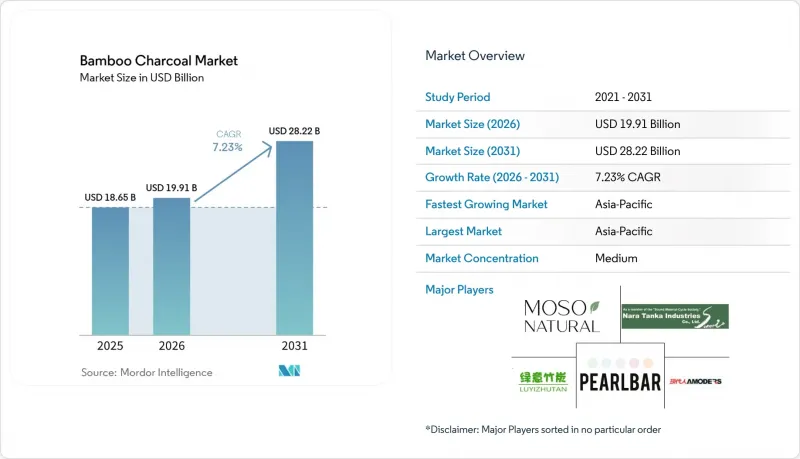
에 따르면 대나무 숯 시장은 2025년 186억 5,000만 달러에서 2026년에는 199억 1,000만 달러로 확대하며, 2031년까지 282억 2,000만 달러에 달할 것으로 전망되고 있으며, 예측 기간(2026-2031년)에 CAGR은 7.23%에 달할 전망입니다.
세계 대나무 숯 시장의 동향 및 인사이트
재생 가능하고 저탄소인 흡착제에 대한 수요 증가
수처리, 제약, 식품 가공 분야의 산업 구매자들은 대나무 숯 시장에서 지속가능성 노력을 바탕으로 흡착제의 사양을 평가하고 있습니다. 기존에는 석탄 유래 활성탄이 주류를 이루던 인증 공급업체 리스트에 재생 가능한 소재가 포함되기 시작하면서 시장이 혜택을 보고 있습니다. 대나무 재배는 열분해를 통해 바이오매스가 안정적인 탄소 풍부한 물질로 변환되기 전에 대기 중의 탄소를 흡수합니다. 2026년에 발표된 조사에 따르면 질소(N)가 도핑된 대나무 유래 바이오차은 첨단 흡착 용도에서 선택적으로 이산화탄소를 포집할 수 있는 것으로 밝혀졌습니다. 조달 팀은 스코프 3 보고에서 구매하는 투입 자재의 배출 강도도 고려하고 있습니다. 그 결과, 확립된 성능 및 비용 기준에 더해 재생 가능한 흡착제를 평가하는 데에는 경제적 인센티브가 작용하고 있습니다.
공기 및 수질 정화 용도의 확대
대기 및 수질 정화는 대나무 숯 시장의 주요 기능적 용도로, 정기적인 교체 수요를 지원하고 있습니다. 규제 요건의 강화로 수요가 증가하고 있으며, 규정 준수를 달성하기 위해서는 처리용 제품의 구매가 종종 필요합니다. 최적화된 KOH-요소 활성화 조건 하에서 고성능 대나무 숯은 디클로로메탄의 흡착 용량 610.90mg/g을 달성했습니다. 이러한 성능은 산업용 휘발성 유기 화합물(VOC) 제어 용도, 특히 용제를 많이 사용하는 공정에서의 사용을 지원합니다. 또한 중국과 인도에서는 대나무 숯을 결합한 복합 필터가 주거용 및 상업용 난방·환기·공조(HVAC) 제품에 점차 도입되고 있습니다. 교체용 필터는 지속적인 수요를 창출하므로, 소비자용 탈취 봉지와 같은 일회성 구매 품목과는 확연히 구분됩니다.
석탄계 활성탄 및 합성 흡착제와의 경쟁
석탄계 활성탄 공급업체는 규모의 경제, 재생 인프라, 그리고 광범위한 성능 데이터를 활용할 수 있다는 이점이 있으며, 이것이 대나무 숯으로의 전환을 저해하는 요인이 될 수 있습니다. 이러한 이점들은 공공사업, 제약, 가스 정제 분야의 계약에서 여전히 중요합니다. 따라서 대나무 숯 시장은 재생 가능한 원료라는 강점 외에도, 입증된 성능으로 경쟁해야 합니다. 금속-유기 골격체(MOF)나 기능화 실리카와 같은 합성 흡착제도 특수한 정화 용도로 사용되고 있습니다. 이러한 소재들의 등장은 낮은 오염 수준이 극히 중요한 고급 용도 시장에서 경쟁을 심화시키고 있습니다. 공급업체가 재생 데이터, 인증 및 장기적인 공급 안정성을 명확하게 문서화하지 않는 경우, 구매자는 기존 재료를 계속 사용할 가능성이 있습니다.
부문 분석
2025년, 원료 부문에서 마소 대나무가 대나무 숯 시장 점유율의 62.45%를 차지했습니다. 이러한 확고한 입지는 중국, 일본, 베트남 전역의 높은 조림 수확량, 확립된 탄화 기술, 그리고 잘 갖춰진 가공 인프라를 반영합니다. 또한 생산자들은 많은 제조 공정을 마소 대나무의 셀룰로오스, 리그닌 및 수분 특성에 맞춰 조정하고 있으며, 기존 시설이 대체 종으로 전환하기는 더욱 어려워지고 있습니다. Bambusa vulgaris(일반 대나무) 및 기타 종은 시장 점유율은 작지만, 마소 대나무 조림이 제한적인 동남아시아 지역에서는 여전히 중요한 위치를 차지하고 있습니다. 이러한 종들은 보다 탄력적인 조달 전략을 추구하는 생산자들에게 원료 다각화를 지원하고 있습니다.
Phyllostachys pubescens는 2031년까지 연평균 성장률(CAGR) 7.87%로 성장할 것으로 예측되며, 이는 원자재 중 가장 높은 성장률입니다. 이 종의 기공 구조는 포름알데히드 제거를 목적으로 하는 건축 환경 제품에 적합합니다. 2026년 연구에 따르면 Bambusa bambos 유래 숯은 메틸렌 블루 흡착 용량 18.8 mg/g, 탄소 순도 94.94%를 달성했습니다. 이러한 연구 결과는 마다케 이외의 품종에서도 소정의 흡착 성능이 요구되는 용도에 대응할 수 있음을 보여줍니다. 또한 재배 품종을 다양화함으로써 마다케 재배가 집중된 지역의 병해 및 가뭄 위험에 대한 노출을 줄일 수도 있습니다. 다만, 각 품종별로 공정에 따른 최적화가 필요하므로 이러한 전환은 점진적으로 이루어질 것으로 보입니다.
2025년 용도별 대나무 숯 시장 규모 중 탈취 용도가 37.76%를 차지했습니다. 일본, 한국, 북미 지역의 소비자 이용이 대나무 숯 제품의 폭넓은 보급 기반을 지원하고 있습니다. 이 카테고리는 규제 대상인 처리 용도에 비해 제품 개발 주기가 짧습니다. 대조적으로, 공기 정화, 농업 및 토양 개량, 퍼스널 케어, 식품 관련 용도는 각각 서로 다른 수요 요인에 의존하고 있습니다. 도시 지역의 대기질 규제가 공기 정화 수요를 지원하는 한편, 천연 성분을 선호하는 소비자의 기호가 퍼스널 케어 용도를 견인하고 있습니다. 또한 농업 분야의 사용자들도 탄소 고정 가능성을 지닌 토양 개량재로 대나무 숯을 높이 평가하고 있습니다.
정수·수처리 분야는 2031년까지 연평균 성장률(CAGR) 7.94%로 성장할 것으로 예측됩니다. 이러한 전망을 지원하는 것은 가정용 여과 및 산업용 폐수 처리에서의 수요이며, 처리 시스템에는 반복적인 구매와 규제 준수를 목적으로 한 투자가 필요하기 때문입니다. 가정용 현장 처리 시스템과 산업용 폐수 처리 용도 모두 수요 증가에 기여하고 있습니다. 환경 규제 준수로 인해 산업용 처리 시스템의 조달은 일반 소비자 구매에 비해 재량권이 적습니다. 말레이시아의 업계 조사에 따르면 조사 대상인 대나무 유래 활성탄 제조업체는 모두 수처리 및 공기 정화 분야에 제품을 공급하고 있는 것으로 나타났습니다. 또한 이 조사에서는 제조업체의 66.7%가 식품 가공 및 제약 업계 고객에게 제품을 제공하고 있는 것으로 보고되었습니다. 일본에서는 탄소 크레딧 제도가 농업용 토양에 대한 적용 측면에서 추가적인 가치 창출의 원천이 될 가능성이 있습니다.
지역별 분석
아시아태평양은 2025년에 매출의 35.23%를 차지할 것으로 예상되며, 2031년까지 연평균 성장률(CAGR) 8.05%로 성장할 것으로 전망됩니다. 이 지역은 풍부한 대나무 원료와 대나무 숯 시장을 지원하는 집중된 생산·소비 시스템을 모두 갖추고 있으며, 중국은 여전히 생산의 중심지로서 모소대나무 조림지와 가까운 저장성, 푸젠성, 쓰촨성에 생산 거점이 집중되어 있습니다. 이 지역의 생산자들은 국내 산업 수요를 충족시킬 뿐만 아니라 북미, 일본, 유럽 등 수출 시장에도 공급하고 있습니다. 인도는 가공 및 바이오매스 분야에 대한 투자를 통해 대나무 밸류체인을 확대하고 있습니다.
아삼주는 2026년 4월, 12억 달러 규모의 대나무 유래 바이오메탄올 제조 시설에 대해 세제상의 우대 조치를 승인했습니다. 이 프로젝트는 더 광범위한 지역의 대나무 공급망을 지원하는 것이며, 인근 대나무 숯 생산자들에게도 잠재적인 이익을 가져다줄 가능성이 있습니다. 한편, 일본에서는 수질 정화의 전통과 정교한 건강 관련 제품 부문의 존재로 인해 평균 판매 가격이 높게 형성되어 있습니다. 북미와 유럽은 주로 수입 지역이며, 지속가능성에 관한 규제와 소비자 선호도가 대나무 숯 시장의 수요를 좌우하고 있습니다. 지침 2024/825에 따라 환경 관련 주장을 지원하는 문서를 보유한 공급업체가 우대받을 가능성이 있습니다.
남미, 중동 및 아프리카는 대나무 숯 시장에서 여전히 수익 규모가 작은 지역입니다. 브라질의 상업 농업 부문에서는 토양 개량 용도를 위한 대나무 유래 바이오차에 대한 평가가 진행되고 있습니다. 아르헨티나 미시오네스 주에서는 2026년 6월, 대나무 유래 활성탄 및 바이오차 제조 시설을 위해 250만 달러의 자금이 조달되었습니다. 이 시설은 지역 대나무 숯 시장 고객을 대상으로 연간 600-800톤의 활성탄을 생산하는 초기 생산 능력을 목표로 하고 있습니다. 콜롬비아산 과두아 앙구스티폴리아(Guadua angustifolia)에 대한 조사 결과, 모소대나무 유래 재료에 필적하는 활성탄으로서의 가능성이 확인되었습니다. 중동 및 아프리카에서는 상수도 인프라와 특수한 소비자 수요가 장기적인 비즈니스 기회를 제공하고 있습니다.
기타 혜택:
- 엑셀 형식의 시장 예측(ME) 시트
- 3개월간의 애널리스트 지원
자주 묻는 질문
목차
제1장 서론
- 조사 전제조건과 시장 정의
- 조사 범위
제2장 조사 방법
제3장 개요
제4장 시장 구도
- 시장 개요
- 시장 성장 촉진요인
- 시장 성장 억제요인
- 밸류체인 분석
- Porter's Five Forces 분석
제5장 시장 규모와 성장 예측
- 원재료별
- 용도별
- 밀도별
- 최종 용도별
- 지역별
- 아시아태평양
- 중국
- 인도
- 일본
- 한국
- ASEAN 국가
- 기타 아시아태평양 국가
- 북미
- 미국
- 캐나다
- 멕시코
- 유럽
- 독일
- 영국
- 프랑스
- 이탈리아
- 북유럽 국가
- 기타 유럽 국가
- 남미
- 브라질
- 아르헨티나
- 기타 남미 국가
- 중동 및 아프리카
- 사우디아라비아
- 남아프리카공화국
- 기타 중동 및 아프리카 국가
- 아시아태평양
제6장 경쟁 구도
- 시장 집중도
- 전략적 동향
- 시장 점유율·순위 분석
- 기업 개요
- Moso Natural
- Nara Tanka Industries Co., Ltd.
- Quzhou Modern Carbon Industry Co., Ltd.
- Jiangshan Luyi Bamboo Charcoal Co., Ltd.
- PearlBar
- Tantech Holdings Ltd.
- Bamboo Life
- Green Charcoal International
- Nagaland Bamboo Resource Centre
- Taiwan Paiho
- Bamboo Charcoal Indonesia
- Charcoal House LLC
- Vivera Bamboo Charcoal
- Fujian Guangze Qingsheng Charcoal Industry Co., Ltd.
- XUTAI BARBECUE CHARCOAL CO.,LTD
제7장 시장 기회와 향후 전망
KSA 26.10.28According to Mordor Intelligence, the bamboo charcoal market is expected to grow from USD 18.65 billion in 2025 to USD 19.91 billion in 2026 and reach USD 28.22 billion by 2031, at a CAGR of 7.23% during the forecast period (2026-2031).
Global Bamboo Charcoal Market Trends and Insights
Rising Demand for Renewable and Low-Carbon Adsorbents
Industrial buyers in the water treatment, pharmaceutical, and food processing sectors are assessing adsorbent specifications against sustainability commitments in the bamboo charcoal market. The market benefits as renewable materials gain inclusion on approved vendor lists historically dominated by coal-derived activated carbon. Bamboo cultivation captures atmospheric carbon before pyrolysis converts the biomass into a stable, carbon-rich material. Research published in 2026 found that N-doped bamboo-derived biochar provides selective carbon dioxide capture for advanced adsorption applications. Procurement teams also consider the emissions intensity of purchased inputs in Scope 3 reporting. Consequently, they have a financial incentive to evaluate renewable adsorbents alongside established performance and cost criteria.
Expansion of Air and Water Purification Applications
Air and water purification represent major functional applications within the bamboo charcoal market, supporting recurring replacement demand. Regulatory requirements are strengthening demand, as treatment purchases are often necessary to achieve compliance. Under optimized KOH-urea activation conditions, advanced bamboo charcoal achieved a dichloromethane adsorption capacity of 610.90 mg/g. This performance supports its use in industrial volatile organic compound control applications, particularly in solvent-intensive operations. Bamboo charcoal-embedded composite filters are also being incorporated into residential and commercial heating, ventilation, and air conditioning products in China and India. Replacement filters can generate repeat demand, distinguishing them from one-time purchases of consumer deodorizing bags.
Competition from Coal-Based Activated Carbon and Synthetic Adsorbents
Coal-based activated carbon suppliers benefit from scale, regeneration infrastructure, and extensive performance documentation, which can limit conversion to bamboo charcoal. These advantages remain important in utility, pharmaceutical, and gas purification contracts. Therefore, the bamboo charcoal market must compete on verified performance in addition to renewable feedstock credentials. Synthetic adsorbents, including metal-organic frameworks and functionalized silica, also serve specialized purification applications. Their presence intensifies competition in premium applications where low contamination levels are critical. Buyers may continue to use incumbent materials when suppliers do not clearly document regeneration data, certifications, and long-term supply consistency.
Other drivers and restraints analyzed in the detailed report include:
- Growth in Natural Personal Care, Wellness, and E-Commerce Products
- Government Support for Bamboo Processing and Biomass Utilization
- Limited Consumer Awareness, Certification, and Traceability Gaps
For complete list of drivers and restraints, kindly check the Table Of Contents.
Segment Analysis
Moso bamboo accounted for 62.45% of the bamboo charcoal market share in the raw material segment in 2025. Its strong position reflects high plantation yields, established carbonization practices, and well-developed processing infrastructure across China, Japan, and Vietnam. Producers have also calibrated many production processes to the cellulose, lignin, and moisture characteristics of Moso bamboo, making it more complex for existing facilities to switch to alternative species. Bambusa vulgaris and other species hold smaller shares but remain important in Southeast Asian regions with limited Moso bamboo plantations. These species support feedstock diversification for producers seeking more resilient sourcing strategies.
Phyllostachys pubescens is projected to grow at a CAGR of 7.87% through 2031, the fastest rate among raw materials. Its pore structure is relevant for building-environment products designed for formaldehyde removal. A 2026 study reports that Bambusa bambos-derived charcoal achieved a methylene blue adsorption capacity of 18.8 mg/g and carbon purity of 94.94%. These findings indicate that non-Moso species can support applications requiring defined adsorption performance. A broader species mix can also reduce exposure to disease and drought risks in areas with concentrated Moso bamboo cultivation. However, this shift is likely to remain gradual, as each species requires process-specific optimization.
Deodorization accounted for 37.76% of the bamboo charcoal market size by application in 2025. Consumer use across Japan, South Korea, and North America supports the broad installed base for bamboo charcoal products. This category has a shorter product development cycle than regulated treatment applications. In contrast, air purification, agriculture and soil improvement, personal care, and food-related applications depend on distinct demand drivers. Urban air quality requirements support demand for air purification, while consumer preferences for natural ingredients drive personal care applications. Agricultural users are also evaluating bamboo charcoal as a soil amendment with carbon-retention potential.
The water purification and treatment segment is forecast to grow at a CAGR of 7.94% through 2031. Demand from household filtration and industrial wastewater treatment supports this outlook, as treatment systems require repeat purchases and compliance-driven investments. Household point-of-use systems and industrial wastewater treatment applications are both contributing to demand growth. Environmental compliance makes industrial treatment procurement less discretionary than many consumer purchases. A Malaysian industry study found that all surveyed producers of bamboo-derived activated carbon supplied the water treatment and air purification sectors. The same study reported that 66.7% of producers served food processing and pharmaceutical clients. In Japan, carbon-credit frameworks may provide an additional source of value for agricultural soil applications.
Complete Report Scope:
- By Raw Material
- Moso Bamboo
- Phyllostachys Pubescens
- Bambusa Vulgaris
- Other Bamboo Species
- By Application
- Deodorization
- Air Purification
- Water Purification and Treatment
- Health and Personal Care
- Agriculture and Soil Improvement
- Other Applications
- By Density
- High Density
- Medium Density
- Low Density
- By End Use
- Residential
- Commercial
- Industrial
- Others
- By Geography
- Asia-Pacific
- China
- India
- Japan
- South Korea
- ASEAN Countries
- Rest of Asia-Pacific
- North America
- United States
- Canada
- Mexico
- Europe
- Germany
- United Kingdom
- France
- Italy
- NORDIC Countries
- Rest of Europe
- South America
- Brazil
- Argentina
- Rest of South America
- Middle East and Africa
- Saudi Arabia
- South Africa
- Rest of Middle East and Africa
- Asia-Pacific
Geography Analysis
Asia-Pacific accounted for 35.23% of revenue in 2025 and is forecast to grow at 8.05% CAGR through 2031. The region combines substantial bamboo feedstock with concentrated production and consumption systems that anchor the bamboo charcoal market, while China remains a production center, with clusters in Zhejiang, Fujian, and Sichuan located near Moso plantation areas. Producers in these areas supply domestic industrial demand and export customers in North America, Japan, and Europe. India is expanding its bamboo value chain through processing and biomass investments.
Assam approved fiscal incentives in April 2026 for a USD 1.20 billion bamboo-to-biomethanol facility. The project supports a larger regional bamboo supply chain, with potential benefits for adjacent charcoal producers, while Japan has higher average selling prices because of its water purification tradition and sophisticated wellness products segment. North America and Europe are primarily importing regions where sustainability rules and consumer preferences guide bamboo charcoal market demand. Directive 2024/825 can favor suppliers with documentation that supports environmental claims.
South America and the Middle East and Africa remain smaller revenue areas within the bamboo charcoal market. Brazil's commercial agriculture sector is evaluating bamboo-derived biochar for soil amendment uses. Argentina's Misiones province attracted USD 2.50 million for a bamboo-derived activated carbon and biochar facility in June 2026. The facility targets initial capacity of 600-800 tonnes of activated carbon each year for regional bamboo charcoal market customers. Research on Colombia's Guadua angustifolia identified activated carbon potential comparable to Moso-derived materials. Water infrastructure and specialty consumer demand offer longer-term opportunities in the Middle East and Africa.
- Moso Natural
- Nara Tanka Industries Co., Ltd.
- Quzhou Modern Carbon Industry Co., Ltd.
- Jiangshan Luyi Bamboo Charcoal Co., Ltd.
- PearlBar
- Tantech Holdings Ltd.
- Bamboo Life
- Green Charcoal International
- Nagaland Bamboo Resource Centre
- Taiwan Paiho
- Bamboo Charcoal Indonesia
- Charcoal House LLC
- Vivera Bamboo Charcoal
- Fujian Guangze Qingsheng Charcoal Industry Co., Ltd.
- XUTAI BARBECUE CHARCOAL CO.,LTD
Additional Benefits:
- The market estimate (ME) sheet in Excel format
- 3 months of analyst support
TABLE OF CONTENTS
1 INTRODUCTION
- 1.1 Study Assumptions and Market Definition
- 1.2 Scope of the Study
2 RESEARCH METHODOLOGY
3 EXECUTIVE SUMMARY
4 MARKET LANDSCAPE
- 4.1 Market Overview
- 4.2 Market Drivers
- 4.2.1 Rising Demand for Renewable and Low-Carbon Adsorbents
- 4.2.2 Expansion of Air and Water Purification Applications
- 4.2.3 Growth in Natural Personal Care and Wellness Products
- 4.2.4 Government Support for Bamboo Processing and Biomass Utilization
- 4.2.5 E-Commerce Expansion for Consumer Deodorizing and Filtration Products
- 4.3 Market Restraints
- 4.3.1 Competition from Coal-Based Activated Carbon and Synthetic Adsorbents
- 4.3.2 Limited Consumer Awareness and Inconsistent Certification
- 4.3.3 Feedstock Age, Moisture, and Species Traceability Gaps
- 4.4 Value Chain Analysis
- 4.5 Porter's Five Forces Analysis
- 4.5.1 Bargaining Power of Suppliers
- 4.5.2 Bargaining Power of Buyers
- 4.5.3 Threat of New Entrants
- 4.5.4 Threat of Substitutes
- 4.5.5 Competitive Rivalry
5 MARKET SIZE AND GROWTH FORECASTS (VALUE)
- 5.1 By Raw Material
- 5.1.1 Moso Bamboo
- 5.1.2 Phyllostachys Pubescens
- 5.1.3 Bambusa Vulgaris
- 5.1.4 Other Bamboo Species
- 5.2 By Application
- 5.2.1 Deodorization
- 5.2.2 Air Purification
- 5.2.3 Water Purification and Treatment
- 5.2.4 Health and Personal Care
- 5.2.5 Agriculture and Soil Improvement
- 5.2.6 Other Applications
- 5.3 By Density
- 5.3.1 High Density
- 5.3.2 Medium Density
- 5.3.3 Low Density
- 5.4 By End Use
- 5.4.1 Residential
- 5.4.2 Commercial
- 5.4.3 Industrial
- 5.4.4 Others
- 5.5 By Geography
- 5.5.1 Asia-Pacific
- 5.5.1.1 China
- 5.5.1.2 India
- 5.5.1.3 Japan
- 5.5.1.4 South Korea
- 5.5.1.5 ASEAN Countries
- 5.5.1.6 Rest of Asia-Pacific
- 5.5.2 North America
- 5.5.2.1 United States
- 5.5.2.2 Canada
- 5.5.2.3 Mexico
- 5.5.3 Europe
- 5.5.3.1 Germany
- 5.5.3.2 United Kingdom
- 5.5.3.3 France
- 5.5.3.4 Italy
- 5.5.3.5 NORDIC Countries
- 5.5.3.6 Rest of Europe
- 5.5.4 South America
- 5.5.4.1 Brazil
- 5.5.4.2 Argentina
- 5.5.4.3 Rest of South America
- 5.5.5 Middle East and Africa
- 5.5.5.1 Saudi Arabia
- 5.5.5.2 South Africa
- 5.5.5.3 Rest of Middle East and Africa
- 5.5.1 Asia-Pacific
6 COMPETITIVE LANDSCAPE
- 6.1 Market Concentration
- 6.2 Strategic Moves
- 6.3 Market Share (%)/Ranking Analysis
- 6.4 Company Profiles (includes Global Level Overview, Market Level Overview, Core Segments, Financials as available, Strategic Information, Products and Services, Recent Developments)
- 6.4.1 Moso Natural
- 6.4.2 Nara Tanka Industries Co., Ltd.
- 6.4.3 Quzhou Modern Carbon Industry Co., Ltd.
- 6.4.4 Jiangshan Luyi Bamboo Charcoal Co., Ltd.
- 6.4.5 PearlBar
- 6.4.6 Tantech Holdings Ltd.
- 6.4.7 Bamboo Life
- 6.4.8 Green Charcoal International
- 6.4.9 Nagaland Bamboo Resource Centre
- 6.4.10 Taiwan Paiho
- 6.4.11 Bamboo Charcoal Indonesia
- 6.4.12 Charcoal House LLC
- 6.4.13 Vivera Bamboo Charcoal
- 6.4.14 Fujian Guangze Qingsheng Charcoal Industry Co., Ltd.
- 6.4.15 XUTAI BARBECUE CHARCOAL CO.,LTD
7 MARKET OPPORTUNITIES AND FUTURE OUTLOOK
- 7.1 White-Space and Unmet-Need Assessment


