

|
시장보고서
상품코드
2083090
자율주행 트럭 시장 기회, 성장 촉진요인, 업계 동향 분석 및 예측(2026-2035년)Self-Driving Truck Market Opportunity, Growth Drivers, Industry Trend Analysis, and Forecast 2026 - 2035 |
||||||

세계의 자율주행 트럭 시장은 2025년에 20억 달러 규모에 달하고, 2035년까지 CAGR 39.4%로 성장하여 638억 달러에 달할 것으로 추정됩니다.
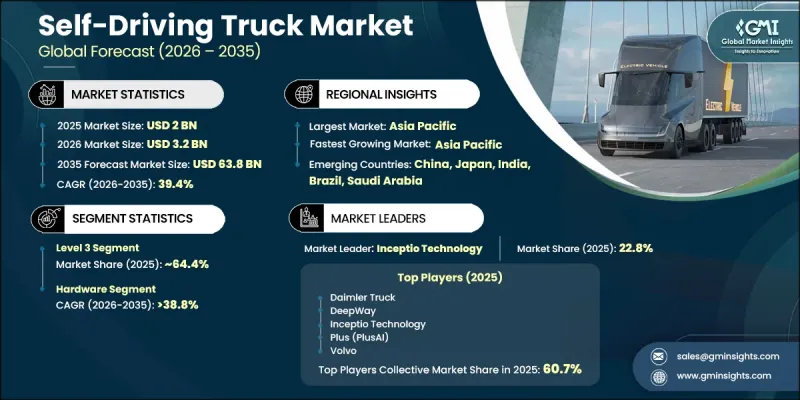
화물 운송 업계가 만성적인 인력 부족, 운영 비용 상승, 그리고 배송 효율성 향상에 대한 압박이 커지는 상황에 대처하기 위한 해결책을 모색하고 있어, 이 시장은 급속히 확대되고 있습니다. 경험이 풍부한 트럭 운전사를 확보하기가 어려워지고 있는 데다 근로자들의 성향 변화까지 더해지면서, 물류 기업들은 인력 운영자에 대한 의존도를 낮추면서도 화물의 지속적인 운송을 보장할 수 있는 자율주행 기술에 대한 투자를 확대하고 있습니다. 자율주행 트럭은 운전자의 피로로 인한 제약 없이 장시간 운행할 수 있으므로, 차량 가동률과 운송 효율을 높일 수 있습니다. E-Commerce와 국제 무역의 지속적인 확대로 인해, 보다 신속한 배송 일정을 뒷받침할 수 있는 신뢰할 수 있는 화물 운송에 대한 수요가 더욱 높아지고 있습니다. 자율주행 트럭은 경로 최적화를 촉진하고, 대기 시간을 최소화하며, 24시간 운영을 가능하게함으로써 물류 사업자의 생산성 향상과 운영비 절감을 지원합니다. 또한, 보다 안정적인 주행 패턴을 통해 연비 효율이 향상되고 교통 흐름이 원활해짐에 따라, 자율주행 트럭 시장의 장기적인 성장 전망을 뒷받침하고 있습니다.
| 시장 범위 | |
|---|---|
| 시작 연도 | 2025년 |
| 예측 기간 | 2026-2035년 |
| 시작 시점 시장 규모 | 20억 달러 |
| 예측액 | 638억 달러 |
| CAGR | 39.4% |
레벨 3 부문은 2025년에 64.4%의 점유율을 차지했으며, 2035년까지 연평균 성장률(CAGR) 38.9%로 성장할 것으로 전망됩니다. 이 부문은 자율주행 기능과 사람의 감시 사이에서 효과적인 균형을 제공함으로써 계속해서 가장 큰 시장 점유율을 유지하고 있습니다. 레벨 3 자율주행 트럭은 정의된 주행 조건 하에서 대부분의 주행 기능을 수행할 수 있는 한편, 필요에 따라 운전자가 조종을 인수할 수도 있습니다. 이 기능을 통해 운전자의 피로 완화, 연비 향상, 장거리 화물 운송의 효율화가 도모됩니다. ADAS(첨단 운전자 지원 시스템), 고속도로 자율주행 기술 및 지능형 차량 관리 솔루션에 대한 수요가 증가함에 따라, 상업 물류 업무에서 레벨 3 자율주행 트럭의 도입이 계속해서 가속화되고 있습니다.
하드웨어 부문은 2025년에 55.1%의 점유율을 차지했으며, 2026년부터 2035년까지 연평균 성장률(CAGR) 38.8%로 성장할 것으로 전망됩니다. 자율주행 트럭은 LiDAR, 레이더, 카메라, 초음파 센서, GPS 모듈, 고성능 프로세서, 차량용 컴퓨팅 시스템 등 첨단 하드웨어 구성요소에 크게 의존하고 있기 때문에 이 부문은 선도적인 위치를 유지하고 있습니다. 이러한 기술을 통해 차량은 주변을 감지하고, 장애물을 식별하며, 실시간 주행 정보를 처리함으로써 다양한 도로 상황에서도 안전하게 주행할 수 있게 됩니다. 운영상의 신뢰성을 확보하기 위한 여러 중복화된 감지 시스템에 대한 수요가 증가함에 따라, 첨단 하드웨어에 대한 수요도 계속해서 견인되고 있습니다. 레벨 3 및 레벨 4 자율주행 트럭의 도입이 확대됨에 따라, 고성능 자율주행 부품에 대한 투자가 더욱 가속화될 것으로 예상됩니다.
중국의 자율주행 트럭 시장은 64.2%의 점유율을 차지하고 있으며, 2025년에는 7억 달러 규모의 시장에 달했습니다. 해당 국가의 시장 성장은 물류 업계의 지속적인 확대, 인공지능 기술의 급속한 발전, 그리고 자율주행 차량 개발에 대한 막대한 투자에 힘입어 이루어지고 있습니다. 대규모 화물 운송 부문에 더해, 지능형 교통 시스템(ITS)을 추진하는 지원 정책이 맞물리면서 시장 성장은 계속해서 탄력을 받고 있습니다. 또한, 수많은 자율주행 기술 개발 기업과 제조업체가 존재한다는 점도 지속적인 혁신에 기여하고 있으며, 지역 자율주행 트럭 시장에서 중국의 주도적 지위를 공고히 하고 있습니다.
자주 묻는 질문
목차
제1장 조사 방법
제2장 주요 요약
제3장 업계 인사이트
제4장 경쟁 구도
제5장 시장 추정 및 예측 : 자율주행 레벨별, 2022-2035년
제6장 시장 추정 및 예측 : 구성요소별, 2022-2035년
제7장 시장 추정 및 예측 : 용도별, 2022-2035년
제8장 시장 추정 및 예측 : 최종사용자별, 2022-2035년
제9장 시장 추정 및 예측 : 추진력별, 2022-2035년
제10장 시장 추정 및 예측 : 차량 클래스별, 2022-2035년
제11장 시장 추정 및 예측 : 지역별, 2022-2035년
제12장 기업 개요
KSM 26.07.16The Global Self-Driving Truck Market was valued at USD 2 billion in 2025 and is estimated to grow at a CAGR of 39.4% to reach USD 63.8 billion by 2035.
The market is expanding rapidly as the freight transportation industry seeks solutions to address persistent workforce shortages, rising operating costs, and increasing pressure to improve delivery efficiency. The declining availability of experienced truck drivers, coupled with changing workforce preferences, has encouraged logistics companies to invest in autonomous transportation technologies that reduce reliance on human operators while ensuring continuous cargo movement. Self-driving trucks offer the ability to operate for extended periods without the limitations associated with driver fatigue, improving fleet utilization and transportation efficiency. The continued expansion of e-commerce activities and international trade is further increasing demand for reliable freight transportation capable of supporting faster delivery schedules. Autonomous trucking also enables better route optimization, minimizes idle time, and supports around-the-clock operations, helping logistics providers improve productivity and lower operating expenses. In addition, more consistent driving patterns contribute to greater fuel efficiency and smoother traffic flow, reinforcing the long-term growth prospects of the self-driving truck market.
| Market Scope | |
|---|---|
| Start Year | 2025 |
| Forecast Year | 2026-2035 |
| Start Value | $2 Billion |
| Forecast Value | $63.8 Billion |
| CAGR | 39.4% |
The Level 3 segment accounted for 64.4% share in 2025 and is projected to grow at a CAGR of 38.9% through 2035. This segment continues to hold the largest market share because it provides an effective balance between automated driving capabilities and human oversight. Level 3 autonomous trucks can perform most driving functions under defined operating conditions while allowing the driver to assume control whenever necessary. This capability helps reduce driver fatigue, improve fuel efficiency, and enhance the performance of long-distance freight transportation. Growing demand for advanced driver assistance systems (ADAS), highway automation technologies, and intelligent fleet management solutions continues to accelerate the adoption of Level 3 autonomous trucks across commercial logistics operations.
The hardware segment held 55.1% share in 2025 and is anticipated to grow at a CAGR of 38.8% between 2026 and 2035. The segment maintains its leading position because autonomous trucks rely heavily on sophisticated hardware components, including LiDAR, radar, cameras, ultrasonic sensors, GPS modules, high-performance processors, and onboard computing systems. These technologies enable vehicles to detect their surroundings, identify obstacles, process real-time driving information, and navigate safely under varying road conditions. The increasing requirement for multiple redundant sensing systems to ensure operational reliability continues to drive demand for advanced hardware. Growing deployment of Level 3 and Level 4 autonomous trucks is expected to further accelerate investment in high-performance autonomous driving components.
China Self-Driving Truck Market held 64.2% share, generating USD 0.7 billion in 2025. Market growth in the country is supported by the continued expansion of the logistics industry, rapid advancements in artificial intelligence technologies, and significant investment in autonomous vehicle development. A large freight transportation sector, combined with supportive policies promoting intelligent transportation systems, continues to strengthen market growth. The presence of numerous autonomous driving technology developers and manufacturers also contributes to continuous innovation, reinforcing China's leadership within the regional self-driving truck market.
Major companies operating in the global self-driving truck market include Tesla, Volvo, Daimler Truck, Waabi, DeepWay, TRATON, Pony.ai, Plus (PlusAI), Einride, and Inceptio Technology. Companies operating in the self-driving truck market are strengthening their competitive position by investing heavily in autonomous driving software, advanced sensing technologies, and artificial intelligence to improve vehicle safety and operational performance. Many industry participants are expanding strategic partnerships with logistics providers, technology developers, and fleet operators to accelerate commercialization and large-scale deployment. Continuous research and development efforts are focused on enhancing autonomous driving capabilities, improving sensor accuracy, and increasing system reliability. Businesses are also investing in high-performance hardware platforms, cloud-connected fleet management solutions, and over-the-air software updates to optimize vehicle operations.
Table of Contents
Chapter 1 Methodology
- 1.1 Research approach
- 1.2 Quality Commitments
- 1.2.1 GMI AI policy & data integrity commitment
- 1.2.1.1 Source consistency protocol
- 1.2.1 GMI AI policy & data integrity commitment
- 1.3 Research Trail & Confidence Scoring
- 1.3.1 Research Trail Components
- 1.3.2 Scoring Components
- 1.4 Data Collection
- 1.4.1 Partial list of primary sources
- 1.5 Data mining sources
- 1.5.1 Paid sources
- 1.5.1.1 Sources, by region
- 1.5.1 Paid sources
- 1.6 Base estimates and calculations
- 1.6.1 Base year calculation
- 1.7 Forecast Model
- 1.7.1 Quantified market impact analysis
- 1.7.1.1 Mathematical impact of growth parameters on forecast
- 1.7.1 Quantified market impact analysis
- 1.8 Research transparency addendum
- 1.8.1 Source attribution framework
- 1.8.2 Quality assurance metrics
- 1.8.3 Our commitment to trust
Chapter 2 Executive Summary
- 2.1 Industry 360° synopsis, 2022 - 2035
- 2.2 Key market trends
- 2.2.1 Regional
- 2.2.2 Level of autonomy
- 2.2.3 Component
- 2.2.4 Application
- 2.2.5 End user
- 2.2.6 Propulsion
- 2.2.7 Vehicle Class
- 2.3 TAM Analysis, 2026-2035
- 2.4 CXO perspectives: Strategic imperatives
Chapter 3 Industry Insights
- 3.1 Industry ecosystem analysis
- 3.1.1 Supplier landscape
- 3.1.2 Profit margin analysis
- 3.1.3 Cost structure
- 3.1.4 Value addition at each stage
- 3.1.5 Factor affecting the value chain
- 3.1.6 Disruptions
- 3.2 Industry impact forces
- 3.2.1 Growth drivers
- 3.2.1.1 Rising driver shortages in the trucking industry
- 3.2.1.2 Growing demand for freight transportation efficiency
- 3.2.1.3 Advancements in AI, sensors, and autonomous driving technologies
- 3.2.1.4 Increasing focus on road safety and accident reduction
- 3.2.2 Industry pitfalls and challenges
- 3.2.2.1 High development and deployment costs
- 3.2.2.2 Regulatory and legal uncertainties
- 3.2.3 Market opportunities
- 3.2.3.1 Development of autonomous long-haul freight networks
- 3.2.3.2 Growth of autonomous truck-as-a-service (TaaS) models
- 3.2.3.3 Expansion in mining, port, and industrial logistics applications
- 3.2.3.4 Increasing investments in smart transportation infrastructure
- 3.2.1 Growth drivers
- 3.3 Growth potential analysis
- 3.4 Technology and Innovation landscape
- 3.4.1 Current technological trends
- 3.4.2 Emerging technologies
- 3.5 Pricing Analysis (Driven by Primary Research)
- 3.5.1 Historical Price Trend Analysis
- 3.5.2 Pricing Strategy by Player Type (Premium / Value / Cost-plus)
- 3.6 Regulatory guidelines
- 3.6.1 North America
- 3.6.1.1 U.S.: FMCSA Autonomous Commercial Vehicle Framework & NHTSA Automated Driving System (ADS) Regulations
- 3.6.1.2 Canada: Transport Canada Automated and Connected Vehicle Policy Framework & Motor Vehicle Safety Regulations.
- 3.6.2 Europe
- 3.6.2.1 Germany: Autonomous Driving Act (AFGBV) & KBA Automated Vehicle Approval Requirements
- 3.6.2.2 UK: Automated Vehicles Act & Connected and Automated Mobility (CAM) Regulatory Framework
- 3.6.2.3 France: Mobility Orientation Law (LOM) & Automated Road Transport System Regulations
- 3.6.2.4 Italy: Smart Road Decree & UNECE Automated Lane Keeping System (ALKS) Compliance Requirements
- 3.6.3 Asia Pacific
- 3.6.3.1 China: Intelligent Connected Vehicle (ICV) Pilot Regulations & Autonomous Freight Transport Guidelines
- 3.6.3.2 India: Ministry of Road Transport & Highways (MoRTH) Vehicle Automation Policies & AIS Safety Standards
- 3.6.3.3 Japan: MLIT Automated Driving Vehicle Safety Standards & Road Transport Vehicle Act
- 3.6.3.4 South Korea: Autonomous Vehicle Commercialization Act & K-City Autonomous Driving Testing Framework
- 3.6.3.5 Australia: National Transport Commission (NTC) Automated Vehicle Regulatory Reforms & Heavy Vehicle National Law (HVNL)
- 3.6.4 Latin America
- 3.6.4.1 Brazil: CONTRAN Connected Vehicle Regulations & Autonomous Freight Mobility Pilot Framework
- 3.6.4.2 Mexico: NOM Commercial Vehicle Safety Standards & Intelligent Transport System (ITS) Regulations
- 3.6.4.3 Argentina: National Road Safety Agency (ANSV) Connected Vehicle Compliance Framework & Automated Mobility Pilot Programs
- 3.6.5 MEA
- 3.6.5.1 UAE: UAE Autonomous Transportation Strategy & Smart Freight Mobility Regulations
- 3.6.5.2 Saudi Arabia: Transport General Authority (TGA) Autonomous Vehicle Guidelines & SASO Commercial Vehicle Standards
- 3.6.5.3 South Africa: National Road Traffic Act & Connected and Automated Vehicle Testing Framework
- 3.6.1 North America
- 3.7 Porter's analysis
- 3.8 PESTEL analysis
- 3.9 Patent Landscape (Driven by Primary Research)
- 3.10 Trade Data Analysis (Driven by paid database)
- 3.10.1 Import/export volume & value trends
- 3.10.2 Key trade corridors & tariff impact
- 3.11 Capacity & Production Landscape (Driven by Primary Research)
- 3.11.1 Installed Capacity by Region & Key Producer
- 3.11.2 Capacity Utilization Rates & Expansion Pipelines
- 3.12 Cost breakdown analysis
- 3.13 Impact of AI & Generative AI on the Market (Driven by Primary Research)
- 3.13.1 AI-Driven Disruption of Existing Business Models
- 3.13.2 GenAI Use Cases & Adoption Roadmap by Segment
- 3.13.3 Risks, Limitations & Regulatory Considerations
- 3.14 Forecast assumptions & scenario analysis (Driven by Primary Research)
- 3.14.1 Base Case - Key Macro & Industry Variables Driving CAGR
- 3.14.2 Optimistic Scenarios - Favourable macro and industry tailwinds
- 3.14.3 Pessimistic Scenario - Macroeconomic slowdown or industry headwinds
Chapter 4 Competitive Landscape, 2025
- 4.1 Introduction
- 4.2 Company market share analysis
- 4.2.1 North America
- 4.2.2 Europe
- 4.2.3 Asia Pacific
- 4.2.4 Latin America
- 4.2.5 MEA
- 4.3 Competitive analysis of major market players
- 4.4 Competitive positioning matrix
- 4.5 Key developments
- 4.5.1 Mergers & acquisitions
- 4.5.2 Partnerships & collaborations
- 4.5.3 New Product Launches
- 4.5.4 Expansion Plans and funding
- 4.6 Company Tier Benchmarking
- 4.6.1 Tier Classification Criteria & Qualifying Thresholds
- 4.6.2 Tier Positioning Matrix by Revenue, Geography & Innovation
Chapter 5 Market Estimates & Forecast, By Level of Autonomy, 2022 - 2035 ($Bn, Units)
- 5.1 Key trends
- 5.2 Level 3
- 5.3 Level 4
- 5.4 Level 5
Chapter 6 Market Estimates & Forecast, By Component, 2022 - 2035 ($Bn, Units)
- 6.1 Key trends
- 6.2 Hardware
- 6.2.1 LiDAR sensors
- 6.2.2 Radar sensors
- 6.2.3 Cameras & vision systems
- 6.2.4 Ultrasonic sensors
- 6.2.5 Compute units (ECUs / GPUs / AI Chips)
- 6.2.6 GPS & HD mapping modules
- 6.2.7 V2X communication hardware
- 6.3 Software
- 6.3.1 Perception & AI/ML algorithms
- 6.3.2 Path planning & decision-making platforms
- 6.3.3 Simulation & virtual testing software
- 6.3.4 OTA update & fleet management software
- 6.4 Services
- 6.4.1 System integration & deployment services
- 6.4.2 Remote monitoring & teleoperation services
- 6.4.3 Maintenance & support services
- 6.4.4 Data analytics & insights services
Chapter 7 Market Estimates & Forecast, By Application, 2022 - 2035 ($Bn, Units)
- 7.1 Key trends
- 7.2 Long-haul freight transportation
- 7.3 Hub-to-hub transportation
- 7.4 Last-mile & regional delivery
- 7.5 Mining & construction logistics
- 7.6 Port & yard operations
- 7.7 Industrial logistics
- 7.8 Others
Chapter 8 Market Estimates & Forecast, By End User, 2022 - 2035 ($Bn, Units)
- 8.1 Key trends
- 8.2 Logistics & transportation companies
- 8.3 E-commerce companies
- 8.4 Retail & consumer goods companies
- 8.5 Manufacturing companies
- 8.6 Mining companies
- 8.7 Government & defense
- 8.8 Others
Chapter 9 Market Estimates & Forecast, By Propulsion, 2022 - 2035 ($Bn, Units)
- 9.1 Key trends
- 9.2 Internal combustion engine (ICE)
- 9.3 Electric
- 9.3.1 Battery electric vehicles (BEV)
- 9.3.2 Fuel cell electric vehicle (FCEV)
- 9.4 Hybrid
Chapter 10 Market Estimates & Forecast, By Vehicle Class, 2022 - 2035 ($Bn, Units)
- 10.1 Key trends
- 10.2 Class 4
- 10.3 Class 5
- 10.4 Class 6
- 10.5 Class 7
- 10.6 Class 8
Chapter 11 Market Estimates & Forecast, By Region, 2022 - 2035 ($Bn, Units)
- 11.1 Key trends
- 11.2 North America
- 11.2.1 US
- 11.2.2 Canada
- 11.3 Europe
- 11.3.1 Germany
- 11.3.2 UK
- 11.3.3 France
- 11.3.4 Italy
- 11.3.5 Spain
- 11.3.6 Russia
- 11.3.7 Netherlands
- 11.3.8 Belgium
- 11.4 Asia Pacific
- 11.4.1 China
- 11.4.2 India
- 11.4.3 Japan
- 11.4.4 Australia
- 11.4.5 South Korea
- 11.4.6 New Zealand
- 11.5 Latin America
- 11.5.1 Brazil
- 11.5.2 Mexico
- 11.5.3 Argentina
- 11.6 MEA
- 11.6.1 South Africa
- 11.6.2 Saudi Arabia
- 11.6.3 UAE
Chapter 12 Company Profiles
- 12.1 Global Players
- 12.1.1 Applied Intuition
- 12.1.2 Aurora Innovation
- 12.1.3 Daimler Truck
- 12.1.4 Einride
- 12.1.5 PACCAR
- 12.1.6 Plus (PlusAI)
- 12.1.7 Tesla
- 12.1.8 TRATON
- 12.1.9 Volvo
- 12.1.10 Waabi
- 12.2 Regional Players
- 12.2.1 DeepWay
- 12.2.2 Gatik
- 12.2.3 Hyundai Motor Company
- 12.2.4 Inceptio Technology
- 12.2.5 Isuzu Motors
- 12.2.6 Kodiak Robotics
- 12.2.7 Pony.ai
- 12.3 Emerging Players
- 12.3.1 Bot Auto
- 12.3.2 RideFlux
- 12.3.3 Trunk Technology


