
|
시장보고서
상품코드
2102911
자율주행 트럭 시장 예측(-2035년) : 용도별, ADAS 특성별, 자율주행 레벨별, 구동 방식별, 센서 유형별, 차량 클래스별, 차종별, 지역별Autonomous Trucks Market by Vehicle Type (Buses, Trucks), LOA (L1, L2&L3, L4, L5), ADAS Features (ACC, AEB, BSD, IPA, TJA, LKA, HP), Vehicle Class (Class 1-3, 4-6, 7-8), Propulsion Type, Application, Sensor Type, and Region Global Forecast To 2035 |
||||||

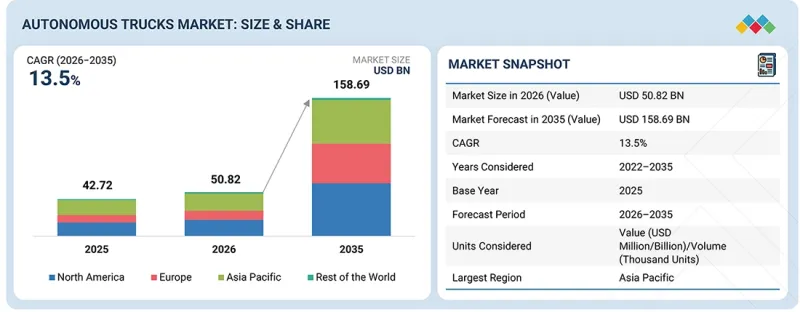
자율주행 트럭 시장 규모는 2026년 508억 2,000만 달러에서 2035년까지 1,586억 9,000만 달러로 확대하며, CAGR은 13.5%에 달할 것으로 예측됩니다.
전기자동차 및 자율주행차에 대한 수요가 증가함에 따라 차세대 화물 운송에 대한 투자가 가속화되고 있으며, 이 시장은 성장세를 보이고 있습니다. 2025년 10월, Aurora Innovation은 미국 텍사스주 포트워스에서 엘파소에 이르는 구간에 걸쳐 상용 무인 트럭 운송 서비스 제공 범위를 확대하며, 미국을 대표하는 주요 운송 노선 중 하나를 따라 자율형 화물 운송 사업을 확충했습니다.
| 조사 범위 | |
|---|---|
| 조사 대상 기간 | 2026-2035년 |
| 기준연도 | 2025년 |
| 예측 기간 | 2026-2035년 |
| 대상 단위 | 10억 달러 |
| 부문 | 용도별, ADAS 기능별, 자율주행 레벨별, 구동 방식별, 센서 유형별, 차량 클래스별, 차종별, 지역별 |
| 대상 지역 | 아시아태평양, 유럽, 북미, 기타 지역 |
OEM의 트럭 플랫폼에 자율주행 기술 통합이 진행되고 있는 데다, 지속가능하고 효율적인 물류에 대한 관심이 높아짐에 따라 차량 운영 사업자들은 자율주행 트럭 솔루션 도입을 적극적으로 추진하고 있습니다. 규제 측면의 진전과 자율주행 시스템의 기술적 발전도 시장 성장을 더욱 지원하고 있으며, 자율주행 트럭은 미래 운송 생태계의 중요한 구성 요소로서의 입지를 확립해 가고 있습니다.
추진 방식별로는 예측 기간 중 디젤 부문이 현저한 성장 기회를 맞이할 것으로 전망됩니다.
양산 가능한 자율주행 차량에 대한 투자 확대, 상업용 화물 운송 시범 사업 확대, 그리고 디젤 구동 트럭 차량군에 대한 첨단 센싱 기술 및 자율주행 기술의 통합으로 인해 디젤은 자율주행 트럭 시장에서 계속해서 주요 추진 방식으로 자리매김할 것으로 예상됩니다. 2026년 5월, 다임러 트럭 AG(독일)와 Torc Robotics(미국)는 레벨 4 자율주행 트럭 ‘Freightliner Cascadia’의 양산용 LiDAR 공급업체로 Innoviz Technologies(이스라엘)를 선정하여, 2027년으로 예정된 상용화를 지원하게 되었습니다. 디젤 플랫폼에 대한 지속적인 집중은 대중교통 사업자들이 제한된 설비 투자로 기존 대중교통 네트워크에 통합 가능한, 실적이 입증된 버스 아키텍처 위에 자율주행 기술을 도입하는 것을 선호하는 경향을 반영하고 있습니다. 2026년 6월, 카르산(Karsan)은 이스탄불 공항에서 레벨 4 자율주행 버스 ‘e ATAK’의 자율주행 실증 시험을 완료하며, 통제된 상용 환경에서 자율주행 버스 기술의 성숙도가 높아지고 있음을 입증했습니다.
차량 등급별로 보면 예측 기간 중 자율주행 트럭 시장에서 클래스 7-8 부문이 가장 높은 성장률을 보일 것으로 전망됩니다.
클래스 7-8 부문에서는 각각 총 차량 중량(GVWR)이 2만 6,000-3만 3,000파운드인 트럭과 3만 3,001파운드 이상의 트럭이 대상이 됩니다. 이러한 성장은 중형 및 대형 화물 운송 분야에서 자율주행 기술의 도입 확대에 힘입어 이루어지고 있습니다. 클래스 7의 경우, 물류 사업자들이 미들마일(middle-mile) 업무를 자동화함에 따라 상용 도입이 확대되고 있습니다. 2025년 9월, Gatik(미국)과 Loblaw Companies Limited(캐나다)는 캐나다내 자율주행 트럭 사업 제휴를 확대하여 무인 화물 운송 업무의 규모를 키웠습니다. 여러 자동화 수준에 대응하는 기술 개발이 진행됨에 따라 클래스 7 및 클래스 8 차량에서의 도입이 가속화되고 있습니다. 예를 들어 2026년 1월, Hesai Technology(중국)는 레벨 2, 레벨 3 및 레벨 4 자율주행 시스템을 위해 설계된 ‘Infinity Eye LiDAR’ 솔루션을 발표하며 상용차 용도의 고도화된 인지 능력을 지원했습니다. 이러한 동향은 중형 및 대형 트럭 부문에서 반자율주행 기술과 자율주행 기술이 모두 점점 더 많이 채택되고 있음을 여실히 보여줍니다.
중국은 아시아태평양의 자율주행 트럭 시장에서 놀라운 성장을 이룰 것으로 예상됩니다.
중국은 자율주행 기술, 상용차 제조 및 지능형 교통시스템(ITS) 분야의 강력한 국내 역량을 바탕으로 아시아태평양의 자율주행 트럭 시장에서 눈에 띄는 성장을 보일 것으로 예상됩니다. 중국은 화물 운송 및 여객 운송 두 분야 모두에서 자율주행 솔루션 도입을 지속적으로 추진하고 있습니다. 예를 들어 2025년 11월, Pony.ai(중국)는 SANY Truck(중국) 및 동풍류저우자동차(중국)와 제휴하여 4세대 자율주행 트럭 플랫폼을 발표했습니다. 이는 확장성이 뛰어난 트럭 플랫폼을 통해 자율주행 화물 운송의 상용화를 지원하기 위한 것입니다. 또한 2025년 8월에는 WeRide(중국)와 선전 버스 그룹이 선전 최초의 완전 무인 자율주행 상용 버스 노선 운행을 시작하며, 대중교통 분야에서 자율주행 기술 도입이 확대되고 있음을 보여주었습니다. 이러한 움직임은 다양한 상용차 용도에 걸친 자율주행 솔루션 도입에서 중국의 진전을 부각시키는 동시에, 중국이 자율주행 기술의 대규모 상용화에 점점 더 주력하고 있음을 반영합니다.
자율주행 트럭 시장은 AB Volvo(스웨덴), Daimler Truck AG(독일), MAN Truck and Bus SE(독일), Iveco S.p.A.(이탈리아), PACCAR Inc.(미국) 등 주요 기업이 주도하고 있습니다. 이 기업은 강력한 제품 포트폴리오에 더해 전 세계적인 판매 네트워크를 보유하고 있습니다.
조사 범위:
본 조사 보고서에서는 자율주행 트럭 시장을 차종(트럭), 차량 등급(클래스 1-3, 클래스 4-6, 클래스 7-8), ADAS 기능(어댑티브 크루즈 컨트롤(ACC), 자동 긴급 제동(AEB), 사각지대 감지(BSD), 차선 유지 보조(LKA), 지능형 주차 보조(IPA), 정체 주행 보조(TJA), 하이웨이 파일럿(HP)), 구동 방식(디젤, 전기, 하이브리드), 용도(라스트 마일 배송 트럭, 광산용 트럭, 셔틀, 도시 간·도시내 트럭), 센서 유형(카메라, 라이다, 레이더, 초음파), 자율주행 레벨(L1, L2 및 L3, L4, L5), 그리고 지역(아시아태평양, 유럽, 북미, 기타 지역)별로 분석하고 있습니다. 이 보고서의 조사 범위에는 자율주행 트럭 시장의 성장에 영향을 미치는 주요 요인(촉진요인, 제약 요인, 과제, 기회 등)에 대한 상세 정보가 포함되어 있습니다. 주요 업계 플레이어에 대해서는 사업 개요, 솔루션, 서비스, 주요 전략, 계약, 파트너십, 합의 사항, 제품·서비스 출시, 합병·인수, 기타 동향에 대한 인사이트를 제공하기 위해 상세한 분석이 이루어졌습니다. 또한 이 보고서에서는 자율주행 트럭 시장의 생태계에서 두각을 보이고 있는 스타트업 기업의 경쟁 분석에 대해서도 다루고 있습니다.
이 보고서를 구매해야 하는 이유:
- 이 보고서는 자율주행 트럭 시장 전체 및 그 하위 부문의 매출에 대한 가장 정확한 추정치를 제공함으로써, 이 시장의 시장 리더와 신규 진입 기업을 지원합니다.
- 이 보고서는 이해관계자가 경쟁 구도를 이해하고, 자사의 비즈니스를 더 나은 위치로 이끌며, 적절한 시장 진입 전략을 수립하기 위한 추가적인 인사이트를 얻는 데 도움이 됩니다.
- 또한 이 보고서는 이해관계자가 시장 동향을 파악하고, 주요 시장 촉진요인, 제약, 과제 및 기회에 대한 정보를 얻는 데 도움이 됩니다.
- 이 보고서는 이해관계자가 적재량에 기반한 각종 자율주행 트럭의 현재 및 미래 가격 동향을 이해하는 데 도움이 됩니다.
이 보고서는 다음 사항에 대한 인사이트를 제공합니다. :
주요 촉진요인(도로 안전 및 교통 통제에 대한 관심 증가, 운전사 부족에 대한 대응 필요성 증가, 자율주행 기술의 확산, 그리고 정부의 우호적인 규제 및 안전 기준)에 대한 분석, 제약 요인(사이버 보안 및 데이터 보안에 대한 우려, 일반 대중의 낮은 수용도, 개발도상국의 인프라 부족)에 대한 분석, 과제(개발 및 통합에 드는 높은 비용, 규제상의 장벽), 그리고 기회(차량 연결을 위한 5G 기술 통합, 첨단 기술 활용 확대, 트럭 플래토닝에 대한 수요 급증, 자동차용 IoT에 대한 관심 증가)에 대한 인사이트를 제공합니다.
- 제품 개발/혁신: 자율주행 트럭 시장의 향후 기술, 연구개발 활동, 그리고 신제품 및 서비스 출시에 대한 상세 인사이트.
- 시장 개발: 수익성이 높은 시장에 대한 포괄적인 정보(이 보고서에서는 다양한 지역의 자율주행 트럭 시장을 분석하고 있습니다).
- 시장 다각화: 자율주행 트럭 시장의 신제품·서비스, 미개발 지역, 최근 동향 및 투자에 관한 포괄적인 정보.
- 경쟁 분석: AB Volvo(스웨덴), Daimler Truck AG(독일), MAN Truck and Bus SE(독일), Iveco S.p.A.(이탈리아), PACCAR Inc.(미국)과 같은 주요 OEM 제조사와 Yutong Bus Co.(중국), Xiamen King Long United Automotive Industry(중국), Einride(스웨덴), WeRide(중국), Isuzu Motors(일본) 등 자율주행 트럭 시장의 주요 OEM 및 기타 주요 기업의 시장 순위, 성장 전략, 서비스 제공에 대해 상세히 평가합니다.
자주 묻는 질문
목차
제1장 서론
제2장 개요
제3장 주요 인사이트
제4장 시장 개요
제5장 업계 동향
제6장 기술 진보, 특허, AI의 영향
제7장 규제 상황
제8장 고객 상황과 구매 행동
제9장 향후 수익화 전망
제10장 자율주행 트럭 시장(용도별)
제11장 자율주행 트럭 시장(ADAS 기능별)
제12장 자율주행 트럭 시장(자율주행 레벨별)
제13장 자율주행 트럭 시장(추진 방식별)
제14장 자율주행 트럭 시장(센서 유형별)
제15장 자율주행 트럭 시장(차량 클래스별)
제16장 자율주행 트럭 시장(차종별)
제17장 자율주행 트럭 시장(지역별)
제18장 경쟁 구도
제19장 기업 개요
제20장 조사 방법
제21장 부록
KSA 26.08.05The autonomous trucks market is projected to expand from USD 50.82 billion in 2026 to 158.69 billion by 2035, at a CAGR of 13.5%. The market is gaining momentum as rising demand for electric and autonomous vehicles accelerates investment in next-generation freight transportation. In October 2025, Aurora Innovation expanded its commercial driverless trucking service from Fort Worth to El Paso in Texas, US, extending autonomous freight operations along one of the country's major transportation routes.
| Scope of the Report | |
|---|---|
| Years Considered for the Study | 2026-2035 |
| Base Year | 2025 |
| Forecast Period | 2026-2035 |
| Units Considered | USD Billion |
| Segments | by Vehicle Type, Vehicle Class, Propulsion Type, Application, Sensor Type, and Region |
| Regions covered | Asia Pacific, Europe, North America, Rest of the World |
Growing integration of autonomous technology into OEM truck platforms, combined with increasing focus on sustainable and efficient logistics, is encouraging fleet operators to adopt autonomous trucking solutions. Supportive regulatory developments and advancements in autonomous driving systems are further strengthening market growth, positioning autonomous trucks as a key component of the future transportation ecosystem.
By propulsion type, the diesel segment is expected to experience notable growth opportunities during the forecast period.
Diesel is expected to remain the leading propulsion type in the autonomous trucks market due to the increasing investments in production-ready autonomous vehicles, expansion of commercial freight pilots, and the integration of advanced sensing and automated driving technologies into diesel-powered truck fleets. In May 2026, Daimler Truck AG (Germany) and Torc Robotics (US) selected Innoviz Technologies (Israel) as the LiDAR supplier for the series production of the Level 4 autonomous Freightliner Cascadia, supporting its planned commercial launch in 2027. The continued focus on diesel platforms reflects transit operators' preference for deploying autonomous technologies on proven bus architectures that can be integrated into existing public transportation networks with limited capital investment. In June 2026, Karsan completed autonomous operational trials of its Level 4 Autonomous e ATAK at Istanbul Airport, demonstrating the growing maturity of autonomous bus technologies in controlled commercial environments.
By vehicle class, the Class 7-8 segment will exhibit the highest growth rate in the autonomous trucks market during the forecast period.
In the Class 7-8 segment, trucks with GVWR ranging between 26,000 and 33,000 lbs and more than or equal to 33,001 lbs are considered, respectively. Growth is being driven by the increasing adoption of autonomous technology across medium and heavy-duty freight applications. In Class 7, commercial deployments are expanding as logistics providers automate middle-mile operations. In September 2025, Gatik (US) and Loblaw Companies Limited (Canada) expanded their autonomous trucking partnership in Canada to scale driverless freight operations. The development of technologies supporting multiple automation levels is accelerating adoption across Class 7 and Class 8 vehicles. For example, in January 2026, Hesai Technology (China) introduced its Infinity Eye LiDAR solution designed for Level 2, Level 3, and Level 4 autonomous driving systems, supporting enhanced perception capabilities for commercial vehicle applications. These developments highlight the growing adoption of both semi-autonomous and autonomous technologies across medium and heavy-duty truck segments.
China is expected to witness substantial growth in the Asia Pacific autonomous trucks market.
China is expected to show substantial growth in the Asia Pacific autonomous trucks market, supported by strong domestic capabilities in autonomous driving technology, commercial vehicle manufacturing, and intelligent transportation systems. The country continues to advance the deployment of automated driving solutions across both freight and passenger transportation applications. For example, in November 2025, Pony.ai (China) introduced its Gen 4 autonomous truck platform in collaboration with SANY Truck (China) and Dongfeng Liuzhou Motor (China), supporting the commercialization of autonomous freight transportation through a scalable truck platform. In addition, in August 2025, WeRide (China) and Shenzhen Bus Group launched Shenzhen's first fully driverless commercial bus route, demonstrating the growing adoption of autonomous driving technologies in public transportation. These developments highlight China's progress in deploying autonomous solutions across multiple commercial vehicle applications and reflect the country's increasing focus on large-scale commercialization of autonomous mobility technologies.
In-depth interviews were conducted with CEOs, marketing directors, other innovation and technology directors, and executives from various key organizations operating in this market.
- By Company Type: OEMs - 32%, Tier 1 - 40% and Tier 2 & 3 - 28%,
- By Designation: CXOs - 31%, Managers -45%, and Executives -24%
- By Region: North America - 26%, Europe - 30%, Asia Pacific - 35%, and Rest of the World-9%
The autonomous trucks market is dominated by major players such as AB Volvo (Sweden), Daimler Truck AG (Germany), MAN Truck and Bus SE (Germany), Iveco S.p.A. (Italy), and PACCAR Inc. (US), among others. These companies have strong product portfolios as well as strong distribution networks at the global level.
Research Coverage:
This research report categorizes the autonomous trucks market by vehicle type (Trucks), vehicle class (Class 1-3, Class 4-6, Class 7-8), ADAS feature (Adaptive Cruise Control (ACC), Automatic Emergency Braking (AEB), Blind Spot Detection (BSD), Lane Keep Assist (LKA), Intelligent Park Assist (IPA), Traffic Jam Assist (TJA), Highway Pilot (HP)), propulsion type (Diesel, Electric, Hybrid), application (Last-mile Delivery Trucks, Mining Trucks, Shuttles, Intercity/Intracity Trucks), sensor type (Camera, LiDAR, Radar, Ultrasonic), level of autonomy (L1, L2 & L3, L4, and L5), and region (Asia Pacific, Europe, North America, and Rest of the World). The scope of the report covers detailed information regarding the major factors, such as drivers, restraints, challenges, and opportunities, influencing the growth of the autonomous trucks market. A detailed analysis of the key industry players has been done to provide insights into their business overview, solutions, and services; key strategies; contracts, partnerships, agreements, product & service launches, mergers & acquisitions, and other developments. This report also covers the competitive analysis of upcoming startups in the autonomous trucks market ecosystem.
Reasons to Buy this Report:
- The report will help the market leaders/new entrants in this market with information on the closest approximations of revenue numbers for the overall autonomous truck market and its subsegments.
- This report will help stakeholders understand the competitive landscape and gain more insights to position their businesses better and plan suitable go-to-market strategies.
- The report will also help stakeholders understand the market pulse and provide information on key market drivers, restraints, challenges, and opportunities.
- The report will help stakeholders understand the current and future pricing trends of different autonomous trucks based on their capacity.
The report provides insights on the following pointers:
Analysis of key drivers (Increasing emphasis on road safety and traffic control, Growing need to address driver shortage, Rising adoption of autonomous technology, and Favorable government regulations and safety standards), restraints (Cybersecurity and data security concerns, Limited public reception, and Lack of infrastructure in developing countries), challenges (High cost of development and integration, and Regulatory hurdles), and opportunities (Integration of 5G technology for vehicle connectivity, Growing utilization of advanced technologies, Surge in demand for truck platooning, and Rising focus on automotive IoT).
- Product Development/Innovation: Detailed insights into upcoming technologies, research & development activities, and new product & service launches in the autonomous trucks market.
- Market Development: Comprehensive information about lucrative markets (the report analyses the autonomous trucks market across varied regions).
- Market Diversification: Exhaustive information about new products & services, untapped geographies, recent developments, and investments in the autonomous trucks market.
- Competitive Assessment: In-depth assessment of market ranking, growth strategies, and service offerings of leading OEMs like AB Volvo (Sweden), Daimler Truck AG (Germany), MAN Truck and Bus SE (Germany), Iveco S.p.A. (Italy), PACCAR Inc. (US), and other players, including Yutong Bus Co. (China), Xiamen King Long United Automotive Industry Co. Ltd. (China), Einride (Sweden), WeRide (China), and Isuzu Motors (Japan), among others, in the autonomous trucks market.
TABLE OF CONTENTS
1 INTRODUCTION
- 1.1 STUDY OBJECTIVES
- 1.2 MARKET DEFINITION
- 1.3 STUDY SCOPE
- 1.3.1 MARKET SEGMENTATION
- 1.3.2 YEARS CONSIDERED
- 1.4 INCLUSIONS AND EXCLUSIONS
- 1.5 CURRENCY CONSIDERED
- 1.6 UNIT CONSIDERED
- 1.7 STAKEHOLDERS
- 1.8 SUMMARY OF CHANGES
2 EXECUTIVE SUMMARY
- 2.1 KEY INSIGHTS AND MARKET HIGHLIGHTS
- 2.2 KEY MARKET PARTICIPANTS: INSIGHTS AND STRATEGIC DEVELOPMENTS
- 2.3 DISRUPTIVE TRENDS SHAPING AUTONOMOUS TRUCKS MARKET
- 2.4 HIGH-GROWTH SEGMENTS & EMERGING FRONTIERS
- 2.5 SNAPSHOT: GLOBAL MARKET SIZE, GROWTH RATE, AND FORECAST
3 PREMIUM INSIGHTS
- 3.1 ATTRACTIVE OPPORTUNITIES FOR PLAYERS IN AUTONOMOUS TRUCKS MARKET
- 3.2 AUTONOMOUS TRUCKS MARKET, BY REGION
- 3.3 AUTONOMOUS TRUCKS MARKET, BY PROPULSION TYPE
- 3.4 AUTONOMOUS TRUCKS MARKET, BY VEHICLE TYPE
- 3.5 AUTONOMOUS TRUCKS MARKET, BY LEVEL OF AUTONOMY
- 3.6 AUTONOMOUS TRUCKS MARKET, BY SENSOR TYPE
- 3.7 AUTONOMOUS TRUCKS MARKET, BY APPLICATION
- 3.8 AUTONOMOUS TRUCKS MARKET, BY VEHICLE CLASS
4 MARKET OVERVIEW
- 4.1 MARKET DYNAMICS
- 4.1.1 DRIVERS
- 4.1.1.1 Increasing emphasis on hub-to-hub autonomous freight corridors
- 4.1.1.2 Increasing OEM focus on autonomous-ready commercial vehicle platforms
- 4.1.1.3 Logistics operators prioritizing asset utilization and cost per mile optimization
- 4.1.2 RESTRAINTS
- 4.1.2.1 High cost of autonomous vehicle hardware architectures
- 4.1.2.2 Rising cybersecurity risks in connected commercial vehicles
- 4.1.3 OPPORTUNITIES
- 4.1.3.1 Growth of Autonomous Mobility as a Service business models
- 4.1.3.2 Growing adoption of 5G and edge computing technologies
- 4.1.4 CHALLENGES
- 4.1.4.1 Limitations in AI perception and sensor fusion
- 4.1.4.2 Continuous software validation and lifecycle management
- 4.1.1 DRIVERS
- 4.2 EU-INDIA TRADE DEAL IMPACT ANALYSIS
- 4.2.1 EU TARIFFS
- 4.2.2 IMPORT TO INDIA
- 4.2.3 EXPORT FROM INDIA
- 4.3 IMPACT OF 2026 IRAN CONFLICT ON AUTONOMOUS TRUCKS MARKET
- 4.3.1 RAW MATERIAL AND COMPONENT PRICE VOLATILITY
- 4.3.2 SUPPLY CHAIN AND LOGISTICS DISRUPTIONS
- 4.3.3 PRODUCT DEVELOPMENT AND COMMERCIAL DEPLOYMENT DELAYS
- 4.3.4 REGIONAL EFFECTS
5 INDUSTRY TRENDS
- 5.1 MACROECONOMIC INDICATORS
- 5.1.1 INTRODUCTION
- 5.1.2 GDP TRENDS AND FORECAST
- 5.1.3 TRENDS IN GLOBAL AUTONOMOUS TRUCKS MARKET
- 5.2 TRENDS AND DISRUPTIONS IMPACTING CUSTOMER BUSINESS
- 5.3 PRICING ANALYSIS
- 5.3.1 AVERAGE SELLING PRICE BY KEY PLAYERS/MANUFACTURERS
- 5.3.1.1 Average selling price for autonomous buses by key players/manufacturers
- 5.3.1.2 Average selling price for autonomous trucks by key players/manufacturers
- 5.3.2 AVERAGE SELLING PRICE, BY SENSOR TYPE
- 5.3.3 AVERAGE SELLING PRICE FOR VEHICLE TYPE, BY REGION
- 5.3.1 AVERAGE SELLING PRICE BY KEY PLAYERS/MANUFACTURERS
- 5.4 ECOSYSTEM ANALYSIS
- 5.5 VALUE CHAIN ANALYSIS
- 5.6 CASE STUDY ANALYSIS
- 5.6.1 APPLIED INTUITION ENABLED ISUZU TO ACCELERATE AUTONOMOUS TRUCK DEVELOPMENT THROUGH SIMULATION AND SOFTWARE VALIDATION
- 5.6.2 EINRIDE ESTABLISHED INDEPENDENT SAFETY ASSESSMENT FRAMEWORK FOR AUTONOMOUS TRUCK OPERATIONS
- 5.6.3 OUSTER'S DIGITAL LIDAR ENABLED OUTRIDER TO IMPROVE AUTONOMOUS YARD TRUCK OPERATIONS
- 5.6.4 AVENUE PROJECT DEMONSTRATED FEASIBILITY OF SHARED AUTONOMOUS ELECTRIC SHUTTLES FOR URBAN MOBILITY
- 5.6.5 FUSION PROCESSING DEPLOYED CAVSTAR AUTONOMOUS DRIVE SYSTEM TO ENABLE LEVEL 4 AUTONOMOUS PUBLIC TRANSPORT
- 5.6.6 FERNRIDE ENABLED DB SCHENKER TO IMPROVE YARD LOGISTICS THROUGH TELEOPERATED AUTONOMOUS VEHICLE OPERATIONS
- 5.6.7 FOLEY ENABLED TORC ROBOTICS TO STREAMLINE COMPLIANCE MANAGEMENT FOR LEVEL 4 AUTONOMOUS TRUCK DEVELOPMENT
- 5.7 INVESTMENT AND FUNDING SCENARIO
- 5.8 KEY CONFERENCES AND EVENTS
- 5.9 TRADE DATA
- 5.9.1 IMPORT DATA (HS CODE 8708)
- 5.9.2 EXPORT DATA (HS CODE 8708)
- 5.10 SOFTWARE-DEFINED TRUCK ROADMAP, 2025 - 2030
- 5.10.1 LEVEL OF SOFTWARE STANDARDIZATION
- 5.10.2 HARDWARE/EE ARCHITECTURE EVOLUTION
- 5.11 OEM AUTONOMY STRATEGY MATRIX
- 5.11.1 DAIMLER TRUCK
- 5.11.2 VOLVO GROUP
- 5.11.3 MAN TRUCK & BUS
- 5.11.4 SCANIA GROUP
- 5.11.5 INTERNATIONAL MOTORS
- 5.11.6 PACCAR
- 5.11.7 IVECO
- 5.11.8 ISUZU MOTORS
- 5.12 AUTONOMOUS FREIGHT CORRIDOR ANALYSIS
- 5.12.1 HUB TO HUB ROUTES
- 5.12.2 MINING CORRIDORS
- 5.12.3 PORT TO WAREHOUSE LOGISTICS
6 TECHNOLOGICAL ADVANCEMENTS, PATENTS, AND IMPACT OF AI
- 6.1 PATENT ANALYSIS
- 6.2 TOTAL COST OF OWNERSHIP
- 6.3 BILL OF MATERIALS ANALYSIS
- 6.3.1 BILL OF MATERIALS ANALYSIS FOR AUTONOMOUS BUSES
- 6.3.1.1 Chassis & Structural Body
- 6.3.1.2 Powertrain (Engine, eAxle, Transmission, Differential)
- 6.3.1.3 Battery Pack, Fuel System & Energy Storage
- 6.3.1.4 Autonomous Sensors (LiDAR, Radar, Cameras, Ultrasonic)
- 6.3.1.5 AI Compute & Domain Controllers
- 6.3.1.6 Drive by Wire Systems
- 6.3.1.7 Suspension & Axles
- 6.3.1.8 Wheels, Tires & Braking Systems
- 6.3.1.9 Thermal Management
- 6.3.1.10 Vehicle Electrical Architecture
- 6.3.1.11 Connectivity & V2X Hardware
- 6.3.1.12 Software, Middleware & Cybersecurity
- 6.3.1.13 Interior, Passenger Information & Accessibility Systems
- 6.3.1.14 HVAC & Auxiliary Systems
- 6.3.1.15 Assembly, Calibration & Validation
- 6.3.2 BILL OF MATERIALS ANALYSIS FOR AUTONOMOUS TRUCKS
- 6.3.2.1 Chassis & Structural Frame
- 6.3.2.2 Powertrain (Engine, eAxle, Transmission, Differential)
- 6.3.2.3 Battery Pack, Fuel System & Energy Storage
- 6.3.2.4 Autonomous Sensors (LiDAR, Radar, Cameras, Ultrasonic)
- 6.3.2.5 AI Compute & Domain Controllers
- 6.3.2.6 Drive by Wire Systems
- 6.3.2.7 Suspension & Axles
- 6.3.2.8 Wheels, Tires & Braking Systems
- 6.3.2.9 Thermal Management
- 6.3.2.10 Vehicle Electrical Architecture
- 6.3.2.11 Connectivity & V2X Hardware
- 6.3.2.12 Software, Middleware & Cybersecurity
- 6.3.2.13 Cabin, HMI and Driver Monitoring
- 6.3.2.14 Assembly, Calibration & Validation
- 6.3.1 BILL OF MATERIALS ANALYSIS FOR AUTONOMOUS BUSES
- 6.4 TECHNOLOGY ANALYSIS
- 6.4.1 INTRODUCTION
- 6.4.2 KEY TECHNOLOGIES
- 6.4.2.1 Artificial intelligence
- 6.4.2.2 Sensor fusion
- 6.4.3 COMPLEMENTARY TECHNOLOGIES
- 6.4.3.1 Vehicle-to-everything (V2X)
- 6.4.3.2 Advanced fleet telematics
- 6.4.4 ADJACENT TECHNOLOGIES
- 6.4.4.1 HD maps & localization
- 6.4.4.2 Cloud computing
- 6.4.4.3 Digital twin technology
- 6.5 IMPACT OF AI ON AUTONOMOUS TRUCKS MARKET
7 REGULATORY LANDSCAPE
- 7.1 REGULATORY LANDSCAPE
- 7.1.1 REGULATIONS AND INITIATIVES PERTAINING AUTONOMOUS TRUCKS, BY KEY COUNTRY
- 7.1.1.1 US
- 7.1.1.2 Canada
- 7.1.1.3 China
- 7.1.1.4 India
- 7.1.1.5 Japan
- 7.1.1.6 European commission
- 7.1.2 REGULATORY BODIES, GOVERNMENT AGENCIES, AND OTHER ORGANIZATIONS
- 7.1.2.1 North America
- 7.1.2.2 Europe
- 7.1.2.3 Asia Pacific
- 7.1.3 REGULATORY LANDSCAPE HEATMAP
- 7.1.3.1 Regulatory landscape heatmap, by key country
- 7.1.3.2 Regulatory landscape heatmap across US states
- 7.1.1 REGULATIONS AND INITIATIVES PERTAINING AUTONOMOUS TRUCKS, BY KEY COUNTRY
8 CUSTOMER LANDSCAPE & BUYER BEHAVIOR
- 8.1 DECISION-MAKING PROCESS
- 8.2 KEY STAKEHOLDERS AND BUYING CRITERIA
- 8.2.1 KEY STAKEHOLDERS IN BUYING PROCESS
- 8.2.2 BUYING CRITERIA
9 FUTURE REVENUE MONETIZATION OUTLOOK
- 9.1 CONNECTED VEHICLE MONETIZATION FRAMEWORK
- 9.1.1 FEATURE AS A SERVICE ROADMAP
- 9.1.2 PAY-PER-USE TELEMATICS SERVICES
- 9.1.3 DATA MONETIZATION OPPORTUNITIES
- 9.2 OEM DIGITAL REVENUE STRATEGY
- 9.2.1 TRANSITION FROM ONE-TIME HARDWARE SALES TO RECURRING SOFTWARE REVENUE
- 9.2.2 CONNECTED SERVICES MONETIZATION ROADMAP
- 9.2.3 SUBSCRIPTION VERSUS BUNDLED OWNERSHIP MODELS
- 9.2.4 LIFETIME CUSTOMER VALUE OPTIMIZATION
- 9.3 COMPETITIVE WHITE SPACE ANALYSIS
- 9.3.1 UNTAPPED OEM OPPORTUNITIES
- 9.3.2 FEATURE PENETRATION GAPS
10 AUTONOMOUS TRUCKS MARKET, BY APPLICATION
- 10.1 INTRODUCTION
- 10.2 SHUTTLES
- 10.2.1 INCREASING DEMAND FOR SIMPLIFIED OPERATIONS TO DRIVE GROWTH
- 10.3 INTERCITY/INTRACITY BUSES
- 10.3.1 GROWING DEMAND FOR SAFE AND EFFICIENT URBAN TRANSPORTATION TO DRIVE GROWTH
- 10.4 LAST-MILE DELIVERY TRUCKS
- 10.4.1 GROWING E-COMMERCE INDUSTRY TO DRIVE MARKET
- 10.5 MINING TRUCKS
- 10.5.1 AUTOMATION IN OPERATIONS TO DRIVE MARKET
- 10.6 OTHERS
- 10.7 KEY INDUSTRY INSIGHTS
11 AUTONOMOUS TRUCKS MARKET, BY ADAS FEATURES
- 11.1 INTRODUCTION
- 11.2 ADAPTIVE CRUISE CONTROL
- 11.3 AUTOMATIC EMERGENCY BRAKING
- 11.4 BLIND SPOT DETECTION
- 11.5 INTELLIGENT PARK ASSIST
- 11.6 TRAFFIC JAM ASSIST
- 11.7 LANE KEEP ASSIST
- 11.8 HIGHWAY PILOT
- 11.9 DRIVER MONITORING SYSTEM
12 AUTONOMOUS TRUCKS MARKET, BY LEVEL OF AUTONOMY
- 12.1 INTRODUCTION
- 12.2 L1
- 12.2.1 STRICT SAFETY REGULATIONS WORLDWIDE TO DRIVE MARKET
- 12.3 L2 & L3
- 12.3.1 INCREASED R&D INVESTMENTS TO DRIVE MARKET
- 12.4 L4
- 12.4.1 INCREASING NEED FOR DRIVERLESS TRUCKS TO DRIVE MARKET
- 12.5 L5
- 12.5.1 INCREASED INVESTMENTS IN SENSOR TECHNOLOGY TO DRIVE MARKET
- 12.6 KEY PRIMARY INSIGHTS
13 AUTONOMOUS TRUCKS MARKET, BY PROPULSION TYPE
- 13.1 INTRODUCTION
- 13.2 DIESEL
- 13.2.1 GROWING USE OF LARGE PUBLIC TRANSPORT BUSES TO DRIVE MARKET
- 13.3 ELECTRIC
- 13.3.1 GROWING AWARENESS OF REDUCED POLLUTION AND GREENHOUSE GAS EMISSIONS TO DRIVE MARKET
- 13.4 HYBRID
- 13.5 KEY INDUSTRY INSIGHTS
14 AUTONOMOUS TRUCKS MARKET, BY SENSOR TYPE
- 14.1 INTRODUCTION
- 14.2 CAMERAS
- 14.2.1 INCREASING AWARENESS OF SAFETY AMONG CONSUMERS TO DRIVE MARKET
- 14.3 LIDAR
- 14.3.1 INCREASING DEMAND FOR ADVANCED PERCEPTION AND NIGHT VISION SYSTEMS TO DRIVE GROWTH
- 14.4 RADAR SENSORS
- 14.4.1 DEVELOPMENT OF ADVANCED 4D IMAGING RADAR TECHNOLOGY TO DRIVE GROWTH
- 14.5 ULTRASONIC SENSORS
- 14.5.1 INCREASING ADOPTION OF ADVANCED DRIVING FUNCTIONS TO DRIVE MARKET
- 14.6 KEY PRIMARY INSIGHTS
15 AUTONOMOUS TRUCKS MARKET, BY VEHICLE CLASS
- 15.1 INTRODUCTION
- 15.2 CLASS 1-3
- 15.2.1 INCREASE IN URBANIZATION TO DRIVE MARKET
- 15.3 CLASS 4-6
- 15.3.1 INCREASED CONCERNS OF DRIVER COMFORT AND FLEET MANAGEMENT TO DRIVE MARKET
- 15.4 CLASS 7-8
- 15.4.1 GROWING NEED FOR HIGHER LOAD-CARRYING CAPACITY IN LONG-HAUL TRANSPORTATION TO DRIVE MARKET
- 15.5 KEY INDUSTRY INSIGHTS
16 AUTONOMOUS TRUCKS MARKET, BY VEHICLE TYPE
- 16.1 INTRODUCTION
- 16.2 BUSES
- 16.2.1 RISING NEED TO REDUCE TRAFFIC CONGESTION AND AIR POLLUTION TO DRIVE GROWTH
- 16.3 TRUCKS
- 16.3.1 INCREASING INVESTMENT IN SAFE AND EFFICIENT LOGISTICS OPERATIONS TO DRIVE GROWTH
- 16.4 KEY INDUSTRY INSIGHTS
17 AUTONOMOUS TRUCKS MARKET, BY REGION
- 17.1 INTRODUCTION
- 17.2 ASIA PACIFIC
- 17.2.1 CHINA
- 17.2.1.1 Growing emphasis on vehicle safety standards to drive market
- 17.2.2 JAPAN
- 17.2.2.1 Government initiatives to drive market
- 17.2.3 INDIA
- 17.2.3.1 Expansion of urban infrastructure to support market growth
- 17.2.4 SOUTH KOREA
- 17.2.4.1 Rising adoption of smart city programs to support market growth
- 17.2.1 CHINA
- 17.3 EUROPE
- 17.3.1 FRANCE
- 17.3.1.1 Increasing adoption of autonomous shuttles to drive market
- 17.3.2 GERMANY
- 17.3.2.1 Presence of major commercial vehicle manufacturers to drive market
- 17.3.3 ITALY
- 17.3.3.1 Increasing adoption of smart mobility solutions to drive market
- 17.3.4 SPAIN
- 17.3.4.1 Increasing investments in L4 autonomy to drive market
- 17.3.5 UK
- 17.3.5.1 Rapid increase in production of autonomous buses and trucks to drive market
- 17.3.1 FRANCE
- 17.4 NORTH AMERICA
- 17.4.1 US
- 17.4.1.1 Increasing R&D activities by leading technology companies to drive market
- 17.4.2 CANADA
- 17.4.2.1 Growth in the testing of autonomous driving assistant systems to drive market
- 17.4.3 MEXICO
- 17.4.1 US
- 17.5 REST OF THE WORLD
- 17.5.1 BRAZIL
- 17.5.1.1 Advancements in semi-autonomous and autonomous vehicle technologies to drive market
- 17.5.2 RUSSIA
- 17.5.2.1 Expansion of manufacturing facilities to drive market
- 17.5.1 BRAZIL
18 COMPETITIVE LANDSCAPE
- 18.1 INTRODUCTION
- 18.2 KEY PLAYER STRATEGIES
- 18.3 REVENUE ANALYSIS, 2021-2025
- 18.4 MARKET SHARE ANALYSIS, 2025
- 18.5 COMPANY VALUATION AND FINANCIAL METRICS
- 18.6 BRAND/PRODUCT COMPARISON
- 18.7 COMPANY EVALUATION MATRIX: KEY PLAYERS
- 18.7.1 STARS
- 18.7.2 EMERGING LEADERS
- 18.7.3 PERVASIVE PLAYERS
- 18.7.4 PARTICIPANTS
- 18.8 COMPANY EVALUATION MATRIX: SOFTWARE PROVIDERS
- 18.8.1 STARS
- 18.8.2 EMERGING LEADERS
- 18.8.3 PERVASIVE PLAYERS
- 18.8.4 PARTICIPANTS
- 18.8.5 COMPANY FOOTPRINT
- 18.9 COMPANY EVALUATION MATRIX: STARTUPS/SMES
- 18.9.1 PROGRESSIVE COMPANIES
- 18.9.2 RESPONSIVE COMPANIES
- 18.9.3 DYNAMIC COMPANIES
- 18.9.4 STARTING BLOCKS
- 18.9.5 COMPETITIVE BENCHMARKING
- 18.10 COMPETITIVE SCENARIO
- 18.10.1 PRODUCT LAUNCHES/DEVELOPMENTS
- 18.10.2 DEALS
- 18.10.3 EXPANSIONS
- 18.10.4 OTHER DEVELOPMENTS
19 COMPANY PROFILES
- 19.1 ORIGINAL EQUIPMENT MANUFACTURERS
- 19.1.1 DAIMLER TRUCK AG
- 19.1.1.1 Business overview
- 19.1.1.2 Products/Solutions/Services offered
- 19.1.1.3 Recent developments
- 19.1.1.3.1 Product launches/developments
- 19.1.1.3.2 Deals
- 19.1.1.3.3 Expansions
- 19.1.1.4 MnM view
- 19.1.1.4.1 Key strengths
- 19.1.1.4.2 Strategic choices
- 19.1.1.4.3 Weaknesses and competitive threats
- 19.1.2 AB VOLVO
- 19.1.2.1 Business overview
- 19.1.2.2 Products/Solutions/Services offered
- 19.1.2.3 Recent developments
- 19.1.2.3.1 Product launches/developments
- 19.1.2.3.2 Deals
- 19.1.2.3.3 Expansions
- 19.1.2.3.4 Other developments
- 19.1.2.4 MnM view
- 19.1.2.4.1 Key strengths
- 19.1.2.4.2 Strategic choices
- 19.1.2.4.3 Weaknesses and competitive threats
- 19.1.3 MAN TRUCK & BUS SE
- 19.1.3.1 Business overview
- 19.1.3.2 Products/Solutions/Services offered
- 19.1.3.3 Recent developments
- 19.1.3.3.1 Deals
- 19.1.3.3.2 Expansions
- 19.1.3.3.3 Other developments
- 19.1.3.4 MnM view
- 19.1.3.4.1 Key strengths
- 19.1.3.4.2 Strategic choices
- 19.1.3.4.3 Weaknesses and competitive threats
- 19.1.4 IVECO S.P.A.
- 19.1.4.1 Business overview
- 19.1.4.2 Products/Solutions/Services offered
- 19.1.4.3 Recent developments
- 19.1.4.3.1 Deals
- 19.1.4.3.2 Other developments
- 19.1.4.4 MnM view
- 19.1.4.4.1 Key strengths
- 19.1.4.4.2 Strategic choices
- 19.1.4.4.3 Weaknesses and competitive threats
- 19.1.5 PACCAR INC.
- 19.1.5.1 Business overview
- 19.1.5.2 Products/Solutions/Services offered
- 19.1.5.3 Recent developments
- 19.1.5.3.1 Product launches/developments
- 19.1.5.3.2 Deals
- 19.1.5.4 MnM view
- 19.1.5.4.1 Key strengths
- 19.1.5.4.2 Strategic choices
- 19.1.5.4.3 Weaknesses and competitive threats
- 19.1.6 HYUNDAI MOTOR CORPORATION
- 19.1.6.1 Business overview
- 19.1.6.2 Products/Solutions/Services offered
- 19.1.6.3 Recent developments
- 19.1.6.3.1 Product launches/developments
- 19.1.7 DONGFENG MOTOR COMPANY
- 19.1.7.1 Business overview
- 19.1.7.2 Products/Solutions/Services offered
- 19.1.7.3 Recent developments
- 19.1.7.3.1 Deals
- 19.1.1 DAIMLER TRUCK AG
- 19.2 SOFTWARE PROVIDERS
- 19.2.1 AURORA INNOVATION INC.
- 19.2.1.1 Business overview
- 19.2.1.2 Products/Solutions/Services offered
- 19.2.1.3 Recent developments
- 19.2.1.3.1 Product launches/developments
- 19.2.1.3.2 Deals
- 19.2.1.3.3 Expansions
- 19.2.1.3.4 Other developments
- 19.2.1.4 MnM view
- 19.2.1.4.1 Key strengths
- 19.2.1.4.2 Strategic choices
- 19.2.1.4.3 Weaknesses and competitive threats
- 19.2.2 NVIDIA CORPORATION
- 19.2.2.1 Business overview
- 19.2.2.2 Products/Solutions/Services offered
- 19.2.2.3 Recent developments
- 19.2.2.3.1 Product launches/developments
- 19.2.2.3.2 Deals
- 19.2.2.3.3 Other developments
- 19.2.2.4 MnM view
- 19.2.2.4.1 Key strengths
- 19.2.2.4.2 Strategic choices
- 19.2.2.4.3 Weaknesses and competitive threats
- 19.2.3 PLUSAI, INC.
- 19.2.3.1 Business overview
- 19.2.3.2 Products/Solutions/Services offered
- 19.2.3.3 Recent developments
- 19.2.3.3.1 Product launches/developments
- 19.2.3.3.2 Deals
- 19.2.3.3.3 Other developments
- 19.2.3.4 MnM view
- 19.2.3.4.1 Key strengths
- 19.2.3.4.2 Strategic choices
- 19.2.3.4.3 Weaknesses and competitive threats
- 19.2.4 AUMOVIO
- 19.2.4.1 Business overview
- 19.2.4.2 Products/Solutions/Services offered
- 19.2.4.3 Recent developments
- 19.2.4.3.1 Product launches/developments
- 19.2.4.3.2 Deals
- 19.2.4.4 MnM view
- 19.2.4.4.1 Key strengths
- 19.2.4.4.2 Strategic choices
- 19.2.4.4.3 Weaknesses and competitive threats
- 19.2.5 KODIAK ROBOTICS INC.
- 19.2.5.1 Business overview
- 19.2.5.2 Products/Solutions/Services offered
- 19.2.5.3 Recent developments
- 19.2.5.3.1 Deals
- 19.2.5.3.2 Expansions
- 19.2.5.3.3 Other developments
- 19.2.5.4 MnM view
- 19.2.5.4.1 Key strengths
- 19.2.5.4.2 Strategic choices
- 19.2.5.4.3 Weaknesses and competitive threats
- 19.2.6 NAVYA
- 19.2.6.1 Business overview
- 19.2.6.2 Products/Solutions/Services offered
- 19.2.6.3 Recent developments
- 19.2.6.3.1 Product launches/developments
- 19.2.6.3.2 Deals
- 19.2.7 JILUO TECHNOLOGY CO., LTD.
- 19.2.7.1 Business overview
- 19.2.7.2 Products/Solutions/Services offered
- 19.2.7.3 Recent developments
- 19.2.7.3.1 Deals
- 19.2.7.3.2 Other developments
- 19.2.1 AURORA INNOVATION INC.
- 19.3 OTHER PLAYERS
- 19.3.1 YUTONG BUS CO., LTD.
- 19.3.2 KARSAN
- 19.3.3 XIAMEN KING LONG UNITED AUTOMOTIVE INDUSTRY CO., LTD.
- 19.3.4 EINRIDE
- 19.3.5 WERIDE
- 19.3.6 ISUZU MOTORS
- 19.3.7 SENSETIME
- 19.3.8 EASYMILE
- 19.3.9 SCANIA
- 19.3.10 ZF FRIEDRICHSHAFEN AG
- 19.3.11 UISEE
- 19.3.12 INTERNATIONAL MOTORS, LLC.
- 19.3.13 ALEXANDER DENNIS LIMITED
- 19.3.14 TOYOTA MOTOR CORPORATION
- 19.3.15 TESLA
- 19.3.16 ROBERT BOSCH GMBH
- 19.3.17 BAIDU
- 19.3.18 WESTWELL
20 RESEARCH METHODOLOGY
- 20.1 RESEARCH DATA
- 20.1.1 SECONDARY DATA
- 20.1.1.1 Key secondary sources
- 20.1.1.2 Key data from secondary sources
- 20.1.2 PRIMARY DATA
- 20.1.2.1 Primary participants
- 20.1.1 SECONDARY DATA
- 20.2 MARKET SIZE ESTIMATION
- 20.2.1 BOTTOM-UP APPROACH
- 20.2.2 TOP-DOWN APPROACH
- 20.3 DATA TRIANGULATION
- 20.4 FACTOR ANALYSIS
- 20.5 RESEARCH ASSUMPTIONS
- 20.6 RESEARCH LIMITATIONS
- 20.7 RISK ANALYSIS
21 APPENDIX
- 21.1 DISCUSSION GUIDE
- 21.2 KNOWLEDGESTORE: MARKETSANDMARKETS' SUBSCRIPTION PORTAL
- 21.3 CUSTOMIZATION OPTIONS
- 21.3.1 SEMI-AUTONOMOUS TRUCKS MARKET, BY SENSOR TYPE AT COUNTRY LEVEL (FOR COUNTRIES NOT COVERED IN THE REPORT)
- 21.3.2 SEMI-AUTONOMOUS TRUCKS AND BUS MARKET, BY PROPULSION TYPE AT COUNTRY LEVEL (FOR COUNTRIES NOT COVERED IN THE REPORT)
- 21.3.3 COMPANY INFORMATION
- 21.3.3.1 Profiling of additional market players (up to 10)
- 21.4 RELATED REPORTS
- 21.5 AUTHOR DETAILS


