

|
시장보고서
상품코드
2083096
E-Commerce용 지속가능 포장 시장 : 시장 기회, 성장 촉진요인, 업계 동향 분석 및 예측(2026-2035년)Sustainable Packaging for E-commerce Market Opportunity, Growth Drivers, Industry Trend Analysis, and Forecast 2026 - 2035 |
||||||

세계의 E-Commerce용 지속가능 포장 시장은 2025년에 371억 달러 규모에 달하고, CAGR 7.7%로 성장하여 2035년까지 785억 달러에 달할 것으로 추정됩니다.
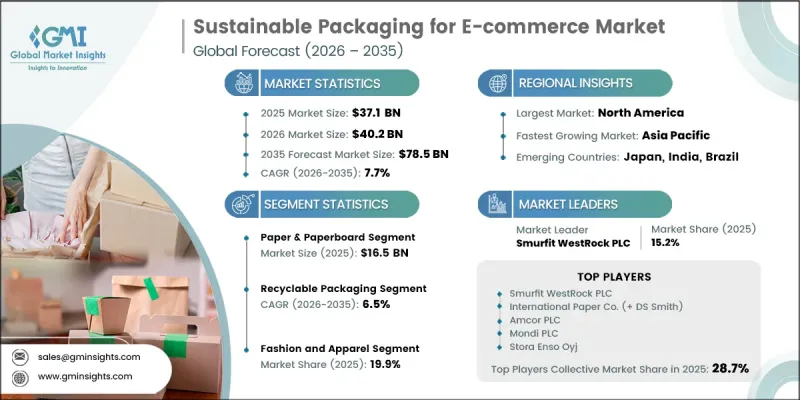
시장 성장을 주도하고 있는 것은 온라인 소매 공급망에서 이루어지고 있는 지속적인 변화입니다. 기업들은 기존의 석유 기반 포장 자재에서 재활용이 가능하고 생분해성이 있으며 재료 효율이 뛰어난 대체 자재로 전환하는 속도를 높이고 있습니다. 시장 확대에 더해, 전 세계 E-Commerce 업계에서 지속가능성 인증, 재생 소재 함유율, 사용 후 재활용 가능성은 더 이상 프리미엄 제품의 차별화 요소가 아니라 공급업체 평가의 표준 기준이 되었기 때문에 구매 전략도 근본적인 변화를 겪고 있습니다. 소비자들의 환경 의식이 높아짐에 따라 포장 자재 조달 결정에 지속적인 변화가 일어나고 있으며, 소매업체들이 여러 제품 카테고리에 걸쳐 친환경 포장 솔루션을 우선적으로 선택하도록 유도하고 있습니다. 기업들은 배송용 상자, 우편용 봉투, 보호재 등에서 기존의 일회용 포장재를 재활용이 가능한 섬유 기반 대체재로 교체하는 움직임을 가속화하고 있습니다. 이러한 전환에 따라 공급망 전반에 걸쳐 인증된 지속가능한 포장 솔루션에 대한 수요가 증가하고 있으며, 제조업체들은 재생 소재 가공, 종이 섬유 생산, 퇴비화 가능한 포장 기술, 그리고 순환형 소재 조달 역량에 대한 투자를 확대하고 있습니다. 이러한 장기적인 업계 동향은 E-Commerce 분야의 지속가능한 포장 시장 성장 전망을 더욱 공고히 할 뿐만 아니라, 전 세계 온라인 소매 포장 업무의 혁신, 업무 효율성 및 환경 규정 준수를 뒷받침하고 있습니다.
| 시장 범위 | |
|---|---|
| 시작 연도 | 2025년 |
| 예측 기간 | 2026-2035년 |
| 시작 시점 시장 규모 | 371억 달러 |
| 예측액 | 785억 달러 |
| CAGR | 7.7% |
종이 및 판지 부문은 2025년에 165억 달러에 달했으며, 시장 점유율의 44.5%를 차지했습니다. 이러한 견고한 시장 지위는 구조적 내구성, 높은 재활용성, 그리고 자동화된 주문 처리 업무와의 호환성이 어우러져 뒷받침되고 있습니다. 골판지 포장재는 최신 창고 자동화 시스템과 지속적으로 효율적으로 통합되어, 대규모 E-Commerce 유통 네트워크 전반에 걸쳐 신뢰할 수 있는 제품 취급, 합리화된 물류, 그리고 일관된 포장 성능을 실현하고 있습니다.
재활용 가능한 포장 부문은 2025년에 149억 달러에 달하며, 40.1%의 점유율을 차지했습니다. 이는 E-Commerce의 전체 주문 처리 업무에서 재활용 가능한 골판지 섬유 포장이 널리 사용되고 있다는 점에 힘입은 것입니다. 이 시장에서 차지하고 있는 선도적 지위는 재활용 가능한 포장 솔루션을 우선시하는 규제 정책의 영향력이 커지고 있음을 반영하며, 기업들로 하여금 자원 회수율을 높이고, 규정 준수 비용을 절감하며, 전 세계 E-Commerce 시장에서 진화하는 환경 기준을 충족하는 포장 방식을 채택하도록 촉진하고 있습니다.
2025년, 미국의 E-Commerce용 지속가능 포장 시장은 88.1%의 점유율을 차지하며 111억 달러에 달했습니다. 시장의 성장은 포장의 재활용 가능성과 생산자의 책임에 대해 더 엄격한 요건을 규정하는 ‘확대 생산자 책임(EPR)’ 규제의 광범위한 도입에 힘입어 이루어지고 있습니다. 규제 체계가 지속적으로 발전함에 따라, 지속가능성 관련 노력은 기업의 자발적인 활동에서 의무적인 규정 준수 기준으로 전환되고 있으며, 이에 따라 E-Commerce 기업들은 재활용 가능한 포장 솔루션과 친환경 조달 전략에 대한 투자를 강화하도록 촉구받고 있습니다.
자주 묻는 질문
목차
제1장 조사 방법
제2장 주요 요약
제3장 업계 인사이트
제4장 경쟁 구도
제5장 시장 추정 및 예측 : 소재 유형별, 2022-2035년
제6장 시장 추정 및 예측 : 포장 형태별, 2022-2035년
제7장 시장 추정 및 예측 : 지속가능성 속성별, 2022-2035년
제8장 시장 추정 및 예측 : 최종 이용 산업별, 2022-2035년
제9장 시장 추정 및 예측 : 지역별, 2022-2035년
제10장 기업 개요
KSM 26.07.16The Global Sustainable Packaging for E-Commerce Market was valued at USD 37.1 billion in 2025 and is estimated to grow at a CAGR of 7.7% to reach USD 78.5 billion by 2035.
Market growth is driven by the ongoing transformation of online retail supply chains as businesses increasingly transition from conventional petroleum-based packaging materials to recyclable, biodegradable, and material-efficient alternatives. Beyond market expansion, purchasing strategies are undergoing a fundamental shift as sustainability certifications, recycled material content, and end-of-life recyclability have become standard supplier evaluation criteria instead of premium product differentiators across global e-commerce sectors. Rising environmental awareness among consumers continues to reshape packaging procurement decisions, encouraging retailers to prioritize environmentally responsible packaging solutions across multiple product categories. Businesses are increasingly replacing conventional single-use packaging with recyclable and fiber-based alternatives for shipping boxes, mailers, and protective materials. This transition is generating stronger demand for certified sustainable packaging solutions throughout the supply chain, prompting manufacturers to expand investments in recycled material processing, paper fiber production, compostable packaging technologies, and circular material sourcing capabilities. These long-term industry trends continue to reinforce the growth outlook for the e-commerce sustainable packaging market while supporting innovation, operational efficiency, and environmental compliance across global online retail packaging operations.
| Market Scope | |
|---|---|
| Start Year | 2025 |
| Forecast Year | 2026-2035 |
| Start Value | $37.1 Billion |
| Forecast Value | $78.5 Billion |
| CAGR | 7.7% |
The paper and paperboard segment reached USD 16.5 billion, accounting for 44.5% share in 2025. Its strong market position is supported by the combination of structural durability, high recyclability, and compatibility with automated fulfillment operations. Corrugated paper-based packaging continues to integrate efficiently with modern warehouse automation systems, enabling reliable product handling, streamlined logistics, and consistent packaging performance across large-scale e-commerce distribution networks.
The recyclable packaging segment reached USD 14.9 billion in 2025 contributing 40.1% share, supported by the widespread use of recyclable corrugated fiber packaging throughout e-commerce fulfillment operations. Its market leadership reflects the increasing influence of regulatory policies that prioritize recyclable packaging solutions, encouraging businesses to adopt packaging formats that improve resource recovery, reduce compliance costs, and align with evolving environmental standards across global e-commerce markets.
United States Sustainable Packaging for E-Commerce Market accounted for 88.1% share in 2025, representing USD 11.1 billion. Market growth is supported by the broader implementation of extended producer responsibility (EPR) regulations that establish stricter requirements for packaging recyclability and producer accountability. As regulatory frameworks continue to evolve, sustainability initiatives are shifting from voluntary corporate commitments to mandatory compliance standards, encouraging e-commerce companies to strengthen investments in recyclable packaging solutions and environmentally responsible procurement strategies.
Major companies operating in the global sustainable packaging for e-commerce market include Amcor PLC, Smurfit WestRock PLC, International Paper Company, Mondi PLC, Graphic Packaging International, Sonoco Products Company, Huhtamaki Oyj, Stora Enso Oyj, UPM-Kymmene Corporation, Ranpak Holdings Corporation, Pregis LLC, Billerud AB, Cascades Inc., SCG Packaging Public Company Limited (SCGP), EcoEnclose LLC, Better Packaging Co., TIPA Corp., Noissue Co., TemperPack, EcoPackables, and Elevate Packaging Inc. Companies participating in the sustainable packaging for e-commerce market are strengthening their competitive position by expanding sustainable product portfolios, investing in advanced material innovation, and improving manufacturing efficiency. Market participants are increasing research and development activities to introduce recyclable, biodegradable, lightweight, and fiber-based packaging solutions that align with evolving customer and regulatory requirements. Strategic partnerships with e-commerce retailers, packaging converters, and raw material suppliers are helping companies broaden market reach and accelerate product adoption. Businesses are also enhancing production capacity, improving supply chain resilience, and integrating circular economy principles into their operations through greater use of recycled materials.
Table of Contents
Chapter 1 Research Methodology
- 1.1 Research approach
- 1.2 Quality Commitments
- 1.2.1 GMI AI policy & data integrity commitment
- 1.2.1.1 Source consistency protocol
- 1.2.1 GMI AI policy & data integrity commitment
- 1.3 Research Trail & Confidence Scoring
- 1.3.1 Research Trail Components
- 1.3.2 Scoring Components
- 1.4 Data Collection
- 1.4.1 Partial list of primary sources
- 1.5 Data mining sources
- 1.5.1 Paid sources
- 1.5.1.1 Sources, by region
- 1.5.1 Paid sources
- 1.6 Base estimates and calculations
- 1.6.1 Base year calculation for any one approach
- 1.7 Forecast model
- 1.7.1 Quantified market impact analysis
- 1.7.1.1 Mathematical impact of growth parameters on forecast
- 1.7.1 Quantified market impact analysis
- 1.8 Research transparency addendum
- 1.8.1 Source attribution framework
- 1.8.2 Quality assurance metrics
- 1.8.3 Our commitment to trust
Chapter 2 Executive Summary
- 2.1 Industry 360° synopsis, 2022 - 2035
- 2.2 Key market trends
- 2.2.1 Regional
- 2.2.2 Material Type
- 2.2.3 Packaging Format
- 2.2.4 Sustainability Attribute
- 2.2.5 End-Use Industry
Chapter 3 Industry Insights
- 3.1 Industry ecosystem analysis
- 3.1.1 Factor affecting the value chain
- 3.1.2 Profit margin analysis
- 3.1.3 Disruptions
- 3.1.4 Future outlook
- 3.1.5 Manufacturers
- 3.1.6 Distributors
- 3.2 Supplier landscape
- 3.3 Key news & initiatives
- 3.4 Technology & Innovation Landscape
- 3.5 Regulatory landscape
- 3.6 Impact on forces
- 3.6.1 Growth drivers
- 3.6.1.1 Rising environmental awareness increases sustainable e-commerce packaging demand.
- 3.6.1.2 Expanding e-commerce industry boosts sustainable packaging adoption globally.
- 3.6.1.3 Government regulations encourage environmentally friendly packaging material usage.
- 3.6.2 Industry pitfalls & challenges
- 3.6.2.1 High sustainable material costs limit widespread packaging adoption
- 3.6.2.2 Limited recycling infrastructure affects packaging waste management efficiency.
- 3.6.3 Opportunities
- 3.6.3.1 Innovation in biodegradable materials creates packaging growth opportunities.
- 3.6.3.2 Smart packaging technologies enhance sustainable shipping efficiency globally.
- 3.6.1 Growth drivers
- 3.7 Porter’s analysis
- 3.8 PESTEL analysis
- 3.9 Pricing analysis (driven by primary research)
- 3.9.1 Historical price trend analysis (sustainable vs. conventional packaging substrates) (driven by primary research)
- 3.9.2 Pricing strategy by player type (premium sustainable-only / value hybrid / cost-plus mainstream) (driven by primary research)
- 3.10 Impact of AI & generative AI on the market
- 3.10.1 AI-driven disruption of existing business models (right-sizing, waste reduction, demand forecasting)
- 3.10.2 GenAI use cases & adoption roadmap by segment (structural design, material selection, custom print)
- 3.10.3 Risks, limitations & regulatory considerations for AI in packaging
- 3.11 Capacity & production landscape (driven by primary research)
- 3.11.1 Installed capacity by region & key producer (corrugated, molded fiber, bioplastic film) (driven by primary research)
- 3.11.2 Capacity utilization rates & expansion pipelines (greenfield & brownfield investments) (driven by primary research)
Chapter 4 Competitive Landscape, 2025
- 4.1 Introduction
- 4.2 Company market share analysis
- 4.3 Competitive positioning matrix
- 4.4 Strategic outlook matrix
- 4.5 Competitive analysis of major market players
- 4.6 Key developments
- 4.6.1 Mergers & acquisitions
- 4.6.2 Partnerships & collaborations
- 4.6.3 New product launches
- 4.6.4 Expansion plans
Chapter 5 Market Estimates & Forecast, By Material Type, 2022-2035 (USD Billion) (Million Units)
- 5.1 Key trends
- 5.2 Paper & Paperboard
- 5.3 Bioplastics & Compostable Polymers
- 5.4 Recycled Plastics
- 5.5 Metal
- 5.6 Others
Chapter 6 Market Estimates & Forecast, By Packaging Format, 2022-2035 (USD Billion) (Million Units)
- 6.1 Key trends
- 6.2 Corrugated Boxes & Cartons
- 6.3 Mailers & Envelopes
- 6.4 Protective & Void-Fill Packaging
- 6.5 Bags & Pouches
- 6.6 Tapes, Labels & Sealing Materials
- 6.7 Others
Chapter 7 Market Estimates & Forecast, By Sustainability Attribute, 2022-2035 (USD Billion) (Million Units)
- 7.1 Key trends
- 7.2 Recyclable Packaging
- 7.3 Biodegradable & Compostable Packaging
- 7.4 Reusable Packaging
- 7.5 Recycled-Content Packaging
Chapter 8 Market Estimates & Forecast, By End-Use Industry, 2022-2035 (USD Billion) (Million Units)
- 8.1 Key trends
- 8.2 Fashion & Apparel
- 8.3 Consumer Electronics
- 8.4 Food & Beverage
- 8.5 Beauty & Personal Care
- 8.6 Pharmaceuticals & Health
- 8.7 Home & Furniture
- 8.8 Others
Chapter 9 Market Estimates & Forecast, By Region, 2022 - 2035, (USD Billion) (Million Units)
- 9.1 Key trends
- 9.2 North America
- 9.2.1 U.S.
- 9.2.2 Canada
- 9.3 Europe
- 9.3.1 Germany
- 9.3.2 U.K.
- 9.3.3 France
- 9.3.4 Italy
- 9.3.5 Spain
- 9.4 Asia Pacific
- 9.4.1 China
- 9.4.2 India
- 9.4.3 Japan
- 9.4.4 South Korea
- 9.4.5 Australia
- 9.5 Latin America
- 9.5.1 Brazil
- 9.5.2 Mexico
- 9.5.3 Argentina
- 9.6 MEA
- 9.6.1 UAE
- 9.6.2 Saudi Arabia
- 9.6.3 South Africa
Chapter 10 Company Profiles
- 10.1 Global players
- 10.1.1 Amcor PLC
- 10.1.2 Smurfit WestRock PLC
- 10.1.3 International Paper Company
- 10.1.4 Mondi PLC
- 10.1.5 Graphic Packaging International
- 10.1.6 Sonoco Products Company
- 10.1.7 Huhtamaki Oyj
- 10.2 Regional players
- 10.2.1 Stora Enso Oyj
- 10.2.2 UPM-Kymmene Corporation
- 10.2.3 Ranpak Holdings Corporation
- 10.2.4 Pregis LLC
- 10.2.5 Billerud AB
- 10.2.6 Cascades Inc.
- 10.2.7 SCG Packaging Public Company Limited (SCGP)
- 10.3 Emerging players
- 10.3.1 EcoEnclose LLC
- 10.3.2 Better Packaging Co.
- 10.3.3 TIPA Corp.
- 10.3.4 Noissue Co.
- 10.3.5 TemperPack
- 10.3.6 EcoPackables
- 10.3.7 Elevate Packaging Inc.


