

|
시장보고서
상품코드
2122306
E-Commerce 포장 : 시장 점유율 분석, 업계 동향과 통계, 성장 예측(2026-2031년)E-commerce Packaging - Market Share Analysis, Industry Trends & Statistics, Growth Forecasts (2026 - 2031) |
||||||
 Mordor Intelligence
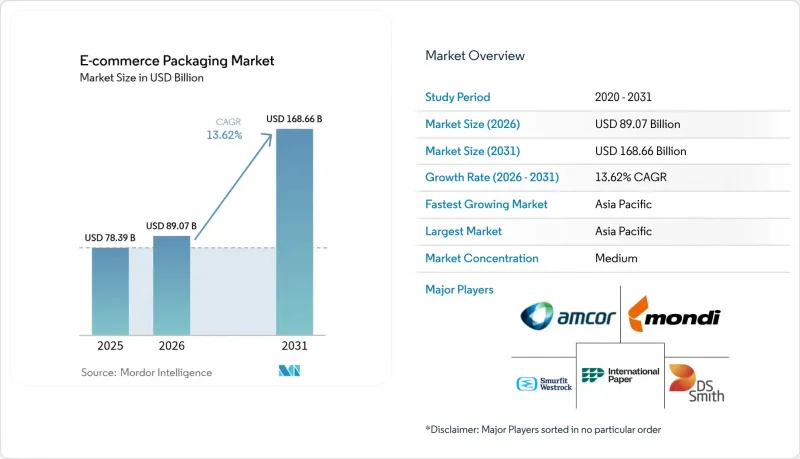
Mordor Intelligence에 의하면, E-Commerce 포장 시장 규모는 2025년 783억 9,000만 달러에서 2026년에는 890억 7,000만 달러에 이르고, 2026-2031년 CAGR 13.62%로 성장을 지속하여 2031년에는 1,686억 6,000만 달러에 달할 것으로 예측됩니다.
본 보고서는 소재 유형별(플라스틱, 종이 및 판지, 골판지, 연질 필름·메일러, 기타), 포장 형태별(상자·카톤,메일러·봉투, 보호용 포장, 기타), 최종 사용자별(패션 및 의류, 가정용 전자기기, 식음료, 퍼스널케어 및 화장품, 식료품·퀵커머스, 기타 온라인 소매업체), 지역별로 분류되어 있습니다.
세계 전자상거래 포장 시장 동향 및 인사이트
온라인 소매 GMV의 폭발적인 성장
세계적으로 전자상거래 총상품가치(GMV)는 두 자릿수 성장을 지속하고 있으며, 주문이 증가할 때마다 보호 포장으로 출고되기 때문에 포장재 수요는 소매 매출 성장률을 웃도는 속도로 확대되고 있습니다. 2024년에는 중국의 165개 크로스보더 전자상거래 시범 구역에서만 하루 약 2,000만 개의 소포가 처리될 것으로 예상되며, 국가 차원의 GMV 확대가 골판지 및 우편 봉투 소비를 직접적으로 견인하고 있음이 부각되고 있습니다. 인도의 도시 지역에서 활동하는 퀵 커머스 사업자들은 현재 식료품 배달 시간을 10-15분 이내로 목표하고 있으며, 깨지기 쉬운 신선식품은 한꺼번에 나무 상자에 담기보다는 개별적으로 발송되기 때문에 포장재와 상품의 비율이 증가하고 있습니다. 구독형 상거래는 브랜드 상자에 담긴 상품을 매월 정기적으로 배송함으로써 취급 물량을 더욱 확대되고 있습니다. 선전의 물류 허브에서 유럽 및 미국 소비자에게 이르는 국경 간 상거래의 더 긴 운송 경로에서는 복합 운송 방식의 취급에도 견딜 수 있는 더 두꺼운 플루트 등급이나 특수 설계된 완충재에 대한 수요가 증가하고 있습니다. 이러한 취급량과 성능의 변화가 전 세계 전자상거래 포장 시장의 성장 궤도를 뒷받침하고 있습니다.
DIM 중량 비용 절감을 위한 경량화 및 유연한 형태로의 전환
택배사의 부피 중량 과금 제도에서는 반쯤 비어 있는 골판지 상자가 요금이 비싸지기 때문에 판매자는 빈 공간을 줄이고 운송 비용을 절감할 수 있는 적정 크기의 우편용 봉투, 접이식 파우치, 거싯이 달린 가방의 채택을 강요받고 있습니다. 아마존의 온디맨드 포장 이니셔티브에서는 머신러닝 소프트웨어와 각 주문 상품을 필름으로 밀봉하는 자동 포장기를 결합하여 배송 중 파손을 24% 줄이고, 배송비를 5% 절감했습니다. 패스트 패션 등 이익률이 낮은 카테고리에서는 포장 비용을 상품 가치의 5% 이하로 억제하기 위해 유연한 폴리머 봉투에 의존하고 있는 반면, 단일 소재 필름은 밀도 향상을 희생하지 않으면서도 재활용 가능성에 관한 규제를 충족하고 있습니다. 조기 도입은 미국과 유럽에서 가장 활발히 진행되고 있지만, 라스트 마일 비용이 물류 총비의 30%를 초과하기도 하는 아시아태평양에서는 이러한 추세가 가속화되고 있습니다. 택배 업체들이 부피 요금 제도를 엄격히 적용함에 따라, 경량 포장 형태가 전자상거래 포장 시장에서 점점 더 큰 점유율을 차지하게 될 것으로 보입니다.
전 세계 플라스틱 규제 강화 및 EPR(생산자 책임) 수수료로 인한 규정 준수 비용 증가
확대 생산자 책임(EPR) 제도에서는 각 소재의 실제 재활용 가능성에 따라 요금이 부과되며, 일부 EU 시장에서는 재활용이 어려운 다층 파우치의 비용이 2배로 증가했습니다. 캘리포니아주의 ‘플라스틱 오염 방지법’에서는 판매되는 포장재 1kg당 정액 요금이 부과되어, 브랜드는 제품 라인업을 근본적으로 재검토하거나 벌금을 부담해야만 합니다. 규제 대응 담당자를 두지 않은 소규모 온라인 판매업체들은 요금 신고 절차에 어려움을 겪고 있으며, 규정 준수에 드는 고정 비용을 대량의 거래량에 분산할 수 있는 통합형 사업자에게 경쟁 우위가 쏠리고 있습니다. 이러한 재무적 역풍으로 인해 향후 2년간 전자상거래 포장 시장의 잠재적 연평균 성장률(CAGR)은 하락할 전망입니다.
부문 분석
골판지는 비용 효율성이 뛰어나고 적재 강도가 높으며, 거의 모든 지역에서 가정 쓰레기로 재활용이 가능하다는 점 덕분에 2025년 전자상거래 포장 시장의 50.35%를 차지했습니다. 이 부문은 국내 및 수출 화물용 골판지 플루트의 등급을 공식적으로 정한 중국의 전국적인 택배 포장 품질 기준의 혜택을 계속해서 누리고 있습니다. 한편, 바이오플라스틱은 규제 측면의 호재와 소비자 의식의 변화를 반영하여 2031년까지 연평균 성장률(CAGR) 14.72%로 가장 빠르게 성장하는 소재 그룹이 될 전망입니다. 각 변환 업체들은 PLA와 사용 후 재활용 소재를 혼합하여 인장 강도를 저하시키지 않으면서도 EU가 정한 30% 재활용 소재 함유율 기준을 충족하는 우편용 봉투를 제조하고 있습니다. 동남아시아 전역에 걸쳐 확장 가능한 발효 시설에 대한 투자를 통해 바이오 수지의 가격 프리미엄은 점차 낮아질 것이며, 고급 화장품 및 유기농 식품 판매업체에 그치지 않고 더 폭넓은 부문에서 채택될 수 있을 것으로 보입니다.
각 브랜드 소유 기업들은 골판지의 확실한 보호 성능과 재생 가능한 대체 소재 간의 균형을 맞추면서 스코프 3 배출량을 감축하고 있습니다. 골판지는 여전히 대량으로 소비되고 있지만, 바이오플라스틱은 차별화를 가져다줍니다. D2C(소비자 직접 판매) 전자제품 판매업체들은 퇴비화 가능한 필름 재질의 수축 슬리브를 눈에 띄는 지속가능성 개선 사례로 내세우고 있습니다. 이에 반해, 기존 PE 및 PP 제조업체들은 기계적 재활용이 가능한 단일 소재 제품을 개발하여 대응함으로써 시장 점유율 유지를 도모하고 있습니다. 재생 가능 원료와 화석 원료 기반 폴리머의 공존은 하룻밤 사이에 대체되는 것이 아니라 과도기에 있음을 보여주며, 두 소재군 모두 전자상거래 포장 시장에서 계속해서 필수적인 역할을 할 것임을 보장합니다.
지역별 분석
아시아태평양은 2025년 매출 점유율 51.30%로 전자상거래 포장 시장을 주도하며, 2031년까지 연평균 성장률(CAGR) 15.39%로 성장할 전망입니다. 중국의 국가 표준 GB 43352-2023은 택배용 포장재의 필수 성능 지표를 규정하고 있으며, 600만 개의 활성 온라인 판매업체 전반에 걸쳐 통일된 품질 기준을 추진하고 있습니다. 동시에 인도의 퀵커머스 매출은 2025년부터 2030년까지 3배로 증가할 전망이며, 몬순철의 습한 환경에서도 성능을 발휘하는 가볍고 내구성이 뛰어난 봉투에 대한 수요가 높아지고 있습니다. 동남아시아 시장도 유사한 규정을 채택하여 종이 완충재를 활용해 플라스틱 폐기물을 줄임으로써 지역 전체의 성장세를 뒷받침하고 있습니다.
북미는 2위를 차지했습니다. 캘리포니아주의 플라스틱 발생원 감축 목표와 캐나다의 재활용이 어려운 스티로폼 사용 금지 조치로 인해 포장재 전환이 가속화되고 있습니다. 풀필먼트 센터에서는 AI를 활용한 상자 선정 도구에 대한 투자가 진행되어, 골판지 사용량을 12% 줄임으로써 비용 절감과 지속가능성이라는 두 가지 목표를 모두 지원하고 있습니다. 또한 미국에서는 2025년에 온라인 식료품 시장의 침투율이 16%에 달함에 따라 콜드체인 부문의 혁신이 촉진되고 있으며, 식품 및 의약품 부문 전반에서 온도 안정성이 뛰어난 라이너에 대한 수요가 증가하고 있습니다.
유럽은 여전히 순환형 경제의 세계적 실증 무대로, PPWR(플라스틱 포장 규제)에 따른 재생재 함유율 및 재사용 의무화가 궁극적으로 전 세계적으로 확산될 형태를 형성하고 있습니다. 독일의 소매업체들은 인구 밀도가 높은 도시 지역에서 일회용 포장을 80% 줄이는 반환 가능한 온라인 식료품용 나무 상자의 시범 운영을 진행하고 있습니다. 한편, 중동 및 아프리카에서는 도입이 늦어지고 있지만, 크로스보더 플랫폼이 물류망을 확대함에 따라 두 자릿수 성장을 기록하고 있습니다. 인프라 부족과 복잡한 통관 절차로 인해 처리량이 제한되고 있지만, 스마트폰 보급률 상승이 장기적인 성장 가능성을 열어주며, 이러한 신흥 지역을 미래 전자상거래 포장 시장의 확장에 포함시키고 있습니다.
기타 혜택
- 엑셀 형식 시장 예측(ME) 시트
- 3개월간의 애널리스트 지원
자주 묻는 질문
목차
제1장 서론
제2장 조사 방법
제3장 주요 요약
제4장 시장 구도
제5장 시장 규모와 성장 예측
제6장 경쟁 구도
제7장 시장 기회와 향후 전망
LSH 26.09.04According to Mordor Intelligence, the e-commerce packaging market size is expected to grow from USD 78.39 billion in 2025 to USD 89.07 billion in 2026 and is forecast to reach USD 168.66 billion by 2031 at 13.62% CAGR over 2026-2031.
This report is Segmented by Material (Plastic, Paper and Paperboard, Corrugated Board, Flexible Films and Mailers, and More), Packaging Format (Boxes and Cartons, Mailers and Envelopes, Protective Packaging, and More), End-User Vertical (Fashion and Apparel, Consumer Electronics, Food and Beverages, Personal Care and Cosmetics, Grocery and Quick-Commerce, and Other End Users), and Geography.
Global E-commerce Packaging Market Trends and Insights
Explosive Online Retail GMV Growth
E-commerce gross merchandise value continues to climb in double digits worldwide, and every incremental order ships in its protective pack, multiplying packaging demand faster than headline retail sales. China's 165 cross-border pilot zones alone processed nearly 20 million packages daily in 2024, underscoring how country-level GMV expansion directly fuels corrugated and mailer consumption. Urban India's quick-commerce operators now target 10-to-15-minute grocery delivery windows, raising packaging-to-product ratios because fragile fresh items ship individually rather than in bulk crates. Subscription commerce further amplifies volumes as recurring shipments deliver monthly replenishments in branded cartons. Longer trade lanes in cross-border commerce, from Shenzhen fulfilment hubs to Western consumers, elevate the need for thicker flute grades and engineered cushioning that can withstand multi-modal handling. These volume and performance shifts anchor the growth trajectory of the global e-commerce packaging market.
Shift Toward Lightweight and Flexible Formats
Courier dimensional-weight pricing penalizes half-empty cartons, pushing sellers to adopt right-sized mailers, collapsible pouches, and gusseted bags that shave airspace and freight spend. Amazon's on-demand packaging initiative trimmed shipping damage 24% and cut outbound freight costs 5% by pairing machine-learning software with auto-baggers that seal film around each order. Lower-margin categories such as fast-fashion rely on flexible poly-mailers to keep packaging costs below 5% of product value, while mono-material films answer recyclability rules without sacrificing density gains. Early adoption is strongest in the United States and Europe, but the trend accelerates in Asia Pacific, where last-mile costs can exceed 30% of total logistics spend. As couriers tighten volumetric pricing, lightweight formats are likely to capture an increasing share of the e-commerce packaging market.
Stringent Plastics Bans and EPR Fees Inflate Costs
Extended Producer Responsibility schemes levy fees that vary with each material's real-world recyclability, doubling the cost of difficult-to-recycle multilayer pouches in some EU markets. California's Plastic Pollution Prevention Act tags flat fees on every kilogram of packaging sold, compelling brands to overhaul portfolios or absorb penalties. Smaller online sellers lacking regulatory staff struggle to complete fee filings, tilting competitive advantage toward integrated players that can spread compliance fixed costs across higher volumes. These financial headwinds pare back the potential CAGR of the e-commerce packaging market over the next two years.
Other drivers and restraints analyzed in the detailed report include:
- Sustainability Regulations Accelerating Paper and Bio-Based Adoption
- Unboxing Experience as a Brand Channel
- Kraft Paper and Resin Price Volatility Squeezes Margins
For complete list of drivers and restraints, kindly check the Table Of Contents.
Segment Analysis
Corrugated board captured 50.35% of the e-commerce packaging market in 2025 thanks to cost efficiency, high stacking strength, and near-universal curbside recyclability. The segment continues to benefit from China's national express-packaging quality standard, which formalizes corrugate flute grades for domestic and export shipments. Meanwhile, bioplastics form the fastest-growing material group at a 14.72% CAGR through 2031, reflecting both regulatory tailwinds and shifting consumer sentiment. Converters blend PLA with post-consumer recyclate to create mailers that meet EU 30% recycled-content thresholds without compromising tensile performance. Investments in scalable fermentation facilities across Southeast Asia will gradually lower bio-resin premiums, enabling wider uptake beyond premium cosmetics and organic food sellers.
Brand owners balance corrugated's reliable protection with renewable alternatives to reduce Scope 3 emissions. Although corrugate commands volume, bioplastics bring differentiation; D2C electronics sellers tout compostable film shrink sleeves as a visible sustainability upgrade. Traditional PE and PP operators respond by designing mono-material variants compatible with mechanical recycling, seeking to defend their share. The coexistence of renewable and fossil-based polymers signals a transition, not an overnight swap, ensuring both material clusters remain essential to the e-commerce packaging market.
Complete Report Scope:
- By Material Type
- Plastic
- Paper and Paperboard
- Corrugated Board
- Flexible Films and Mailers
- Bioplastics
- Others
- By Packaging Format
- Boxes and Cartons
- Mailers and Envelopes
- Protective Packaging (void-fill, cushioning, liners)
- Labels, Tapes and Closures
- Specialty/Returnable Systems
- By End User
- Fashion and Apparel
- Consumer Electronics
- Food and Beverage
- Personal Care and Cosmetics
- Grocery and Quick-Commerce
- Home and Living/Furniture
- Other Online Retailers
- By Geography
- North America
- United States
- Canada
- Mexico
- South America
- Brazil
- Argentina
- Rest of South America
- Europe
- United Kingdom
- Germany
- France
- Italy
- Rest of Europe
- Asia-Pacific
- China
- India
- Japan
- South Korea
- Rest of Asia-Pacific
- Middle East and Africa
- United Arab Emirates
- Saudi Arabia
- South Africa
- Rest of Middle East and Africa
- North America
Geography Analysis
Asia Pacific led the e-commerce packaging market with a 51.30% revenue share in 2025 and is scaling at a 15.39% CAGR through 2031. China's national standard GB 43352-2023 defines mandatory performance metrics for express packs, driving uniform quality expectations across 6 million active online sellers. Concurrently, India's quick-commerce sales triple between 2025 and 2030, elevating demand for lightweight yet durable bags that perform in monsoon humidity. Southeast Asian marketplaces adopt similar rules, leveraging paper cushioning to cut plastic waste, reinforcing regional momentum.
North America ranks second. California's plastic-source-reduction targets and Canada's ban on difficult-to-recycle foam prompt accelerated substrate shifts. Fulfilment centers invest in AI-driven box-selection tools that trim corrugated usage by 12%, supporting both cost and sustainability goals. The United States also incubates cold-chain innovations as online grocery penetration touches 16% in 2025, spurring demand for temperature-stable liners across food and pharma.
Europe remains the global test bed for circularity, with the PPWR's recycled-content and reuse mandates shaping formats that eventually scale worldwide. Retailers in Germany pilot returnable e-grocery crates that cut single-use packs by 80% in dense urban districts. Elsewhere, the Middle East and Africa trail in adoption but record double-digit gains as cross-border platforms extend logistics footprints. Infrastructure gaps and customs complexities temper volume, yet rising smartphone penetration unlocks long-run upside, embedding emerging regions in future expansion of the e-commerce packaging market.
- Amcor plc
- Mondi plc
- International Paper
- Smurfit Kappa Group
- DS Smith plc
- WestRock Company
- Georgia-Pacific LLC
- Sealed Air Corporation
- Ranpak Holdings Corp.
- Pregis LLC
- Klabin SA
- Rengo Co. Ltd
- Stora Enso Oyj
- Nippon Paper Industries
- Oji Holdings
- Ranpak Holdings Corp
- Packhelp SA
- Shorr Packaging Corp.
- Packsize Intl.
- Packsize International
Additional Benefits:
- The market estimate (ME) sheet in Excel format
- 3 months of analyst support
TABLE OF CONTENTS
1 INTRODUCTION
- 1.1 Study Assumptions and Market Definition
- 1.2 Scope of the Study
2 RESEARCH METHODOLOGY
3 EXECUTIVE SUMMARY
4 MARKET LANDSCAPE
- 4.1 Market Overview
- 4.2 Market Drivers
- 4.2.1 Explosive growth of online retail GMV
- 4.2.2 Shift toward lightweight and flexible formats to lower DIM-weight costs
- 4.2.3 Sustainability regulations accelerating paper and bio-based adoption
- 4.2.4 "Unboxing experience" as a brand-engagement channel
- 4.2.5 AI-enabled fit-to-product automation reducing material waste
- 4.2.6 Rapid rise of quick-commerce/subscription retail raising shipment frequency
- 4.3 Market Restraints
- 4.3.1 Stringent global plastics bans and EPR fees inflate compliance costs
- 4.3.2 Kraft paper and resin price volatility squeezes converter margins
- 4.3.3 Cross-border fulfilment damage/return rates erode ROI on packaging
- 4.3.4 Carbon-footprint audits forcing redesigns amid data-knowledge gaps
- 4.4 Value/Supply-Chain Analysis
- 4.5 Regulatory Landscape
- 4.6 Technological Outlook
- 4.7 Porter's Five Forces Analysis
- 4.7.1 Bargaining Power of Suppliers
- 4.7.2 Bargaining Power of Buyers
- 4.7.3 Threat of New Entrants
- 4.7.4 Threat of Substitutes
- 4.7.5 Intensity of Competitive Rivalry
- 4.8 Investment Analysis
5 MARKET SIZE AND GROWTH FORECASTS (VALUE)
- 5.1 By Material Type
- 5.1.1 Plastic
- 5.1.2 Paper and Paperboard
- 5.1.3 Corrugated Board
- 5.1.4 Flexible Films and Mailers
- 5.1.5 Bioplastics
- 5.1.6 Others
- 5.2 By Packaging Format
- 5.2.1 Boxes and Cartons
- 5.2.2 Mailers and Envelopes
- 5.2.3 Protective Packaging (void-fill, cushioning, liners)
- 5.2.4 Labels, Tapes and Closures
- 5.2.5 Specialty/Returnable Systems
- 5.3 By End User
- 5.3.1 Fashion and Apparel
- 5.3.2 Consumer Electronics
- 5.3.3 Food and Beverage
- 5.3.4 Personal Care and Cosmetics
- 5.3.5 Grocery and Quick-Commerce
- 5.3.6 Home and Living/Furniture
- 5.3.7 Other Online Retailers
- 5.4 By Geography
- 5.4.1 North America
- 5.4.1.1 United States
- 5.4.1.2 Canada
- 5.4.1.3 Mexico
- 5.4.2 South America
- 5.4.2.1 Brazil
- 5.4.2.2 Argentina
- 5.4.2.3 Rest of South America
- 5.4.3 Europe
- 5.4.3.1 United Kingdom
- 5.4.3.2 Germany
- 5.4.3.3 France
- 5.4.3.4 Italy
- 5.4.3.5 Rest of Europe
- 5.4.4 Asia-Pacific
- 5.4.4.1 China
- 5.4.4.2 India
- 5.4.4.3 Japan
- 5.4.4.4 South Korea
- 5.4.4.5 Rest of Asia-Pacific
- 5.4.5 Middle East and Africa
- 5.4.5.1 United Arab Emirates
- 5.4.5.2 Saudi Arabia
- 5.4.5.3 South Africa
- 5.4.5.4 Rest of Middle East and Africa
- 5.4.1 North America
6 COMPETITIVE LANDSCAPE
- 6.1 Market Concentration
- 6.2 Strategic Moves (MandA, capacity, tech)
- 6.3 Market Share Analysis
- 6.4 Company Profiles (includes Global level Overview, Market level overview, Core Segments, Financials as available, Strategic Information, Market Rank/Share, Products and Services, Recent Developments)
- 6.4.1 Amcor plc
- 6.4.2 Mondi plc
- 6.4.3 International Paper
- 6.4.4 Smurfit Kappa Group
- 6.4.5 DS Smith plc
- 6.4.6 WestRock Company
- 6.4.7 Georgia-Pacific LLC
- 6.4.8 Sealed Air Corporation
- 6.4.9 Ranpak Holdings Corp.
- 6.4.10 Pregis LLC
- 6.4.11 Klabin SA
- 6.4.12 Rengo Co. Ltd
- 6.4.13 Stora Enso Oyj
- 6.4.14 Nippon Paper Industries
- 6.4.15 Oji Holdings
- 6.4.16 Ranpak Holdings Corp
- 6.4.17 Packhelp SA
- 6.4.18 Shorr Packaging Corp.
- 6.4.19 Packsize Intl.
- 6.4.20 Packsize International
7 MARKET OPPORTUNITIES AND FUTURE OUTLOOK
- 7.1 White-space and Unmet-Need Assessment


