

|
시장보고서
상품코드
2083254
에어 호스 시장 비즈니스 기회, 성장요인, 업계 동향 분석 및 예측(2026-2035년)Air Hoses Market Opportunity, Growth Drivers, Industry Trend Analysis, and Forecast 2026 - 2035 |
||||||

세계의 에어 호스 시장은 2025년에 25억 달러로 평가되었고, CAGR 6.7%로 성장하여 2035년까지 48억 달러에 달할 것으로 추정되고 있습니다.
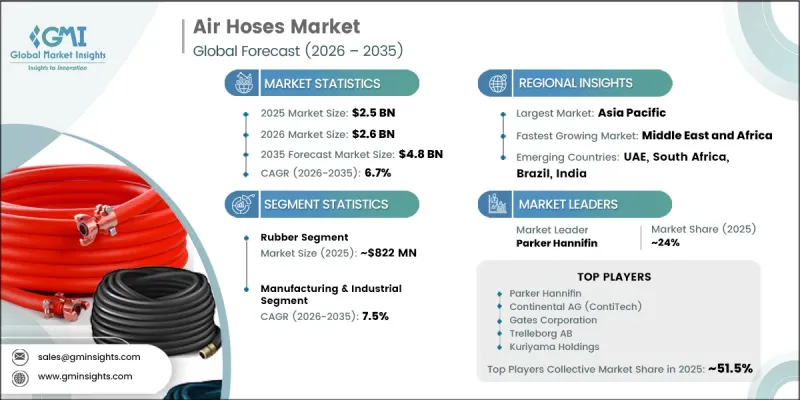
에어 호스 시장은 산업 활동의 확대와 여러 최종 용도 부문에서 압축 공기 시스템에 대한 의존도가 높아지는 것을 배경으로, 꾸준하고 지속적인 성장을 이루고 있습니다. 제조, 자동차, 건설, 광업 및 유지보수 분야에서 공압 공구와 장비의 채택이 확대됨에 따라, 내구성이 뛰어나고 고성능인 에어 호스 솔루션에 대한 수요가 증가하고 있습니다. 생산 환경에서의 자동화 또한 시장 성장을 더욱 가속화하고 있는데, 이는 공압 기계나 조립 작업의 동력원으로 압축 공기 배관 시스템이 여전히 필수적이기 때문입니다. 로봇 공학 및 첨단 제조 기술의 부상으로 효율적인 공기 공급 인프라에 대한 수요가 크게 증가하고 있으며, 이것이 에어 호스 소비를 직접적으로 뒷받침하고 있습니다. 또한, 산업 인프라 및 시설 확장에 대한 지속적인 투자로 인해 압축기 설치 대수가 증가하고 있으며, 이로 인해 에어 호스 수요가 더욱 늘어나고 있습니다. 각 산업이 현대화를 추진하며 핵심 업무에 자동화를 지속적으로 통합해 나가는 가운데, 에어 호스 시장은 효율성 요구 사항과 산업 생산성 향상에 힘입어 장기적으로 안정적인 성장을 유지할 것으로 예측됩니다.
| 시장 범위 | |
|---|---|
| 개시 연도 | 2025년 |
| 예측 기간 | 2026-2035년 |
| 초기 시장 규모 | 25억 달러 |
| 예측액 | 48억 달러 |
| CAGR | 6.7% |
고무 부문은 2025년에 8억 2,200만 달러의 매출을 기록했으며, 산업 전반에 걸쳐 뛰어난 내구성, 유연성 및 비용 효율성을 갖추고 있어 2035년까지 연평균 성장률(CAGR) 5.7%로 성장할 것으로 전망됩니다. 고압 환경을 견디고, 내마모성이 뛰어나며, 가혹한 작동 환경에서도 성능을 유지할 수 있는 특성 덕분에 제조 플랜트, 건설 현장, 광산 현장에서 사용하기에 매우 적합합니다. 또한, 고무 호스는 다양한 온도 조건에서도 신뢰할 수 있는 성능을 발휘하므로, 서로 다른 지역이나 산업 환경에서도 일관된 기능성을 보장할 수 있습니다.
제조·산업 부문은 2025년에 33.6%의 점유율을 차지했으며, 2035년까지 연평균 성장률(CAGR) 7.5%로 성장할 것으로 전망됩니다. 이 부문이 시장을 주도하고 있는 이유는 압축 공기 시스템이 대부분의 생산 시설에서 필수적인 설비이기 때문입니다. 에어 호스는 공압 공구, 자동화 기계, 조립 라인 및 자재관리 시스템에서 널리 사용되고 있으며, 현대 산업 활동에서 없어서는 안 될 구성 요소가 되었습니다. 자동화, 스마트 제조 시스템 및 고효율 생산 기술의 도입이 확대됨에 따라, 산업 환경 전반에서 신뢰성이 높은 공기 배관 솔루션에 대한 수요가 더욱 증가하고 있습니다.
북미의 에어 호스 시장은 선진적인 산업 기반과 주요 부문의 고도화된 자동화에 힘입어 2025년에는 28.5%의 시장 점유율을 기록했습니다. 해당 지역에서는 공압 시스템이 업무상 매우 중요한 역할을 담당하고 있는 제조, 자동차, 항공우주, 석유 및 가스, 건설 등 각 산업 분야에서 계속해서 견조한 수요가 나타나고 있습니다. 에어 호스는 높은 신뢰성과 안전성이 요구되는 유지보수 작업이나 가혹한 산업 현장에서 널리 사용되고 있습니다. 제조 시설의 지속적인 현대화와 구형 공압 시스템의 교체는 해당 지역 전체의 꾸준한 시장 성장을 뒷받침하고 있습니다.
자주 묻는 질문
목차
제1장 조사 방법과 범위
제2장 주요 요약
제3장 업계 인사이트
제4장 경쟁 구도
제5장 시장 추산 및 예측 : 소재 유형별, 2022년-2035년
제6장 시장 추산 및 예측 : 압력 레이팅별, 2022년-2035년
제7장 시장 추산 및 예측 : 가격별, 2022년-2035년
제8장 시장 추산 및 예측 : Diameter별, 2022년-2035년
제9장 시장 추산 및 예측 : 보강 방식별, 2022년-2035년
제10장 시장 추산 및 예측 : 최종사용자 산업별, 2022년-2035년
제11장 시장 추산 및 예측 : 유통 채널별, 2022년-2035년
제12장 시장 추산 및 예측 : 지역별, 2022년-2035년
제13장 기업 개요
LSH 26.07.14The Global Air Hoses Market was valued at USD 2.5 billion in 2025 and is estimated to grow at a CAGR of 6.7% to reach USD 4.8 billion by 2035.
The air hoses market is experiencing steady and sustained growth driven by the expansion of industrial operations and the increasing reliance on compressed air systems across multiple end-use sectors. Growing adoption of pneumatic tools and equipment in manufacturing, automotive, construction, mining, and maintenance applications is reinforcing demand for durable and high-performance air hose solutions. Automation in production environments is further strengthening market growth, as compressed air distribution systems remain essential for powering pneumatic machinery and assembly operations. The rise of robotics and advanced manufacturing technologies has significantly increased the need for efficient air delivery infrastructure, directly supporting air hose consumption. In addition, ongoing investments in industrial infrastructure and facility expansion are contributing to higher compressor installations, which further drives demand for air hoses. As industries continue to modernize and integrate automation into core operations, the air hoses market is expected to maintain stable long-term growth supported by efficiency requirements and industrial productivity improvements.
| Market Scope | |
|---|---|
| Start Year | 2025 |
| Forecast Year | 2026-2035 |
| Start Value | $2.5 Billion |
| Forecast Value | $4.8 Billion |
| CAGR | 6.7% |
The rubber segment generated USD 822 million in 2025 and is projected to grow at a CAGR of 5.7% through 2035, owing to its strong durability, flexibility, and cost-effectiveness across industrial applications. Its ability to withstand high-pressure conditions, resist abrasion, and maintain performance under demanding operating environments makes it highly suitable for use in manufacturing plants, construction activities, and mining operations. In addition, rubber hoses offer reliable performance across varying temperature conditions, enabling consistent functionality across different geographic regions and industrial settings.
The manufacturing and industrial segment accounted for 33.6% share in 2025 and is expected to grow at a CAGR of 7.5% through 2035. This segment leads the market because compressed air systems are a fundamental utility across most production facilities. Air hoses are extensively used in pneumatic tools, automated machinery, assembly lines, and material handling systems, making them an essential component of modern industrial operations. Increasing adoption of automation, smart manufacturing systems, and high-efficiency production technologies is further driving demand for reliable air distribution solutions across industrial environments.
North America Air Hoses Market held 28.5% share in 2025, supported by its advanced industrial base and high level of automation across key sectors. The region continues to demonstrate strong demand across manufacturing, automotive, aerospace, oil and gas, and construction industries, where pneumatic systems play a vital operational role. Air hoses are widely used in maintenance activities and heavy-duty industrial applications that require high reliability and safety performance. Ongoing modernization of manufacturing facilities and replacement of outdated pneumatic systems continue to support steady market growth across the region.
Major companies operating in the global air hoses market include Festo SE & Co. KG, Eaton Corporation, Trelleborg AB, Gates Corporation, Parker Hannifin Corporation, Kuriyama Holdings Corporation, Alfagomma S.p.A., Continental AG (ContiTech), SMC Corporation, Novaflex Group, Milton Industries Inc., Semperit AG, Dixon Valve & Coupling Company, Toyox Co., Ltd., Prevost SAS, Legacy Manufacturing Co. (Flexzilla(R)), Kanaflex Corporation, Sumitomo Riko Hosetex, Ltd., Coilhose Pneumatics, Nitta Corporation, Teknor Apex (Apex Hose Division), and Dayco. Companies operating in the air hoses market are strengthening their competitive position by investing in advanced material technologies, high-performance elastomer development, and enhanced product durability to meet demanding industrial requirements. Many manufacturers are expanding their production capacities and optimizing supply chains to support rising global demand. Strategic partnerships with industrial equipment providers and automation solution companies are helping broaden application reach and improve market penetration. Businesses are also focusing on product innovation, including lightweight designs, higher pressure resistance, and improved flexibility to enhance operational efficiency.
Table of Contents
Chapter 1 Methodology & Scope
- 1.1 Market scope and definition
- 1.2 Research design
- 1.2.1 Research approach
- 1.2.2 Data collection methods
- 1.3 Data mining sources
- 1.3.1 Global
- 1.3.2 Regional/Country
- 1.4 Base estimates and calculations
- 1.4.1 Base year calculation
- 1.4.2 Key trends for market estimation
- 1.5 Primary research and validation
- 1.5.1 Primary sources
- 1.6 Forecast model
- 1.7 Research assumptions and limitations
Chapter 2 Executive Summary
- 2.1 Industry 360° synopsis
- 2.2 Key market trends
- 2.2.1 Region
- 2.2.2 Material Type
- 2.2.3 Pressure Rating
- 2.2.4 Pricing Range
- 2.2.5 Diameter
- 2.2.6 Reinforcement Type
- 2.2.7 End-user Industry
- 2.2.8 Distribution channel
Chapter 3 Industry Insights
- 3.1 Industry ecosystem analysis
- 3.1.1 Supplier landscape
- 3.1.2 Profit margin
- 3.1.3 Value addition at each stage
- 3.1.4 Factor affecting the value chain
- 3.2 Industry impact forces
- 3.2.1 Growth drivers
- 3.2.1.1 Accelerating industrial automation & robotics integration driving pneumatic component demand
- 3.2.1.2 Rising global manufacturing infrastructure investment
- 3.2.1.3 Stringent workplace safety regulations mandating high-performance hose assemblies
- 3.2.1.4 Growing adoption of air-powered tools in automotive & construction sectors
- 3.2.2 Industry pitfalls & challenges
- 3.2.2.1 High volatility in raw material costs (rubber, polymers, steel wire) squeezing margins
- 3.2.2.2 Threat of substitution from all-electric & battery-powered tools
- 3.2.2.3 Long product lifecycles & high durability elongating replacement cycles
- 3.2.3 Opportunities
- 3.2.3.1 Growing demand for smart & IoT-enabled air hoses with embedded pressure sensors
- 3.2.3.2 Rising preference for eco-friendly, recyclable & PVC-free hose materials
- 3.2.3.3 Expanding e-commerce & online distribution channels for direct-to-consumer reach
- 3.2.3.4 Untapped demand in agriculture & food processing sectors in emerging markets
- 3.2.1 Growth drivers
- 3.3 Growth potential analysis
- 3.4 Supply Chain Analysis
- 3.4.1 Raw material sourcing & price volatility (rubber, polymers, steel)
- 3.4.2 Manufacturing concentration & outsourcing trends
- 3.4.3 Supply chain disruption risk assessment
- 3.5 Future market trends
- 3.6 Technology and innovation landscape
- 3.6.1 Current technological trends
- 3.6.2 Emerging technologies
- 3.7 Regulatory landscape
- 3.7.1 Standards and compliance requirements
- 3.7.2 Regional regulatory frameworks
- 3.7.3 Certification standards
- 3.8 Trade data analysis (HS Code - 4009.12)
- 3.8.1 Import/Export Volume & Value Trends (Driven by Primary Research)
- 3.8.2 Key Trade Corridors & Tariff Impact (Driven by Primary Research)
- 3.9 Impact of AI & generative AI on the market
- 3.9.1 AI-Driven Disruption of Existing Business Models
- 3.9.2 GenAI Use Cases & Adoption Roadmap by Segment
- 3.9.3 Risks, Limitations & Regulatory Considerations
- 3.10 Pricing Analysis
- 3.11 Historical Price Trend Analysis (Driven by Primary Research)
- 3.12 Pricing Strategy by Player Type (Premium / Value / Cost-plus) (Driven by Primary Research)
- 3.13 Porter's analysis
- 3.14 PESTEL analysis
Chapter 4 Competitive Landscape, 2025
- 4.1 Introduction
- 4.2 Company market share analysis
- 4.3 Company matrix analysis
- 4.4 Competitive analysis of major market players
- 4.5 Competitive positioning matrix
- 4.6 Key developments
- 4.6.1 Mergers & acquisitions
- 4.6.2 Partnerships & collaborations
- 4.6.3 New product launches
- 4.6.4 Expansion plans
Chapter 5 Market Estimates & Forecast, By Material Type, 2022 - 2035, (USD Billion) (Million Units)
- 5.1 Key Trends
- 5.2 Rubber Air Hoses
- 5.2.1 EPDM Rubber
- 5.2.2 SBR Rubber
- 5.2.3 NBR (Nitrile) Rubber
- 5.3 PVC Air Hoses
- 5.3.1 Standard PVC
- 5.3.2 Reinforced PVC
- 5.4 Polyurethane (PU) Air Hoses
- 5.4.1 Standard PU
- 5.4.2 Premium PU (Coiled / Retractable)
- 5.5 Hybrid Air Hoses
- 5.6 Others (Silicone, TPE, Specialty Composites)
Chapter 6 Market Estimates & Forecast, By Pressure Rating, 2022 - 2035, (USD Billion) (Million Units)
- 6.1 Key Trends
- 6.2 Low Pressure (Up to 10 bar)
- 6.3 Medium Pressure (10-20 bar)
- 6.4 High Pressure (Above 20 bar)
Chapter 7 Market Estimates & Forecast, By Price Range, 2022 - 2035, (USD Billion) (Million Units)
- 7.1 Key Trends
- 7.2 Economy
- 7.3 Mid-Range
- 7.4 Premium
Chapter 8 Market Estimates & Forecast, By Diameter, 2022 - 2035, (USD Billion) (Million Units)
- 8.1 Key Trends
- 8.2 Less than 1/4 inch
- 8.3 1/4 inch to 1/2 inch
- 8.4 1/2 inch to 1 inch
- 8.5 Greater than 1 inch
Chapter 9 Market Estimates & Forecast, By Reinforcement Type, 2022 - 2035, (USD Billion) (Million Units)
- 9.1 Key Trends
- 9.2 Single Layer (Unreinforced)
- 9.3 Double Layer / Braided
- 9.4 Spiral / Wire Reinforced
Chapter 10 Market Estimates & Forecast, By End-user Industry, 2022 - 2035, (USD Billion) (Million Units)
- 10.1 Key Trends
- 10.2 Manufacturing & Industrial
- 10.2.1 General Manufacturing & Assembly Lines
- 10.2.2 Electronics & Semiconductor Assembly
- 10.2.3 Textile & Apparel Manufacturing
- 10.3 Automotive
- 10.3.1 OEM Assembly Plants
- 10.3.2 Aftermarket Repair Workshops
- 10.4 Construction
- 10.4.1 Residential Construction
- 10.4.2 Commercial & Infrastructure Projects
- 10.5 Oil & Gas
- 10.5.1 Upstream (Exploration & Drilling)
- 10.5.2 Downstream (Refining & Processing)
- 10.6 Mining
- 10.7 Agriculture
- 10.8 Food & Beverage
- 10.9 Others (Marine, Aerospace, Chemical Processing)
Chapter 11 Market Estimates & Forecast, By Distribution Channel, 2022 - 2035, (USD Billion) (Million Units)
- 11.1 Key Trends
- 11.2 Industrial Distributors / Direct Sales
- 11.2.1 OEM Bundling & Key Account Sales
- 11.2.2 MRO (Maintenance, Repair & Operations) Procurement
- 11.3 Retail (Offline)
- 11.3.1 Hardware & Home Improvement Stores
- 11.3.2 Specialty Tool & Equipment Retailers
- 11.3.3 Automotive Aftermarket Chains
- 11.4 E-Commerce (Online)
- 11.4.1 Third-Party Marketplaces (Amazon, Alibaba, Indiamart)
- 11.4.2 Manufacturer (Direct-to-Consumer Digital Platforms)
Chapter 12 Market Estimates & Forecast, By Region, 2022 - 2035, (USD Billion) (Million Units)
- 12.1 Key Trends
- 12.2 North America
- 12.2.1 U.S.
- 12.2.2 Canada
- 12.3 Europe
- 12.3.1 Germany
- 12.3.2 France
- 12.3.3 UK
- 12.3.4 Italy
- 12.3.5 Spain
- 12.4 Asia Pacific
- 12.4.1 China
- 12.4.2 Japan
- 12.4.3 India
- 12.4.4 Australia
- 12.4.5 South Korea
- 12.5 Latin America
- 12.5.1 Brazil
- 12.5.2 Mexico
- 12.5.3 Argentina
- 12.6 MEA
- 12.6.1 Saudi Arabia
- 12.6.2 UAE
- 12.6.3 South Africa
Chapter 13 Company Profiles
- 13.1 Parker Hannifin Corporation
- 13.2 Gates Corporation
- 13.3 Continental AG (ContiTech)
- 13.4 Trelleborg AB
- 13.5 Kuriyama Holdings Corporation
- 13.6 Coilhose Pneumatics
- 13.7 Legacy Manufacturing Co. (Flexzilla®)
- 13.8 Prevost SAS
- 13.9 Milton Industries Inc.
- 13.10 Semperit AG
- 13.11 Toyox Co., Ltd.
- 13.12 Novaflex Group
- 13.13 Alfagomma S.p.A.
- 13.14 Festo SE & Co. KG
- 13.15 SMC Corporation
- 13.16 Sumitomo Riko Hosetex, Ltd.
- 13.17 Dayco
- 13.18 Eaton Corporation
- 13.19 Dixon Valve & Coupling Company
- 13.20 Teknor Apex (Apex Hose Division)
- 13.21 Kanaflex Corporation
- 13.22 Nitta Corporation


