

|
시장보고서
상품코드
2118110
미국 및 유럽 간 Ro-Ro 해상 화물 운송 시장 : 시장 점유율 분석, 업계 동향 및 통계, 성장 예측(2026-2031년)United States-Europe Ro-Ro Ocean Freight Transport - Market Share Analysis, Industry Trends & Statistics, Growth Forecasts (2026 - 2031) |
||||||
 Mordor Intelligence
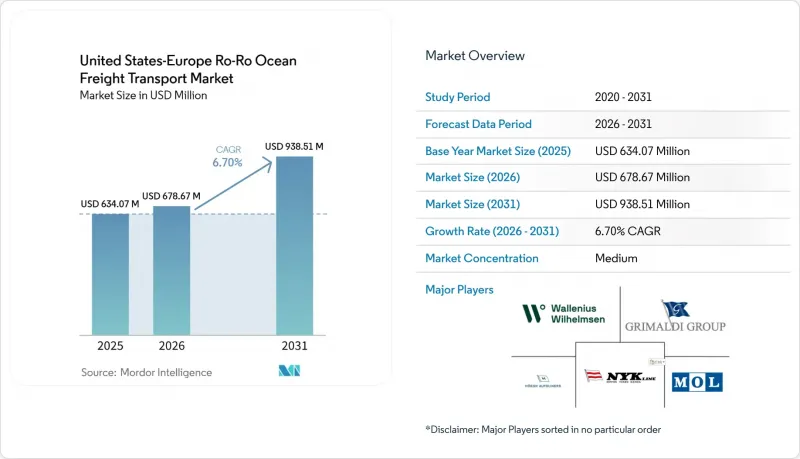
Mordor Intelligence에 의하면, 미국 및 유럽 간 Ro-Ro 해상 화물 운송 시장 규모는 2025년에 6억 3,407만 달러로 평가되었고, 2026년 6억 7,867만 달러에서 2031년까지 9억 3,851만 달러에 이를 것으로 추정되며, 2026-2031년 예측 기간 CAGR은 6.70%를 나타낼 전망입니다.
미국 및 유럽 간 Ro-Ro 해상 화물 운송 시장은 관세 변경이 해당 노선 전체의 계획에 계속해서 혼란을 초래하고 있음에도 불구하고, 북미와 유럽 간의 견고한 자동차 무역 관계에 힘입어 지속적으로 확대되고 있습니다. 본 보고서는 화물 유형별(승용차, 상용차, 오프로드 차량), 선박 규모별(소형 선박, 중형 선박, 대형 선박), 최종 사용자 산업별(OEM, 딜러, 기타(렌탈 회사, 차량 리스 회사, 기타)), 화물 물동량/노선 클러스터별(미국에서 수출, 유럽에서 수출)로 분류되어 있습니다. 시장 전망은 금액(달러) 기준으로 제시되어 있습니다.
미국 및 유럽 간 Ro-Ro 해상 화물 운송 시장 동향 및 인사이트
미국 및 유럽 간 완성차 무역의 확대
미국 및 유럽 간 Ro-Ro 해상 화물 운송 시장은 미국과 유럽 간의 완성차 무역과 밀접한 관련이 있습니다. 유럽의 자동차 그룹은 이미 미국에서 연간 약 83만 대의 차량을 생산하고 있으며, 그 생산량의 50-60%가 수출되고 있습니다. 이 때문에 대서양 횡단 차량 운송은 이 노선을 이용하는 양측 모두에게 전략적으로 중요한 위치를 계속 차지하고 있습니다. 2025년, 유럽연합(EU)과 미국 간의 양자 상품 무역 총액은 9,106억 유로(1조 400억 달러)에 달했으며, 보다 광범위한 무역 체계 속에서 완성차의 이동을 뒷받침하는 상업적 관계의 규모를 여실히 보여주고 있습니다. 이러한 무역의 깊이는 정책 전환으로 인해 단기간의 혼란이 발생하더라도, 미국과 유럽 간의 Ro-Ro 해상 화물 운송 시장에서는 수요가 유지될 것임을 의미합니다. 또한, 관세나 무역 규정이 사전 예고 없이 변경될 경우, 현물 수요에 의존하는 사업자보다 계약 기반의 화주가 많은 운송업체가 더 유리한 입장에 있음을 보여줍니다.
더 크고 연비 효율이 높은 PCTC로 선단 갱신
선단 현대화는 미국 및 유럽 간 Ro-Ro 해상 화물 운송 시장에 있어 가장 확실한 장기적 버팀목 중 하나로 자리 잡고 있습니다. Hoegh Autoliners는 2025년과 2026년에 걸쳐 ‘오로라’급 프로그램의 인도를 계속하고 있으며, 이 시리즈의 마지막 4척은 인도 시점부터 탄소 배출이 없는 암모니아를 연료로 운항하도록 설계된 최초의 순수 자동차·트럭 전용선이 될 예정입니다. 이는 더 크고 친환경적인 선박이 슬롯의 수익성을 높이고 대서양 횡단 운송에서 차량 1대당 배출 강도를 낮추는 데 중요한 의미를 지닙니다. 따라서 시장은 조기에 운송 능력을 현대화하고, 점점 더 엄격해지는 고객 및 규제 당국의 기대에 부응할 수 있는 해운사에 보상을 주고 있습니다. 구형 선박도 여전히 그 역할이 있지만, 신조선의 성능 기준이 향상됨에 따라 그 비용 경쟁력은 약화되고 있습니다.
지정학적 무역 마찰과 관세 변동
지정학적 무역 마찰은 미국과 유럽 간의 Ro-Ro 해상 화물 운송 시장에 있어 여전히 단기적으로 가장 큰 제약 요인으로 작용하고 있습니다. 2025년, EU에서 미국으로의 자동차 수출액은 21.7% 감소한 310억 유로(354억 달러)를 기록했고, 운송 대수도 66만 7,794대로 감소함에 따라 유럽에서 출발하는 수출 노선의 화물 수요가 위축되었습니다. 또한, 관세 변경 및 선박 관련 항만 요금 조치 역시 이 항로 전체에 걸쳐 운송업체의 계획 수립과 계약 가격 책정에 추가적인 불확실성을 초래했습니다. 운송 사업자에게 있어 문제는 무역 규칙이 변경되면 수요가 급격히 약화될 가능성이 있는 반면, 회복은 대개 훨씬 더 완만한 속도로 진행되는 협상 주기에 의존한다는 점에 있습니다. 따라서 미국 및 유럽 간 Ro-Ro 해상 화물 운송 시장은 많은 국내 물류 시장에 비해 정책 시기의 영향을 더 쉽게 받는 상황에 놓여 있습니다.
부문 분석
2025년, 승용차는 미국 및 유럽 간 Ro-Ro 해상 화물 운송 시장 점유율의 85.18%를 차지했으며, 이는 이 항로가 완성차 운송과 얼마나 밀접하게 연결되어 있는지를 보여줍니다. 이 범주는 주요 생산 거점과 소매 시장 간에 고급차 및 일반차 운송에서 대서양 항로가 오랫동안 수행해 온 역할을 반영하고 있습니다. 상용차는 가장 빠르게 성장하는 화물 유형이며, 이 부문에서 미국 및 유럽 간 Ro-Ro 해상 화물 운송 시장 규모는 2026-2031년 연평균 성장률(CAGR) 8.39%로 확대될 것으로 예측됩니다. 이러한 성장은 방위 관련 화물, 인프라 설비, 농업 기계, 드라이브온-드라이브오프(DOD) 방식의 하역에 적합한 기타 차량에 기인합니다.
오프로드 차량은 많은 차량이 초대형 크기이거나 컨테이너 운송에 적합하지 않기 때문에 미국 및 유럽 간 Ro-Ro 해상 화물 운송 시장에서 규모는 작지만 견실한 틈새 시장을 계속 유지하고 있습니다. 승용차 수요는 운송업체에게 가장 규모가 크고 정기적인 화물 기반을 제공하기 때문에 여전히 이 항로의 가격 책정에 큰 영향을 미치고 있습니다. 또한, 고가 차량일수록 손상률이 낮고 신뢰할 수 있는 일정 준수가 요구되기 때문에 화물 구성은 상업적으로 점점 더 민감해지고 있습니다. 이는 높은 터미널 취급 기준과 안정적인 계약 이행을 입증할 수 있는 운송업체에게 유리하게 작용합니다. 따라서 미국 및 유럽 간 Ro-Ro 해상 화물 운송 시장은 특수 차량 화물을 운송하기에 충분한 규모를 유지하고 있습니다. 그러나 운임 동향은 여전히 주로 승용차 운송 기반에 좌우되고 있습니다.
2025년 시점에서 미국 및 유럽 간 Ro-Ro 해상 화물 운송 시장 규모의 64.93%를 대형 선박이 차지했으며, 이는 대서양 횡단 심해 항로의 경제성을 반영하고 있습니다. 주요 대서양 게이트웨이 간에 완성차를 대량으로 효율적으로 운송해야 할 필요성으로 인해 대형 선박의 역할은 더욱 강화되고 있습니다. 최신 세대의 대형 PCTC(자동차 전용 수송선) 역시 적재 능력, 배기 가스 프로파일, 운항 비용 면에서 성능 기준을 높이고 있습니다. 그 결과, 대형 선박은 미국 및 유럽 간 Ro-Ro 해상 화물 운송 시장의 주요 노선 구조에서 계속해서 중심적인 위치를 차지하고 있습니다.
중형 선박은 2031년까지 연평균 성장률(CAGR) 8.76%를 나타낼 것으로 예측되며, 현재 선박 유형 구성에서 가장 역동적인 선박 유형이 되고 있습니다. 주요 허브와 항상 최대 규모의 선박을 수용할 수 없는 소규모 유럽 목적지 사이에서 운송업체들이 더 큰 유연성을 필요로 함에 따라 중형 선박의 존재감이 커지고 있습니다. 이로 인해 대형 선박과 중형 선박 사이에는 단순한 대체 사이클이 아닌, 서로를 보완하는 네트워크 구조가 형성되고 있습니다. 소형 선박은 흘수 제한, 특수한 항로, 혹은 소량 운송 등이 선박 배정 결정에 영향을 미치는 상황에서 여전히 중요한 역할을 수행하고 있습니다. 따라서 미국 및 유럽 간 Ro-Ro 해상 화물 운송 시장은 대형 PCTC가 간선 운송량을 주도하고, 중형 선박이 지역 배송에서의 역할을 확대하는 보다 다층적인 선박 구조로 전환되고 있습니다.
기타 혜택
- 엑셀 형식 시장 예측(ME) 시트
- 3개월간의 애널리스트 지원
자주 묻는 질문
목차
제1장 서론
제2장 조사 방법
제3장 주요 요약
제4장 시장 구도
제5장 시장 규모 및 성장 예측(금액 기준, 2026-2031년)
제6장 경쟁 구도
제7장 시장 기회 및 향후 전망
AJY 26.09.03According to Mordor Intelligence, the United States-Europe ro-Ro ocean freight transport market size was valued at USD 634.07 million in 2025 and is estimated to grow from USD 678.67 million in 2026 to reach USD 938.51 million by 2031, at a CAGR of 6.70% during the forecast period 2026-2031.
The United States-Europe Ro-Ro ocean freight transport market is advancing on the back of durable automotive trade links between North America and Europe, even as tariff changes continue to disrupt planning across the corridor. This report is Segmented by Cargo Type (Passenger Vehicles, Commercial Vehicles, and Off-Road Vehicles), by Vessel Size (Small Vehicles, Mid-Size Vehicles, and Large Vehicles), by End-User (OEMs, Dealers, and Others (Rental Companies, Fleet Leasing Companies, and More)), and by Flows (United States Export and Europe Export). The Market Forecasts are Provided in Terms of Value (USD).
United States-Europe Ro-Ro Ocean Freight Transport Market Trends and Insights
Rising Finished Vehicle Trade Between the United States and Europe
The United States-Europe Ro-Ro ocean freight transport market is tied closely to the two-way finished vehicle trade between the United States and Europe. European automotive groups already produce around 830,000 vehicles per year in the United States, and 50-60% of that output is exported, which keeps transatlantic vehicle shipping strategically important for both sides of the corridor. Total bilateral trade in goods between the European Union and the United States reached EUR 910.6 billion (USD 1.04 trillion) in 2025, underscoring the scale of the commercial relationship that supports finished vehicle movements within a broader trade system. This trade depth means the United States-Europe Ro-Ro ocean freight transport market keeps demand even when policy shifts create short periods of disruption. It also means carriers with contract-heavy books are better placed than operators that depend on spot demand when tariffs or trade rules change without much warning.
Fleet Renewal Toward Larger, More Fuel-Efficient PCTCs
Fleet renewal is becoming one of the clearest long-term supports for the United States-Europe Ro-Ro ocean freight transport market. Hoegh Autoliners continued delivery of its Aurora-class program through 2025 and 2026, and the final 4 vessels in the series are set to become the first pure car and truck carriers designed to run on zero-carbon ammonia from delivery. This matters because larger and cleaner vessels improve slot economics and lower emissions intensity per vehicle moved across the Atlantic. The market is, therefore, rewarding carriers that can modernize capacity early and align with tightening customer and regulatory expectations. Older vessels still have a role, but their cost position is weakening as newbuild performance standards rise.
Geopolitical Trade Frictions and Tariff Volatility
Geopolitical trade friction remains the largest near-term restraint on the United States-Europe Ro-Ro ocean freight transport market. EU vehicle exports to the United States fell 21.7% in value to EUR 31 billion (USD 35.4 billion) in 2025, and unit volumes declined to 667,794 cars, thereby reducing freight demand on the Europe export lane. Tariff changes and vessel-related port fee measures also created another layer of uncertainty for carrier planning and contract pricing across the corridor. The problem for operators is that demand can weaken quickly when trade rules change, while recovery usually depends on negotiation cycles that move much more slowly. That makes the United States Europe Ro-Ro ocean freight transport market more exposed to policy timing than many domestic logistics markets.
Other drivers and restraints analyzed in the detailed report include:
- Expansion of EV and Premium Vehicle Logistics Demand
- Port Infrastructure Upgrades at Key Atlantic Gateway Terminals
- Limited Vessel Availability on Peak Transatlantic Sailings
For complete list of drivers and restraints, kindly check the Table Of Contents.
Segment Analysis
Passenger vehicles accounted for 85.18% of the United States-Europe Ro-Ro ocean freight transport market share in 2025, which shows how strongly this corridor remains tied to finished car movements. The category reflects the long-standing role of the Atlantic lane in moving premium and mainstream vehicles between major production bases and retail markets. Commercial vehicles are the fastest-growing cargo type, with the United States-Europe Ro-Ro ocean freight transport market size for this segment projected to expand at 8.39% CAGR between 2026 and 2031. That growth comes from defense shipments, infrastructure equipment, agricultural machinery, and other rolling stock well-suited to drive-on, drive-off handling.
Off-road vehicles continue to serve a smaller but durable niche in the United States-Europe Ro-Ro ocean freight transport industry because many units are oversized or less suitable for container shipment. Passenger vehicle demand still sets corridor pricing because it supplies the deepest and most regular cargo base for carriers. The cargo mix is also becoming more commercially sensitive as higher-value units require lower damage rates and more reliable schedule performance. That favors operators that can demonstrate strong terminal-handling standards and stable contract execution. The United States-Europe Ro-Ro ocean freight transport market, therefore, remains broad enough to carry specialized rolling cargo. However, the direction of rates still depends mostly on the passenger vehicle base.
Large vessels held 64.93% of the United States-Europe Ro-Ro ocean freight transport market size in 2025, reflecting the economics of deep-sea transatlantic services. Their role is reinforced by the need to move large finished vehicle batches efficiently between primary Atlantic gateways. The newest generation of large PCTCs is also raising the performance benchmark for capacity, emissions profile, and operating costs. That keeps large ships central to the mainline structure of the United States-Europe Ro-Ro ocean freight transport market.
Mid-size vessels are forecast to grow at 8.76% CAGR through 2031, which makes them the most dynamic vessel class in the current mix. They are gaining ground because carriers need more flexibility between major hubs and smaller European destinations that cannot always support the largest ships. This creates a complementary network pattern rather than a direct replacement cycle between large and mid-size tonnage. Small vessels remain relevant where draft limits, specialized routes, or lower lot sizes shape deployment decisions. The United States Europe Ro-Ro ocean freight transport market is therefore moving toward a more layered vessel structure, with large PCTCs dominating linehaul volume and mid-size vessels expanding their role in regional distribution.
Complete Report Scope:
- By Cargo Type
- Passenger Vehicles (incl. 2 and 3-wheeler vehicles)
- Commercial Vehicles
- Off-road Vehicles
- By Vessel-size
- Small-size Vessels (Less than 2,000 CEU)
- Mid-size Vessels (2,000-4,000 CEU)
- Large vessels (More than 4,000 CEU)
- By End-user Industry
- OEMs
- Dealers
- Others (Rental Companies, Fleet leasing companies, Government & Defense Fleets, etc.)
- By Flows/Route Clusters
- United States Export
- Germany
- Belgium
- Netherlands
- United Kingdom
- France
- Italy
- Rest of Europe
- Europe Export
- Germany
- Belgium
- United Kingdom
- Sweden
- Italy
- Spain
- Rest of Europe
- United States Export
List of Companies Covered in this Report:
- Wallenius Wilhelmsen ASA
- Hoegh Autoliners ASA
- Grimaldi Group
- NYK Line
- Mitsui O.S.K. Lines, Ltd.
- Kawasaki Kisen Kaisha, Ltd. ("K" Line)
- Hyundai Glovis Co., Ltd.
- Neptune Lines Shipping & Managing Enterprises S.A.
- Atlantic Container Line (ACL)
- American Roll-On Roll-Off Carrier, LLC (ARC)
- DFDS A/S
- Sallaum Lines
- COSCO Shipping Specialized Carriers Co., Ltd.
- Siem Car Carriers AS
- United European Car Carriers (UECC)
- Eastern Pacific Shipping Pte. Ltd.
- Spliethoff Group
- AAL Shipping
- WWL Vehicle Services Americas
- CFR Rinkens
- MSC Group (including Gram Car Carriers)
- Liberty Global Logistics LLC
Additional Benefits:
- The market estimate (ME) sheet in Excel format
- 3 months of analyst support
TABLE OF CONTENTS
1 Introduction
- 1.1 Study Assumptions and Market Definition
- 1.2 Scope of the Study
2 Research Methodology
3 Executive Summary
4 Market Landscape
- 4.1 Market Overview and Importance of Ro-Ro Ocean Freight Transport Market
- 4.2 Market Drivers
- 4.2.1 Rising Finished Vehicle Trade Between the United States and Europe
- 4.2.2 Fleet Renewal Toward Larger, More Fuel-Efficient PCTCs
- 4.2.3 Expansion of EV and Premium Vehicle Logistics Demand
- 4.2.4 Port Infrastructure Upgrades at Key Atlantic Gateway Terminals
- 4.2.5 Nearshoring and Intra-Alliance Automotive Trade Reconfiguration
- 4.2.6 Stricter Cargo Damage and Chain-of-Custody Requirements Favor Ro-Ro
- 4.3 Market Restraints
- 4.3.1 Geopolitical Trade Frictions and Tariff Volatility
- 4.3.2 Limited Vessel Availability on Peak Transatlantic Sailings
- 4.3.3 Port Congestion and Terminal Slot Constraints
- 4.3.4 High Capital Intensity for New PCTC Orders
- 4.4 Regulatory Framework
- 4.5 Value Chain and Distribution Channel Architecture Analysis
- 4.6 Technology Innovations Outlook
- 4.7 Porter's Five Forces Analysis
- 4.7.1 Threat of New Entrants
- 4.7.2 Bargaining Power of Suppliers
- 4.7.3 Bargaining Power of Buyers
- 4.7.4 Threat of Substitutes
- 4.7.5 Rivalry Among Competitors
- 4.8 Port and Terminal Infrastructure Analysis
- 4.9 Sustainability and ESG Analysis
- 4.10 Evolution of United States-Europe Ro-Ro Ocean Freight Transport
- 4.11 Impact of Geo-Political Events on Supply Chain Shifts
5 Market Size and Growth Forecasts (Value, 2026-2031)
- 5.1 By Cargo Type
- 5.1.1 Passenger Vehicles (incl. 2 and 3-wheeler vehicles)
- 5.1.2 Commercial Vehicles
- 5.1.3 Off-road Vehicles
- 5.2 By Vessel-size
- 5.2.1 Small-size Vessels (Less than 2,000 CEU)
- 5.2.2 Mid-size Vessels (2,000-4,000 CEU)
- 5.2.3 Large vessels (More than 4,000 CEU)
- 5.3 By End-user Industry
- 5.3.1 OEMs
- 5.3.2 Dealers
- 5.3.3 Others (Rental Companies, Fleet leasing companies, Government & Defense Fleets, etc.)
- 5.4 By Flows/Route Clusters
- 5.4.1 United States Export
- 5.4.1.1 Germany
- 5.4.1.2 Belgium
- 5.4.1.3 Netherlands
- 5.4.1.4 United Kingdom
- 5.4.1.5 France
- 5.4.1.6 Italy
- 5.4.1.7 Rest of Europe
- 5.4.2 Europe Export
- 5.4.2.1 Germany
- 5.4.2.2 Belgium
- 5.4.2.3 United Kingdom
- 5.4.2.4 Sweden
- 5.4.2.5 Italy
- 5.4.2.6 Spain
- 5.4.2.7 Rest of Europe
- 5.4.1 United States Export
6 Competitive Landscape
- 6.1 Market Concentration
- 6.2 Key Strategic Moves
- 6.3 Market Share Analysis
- 6.4 Company Profiles (includes Global level Overview, Market level overview, Core Segments, Financials as available, Strategic Information, Market Rank/Share for key companies, Products & Services, and Recent Developments)
- 6.4.1 Wallenius Wilhelmsen ASA
- 6.4.2 Hoegh Autoliners ASA
- 6.4.3 Grimaldi Group
- 6.4.4 NYK Line
- 6.4.5 Mitsui O.S.K. Lines, Ltd.
- 6.4.6 Kawasaki Kisen Kaisha, Ltd. ("K" Line)
- 6.4.7 Hyundai Glovis Co., Ltd.
- 6.4.8 Neptune Lines Shipping & Managing Enterprises S.A.
- 6.4.9 Atlantic Container Line (ACL)
- 6.4.10 American Roll-On Roll-Off Carrier, LLC (ARC)
- 6.4.11 DFDS A/S
- 6.4.12 Sallaum Lines
- 6.4.13 COSCO Shipping Specialized Carriers Co., Ltd.
- 6.4.14 Siem Car Carriers AS
- 6.4.15 United European Car Carriers (UECC)
- 6.4.16 Eastern Pacific Shipping Pte. Ltd.
- 6.4.17 Spliethoff Group
- 6.4.18 AAL Shipping
- 6.4.19 WWL Vehicle Services Americas
- 6.4.20 CFR Rinkens
- 6.4.21 MSC Group (including Gram Car Carriers)
- 6.4.22 Liberty Global Logistics LLC
7 Market Opportunities and Future Outlook
- 7.1 White-space and Unmet-Need Assessment


