

|
시장보고서
상품코드
2083298
전기차 충전 서비스 시장 비즈니스 기회, 성장요인, 업계 동향 분석 및 예측(2026-2035년)EV Charging as a Service Market Opportunity, Growth Drivers, Industry Trend Analysis, and Forecast 2026 - 2035 |
||||||

세계의 전기차 충전 서비스 시장은 2025년에 84억 달러로 평가되었고, CAGR 18.8%로 성장하여 2035년까지 464억 달러에 달할 것으로 추정되고 있습니다.
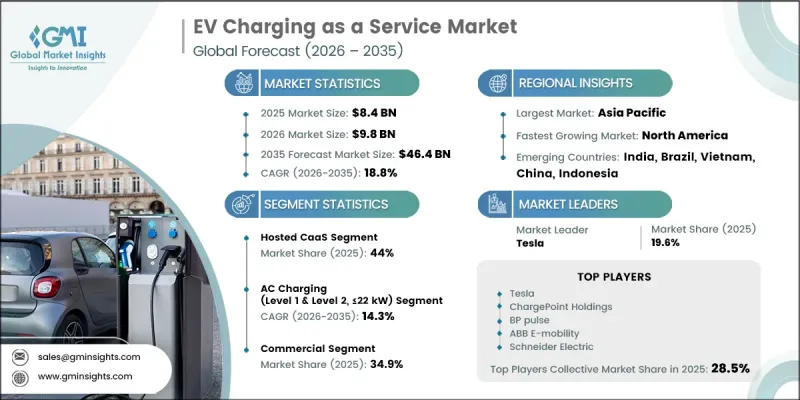
세계적으로 전기차 보급이 가속화되고, 충전 인프라에 대한 요구 사항이 점점 더 고도화됨에 따라 전기차 충전 서비스 시장은 크게 성장하고 있습니다. 시장의 성장은 규제 체계의 발전, 전기화 교통에 대한 투자 확대, 그리고 초기 인프라 비용을 최소화하는 확장 가능한 충전 솔루션에 대한 수요 증가에 힘입어 이루어지고 있습니다. 서비스 기반 충전 모델은 하드웨어, 소프트웨어, 에너지 관리, 유지보수, 결제 시스템을 통합 플랫폼에 결합함으로써 업계에 혁신을 가져오고 있습니다. 이 분야는 자본 집약적인 도입 방식에서 운영 효율성과 사용자 편의성을 중시하는 종합적인 모빌리티·에너지 생태계로 점차 전환되고 있습니다. 에너지 사업자, 충전 네트워크 사업자, 차량 관리 업체, 자동차 제조업체 시장 진입이 늘어나면서 시장 발전이 더욱 가속화되고 있습니다. 동시에, 전력 시스템 관리에 대한 요구가 높아지고, 스마트 에너지 통합 노력이 진행되며, 디지털 충전 플랫폼의 중요성이 커짐에 따라 업계 전반에 새로운 기회가 창출되고 있습니다. 충전 네트워크가 지속적으로 확대되는 가운데, 서비스 제공업체들은 지능형 에너지 관리, 상호 운용성, 원활한 고객 경험에 주력하고 있으며, 이를 통해 장기적인 시장 성장을 뒷받침하고 지속 가능한 교통으로의 전환을 가속화하고 있습니다.
| 시장 범위 | |
|---|---|
| 개시 연도 | 2025년 |
| 예측 기간 | 2026-2035년 |
| 개시 연도 시장 규모 | 84억 달러 |
| 예측액 | 464억 달러 |
| CAGR | 18.8% |
전기차 충전 서비스 시장은 충전 인프라 확충을 목표로 한 긍정적인 정책 조치와 업계 전반의 노력에 힘입어 강력한 성장세를 보이고 있습니다. 교통 수단의 전기화 및 에너지 효율 향상을 촉진하기 위해 마련된 규제 프로그램은 서비스 중심의 충전 모델에 유리한 환경을 조성하고 있습니다. 이러한 추세는 네트워크 접속, 결제 관리, 에너지 최적화, 충전 운영을 단일 플랫폼 아래 통합하는 통합형 충전 생태계의 성장을 뒷받침하고 있습니다. 전력 회사, 충전 서비스 제공업체, 모빌리티 기업, 기술 개발자 간의 협력이 강화됨에 따라 확장성이 뛰어난 충전 솔루션의 도입이 가속화되고 있습니다. 또한, 사용자에게 유연성과 비용 효율성을 제공하는 구독형 및 성능 중심의 충전 서비스에 대한 수요가 증가하면서 시장 성장을 뒷받침하고 있습니다. 업계가 성숙해짐에 따라, 고도화된 소프트웨어 오케스트레이션, 전력망 연동형 충전, 그리고 지능형 에너지 분배 기능은 현대 전기차 충전 서비스에서 필수적인 요소로 자리 잡고 있습니다.
'호스트형 충전 서비스(Charging as a Service)' 부문은 2025년에 44%의 시장 점유율을 차지했으며, 2026년부터 2035년까지 연평균 성장률(CAGR) 15.2%로 성장할 것으로 전망됩니다. 이 비즈니스 모델은 충전 서비스 제공업체가 제3자의 부지 내에 충전 인프라를 설치·운영·관리할 수 있을 뿐만 아니라, 부지 운영자의 소유 부담을 줄일 수 있기 때문에 인기를 끌고 있습니다. 이 모델은 수익 분배 계약, 에너지 서비스 계약, 그리고 이용자의 참여도 제고를 통해 가치를 창출합니다. 이용하기 편리한 공공 충전소와 목적지 충전 서비스에 대한 수요가 증가함에 따라, 호스트형 충전 솔루션의 도입이 더욱 가속화되고 있습니다. 이 부문은 부동산 소유주로부터 막대한 설비 투자를 요구하지 않으면서도 충전 네트워크의 광범위한 확장을 지원하고, 자산을 효율적으로 활용할 수 있게 한다는 점에서 특히 매력적입니다.
최대 22kW 용량의 레벨 1 및 레벨 2 시스템을 포함하는 AC 충전 부문은 2025년에 52.9%의 점유율을 차지했으며, 2035년까지 연평균 성장률(CAGR) 14.3%로 성장할 것으로 전망됩니다. AC 충전은 주택, 직장 및 준공공시설에서 여전히 가장 널리 보급된 충전 방식입니다. 장시간 충전에 적합하기 때문에 일상적인 차량 충전 수요에 있어 선호되는 선택지가 되고 있습니다. 전기차 보유 대수 증가, 직장에서의 전기화 이니셔티브 확대, 그리고 스마트 충전 기술의 도입 확대가 이 부문의 성장을 주도하고 있습니다. 또한, 첨단 에너지 관리 소프트웨어의 통합을 통해 부하 균형 최적화 및 지능형 전력 소비 관리를 실현함으로써 충전 효율이 향상되어, AC 충전 인프라의 보다 광범위한 보급을 뒷받침하고 있습니다.
2025년, 중국의 전기차 충전 서비스(Charging as a Service) 시장은 76%의 점유율을 차지하며 32억 달러의 매출을 올렸습니다. 이 나라는 충전 인프라에 대한 적극적인 투자, 전기차의 급속한 보급, 그리고 스마트 모빌리티와 에너지 전환에 초점을 맞춘 지원 정책 체계를 통해 계속해서 지역 시장을 선도하고 있습니다. 지능형 충전 시스템, 차량·전력망 통합 기술, 그리고 가상 발전소 개발을 추진하기 위한 지속적인 노력이 시장 전망을 더욱 견고하게 만들고 있습니다. 전력 계통에 대응하는 충전 네트워크와 첨단 에너지 관리 시스템의 도입이 지속됨에 따라, 충전 효율이 향상될 뿐만 아니라 상호 연계가 강화되어 지속 가능한 교통 생태계의 발전이 촉진되고 있습니다.
자주 묻는 질문
목차
제1장 조사 방법
제2장 주요 요약
제3장 업계 인사이트
제4장 경쟁 구도
제5장 시장 추산 및 예측 : 서비스 모델별, 2022년-2035년
제6장 시장 추산 및 예측 : 충전 유형별, 2022년-2035년
제7장 시장 추산 및 예측 : 차량별, 2022년-2035년
제8장 시장 추산 및 예측 : 용도별, 2022년-2035년
제9장 시장 추산 및 예측 : 지역별, 2022년-2035년
제10장 기업 개요
LSH 26.07.14The Global EV Charging as a Service Market was valued at USD 8.4 billion in 2025 and is estimated to grow at a CAGR of 18.8% to reach USD 46.4 billion by 2035.
The EV charging as a service market is experiencing substantial expansion as electric vehicle adoption accelerates worldwide and charging infrastructure requirements become increasingly sophisticated. Market growth is being supported by evolving regulatory frameworks, growing investments in electrified transportation, and the increasing need for scalable charging solutions that minimize upfront infrastructure costs. Service-based charging models are transforming the industry by combining hardware, software, energy management, maintenance, and payment systems into integrated platforms. The sector is gradually moving away from capital-intensive deployment approaches toward comprehensive mobility energy ecosystems that emphasize operational efficiency and user convenience. Increasing participation from energy providers, charging network operators, fleet managers, and automotive manufacturers is further strengthening market development. At the same time, rising grid management requirements, smart energy integration initiatives, and the growing importance of digital charging platforms are creating new opportunities across the industry. As charging networks continue to expand, service providers are focusing on intelligent energy management, interoperability, and seamless customer experiences, supporting long-term market growth and accelerating the transition toward sustainable transportation.
| Market Scope | |
|---|---|
| Start Year | 2025 |
| Forecast Year | 2026-2035 |
| Start Value | $8.4 Billion |
| Forecast Value | $46.4 Billion |
| CAGR | 18.8% |
The EV charging as a service market is witnessing strong momentum due to favorable policy initiatives and industry-wide efforts aimed at expanding charging infrastructure. Regulatory programs designed to encourage transportation electrification and energy efficiency are creating a supportive environment for service-oriented charging models. These developments are fostering the growth of integrated charging ecosystems that combine network accessibility, payment management, energy optimization, and charging operations under unified platforms. Growing collaboration between utilities, charging service providers, mobility companies, and technology developers is accelerating the deployment of scalable charging solutions. The market is also benefiting from increased demand for subscription-based and performance-driven charging services that offer flexibility and cost efficiency for users. As the industry matures, advanced software orchestration, grid-responsive charging, and intelligent energy distribution capabilities are becoming essential components of modern EV charging services.
The hosted charging as a service segment accounted for 44% share in 2025 and is projected to grow at a CAGR of 15.2% from 2026 to 2035. This business model is gaining popularity as it allows charging service providers to install, operate, and manage charging infrastructure on third-party properties while reducing ownership burdens for site operators. The model creates value through revenue-sharing arrangements, energy service agreements, and increased visitor engagement. Growing demand for accessible public charging locations and destination charging services continues to strengthen adoption of hosted charging solutions. The segment is particularly attractive because it enables efficient asset utilization while supporting broader charging network expansion without requiring significant capital investments from property owners.
The AC charging segment, including Level 1 and Level 2 systems with capacities up to 22 kW, held a 52.9% share in 2025 and is anticipated to grow at a CAGR of 14.3% through 2035. AC charging remains the most widely deployed charging format across residential, workplace, and semi-public environments. Its suitability for extended-duration charging applications makes it a preferred option for daily vehicle charging needs. Rising electric vehicle ownership, expanding workplace electrification initiatives, and increasing deployment of smart charging technologies are driving segment growth. Furthermore, the integration of advanced energy management software is enhancing charging efficiency through optimized load balancing and intelligent electricity consumption management, supporting broader adoption of AC charging infrastructure.
China EV Charging as a Service Market held a 76% share and generated USD 3.2 billion in revenue during 2025. The country continues to dominate the regional landscape due to strong investments in charging infrastructure, rapid electric vehicle adoption, and supportive policy frameworks focused on smart mobility and energy transition. Ongoing initiatives aimed at advancing intelligent charging systems, vehicle-grid integration technologies, and virtual power plant development are strengthening the market outlook. Continued deployment of grid-responsive charging networks and advanced energy management systems is enhancing charging efficiency while supporting the development of a more connected and sustainable transportation ecosystem.
Key participants operating across the EV charging as a service market include Tesla, EVgo, ABB E-mobility, Siemens, ChargePoint Holdings, Schneider Electric, and bp pulse. Companies operating in the EV charging as a service market are focusing on expanding charging networks, strengthening software capabilities, and developing integrated energy management solutions to reinforce their competitive position. Strategic partnerships with utilities, fleet operators, commercial property owners, and automotive manufacturers are helping providers accelerate infrastructure deployment and improve market reach. Businesses are increasingly investing in cloud-based charging platforms, smart charging technologies, predictive maintenance systems, and data analytics tools to enhance operational efficiency and customer experience. Subscription-based service models, energy optimization solutions, and managed charging services are also gaining prominence as companies seek recurring revenue streams. In addition, market participants are pursuing acquisitions, technology collaborations, and geographic expansion initiatives to strengthen their service portfolios.
Table of Contents
Chapter 1 Research Methodology
- 1.1 Research approach
- 1.2 Quality Commitments
- 1.2.1 GMI AI policy & data integrity commitment
- 1.2.1.1 Source consistency protocol
- 1.2.1 GMI AI policy & data integrity commitment
- 1.3 Research Trail & Confidence Scoring
- 1.3.1 Research Trail Components
- 1.3.2 Scoring Components
- 1.4 Data Collection
- 1.4.1 Partial list of primary sources
- 1.5 Data mining sources
- 1.5.1 Paid sources
- 1.5.1.1 Sources, by region
- 1.5.1 Paid sources
- 1.6 Base estimates and calculations
- 1.6.1 Base year calculation for any one approach
- 1.7 Forecast model
- 1.7.1 Quantified market impact analysis
- 1.7.1.1 Mathematical impact of growth parameters on forecast
- 1.7.1 Quantified market impact analysis
- 1.8 Research transparency addendum
- 1.8.1 Source attribution framework
- 1.8.2 Quality assurance metrics
- 1.8.3 Our commitment to trust
Chapter 2 Executive Summary
- 2.1 Industry 360° synopsis, 2022 - 2035
- 2.2 Key market trends
- 2.2.1 Regional
- 2.2.2 Service Model
- 2.2.3 Charger Type
- 2.2.4 Vehicle
- 2.2.5 Application
- 2.3 TAM Analysis, 2026-2035
- 2.4 CXO perspectives: Strategic imperatives
Chapter 3 Industry Insights
- 3.1 Industry ecosystem analysis
- 3.1.1 Supplier landscape
- 3.1.2 Profit margin analysis
- 3.1.3 Cost structure
- 3.1.4 Value addition at each stage
- 3.1.5 Factor affecting the value chain
- 3.1.6 Disruptions
- 3.2 Industry impact forces
- 3.2.1 Growth drivers
- 3.2.1.1 Rapid EV Adoption Reducing Upfront Infrastructure Cost Barriers for Businesses & Fleets
- 3.2.1.2 Government Mandates & Incentive Programs Accelerating CaaS Deployment (US NEVI, EU AFIR, India FAME)
- 3.2.1.3 Corporate Sustainability Commitments & ESG-Driven Fleet Electrification
- 3.2.1.4 Rising Total Cost of Ownership (TCO) Advantage of CaaS vs Owned Infrastructure
- 3.2.2 Industry pitfalls and challenges
- 3.2.2.1 Grid Capacity Constraints & Power Availability at High-Density Deployment Sites
- 3.2.2.2 Cybersecurity Vulnerabilities & Data Privacy Risks in Connected Charging Networks
- 3.2.3 Market opportunities
- 3.2.3.1 Multi-Unit Dwelling (MDU) & Residential Complex Charging - Largely Underserved Segment
- 3.2.3.2 Fleet Electrification Surge in Last-Mile Logistics & Ride-Hailing Sectors
- 3.2.3.3 Renewable Energy & BESS Integration Creating Green CaaS Premium Offerings
- 3.2.3.4 Emerging Markets in Asia Pacific, Latin America & MEA - Greenfield CaaS Deployment
- 3.2.1 Growth drivers
- 3.3 Growth potential analysis
- 3.4 Technology and innovation landscape
- 3.4.1 Current technological trends
- 3.4.2 Emerging technologies
- 3.5 Pricing Analysis (Driven by primary research)
- 3.5.1 Historical Price Trend Analysis
- 3.5.2 Pricing Strategy by Player Type
- 3.6 Regulatory landscape
- 3.6.1 North America
- 3.6.1.1 National Electric Vehicle Infrastructure Program (NEVI) - U.S. Department of Transportation
- 3.6.1.2 Federal Highway Administration Electric Vehicle Charging Infrastructure Standards
- 3.6.1.3 California Air Resources Board Zero Emission Vehicle Regulations
- 3.6.1.4 Federal Energy Regulatory Commission Grid Interconnection Rules
- 3.6.2 Europe
- 3.6.2.1 Alternative Fuels Infrastructure Regulation (AFIR)
- 3.6.2.2 Renewable Energy Directive III (RED III)
- 3.6.2.3 General Data Protection Regulation (GDPR)
- 3.6.2.4 European Union Data Act
- 3.6.3 Asia Pacific
- 3.6.3.1 China New Energy Vehicle Industry Development Plan (2021-2035)
- 3.6.3.2 China GB/T Electric Vehicle Charging Standards
- 3.6.3.3 China Cybersecurity Law
- 3.6.3.4 India Ministry of Power Electric Vehicle Charging Guidelines
- 3.6.4 Latin America
- 3.6.4.1 Brazil National Electric Mobility Program (MOVER Program)
- 3.6.4.2 Brazil General Data Protection Law (LGPD)
- 3.6.4.3 Mexico Energy Regulatory Commission Electric Vehicle Charging Guidelines
- 3.6.4.4 Chile National Electromobility Strategy (2021-2035)
- 3.6.5 Middle East & Africa
- 3.6.5.1 United Arab Emirates Electric Vehicle Charging Infrastructure Regulation
- 3.6.5.2 Saudi Arabia Vision 2030 Electric Vehicle Infrastructure Program
- 3.6.5.3 Gulf Cooperation Council Standardization Organization Electric Vehicle Charging Standards
- 3.6.5.4 National Energy Regulator of South Africa Electric Vehicle Charging Regulations
- 3.6.1 North America
- 3.7 Porter’s analysis
- 3.8 PESTEL analysis
- 3.9 Patent analysis (Driven by primary research)
- 3.10 Cost breakdown analysis
- 3.11 Impact of AI and Generative AI on the Market
- 3.11.1 AI Driven Disruption of Existing Business Models
- 3.11.2 GenAI Use Cases and Adoption Roadmap by Segment
- 3.11.3 Risks Limitations and Regulatory Considerations
- 3.12 Sustainability and environmental aspects
- 3.12.1 Sustainable practices
- 3.12.2 Waste reduction strategies
- 3.12.3 Energy efficiency in production
- 3.12.4 Eco-friendly Initiatives
- 3.12.5 Carbon footprint considerations
- 3.13 Forecast assumptions & scenario analysis (Driven by Primary Research)
- 3.13.1 Base Case- Key Macro & Industry Variables Driving CAGR
- 3.13.2 Optimistic Scenarios- Favorable macro and industry tailwinds
- 3.13.3 Pessimistic Scenario - Macroeconomic slowdown or industry headwinds
Chapter 4 Competitive Landscape, 2025
- 4.1 Introduction
- 4.2 Company market share analysis
- 4.2.1 North America
- 4.2.2 Europe
- 4.2.3 Asia Pacific
- 4.2.4 LATAM
- 4.2.5 MEA
- 4.3 Competitive analysis of major market players
- 4.4 Competitive positioning matrix
- 4.5 Key developments
- 4.5.1 Mergers & acquisitions
- 4.5.2 Partnerships & collaborations
- 4.5.3 New Product Launches
- 4.5.4 Expansion Plans and funding
- 4.6 Company tier benchmarking
- 4.6.1 Tier classification criteria & qualifying thresholds
- 4.6.2 Tier positioning matrix by revenue, geography & innovation
Chapter 5 Market Estimates & Forecast, By Service Model, 2022 - 2035 (USD Bn)
- 5.1 Key trends
- 5.2 Subscription-based CaaS
- 5.3 Hosted CaaS
- 5.4 Financed / Capex-Lite CaaS
Chapter 6 Market Estimates & Forecast, By Charger Type, 2022 - 2035 (USD Bn)
- 6.1 Key trends
- 6.2 AC Charging (Level 1 & Level 2, ≤22 kW)
- 6.3 DC Fast Charging (Level 3, 50-150 kW)
- 6.4 Ultra-Fast / High-Power Charging (>150 kW)
Chapter 7 Market Estimates & Forecast, By Vehicle, 2022 - 2035 (USD Bn)
- 7.1 Key trends
- 7.2 Passenger Vehicles
- 7.2.1 Hatchback
- 7.2.2 Sedan
- 7.2.3 SUV
- 7.3 Commercial Vehicles
- 7.3.1 LCV (Light Commercial Vehicles)
- 7.3.2 MCV (Medium Commercial Vehicles)
- 7.3.3 HCV (Heavy Commercial Vehicles)
Chapter 8 Market Estimates & Forecast, By Application, 2022 - 2035 (USD Bn)
- 8.1 Key trends
- 8.2 Commercial
- 8.2.1 Retail & Shopping Centers
- 8.2.2 Parking Garages & Operators
- 8.2.3 Office Buildings & Corporate Campuses
- 8.2.4 Others
- 8.3 Fleet - Corporate & Logistics
- 8.3.1 Company Vehicle & Motor Pool Fleets
- 8.3.2 Delivery & Last-Mile Logistics Fleets
- 8.3.3 Ride-Hailing & Shared Mobility Fleets
- 8.4 Public / Municipal
- 8.4.1 Highway & Corridor Charging Networks
- 8.4.2 Government-Operated Public Charging
- 8.4.3 Public Transit Operator Networks
- 8.5 Residential / Multi-Dwelling Units (MDUs)
- 8.5.1 Single-Family Residential
- 8.5.2 Multi-Dwelling Unit (MDU) Managed Charging
Chapter 9 Market Estimates & Forecast, By Region, 2022 - 2035 (USD Bn)
- 9.1 Key trends
- 9.2 North America
- 9.2.1 US
- 9.2.2 Canada
- 9.3 Europe
- 9.3.1 Germany
- 9.3.2 UK
- 9.3.3 France
- 9.3.4 Italy
- 9.3.5 Spain
- 9.3.6 Russia
- 9.3.7 Norway
- 9.3.8 Netherlands
- 9.3.9 Sweden
- 9.4 Asia Pacific
- 9.4.1 China
- 9.4.2 India
- 9.4.3 Japan
- 9.4.4 Australia
- 9.4.5 South Korea
- 9.4.6 Singapore
- 9.4.7 Thailand
- 9.4.8 Indonesia
- 9.4.9 Vietnam
- 9.5 Latin America
- 9.5.1 Brazil
- 9.5.2 Mexico
- 9.5.3 Argentina
- 9.6 MEA
- 9.6.1 South Africa
- 9.6.2 Saudi Arabia
- 9.6.3 UAE
- 9.6.4 Turkey
Chapter 10 Company Profiles
- 10.1 Global Players
- 10.1.1 ChargePoint Holdings
- 10.1.2 EVgo
- 10.1.3 Fastned
- 10.1.4 IONITY
- 10.1.5 Tesla
- 10.1.6 TELD New Energy
- 10.1.7 Star Charge
- 10.1.8 EnBW mobility+
- 10.1.9 ChargeNode
- 10.2 Regional Players
- 10.2.1 Allego
- 10.2.2 Electrify America
- 10.2.3 EVCS
- 10.2.4 Pod Point
- 10.2.5 Statiq
- 10.2.6 SWTCH Energy
- 10.2.7 EverCharge
- 10.2.8 EV Connect
- 10.2.9 3ti Energy Hubs
- 10.2.10 EV+ Charging
- 10.2.11 JET Charge
- 10.2.12 Keppel Volt


