

|
시장보고서
상품코드
2083311
자동차 와이어링 하네스 시장 기회, 성장 촉진요인, 업계 동향 분석 및 예측(2026-2035년)Automotive Wiring Harness Market Opportunity, Growth Drivers, Industry Trend Analysis, and Forecast 2026 - 2035 |
||||||

세계의 자동차 와이어링 하네스 시장은 2025년에 712억 달러 규모에 달하고, CAGR 5.7%로 성장하여 2035년까지 1,231억 달러에 달할 것으로 추정됩니다.
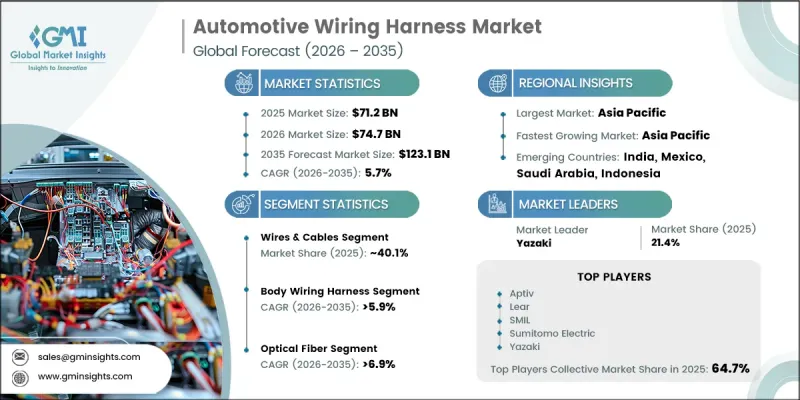
자동차 와이어링 하네스 시장은 기존의 내연기관 차량에 비해 훨씬 더 복잡한 전기 아키텍처가 필요한 전기자동차(EV) 및 하이브리드 차량으로의 전 세계적 전환을 배경으로 꾸준한 성장세를 보이고 있습니다. 고전압 배터리 시스템, 전기 구동 시스템 및 차량용 충전 부품의 채택이 확대됨에 따라, 손실을 최소화하면서 높은 에너지를 효율적으로 전달할 수 있는 첨단 와이어링 하네스 솔루션에 대한 수요가 크게 증가하고 있습니다. 이와 동시에, 배기가스 규제 강화와 정부 주도의 전동 모빌리티 인프라 투자가 주요 자동차 시장 전반에서 차량의 전동화를 가속화하고 있습니다. ADAS(첨단 운전자 지원 시스템)의 통합이 진행됨에 따라 전기 시스템의 복잡성은 더욱 커지고 있습니다. 현대 차량은 고속 데이터 전송과 신뢰성 높은 전력 분배가 필요한 센서, 카메라, 레이더, LiDAR 기술에 크게 의존하고 있기 때문입니다. 또한, 안전성, 연결성, 자동화 기능 향상에 대한 소비자의 기대가 높아짐에 따라 자동차 제조사들은 다양한 차량 플랫폼에 더 많은 전자 시스템을 탑재하도록 유도되고 있습니다. 이러한 요인들이 복합적으로 작용하여 자동차 와이어링 하네스 시장의 장기적인 성장 전망을 뒷받침하고 있습니다.
| 시장 범위 | |
|---|---|
| 시작 연도 | 2025년 |
| 예측 기간 | 2026-2035년 |
| 개시 금액 | 712억 달러 |
| 예측 금액 | 1,231억 달러 |
| CAGR | 5.7% |
전선·케이블 부문은 2025년에 40.1%의 시장 점유율을 차지했으며, 2035년까지 연평균 성장률(CAGR) 5.8%로 성장할 것으로 전망됩니다. 이 부문은 여러 차량 시스템 간의 전기적 연결을 가능하게 하는 데 있어 매우 중요한 역할을 수행하고 있기 때문에 선도적인 위치를 유지하고 있습니다. 와이어 및 케이블은 주요 자동차 부품 간에 전력 및 신호를 전송하는 데 필수적이며, 구동, 조명, 인포테인먼트, 안전 시스템, 커넥티비티 모듈 등의 기능을 뒷받침합니다. 자동차의 전동화가 진행되고, 현대 자동차의 전자화 수준이 높아짐에 따라 고성능 배선 솔루션에 대한 수요가 지속적으로 증가하고 있습니다.
차체용 와이어링 하네스 부문은 2025년에 24.7%의 시장 점유율을 차지했으며, 2026년부터 2035년까지 연평균 성장률(CAGR) 5.9%로 성장할 것으로 전망됩니다. 이 부문은 조명, 창문, 미러, 잠금 장치, 시트 시스템, 와이퍼 제어 등 차체 시스템 전체의 전기 기능을 뒷받침하는 데 있어 매우 중요한 역할을 하고 있습니다. 쾌적성, 편의성, 안전성 향상을 추구하는 소비자의 수요가 증가함에 따라, 승용차 및 상용차의 차체용 와이어링 하네스 시스템의 복잡성과 적용 범위가 현저히 확대되고 있습니다. 차량 내부 및 외부에서 전자부품의 통합이 진행되고 있는 점도 이 부문의 성장을 더욱 뒷받침하고 있습니다.
중국의 자동차 와이어링 하네스 시장은 64.2%의 점유율을 차지했으며, 2025년에는 215억 달러의 시장 규모를 기록했습니다. 이 나라의 시장 성장은 세계 최대의 자동차 생산 거점으로서의 지위와 전기자동차 생산의 급속한 확대에 힘입어 강력하게 뒷받침되고 있습니다. 수많은 OEM 및 부품 공급업체가 존재한다는 점이 저전압 및 고전압 와이어링 하네스 시스템 모두에 대한 강력한 수요를 이끌고 있습니다. 또한, 커넥티드카 기술, ADAS(첨단 운전자 지원 시스템), 소프트웨어 정의 차량(SDV) 플랫폼의 도입 확대가 시장 성장을 더욱 가속화하고 있습니다.
자주 묻는 질문
목차
제1장 조사 방법
제2장 주요 요약
제3장 업계 인사이트
제4장 경쟁 구도
제5장 시장 추정 및 예측 : 구성요소별, 2022-2035년
제6장 시장 추정 및 예측 : 제품별, 2022-2035년
제7장 시장 추정 및 예측 : 용도별, 2022-2035년
제8장 시장 추정 및 예측 : 커넥터 유형별, 2022-2035년
제9장 시장 추정 및 예측 : 재료 유형별, 2022-2035년
제10장 시장 추정 및 예측 : 추진력별, 2022-2035년
제11장 시장 추정 및 예측 : 차량별, 2022-2035년
제12장 시장 추정 및 예측 : 판매 채널별, 2022-2035년
제13장 시장 추정 및 예측 : 지역별, 2022-2035년
제14장 기업 개요
KSM 26.07.16The Global Automotive Wiring Harness Market was valued at USD 71.2 billion in 2025 and is estimated to grow at a CAGR of 5.7% to reach USD 123.1 billion by 2035.
The automotive wiring harness market is witnessing steady expansion driven by the global shift toward electric and hybrid vehicles, which require significantly more complex electrical architectures than conventional internal combustion engine vehicles. Increased adoption of high-voltage battery systems, electric drivetrains, and onboard charging components is substantially raising demand for advanced wiring harness solutions capable of efficient high-energy transmission with minimal losses. In parallel, tightening emission regulations and government-backed investments in electric mobility infrastructure are accelerating vehicle electrification across major automotive markets. The growing integration of advanced driver assistance systems is further increasing electrical complexity, as modern vehicles rely heavily on sensors, cameras, radar, and LiDAR technologies that require high-speed data transfer and reliable power distribution. Rising consumer expectations for enhanced safety, connectivity, and automation features are also pushing automakers to incorporate more electronic systems across vehicle platforms. Collectively, these factors are reinforcing long-term growth prospects for the automotive wiring harness market.
| Market Scope | |
|---|---|
| Start Year | 2025 |
| Forecast Year | 2026-2035 |
| Start Value | $71.2 Billion |
| Forecast Value | $123.1 Billion |
| CAGR | 5.7% |
The wires and cables segment accounted for 40.1% share in 2025 and is expected to grow at a CAGR of 5.8% through 2035. This segment maintains its leading position due to its critical role in enabling electrical connectivity across multiple vehicle systems. Wires and cables are essential for transmitting power and signals between key automotive components, supporting functions such as propulsion, lighting, infotainment, safety systems, and connectivity modules. Increasing vehicle electrification and rising electronic content in modern automobiles are driving sustained demand for high-performance wiring solutions.
The body wiring harness segment held 24.7% in 2025 and is projected to grow at a CAGR of 5.9% during 2026-2035. This segment plays a vital role in supporting electrical functions across vehicle body systems, including lighting, windows, mirrors, locking mechanisms, seating systems, and wiper controls. Growing consumer demand for enhanced comfort, convenience, and safety features is significantly increasing the complexity and adoption of body wiring harness systems across passenger and commercial vehicles. Rising integration of electronic components across vehicle interiors and exteriors is further strengthening segment growth.
China Automotive Wiring Harness Market held 64.2% share, generating USD 21.5 billion in 2025. Market growth in the country is strongly supported by its position as the world's largest automotive manufacturing hub and the rapid expansion of electric vehicle production. The presence of many OEMs and component suppliers is driving strong demand for both low-voltage and high-voltage wiring harness systems. In addition, increasing adoption of connected vehicle technologies, advanced driver assistance systems, and software-defined vehicle platforms is further accelerating market expansion.
Major companies operating in the global automotive wiring harness market include Aptiv, Sumitomo Electric, Furukawa Electric, LEONI, Lear, SMIL, and Yazaki (reaffirmed global leadership presence across major OEM supply chains). Companies operating in the automotive wiring harness market are strengthening their market position by investing in lightweight materials, high-voltage capable designs, and advanced thermal-resistant wiring technologies to support electric vehicle platforms. Manufacturers are expanding production capacities and establishing localized manufacturing facilities to improve supply chain efficiency and reduce lead times. Strategic collaborations with automotive OEMs are enabling co-development of customized wiring architectures tailored for electric and autonomous vehicles. Firms are also focusing on automation in manufacturing processes to enhance precision, reduce costs, and improve scalability.
Table of Contents
Chapter 1 Methodology
- 1.1 Research approach
- 1.2 Quality Commitments
- 1.2.1 GMI AI policy & data integrity commitment
- 1.2.1.1 Source consistency protocol
- 1.2.1 GMI AI policy & data integrity commitment
- 1.3 Research Trail & Confidence Scoring
- 1.3.1 Research Trail Components
- 1.3.2 Scoring Components
- 1.4 Data Collection
- 1.4.1 Partial list of primary sources
- 1.5 Data mining sources
- 1.5.1 Paid sources
- 1.5.1.1 Sources, by region
- 1.5.1 Paid sources
- 1.6 Base estimates and calculations
- 1.6.1 Base year calculation
- 1.7 Forecast Model
- 1.7.1 Quantified market impact analysis
- 1.7.1.1 Mathematical impact of growth parameters on forecast
- 1.7.1 Quantified market impact analysis
- 1.8 Research transparency addendum
- 1.8.1 Source attribution framework
- 1.8.2 Quality assurance metrics
- 1.8.3 Our commitment to trust
Chapter 2 Executive Summary
- 2.1 Industry 360° synopsis, 2022 - 2035
- 2.2 Key market trends
- 2.2.1 Regional
- 2.2.2 Component
- 2.2.3 Product
- 2.2.4 Application
- 2.2.5 Connector type
- 2.2.6 Material type
- 2.2.7 Propulsion
- 2.2.8 Vehicle
- 2.2.9 Sales channel
- 2.3 TAM Analysis, 2026-2035
- 2.4 CXO perspectives: Strategic imperatives
Chapter 3 Industry Insights
- 3.1 Industry ecosystem analysis
- 3.1.1 Supplier landscape
- 3.1.2 Profit margin analysis
- 3.1.3 Cost structure
- 3.1.4 Value addition at each stage
- 3.1.5 Factor affecting the value chain
- 3.1.6 Disruptions
- 3.2 Industry impact forces
- 3.2.1 Growth drivers
- 3.2.1.1 Rising vehicle electrification
- 3.2.1.2 Increasing ADAS adoption
- 3.2.1.3 Growing electronic content per vehicle
- 3.2.1.4 Expansion of connected vehicle technologies
- 3.2.2 Industry pitfalls and challenges
- 3.2.2.1 Volatile copper and aluminum prices
- 3.2.2.2 Labor-intensive manufacturing process
- 3.2.3 Market opportunities
- 3.2.3.1 High-voltage harness demand from ev growth
- 3.2.3.2 Expansion of software-defined vehicles (SDVS)
- 3.2.3.3 Growth of automotive ethernet & data harnesses
- 3.2.3.4 Localization and near-shoring initiatives
- 3.2.1 Growth drivers
- 3.3 Growth potential analysis
- 3.4 Technology and Innovation landscape
- 3.4.1 Current technological trends
- 3.4.2 Emerging technologies
- 3.5 Pricing Analysis (Driven by Primary Research)
- 3.5.1 Historical Price Trend Analysis
- 3.5.2 Pricing Strategy by Player Type (Premium / Value / Cost-plus)
- 3.6 Regulatory guideline
- 3.6.1 North America
- 3.6.1.1 U.S.: FMVSS Electrical Safety Standards & NHTSA Vehicle Electrical System Regulations
- 3.6.1.2 Canada: CMVSS Vehicle Electrical Safety Regulations & EV Compliance Framework
- 3.6.2 Europe
- 3.6.2.1 Germany: UNECE R100 Electric Vehicle Safety Regulations & VDA Electrical System Standards
- 3.6.2.2 UK: UK Whole Vehicle Type Approval (WVTA) Electrical Safety Regulations
- 3.6.2.3 France: EU REACH & End-of-Life Vehicle (ELV) Compliance Regulations
- 3.6.2.4 Italy: ISO 26262 Functional Safety Standards & UNECE Cybersecurity Regulations
- 3.6.3 Asia Pacific
- 3.6.3.1 China: GB 18384 Electric Vehicle Safety Regulations & High-Voltage Cable Standards
- 3.6.3.2 India: AIS-038 EV Safety Standards & AIS-156 Battery Safety Regulations
- 3.6.3.3 Japan: JASO Automotive Wiring Standards & MLIT Vehicle Safety Regulations
- 3.6.3.4 South Korea: KMVSS Electrical Safety Standards & EV Compliance Regulations
- 3.6.3.5 Australia: Australian Design Rules (ADR) Vehicle Electrical Safety Standards
- 3.6.4 Latin America
- 3.6.4.1 Brazil: CONTRAN Vehicle Electrical Safety Regulations & INMETRO Certification Standards
- 3.6.4.2 Mexico: NOM Automotive Electrical Safety Standards & Vehicle Compliance Regulations
- 3.6.4.3 Argentina: National Vehicle Electrical Safety Standards & Automotive Compliance Framework
- 3.6.5 MEA
- 3.6.5.1 UAE: GCC Vehicle Safety Regulations & UAE EV Compliance Framework
- 3.6.5.2 Saudi Arabia: SASO Vehicle Electrical Safety Standards & EV Regulatory Framework
- 3.6.5.3 South Africa: National Road Traffic Act Vehicle Safety Standards & SABS Electrical Compliance Regulations
- 3.6.1 North America
- 3.7 Porter's analysis
- 3.8 PESTEL analysis
- 3.9 Trade data analysis (Driven by Paid Research)
- 3.9.1 Import/export volume & value trends
- 3.9.2 Key trade corridors & tariff impact
- 3.10 Cost breakdown analysis
- 3.11 Patent Landscape (Driven by Primary Research)
- 3.12 Impact of AI & Generative AI on the Market (Driven by Primary Research)
- 3.12.1 AI-Driven Disruption of Existing Business Models
- 3.12.2 GenAI Use Cases & Adoption Roadmap by Segment
- 3.12.3 Risks, Limitations & Regulatory Considerations
- 3.13 Capacity & production landscape (Driven by Primary Research)
- 3.13.1 Installed capacity by region & key producer
- 3.13.2 Capacity utilization rates & expansion pipelines
- 3.14 Vehicle production & harness demand analysis
- 3.14.1 Global vehicle production trends & output forecasts (2026-2035)
- 3.14.2 Wiring harness demand correlation with global vehicle production volumes
- 3.14.3 Harness content & consumption per vehicle type (wiring length, weight, complexity index)
- 3.14.4 Ev production ramp-up impact on harness consumption
- 3.15 Forecast assumptions & scenario analysis (Driven by Primary Research)
- 3.15.1 Base Case - Key Macro & Industry Variables Driving CAGR
- 3.15.2 Optimistic Scenarios - Favourable macro and industry tailwinds
- 3.15.3 Pessimistic Scenario - Macroeconomic slowdown or industry headwinds
Chapter 4 Competitive Landscape, 2025
- 4.1 Introduction
- 4.2 Company market share analysis
- 4.2.1 North America
- 4.2.2 Europe
- 4.2.3 Asia Pacific
- 4.2.4 Latin America
- 4.2.5 MEA
- 4.3 Competitive analysis of major market players
- 4.4 Competitive positioning matrix
- 4.5 Key developments
- 4.5.1 Mergers & acquisitions
- 4.5.2 Partnerships & collaborations
- 4.5.3 New Product Launches
- 4.5.4 Expansion Plans and funding
- 4.6 Company Tier Benchmarking
- 4.6.1 Tier Classification Criteria & Qualifying Thresholds
- 4.6.2 Tier Positioning Matrix by Revenue, Geography & Innovation
Chapter 5 Market Estimates & Forecast, By Component, 2022 - 2035 ($Bn, Units)
- 5.1 Key trends
- 5.2 Wires & cables
- 5.2.1 Low-voltage wires (<60V)
- 5.2.2 High-voltage wires (>60V)
- 5.3 Connectors
- 5.4 Terminals
- 5.4.1 Crimp terminals
- 5.4.2 Insulation displacement terminals
- 5.4.3 Others
- 5.5 Relays
- 5.5.1 Electromagnetic relays
- 5.5.2 Solid-state relays
- 5.6 Fuses
- 5.6.1 Blade fuses
- 5.6.2 High-voltage fuses
- 5.6.3 Others
- 5.7 Protective sleeves & conduits
- 5.7.1 Corrugated conduits
- 5.7.2 Braided sleeves
- 5.7.3 Heat shrink tubing
- 5.7.4 Others
- 5.8 Others
Chapter 6 Market Estimates & Forecast, By Product, 2022 - 2035 ($Bn, Units)
- 6.1 Key trends
- 6.2 Engine wiring harness
- 6.2.1 ICE engine harness
- 6.2.2 Electric motor management harness
- 6.3 Body wiring harness
- 6.3.1 Door & window harness
- 6.3.2 Roof & sunroof harness
- 6.3.3 Exterior body module harness
- 6.4 Chassis wiring harness
- 6.5 HVAC wiring harness
- 6.6 Dashboard/cabin wiring harness
- 6.7 Battery & high-voltage wiring harness
- 6.7.1 Traction battery harness
- 6.7.2 Battery management system (BMS) harness
- 6.7.3 Charging system harness
- 6.7.4 HV inter-connected harness
- 6.8 Lighting wiring harness
- 6.8.1 Exterior lighting harness
- 6.8.2 Interior lighting harness
- 6.9 Others
Chapter 7 Market Estimates & Forecast, By Application, 2022 - 2035 ($Bn, Units)
- 7.1 Key trends
- 7.2 ADAS & autonomous driving
- 7.3 Connectivity & communication
- 7.4 Infotainment & entertainment
- 7.5 Others
Chapter 8 Market Estimates & Forecast, By Connector Type, 2022 - 2035 ($Bn, Units)
- 8.1 Key trends
- 8.2 Wire-to-wire connectors
- 8.2.1 Sealed
- 8.2.2 Unsealed
- 8.3 Wire-to-board connectors
- 8.3.1 Sealed
- 8.3.2 Unsealed
- 8.4 Board-to-board connectors
- 8.5 High-speed data connectors
- 8.6 High-voltage connectors
- 8.7 RF/coaxial connectors
- 8.8 Others
Chapter 9 Market Estimates & Forecast, By Material Type, 2022 - 2035 ($Bn, Units)
- 9.1 Key trends
- 9.2 Metallic conductors
- 9.2.1 Copper
- 9.2.2 Aluminum
- 9.2.3 Copper-clad aluminum (CCA)
- 9.2.4 Other specialty metals
- 9.3 Optical fiber
- 9.3.1 Plastic optical fiber (POF)
- 9.3.2 Glass optical fiber (GOF)
Chapter 10 Market Estimates & Forecast, By Propulsion, 2022 - 2035 ($Bn, Units)
- 10.1 Key trends
- 10.2 ICE
- 10.3 Electric
- 10.4 Hybrid
Chapter 11 Market Estimates & Forecast, By Vehicle, 2022 - 2035 ($Bn, Units)
- 11.1 Key trends
- 11.2 Passenger cars
- 11.2.1 Sedans & hatchbacks
- 11.2.2 SUVs & crossovers
- 11.2.3 Premium & luxury vehicles
- 11.3 Commercial vehicles
- 11.3.1 Light commercial vehicles (LCV)
- 11.3.2 Medium commercial vehicles (MCV)
- 11.3.3 Heavy commercial vehicles (HCV)
- 11.4 Two-wheelers
- 11.4.1 Motorcycles
- 11.4.2 Electric two-wheelers
Chapter 12 Market Estimates & Forecast, By Sales Channel, 2022 - 2035 ($Bn, Units)
- 12.1 Key trends
- 12.2 OEM
- 12.3 Aftermath
Chapter 13 Market Estimates & Forecast, By Region, 2022 - 2035 ($Bn, Units)
- 13.1 Key trends
- 13.2 North America
- 13.2.1 US
- 13.2.2 Canada
- 13.3 Europe
- 13.3.1 Germany
- 13.3.2 UK
- 13.3.3 France
- 13.3.4 Italy
- 13.3.5 Spain
- 13.3.6 Russia
- 13.3.7 Netherlands
- 13.3.8 Belgium
- 13.4 Asia Pacific
- 13.4.1 China
- 13.4.2 India
- 13.4.3 Japan
- 13.4.4 Australia
- 13.4.5 South Korea
- 13.4.6 New Zealand
- 13.5 Latin America
- 13.5.1 Brazil
- 13.5.2 Mexico
- 13.5.3 Argentina
- 13.6 MEA
- 13.6.1 South Africa
- 13.6.2 Saudi Arabia
- 13.6.3 UAE
Chapter 14 Company Profiles
- 14.1 Global Players
- 14.1.1 Amphenol
- 14.1.2 Aptiv
- 14.1.3 Fujikura
- 14.1.4 Furukawa Electric
- 14.1.5 Lear Corporation
- 14.1.6 LEONI
- 14.1.7 Molex LLC
- 14.1.8 Sumitomo Electric
- 14.1.9 TE Connectivity
- 14.1.10 Yazaki Corporation
- 14.2 Regional Players
- 14.2.1 COFICAB Group
- 14.2.2 Draxlmaier Group
- 14.2.3 K.S. Terminals Inc. (KST)
- 14.2.4 Kyungshin Corporation
- 14.2.5 Nexans Autoelectric
- 14.2.6 Samvardhana Motherson International (SMIL)
- 14.2.7 Spark Minda (Minda Industries Ltd.)
- 14.3 Emerging Players
- 14.3.1 BizLink Holding
- 14.3.2 Luxshare Precision Industry
- 14.3.3 Rosenberger Hochfrequenztechnik


