

|
시장보고서
상품코드
2101569
농약 합성용 아닐린 및 p-니트로페놀 : 시장 기회, 성장 촉진요인, 업계 동향 분석 및 예측(2026-2035년)Aniline and p-Nitrophenol from Pesticide Synthesis Market Opportunity, Growth Drivers, Industry Trend Analysis, and Forecast 2026 - 2035 |
||||||

세계의 농약 합성용 아닐린 및 p-니트로페놀 시장은 2025년에 4억 8,000만 달러 규모에 달하고, 2035년까지 CAGR 4.6%로 성장하여 7억 5,400만 달러에 달할 것으로 추정됩니다.

시장의 성장은 식량 안보에 대한 우려의 고조와 아시아태평양 및 라틴아메리카를 중심으로 한 농업 개발도상국에서 작물 보호용 화학제품 사용 증가에 힘입고 있습니다. 농업 생산량 확대에 따른 수요 증가가 농약 제조에 사용되는 아닐린계 화학 중간체의 소비 확대를 견인하고 있는 한편, 농약 제조업체들은 변화하는 농업 관행에 대응하기 위해 제품 포트폴리오의 다각화를 추진하고 있습니다. 또한, 기존 제초제에 대한 내성이 확산됨에 따라 대체적인 잡초 관리 솔루션에 대한 수요가 높아지고 있는 점도 농약 합성용 아닐린 및 p-니트로페놀 시장에 긍정적인 영향을 미치고 있습니다. 이러한 추세로 인해 최신 제초제 제조에 사용되는 방향족 중간체에 대한 수요가 증가하고 있으며, 그 결과 소비량은 여전히 과거 평균을 상회하고 있습니다. 동시에 화학 합성 기술의 지속적인 발전으로 제조 효율이 향상되고 제품 품질이 유지되며, 생산자는 제조 공정을 최적화할 수 있게 되었습니다. 이러한 요인들에 더해, 농업 생산성에 대한 지속적인 투자와 작물 보호 전략의 진화가 맞물리면서 전 세계 농약 합성용 아닐린 및 p-니트로페놀 시장에는 계속해서 양호한 장기 성장 기회가 창출되고 있습니다.
| 시장 범위 | |
|---|---|
| 시작 연도 | 2025년 |
| 예측 기간 | 2026-2035년 |
| 초기 시장 규모 | 4억 8,000만 달러 |
| 예측액 | 7억 5,400만 달러 |
| CAGR | 4.6% |
아닐린 부문은 2025년에 4억 4,000만 달러의 매출을 기록했습니다. 이 부문에는 농약 합성 용도로 설계된 여러 제품 카테고리가 포함되어 있으며, 제초제, 살균제 및 특수 농약 제조에 필수적인 방향족 중간체로서의 역할이 수요를 뒷받침하고 있습니다. 농업 생산량 증가와 농약 생산능력 확대로 인해, 이러한 제품 카테고리 전반에 걸친 소비는 계속해서 견조한 추세를 보이고 있습니다. 그중에서도 2035년까지 절대적인 수요 증가에 가장 크게 기여할 것으로 예상되는 것은 프라이머리 아닐린이며, 한편 제조사들이 첨단 제초제 제제의 생산을 지속적으로 확대함에 따라 파라니트로페놀 관련 중간체는 평균 이상의 성장을 기록할 것으로 전망됩니다.
제초제 부문의 시장 규모는 2025년에 2억 7,600만 달러로 평가되며, 이는 제초제 생산량과 아닐린계 원료 소비량 사이에 직접적인 관계가 있음을 반영합니다. 이러한 중간체는 농약 합성에서 기본적인 반응 물질로 기능하기 때문에 수요는 계속해서 제초제 생산 활동과 밀접하게 연동될 것입니다. 내성 관리 프로그램의 지속적인 확대, 재배 면적 증가, 그리고 효율적인 작물 보호 솔루션에 대한 수요 증가로 인해, 예측 기간 동안 제초제 살포 부문 전체에서 지속적인 성장이 뒷받침될 것으로 전망됩니다.
북미의 농약 합성용 아닐린 및 p-니트로페놀 시장은 2025년에 9,600만 달러 규모를 기록했습니다. 이 지역은 세계 시장의 20%를 차지하고 있으며, 소비량 및 농약 중간체 산업 전반에 미치는 영향력을 고려할 때 미국이 여전히 가장 큰 기여국으로 남아 있습니다. 국내 생산능력에 대한 지속적인 투자, 확립된 공급 계약, 그리고 농약 제조업체들의 안정적인 수요가 계속해서 이 지역의 시장 확대를 뒷받침하고 있습니다. 견고한 산업 인프라와 안정적인 고객 기반을 바탕으로, 예측 기간 동안 북미의 입지는 더욱 강화될 것으로 전망됩니다.
자주 묻는 질문
목차
제1장 조사 방법과 범위
제2장 주요 요약
제3장 업계 인사이트
제4장 경쟁 구도
제5장 시장 추정 및 예측 : 제품 유형별, 2022-2035년
제6장 시장 추정 및 예측 : 농약 살포 방법별, 2022-2035년
제7장 시장 추정 및 예측 : 지역별, 2022-2035년
제8장 기업 개요
KSM 26.08.04The Global Aniline & P-Nitrophenol from Pesticide Synthesis Market was valued at USD 480 million in 2025 and is estimated to grow at a CAGR of 4.6% to reach USD 754 million by 2035.
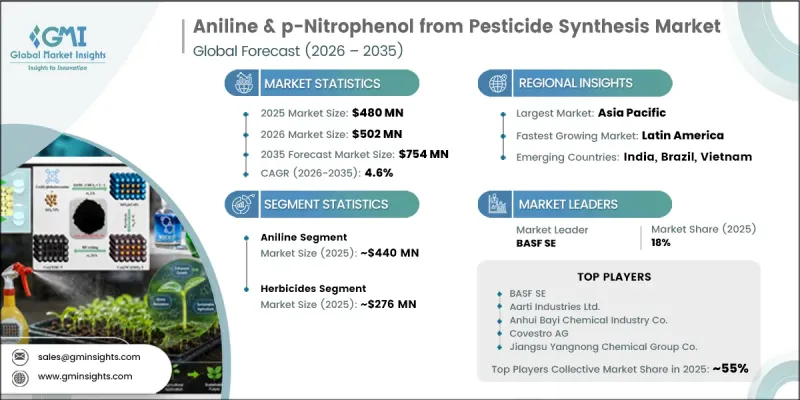
Market growth is supported by rising food security concerns and the increasing use of crop protection chemicals across developing agricultural economies, particularly in Asia Pacific and Latin America. Expanding agricultural production requirements are driving greater consumption of aniline-based chemical intermediates used in pesticide manufacturing, while agrochemical producers continue to diversify product portfolios to address changing farming practices. The aniline & p-nitrophenol from pesticide synthesis market is also benefiting from the growing need for alternative weed management solutions as resistance to conventional herbicide chemistries becomes more widespread. This trend is encouraging higher demand for aromatic intermediates used in the production of modern herbicides, resulting in consumption levels that continue to exceed historical averages. At the same time, ongoing advancements in chemical synthesis technologies are improving manufacturing efficiency, supporting product quality, and enabling producers to optimize production processes. These factors, combined with sustained investment in agricultural productivity and evolving crop protection strategies, continue to create favorable long-term growth opportunities for the global aniline & p-nitrophenol from pesticide synthesis market.
| Market Scope | |
|---|---|
| Start Year | 2025 |
| Forecast Year | 2026-2035 |
| Start Value | $480 Million |
| Forecast Value | $754 Million |
| CAGR | 4.6% |
The aniline segment generated USD 440 million in 2025. The segment includes multiple product categories designed for pesticide synthesis applications, with demand supported by their role as essential aromatic intermediates in herbicide, fungicide, and specialty agrochemical production. Increasing agricultural output and expanding pesticide manufacturing capacity continue to strengthen consumption across these product categories. Among them, primary aniline is expected to contribute the largest increase in absolute demand through 2035, while para-nitrophenol-related intermediates are anticipated to record above-average growth as manufacturers continue to expand production of advanced herbicide formulations.
The herbicides segment was valued at USD 276 million in 2025, reflecting the direct relationship between herbicide manufacturing volumes and the consumption of aniline-based raw materials. Because these intermediates serve as fundamental reactants in pesticide synthesis, demand remains closely aligned with herbicide production activity. Continued expansion of resistance management programs, increasing cultivation acreage, and rising demand for efficient crop protection solutions are expected to support sustained growth across the herbicide application segment throughout the forecast period.
North America Aniline & P-Nitrophenol from Pesticide Synthesis Market generated USD 96 million in 2025. The region accounted for 20% of the global market, with the United States remaining the largest national contributor based on consumption levels and its influence on the broader pesticide intermediate industry. Ongoing investment in domestic manufacturing capabilities, established supply agreements, and consistent demand from agrochemical producers continue to support regional market expansion. Strong industrial infrastructure and a stable customer base are expected to reinforce North America's position throughout the forecast period.
Major companies operating in the global aniline & p-nitrophenol from pesticide synthesis market include BASF SE, Covestro AG, Lanxess AG, Sumitomo Chemical Co., Ltd., Aarti Industries Ltd., Jiangsu Yangnong Chemical Group Co., Ltd., Seya Industries Ltd., Valiant Organics Ltd., Gujarat Narmada Valley Fertilizers & Chemicals Ltd. (GNFC), Anhui Bayi Chemical Industry Co., Ltd., Deepak Nitrite Limited, Ningbo Inno Pharmchem Co., Ltd., Bodal Chemicals Ltd., Crystal Surfactants & Chemicals, and Hemani Global. Companies operating in the aniline & p-nitrophenol from pesticide synthesis market are strengthening their market position by expanding manufacturing capacity, improving process efficiency, and investing in advanced production technologies to enhance product quality and cost competitiveness. Many producers are focusing on portfolio diversification to address evolving agrochemical requirements while increasing investment in research and development to support innovative synthesis processes. Strategic collaborations with agrochemical manufacturers, long-term supply agreements, and geographic expansion initiatives continue to improve market reach and customer retention. Businesses are also emphasizing regulatory compliance, sustainable manufacturing practices, and supply chain optimization to strengthen operational resilience.
Table of Contents
Chapter 1 Methodology & Scope
- 1.1 Market scope and definition
- 1.2 Research design
- 1.2.1 Research approach
- 1.2.2 Data collection methods
- 1.3 Data mining sources
- 1.3.1 Global
- 1.3.2 Regional/Country
- 1.4 Base estimates and calculations
- 1.4.1 Base year calculation
- 1.4.2 Key trends for market estimation
- 1.5 Primary research and validation
- 1.5.1 Primary sources
- 1.6 Forecast model
- 1.7 Research assumptions and limitations
Chapter 2 Executive Summary
- 2.1 Industry 360° synopsis
- 2.2 Key market trends
- 2.2.1 Product Type
- 2.2.2 Pesticide Application
- 2.2.3 Regional
- 2.3 TAM Analysis, 2026-2035
- 2.4 CXO perspectives: Strategic imperatives
- 2.5 Future outlook and strategic recommendations
Chapter 3 Industry Insights
- 3.1 Industry ecosystem analysis
- 3.1.1 Supplier landscape
- 3.1.2 Profit margin
- 3.1.3 Value addition at each stage
- 3.1.4 Factor affecting the value chain
- 3.1.5 Disruptions
- 3.2 Industry impact forces
- 3.2.1 Growth drivers
- 3.2.2 Industry pitfalls and challenges
- 3.2.3 Market opportunities
- 3.3 Growth potential analysis
- 3.4 Regulatory landscape
- 3.4.1 North America
- 3.4.2 Europe
- 3.4.3 Asia Pacific
- 3.4.4 Latin America
- 3.4.5 Middle East & Africa
- 3.5 Porter's analysis
- 3.6 PESTEL analysis
- 3.7 Technology and innovation landscape
- 3.7.1 Current technological trends
- 3.7.2 Emerging technologies
- 3.8 Price trends
- 3.8.1 By region
- 3.8.2 By Product Type
- 3.9 Future market trends
- 3.10 Patent landscape
- 3.11 Trade statistics
- 3.11.1 Major importing countries
- 3.11.2 Major exporting countries
- 3.12 Sustainability and environmental aspects
- 3.12.1 Sustainable practices
- 3.12.2 Waste reduction strategies
- 3.12.3 Energy efficiency in production
- 3.12.4 Eco-friendly initiatives
Chapter 4 Competitive Landscape, 2025
- 4.1 Introduction
- 4.2 Company market share analysis
- 4.2.1 By region
- 4.2.1.1 North America
- 4.2.1.2 Europe
- 4.2.1.3 Asia Pacific
- 4.2.1.4 LATAM
- 4.2.1.5 MEA
- 4.2.1 By region
- 4.3 Company matrix analysis
- 4.4 Competitive analysis of major market players
- 4.5 Competitive positioning matrix
- 4.6 Key developments
- 4.6.1 Mergers & acquisitions
- 4.6.2 Partnerships & collaborations
- 4.6.3 New product launches
- 4.6.4 Expansion plans
Chapter 5 Market Estimates and Forecast, By Product Type, 2022-2035 (USD Million) (Kilo Tons)
- 5.1 Key trends
- 5.2 Aniline (Pesticide Synthesis Grade)
- 5.2.1 Primary Aniline (Pesticide Synthesis Grade)
- 5.2.2 Para-Nitroaniline (PNA) - Pesticide Intermediate Pathway
- 5.2.3 Ortho-Nitroaniline (ONA) - Specialty Pesticide Applications
- 5.3 p-Nitrophenol (4-Nitrophenol / PNP)
- 5.3.1 Technical Grade PNP (≥98%)
- 5.3.2 Refined/High Purity Grade PNP (≥99.5%)
- 5.3.3 Industrial Grade PNP
Chapter 6 Market Estimates and Forecast, By Pesticide Application, 2022-2035 (USD Million) (Kilo Tons)
- 6.1 Key trends
- 6.2 Herbicides
- 6.2.1 Acetanilide Herbicides
- 6.2.2 Phenoxy & Dinitroaniline Herbicides
- 6.2.3 Other Herbicidal Applications
- 6.3 Insecticides
- 6.3.1 Organophosphate Insecticides
- 6.3.2 Carbamate Insecticides
- 6.3.3 Other Insecticidal Applications
- 6.4 Fungicides
- 6.4.1 Aniline-Derived Fungicide Intermediates
- 6.4.2 Nitrophenol-Based Fungicide Pathways
- 6.4.3 Others
Chapter 7 Market Estimates and Forecast, By Region, 2022-2035 (USD Million) (Kilo Tons)
- 7.1 Key trends
- 7.2 North America
- 7.2.1 U.S.
- 7.2.2 Canada
- 7.3 Europe
- 7.3.1 Germany
- 7.3.2 UK
- 7.3.3 France
- 7.3.4 Spain
- 7.3.5 Italy
- 7.3.6 Rest of Europe
- 7.4 Asia Pacific
- 7.4.1 China
- 7.4.2 India
- 7.4.3 Japan
- 7.4.4 Australia
- 7.4.5 South Korea
- 7.4.6 Rest of Asia Pacific
- 7.5 Latin America
- 7.5.1 Brazil
- 7.5.2 Mexico
- 7.5.3 Argentina
- 7.5.4 Rest of Latin America
- 7.6 Middle East and Africa
- 7.6.1 Saudi Arabia
- 7.6.2 South Africa
- 7.6.3 UAE
- 7.6.4 Rest of Middle East and Africa
Chapter 8 Company Profiles
- 8.1 BASF SE
- 8.2 Covestro AG
- 8.3 Lanxess AG
- 8.4 Sumitomo Chemical Co., Ltd.
- 8.5 Aarti Industries Ltd.
- 8.6 Jiangsu Yangnong Chemical Group Co., Ltd.
- 8.7 Seya Industries Ltd.
- 8.8 Valiant Organics Ltd.
- 8.9 Gujarat Narmada Valley Fertilizers & Chemicals Ltd. (GNFC)
- 8.10 Anhui Bayi Chemical Industry Co., Ltd.
- 8.11 Deepak Nitrite Limited
- 8.12 Ningbo Inno Pharmchem Co., Ltd.
- 8.13 Bodal Chemicals Ltd.
- 8.14 Crystal Surfactants & Chemicals
- 8.15 Hemani Global


