

|
시장보고서
상품코드
2118174
키랄라세미화 억제제 시장 : 시장 점유율 분석, 업계 동향 및 통계, 성장 예측(2026-2031년)Chiral Racemization Inhibitors - Market Share Analysis, Industry Trends & Statistics, Growth Forecasts (2026 - 2031) |
||||||
 Mordor Intelligence
Mordor Intelligence에 의하면, 키랄라세미화 억제제 시장 규모는 2025년 4억 2,012만 달러로 평가되었고, 2026년에는 4억 5,118만 달러로 추정되고, 2031년까지 6억 5,165만 달러에 이를 것으로 전망되며, 2026-2031년 CAGR 7.63%를 나타낼 것으로 예측됩니다.
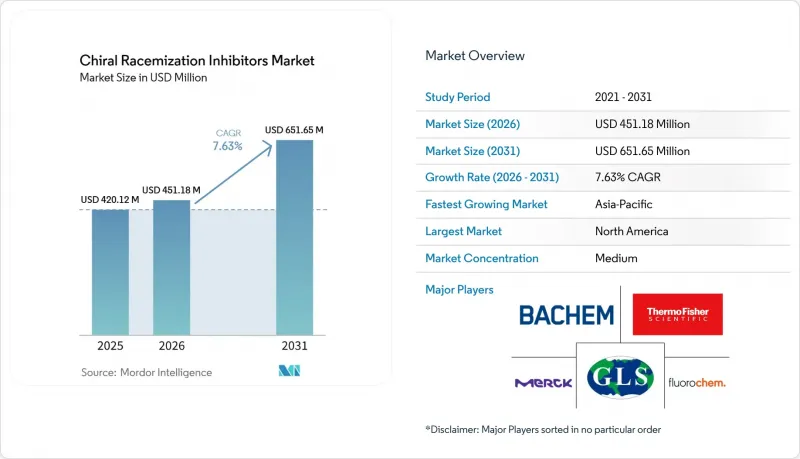
본 보고서는 제품 유형별(옥시마계 억제제, Hobt 등), 제형별(분말, 용액, 기타), 용도별(펩타이드 합성, 의약품 원료(API) 합성, 생체 결합 등), 지역별(아시아태평양, 북미, 유럽, 남미, 중동 및 아프리카)로 분류되어 있습니다. 시장 예측은 금액(달러) 기준으로 제시되어 있습니다.
세계의 키랄라세미화 억제제 시장 동향 및 인사이트
의약품 원료의약품(API) 합성에서 고순도 키랄 화합물에 대한 수요 증가
키랄라세미화 억제제 시장은 의약품 원료의약품(API) 제조 과정에서 키랄 불순물에 대한 관리가 강화됨에 따라 꾸준한 지지를 얻고 있습니다. ICH의 원료의약품 관련 요건에 부합하는 FDA 지침에 따르면, 제품의 품질에 영향을 미칠 가능성이 있는 전체 합성 공정에서 기업은 입체화학적 위험을 파악하고 관리해야 합니다. 이에 따라 라세미화 억제제는 단순한 연구용 선택 구매 품목이 아니라, 많은 규제 대상 펩타이드 및 API 워크플로우에서 표준 비용 항목이 되었습니다. 펩타이드 사슬이 길어질수록 부담은 더욱 커집니다. 이는 아미노산이 하나 추가될 때마다 라세미화를 제어해야 하는 지점이 하나씩 늘어나기 때문입니다. 합성의 복잡성이 증가하면 수요가 진행 중인 개발 프로그램의 수보다 빠르게 증가할 가능성이 있으므로, 이러한 상업적 영향은 키랄라세미화 억제제 시장에서 두드러지게 나타납니다. ICH Q11 준수에 따라, 이 요건은 주요 규제 지역의 제조 실무에 정착되어 있습니다.
GLP-1 수용체 작용제를 필두로 한 펩타이드계 치료제의 채택 확대
키랄라세미화 억제제 시장은 펩타이드 치료제, 특히 글루카곤 유사 펩타이드-1(GLP-1) 수용체 작용제 분야의 활발한 상업 활동 및 개발 활동으로부터도 혜택을 받고 있습니다. 대규모 펩타이드 제조는 단순히 반응기 용량만으로 추진되는 것이 아니며, 모든 스케일업 단계에서 순도 관리가 여전히 핵심적인 역할을 하고 있습니다. 검증된 억제제 시스템은 복잡한 펩타이드 합성 과정에서 반복되는 커플링 사이클 동안 축적될 수 있는 라세미화 위험을 억제하는 데 도움이 됩니다. 펩타이드 제조 분야의 과학적·상업적 활동이 지속적으로 확대됨에 따라, 이 분야에 서비스를 제공하는 각 공급업체들은 개발 및 임상적 요구를 충족하기 위해 인증된 시약 포트폴리오를 확충하고 있습니다. Bachem사는 2025 회계연도에 현지 통화 기준으로 임상 개발 관련 매출이 29.7% 증가했다고 보고했는데, 이는 개발 단계의 펩타이드 연구가 키랄라세미화 억제제 시장 전망 수요를 지속적으로 뒷받침하고 있다는 견해를 뒷받침하는 것입니다.
특수 키랄 시약의 높은 비용
키랄라세미화 억제제 시장은 비용에 민감한 제조 환경에서 가격 장벽에 직면해 있습니다. 고순도 OxymaPure 및 관련 차세대 제품은 보다 단순한 커플링 원료에 비해 가격이 높게 책정되어 있어, 소규모 CDMO의 경우 적합성 확인 및 재고 계획 수립이 더욱 어려워지고 있습니다. 아이리스 바이오테크(Iris Biotech)는 OxymaPure를 연구용 규모 가격대로 제시하고 있어, 이러한 프리미엄 가격 책정을 여실히 보여주고 있습니다. 대규모 API 제조업체는 이 추가 비용을 규정 준수 및 배치 릴리스 보호의 일환으로 간주함으로써 보다 쉽게 흡수할 수 있습니다. 반면, 소규모 지역 제조업체는 대개 비용과 고객의 예산을 저울질해야 하기 때문에 규제가 가장 엄격한 시장을 제외한 곳에서는 광범위한 채택이 더딘 양상을 보이고 있습니다. 따라서 키랄라세미화 억제제 시장은 순도 위험이 상업적으로 중대한 영향을 미치는 지역, 최종 사용자가 고가의 시약에 대한 경제성을 정당화할 수 있는 지역에서 가장 빠르게 성장하고 있습니다.
부문 분석
2025년에는 옥시마계 억제제가 제품 유형 구성의 34.52%를 차지한 것으로 평가되었으며, 키랄라세미화 억제제 시장에서 이 부문은 2031년까지 연평균 성장률(CAGR) 8.41%로 성장할 것으로 전망됩니다. 이러한 점유율은 규제 대상인 합성 환경에서 안전성, 취급 용이성 및 성능이 조화를 이루고 있음을 반영합니다. Iris Biotech GmbH는 ‘OxymaPure’를 생산이 중단된 HOBt 및 1-하이드록시-7-아자벤조트리아졸(HOAt) 제제의 직접적인 대체품으로 포지셔닝하고 있습니다. 이 제품은 이러한 화합물에 수반되는 폭발성 분류의 부담을 피하면서, 에피머화를 저감하는 성능을 갖추고 있습니다. 조달 부서는 반응 효율은 물론 운송 비용, 작업자 안전 및 플랜트 인증 요건도 고려하기 때문에 이러한 포지셔닝은 키랄라세미화 억제제 업계에서 중요합니다. 그 결과, 기존의 벤조트리아졸계 첨가제에 수반되는 물류상의 마찰 없이, 연구 규모와 제조 규모 모두에 적합한 제품군이 실현되었습니다.
HOBt는 용액상 합성 및 카르보디이미드를 매개로 하는 워크플로우에서 여전히 사용되고 있습니다. 이러한 분야에서는 확립된 방법, 기존의 검증, 그리고 가격에 대한 민감도로 인해 구식 시스템이 계속해서 채택되고 있습니다. HOAt, HONB 및 HOSu는 특정 활성화 거동이나 취급이 까다로운 잔기에 대한 pKa 특성이 필요한, 보다 제한된 이용 사례에서 계속해서 활용되고 있습니다. 미국 화학회(ACS) 그린 케미스트리 연구소의 제약 원탁 회의는 펩타이드 합성에서 보다 친환경적인 대안 중 하나로 OxymaPure 유래 시약을 선정함으로써 이러한 변화를 뒷받침하고 있습니다. 또한, Bachem AG사는 COMU 및 PyOxim을 벤조트리아졸 계열에서 벗어나는 더 광범위한 움직임의 일환으로 자리매김하고 있으며, 이러한 대체 움직임이 단일 첨가제에 그치지 않고 시약 플랫폼 전체로 확대되고 있음을 보여줍니다. 이를 통해 옥시마계 화학은 단순한 첨가제 수준에서 예상되는 것보다 키랄라세미화 억제제 시장에서 더 폭넓은 성장 여지를 얻게 될 것입니다.
지역별 분석
2025년, 북미는 매출의 38.62%를 차지했으며, 키랄라세미화 억제제 시장에서 가장 규모가 큰 지역 점유율을 유지했습니다. 이 지역에서는 펩타이드 개발 기업, CDMO, 그리고 엄격한 품질 관리 시스템이 단일 조달 기반 아래 통합되어 있습니다. 미국은 여전히 이 중심적인 위치를 차지하고 있으며, FDA의 감독 및 국제조화회의(ICH) 준수 요건에 따라 원료의약품 제조에서 키랄 불순물 관리가 일상적인 요건이 되고 있습니다. 따라서 이 지역 수요는 단가뿐만 아니라 검증된 제품, 문서화의 질, 그리고 신뢰할 수 있는 공급에 중점을 두고 있습니다. 캐나다는 연구개발 수요를, 멕시코는 제네릭 의약품과 관련된 API(유효 성분) 활동 및 소규모 제조 거점을 통해 기여하고 있습니다. 지역 전체의 동향을 살펴보면, 키랄라세미화 억제제 시장은 펩타이드의 규모 확대, 규제 준수 및 조달 체계가 융합된 지역에서 가장 견조한 추세를 보이고 있습니다.
아시아태평양은 2031년까지 연평균 성장률(CAGR) 8.33%라는 가장 높은 성장률을 보일 것으로 예측됩니다. 키랄라세미화 억제제 시장에서 이 지역의 성장은 중국의 CDMO 규모, 인도의 의약품 제조 확대, 그리고 한국의 펩타이드 생산 능력에 대한 관심에 의해 주도되고 있습니다. 중국은 현지 생산자들이 키랄라세미화 억제제 및 첨가제 화학 분야에서 국내 수요와 수출 채널 모두를 충족시키고 있기 때문에 이 지역공급 상황에서 중심적인 역할을 하고 있습니다. 쑤저우 하이파인 바이오테크는 2025년 매출이 6억 230만 위안(8,300만 달러)에 달할 것이라고 보고했으며, 이러한 성장은 GLP-1 중간체 및 소분자 핵산 시약에 기인합니다.
유럽은 2025년에도 3위의 지역 규모를 유지했으며, 수많은 선진적인 시약·펩타이드 전문 기업이 거점을 두고 있어 키랄라세미화 억제제 시장에서 계속해서 중요한 역할을 수행하고 있습니다. Bachem사는 2025년 매출액으로 6억 9,510만 스위스 프랑(7억 7,900만 달러)을 보고했으며, 이 회사의 임상 개발 관련 매출액은 현지 통화 기준으로 29.7% 증가했습니다. 이는 펩타이드 관련 조달 수요가 계속해서 견조함을 반영하고 있습니다. 또한,독일에는 아이리스 바이오테크(Iris Biotech)사가 있으며, 이 회사는 2024년에 디메틸포름아미드(DMF)를 사용하지 않는 펩타이드 및 올리고뉴클레오티드 합성을 위한 ‘Cyclover-Amine’ 플랫폼을 도입하여, 그린 케미스트리에 대한 고려가 워크플로우 설계에 어떻게 반영되고 있는지를 입증했습니다. 남미, 중동 및 아프리카의 경우, 해당 지역에서의 도입이 여전히 대규모 펩타이드 API 생산보다는 연구 기관이나 지역 제네릭 의약품 제조에 중점을 두고 있기 때문에 상업적 비중은 여전히 낮은 상태입니다.
기타 혜택 :
- 엑셀 형식 시장 예측(ME) 시트
- 3개월간의 애널리스트 지원
자주 묻는 질문
목차
제1장 서론
제2장 조사 방법
제3장 개요
제4장 시장 구도
제5장 시장 규모 및 성장 예측
제6장 경쟁 구도
제7장 시장 기회 및 향후 전망
AJY 26.09.01According to Mordor Intelligence, the chiral racemization inhibitors market size is expected to increase from USD 420.12 million in 2025 to USD 451.18 million in 2026 and reach USD 651.65 million by 2031, and is expected to grow at a CAGR of 7.63% over 2026-2031.
This report is Segmented by Product Type (Oxyma-Based Inhibitors, Hobt, and More), Form (Powder, Solution, and Other Forms), Application (Peptide Synthesis, Pharmaceutical API Synthesis, Bioconjugation, and More), and Geography (Asia-Pacific, North America, Europe, South America, and Middle-East and Africa). The Market Forecasts are Provided in Terms of Value (USD).
Global Chiral Racemization Inhibitors Market Trends and Insights
Rising Demand for High-Purity Chiral Compounds in Pharmaceutical API Synthesis
The chiral racemization inhibitors market is gaining steady support from tighter control of chiral impurities in pharmaceutical API manufacturing. FDA guidance, aligned with ICH drug substance expectations, requires companies to characterize and control stereochemical risk across synthesis steps that may affect product quality. This has made racemization inhibitors a standard cost line in many regulated peptide and API workflows, rather than an optional research purchase. The burden increases further as peptide chains grow longer, because each additional amino acid introduces another point at which racemization must be controlled. The commercial impact is evident in the chiral racemization inhibitors market, as demand can grow faster than the number of active development programs when synthesis complexity increases. Compliance with ICH Q11 keeps this requirement embedded in manufacturing practice across major regulated regions.
Increasing Adoption of Peptide-Based Therapeutics, Led by GLP-1 Receptor Agonists
The chiral racemization inhibitors market is also benefiting from strong commercial and development activity in peptide therapeutics, especially glucagon-like peptide-1 (GLP-1) receptor agonists. Large-scale peptide manufacturing is not driven solely by reactor capacity, as purity control remains central at every scale-up stage. A validated inhibitor system helps suppress the cumulative racemization risk that can build during repeated coupling cycles in complex peptide synthesis. As scientific and commercial activity in peptide manufacturing continues to expand, suppliers serving this field are broadening their qualified reagent portfolios to meet development and clinical needs. Bachem reported 29.7% growth in clinical development revenues in local currencies for fiscal year (FY) 2025, supporting the view that development-stage peptide work continues to feed future demand in the chiral racemization inhibitors market.
High Cost of Specialty Chiral Reagents
The chiral racemization inhibitors market faces a price barrier in cost-sensitive manufacturing environments. High-purity OxymaPure and related next-generation products command premiums over simpler coupling inputs, making qualification and inventory planning more difficult for smaller CDMOs. Iris Biotech lists OxymaPure at research-scale pricing, illustrating this premium positioning. Larger API producers can more easily absorb the additional cost, treating it as part of compliance and batch release protection. Smaller regional manufacturers often weigh the cost against customer budgets, which slows broader adoption outside the most heavily regulated markets. The chiral racemization inhibitors market, therefore, expands fastest where purity risk carries high commercial consequences and where end users can justify premium reagent economics.
Other drivers and restraints analyzed in the detailed report include:
- Shift Toward Safer, Non-Explosive Coupling Chemistry Replacing HOBt and HOAt
- Expansion of Peptide Drug Pipelines and Clinical Trial Activity
- Availability of Integrated Coupling Reagent Packages
For complete list of drivers and restraints, kindly check the Table Of Contents.
Segment Analysis
Oxyma-based inhibitors accounted for 34.52% of the product type mix in 2025, and this segment of the chiral racemization inhibitors market is projected to grow at a CAGR of 8.41% through 2031. Their share reflects an alignment of safety, ease of handling, and performance across regulated synthesis settings. Iris Biotech GmbH positions OxymaPure as a direct replacement for discontinued HOBt and 1-Hydroxy-7-azabenzotriazole (HOAt) formulations, with performance that supports lower epimerization while avoiding the explosive classification burden associated with those compounds. This positioning matters in the chiral racemization inhibitors industry because procurement teams weigh freight, worker safety, and plant qualification alongside reaction efficiency. The result is a product class that fits both research and manufacturing scale without the logistics friction associated with older benzotriazole additives.
HOBt remains in use for solution-phase synthesis and carbodiimide-mediated workflows, where established methods, existing validation, and price sensitivity keep older systems in place. HOAt, HONB, and HOSu continue to serve narrower use cases that require specific activation behavior or pKa characteristics for difficult residues. The American Chemical Society (ACS) Green Chemistry Institute Pharmaceutical Roundtable has reinforced this shift by identifying OxymaPure-derived reagents among greener options for peptide synthesis. Bachem AG also positions COMU and PyOxim as part of a broader move away from the benzotriazole family, indicating that substitution is extending to the reagent platform rather than remaining limited to single additives. This gives Oxyma-based chemistry a wider growth runway in the chiral racemization inhibitors market than a simple additive-level view would suggest.
Complete Report Scope:
- By Product Type
- Oxyma-Based Inhibitors
- HOBt
- HOAt
- HONB
- HOSu
- Other Chiral Racemization Inhibitors
- By Form
- Powder
- Solution
- Other Forms
- By Application
- Peptide Synthesis
- Pharmaceutical API Synthesis
- Bioconjugation
- Oligonucleotide Synthesis
- Academic and Research
- Specialty and Fine Chemical Synthesis
- Other Applications
- By Geography
- Asia-Pacific
- China
- India
- Japan
- South Korea
- Rest of Asia-Pacific
- North America
- United States
- Canada
- Mexico
- Europe
- Germany
- United Kingdom
- France
- Italy
- Russia
- Rest of Europe
- South America
- Brazil
- Argentina
- Rest of South America
- Middle-East and Africa
- Saudi Arabia
- South Africa
- Rest of Middle-East and Africa
- Asia-Pacific
Geography Analysis
North America accounted for 38.62% of revenue in 2025 and held the largest regional share of the chiral racemization inhibitors market. The region brings together peptide developers, CDMOs, and stringent quality systems under a single procurement base. The United States remains the center of this position, with FDA oversight and International Council for Harmonization (ICH)-aligned expectations making chiral impurity control a routine requirement in drug substance work. This keeps regional demand focused on validated products, documentation quality, and dependable supply rather than unit price alone. Canada adds research and development demand, while Mexico contributes through generics-linked API activity and a smaller manufacturing footprint. Across the regional mix, the chiral racemization inhibitors market remains strongest where peptide scale-up, regulatory compliance, and procurement discipline converge.
Asia-Pacific is projected to grow at the fastest CAGR of 8.33% through 2031. Growth in this part of the chiral racemization inhibitors market is driven by China's CDMO scale, India's pharmaceutical manufacturing expansion, and South Korea's interest in peptide capacity. China plays a central role in the regional supply picture, as local producers serve both domestic demand and export channels for inhibitor and additive chemistry. Suzhou Highfine Biotech reported FY2025 revenue of CNY 602.3 million (USD 83 million), with growth linked to GLP-1 intermediates and small nucleic acid reagents.
Europe remained the third-largest geography in 2025 and continues to play an important role in the chiral racemization inhibitors market, as several advanced reagent and peptide specialists are based there. Bachem reported CHF 695.1 million (USD 779 million) in 2025 sales, and its clinical development revenues rose 29.7% in local currencies, reflecting continued strength in peptide-related procurement. Germany also hosts Iris Biotech, which introduced the Cyclover-Amine platform for dimethylformamide (DMF)-free peptide and oligonucleotide synthesis in 2024, demonstrating how green chemistry considerations are entering workflow design. South America, the Middle-East, and Africa remain smaller in commercial weight, as adoption in these regions is still centered more on research institutions and regional generic manufacturing than on large peptide API production.
- AAPPTec
- AnaSpec, Inc.
- Bachem Inc.
- Biosolve Chimie
- Biosynth
- BLD Pharmatech Ltd.
- Carl Roth GmbH + Co. KG
- CEM Corporation
- Chem-Impex International
- CS Bio Co.
- Enamine Ltd.
- Fluorochem Limited
- FUJIFILM Wako Pure Chemical Corporation
- GL Biochem (Shanghai) Ltd.
- Iris Biotech GmbH
- Merck KGaA
- Santa Cruz Biotechnology, Inc.
- Suzhou Highfine Biotech Co., Ltd.
- Thermo Fisher Scientific Inc.
- Tokyo Chemical Industry Co., Ltd.
Additional Benefits:
- The market estimate (ME) sheet in Excel format
- 3 months of analyst support
TABLE OF CONTENTS
1 Introduction
- 1.1 Study Assumptions and Market Definition
- 1.2 Scope of the Study
2 Research Methodology
3 Executive Summary
4 Market Landscape
- 4.1 Market Overview
- 4.2 Market Drivers
- 4.2.1 Rising Demand for High-Purity Therapeutic Peptides
- 4.2.2 Increasing Adoption of Solid-Phase Peptide Synthesis
- 4.2.3 Expansion of Peptide Contract Development and Manufacturing Organizations Capacity
- 4.2.4 Shift Toward Safer Non-Benzotriazole Racemization Inhibitors
- 4.2.5 Growing Use of Racemization-Suppressing Additives in Pharmaceutical Manufacturing
- 4.3 Market Restraints
- 4.3.1 High Cost of Specialty Racemization Inhibitors
- 4.3.2 Availability of Integrated Coupling Reagent Systems
- 4.3.3 Safety and Regulatory Concerns for Certain Benzotriazole-Based Additives
- 4.4 Value Chain Analysis
- 4.5 Porter's Five Forces Analysis
- 4.5.1 Threat of New Entrants
- 4.5.2 Bargaining Power of Suppliers
- 4.5.3 Bargaining Power of Buyers
- 4.5.4 Threat of Substitutes
- 4.5.5 Competitive Rivalry
5 Market Size and Growth Forecasts (Value)
- 5.1 By Product Type
- 5.1.1 Oxyma-Based Inhibitors
- 5.1.2 HOBt
- 5.1.3 HOAt
- 5.1.4 HONB
- 5.1.5 HOSu
- 5.1.6 Other Chiral Racemization Inhibitors
- 5.2 By Form
- 5.2.1 Powder
- 5.2.2 Solution
- 5.2.3 Other Forms
- 5.3 By Application
- 5.3.1 Peptide Synthesis
- 5.3.2 Pharmaceutical API Synthesis
- 5.3.3 Bioconjugation
- 5.3.4 Oligonucleotide Synthesis
- 5.3.5 Academic and Research
- 5.3.6 Specialty and Fine Chemical Synthesis
- 5.3.7 Other Applications
- 5.4 By Geography
- 5.4.1 Asia-Pacific
- 5.4.1.1 China
- 5.4.1.2 India
- 5.4.1.3 Japan
- 5.4.1.4 South Korea
- 5.4.1.5 Rest of Asia-Pacific
- 5.4.2 North America
- 5.4.2.1 United States
- 5.4.2.2 Canada
- 5.4.2.3 Mexico
- 5.4.3 Europe
- 5.4.3.1 Germany
- 5.4.3.2 United Kingdom
- 5.4.3.3 France
- 5.4.3.4 Italy
- 5.4.3.5 Russia
- 5.4.3.6 Rest of Europe
- 5.4.4 South America
- 5.4.4.1 Brazil
- 5.4.4.2 Argentina
- 5.4.4.3 Rest of South America
- 5.4.5 Middle-East and Africa
- 5.4.5.1 Saudi Arabia
- 5.4.5.2 South Africa
- 5.4.5.3 Rest of Middle-East and Africa
- 5.4.1 Asia-Pacific
6 Competitive Landscape
- 6.1 Market Concentration
- 6.2 Strategic Moves
- 6.3 Market Share (%)/Ranking Analysis
- 6.4 Company Profiles (includes Global Overview, Market Overview, Core Segments, Financials as available, Strategic Information, Products and Services, and Recent Developments)
- 6.4.1 AAPPTec
- 6.4.2 AnaSpec, Inc.
- 6.4.3 Bachem Inc.
- 6.4.4 Biosolve Chimie
- 6.4.5 Biosynth
- 6.4.6 BLD Pharmatech Ltd.
- 6.4.7 Carl Roth GmbH + Co. KG
- 6.4.8 CEM Corporation
- 6.4.9 Chem-Impex International
- 6.4.10 CS Bio Co.
- 6.4.11 Enamine Ltd.
- 6.4.12 Fluorochem Limited
- 6.4.13 FUJIFILM Wako Pure Chemical Corporation
- 6.4.14 GL Biochem (Shanghai) Ltd.
- 6.4.15 Iris Biotech GmbH
- 6.4.16 Merck KGaA
- 6.4.17 Santa Cruz Biotechnology, Inc.
- 6.4.18 Suzhou Highfine Biotech Co., Ltd.
- 6.4.19 Thermo Fisher Scientific Inc.
- 6.4.20 Tokyo Chemical Industry Co., Ltd.
7 Market Opportunities and Future Outlook
- 7.1 White-Space and Unmet-Need Assessment


