

|
시장보고서
상품코드
2101572
자동차용 뒷좌석 인포테인먼트 시장 기회, 성장요인, 업계 동향 분석 및 예측(2026-2035년)Automotive Rear Seat Infotainment Market Opportunity, Growth Drivers, Industry Trend Analysis, and Forecast 2026 - 2035 |
||||||

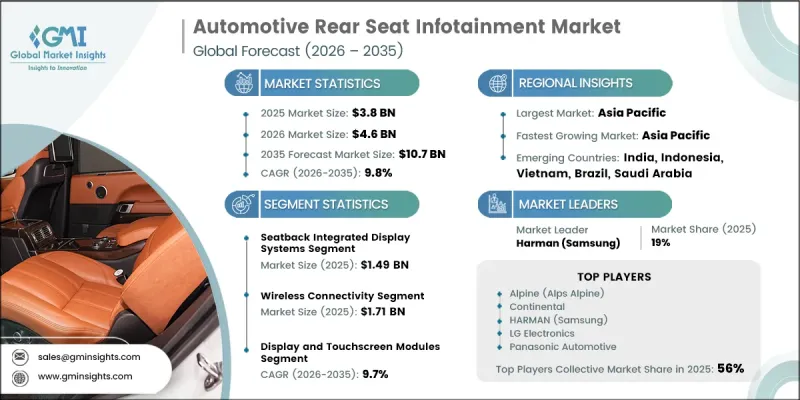
세계의 자동차용 뒷좌석 인포테인먼트 시장은 2025년에 38억 달러 규모에 달하며, CAGR 9.8%로 성장하며, 2035년까지 107억 달러에 달할 것으로 예측됩니다.
시장 성장을 주도하는 요인은 전기자동차 인테리어의 급속한 진화, 소프트웨어 정의 차량 플랫폼, 그리고 차량내 원활한 디지털 경험에 대한 소비자의 기대 변화입니다. 각 제조사가 승객의 편의성을 높이고 자사 제품의 차별화를 꾀함에 따라 뒷좌석용 인포테인먼트 시스템은 더욱 폭넓은 차종 카테고리에서 중요한 기능으로 자리 잡고 있습니다. 소비자들은 개인 전자 기기에서 이용할 수 있는 것과 동등한 수준의 디지털 컨텐츠, 모바일 애플리케이션, 스트리밍 서비스, 그리고 커넥티드 경험에 대한 끊김 없는 접근을 점점 더 기대하고 있습니다. 이에 대응하여 자동차 제조사들은 첨단 디스플레이 기술, 지능형 사용자 인터페이스, 다중 사용자 지원 엔터테인먼트 기능, 그리고 광범위한 멀티미디어 및 생산성 향상 애플리케이션을 지원하는 향상된 연결성을 도입하고 있습니다. 또한 차량 아키텍처와 디지털 통합의 지속적인 발전으로 인해 정교한 뒷좌석 엔터테인먼트 시스템을 탑재할 새로운 기회가 생겨나고 있으며, 이는 전 세계 자동차 뒷좌석 인포테인먼트 시장 전체의 지속적인 장기 성장을 지원하고 있습니다.
| 시장 범위 | |
|---|---|
| 시작연도 | 2025년 |
| 예측 기간 | 2026-2035년 |
| 초기 시장 규모 | 38억 달러 |
| 예측액 | 107억 달러 |
| CAGR | 9.8% |
시트백 일체형 디스플레이 시스템 시장은 2025년에 14억 9,000만 달러의 시장 규모를 기록했습니다. 이러한 강력한 성장은 승객의 편의성을 높이고 차량내 전체 경험을 향상시키는 통합형 고해상도 디스플레이 솔루션에 대한 수요 증가에 힘입은 것입니다. 각 제조사들은 첨단 디스플레이 시스템을 표준 플랫폼의 구성 요소로 지속적으로 통합하고 있으며, 모듈식 하드웨어 설계, 소프트웨어 업그레이드, 장기적인 기능 향상을 통해 유연성을 높이는 동시에 폭넓은 엔터테인먼트 및 정보 서비스를 지원하고 있습니다.
2025년, 무선 연결 시장은 17억 1,000만 달러를 차지했습니다. 이 부문은 케이블 없는 연결에 대한 소비자의 선호도 증가, 시스템 통합의 간소화, 그리고 여러 승객용 기기 간의 원활한 연결성 덕분에 계속해서 혜택을 보고 있습니다. 첨단 무선통신 기술의 채택 확대에 따라 데이터 전송 속도 향상, 컨텐츠 스트리밍 개선, 게임 경험 향상 및 효율적인 소프트웨어 업데이트가 가능해졌습니다.
2025년, 북미 자동차 뒷좌석용 인포테인먼트 시장은 7억 9,430만 달러 규모를 기록하며 시장 점유율의 21.1%를 차지했습니다. 프리미엄 차량의 보급 확대, 전기자동차에 대한 수요 증가, 그리고 소프트웨어 정의 차량(SDV) 기술에 대한 투자 확대가 지속적인 성장을 지원하고 있습니다. 커넥티드 카 생태계와 디지털 캐빈 경험에 대한 지속적인 혁신으로 인해 향후 수년간 이 지역의 시장 확대가 더욱 가속화될 것으로 예상됩니다.
자주 묻는 질문
목차
제1장 조사 방법
제2장 개요
제3장 업계 인사이트
제4장 경쟁 구도
제5장 시장 추산·예측 : 시스템별, 2022-2035년
제6장 시장 추산·예측 : 판매 채널별, 2022-2035년
제7장 시장 추산·예측 : 컴포넌트별, 2022-2035년
제8장 시장 추산·예측 : 차량별, 2022-2035년
제9장 시장 추산·예측 : 접속성별, 2022-2035년
제10장 시장 추산·예측 : 운영체제별, 2022-2035년
제11장 시장 추산·예측 : 지역별, 2022-2035년
제12장 기업 개요
KSA 26.07.31The Global Automotive Rear Seat Infotainment Market was valued at USD 3.8 billion in 2025 and is estimated to grow at a CAGR of 9.8% to reach USD 10.7 billion by 2035.
Market growth is fueled by the rapid evolution of electric vehicle interiors, software-defined vehicle platforms, and changing consumer expectations for seamless digital experiences inside the cabin. Rear seat infotainment systems are becoming an important feature across a broader range of vehicle categories as manufacturers seek to enhance passenger comfort and differentiate their offerings. Consumers increasingly expect uninterrupted access to digital content, mobile applications, streaming services, and connected experiences comparable to those available on personal electronic devices. Automakers are responding by introducing advanced display technologies, intelligent user interfaces, multi-user entertainment capabilities, and improved connectivity that support a wide range of multimedia and productivity applications. Continued advancements in vehicle architecture and digital integration are also creating additional opportunities to incorporate sophisticated rear seat entertainment systems, supporting sustained long-term growth across the global automotive rear seat infotainment market.
| Market Scope | |
|---|---|
| Start Year | 2025 |
| Forecast Year | 2026-2035 |
| Start Value | $3.8 Billion |
| Forecast Value | $10.7 Billion |
| CAGR | 9.8% |
The seatback integrated display systems segment generated USD 1.49 billion in 2025. Strong growth is supported by increasing demand for integrated, high-resolution display solutions that improve passenger comfort and enhance the overall in-vehicle experience. Manufacturers continue to incorporate advanced display systems as standard platform components, allowing greater flexibility through modular hardware designs, software upgrades, and improved long-term functionality while supporting a wide range of entertainment and information services.
The wireless connectivity accounted for USD 1.71 billion in 2025. The segment continues to benefit from increasing consumer preference for cable-free connectivity, simplified system integration, and seamless connectivity across multiple passenger devices. Growing adoption of advanced wireless communication technologies enable faster data transfer, improved content streaming, enhanced gaming experiences, and efficient software updates.
North America Automotive Rear Seat Infotainment Market generated USD 794.3 million in 2025, accounting for 21.1% share. Continued growth is supported by increasing adoption of premium vehicles, rising demand for electric vehicles, and expanding investment in software-defined vehicle technologies. Ongoing innovation in connected vehicle ecosystems and digital cabin experiences is expected to strengthen regional market expansion over the coming years.
Major companies operating in the global automotive rear seat infotainment market include Panasonic Automotive Systems, Robert Bosch, Continental, HARMAN (Samsung), LG Electronics, Mitsubishi Electric, Hyundai Mobis, Alpine Electronics (Alps Alpine), Visteon, JVCKenwood, Forvia / Clarion, and Desay. Companies operating in the automotive rear seat infotainment market are strengthening their competitive position by investing in advanced display technologies, software-defined vehicle platforms, and intelligent connectivity solutions. Manufacturers continue to enhance user experience through larger high-resolution displays, artificial intelligence-enabled interfaces, seamless wireless connectivity, and continuous software upgrades. Strategic collaborations with automotive manufacturers, increased investment in research and development, and expansion of integrated digital ecosystems are helping companies broaden their market presence. Businesses are also focusing on modular product architectures, improved cybersecurity capabilities, and cloud-based service integration to deliver greater flexibility and long-term value.
Table of Contents
Chapter 1 Methodology
- 1.1 Research approach
- 1.2 Quality Commitments
- 1.2.1 GMI AI policy & data integrity commitment
- 1.2.1.1 Source consistency protocol
- 1.2.1 GMI AI policy & data integrity commitment
- 1.3 Research Trail & Confidence Scoring
- 1.3.1 Research Trail Components
- 1.3.2 Scoring Components
- 1.4 Data Collection
- 1.4.1 Partial list of primary sources
- 1.5 Data mining sources
- 1.5.1 Paid sources
- 1.5.1.1 Sources, by region
- 1.5.1 Paid sources
- 1.6 Base estimates and calculations
- 1.6.1 Base year calculation
- 1.7 Forecast model
- 1.7.1 Quantified market impact analysis
- 1.7.1.1 Mathematical impact of growth parameters on forecast
- 1.7.1 Quantified market impact analysis
- 1.8 Research transparency addendum
- 1.8.1 Source attribution framework
- 1.8.2 Quality assurance metrics
- 1.8.3 Our commitment to trust
Chapter 2 Executive Summary
- 2.1 Industry 360° synopsis
- 2.2 Key market trends
- 2.2.1 Regional
- 2.2.2 System
- 2.2.3 Sales channel
- 2.2.4 Component
- 2.2.5 Vehicle
- 2.2.6 Connectivity
- 2.2.7 Operating system
- 2.3 TAM analysis, 2026-2035
- 2.4 CXO perspectives: Strategic imperatives
Chapter 3 Industry Insights
- 3.1 Industry ecosystem analysis
- 3.1.1 Supplier landscape
- 3.1.2 Profit margin
- 3.1.3 Cost structure
- 3.1.4 Value addition at each stage
- 3.1.5 Factor affecting the value chain
- 3.1.6 Disruptions
- 3.2 Industry impact forces
- 3.2.1 Growth drivers
- 3.2.1.1 Premium connected entertainment demand
- 3.2.1.2 EV & autonomous cabin innovation
- 3.2.1.3 5G-enabled streaming and cloud gaming
- 3.2.1.4 Luxury & premium vehicle growth
- 3.2.2 Industry pitfalls and challenges
- 3.2.2.1 High integration and development costs
- 3.2.2.2 Cybersecurity and privacy compliance challenges
- 3.2.3 Market opportunities
- 3.2.3.1 Subscription-based content revenue models
- 3.2.3.2 AR/VR immersive cabin experiences
- 3.2.3.3 Aftermarket retrofit market expansion
- 3.2.3.4 Educational and productivity content integration
- 3.2.1 Growth drivers
- 3.3 Growth potential analysis
- 3.4 Technology and innovation landscape
- 3.4.1 Current technological trends
- 3.4.1.1 Display technology evolution
- 3.4.1.2 Voice & gesture-based control interface advancements
- 3.4.2 Emerging technologies
- 3.4.2.1 Augmented Reality (AR) Integration in Rear Cabin Systems
- 3.4.2.2 OTA (Over-the-Air) Software Update Architecture for Rear-Seat Units
- 3.4.1 Current technological trends
- 3.5 Regulatory landscape
- 3.5.1 North America
- 3.5.1.1 National Highway Traffic Safety Administration (NHTSA)
- 3.5.1.2 Federal Communications Commission (FCC), U.S.
- 3.5.2 Europe
- 3.5.2.1 European Commission (EU Vehicle Regulations, GDPR, Cybersecurity Act)
- 3.5.2.2 United Nations Economic Commission for Europe (UNECE)
- 3.5.3 Asia Pacific
- 3.5.3.1 Ministry of Industry and Information Technology (MIIT), China
- 3.5.3.2 China Compulsory Certification (CCC)
- 3.5.4 Latin America
- 3.5.4.1 National Institute of Metrology, Quality and Technology (INMETRO), Brazil
- 3.5.4.2 NOM (Normas Oficiales Mexicanas)
- 3.5.5 Middle East & Africa
- 3.5.5.1 Saudi Standards, Metrology and Quality Organization (SASO)
- 3.5.5.2 Telecommunications and Digital Government Regulatory Authority (TDRA), UAE
- 3.5.1 North America
- 3.6 Porter's analysis
- 3.7 PESTEL analysis
- 3.8 Pricing Analysis (Driven by Primary Research)
- 3.8.1 Historical Price Trend Analysis System-Level & Component-Level
- 3.8.2 Pricing Strategy by Player Type (Premium / Value / Cost-plus)
- 3.9 Patent analysis (Driven by Primary Research)
- 3.10 Cost breakdown analysis
- 3.11 Trade data analysis (Driven by paid database)
- 3.11.1 Import/export volume & value trends
- 3.11.2 Key trade corridors & tariff impact
- 3.12 Capacity & Production Landscape (Driven by Primary Research)
- 3.12.1 Installed Capacity by Region & Key Producer
- 3.12.2 Capacity Utilization Rates & Expansion Pipelines
- 3.13 Sustainability and environmental aspects
- 3.13.1 Sustainable practices
- 3.13.2 Waste reduction strategies
- 3.13.3 Energy efficiency in production
- 3.13.4 Eco-friendly Initiatives
- 3.13.5 Carbon footprint considerations
- 3.14 Impact of AI & Generative AI on the Market
- 3.14.1 AI-driven disruption of existing business models
- 3.14.2 Gen AI use cases & adoption roadmap by segment
- 3.14.3 Risks, limitations & regulatory considerations
- 3.15 Forecast assumptions & scenario analysis (Driven by primary research)
- 3.15.1 Base Case key macro & industry variables driving CAGR
- 3.15.2 Optimistic Scenarios Favorable macro and industry tailwinds
- 3.15.3 Pessimistic Scenario Macroeconomic slowdown or industry headwinds
Chapter 4 Competitive Landscape, 2025
- 4.1 Introduction
- 4.2 Company market share analysis
- 4.2.1 North America
- 4.2.2 Europe
- 4.2.3 Asia Pacific
- 4.2.4 LATAM
- 4.2.5 MEA
- 4.3 Competitive analysis of major market players
- 4.4 Competitive positioning matrix
- 4.5 Key developments
- 4.5.1 Mergers & acquisitions
- 4.5.2 Partnerships & collaborations
- 4.5.3 New product launches
- 4.5.4 Expansion plans and funding
- 4.6 Company tier benchmarking
- 4.6.1 Tier classification criteria & qualifying thresholds
- 4.6.2 Tier positioning matrix by revenue, geography & innovation
Chapter 5 Market Estimates & Forecast, By System, 2022 - 2035 ($Mn, Units)
- 5.1 Key trends
- 5.2 Headrest mounted display systems
- 5.3 Overhead/roof mounted display systems
- 5.4 Seatback integrated display systems
- 5.5 Tablet-based rear seat systems
- 5.6 Portable/plug-and-play systems
- 5.7 Others
Chapter 6 Market Estimates & Forecast, By Sales channel, 2022 - 2035 ($Mn, Units)
- 6.1 Key trends
- 6.2 OEM
- 6.3 Aftermarket
Chapter 7 Market Estimates & Forecast, By Component, 2022 - 2035 ($Mn, Units)
- 7.1 Key trends
- 7.2 Display & touchscreen modules
- 7.2.1 LCD
- 7.2.2 OLED
- 7.2.3 TFT
- 7.2.4 Others
- 7.3 Audio systems & amplifiers
- 7.4 Connectivity & communication modules
- 7.5 Software & infotainment platforms
- 7.6 Remote control & input devices
- 7.7 Others
Chapter 8 Market Estimates & Forecast, By Vehicle, 2022 - 2035 ($Mn, Units)
- 8.1 Key trends
- 8.2 Sedan
- 8.3 SUV
- 8.4 Hatchback
- 8.5 MPVs
Chapter 9 Market Estimates & Forecast, By Connectivity, 2022 - 2035 ($Mn, Units)
- 9.1 Key trends
- 9.2 Wired connectivity
- 9.3 Wireless connectivity
- 9.4 Cellular connectivity
Chapter 10 Market Estimates & Forecast, By Operating system, 2022 - 2035 ($Mn, Units)
- 10.1 Key trends
- 10.2 Android Automotive OS / AOSP
- 10.3 Linux-Based Systems
- 10.4 QNX-Based Systems
- 10.5 Proprietary OEM Operating Systems
- 10.6 Other Operating Systems
Chapter 11 Market Estimates & Forecast, By Region, 2022 - 2035 ($Mn, Units)
- 11.1 Key trends
- 11.2 North America
- 11.2.1 U.S.
- 11.2.2 Canada
- 11.3 Europe
- 11.3.1 Germany
- 11.3.2 UK
- 11.3.3 France
- 11.3.4 Italy
- 11.3.5 Spain
- 11.3.6 Nordics
- 11.3.7 Russia
- 11.3.8 Netherlands
- 11.4 Asia Pacific
- 11.4.1 China
- 11.4.2 India
- 11.4.3 Japan
- 11.4.4 South Korea
- 11.4.5 Australia
- 11.4.6 Singapore
- 11.4.7 Malaysia
- 11.5 Latin America
- 11.5.1 Brazil
- 11.5.2 Mexico
- 11.5.3 Argentina
- 11.6 MEA
- 11.6.1 South Africa
- 11.6.2 Saudi Arabia
- 11.6.3 UAE
Chapter 12 Company Profiles
- 12.1 Global players
- 12.1.1 Alpine Electronics
- 12.1.2 Continental
- 12.1.3 Denso
- 12.1.4 Harman (Samsung)
- 12.1.5 LG Electronics
- 12.1.6 Panasonic Automotive Systems
- 12.1.7 Robert Bosch
- 12.1.8 Visteon
- 12.2 Regional players
- 12.2.1 Desay Automotive
- 12.2.2 Forvia / Clarion
- 12.2.3 Foryou
- 12.2.4 Hangsheng Electronics
- 12.2.5 Hyundai Mobis
- 12.2.6 JVCKenwood
- 12.2.7 Mitsubishi Electric
- 12.2.8 VOXX International
- 12.3 Emerging players
- 12.3.1 3SS (Three Screen Solutions)
- 12.3.2 Huawei Technologies
- 12.3.3 Vestel Mobility
- 12.3.4 Xperi (TiVo Automotive)


