

|
시장보고서
상품코드
2101588
바이오 아디핀산 시장 기회, 성장요인, 업계 동향 분석 및 예측(2026-2035년)Bio-Adipic Acid Market Opportunity, Growth Drivers, Industry Trend Analysis, and Forecast 2026 - 2035 |
||||||

세계의 바이오 아디핀산 시장은 2025년에 1억 5,310만 달러 규모에 달하며, 2035년까지 CAGR 12.7%로 성장하며, 5억 600만 달러에 달할 것으로 추정되고 있습니다.
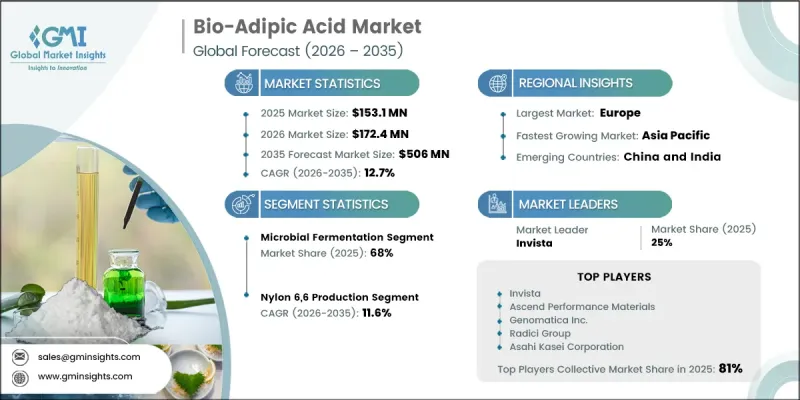
각 제조사들이 재생 가능한 원료로의 전환 및 저탄소 화학 제품 제조 공정으로의 전환을 가속화하는 가운데, 전 세계 바이오아디핀산 시장은 계속해서 성장세를 보이고 있습니다. 미생물 발효, 바이오 기반 원료 전환 기술 및 통합형 바이오리파이너리 운영의 발전으로 생산 효율이 향상됨과 동시에, 바이오 기반 제품과 기존 대체품 간의 비용 차이도 점차 줄어들고 있습니다. 산업 부문의 온실가스 배출 감축에 대한 규제가 강화되면서, 여러 최종 용도 산업에서 바이오 아디핀산의 더 광범위한 채택을 위한 유리한 여건이 조성되고 있습니다. 동시에, 기업의 지속가능성 노력 강화와 친환경 소재에 대한 수요 증가로 인해 전 세계 공급망 전반에 걸쳐 바이오 유래 화학 중간체의 활용 확대가 지속적으로 촉진되고 있습니다. 또한 각 제조사는 지속가능한 생산 능력 확대와 공정 확장성 향상을 통해 변화하는 조달 요건에 대응하고 있습니다. 재생 가능 화학 기술에 대한 지속적인 투자와 저배출 제조 솔루션에 대한 수요 증가가 맞물려, 예측 기간 중 전 세계 바이오 아디핀산 시장의 장기적인 성장을 지원하고 상업적 전망을 강화할 것으로 예상됩니다.
| 시장 범위 | |
|---|---|
| 시작연도 | 2025년 |
| 예측 기간 | 2026-2035년 |
| 개시 금액 | 1억 5,310만 달러 |
| 예측액 | 5억 600만 달러 |
| CAGR | 12.7% |
2025년에는 미생물 발효가 시장 점유율의 68%를 차지하며, 2035년까지 연평균 성장률(CAGR) 12.3%로 성장할 것으로 전망됩니다. 이 부문이 주도적인 위치를 유지하고 있는 이유는 광범위한 재생 가능 원료와의 호환성을 갖추고 있으며, 확장성이 뛰어난 바이오 기반 생산 공정을 지원할 수 있는 능력을 보유하고 있기 때문입니다. 산업용 발효, 균주 최적화, 대사 공학 및 공정 효율성 분야의 지속적인 기술 발전으로 생산 성능이 지속적으로 향상되고 있으며, 이는 상업적 보급 확대에도 기여하고 있습니다. 지속가능한 제조 기술에 대한 투자 확대는 전 세계 바이오아지핀산 시장에서 미생물 발효의 우위를 더욱 공고히 하고 있습니다.
나일론 6,6 생산 부문은 2025년에 58%의 점유율을 차지하며, 2035년까지 연평균 성장률(CAGR) 11.6%로 성장할 것으로 전망됩니다. 바이오아디핀산은 기존의 나일론 6,6 제조 공정에서 생산 공정을 대폭 변경할 필요 없이 기존 아디핀산의 직접적인 대체재로 기능하므로 수요는 계속해서 견고할 전망입니다. 지속가능한 폴리머 생산에 대한 관심 증가와 친환경 엔지니어링 소재에 대한 수요 증가가 맞물려, 이 용도 부문 전체의 시장 성장을 지속적으로 지원하고 있습니다. 산업 생산 전반에 걸친 바이오 유래 원료의 채택 확대는 나일론 6,6 생산에서 바이오 아디핀산에 대한 장기적인 수요를 더욱 강화하고 있습니다.
북미 바이오아디핀산 시장은 2025년에 32%의 점유율을 차지하며, 2035년까지 연평균 성장률(CAGR) 12.1%로 성장할 것으로 전망됩니다. 미국은 지역 매출의 85.1%를 차지하며, 북미 전체 시장 성장에 가장 크게 기여하는 국가로서의 위상을 유지하고 있습니다. 온실가스 배출 감축에 대한 규제 당국의 지속적인 중시, 재생 가능 화학물질 생산에 대한 투자 확대, 그리고 지속가능한 산업 생산에 대한 지원 강화가 해당 지역의 수요를 더욱 끌어올리고 있습니다. 바이오 기반 기술의 지속적인 발전과 재생 가능 화학 물질의 상용화 확대에 힘입어, 예측 기간 중 북미는 전 세계 바이오 아디핀산 시장에서 주도적인 역할을 더욱 공고히 할 것으로 전망됩니다.
자주 묻는 질문
목차
제1장 조사 방법과 범위
제2장 개요
제3장 업계 인사이트
제4장 경쟁 구도
제5장 시장 추산·예측 : 생산 기술별, 2022-2035년
제6장 시장 추산·예측 : 용도별, 2022-2035년
제7장 시장 추산·예측 : 등급별, 2022-2035년
제8장 시장 추산·예측 : 최종사용자별, 2022-2035년
제9장 시장 추산·예측 : 지역별, 2022-2035년
제10장 기업 개요
KSA 26.07.31The Global Bio-Adipic Acid Market was valued at USD 153.1 million in 2025 and is estimated to grow at a CAGR of 12.7% to reach USD 506 million by 2035.
The global bio-adipic acid market continues to gain momentum as manufacturers accelerate the transition toward renewable raw materials and lower-carbon chemical production processes. Advancements in microbial fermentation, bio-based feedstock conversion technologies, and integrated biorefinery operations are improving production efficiency while narrowing the cost difference between bio-based and conventional alternatives. Increasing regulatory emphasis on reducing industrial greenhouse gas emissions is creating favorable conditions for wider adoption of bio-adipic acid across multiple end-use industries. At the same time, growing corporate sustainability commitments and stronger demand for environmentally responsible materials continue to encourage greater use of bio-based chemical intermediates throughout global supply chains. Manufacturers are also responding to evolving procurement requirements by expanding sustainable production capabilities and improving process scalability. Continued investment in renewable chemical technologies, combined with rising demand for low-emission manufacturing solutions, is expected to support long-term market expansion and strengthen the commercial outlook for the global bio-adipic acid market throughout the forecast period.
| Market Scope | |
|---|---|
| Start Year | 2025 |
| Forecast Year | 2026-2035 |
| Start Value | $153.1 Million |
| Forecast Value | $506 Million |
| CAGR | 12.7% |
Microbial fermentation accounted for 68% share in 2025 and is expected to grow at a CAGR of 12.3% through 2035. The segment maintains its leading position because of its compatibility with a broad range of renewable feedstocks and its ability to support scalable bio-based production processes. Ongoing technological advancements in industrial fermentation, strain optimization, metabolic engineering, and process efficiency continue to improve production performance while supporting higher commercial adoption. Growing investments in sustainable manufacturing technologies further reinforce the dominance of microbial fermentation within the global bio-adipic acid market.
The nylon 6,6 production segment held 58% share in 2025 and is projected to grow at a CAGR of 11.6% through 2035. Demand remains strong because bio-adipic acid serves as a direct substitute for conventional adipic acid in existing nylon 6,6 manufacturing processes without requiring significant production modifications. Increasing preference for sustainable polymer production, combined with rising demand for environmentally responsible engineering materials, continues to support market growth across this application segment. Expanding adoption of bio-based raw materials throughout industrial manufacturing further strengthens long-term demand for bio-adipic acid in nylon 6,6 production.
North America Bio-Adipic Acid Market accounted for 32% share in 2025 and is forecast to grow at a CAGR of 12.1% through 2035. The United States represented 85.1% of regional revenue, maintaining its position as the largest contributor to market growth across North America. Continued regulatory emphasis on greenhouse gas emission reduction, growing investment in renewable chemical production, and increasing support for sustainable industrial manufacturing continue to strengthen regional demand. Ongoing advancements in bio-based technologies and expanding commercialization of renewable chemicals are expected to reinforce North America's leading role in the global bio-adipic acid market during the forecast period.
Major companies operating in the global bio-adipic acid market include Ascend Performance Materials, Asahi Kasei Corporation, Invista, Genomatica Inc., and Radici Group. Companies participating in the global bio-adipic acid market focus on technology innovation, production scale expansion, and sustainability initiatives to strengthen their competitive position. Manufacturers continue investing in research and development to improve microbial fermentation efficiency, optimize bio-based feedstock utilization, and reduce production costs. Many companies also expand manufacturing capabilities and strengthen vertically integrated production models to improve supply chain efficiency and meet growing commercial demand. Strategic partnerships, joint development programs, and long-term customer agreements help accelerate product commercialization and broaden market reach. Businesses further differentiate themselves by emphasizing renewable production processes, regulatory compliance, and high-quality bio-based materials that align with evolving sustainability goals.
Table of Contents
Chapter 1 Methodology & Scope
- 1.1 Research approach
- 1.2 Quality Commitments
- 1.2.1 GMI AI policy & data integrity commitment
- 1.2.1.1 Source consistency protocol
- 1.2.1 GMI AI policy & data integrity commitment
- 1.3 Research Trail & Confidence Scoring
- 1.3.1 Research Trail Components
- 1.3.2 Scoring Components
- 1.4 Data Collection
- 1.4.1 Partial list of primary sources
- 1.5 Data mining sources
- 1.5.1 Paid sources
- 1.5.1.1 Sources, by region
- 1.5.1 Paid sources
- 1.6 Base estimates and calculations
- 1.6.1 Base year calculation for any one approach
- 1.7 Forecast model
- 1.7.1 Quantified market impact analysis
- 1.7.1.1 Mathematical impact of growth parameters on forecast
- 1.7.1 Quantified market impact analysis
- 1.8 Research transparency addendum
- 1.8.1 Source attribution framework
- 1.8.2 Quality assurance metrics
- 1.8.3 Our commitment to trust
Chapter 2 Executive Summary
- 2.1 Industry 360° synopsis
- 2.2 Key market trends
- 2.2.1 Regional
- 2.2.2 By Production Technology
- 2.2.3 By Application
- 2.2.4 By Grade
- 2.2.5 By End User
- 2.3 TAM Analysis, 2026 - 2035
- 2.4 CXO perspectives: Strategic imperatives
Chapter 3 Industry Insights
- 3.1 Industry ecosystem analysis
- 3.1.1 Supplier landscape
- 3.1.2 Profit margin
- 3.1.3 Value addition at each stage
- 3.1.4 Factor affecting the value chain
- 3.1.5 Disruptions
- 3.2 Industry impact forces
- 3.2.1 Growth drivers
- 3.2.2 Industry pitfalls and challenges
- 3.2.3 Market opportunities
- 3.3 Growth potential analysis
- 3.4 Regulatory landscape
- 3.4.1 North America
- 3.4.2 Europe
- 3.4.3 Asia Pacific
- 3.4.4 Latin America
- 3.4.5 Middle East & Africa
- 3.5 Porter's analysis
- 3.6 PESTEL analysis
- 3.7 Price trends
- 3.7.1 By region
- 3.7.2 By Production Technology
- 3.8 Future market trends
- 3.9 Technology and Innovation landscape
- 3.9.1 Current technological trends
- 3.9.2 Emerging technologies
- 3.10 Patent Landscape
- 3.11 Trade statistics (HS code)
- 3.11.1 Major importing countries
- 3.11.2 Major exporting countries
- 3.12 Sustainability and environmental aspects
- 3.12.1 Sustainable practices
- 3.12.2 Waste reduction strategies
- 3.12.3 Energy efficiency in production
- 3.12.4 Eco friendly initiatives
Chapter 4 Competitive Landscape, 2025
- 4.1 Introduction
- 4.2 Company market share analysis
- 4.2.1 By region
- 4.2.1.1 North America
- 4.2.1.2 Europe
- 4.2.1.3 Asia Pacific
- 4.2.1.4 LATAM
- 4.2.1.5 MEA
- 4.2.1 By region
- 4.3 Company matrix analysis
- 4.4 Competitive analysis of major market players
- 4.5 Competitive positioning matrix
- 4.6 Key developments
- 4.6.1 Mergers & acquisitions
- 4.6.2 Partnerships & collaborations
- 4.6.3 New Product Launches
- 4.6.4 Expansion Plans
Chapter 5 Market Estimates and Forecast, By Production Technology, 2022 to 2035 (USD Million) (Tons)
- 5.1 Key trends
- 5.2 Microbial Fermentation
- 5.2.1 Glucose / Sugar-Based Fermentation
- 5.2.2 Lignocellulosic Biomass Fermentation
- 5.2.3 Fatty Acid / Vegetable Oil-Based Fermentation
- 5.3 Catalytic Conversion
- 5.3.1 Chemo-Catalytic Conversion
- 5.3.2 Biocatalytic / Enzymatic Conversion
- 5.4 Semi-Biosynthetic (Hybrid)
Chapter 6 Market Estimates and Forecast, By Application, 2022 to 2035 (USD Million) (Tons)
- 6.1 Key trends
- 6.2 Nylon 6,6 Production
- 6.2.1 Nylon 6,6 Fiber
- 6.2.2 Nylon 6,6 Resin
- 6.3 Polyurethanes
- 6.3.1 Flexible Polyurethane Foam
- 6.3.2 Rigid Polyurethane Foam
- 6.3.3 Polyurethane Elastomers & Adhesives
- 6.4 Adipate Esters (Plasticizers)
- 6.4.1 Dioctyl Adipate (DOA)
- 6.4.2 Diisodecyl Adipate (DIDA) & Others
- 6.5 Lubricants
- 6.5.1 Synthetic Base Oils
- 6.5.2 Low-Temperature Lubricants
- 6.6 Coatings & Paints
- 6.6.1 Polyamide-Based Coatings
- 6.6.2 Polyester-Based Coatings
- 6.7 Food Additives
- 6.7.1 Acidulants & pH Buffers
- 6.7.2 Leavening Agents
- 6.8 Others
Chapter 7 Market Estimates and Forecast, By Grade, 2022 to 2035 (USD Million) (Tons)
- 7.1 Key trends
- 7.2 Industrial Grade
- 7.3 Food Grade
Chapter 8 Market Estimates and Forecast, By End User, 2022 to 2035 (USD Million) (Tons)
- 8.1 Key trends
- 8.2 Automotive
- 8.2.1 Under-Hood & Structural Components
- 8.2.2 Interior Applications
- 8.2.3 EV-Specific Applications
- 8.3 Textiles & Fibers
- 8.3.1 Apparel & Hosiery
- 8.3.2 Industrial Textiles
- 8.3.3 Carpets & Home Furnishings
- 8.4 Electrical & Electronics
- 8.4.1 Connectors, Switches & Housings
- 8.4.2 Cable & Wire Insulation
- 8.5 Construction
- 8.5.1 Polyurethane Insulation Foams
- 8.5.2 Sealants, Adhesives & Coatings
- 8.6 Food & Beverage
- 8.6.1 Beverages & Dairy
- 8.6.2 Processed & Baked Foods
- 8.7 Others (Packaging, Pharma, Cosmetics)
Chapter 9 Market Estimates and Forecast, By Region, 2022 to 2035 (USD Million) (Tons)
- 9.1 Key trends
- 9.2 North America
- 9.2.1 U.S.
- 9.2.2 Canada
- 9.3 Europe
- 9.3.1 Germany
- 9.3.2 UK
- 9.3.3 France
- 9.3.4 Spain
- 9.3.5 Italy
- 9.3.6 Rest of Europe
- 9.4 Asia Pacific
- 9.4.1 China
- 9.4.2 India
- 9.4.3 Japan
- 9.4.4 Australia
- 9.4.5 South Korea
- 9.4.6 Rest of Asia Pacific
- 9.5 Latin America
- 9.5.1 Brazil
- 9.5.2 Mexico
- 9.5.3 Argentina
- 9.5.4 Rest of Latin America
- 9.6 Middle East and Africa
- 9.6.1 Saudi Arabia
- 9.6.2 South Africa
- 9.6.3 UAE
- 9.6.4 Rest of Middle East and Africa
Chapter 10 Company Profiles
- 10.1 Invista
- 10.2 Ascend Performance Materials
- 10.3 Genomatica Inc.
- 10.4 Radici Group
- 10.5 Asahi Kasei Corporation
- 10.6 OzoneBio Inc.
- 10.7 BASF SE
- 10.8 twig.bio
- 10.9 Sumatra Biorenewables


