|
시장보고서
상품코드
2121921
바이오 유래 숙신산 : 시장 점유율 분석, 업계 동향과 통계, 성장 예측(2026-2031년)Bio-Based Succinic Acid - Market Share Analysis, Industry Trends & Statistics, Growth Forecasts (2026 - 2031) |
||||||
 Mordor Intelligence
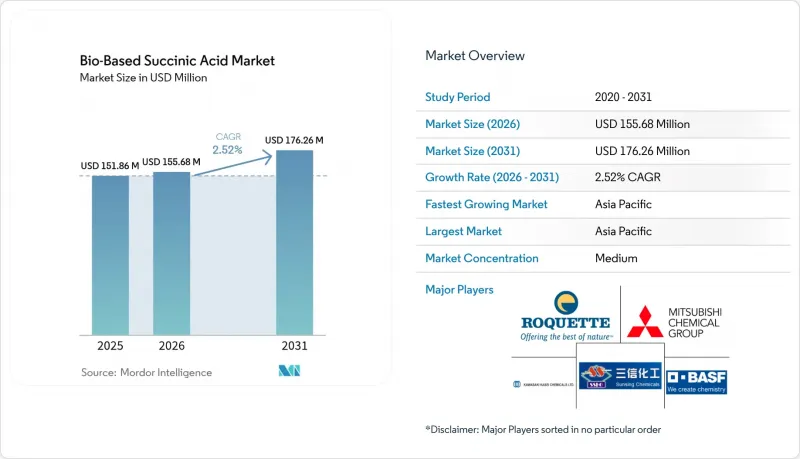
Mordor Intelligence에 따르면 바이오 유래 숙신산 시장 규모는 2025년에 1억 5,186만 달러로 평가되며, 2026년 1억 5,568만 달러에서 2031년까지 1억 7,626만 달러에 달할 것으로 예측되고 있으며, 예측 기간(2026-2031년)에 CAGR은 2.52%에 달할 전망입니다.
이 보고서는 용도(산업, 의약품, 퍼스널 케어, 도료·코팅, 기타), 원료(옥수수 유래 포도당, 사탕수수·사탕무 유래 자당, 리그노셀룰로오스계 바이오매스 등) 및 지역별(아시아태평양, 북미, 유럽, 남미, 중동 및 아프리카)로 분류되어 있습니다. 시장 전망은 금액(달러) 기준으로 제시되어 있습니다.
전 세계 바이오 유래 숙신산 시장의 동향 및 인사이트
산업용 폴리머 분야에서 친환경 화학물질 채택 확대
엔지니어링 플라스틱, 열경화성 수지, 엘라스토머 제조사들은 화석 유래 원료를 인증된 바이오 유래 대체재로 계속해서 대체하고 있습니다. BASF는 60개 이상의 제품 포트폴리오에 대해 ISCC+ 인증을 획득하고, 재생 가능한 원료를 40% 함유한 바이오 기반 에틸 아크릴레이트를 도입했습니다. 이를 통해 크래들-투-게이트(제조 공정) 배출량을 30% 감축했습니다. 폴리우레탄 분야의 병행 노력으로는 숙신산 발효를 통해 직접 얻어지는 바이오 유래 1,4-부탄디올이 활용되고 있습니다. 이 제조 공정은 Genomatica사가 선구적으로 개발했으며, 중국 생산 업체에 대한 기술 라이선싱을 통해 더욱 확대되었습니다. PBS 수지는 이미 숙신산과 1,4-부탄디올로부터 합성되고 있으므로, 숙신산염의 생산량이 증가할 때마다 그 효과는 포장재, 멀치 필름, 일회용 가전 부품 등 광범위한 분야로 파급됩니다. 브랜드 소유주들이 Scope 3 탈탄소화 목표를 상향 조정함에 따라 조달 팀은 온실가스 감축 실적을 입증할 수 있는 공급업체를 우선적으로 선정하고 있으며, 이로 인해 바이오 유래 숙신산 시장에서 대량 생산형 폴리머 용도에 대한 수요가 더욱 높아지고 있습니다.
원유 가격 변동이 바이오 경로로의 전환을 촉진
원유 가격이 배럴당 80달러의 임계치를 넘나드는 변동을 반복함에 따라 석유화학 유래 숙신산이 누리던 비용 우위가 주기적으로 훼손되고 있으며, 가공업체들은 원자재 가격의 급격한 변동으로부터 보호받기 위해 바이오 유래 루트에 대한 공급 계약을 체결하도록 유도되고 있습니다. 유럽연합 집행위원회의 산업용 탄소 관리 계획은 화석 유래 중간체를 대체하는 프로젝트에 자본 보조금 및 세액 공제를 제공함으로써 이러한 경제적 움직임을 지원하고 있습니다. 일본의 대기업인 미쓰비시 케미칼(Mitsubishi Chemical), 미쓰이 케미칼(Mitsui Chemicals), 아사히 카세이(Asahi Kasei)는 가격 변동 위험을 완화하면서 국가의 탄소 중립 공약을 달성하기 위해 나프타 크래커에 바이오매스 나프타를 시범 도입하고 있습니다. 원유 가격이 침체기에 접어들면 일시적으로 추진력이 둔화될 수도 있지만, 구매 부서에서는 확률 가중치를 적용한 원유 가격 추이를 반영한 총소유비용(TCO) 시나리오를 수립하는 사례가 늘어나고 있으며, 원유 가격에 대한 비관적인 전망 하에서도 바이오 유래 숙신산 시장에 전략적 여지를 확보하고 있습니다.
석유 유래 숙신산에 비해 높은 생산 비용
기술경제 모델에 따르면 현재의 전력 요금 수준에서 상업용 바이오 유래 숙신산의 가격 하한선은 1킬로그램당 2.5-2.7달러로 추산됩니다. 이 가격대는 유가 하락 시나리오 하에서도 석유 유래 동등 제품의 현물 가격을 상회하고 있습니다. 이러한 가격 차이는 살균에 필요한 에너지, 다단계 침전 공정, 그리고 스테인리스 발효조의 자본 집약성에서 기인합니다. 탄소세나 프리미엄 틈새 시장이 이 가격 차이를 부분적으로 상쇄하는 반면, 수지 및 도료 분야의 대규모 사용자들은 여전히 가격에 민감합니다. 공정 집약화-연속 발효, 현장 제품 회수, 저pH 내성 미생물 활용-에는 기대가 걸리지만, 석유 유래 제품과의 가격 평형을 달성하기까지의 기간은 이러한 기술을 파일럿 단계에서 50킬로톤의 정격 생산 능력으로 가속화할 수 있는지 여부에 달려 있습니다.
부문 분석
2025년에는 산업 용도가 바이오 유래 숙신산 시장 점유율의 42.65%를 차지하며, 그 중심에는 PBS 포장 필름, 생분해성 멀치 및 폴리우레탄 중간체가 있으며, 이들 모두 합쳐 수 킬로톤 규모의 소비량을 보입니다. 이 분야에서의 수요는 예측 가능한 규모로 확대될 것입니다. 이는 가공업체들이 플랜트 가동률을 지원하는 다년간의 테이크-오어-페이(take-or-pay) 계약을 체결하고 있으며, 그로 인해 바이오 유래 숙신산 시장 전체가 안정화되고 있기 때문입니다. 예측 기간 중 퍼스널 케어 분야는 연평균 성장률(CAGR) 3.73%라는 가장 급격한 성장 곡선을 보이며, 씻어내지 않는 유형의 여드름 치료제, 천연 유래 데오도란트, 순한 각질 제거제와 같은 특수한 제품 형태를 통한 기여도를 높이고 있습니다. 피부과학 연구에 따르면 1%의 숙신산 젤이 자극을 유발하지 않으면서 프로피오니박테리움 아크네스(Propionibacterium acnes)의 증식을 억제하는 것으로 확인되었습니다. 이를 통해 각 브랜드는 기존의 베타-하이드록시산과 함께 보다 친환경적인 유효 성분으로 포지셔닝할 수 있게 되었습니다. 제제 개발자들이 서방형 매트릭스 내의 pH를 유지하기 위해 숙신산 완충액을 배합하는 한편, 코팅 제조업체들은 고형분 함량이 높으면서도 생분해성을 확보하는 숙신산계 폴리올에 대한 시험을 진행하고 있으며, 제약 분야에서의 채택이 꾸준히 진행되고 있습니다.
생산량 확대와 더불어, 각 최종 시장에서의 가격 책정에는 큰 차이가 나타납니다. 산업용 수지 구매자들은 톤당 단가 인하를 협상하면서도 안정적인 인수량을 확보하고 있습니다. 한편, 퍼스널 케어 및 의약품 사용자들은 미생물학적 순도 및 추적성 요건을 충족하기 위해 상대적으로 높은 가격을 수용하고 있으며, 이로 인해 생산자들은 이익률을 확보하고 있습니다. 이러한 동향에 따라 얼리 어답터들이 기본 생산 능력을 폴리머에 할당하고, 개량된 발효조의 생산분을 특수 배치에 할당하는 듀얼 채널 모델이 촉진되고 있습니다. 각 다운스트림 부문이 생애주기 평가(LCA) 지표를 중시함에 따라 부문 간 시너지 효과가 발생하고 있습니다. 의료 분야에서 입증된 실적이 화장품 분야의 효능 주장에 신빙성을 부여하는 한편, 포장 분야에서 기계적 재활용 가능성에 대한 시험 결과는 소비재 제조업체로 하여금 제품 수명 종료 시의 처리가 순환형 경제의 공약에 부합한다는 확신을 심어주고 있습니다. 이러한 경향은 종합적으로 볼 때, 바이오 유래 숙신산 시장 전체에서 수익의 안정성을 높이는 데 있으며, 용도의 다양성이 중심적인 역할을 하고 있음을 지원합니다.
지역별 분석
아시아태평양은 가장 큰 점유율을 차지하고 있으며, 2025년에는 바이오 유래 숙신산 시장의 33.05%를 차지하고, 2031년까지 연평균 성장률(CAGR) 3.66%로 성장을 이어가고 있습니다. 중국의 각성 정부는 산업 생명공학 단지에 저금리 자금을 지원하고 있으며, 이를 통해 숙신산 및 1,4-부탄디올 전용 50킬로톤급 발효조의 급속한 규모 확대가 가능해졌습니다. 국가발전개혁위원회는 바이오화학품을 제14차 5개년 계획의 우대 조치에 포함시키고, 현금 비용의 손익분기점을 낮추는 세제 우대 조치를 추가했습니다. 일본에서는 탄소 중립을 위한 녹색 성장 전략의 일환으로 바이오매스 나프타 공동 처리에 대한 보조금이 배정되었으며, 이에 따라 미쓰비시 케미칼, 미쓰이 케미칼, 아사히 카세이가 공동으로 숙신산계 폴리에스터의 원료가 되는 파일럿 크래커에 투자하고 있습니다. 한국은 바이오 전략 기술의 청사진을 통해 유사한 노력을 지원하고 있으며, 한편 인도는 당화 처리된 부산물을 화학 발효조에 전용할 가능성이 있는 빻은 쌀 에탄올 프로그램을 확대함으로써 원료 공급에 주력하고 있습니다. 이러한 일련의 노력은 정책 지원과 규모의 경제 효과를 시너지 효과를 내며, 바이오 유래 숙신산 시장에서 아시아태평양의 리더십을 강화하고 있습니다.
북미에서는 첨단인 합성생물학 클러스터, 위험 감수성이 높은 벤처 자금, 주 차원의 청정 연료 인센티브를 통해 활발한 활동이 지속되고 있습니다. 미국 농무부는 2025년 바이오매스 연구개발 의제에서 숙신산을 최우선 제품으로 지정하고, 균주 공학 및 폐기물 흐름의 가치화를 위한 보조금 체계를 마련하고 있습니다. 캘리포니아주의 저탄소 연료 기준(LCFS)은 생물 유래 CO₂ 활용에 대해 크레딧 배율을 부여하고 있으며, 발효 플랜트는 탄소 포집 장치를 통합할 때 이 제도를 활용하여 추가 수익을 얻고 있습니다. Green Plains의 자회사인 Clean Sugar는 탄소발자국을 40% 줄인 덱스트로스를 실증하고 있으며, 이 원료는 현재 네브래스카주의 위탁 발효 업체에 의해 시험적으로 사용되고 있습니다. 캐나다에서는 생화학 제품 제조에 도입되는 설비에 대해 가속 감가상각 조치를 시행하고 있으며, 멕시코에서는 북부 산업 회랑을 활성화하기 위해 바이오 중간체에 대한 우대 조치를 검토하고 있습니다. 이러한 정책과 인프라 요소가 결합되어, 이 지역의 바이오 유래 숙신산 시장의 꾸준한 확장을 지원하는 비옥한 생태계를 형성하고 있습니다.
유럽의 향후 전개는 석유화학제품 1톤당 탄소 비용을 반영하는 엄격한 규제에 달려 있습니다. 유럽연합 집행위원회의 2040년 기후 중립 로드맵에서는 이산화탄소 포집 및 활용(CCU) 제품을 공공 조달의 우선 조달 대상으로 지정하고 있습니다. 독일의 국가 바이오경제 전략에서는 연구개발 보조금에 더해, 원료 물류 프로그램을 통해 Leuna 등의 화학 산업 단지에 사탕무 잔여물을 통합하는 노력이 진행되고 있습니다. 프랑스에서는 소비재에 대한 탄소발자국 표시를 시범적으로 도입하고 있으며, 검증된 저배출 중간체의 수요가 증가하고 있습니다. 영국의 산업용 탄소 제거를 위한 차액 계약(CfD) 방식은 최저 지급액을 보장하며, 북해의 탄소 격리 우물과 발효 플랜트를 동일한 장소에 설치하도록 촉진하고 있습니다. 생산 비용은 아시아 평균보다 높지만, 브랜드 소유주들의 압력과 그린 파이낸스 수단에 대한 접근성 덕분에 경쟁력은 여전히 유지되고 있습니다. 그 결과, 유럽은 바이오 유래 숙신산 시장에서 주요 프리미엄 시장으로 기능하며, 높은 가격 책정을 정당화하는 고순도 등급 및 특수 제품을 흡수하고 있습니다.
기타 혜택:
- 엑셀 형식의 시장 예측(ME) 시트
- 3개월간의 애널리스트 지원
자주 묻는 질문
목차
제1장 서론
제2장 조사 방법
제3장 개요
제4장 시장 구도
제5장 시장 규모와 성장 예측
제6장 경쟁 구도
제7장 시장 기회와 향후 전망
KSA 26.09.04According to Mordor Intelligence, the bio-Based succinic acid market size was valued at USD 151.86 million in 2025 and estimated to grow from USD 155.68 million in 2026 to reach USD 176.26 million by 2031, at a CAGR of 2.52% during the forecast period (2026-2031).
This report is Segmented by Application (Industrial, Pharmaceuticals, Personal Care, Paints and Coatings, Other Applications), Feedstock Source (Corn-Derived Glucose, Sugarcane & Beet Sucrose, Lignocellulosic Biomass, and More), and Geography (Asia-Pacific, North America, Europe, South America, Middle East and Africa). The Market Forecasts are Provided in Terms of Value (USD).
Global Bio-Based Succinic Acid Market Trends and Insights
Increasing Adoption of Green Chemicals in Industrial Polymers
Manufacturers of engineering plastics, thermoset resins, and elastomers continue to swap fossil building blocks for certified bio-alternatives. BASF secured ISCC+ certification for more than 60 portfolio products and introduced a bio-based ethyl acrylate featuring 40% renewable content that cuts cradle-to-gate emissions by 30%. Parallel initiatives in polyurethane chains rely on bio-1,4-butanediol derived directly from succinic acid fermentations, a pathway pioneered by Genomatica and scaled further through technology licensing to Chinese producers. Because PBS resin is already synthesized from succinic acid and 1,4-butanediol, every incremental gain in succinate output ripples through packaging, mulch film, and single-use appliance parts. As brand owners escalate scope-3 decarbonization targets, procurement teams favor suppliers able to document greenhouse-gas savings, reinforcing the pull on the bio-based succinic acid market toward high-volume polymer applications.
Volatility in Crude-Oil Prices Prompting Switch to Bio-Routes
Oil-price swings above the USD 80 per-barrel threshold regularly erode the cost advantage enjoyed by petrochemical succinic acid, nudging converters to lock in offtake agreements for bio-routes that insulate them from feedstock shocks. The European Commission's industrial carbon-management plan complements this economic push by aligning capital grants and tax credits with projects that displace fossil intermediates. Japanese majors Mitsubishi Chemical, Mitsui Chemicals, and Asahi Kasei have responded by trialing biomass naphtha in naphtha crackers to derisk volatility while meeting national net-zero pledges. Although low oil phases can stall momentum temporarily, purchasing departments increasingly model total-cost-of-ownership scenarios that assign probability-weighted oil trajectories, keeping a strategic wedge for the bio-based succinic acid market even under bearish crude forecasts.
Higher Production Costs Versus Petro-Based Succinic Acid
Techno-economic models place the price floor for commercial bio-based succinic acid between USD 2.5 and 2.7 per kilogram at today's utility tariffs, a band still above the spot price of petro-derived equivalents in low-oil scenarios. The delta stems from sterilization energy demand, multi-step precipitation, and the capital intensity of stainless-steel fermenters. While carbon levies and premium niches partially offset the spread, large-volume users in resins and coatings remain price sensitive. Process intensification-continuous fermentation, in-situ product removal, and low-pH tolerant microbes-holds promise, but the timeline for parity hinges on accelerating these technologies from pilot to 50 kiloton nameplate capacity.
Other drivers and restraints analyzed in the detailed report include:
- Government Incentives & Carbon-Pricing Regulations
- Engineered Micro-Organisms Slashing Downstream Costs
- Agricultural Feedstock Price Volatility
For complete list of drivers and restraints, kindly check the Table Of Contents.
Segment Analysis
Industrial uses captured 42.65% of the bio-based succinic acid market share in 2025, anchored by PBS packaging films, biodegradable mulch, and polyurethane intermediates that together consume multi-kiloton volumes. Demand in these channels scales predictably because converters sign multi-year take-or-pay contracts that underpin plant-load factors, thereby stabilizing the overall bio-based succinic acid market. Over the forecast horizon, personal care presents the sharpest growth curve at a 3.73% CAGR, lifting contribution from specialty formats such as leave-on acne treatments, natural deodorants, and mild exfoliants. Dermatology studies confirm that 1% succinic acid gels diminish Propionibacterium acnes proliferation without triggering irritation, which allows brands to position greener actives alongside existing beta-hydroxy acids. Pharmaceutical uptake continues steadily as formulators incorporate succinate buffers to maintain pH in controlled-release matrices, while coatings makers experiment with succinate-based polyols that give high-solids content yet ensure biodegradability.
Parallel to volume expansion, price realization differs widely among end markets. Industrial resin buyers negotiate lower per-tonne tariffs yet provide consistent offtake. Personal care and pharmaceutical users accept a premium due to microbiological purity and traceability requirements, creating a margin hedge for producers. These dynamics encourage a dual-channel model in which early adopters allocate baseline capacity to polymers and consume upgraded fermenter runs for specialty batches. Because each downstream sector prioritizes life-cycle-assessment metrics, cross-segment synergies emerge: credentials validated in medicine lend credibility to cosmetic claims, while mechanical recyclability tests in packaging reassure consumer-goods owners that end-of-life outcomes align with circular-economy pledges. Together, these patterns affirm the central role of application diversity in extending revenue stability across the bio-based succinic acid market.
Complete Report Scope:
- By Application
- Industrial
- Pharmaceuticals
- Personal Care
- Paints and Coatings
- Other Applications
- By Feedstock Source
- Corn-derived Glucose
- Sugarcane and Beet Sucrose
- Lignocellulosic Biomass
- Crude Glycerol and Waste Streams
- CO2-coupled Bio-electrochemical Routes
- By Geography
- Asia-Pacific
- China
- Japan
- India
- South Korea
- Rest of Asia-Pacific
- North America
- United States
- Canada
- Mexico
- Europe
- Germany
- United Kingdom
- France
- Italy
- Rest of Europe
- South America
- Brazil
- Argentina
- Rest of South America
- Middle East and Africa
- Saudi Arabia
- South Africa
- Rest of Middle East and Africa
- Asia-Pacific
Geography Analysis
Asia-Pacific owned the largest regional slice, representing 33.05% of the bio-based succinic acid market in 2025 and cruising toward a 3.66% CAGR through 2031. China's provincial governments funnel low-interest loans into industrial-biotech parks, enabling rapid scale-up of 50 kiloton fermenters dedicated to succinic acid and 1,4-butanediol. The National Development and Reform Commission integrates bio-chemicals into its Five-Year Plan incentives, adding tax holidays that lower cash-cost breakevens. In Japan, the Green Growth Strategy for Carbon Neutrality allocates subsidies for biomass naphtha co-processing, prompting Mitsubishi Chemical, Mitsui Chemicals, and Asahi Kasei to co-invest in pilot crackers that will feed succinate-based polyesters. South Korea supports similar ambitions through its Bio-Strategic Technology blueprint, while India focuses on feedstock supply by expanding broken-rice ethanol programs that could divert saccharified streams into chemical fermenters. Altogether, these initiatives compound policy support with scale economies, reinforcing Asia-Pacific's leadership in the bio-based succinic acid market.
North America sustains robust activity through advanced synthetic-biology clusters, risk-tolerant venture funding, and state-level clean-fuel incentives. The United States Department of Agriculture frames succinic acid as a high-priority product in its 2025 Biomass Research and Development Agenda, unlocking grant pools for strain engineering and waste-stream valorization. California's Low Carbon Fuel Standard awards credit multipliers to biogenic CO2 utilization, a mechanism that fermentation plants leverage for additional revenue when they integrate carbon capture units. Green Plains' clean-sugar subsidiary demonstrated 40% lower carbon footprint dextrose, a feedstock now trialed by contract fermenters in Nebraska. Canada provides accelerated depreciation for equipment deployed in biochemicals, and Mexico evaluates concessions for bio-intermediates to spur northern industrial corridors. Collectively, these policy and infrastructure elements create a fertile ecosystem that underpins steady expansion of the bio-based succinic acid market within the region.
Europe's trajectory hinges on regulatory stringency that embeds carbon costs into every tonne of petrochemical output. The European Commission's 2040 climate-neutral roadmap positions carbon-capture-and-utilization products for priority offtake in public procurement. Germany's National Bioeconomy Strategy supplements R&D grants with feedstock logistics programs to integrate sugar-beet residues into chemical parks such as Leuna. France pilots carbon-footprint labeling on consumer goods, elevating demand for verified low-emission intermediates. The United Kingdom's Contracts for Difference-style mechanism for industrial carbon removal assures payment floors, encouraging fermentation plants to co-locate with sequestration wells in the North Sea. While production costs exceed Asian averages, brand-owner pressure and access to green-finance instruments maintain competitive momentum. Consequently, Europe operates as the principal premium market within the bio-based succinic acid market, absorbing high-purity grades and specialty volumes that justify elevated pricing.
- Anhui Sunsing Chemicals Co. Ltd.
- BASF SE
- dsm-firmenich
- Kawasaki Kasei Chemicals Ltd.
- Mitsubishi Chemical Group Corporation
- Reverdia
- Roquette Freres
- Technip Energies N.V.
Additional Benefits:
- The market estimate (ME) sheet in Excel format
- 3 months of analyst support
TABLE OF CONTENTS
1 Introduction
- 1.1 Study Assumptions and Market Definition
- 1.2 Scope of the Study
2 Research Methodology
3 Executive Summary
4 Market Landscape
- 4.1 Market Overview
- 4.2 Market Drivers
- 4.2.1 Increasing adoption of green chemicals in industrial polymers
- 4.2.2 Volatility in crude-oil prices prompting switch to bio-routes
- 4.2.3 Government incentives and carbon-pricing regulations
- 4.2.4 Engineered micro-organisms slashing downstream costs
- 4.2.5 Circular-economy sourcing mandates from brand owners
- 4.3 Market Restraints
- 4.3.1 Higher production costs versus petro-based succinic acid
- 4.3.2 Agricultural feedstock price volatility
- 4.3.3 Competition from emerging bio-adipic acid pathways
- 4.4 Value Chain Analysis
- 4.5 Porter's Five Forces
- 4.5.1 Bargaining Power of Suppliers
- 4.5.2 Bargaining Power of Buyers
- 4.5.3 Threat of New Entrants
- 4.5.4 Threat of Substitutes
- 4.5.5 Degree of Competition
5 Market Size and Growth Forecasts (Value)
- 5.1 By Application
- 5.1.1 Industrial
- 5.1.2 Pharmaceuticals
- 5.1.3 Personal Care
- 5.1.4 Paints and Coatings
- 5.1.5 Other Applications
- 5.2 By Feedstock Source
- 5.2.1 Corn-derived Glucose
- 5.2.2 Sugarcane and Beet Sucrose
- 5.2.3 Lignocellulosic Biomass
- 5.2.4 Crude Glycerol and Waste Streams
- 5.2.5 CO2-coupled Bio-electrochemical Routes
- 5.3 By Geography
- 5.3.1 Asia-Pacific
- 5.3.1.1 China
- 5.3.1.2 Japan
- 5.3.1.3 India
- 5.3.1.4 South Korea
- 5.3.1.5 Rest of Asia-Pacific
- 5.3.2 North America
- 5.3.2.1 United States
- 5.3.2.2 Canada
- 5.3.2.3 Mexico
- 5.3.3 Europe
- 5.3.3.1 Germany
- 5.3.3.2 United Kingdom
- 5.3.3.3 France
- 5.3.3.4 Italy
- 5.3.3.5 Rest of Europe
- 5.3.4 South America
- 5.3.4.1 Brazil
- 5.3.4.2 Argentina
- 5.3.4.3 Rest of South America
- 5.3.5 Middle East and Africa
- 5.3.5.1 Saudi Arabia
- 5.3.5.2 South Africa
- 5.3.5.3 Rest of Middle East and Africa
- 5.3.1 Asia-Pacific
6 Competitive Landscape
- 6.1 Market Concentration
- 6.2 Strategic Moves
- 6.3 Market Share(%)/Ranking Analysis
- 6.4 Company Profiles (includes Global level Overview, Market level overview, Core Segments, Financials as available, Strategic Information, Market Rank/Share for key companies, Products and Services, and Recent Developments)
- 6.4.1 Anhui Sunsing Chemicals Co. Ltd.
- 6.4.2 BASF SE
- 6.4.3 dsm-firmenich
- 6.4.4 Kawasaki Kasei Chemicals Ltd.
- 6.4.5 Mitsubishi Chemical Group Corporation
- 6.4.6 Reverdia
- 6.4.7 Roquette Freres
- 6.4.8 Technip Energies N.V.
7 Market Opportunities and Future Outlook
- 7.1 White-space and Unmet-Need Assessment
- 7.2 Sustainable Dyes Made from Bio-based Succinic Acid