|
시장보고서
상품코드
2101615
특허 만료 및 제네릭 농약 시장 기회, 성장 촉진요인, 업계 동향 분석 및 예측(2026-2035년)Off-Patent / Generic Pesticides Market Opportunity, Growth Drivers, Industry Trend Analysis, and Forecast 2026 - 2035 |
||||||

세계의 특허 만료 및 제네릭 농약 시장은 2025년에 675억 달러 규모에 달하고, CAGR 5.8%로 성장하여 2035년에는 1,190억 달러에 달할 것으로 추정됩니다.
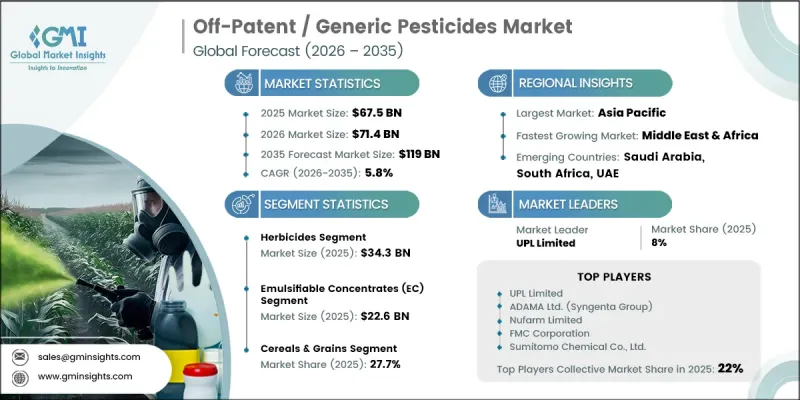
특허 만료 및 제네릭 농약 시장은 단기 실적에 일시적인 영향을 미치는 가격 조정이나 재고 조정이 정기적으로 이루어지고 있음에도 불구하고 계속해서 확대되고 있습니다. 이러한 변동은 수요의 장기적인 감소가 아니라 일반적인 시장 주기를 반영한 것입니다. 경제적인 작물 보호 제품의 안정적인 소비가 시장 성장을 지속적으로 뒷받침하고 있으며, 일시적인 혼란 이후에도 업계는 착실히 회복되고 있습니다. 농장 수익성 극대화에 대한 중요성이 커지는 가운데, 생산자들은 생산 비용을 절감하면서도 신뢰할 수 있는 성능을 발휘하는 제품을 지속적으로 찾고 있으며, 이로 인해 제네릭 작물 보호 솔루션의 채택이 더욱 확대되고 있습니다. 유효 성분의 특허 보호 기간이 만료되어 제네릭 제품으로 꾸준히 전환됨에 따라, 여러 작물 보호 부문에 걸쳐 제품의 접근성이 지속적으로 확대되고 있습니다. 동시에, 개발도상국에서의 농지 면적 지속적 확대는 제품 소비량 증가를 뒷받침하며, 일시적인 가격 변동과 관계없이 신뢰할 수 있는 수요 기반을 형성하고 있습니다. 또한 시장에서는 제품의 효율성과 살포 성능을 향상시키는 첨단 제형으로의 점진적인 전환이 관찰되고 있으며, 이는 전 세계 특허 만료 및 제네릭 농약 시장 전체의 장기적인 성장 기회를 더욱 강화하고 있습니다.
| 시장 범위 | |
|---|---|
| 시작 연도 | 2025년 |
| 예측 기간 | 2026-2035년 |
| 시작 시점 시장 규모 | 675억 달러 |
| 예측액 | 1,190억 달러 |
| CAGR | 5.8% |
제초제 부문은 50.8%의 점유율을 차지하며, 2025년에는 343억 달러의 매출을 기록하고, 2035년까지 연평균 성장률(CAGR) 5.4%로 성장할 것으로 예측됩니다. 농업 생산 시스템 전반에서 잡초 관리가 작물 수확량을 보호하는 데 매우 중요한 역할을 하고 있기 때문에 효과적인 잡초 방제에 대한 지속적인 수요가 이 부문을 지탱하는 주요 요인이 되고 있습니다. 제네릭 제초제 분자의 광범위한 보급에 더해, 통합 저항성 관리 프로그램 및 다제품 병용 처리 방식에서의 사용 확대가 맞물리면서, 성숙한 농업 시장과 신흥 농업 시장 모두에서 수요를 지속적으로 견인하고 있습니다.
2025년, 곡물 및 잡곡 용도 부문은 27.7%의 점유율을 차지하며 최대 용도 카테고리가 되었습니다. 이러한 선도적 지위는 주곡 작물의 광범위한 재배와 안정적인 생산성을 유지하기 위한 신뢰할 수 있는 작물 보호 솔루션에 대한 지속적인 수요에 의해 뒷받침되고 있습니다. 제네릭 농약은 경제적인 방제 효과를 제공할 뿐만 아니라 상업적 농업 생산 관행에 효율적으로 부합하기 때문에 대규모 농업 경영에서 여전히 선호되는 선택지로 남아 있습니다.
2025년, 북미의 특허 만료 및 제네릭 농약 시장은 22.8%의 점유율을 차지했습니다. 상업적 농업 경영 전반에 걸친 제네릭 농약 제품의 적극적인 활용이 계속해서 이 지역의 수요를 뒷받침하고 있습니다. 합리적인 가격의 농업 투입재에 대한 수요는 여전히 중요한 성장 요인인 반면, 규제 평가의 진화는 대체 가능한 제네릭 솔루션의 기회를 창출함으로써 제품 포트폴리오에 지속적인 영향을 미치고 있습니다. 업계 재편과 변화하는 규제 준수 요건이 맞물리면서, 해당 지역 전체에서 보다 안전하고 지속가능한 특허 만료 농약 제품의 채택이 더욱 촉진되고 있습니다.
자주 묻는 질문
목차
제1장 조사 방법과 범위
제2장 주요 요약
제3장 업계 인사이트
제4장 경쟁 구도
제5장 시장 추정 및 예측 : 농약 종류별, 2022-2035년
제6장 시장 추정 및 예측 : 제제 유형별, 2022-2035년
제7장 시장 추정 및 예측 : 작물 유형별, 2022-2035년
제8장 시장 추정 및 예측 : 지역별, 2022-2035년
제9장 기업 개요
KSM 26.08.05The Global Off-Patent/Generic Pesticides Market was valued at USD 67.5 billion in 2025 and is estimated to grow at a CAGR of 5.8% to reach USD 119 billion by 2035.
The off-patent/generic pesticides market continues to expand despite periodic pricing adjustments and inventory corrections that temporarily affect short-term performance. These fluctuations reflect normal market cycles rather than any long-term decline in demand. Stable consumption of economical crop protection products continues to support market growth, allowing industry to recover steadily after temporary disruptions. Increasing emphasis on maximizing farm profitability has encouraged wider adoption of generic crop protection solutions, as growers continue to seek products that deliver reliable performance while lowering production costs. The steady transition of active ingredients from patent protection into the generic category continues to broaden product availability across multiple crop protection segments. At the same time, the ongoing expansion of agricultural land in developing economies supports higher product consumption and creates a dependable demand base regardless of temporary pricing movements. The market is also witnessing a gradual transition toward advanced formulations that improve product efficiency and application performance, further strengthening long-term growth opportunities across the global off-patent/generic pesticides market.
| Market Scope | |
|---|---|
| Start Year | 2025 |
| Forecast Year | 2026-2035 |
| Start Value | $67.5 Billion |
| Forecast Value | $119 Billion |
| CAGR | 5.8% |
The herbicides segment held 50.8% share, generating USD 34.3 billion in 2025, and is anticipated to grow at a 5.4% CAGR through 2035. Continued demand for effective weed control remains the primary factor supporting this segment, as weed management plays a vital role in protecting crop yields across agricultural production systems. Broad acceptance of generic herbicide molecules, combined with their growing use in integrated resistance management programs and multi-product treatment approaches, continues to reinforce demand across both established and developing agricultural markets.
The cereals & grains application segment captured 27.7% share in 2025, making it the largest application category. Its leadership is supported by the widespread cultivation of staple crops and the ongoing need for dependable crop protection solutions to maintain consistent productivity. Generic pesticides remain a preferred choice for large-scale farming operations because they provide economical protection while fitting efficiently into commercial agricultural production practices.
North America Off-Patent/Generic Pesticides Market held 22.8% share in 2025. Strong utilization of generic crop protection products across commercial farming operations continues to support regional demand. The need for affordable agricultural inputs remains an important growth driver, while evolving regulatory assessments continue to influence product portfolios by creating opportunities for alternative generic solutions. Industry consolidation, together with changing regulatory compliance requirements, is further encouraging the adoption of safer and more sustainable off-patent pesticide products throughout the region.
Major companies operating in the global off-patent / generic pesticides market include UPL Limited, ADAMA Ltd. (Syngenta Group), Nufarm Limited, FMC Corporation, Sumitomo Chemical Co., Ltd., Sharda Cropchem Ltd., Albaugh LLC, Sipcam-Oxon S.p.A., Rotam CropSciences Ltd., American Vanguard Corporation, Jiangsu Yangnong Chemical Co., Ltd., Zhejiang Wynca Chemical Group Co., Ltd., Gharda Chemicals Ltd., Meghmani Organics Ltd., and Rallis India Limited (Tata Group). Leading participants in the off-patent / generic pesticides market continue to strengthen their market position by expanding their generic product portfolios as additional active ingredients transition beyond patent protection. Companies are investing in formulation improvements that enhance product performance, application efficiency, and overall value for growers. Strategic partnerships, distribution network expansion, and greater penetration into high-growth agricultural regions remain important approaches for increasing market reach. Many manufacturers are also focusing on regulatory compliance by aligning product offerings with evolving environmental and safety requirements. Capacity expansion, manufacturing optimization, and supply chain improvements help ensure reliable product availability while maintaining cost competitiveness.
Table of Contents
Chapter 1 Methodology & Scope
- 1.1 Research approach
- 1.2 Quality Commitments
- 1.2.1 GMI AI policy & data integrity commitment
- 1.2.1.1 Source consistency protocol
- 1.2.1 GMI AI policy & data integrity commitment
- 1.3 Research Trail & Confidence Scoring
- 1.3.1 Research Trail Components
- 1.3.2 Scoring Components
- 1.4 Data Collection
- 1.4.1 Partial list of primary sources
- 1.5 Data mining sources
- 1.5.1 Paid sources
- 1.5.1.1 Sources, by region
- 1.5.1 Paid sources
- 1.6 Base estimates and calculations
- 1.6.1 Base year calculation for any one approach
- 1.7 Forecast model
- 1.7.1 Quantified market impact analysis
- 1.7.1.1 Mathematical impact of growth parameters on forecast
- 1.7.1 Quantified market impact analysis
- 1.8 Research transparency addendum
- 1.8.1 Source attribution framework
- 1.8.2 Quality assurance metrics
- 1.8.3 Our commitment to trust
Chapter 2 Executive Summary
- 2.1 Industry 360° synopsis
- 2.2 Key market trends
- 2.2.1 Regional
- 2.2.2 Pesticide Type
- 2.2.3 Formulation Type
- 2.2.4 Crop Type
Chapter 3 Industry Insights
- 3.1 Industry ecosystem analysis
- 3.1.1 Supplier landscape
- 3.1.2 Profit margin
- 3.1.3 Value addition at each stage
- 3.1.4 Factor affecting the value chain
- 3.1.5 Disruptions
- 3.2 Industry impact forces
- 3.2.1 Growth drivers
- 3.2.2 Industry pitfalls and challenges
- 3.2.3 Market opportunities
- 3.3 Growth potential analysis
- 3.4 Regulatory landscape
- 3.4.1 North America
- 3.4.2 Europe
- 3.4.3 Asia Pacific
- 3.4.4 Latin America
- 3.4.5 Middle East & Africa
- 3.5 Porter's analysis
- 3.6 PESTEL analysis
- 3.7 Price trends
- 3.7.1 By region
- 3.7.2 By feedstock type
- 3.8 Future market trends
- 3.9 Technology and innovation landscape
- 3.9.1 Current technological trends
- 3.9.2 Emerging technologies
- 3.10 Patent Landscape
- 3.11 Trade statistics (HS code)
- 3.11.1 Major importing countries
- 3.11.2 Major exporting countries
- 3.12 Sustainability and environmental aspects
- 3.12.1 Sustainable practices
- 3.12.2 Waste reduction strategies
- 3.12.3 Energy efficiency in production
- 3.12.4 Eco-friendly initiatives
- 3.13 Carbon footprint consideration
Chapter 4 Competitive Landscape, 2025
- 4.1 Introduction
- 4.2 Company market share analysis
- 4.2.1 By region
- 4.2.1.1 North America
- 4.2.1.2 Europe
- 4.2.1.3 Asia Pacific
- 4.2.1.4 LATAM
- 4.2.1.5 MEA
- 4.2.1 By region
- 4.3 Competitive analysis of major market players
- 4.4 Competitive positioning matrix
- 4.5 Key developments
- 4.5.1 Mergers & acquisitions
- 4.5.2 Partnerships & collaborations
- 4.5.3 New Product Launches
- 4.5.4 Expansion Plans
Chapter 5 Market Estimates and Forecast, By Pesticide Type, 2022-2035 (USD Billion) (Kilo Tons)
- 5.1 Key trends
- 5.2 Herbicides
- 5.2.1 Glyphosate-Based Generics
- 5.2.2 2,4-D-Based Generics
- 5.2.3 Paraquat-Based Generics
- 5.2.4 Atrazine-Based Generics
- 5.2.5 Metolachlor & Acetochlor-Based Generics
- 5.2.6 Others
- 5.3 Insecticides
- 5.3.1 Organophosphates (Chlorpyrifos, Malathion, Dimethoate)
- 5.3.2 Pyrethroids (Lambda-cyhalothrin, Cypermethrin, Deltamethrin)
- 5.3.3 Neonicotinoids (Imidacloprid, Thiamethoxam)
- 5.3.4 Carbamates (Carbofuran, Carbaryl, Methomyl)
- 5.3.5 Others
- 5.4 Fungicides
- 5.4.1 Triazoles (Propiconazole, Tebuconazole, Epoxiconazole)
- 5.4.2 Strobilurins (Azoxystrobin, Trifloxystrobin)
- 5.4.3 Dithiocarbamates (Mancozeb, Thiram, Maneb)
- 5.4.4 Benzimidazoles (Carbendazim, Thiophanate-Methyl)
- 5.4.5 Others
- 5.5 Nematicides
- 5.5.1 Organophosphate Nematicides
- 5.5.2 Carbamate Nematicides
- 5.5.3 Others
- 5.6 Plant Growth Regulators (PGRs)
- 5.6.1 Ethylene-Based (Ethephon)
- 5.6.2 Gibberellin-Based
- 5.6.3 Cytokinin-Based
- 5.6.4 Others
- 5.7 Others
- 5.7.1 Rodenticides
- 5.7.2 Molluscicides
- 5.7.3 Soil Fumigants
Chapter 6 Market Estimates and Forecast, By Formulation Type, 2022-2035 (USD Billion) (Kilo Tons)
- 6.1 Key trends
- 6.2 Emulsifiable Concentrates (EC)
- 6.3 Wettable Powders (WP)
- 6.4 Water Dispersible Granules / Dry Flowables (WDG/WG)
- 6.5 Suspension Concentrates (SC)
- 6.6 Granules (GR)
- 6.7 Others
- 6.7.1 Soluble Liquids
- 6.7.2 Dusts
- 6.7.3 Aerosols
- 6.7.4 Baits
- 6.7.5 Microencapsulated
Chapter 7 Market Estimates and Forecast, By Crop Type, 2022-2035 (USD Billion) (Kilo Tons)
- 7.1 Key trends
- 7.2 Cereals & Grains
- 7.2.1 Wheat
- 7.2.2 Rice
- 7.2.3 Maize/Corn
- 7.2.4 Barley & Others
- 7.3 Fruits & Vegetables
- 7.3.1 Deciduous Fruits & Citrus
- 7.3.2 Berries & Soft Fruits
- 7.3.3 Vegetables (Leafy, Root & Cucurbits)
- 7.4 Oilseeds & Pulses
- 7.4.1 Soybean
- 7.4.2 Canola/Rapeseed
- 7.4.3 Sunflower, Groundnut & Others
- 7.4.4 Lentils, Chickpeas & Other Pulses
- 7.5 Turf, Ornamentals & Non-Crop
- 7.5.1 Turf & Golf Course Management
- 7.5.2 Ornamental Horticulture & Nurseries
- 7.5.3 Right-of-Way & Industrial/Non-Agricultural Land
- 7.6 Others
- 7.6.1 Sugarcane
- 7.6.2 Cotton
- 7.6.3 Tobacco
- 7.6.4 Plantation Crops
Chapter 8 Market Estimates and Forecast, By Region, 2022-2035 (USD Billion) (Kilo Tons)
- 8.1 Key trends
- 8.2 North America
- 8.2.1 U.S.
- 8.2.2 Canada
- 8.3 Europe
- 8.3.1 Germany
- 8.3.2 UK
- 8.3.3 France
- 8.3.4 Spain
- 8.3.5 Italy
- 8.3.6 Rest of Europe
- 8.4 Asia Pacific
- 8.4.1 China
- 8.4.2 India
- 8.4.3 Japan
- 8.4.4 Australia
- 8.4.5 South Korea
- 8.4.6 Rest of Asia Pacific
- 8.5 Latin America
- 8.5.1 Brazil
- 8.5.2 Mexico
- 8.5.3 Argentina
- 8.5.4 Rest of Latin America
- 8.6 Middle East and Africa
- 8.6.1 Saudi Arabia
- 8.6.2 South Africa
- 8.6.3 UAE
- 8.6.4 Rest of Middle East and Africa
Chapter 9 Company Profiles
- 9.1 UPL Limited
- 9.2 ADAMA Ltd. (Syngenta Group)
- 9.3 Nufarm Limited
- 9.4 FMC Corporation
- 9.5 Sumitomo Chemical Co., Ltd.
- 9.6 Sharda Cropchem Ltd.
- 9.7 Albaugh LLC
- 9.8 Sipcam-Oxon S.p.A.
- 9.9 Rotam CropSciences Ltd.
- 9.10 American Vanguard Corporation
- 9.11 Jiangsu Yangnong Chemical Co., Ltd.
- 9.12 Zhejiang Wynca Chemical Group Co., Ltd.
- 9.13 Gharda Chemicals Ltd.
- 9.14 Meghmani Organics Ltd.
- 9.15 Rallis India Limited (Tata Group)