

|
시장보고서
상품코드
2101637
시스루나 공간 인프라 시스템 시장 기회, 성장 촉진요인, 업계 동향 분석 및 예측(2026-2035년)Cislunar Space Infrastructure System Market Opportunity, Growth Drivers, Industry Trend Analysis, and Forecast 2026 - 2035 |
||||||

세계의 시스루나 공간 인프라 시스템 시장은 2025년에 39억 달러로 평가되었으며, CAGR 15.1%로 성장하여 2035년까지 159억 달러에 달할 것으로 추정됩니다.
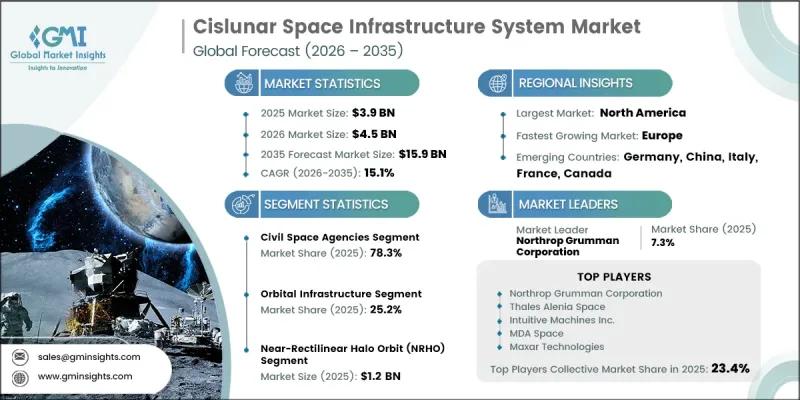
시스루나 공간 인프라 시스템 산업의 성장은 지구 및 달 환경 전반에서 인간과 로봇에 의한 지속적인 운영을 가능하게 하는 장기적인 달 탐사 프로그램의 확립에 초점을 맞춘 정부 투자의 증가에 힘입고 있습니다. 우주 프로그램은 개별 임무 목표에서 반복적인 달 표면 접근 및 장기 운영을 뒷받침하는 통합적인 인프라 개발로 점차 전환되고 있습니다. 이러한 전환은 탐사, 과학 연구, 물류, 통신, 항법, 전력 시스템 및 향후 상업 활동을 지원하도록 설계된 인프라의 구축에 큰 기회를 창출하고 있습니다. 달 탐사 임무의 수가 계속 증가함에 따라, 신뢰할 수 있는 위치 측정, 항법, 시간 동기화 및 통신 기능에 대한 수요 증가가 시장 확장을 더욱 가속화하고 있습니다. 달 궤도 인프라의 지속가능한 개발에는 미래의 운영 요건을 지원할 수 있는, 신뢰성이 높고 상호연결된 통신 및 항법 시스템이 필요합니다. 정부 및 민간 기관이 장기적인 달 표면 인프라에 대한 투자를 계속 확대함에 따라, 예측 기간 동안 첨단 시슬루나(SisLuna) 우주 인프라 시스템에 대한 수요는 꾸준히 증가할 것으로 예상됩니다.
| 시장 범위 | |
|---|---|
| 시작 연도 | 2025년 |
| 예측 기간 | 2026-2035년 |
| 초기 시장 규모 | 39억 달러 |
| 예측액 | 159억 달러 |
| CAGR | 15.1% |
2025년에는 민간 우주 기관 부문이 78.3%의 점유율을 차지하며 가장 큰 시장 점유율을 유지했습니다. 공적 자금을 받는 기관들은 달 궤도 탐사 이니셔티브 및 인프라 개발에 대한 투자의 주요 원천으로 계속 자리 잡고 있습니다. 달 표면 인프라, 탐사 활동, 항법 능력, 통신 네트워크, 궤도 시스템 및 지상 운영에 대한 장기적인 자금 지원이 시장의 지속적인 성장을 뒷받침하고 있습니다. 심우주 탐사 프로그램에 대한 지속적인 투자, 장기적인 전략적 계획, 그리고 우주 탐사 확대에 대한 지속적인 관심으로 인해, 예측 기간 동안 이 부문의 주도적 지위가 유지될 것으로 전망됩니다.
2025년, 준직선형 헤일로 궤도(NRHO) 부문은 12억 달러의 시장 규모를 기록하며, 시스루나 공간 인프라 시스템 시장에서 가장 큰 궤도 부문이 되었습니다. 이 부문은 장기적인 달 탐사 임무를 지원하는 운영상의 장점을 활용하면서, 궤도 인프라, 물류 운영 및 통신 서비스에 유리한 조건을 제공하고 있습니다. 효율적인 궤도 성능, 지속적인 운영 접근성, 그리고 자원 요구 사항의 감소로 인해 이 궤도는 앞으로도 미래의 인류 및 로봇 임무를 지원하는 데 적합한 선택지로 남을 것입니다. 달 궤도 인프라가 추가로 가동을 시작함에 따라, 예측 기간 동안 이 궤도 부문에 대한 수요는 계속해서 견조할 것으로 전망됩니다.
2025년, 북미의 시스루나 공간 인프라 시스템 시장은 67.7%의 점유율을 차지했습니다. 이 지역의 성장은 장기 달 탐사 프로그램에 대한 정부의 막대한 자금 지원, 심우주 통신 및 항법 능력에 대한 투자 확대, 그리고 달 탐사 이니셔티브를 지원하는 민관 조직 간의 협력 강화에 의해 주도되고 있습니다. 또한, 이 지역은 확립된 우주 산업, 첨단 발사 능력, 달 표면 물류 및 궤도 인프라에 대한 지속적인 투자, 그리고 우주 영역 인식 시스템의 지속적인 개발과 같은 이점도 누리고 있으며, 이 모든 요소가 세계 시장에서 북미의 리더십을 더욱 공고히 하고 있습니다.
자주 묻는 질문
목차
제1장 조사 방법과 범위
제2장 주요 요약
제3장 업계 인사이트
제4장 경쟁 구도
제5장 시장 추정 및 예측 : 인프라 시스템 종류별, 2022-2035년
제6장 시장 추정 및 예측 : 도입 지역별, 2022-2035년
제7장 시장 추정 및 예측 : 최종사용자별, 2022-2035년
제8장 시장 추정 및 예측 : 지역별, 2022-2035년
제9장 기업 개요
KSM 26.08.05The Global Cislunar Space Infrastructure System Market was valued at USD 3.9 billion in 2025 and is estimated to grow at a CAGR of15.1% to reach USD 15.9 billion by 2035.
Growth in the cislunar space infrastructure system industry is supported by rising government investments focused on establishing long-term lunar programs that enable continuous human and robotic operations throughout the Earth-Moon environment. Space programs are increasingly shifting from mission-specific objectives toward integrated infrastructure development that supports recurring lunar access and long-duration operations. This transition is creating significant opportunities for the deployment of infrastructure designed to support exploration, scientific research, logistics, communications, navigation, power systems, and future commercial activities. Growing demand for dependable positioning, navigation, timing, and communication capabilities is further accelerating market expansion as the number of lunar missions continues to increase. Sustainable development of cislunar infrastructure requires reliable and interconnected communication and navigation systems capable of supporting future operational requirements. As governments and commercial organizations continue to expand investments in long-term lunar infrastructure, demand for advanced cislunar space infrastructure systems is expected to strengthen steadily throughout the forecast period.
| Market Scope | |
|---|---|
| Start Year | 2025 |
| Forecast Year | 2026-2035 |
| Start Value | $3.9 Billion |
| Forecast Value | $15.9 Billion |
| CAGR | 15.1% |
The civil space agencies segment accounted for 78.3% share in 2025, maintaining the largest market share. Publicly funded organizations continue to represent the primary source of investment for cislunar exploration initiatives and infrastructure development. Long-term funding for lunar infrastructure, research activities, navigation capabilities, communications networks, orbital systems, and surface operations continues to support sustained market growth. Continued investment in deep-space exploration programs, long-term strategic planning, and ongoing interest in expanding space research are expected to maintain the segment's leadership position throughout the forecast period.
The near-rectilinear halo orbit (NRHO) segment generated USD 1.2 billion in 2025, making it the leading orbital segment within the cislunar space infrastructure system market. The segment benefits from operational characteristics that support extended-duration lunar missions while providing favorable conditions for orbital infrastructure, logistics operations, and communication services. Efficient orbital performance, continuous operational accessibility, and reduced resource requirements continue to make this orbit well suited for supporting future human and robotic missions. As additional cislunar infrastructure becomes operational, demand for this orbital segment is expected to remain strong during the forecast period.
North America Cislunar Space Infrastructure System Market accounted for 67.7% share in 2025. Regional growth is driven by substantial government funding for long-duration lunar programs, increasing investments in deep-space communication and navigation capabilities, and stronger collaboration between public and private organizations supporting lunar exploration initiatives. The region also benefits from a well-established space industry, advanced launch capabilities, continued investment in lunar logistics, orbital infrastructure, and ongoing development of space domain awareness systems, all of which continue to strengthen North America's leadership in the global market.
Major companies operating in the global cislunar space infrastructure system market include Airbus Defence & Space, Astrobotic Technology Inc., Blue Origin LLC, Boeing Company, Intuitive Machines Inc., Lockheed Martin Corporation, Maxar Technologies, MDA Space, Northrop Grumman Corporation, OHB System AG, and Thales Alenia Space. Companies operating in the cislunar space infrastructure system market are strengthening their market position by expanding investments in advanced space technologies, developing integrated infrastructure solutions, and enhancing engineering capabilities for long-duration lunar missions. Market participants continue to focus on research and development to improve communication, navigation, logistics, and orbital support systems that address evolving mission requirements. Strategic collaborations with government organizations and commercial partners remain a key approach for securing long-term projects and expanding technological expertise.
Table of Contents
Chapter 1 Methodology and Scope
- 1.1 Market scope and definition
- 1.2 Research design
- 1.2.1 Research approach
- 1.2.2 Data collection methods
- 1.3 Data mining sources
- 1.3.1 Global
- 1.3.2 Regional/Country
- 1.4 Base estimates and calculations
- 1.4.1 Base year calculation
- 1.4.2 Key trends for market estimation
- 1.5 Primary research and validation
- 1.5.1 Primary sources
- 1.6 Forecast model
- 1.7 Research assumptions and limitations
Chapter 2 Executive Summary
- 2.1 Industry 360° synopsis, 2022 - 2035
- 2.2 Key market trends
- 2.2.1 Infrastructure system type trends
- 2.2.2 Deployment zone trends
- 2.2.3 End-user trends
- 2.2.4 Regional trends
- 2.3 TAM Analysis, 2026-2035
- 2.4 CXO perspectives: Strategic imperatives
Chapter 3 Industry Insights
- 3.1 Industry ecosystem analysis
- 3.1.1 Supplier Landscape
- 3.1.2 Profit Margin
- 3.1.3 Cost structure
- 3.1.4 Value addition at each stage
- 3.1.5 Factor affecting the value chain
- 3.1.6 Disruptions
- 3.2 Industry impact forces
- 3.2.1 Growth drivers
- 3.2.1.1 Expansion of government-led lunar exploration programs
- 3.2.1.2 Growing demand for lunar communication and navigation infrastructure
- 3.2.1.3 Increasing international collaboration on cislunar missions
- 3.2.1.4 Commercialization of the lunar economy and in-space logistics
- 3.2.1.5 Rising need for space domain awareness and cislunar traffic management
- 3.2.2 Industry pitfalls and challenges
- 3.2.2.1 High development and deployment costs of cislunar infrastructure
- 3.2.2.2 Technical complexity and harsh cislunar operating environment
- 3.2.3 Market opportunities
- 3.2.3.1 Expansion of commercial lunar economy and in-space services
- 3.2.3.2 Development of interoperable lunar communication and navigation networks
- 3.2.1 Growth drivers
- 3.3 Growth potential analysis
- 3.4 Regulatory landscape
- 3.4.1 North America
- 3.4.2 Europe
- 3.4.3 Asia Pacific
- 3.4.4 Latin America
- 3.4.5 Middle East & Africa
- 3.5 Porter's analysis
- 3.6 PESTEL analysis
- 3.7 Technology and Innovation landscape
- 3.7.1 Current technological trends
- 3.7.2 Emerging technologies
- 3.8 Price trends
- 3.8.1 By region
- 3.8.2 By product
- 3.9 Pricing Strategies
- 3.10 Emerging Business Models
- 3.11 Compliance Requirements
- 3.12 Patent and IP analysis
Chapter 4 Competitive Landscape, 2025
- 4.1 Introduction
- 4.2 Company market share analysis
- 4.2.1 By region
- 4.2.1.1 North America
- 4.2.1.2 Europe
- 4.2.1.3 Asia Pacific
- 4.2.1.4 Latin America
- 4.2.1.5 Middle East & Africa
- 4.2.2 Market concentration analysis
- 4.2.1 By region
- 4.3 Competitive benchmarking of key players
- 4.3.1 Financial performance comparison
- 4.3.1.1 Revenue
- 4.3.1.2 Profit margin
- 4.3.1.3 R&D
- 4.3.2 Product portfolio comparison
- 4.3.2.1 Product range breadth
- 4.3.2.2 Technology
- 4.3.2.3 Innovation
- 4.3.3 Geographic presence comparison
- 4.3.3.1 Global footprint analysis
- 4.3.3.2 Service network coverage
- 4.3.3.3 Market penetration by region
- 4.3.4 Competitive positioning matrix
- 4.3.4.1 Leaders
- 4.3.4.2 Challengers
- 4.3.4.3 Followers
- 4.3.4.4 Niche players
- 4.3.5 Strategic outlook matrix
- 4.3.1 Financial performance comparison
- 4.4 Key developments
- 4.4.1 Mergers and acquisitions
- 4.4.2 Partnerships and collaborations
- 4.4.3 Technological advancements
- 4.4.4 Expansion and investment strategies
- 4.4.5 Digital transformation initiatives
- 4.5 Emerging/ startup competitors landscape
Chapter 5 Market Estimates and Forecast, By Infrastructure System Type, 2022 - 2035 (USD Million)
- 5.1 Key trends
- 5.2 Communication infrastructure
- 5.3 Navigation, positioning & timing (PNT) infrastructure
- 5.4 Transportation & logistics infrastructure
- 5.5 Orbital infrastructure
- 5.6 Lunar surface infrastructure
- 5.7 Power infrastructure
- 5.8 Space domain awareness (SDA) infrastructure
- 5.9 Digital infrastructure
Chapter 6 Market Estimates and Forecast, By Deployment Zone, 2022 - 2035 (USD Million)
- 6.1 Key trends
- 6.2 Near-rectilinear halo orbit (NRHO)
- 6.3 Earth-moon lagrange region (EML1-EML5)
- 6.4 Low lunar orbit (LLO)
- 6.5 Lunar surface
- 6.6 Trans-lunar space / cislunar transit corridors
Chapter 7 Market Estimates and Forecast, By End-User, 2022 - 2035 (USD Million)
- 7.1 Key trends
- 7.2 Civil space agencies (incl. Publicly funded research)
- 7.3 Defense & national security
- 7.4 Commercial & private enterprises
Chapter 8 Market Estimates and Forecast, By Region, 2022 - 2035 (USD Million)
- 8.1 Key trend
- 8.2 North America
- 8.2.1 U.S.
- 8.2.2 Canada
- 8.3 Europe
- 8.3.1 Germany
- 8.3.2 UK
- 8.3.3 France
- 8.3.4 Spain
- 8.3.5 Italy
- 8.4 Asia Pacific
- 8.4.1 China
- 8.4.2 India
- 8.4.3 Japan
- 8.4.4 Australia
- 8.4.5 South Korea
- 8.5 Latin America
- 8.5.1 Brazil
- 8.5.2 Mexico
- 8.5.3 Argentina
- 8.6 Middle East and Africa
- 8.6.1 South Africa
- 8.6.2 Saudi Arabia
- 8.6.3 UAE
Chapter 9 Company Profiles
- 9.1 Global Key Players
- 9.1.1 Northrop Grumman Corporation
- 9.1.2 Thales Alenia Space
- 9.1.3 Intuitive Machines Inc.
- 9.1.4 MDA Space
- 9.1.5 Maxar Technologies
- 9.2 Regional Key Players
- 9.2.1 North America
- 9.2.1.1 Lockheed Martin Corporation
- 9.2.1.2 Blue Origin LLC
- 9.2.1.3 Boeing Company
- 9.2.2 Europe
- 9.2.2.1 Airbus Defence & Space
- 9.2.2.2 OHB System AG
- 9.2.1 North America
- 9.3 Niche Players/Disruptors
- 9.3.1 Astrobotic Technology Inc


