

|
시장보고서
상품코드
2101657
올리고뉴클레오티드 합성 시장 기회, 성장요인, 업계 동향 분석 및 예측(2026-2035년)Oligonucleotide Synthesis Market Opportunity, Growth Drivers, Industry Trend Analysis, and Forecast 2026 - 2035 |
||||||

세계의 올리고뉴클레오티드 합성 시장은 2025년에 28억 달러 규모에 달하며, CAGR 12.5%로 성장하며, 2035년까지 86억 달러에 달할 것으로 추정되고 있습니다.
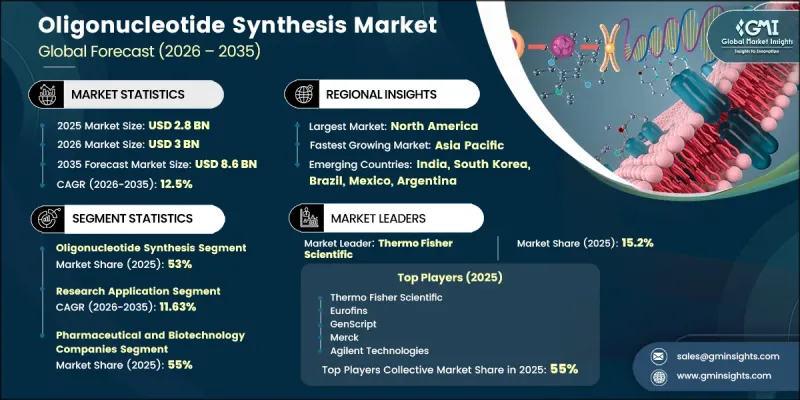
시장 확대의 원동력으로는 올리고뉴클레오티드 치료제 파이프라인의 확대, 연구개발 및 임상 현장에서 합성 올리고뉴클레오티드의 채택 증가, 그리고 정밀 의학 및 유전자 편집 기술의 상용화가 진행되고 있는 점 등이 꼽힙니다. 올리고뉴클레오티드 합성은 생명과학 분야 전반에 걸쳐 계속해서 중요한 기반 기술로 자리 잡고 있으며, 치료제 개발, 분자 연구 및 합성 생물학 연구에 필수적인 핵산 성분을 공급하고 있습니다. 주요 상업용 합성 공급업체들의 생산 능력에 대한 지속적인 투자와 여러 최종 용도 산업에서의 꾸준한 수요가 맞물려 장기적인 시장 성장을 지원할 것으로 예상됩니다. 또한 분자 진단 솔루션 및 정밀 의료 접근법의 도입 확대에 따라 합성 올리고뉴클레오티드에 대한 수요는 계속해서 증가하고 있습니다. 합성 올리고뉴클레오티드는 의료 및 연구 분야의 광범위한 유전체·분자 분석 응용 분야에서 여전히 필수적인 구성 요소로 자리 잡고 있습니다.
| 시장 범위 | |
|---|---|
| 시작연도 | 2025년 |
| 예측 기간 | 2026-2035년 |
| 초기 시장 규모 | 28억 달러 |
| 예측액 | 86억 달러 |
| CAGR | 12.5% |
제품 및 서비스 부문은 시장 점유율의 53%를 차지하고 있으며, 2026-2035년에 연평균 성장률(CAGR) 12.05%로 성장할 것으로 예측됩니다. 이 부문에는 고객별 서열 길이, 순도 사양 및 화학적 변형 요건을 충족하도록 설계된 연구용 등급, 분석용 등급 및 GMP 등급의 올리고뉴클레오티드를 제공하는 상업용 합성 솔루션이 포함됩니다. 이 부문이 시장을 주도하고 있다는 사실은 합성 서비스가 과학 연구부터 첨단 의약품 개발, 상업적 생산에 이르기까지 사실상 모든 하류 용도의 기반으로 필수적인 역할을 하고 있음을 반영합니다.
제약 및 생명공학 기업 부문은 55%의 점유율을 차지하고 있으며, 2035년까지 연평균 성장률(CAGR) 12.65%를 기록할 것으로 예측됩니다. 이 부문의 시장 주도적 지위는 표적 발견, 선도 화합물 최적화, 전임상 평가, 임상 제조, 상업적 생산 등 의약품 개발의 여러 단계에서 합성 올리고뉴클레오티드에 대한 의존도가 높아지고 있는 데 기인합니다. 공급의 신뢰성을 높이고 제조 능력의 단절을 방지하기 위해 많은 기관이 GMP 인증을 획득한 합성 공급업체와 장기적인 파트너십을 체결하고 있으며, 올리고뉴클레오티드를 기반으로 한 의약품 개발 프로그램을 추진하고, 규제 및 운영 측면의 연속성을 유지하기 위해 신뢰할 수 있는 생산 능력이 전략적으로 중요하다는 점이 부각되고 있습니다.
북미 올리고뉴클레오티드 합성 시장은 확립된 제약 및 생명공학 생태계와 탄탄한 연구 인프라에 힘입어 2025년에는 9억 5,590만 달러의 시장 규모를 기록했습니다. 미국은 일관된 연방 정부의 연구 자금 지원, 임상 단계 바이오기술 기업의 집중, 그리고 올리고뉴클레오티드 합성 기술 및 제조 서비스를 전문으로 하는 여러 주요 공급업체의 존재를 배경으로, 해당 지역의 매출 대부분을 차지하고 있습니다.
자주 묻는 질문
목차
제1장 조사 방법과 범위
제2장 개요
제3장 업계 인사이트
제4장 경쟁 구도
제5장 시장 추산·예측 : 제품 유형별, 2022-2035년
제6장 시장 추산·예측 : 용도별, 2022-2035년
제7장 시장 추산·예측 : 최종 사용별, 2022-2035년
제8장 시장 추산·예측 : 지역별, 2022-2035년
제9장 기업 개요
KSA 26.07.31The Global Oligonucleotide Synthesis Market was valued at USD 2.8 billion in 2025 and is estimated to grow at a CAGR of 12.5% to reach USD 8.6 billion by 2035.
Market expansion is driven by the growing pipeline of oligonucleotide therapeutics, the rising adoption of synthetic oligonucleotides across research and clinical settings, and the increasing commercialization of precision medicine and gene-editing technologies. Oligonucleotide synthesis continues to be a critical enabling technology across the life sciences sector, supplying essential nucleic acid components for therapeutic development, molecular research, and synthetic biology initiatives. Ongoing investments in manufacturing capabilities by leading commercial synthesis providers, together with sustained demand from multiple end-use industries, are expected to reinforce long-term market growth. Furthermore, the expanding implementation of molecular diagnostic solutions and precision medicine approaches continues to strengthen demand for synthetic oligonucleotides, which remain indispensable components in a wide range of genomic and molecular analysis applications across healthcare and research settings.
| Market Scope | |
|---|---|
| Start Year | 2025 |
| Forecast Year | 2026-2035 |
| Start Value | $2.8 Billion |
| Forecast Value | $8.6 Billion |
| CAGR | 12.5% |
The products and services segment accounts for 53% share and is forecast to grow at a CAGR of 12.05% between 2026 and 2035. This segment includes commercial synthesis solutions that deliver research-grade, analytical-grade, and GMP-grade oligonucleotides designed to meet customer-specific sequence lengths, purity specifications, and chemical modification requirements. Its leading market position reflects the indispensable role of synthesis services as the foundation for virtually every downstream application, supporting activities ranging from scientific research to advanced pharmaceutical development and commercial manufacturing.
The pharmaceutical and biotechnology companies segment held 55% share and is projected to register a CAGR of 12.65% throughout 2035. Their market leadership is supported by the increasing reliance on synthetic oligonucleotides across multiple stages of drug development, including target discovery, lead optimization, preclinical evaluation, clinical manufacturing, and commercial production. To strengthen supply reliability and ensure uninterrupted manufacturing capacity, many organizations are entering long-term partnerships with GMP-certified synthesis providers, highlighting the strategic importance of dependable production capabilities for advancing oligonucleotide-based drug development programs and maintaining regulatory and operational continuity.
North America Oligonucleotide Synthesis Market captured USD 955.9 million in 2025, supported by its well-established pharmaceutical and biotechnology ecosystem and extensive research infrastructure. The United States generates most of the regional revenue, benefiting from consistent federal research funding, a strong concentration of clinical-stage biotechnology companies, and the presence of several leading providers specializing in oligonucleotide synthesis technologies and manufacturing services.
Key companies operating in the global oligonucleotide synthesis market include Thermo Fisher Scientific, Integrated DNA Technologies, LGC Biosearch Technologies, Bioneer, Eurogentec, Azenta Life Sciences, Eurofins, Maravai LifeSciences, GenScript, Twist Bioscience, Merck, and Agilent. Companies operating in the oligonucleotide synthesis market are strengthening their market position by expanding manufacturing capacity, enhancing GMP-compliant production capabilities, and investing in advanced synthesis technologies that improve scalability, quality, and turnaround times. Many participants are broadening their product portfolios through the introduction of customized oligonucleotide solutions with diverse purity levels and chemical modifications to address evolving customer requirements. Strategic collaborations with pharmaceutical companies, biotechnology firms, and research organizations remain a key approach for securing long-term business opportunities and supporting drug development pipelines. Organizations are also focusing on geographic expansion by establishing new production facilities and strengthening regional distribution networks.
Table of Contents
Chapter 1 Methodology and Scope
- 1.1 Market scope and definition
- 1.2 Research approach
- 1.3 Quality commitments
- 1.3.1 GMI AI policy & data integrity commitment
- 1.3.1.1 Source consistency protocol
- 1.3.1 GMI AI policy & data integrity commitment
- 1.4 Research trail & confidence scoring
- 1.4.1 Research trail components
- 1.4.2 Scoring components
- 1.5 Data collection
- 1.5.1 Partial list of primary sources
- 1.6 Data mining sources
- 1.6.1 Paid sources
- 1.6.1.1 Sources, by region
- 1.6.1 Paid sources
- 1.7 Base estimates and calculations
- 1.7.1 Base year calculation for any one approach
- 1.8 Forecast model
- 1.8.1 Quantified market impact analysis
- 1.8.1.1 Mathematical impact of growth parameters on forecast
- 1.8.1 Quantified market impact analysis
- 1.9 Research transparency addendum
- 1.9.1 Source attribution framework
- 1.9.2 Quality assurance metrics
- 1.9.3 Our commitment to trust
Chapter 2 Executive Summary
- 2.1 Industry 360° synopsis
- 2.2 Key market trends
- 2.2.1 Regional trends
- 2.2.2 Product type trends
- 2.2.3 Application trends
- 2.2.4 End use trends
- 2.3 CXO perspectives: Strategic imperatives
Chapter 3 Industry Insights
- 3.1 Industry ecosystem analysis
- 3.2 Industry impact forces
- 3.2.1 Growth drivers
- 3.2.1.1 Expanding Applications in Molecular Diagnostics and Precision Medicine.
- 3.2.1.2 Growing Prevalence of Diseases Globally.
- 3.2.1.3 Rapid Technology Advancements in Synthetic Biology.
- 3.2.1.4 Rising Investments Towards Research and Development Activities
- 3.2.2 Industry pitfalls and challenges
- 3.2.2.1 Stringent Government Regulations and Guidelines.
- 3.2.2.2 High Cost, Biosafety, Biosecurity, and Ethical Issues.
- 3.2.3 Market opportunities
- 3.2.3.1 Untapped Potential in Emerging Markets for Research-Grade Oligo Demand
- 3.2.3.2 Emergence of High-Complexity Oligo Pools for Synthetic Biology & CRISPR Screening
- 3.2.1 Growth drivers
- 3.3 Growth potential analysis
- 3.4 Regulatory landscape
- 3.4.1 North America
- 3.4.2 Europe
- 3.4.3 Asia Pacific
- 3.5 Technology and innovation landscape
- 3.5.1 Current technological trends
- 3.5.2 Emerging technologies
- 3.6 Pricing trend analysis (Driven by Primary Research)
- 3.7 Future market trends
- 3.8 Impact of AI & Generative AI on the market (Driven by Primary Research)
- 3.9 Porter's analysis
- 3.10 PESTEL analysis
Chapter 4 Competitive Landscape, 2025
- 4.1 Introduction
- 4.2 Company market share analysis
- 4.2.1 North America
- 4.2.2 Europe
- 4.2.3 Asia Pacific
- 4.3 Company matrix analysis
- 4.4 Competitive analysis of major market players
- 4.5 Competitive positioning matrix
- 4.6 Key developments
- 4.6.1 Merger and acquisition
- 4.6.2 Partnership and collaboration
- 4.6.3 New product launches
- 4.6.4 Expansion plans
Chapter 5 Market Estimates and Forecast, By Product Type, 2022 - 2035 ($ Mn)
- 5.1 Key trends
- 5.2 Oligonucleotide Synthesis
- 5.2.1 Standard oligonucleotide synthesis
- 5.2.2 Custom oligonucleotide synthesis
- 5.3 Reagents and Consumables
- 5.4 Equipments
Chapter 6 Market Estimates and Forecast, By Application, 2022 - 2035 ($ Mn)
- 6.1 Key trends
- 6.2 Research
- 6.2.1 Synthetic biology
- 6.2.2 Drug discovery
- 6.2.3 Other research applications
- 6.3 Therapeutics
- 6.3.1 Neurology
- 6.3.2 Rare diseases
- 6.3.3 Cardiovascular disease
- 6.3.4 Infectious diseases
- 6.3.5 Other therapeutic areas
- 6.4 Diagnostics
Chapter 7 Market Estimates and Forecast, By End Use, 2022 - 2035 ($ Mn)
- 7.1 Key trends
- 7.2 Pharmaceutical and biotechnology companies
- 7.3 Academic and research institutes
- 7.4 Contract research organization
- 7.5 Other end users
Chapter 8 Market Estimates and Forecast, By Region, 2022 - 2035 ($ Mn)
- 8.1 Key trends
- 8.2 North America
- 8.2.1 U.S.
- 8.2.2 Canada
- 8.3 Europe
- 8.3.1 Germany
- 8.3.2 UK
- 8.3.3 France
- 8.3.4 Spain
- 8.3.5 Italy
- 8.3.6 Netherlands
- 8.4 Asia Pacific
- 8.4.1 China
- 8.4.2 India
- 8.4.3 Japan
- 8.4.4 Australia
- 8.4.5 South Korea
- 8.5 Latin America
- 8.5.1 Brazil
- 8.5.2 Mexico
- 8.5.3 Argentina
- 8.6 Middle East and Africa
- 8.6.1 South Africa
- 8.6.2 Saudi Arabia
- 8.6.3 UAE
Chapter 9 Company Profiles
- 9.1 Agilent Technologies
- 9.2 Azenta Life Sciences
- 9.3 Bioneer
- 9.4 Eurofins
- 9.5 Eurogentec
- 9.6 GenScript
- 9.7 Integrated DNA Technologies
- 9.8 LGC Biosearch Technologies
- 9.9 Maravai LifeSciences
- 9.10 Merck
- 9.11 Thermo Fisher Scientific
- 9.12 Twist Bioscience


