

|
시장보고서
상품코드
2101691
해산물 및 육류 인증용 DNA 바코딩 시장 기회, 성장 촉진요인, 업계 동향 분석 및 예측(2026-2035년)DNA Barcoding for Seafood and Meat Authentication Market Opportunity, Growth Drivers, Industry Trend Analysis, and Forecast 2026 - 2035 |
||||||

세계의 해산물 및 육류 인증용 DNA 바코딩 시장은 2025년에 8억 3,000만 달러 규모에 달하고, CAGR 9.3%로 성장하여 2035년까지 20억 3,000만 달러에 달할 것으로 추정됩니다.
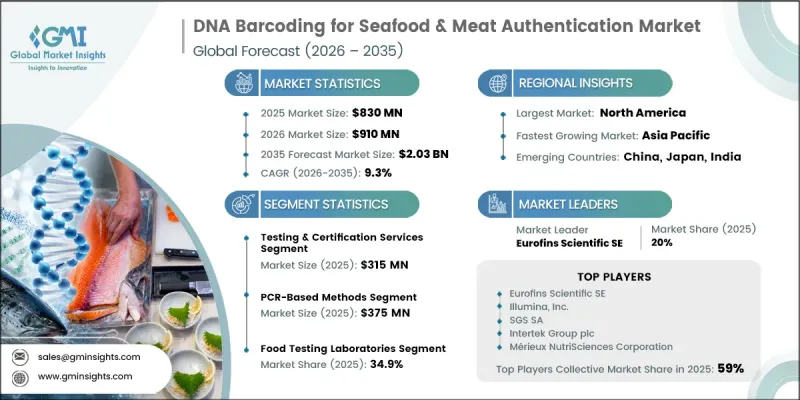
식품 제조업체, 규제 당국 및 공급망 관계자들이 제품의 진위성, 추적성, 식품 안전성을 더욱 중시함에 따라 해산물 및 육류 인증용 DNA 바코딩 시장은 꾸준히 확대되고 있습니다. 전 세계 식품 공급망의 복잡화와 신뢰할 수 있는 종 식별 기법에 대한 수요 증가로 인해 분자 기반 인증 기술의 도입이 가속화되고 있습니다. DNA 바코딩은 정확하고 과학적으로 검증된 식별 결과를 제공함으로써 품질 보증 프로그램을 뒷받침하는 확립된 솔루션으로 진화했습니다. 이 시장은 초기 도입 단계를 넘어, 현재는 상업적 및 규제적 용도를 불문하고 식품 진위성 확인 프로세스의 필수적인 요소가 되었습니다. 검사 정확도와 업무 효율을 향상시키는 실험실 검사, 인증 서비스 및 첨단 데이터 관리 솔루션에 대한 수요는 계속해서 증가하고 있습니다. 동시에 디지털 실험실 시스템, 엄선된 참조 데이터베이스, 그리고 첨단 분석 기술을 통해 진위 확인 워크플로의 확장성과 신뢰성이 향상되고 있습니다. 규제 감독 강화, 품질 기준의 엄격화, 그리고 소비자 신뢰에 대한 관심 증대가 시장의 추가적인 확장을 뒷받침할 것으로 예상되며, DNA 바코딩은 전 세계 해산물 및 육류 공급망 전반에 걸쳐 투명성과 무결성을 확보하기 위한 핵심 기술로서의 입지를 확고히 해 나갈 것으로 전망됩니다.
| 시장 범위 | |
|---|---|
| 시작 연도 | 2025년 |
| 예측 기간 | 2026-2035년 |
| 시작 시점 시장 규모 | 8억 3,000만 달러 |
| 예측액 | 20억 3,000만 달러 |
| CAGR | 9.3% |
시험·인증 서비스 부문은 38%의 점유율을 차지하며 3억 1,500만 달러의 매출을 창출하고 있으며, 2035년까지 연평균 성장률(CAGR) 8.3%로 성장할 것으로 예측됩니다. 인증된 시험 서비스는 제품의 진위성을 검증하고 규제 준수를 지원하는 데 필수적이기 때문에 이 부문은 계속해서 시장을 주도하고 있습니다. 독립적인 검증 서비스에 대한 수요 증가, 시험 빈도 증가, 그리고 품질 관리 프로세스 전반에 걸친 진위성 확인 도입 확대가 이 부문의 성장을 뒷받침하고 있습니다. 시험소의 역량 강화를 위한 투자 증가와 시험 효율의 지속적인 개선으로 인해, 시험 및 인증 서비스에 대한 장기적인 수요가 유지될 것으로 예상됩니다.
식품 검사 기관 부문은 독립적인 시험 및 규제 준수 서비스 제공에서 중심적인 역할을 수행하고 있어, 2025년에는 34.9%의 점유율을 차지했습니다. 식품 제조업체, 공급망 관계자 및 품질 보증 프로그램의 지속적인 수요가 식품 검사 기관의 확장과 첨단 분자 검사 기술에 대한 투자를 계속해서 뒷받침하고 있습니다. 검증된 시험 절차와 신뢰할 수 있는 종 식별에 대한 중요성이 높아짐에 따라, 예측 기간 동안 수요가 더욱 강해질 것으로 예상됩니다.
북미의 해산물 및 육류 인증용 DNA 바코딩 시장은 엄격한 식품 안전 기준, 제품 추적성에 대한 수요 증가, 그리고 첨단 검사 기술의 광범위한 도입에 힘입어 2025년에는 34.9%의 시장 점유율을 기록했습니다. 인증된 검사 인프라, 품질 보증 프로그램 및 인증 서비스에 대한 지속적인 투자가 시장 확대를 주도하고 있습니다. 식품 공급망 전반에 걸친 투명성에 대한 관심 증가와 분자 동정 기술의 채택 확대에 힘입어, 향후 몇 년간 이 지역의 성장이 지속될 것으로 예상됩니다.
자주 묻는 질문
목차
제1장 조사 방법과 범위
제2장 주요 요약
제3장 업계 인사이트
제4장 경쟁 구도
제5장 시장 추정 및 예측 : 제공 유형별, 2022-2035년
제6장 시장 추정 및 예측 : 기술 플랫폼별, 2022-2035년
제7장 시장 추정 및 예측 : 식품 매트릭스별, 2022-2035년
제8장 시장 추정 및 예측 : 최종사용자별, 2022-2035년
제9장 시장 추정 및 예측 : 지역별, 2022-2035년
제10장 기업 개요
KSM 26.08.05The Global DNA Barcoding for Seafood & Meat Authentication Market was valued at USD 830 million in 2025 and is estimated to grow at a CAGR of 9.3% to reach USD 2.03 billion by 2035.
The DNA barcoding for seafood & meat authentication market continues to expand steadily as food manufacturers, regulatory authorities, and supply chain participants place greater emphasis on product authenticity, traceability, and food safety. Increasing complexity in global food supply chains and rising demand for reliable species identification methods are accelerating the adoption of molecular-based authentication technologies. DNA barcoding has evolved into a well-established solution that supports quality assurance programs by delivering accurate and scientifically validated identification results. The market has progressed beyond early adoption and is now an integral component of food authentication processes across commercial and regulatory applications. Demand continues to increase for laboratory testing, certification services, and advanced data management solutions that improve testing accuracy and operational efficiency. At the same time, digital laboratory systems, curated reference databases, and advanced analytical technologies are enhancing the scalability and reliability of authentication workflows. Growing regulatory oversight, stronger quality standards, and increasing focus on consumer confidence are expected to further support market expansion, positioning DNA barcoding as a critical technology for ensuring transparency and integrity throughout the global seafood and meat supply chain.
| Market Scope | |
|---|---|
| Start Year | 2025 |
| Forecast Year | 2026-2035 |
| Start Value | $830 Million |
| Forecast Value | $2.03 Billion |
| CAGR | 9.3% |
The testing and certification services segment held 38% share, generating USD 315 million, and is projected to grow at a CAGR of 8.3% through 2035. This segment continues to lead the market because accredited testing services remain essential for validating product authenticity and supporting regulatory compliance. Growing demand for independent verification services, increasing testing frequency, and broader implementation of authentication throughout quality management processes are strengthening segment growth. Rising investment in laboratory capabilities and continuous improvements in testing efficiency are expected to sustain long-term demand for testing and certification services.
The food testing laboratories segment accounted for 34.9% share in 2025 owing to its central role in providing independent testing and regulatory compliance services. Ongoing demand from food manufacturers, supply chain participants, and quality assurance programs continues to support laboratory expansion and investment in advanced molecular testing technologies. Increasing emphasis on validated testing procedures and reliable species identification is expected to further strengthen demand throughout the forecast period.
North America DNA Barcoding for Seafood & Meat Authentication Market held 34.9% share in 2025 supported by strong food safety standards, increasing demand for product traceability, and widespread adoption of advanced laboratory testing technologies. Continuous investment in accredited testing infrastructure, quality assurance programs, and authentication services is driving market expansion. Growing focus on transparency across food supply chains and increasing adoption of molecular identification technologies are expected to sustain regional growth over the coming years.
Major companies operating in the Global DNA barcoding for seafood & meat authentication market include Eurofins Scientific SE, Illumina, Inc., SGS SA, Intertek Group plc, Merieux NutriSciences Corporation, Oxford Nanopore Technologies plc, Neogen Corporation, AllGenetics & Biology SL, CD Genomics, Bureau Veritas SA, 1st BASE / Apical Scientific Sdn. Bhd., Genetic ID / FoodChain ID, Bento Bioworks Ltd, BIOSERVE Biotechnologies (USA) Ltd, Oritain Global Ltd, and Genetika Science (PT Genetika Science Indonesia). Companies operating in the DNA barcoding for seafood & meat authentication market are strengthening their position through continuous investment in molecular testing technologies, laboratory expansion, and digital innovation. Market participants are enhancing analytical capabilities by improving testing accuracy, expanding reference databases, and integrating advanced laboratory information management systems that streamline authentication workflows. Businesses are also broadening their service portfolios to provide comprehensive testing, certification, and regulatory support for food manufacturers and supply chain partners. Strategic collaborations, geographic expansion, and investment in research and development remain important approaches for strengthening competitive advantage.
Table of Contents
Chapter 1 Methodology & Scope
- 1.1 Research approach
- 1.2 Quality Commitments
- 1.2.1 GMI AI policy & data integrity commitment
- 1.2.1.1 Source consistency protocol
- 1.2.1 GMI AI policy & data integrity commitment
- 1.3 Research Trail & Confidence Scoring
- 1.3.1 Research Trail Components
- 1.3.2 Scoring Components
- 1.4 Data Collection
- 1.4.1 Partial list of primary sources
- 1.5 Data mining sources
- 1.5.1 Paid sources
- 1.5.1.1 Sources, by region
- 1.5.1 Paid sources
- 1.6 Base estimates and calculations
- 1.6.1 Base year calculation for any one approach
- 1.7 Forecast model
- 1.7.1 Quantified market impact analysis
- 1.7.1.1 Mathematical impact of growth parameters on forecast
- 1.7.1 Quantified market impact analysis
- 1.8 Research transparency addendum
- 1.8.1 Source attribution framework
- 1.8.2 Quality assurance metrics
- 1.8.3 Our commitment to trust
Chapter 2 Executive Summary
- 2.1 Industry 360° synopsis
- 2.2 Key market trends
- 2.2.1 Regional
- 2.2.2 Offering Type
- 2.2.3 Technology Platform
- 2.2.4 Food Matrix
- 2.2.5 End-User
Chapter 3 Industry Insights
- 3.1 Industry ecosystem analysis
- 3.1.1 Supplier landscape
- 3.1.2 Profit margin
- 3.1.3 Value addition at each stage
- 3.1.4 Factor affecting the value chain
- 3.1.5 Disruptions
- 3.2 Industry impact forces
- 3.2.1 Growth drivers
- 3.2.2 Industry pitfalls and challenges
- 3.2.3 Market opportunities
- 3.3 Growth potential analysis
- 3.4 Regulatory landscape
- 3.4.1 North America
- 3.4.2 Europe
- 3.4.3 Asia Pacific
- 3.4.4 Latin America
- 3.4.5 Middle East & Africa
- 3.5 Porter's analysis
- 3.6 PESTEL analysis
- 3.7 Price trends
- 3.7.1 By region
- 3.7.2 By feedstock type
- 3.8 Future market trends
- 3.9 Technology and innovation landscape
- 3.9.1 Current technological trends
- 3.9.2 Emerging technologies
- 3.10 Patent Landscape
- 3.11 Trade statistics (HS code)
- 3.11.1 Major importing countries
- 3.11.2 Major exporting countries
- 3.12 Sustainability and environmental aspects
- 3.12.1 Sustainable practices
- 3.12.2 Waste reduction strategies
- 3.12.3 Energy efficiency in production
- 3.12.4 Eco-friendly initiatives
- 3.13 Carbon footprint consideration
Chapter 4 Competitive Landscape, 2025
- 4.1 Introduction
- 4.2 Company market share analysis
- 4.2.1 By region
- 4.2.1.1 North America
- 4.2.1.2 Europe
- 4.2.1.3 Asia Pacific
- 4.2.1.4 LATAM
- 4.2.1.5 MEA
- 4.2.1 By region
- 4.3 Competitive analysis of major market players
- 4.4 Competitive positioning matrix
- 4.5 Key developments
- 4.5.1 Mergers & acquisitions
- 4.5.2 Partnerships & collaborations
- 4.5.3 New Product Launches
- 4.5.4 Expansion Plans
Chapter 5 Market Estimates and Forecast, By Offering Type, 2022-2035 (USD Million) (Kilo Tons)
- 5.1 Key trends
- 5.2 Testing & Certification Services
- 5.2.1 Seafood Species Authentication Services
- 5.2.2 Meat & Meat Product Authentication Services
- 5.2.3 Halal/Kosher Compliance Testing Services
- 5.2.4 Geographic Origin Verification Services
- 5.3 Kits & Reagents
- 5.3.1 DNA Extraction Kits
- 5.3.2 PCR Reagent Kits & Primer Sets
- 5.3.3 NGS Library Preparation Kits
- 5.3.4 Reference DNA Panels & Standards
- 5.4 Instruments & Equipment
- 5.4.1 PCR Thermal Cyclers & qPCR Systems
- 5.4.2 Next-Generation Sequencers
- 5.4.3 DNA Microarray Scanners
- 5.4.4 Portable & Point-of-Care Sequencing Devices
- 5.5 Software & Databases
- 5.5.1 Species Identification & Sequence Analysis Software
- 5.5.2 Reference Database Subscriptions (BOLD, GenBank-Integrated, Proprietary)
- 5.5.3 LIMS & Workflow Management Platforms
- 5.5.4 AI-Powered Authentication Decision Support Tools
Chapter 6 Market Estimates and Forecast, By Technology Platform, 2022-2035 (USD Million) (Kilo Tons)
- 6.1 Key trends
- 6.2 PCR-Based Methods
- 6.2.1 Conventional & Multiplex PCR
- 6.2.2 Quantitative Real-Time PCR (qPCR)
- 6.2.3 Digital PCR (dPCR)
- 6.3 Next-Generation Sequencing (NGS)
- 6.3.1 Amplicon Sequencing
- 6.3.2 Metabarcoding (Multi-Marker, Multi-Species)
- 6.3.3 Shotgun Sequencing
- 6.4 DNA Microarrays
- 6.4.1 Hybridization-Based Species Detection Arrays
- 6.4.2 High-Throughput Screening Arrays for Standardized Target Panels
- 6.5 Other Emerging Technologies
- 6.5.1 Isothermal Amplification (LAMP & NASBA)
- 6.5.2 Sanger Sequencing (Single-Locus Reference Method)
- 6.5.3 MALDI-TOF Mass Spectrometry
- 6.5.4 Portable Biosensor & Nanopore Platforms
Chapter 7 Market Estimates and Forecast, By Food Matrix, 2022-2035 (USD Million) (Kilo Tons)
- 7.1 Key trends
- 7.2 Seafood
- 7.2.1 Finfish
- 7.2.1.1 Pelagic Species (Tuna, Swordfish, Mackerel)
- 7.2.1.2 Demersal Species (Cod, Haddock, Snapper, Grouper)
- 7.2.1.3 Salmonids (Salmon, Trout)
- 7.2.1.4 Freshwater Fish (Tilapia, Carp, Catfish)
- 7.2.2 Shellfish
- 7.2.2.1 Crustaceans (Shrimp, Lobster, Crab)
- 7.2.2.2 Mollusks (Oysters, Mussels, Scallops, Squid)
- 7.2.3 Processed Seafood Products
- 7.2.3.1 Canned & Smoked Fish
- 7.2.3.2 Surimi & Analog Products
- 7.2.3.3 Breaded & Battered Seafood
- 7.2.1 Finfish
- 7.3 Meat & Meat Products
- 7.3.1 Red Meat
- 7.3.1.1 Bovine (Beef & Veal)
- 7.3.1.2 Porcine (Pork)
- 7.3.1.3 Ovine & Caprine (Lamb, Mutton, Goat)
- 7.3.2 Poultry
- 7.3.2.1 Chicken
- 7.3.2.2 Turkey & Other Avian Species
- 7.3.3 Exotic & Game Meat
- 7.3.3.1 Venison, Bison & Wild Ungulates
- 7.3.3.2 Kangaroo, Ostrich & Non-Conventional Species
- 7.3.4 Processed Meat Products
- 7.3.4.1 Sausages, Deli Meats & Cured Products
- 7.3.4.2 Burgers, Meatballs & Mixed-Species Formulations
- 7.3.4.3 Pates, Spreads & Ready Meals
- 7.3.1 Red Meat
Chapter 8 Market Estimates and Forecast, By End-User, 2022-2035 (USD Million) (Kilo Tons)
- 8.1 Key trends
- 8.2 Food Testing Laboratories
- 8.2.1 Commercial Contract Testing Laboratories (CROs)
- 8.2.2 Accredited Third-Party Reference Laboratories
- 8.3 Food Manufacturers & Processors
- 8.3.1 Seafood Processors & Aquaculture Companies
- 8.3.2 Meat Packers & Slaughterhouse Operators
- 8.3.3 Food Ingredient Suppliers & Distributors
- 8.4 Regulatory & Government Agencies
- 8.4.1 National Food Safety Authorities (FDA, EFSA, FSSAI, AQSIQ)
- 8.4.2 Customs & Border Inspection Agencies
- 8.4.3 Fisheries Enforcement & IUU Investigation Units
- 8.5 Retailers & Foodservice Operators
- 8.5.1 Supermarket & Grocery Chains - Private Label Verification
- 8.5.2 Foodservice & Restaurant Groups
- 8.5.3 E-Commerce Food Platforms
- 8.6 Research & Academic Institutions
- 8.6.1 University & Government Research Laboratories
- 8.6.2 Biodiversity & Fisheries Conservation Institutes
- 8.6.3 Reference Database Development Organizations (BOLD, GenBank Curators)
Chapter 9 Market Estimates and Forecast, By Region, 2022-2035 (USD Million) (Kilo Tons)
- 9.1 Key trends
- 9.2 North America
- 9.2.1 U.S.
- 9.2.2 Canada
- 9.3 Europe
- 9.3.1 Germany
- 9.3.2 UK
- 9.3.3 France
- 9.3.4 Spain
- 9.3.5 Italy
- 9.3.6 Rest of Europe
- 9.4 Asia Pacific
- 9.4.1 China
- 9.4.2 India
- 9.4.3 Japan
- 9.4.4 Australia
- 9.4.5 South Korea
- 9.4.6 Rest of Asia Pacific
- 9.5 Latin America
- 9.5.1 Brazil
- 9.5.2 Mexico
- 9.5.3 Argentina
- 9.5.4 Rest of Latin America
- 9.6 Middle East and Africa
- 9.6.1 Saudi Arabia
- 9.6.2 South Africa
- 9.6.3 UAE
- 9.6.4 Rest of Middle East and Africa
Chapter 10 Company Profiles
- 10.1 Eurofins Scientific SE
- 10.2 Illumina, Inc.
- 10.3 SGS SA
- 10.4 Intertek Group plc
- 10.5 Merieux NutriSciences Corporation
- 10.6 Oxford Nanopore Technologies plc
- 10.7 Neogen Corporation
- 10.8 AllGenetics & Biology SL
- 10.9 CD Genomics
- 10.10 Bureau Veritas SA
- 10.11 Apical Scientific Sdn. Bhd.
- 10.12 Genetic ID / FoodChain ID
- 10.13 Bento Bioworks Ltd
- 10.14 BIOSERVE Biotechnologies (USA) Ltd
- 10.15 Oritain Global Ltd
- 10.16 Genetika Science (PT Genetika Science Indonesia)


