

|
시장보고서
상품코드
2101898
포장 및 라벨링 기계 시장 기회, 성장 촉진요인, 업계 동향 분석 및 예측(2026-2035년)Packaging and Labelling Machine Market Opportunity, Growth Drivers, Industry Trend Analysis, and Forecast 2026 - 2035 |
||||||

세계의 포장 및 라벨링 기계 시장은 2025년에 547억 달러 규모에 달하고, CAGR 5%로 성장하여 2035년까지 893억 달러에 달할 것으로 추정됩니다.
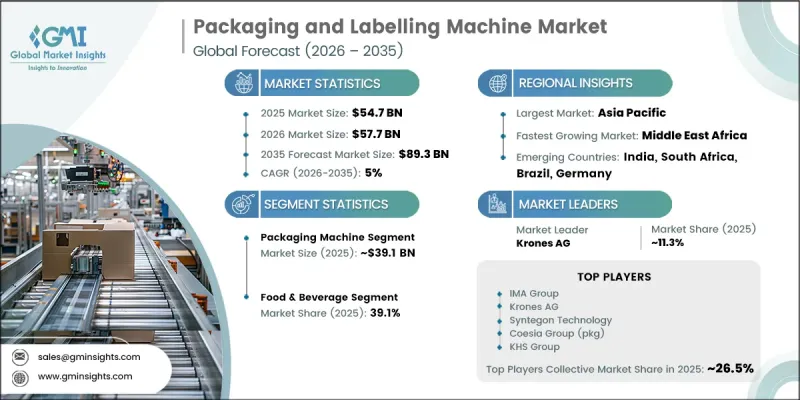
포장 및 라벨링 기계 시장은 규제 요건의 진화, 산업 자동화의 발전, 그리고 다양한 산업 분야에서 효율적인 제품 식별 및 추적성에 대한 수요 증가에 힘입어 안정적인 성장을 이루고 있습니다. 더욱 엄격해진 제품 일련번호 부여 및 공급망 추적 관련 규제를 준수해야 하는 상황에서, 각 제조사는 빠르고 정확하며 규정을 준수하는 생산 공정을 뒷받침할 수 있는 첨단 포장·라벨링 시스템에 대한 투자를 확대하고 있습니다. 동시에, 산업용 사물인터넷(IIoT) 기술, 클라우드를 활용한 모니터링, 지능형 분석, 서보 구동 방식의 자동화가 급속히 보급됨에 따라 생산성 향상, 가동 중단 시간 단축, 예측 유지보수의 실현을 통해 포장 업무는 혁신을 이루고 있습니다. 제조업체들은 대규모 설비 개조를 하지 않고도 변화하는 포장 형식, 신속한 생산 전환, 다양한 제품 포트폴리오에 대응할 수 있는 유연성이 높은 기계를 점점 더 우선시하고 있습니다. 또한, 재활용 및 지속가능성에 관한 규제의 진화에 따라 최신 라벨링 요건, 확대된 라벨 형식, 강화된 재료 식별에 대응할 수 있는 기계에 대한 수요가 높아지고 있습니다. 이러한 기술적 및 규제적 동향은 전 세계 포장 및 라벨링 기계 시장 전반에 걸친 장기적인 투자를 촉진할 것으로 예상됩니다.
| 시장 범위 | |
|---|---|
| 시작 연도 | 2025년 |
| 예측 기간 | 2026-2035년 |
| 시작 시점 시장 규모 | 547억 달러 |
| 예측액 | 893억 달러 |
| CAGR | 5% |
2025년, 라벨링 기계 부문은 시장 점유율의 28.4%를 차지했으며, 그 규모는 155억 달러에 달했습니다. 이 부문의 성장은 제품 추적성, 규정 준수 및 포장 효율성 향상을 지원하는 첨단 라벨링 솔루션에 대한 수요 증가에 힘입어 이루어지고 있습니다. 자동 식별 시스템에 대한 관심 증가, 생산 정밀도 향상, 그리고 진화하는 포장 기준으로 인해 다양한 제조 산업 분야에서 최신 라벨링 기술에 대한 투자가 지속적으로 강화되고 있습니다.
식품·음료 부문은 2025년에 39.1%의 점유율을 차지했으며, 2026년부터 2035년까지 연평균 성장률(CAGR) 4.1%로 성장할 것으로 전망됩니다. 효율적인 포장 솔루션에 대한 지속적인 수요, 생산량 증가, 엄격한 제품 안전 요건, 그리고 식품 가공 시설 전반에 걸친 자동화 진전이 첨단 포장 및 라벨링 기계에 대한 지속적인 투자를 뒷받침하고 있습니다. 또한, 각 제조사는 대량 생산 환경에서도 업무 효율과 제품 품질을 유지하면서 다양한 포장 형식에 대응할 수 있는 유연성이 높은 설비의 도입을 추진하고 있습니다.
유럽의 포장 및 라벨링 기계 시장은 2025년에 27.4%의 점유율을 기록했으나, 이미 확립된 포장 부문의 성숙도와 진화하는 포장·라벨링 규제를 준수하는 데 필요한 막대한 투자로 인해 세계 평균보다 낮은 수준을 보이고 있습니다. 제조 시설의 지속적인 현대화와 더불어 최신 지속가능성 및 재활용 기준의 도입으로 인해, 예측 기간 동안 기술적으로 진보된 포장 및 라벨링 기계에 대한 수요가 유지될 것으로 전망됩니다.
자주 묻는 질문
목차
제1장 조사 방법과 범위
제2장 주요 요약
제3장 업계 인사이트
제4장 경쟁 구도
제5장 시장 추정 및 예측 : 기계 유형별, 2022-2035년
제6장 시장 추정 및 예측 : 라벨링 기술별, 2022-2035년
제7장 시장 추정 및 예측 : 자동화 레벨별, 2022-2035년
제8장 시장 추정 및 예측 : 최종 이용 산업별, 2022-2035년
제9장 시장 추정 및 예측 : 유통 채널별, 2022-2035년
제10장 시장 추정 및 예측 : 지역별, 2022-2035년
제11장 기업 개요
KSM 26.08.06The Global Packaging and Labelling Machine Market was valued at USD 54.7 billion in 2025 and is estimated to grow at a CAGR of 5% to reach USD 89.3 billion by 2035.
The packaging and labelling machine market is experiencing stable growth, supported by evolving regulatory requirements, increasing industrial automation, and the rising need for efficient product identification and traceability across multiple industries. Compliance with stricter product serialization and supply chain tracking regulations is encouraging manufacturers to invest in advanced packaging and labeling systems capable of supporting high-speed, accurate, and compliant production processes. At the same time, rapid adoption of Industrial Internet of Things (IIoT) technologies, cloud-enabled monitoring, intelligent analytics, and servo-driven automation is transforming packaging operations by improving productivity, reducing downtime, and enabling predictive maintenance. Manufacturers are increasingly prioritizing flexible machinery that can accommodate changing packaging formats, faster production changeovers, and diverse product portfolios without extensive equipment modifications. In addition, evolving recycling and sustainability regulations are driving demand for machinery capable of handling updated labeling requirements, expanded label formats, and enhanced material identification. These technological and regulatory developments are expected to support long-term investment across the global packaging and labelling machine market.
| Market Scope | |
|---|---|
| Start Year | 2025 |
| Forecast Year | 2026-2035 |
| Start Value | $54.7 Billion |
| Forecast Value | $89.3 Billion |
| CAGR | 5% |
The labelling machines segment accounted for 28.4% share in 2025, representing USD 15.5 billion. Growth in this category is being driven by increasing demand for advanced labeling solutions that support product traceability, regulatory compliance, and enhanced packaging efficiency. The growing emphasis on automated identification systems, improved production accuracy, and evolving packaging standards continues to strengthen investment in modern labeling technologies across a broad range of manufacturing industries.
The food and beverage segment held 39.1% share in 2025 and is projected to grow at a CAGR of 4.1% from 2026 to 2035. Continued demand for efficient packaging solutions, higher production volumes, strict product safety requirements, and increasing automation throughout food processing facilities are supporting sustained investments in advanced packaging and labeling machinery. Manufacturers are also adopting flexible equipment capable of managing diverse packaging formats while maintaining operational efficiency and product quality throughout high-volume production environments.
Europe Packaging and Labelling Machine Market held 27.4% share in 2025, which remains below the global average owing to the maturity of established packaging sectors and the significant investments required to comply with evolving packaging and labeling regulations. Continued modernization of manufacturing facilities, along with the implementation of updated sustainability and recycling standards, is expected to sustain demand for technologically advanced packaging and labeling equipment throughout the forecast period.
Major companies operating in the global packaging and labelling machine market include Krones AG, Syntegon Technology GmbH, Coesia Group, Tetra Pak, GEA Group AG, IMA Group, KHS Group GmbH, ProMach Inc., HERMA GmbH, SIG Group AG, Multivac SE & Co. KG, Marchesini Group S.p.A., Guangzhou Tech-Long Packaging Machinery Co., Ltd., ROVEMA GmbH, Accutek Packaging Equipment Companies, Inc., NITA Labeling Systems (Nita Equipment Inc.), Optima Packaging Group GmbH, Fuji Seal International, Inc., Pack Leader Machinery Inc., Shree Bhagwati Machtech (India) Pvt. Ltd., and Weber Packaging Solutions, Inc. Leading companies in the packaging and labelling machine market are strengthening their market position by investing in automation, digital connectivity, and intelligent manufacturing technologies that improve production efficiency and operational flexibility. Manufacturers are expanding their product portfolios with equipment capable of supporting serialization, traceability, sustainability, and evolving regulatory requirements. Businesses are also focusing on integrating IIoT capabilities, predictive maintenance features, cloud-based monitoring, and advanced motion control technologies to enhance equipment performance and minimize downtime. Strategic collaborations with packaging manufacturers, system integrators, and industrial automation providers are helping companies expand their customer base and strengthen global distribution networks.
Table of Contents
Chapter 1 Methodology & Scope
- 1.1 Market scope and definition
- 1.2 Research design
- 1.2.1 Research approach
- 1.2.2 Data collection methods
- 1.3 Data mining sources
- 1.3.1 Global
- 1.3.2 Regional/Country
- 1.4 Base estimates and calculations
- 1.4.1 Base year calculation
- 1.4.2 Key trends for market estimation
- 1.5 Primary research and validation
- 1.5.1 Primary sources
- 1.6 Forecast model
- 1.7 Research assumptions and limitations
Chapter 2 Executive Summary
- 2.1 Industry 360° synopsis
- 2.2 Key market trends
- 2.2.1 Region
- 2.2.2 Machine Type
- 2.2.3 Labelling Technology
- 2.2.4 Automation Level
- 2.2.5 End-use Industry
- 2.2.6 Distribution Channel
Chapter 3 Industry Insights
- 3.1 Industry ecosystem analysis
- 3.1.1 Supplier landscape
- 3.1.2 Profit margin
- 3.1.3 Value addition at each stage
- 3.1.4 Factor affecting the value chain
- 3.2 Industry impact forces
- 3.2.1 Growth drivers
- 3.2.1.1 Rising Automation Demand Across Manufacturing Industries
- 3.2.1.2 Pharmaceutical Serialization & Track-and-Trace Regulatory Mandates
- 3.2.1.3 E-commerce Growth Driving Demand for Flexible Packaging & Labelling Systems
- 3.2.1.4 Consumer Demand for Product Transparency & Traceability
- 3.2.2 Industry pitfalls & challenges
- 3.2.2.1 High Capital Expenditure & Long Payback Periods for Automated Systems
- 3.2.2.2 Integration Complexity with Legacy Production Lines
- 3.2.2.3 Volatile Raw Material Prices (Label Stock, Adhesives, Acrylic Resins)
- 3.2.2.4 Interoperability Gaps Across Multi-Vendor Lines
- 3.2.3 Opportunities
- 3.2.3.1 Pharmaceutical Serialization Creating Demand for Variable-Data & RFID Labelling Systems
- 3.2.3.2 Sustainability-Driven Shift to Linerless, Recyclable & Low-Waste Labelling Solutions
- 3.2.3.3 Rapid Industrialization & Packaging Modernization in Emerging Markets (India, Southeast Asia)
- 3.2.3.4 IoT-Enabled Smart Packaging Lines & Predictive Maintenance as a Service Revenue Model
- 3.2.1 Growth drivers
- 3.3 Growth potential analysis
- 3.4 Supply Chain Analysis
- 3.4.1 Supply Chain Structure & Key Nodes
- 3.4.2 Supply Chain Disruption & Risk Assessment
- 3.4.3 Nearshoring & Regionalization Trends
- 3.5 Future market trends
- 3.6 Technology and innovation landscape
- 3.6.1 Current technological trends
- 3.6.2 Emerging technologies
- 3.7 Regulatory landscape
- 3.7.1 Pharmaceutical Serialization & Track-and-Trace Mandates (DSCSA, EU FMD)
- 3.7.2 Food Safety Labelling Regulations (FDA, EFSA, FSSAI)
- 3.7.3 Environmental & Sustainability Packaging Regulations
- 3.7.4 Machinery Safety Standards (CE Marking, ISO, OSHA)
- 3.8 Trade data analysis (HS Code - 8422.30)
- 3.8.1 Import/Export Volume & Value Trends by Machine Category (Driven by Primary Research)
- 3.8.2 Key Trade Corridors & Tariff Impact (Driven by Primary Research)
- 3.9 Impact of AI & generative AI on the market
- 3.9.1 AI-Driven Disruption of Existing Business Models
- 3.9.2 GenAI Use Cases & Adoption Roadmap by Segment
- 3.10 Pricing Analysis
- 3.10.1 Pricing Strategy by Player Type (Premium / Value / Cost-plus) (Driven by Primary Research)
- 3.10.2 Price Benchmarking by Machine Type & Automation Level
- 3.11 Porter’s analysis
- 3.12 PESTEL analysis
Chapter 4 Competitive Landscape, 2025
- 4.1 Introduction
- 4.2 Company market share analysis
- 4.3 Company matrix analysis
- 4.4 Competitive analysis of major market players
- 4.5 Competitive positioning matrix
- 4.6 Key developments
- 4.6.1 Mergers & acquisitions
- 4.6.2 Partnerships & collaborations
- 4.6.3 New product launches
- 4.6.4 Expansion plans
Chapter 5 Market Estimates & Forecast, By Machine Type, 2022 – 2035, (USD Billion) (Million Units)
- 5.1 Key Trends
- 5.2 Packaging Machine
- 5.2.1 Filling & Dosing Machines
- 5.2.2 Form Fill & Seal (FFS) Machines
- 5.2.3 Wrapping & Bundling Machines
- 5.2.4 Cartoning Machines
- 5.2.5 Case Packing Machines
- 5.2.6 Palletizing & Depalletizing Machines
- 5.3 Labelling Machines
- 5.3.1 Pressure-Sensitive / Self-Adhesive Labelling Machines
- 5.3.2 Glue-Based Labelling Machines
- 5.3.3 Sleeve Labelling Machines
- 5.3.4 In-Mold Labelling (IML) Machines
- 5.3.5 RFID & Print-and-Apply Labelling Machines
Chapter 6 Market Estimates & Forecast, By Labelling Technology, 2022 – 2035, (USD Billion) (Million Units)
- 6.1 Key Trends
- 6.2 Pressure-Sensitive / Self-Adhesive
- 6.2.1 Top Labelling Machines
- 6.2.2 Side Labelling Machines
- 6.2.3 Front & Back Labelling Machines
- 6.2.4 Wrap-Around Labelling Machines
- 6.2.5 Rotary Labelling Machines
- 6.3 Glue-Based
- 6.3.1 Hot-Melt Glue Labelling Machines
- 6.3.2 Cold-Glue Labelling Machines
- 6.3.3 Roll-Fed Glue Labelling Machines
- 6.3.4 Cut-and-Stack Labelling Machines
- 6.4 Sleeve Labelling
- 6.4.1 Shrink Sleeve Labelling Machines
- 6.4.2 Stretch Sleeve Labelling Machines
- 6.4.3 Full-Body Sleeve Labelling Machines
- 6.4.4 Neck-Band Applicators
- 6.5 In-Mold Labelling (IML)
- 6.6 RFID & Print-and-Apply
- 6.6.1 RFID Labelling Machines
- 6.6.2 Print-and-Apply Labelling Machines
Chapter 7 Market Estimates & Forecast, By Automation Level, 2022 – 2035, (USD Billion) (Million Units)
- 7.1 Key Trends
- 7.2 Automatic
- 7.2.1 High-Speed Automatic (>400 BPM)
- 7.2.2 Mid-Speed Automatic (201–400 BPM)
- 7.2.3 Low-Speed Automatic (≤ 200 BPM)
- 7.3 Semi-Automatic
- 7.4 Manual
Chapter 8 Market Estimates & Forecast, By End-use Industry, 2022 – 2035, (USD Billion) (Million Units)
- 8.1 Key Trends
- 8.2 Food & Beverage
- 8.2.1 Packaged & Processed Food
- 8.2.2 Dairy Products
- 8.2.3 Beverages (Alcoholic & Non-Alcoholic)
- 8.2.4 Bottled Water & Soft Drinks
- 8.3 Pharmaceuticals & Healthcare
- 8.3.1 Solid Dosage (Tablets & Capsules)
- 8.3.2 Liquid & Injectable Medicines
- 8.3.3 Medical Devices & Equipment
- 8.3.4 OTC & Prescription Drugs
- 8.4 Cosmetics & Personal Care
- 8.4.1 Cosmetics & Makeup
- 8.4.2 Hair Care Products
- 8.4.3 Skin Care Products
- 8.4.4 Oral Care Products
- 8.5 Chemicals & Industrial
- 8.5.1 Industrial Chemicals
- 8.5.2 Household Cleaning Products
- 8.5.3 Agrochemicals & Fertilizers
- 8.6 E-commerce & Logistics
- 8.6.1 Fulfilment Centre Packaging
- 8.6.2 Variable-Data & Personalized Labelling for Last-Mile Delivery
- 8.7 Others (Electronics, Automotive, Agricultural Products)
Chapter 9 Market Estimates & Forecast, By Distribution Channel, 2022 – 2035, (USD Billion) (Million Units)
- 9.1 Key Trends
- 9.2 Direct
- 9.3 Indirect
Chapter 10 Market Estimates & Forecast, By Region, 2022 – 2035, (USD Billion) (Million Units)
- 10.1 Key Trends
- 10.2 North America
- 10.2.1 U.S.
- 10.2.2 Canada
- 10.3 Europe
- 10.3.1 Germany
- 10.3.2 France
- 10.3.3 UK
- 10.3.4 Italy
- 10.3.5 Spain
- 10.4 Asia Pacific
- 10.4.1 China
- 10.4.2 Japan
- 10.4.3 India
- 10.4.4 Australia
- 10.4.5 South Korea
- 10.5 Latin America
- 10.5.1 Brazil
- 10.5.2 Mexico
- 10.5.3 Argentina
- 10.6 MEA
- 10.6.1 Saudi Arabia
- 10.6.2 UAE
- 10.6.3 South Africa
Chapter 11 Company Profiles
- 11.1 Global Leaders
- 11.1.1 Krones AG
- 11.1.2 IMA Group
- 11.1.3 Syntegon Technology GmbH
- 11.1.4 GEA Group AG
- 11.1.5 Tetra Pak
- 11.1.6 KHS Group GmbH
- 11.1.7 Coesia Group
- 11.2 Regional Players
- 11.2.1 Multivac SE & Co. KG
- 11.2.2 Marchesini Group S.p.A.
- 11.2.3 HERMA GmbH
- 11.2.4 ProMach Inc.
- 11.2.5 Guangzhou Tech-Long Packaging Machinery Co., Ltd.
- 11.2.6 ROVEMA GmbH
- 11.2.7 SIG Group AG
- 11.3 Emerging Players
- 11.3.1 Accutek Packaging Equipment Companies, Inc.
- 11.3.2 NITA Labeling Systems (Nita Equipment Inc.)
- 11.3.3 Shree Bhagwati Machtech (India) Pvt. Ltd.
- 11.3.4 Fuji Seal International, Inc.
- 11.3.5 Pack Leader Machinery Inc.
- 11.3.6 Optima Packaging Group GmbH
- 11.3.7 Weber Packaging Solutions, Inc.


