
|
시장보고서
상품코드
2125369
포장기계 : 시장 점유율 분석, 업계 동향과 통계, 성장 예측(2026-2031년)Packaging Machinery - Market Share Analysis, Industry Trends & Statistics, Growth Forecasts (2026 - 2031) |
||||||
 Mordor Intelligence
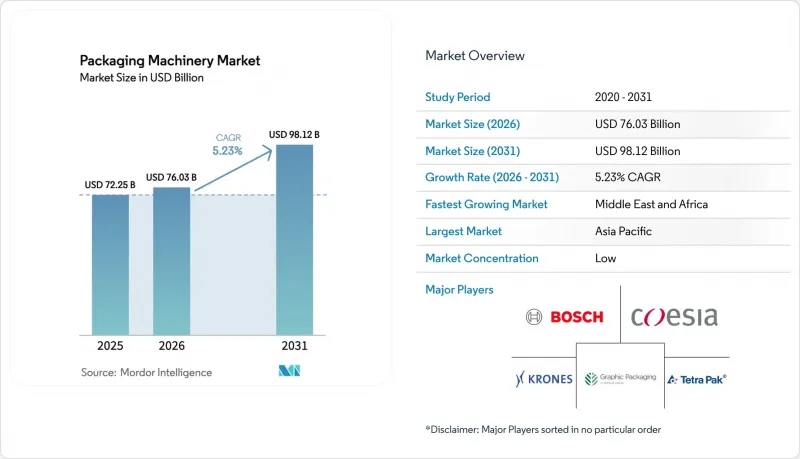
Mordor Intelligence에 따르면 2026년 포장기계 시장 규모는 760억 3,000만 달러로 추정되고 있으며, 2025년 722억 5,000만 달러에서 확대하며, 2031년에는 981억 2,000만 달러에 달할 것으로 예측됩니다.2026-2031년에는 CAGR 5.23%로 성장할 것으로 전망되고 있습니다.
이 보고서는 기계 유형(충진·계량, 라벨링·장식·코딩 등), 자동화 수준(수동 등), 최종사용자 산업(식품, 음료, 의약품 등), 기술 플랫폼(일반 포장, 기존 방식, 조절 대기 포장(MAP) 등) 및 지역별로 분류되어 있습니다. 시장 전망은 달러 기준 금액으로 제시되어 있습니다.
글로벌 포장 기계 시장의 동향 및 인사이트
연포장 및 파우치 형태의 확대가 고속 충전 라인의 수요를 견인하고 있습니다.
유연한 포장 형식은 스낵에서 음료로 확대되고 있으며, 브랜드 소유주는 더 빠른 수평형 및 수직형 성형·충전·밀봉(FFS) 플랫폼을 도입할 수밖에 없습니다. Mespack사의 ‘UHS Performa’와 같은 신형 모델은 가동률 향상과 필름 폐기량 감소를 실현하여 단위 비용을 절감하는 동시에, 지속가능성 목표 달성에도 기여하고 있습니다. 각 공급업체는 연속 작동을 유지하는 필름 스플라이싱 모듈을 탑재하여 설비 종합 효율(OEE) 향상을 도모하고 있습니다. 아시아태평양(APAC)에서는 소비재 제조업체들이 운송비를 절감할 수 있는 경량 포장을 사용하여 지방 시장에 접근하기 위해 파우치를 선호하고 있습니다. 북미의 음료 제조업체들은 프리미엄 주스의 차별화를 꾀하기 위해 주입구가 달린 파우치의 시범 도입을 추진하고 있으며, 이에 따라 점도가 높은 제품을 다룰 수 있는 위생적이고 고속의 충전 헤드에 대한 수요가 증가하고 있습니다.
유럽에서 지속가능한 종이 포장재로의 급속한 전환에 따라 새로운 카트닝 기술이 요구되고 있습니다.
2025년 2월에 시행될 유럽의 ‘포장 및 포장 폐기물 규정’에 따라 기업은 플라스틱으로된 2차 포장을 재활용 가능한 종이 구조로 대체해야 합니다. 이러한 전환에 따라 밀봉 강도를 저하시키지 않으면서 더 얇은 판지를 처리할 수 있도록 카트너를 개조하는 사례가 잇따르고 있습니다. 디아지오(Diageo)가 ‘조니 워커(Johnny Walker)’를 위해 개발한 90% 종이 소재 병은 이산화탄소 배출량을 약 47% 줄이는 섬유 솔루션에 대한 브랜드의 강한 관심을 지원하고 있습니다. 각 OEM 업체들은 단일 소재로된 카톤이 기존의 플라스틱 포맷과 동등한 라인 속도를 달성할 수 있도록 블랭크 처리 시스템, 접착 스테이션 및 비전 가이드를 통한 품질 검사 개선을 추진하고 있습니다. 소매업체들이 공급업체에 대해 유사한 환경 평가 기준을 채택함에 따라 이러한 종이로의 전환 움직임은 북미 지역으로도 확산되고 있습니다.
스테인리스강 가격의 급등으로 인해 높은 위생 기준을 충족하는 기계의 설비 투자 비용이 상승하고 있습니다.
니켈 가격 변동으로 인해 스테인리스강 시세는 톤당 700-800달러의 고가권으로 치솟아, 워시다운식 충전기, 무균 블록, 제약 라인의 이익률을 압박하고 있습니다. OEM 각사는 강성을 해치지 않으면서 무게를 줄이기 위해 하이브리드 합금이나 전략적인 보강을 가한 프레임 재설계를 추진하고 있습니다. 일부 구매자는 금속 시장이 안정될 때까지 구매 결정을 미루고 개조를 선택하고 있습니다. 유럽의 공급업체들은 장기 철강 계약을 통해 비용을 헤지하고 있지만, 그 일부를 할증료 형태로 고객에게 전가하고 있습니다. 이러한 가격 상승의 영향이 가장 심각한 곳은 316L 규격을 충족해야 하는 유제품 및 유아용 분유 제조 공장입니다.
부문별 분석
2025년, 충전 및 계량 장비는 포장 기계 시장 점유율의 20.08%를 차지하며, 식품, 음료, 의약품 라인 전체에서 필수적인 존재임을 여실히 보여주었습니다. 한편, 카트닝 유닛은 유럽의 종이 포장 전환과 견고한 2차 포장에 대한 E-Commerce 수요의 혜택을 받아 연평균 성장률(CAGR) 7.56%로 성장하고 있습니다. GEA가 중소기업을 위해 제공하는 소형 열성형 카트너는 공급업체들이 플러그 앤 플레이 방식의 솔루션으로 소규모 공장을 공략하고 있음을 여실히 보여줍니다. 현재 카트너에는 치수 변동이 큰 재생 골판지를 처리할 수 있는 서보 제어식 블랭크 피더가 탑재되어 있습니다. 한편, 추적성 규제가 강화됨에 따라 라벨링 및 코딩 시스템과 관련된 포장 기계 시장의 규모는 꾸준히 확대되고 있습니다.
블리스터, 열성형, 진공 장비의 틈새 시장에서는 육류 제품 및 즉석식의 유통 기한을 연장하는 차단성 향상 필름에 초점이 맞춰져 있습니다. 프리미엄 생수 및 기능성 음료의 성장에 힘입어 병입 라인에 대한 수요는 견고한 추세를 보이고 있습니다. 팔레타이징 시스템의 경우, 수동 스트레치 랩 턴테이블보다 라인 말단의 로봇 셀을 우선시하는 창고 자동화 프로그램으로 인해 수요가 증가하고 있습니다. 포장 및 번들링 기계의 업그레이드는 지속가능성 목표에 부합하여 필름 사용량을 최적화하는 가변 포맷 기술을 중심으로 진행되고 있습니다.
완전 자동 및 로봇 통합형 라인은 2025년에 포장 기계 시장 규모의 55.12%를 차지하며, 2031년까지 연평균 7.78%의 성장률로 확대될 전망입니다. 인건비 절감, OEE 향상, 위생 상태 개선을 통해 투자 회수가 신속하게 이루어집니다. 의약품 바이알 취급에서 이러한 장점이 두드러지게 나타납니다. TM Robotics사의 ‘QPack-1’은 수작업시 시간당 2,000병에 비해 시간당 7,200병의 바이알을 처리하며, 오염 위험을 줄여줍니다. 반자동 라인은 제조업체가 단계적으로 업그레이드를 진행하거나 소량 생산을 관리할 때 여전히 유용합니다. 아프리카나 동남아시아 일부 지역에서는 장인의 수작업이나 소규모 생산 과정에서 여전히 수작업 공정이 남아 있습니다. 로봇 기술의 도입은 케이스 포장 및 팔레타이징 분야로도 확대되고 있으며, 비전 가이드 방식의 피킹 헤드를 통해 SKU가 혼합된 적층이 가능해졌습니다.
인력 부족을 배경으로, 포장 기계 시장에서는 코딩 지식이 없어도 신속하게 레시피를 변경할 수 있는 사용자 친화적인 프로그래밍 제품군에 대한 수요가 급증하고 있습니다. 예지보전 분석을 통해 예기치 못한 가동 중단 시간이 더욱 줄어들기 때문에 많은 운영자는 전체 라인을 교체하기 전에 센서 키트를 사용하여 기존 기계를 개조하고 있습니다.
지역별 분석
2025년, 아시아태평양은 포장 기계 시장 점유율의 45.72%를 차지했습니다. 이는 중국 시장 규모와 인도내 포장 제품 소비 확대에 힘입은 결과입니다. ‘ProPak China 2025’에서는 지역 공급업체들이 2,500점 이상의 자동화 관련 전시물을 선보이며, AI를 활용한 검사 및 물류 통합 기술을 소개했습니다. 일본과 한국은 고정밀 로봇 기술을 제공하고 있는 반면, 인도네시아에서는 지역 스낵 및 면류 브랜드를 위한 새로운 연포장 공장이 가동되고 있습니다. 아시아태평양의 포장 기계 시장 규모는 스마트 제조 및 인더스트리 4.0 도입에 대한 정부의 우대 조치에 힘입어 더욱 확대되고 있습니다.
중동 및 아프리카는 사우디아라비아, 이집트, 남아프리카공화국이 음료 및 유제품 가공을 현지화하고 있으며, 2031년까지 연평균 성장률(CAGR) 6.08%로 가장 높은 성장세를 기록하고 있습니다. 사이델(Sidel)사와 사우디아라비아 이해관계자 간의 합의는 수입 의존도를 낮추기 위한 정부 주도의 움직임을 여실히 보여주고 있습니다. 그러나 사하라 이남 아프리카 일부 지역의 만성적인 정전은 운영 비용을 상승시키고 있으며, 생산자들은 태양전지판과 고효율 모터 도입을 추진하고 있습니다. 장비 공급업체들은 수입 관세 및 서비스 측면의 과제를 해결하기 위해 현지 시스템 통합사업자와 제휴하고 있습니다.
북미에서는 E-Commerce(EC) 풀필먼트 센터가 최종 공정 자동화에 투자하고 있으며, 수요가 계속해서 견고합니다. 2023년 미국의 출하액은 5.8% 증가한 109억 달러에 달했으며, 이는 설비 교체 주기가 지속되고 있음을 반영합니다. 캐나다의 식품 가공업체들은 인력 부족을 보완하기 위해 로봇식 케이스 패커를 도입하고 있는 반면, 멕시코에서는 지역 허브를 설립하는 다국적 음료 기업의 투자를 유치하고 있습니다. 유럽에서는 지속가능성 규제에 대한 대응이 중시되고 있으며, 재활용이 가능한 카트너 및 단일 소재 파우치 생산 라인의 도입이 활발해지고 있습니다. 남미에서는 브라질과 콜롬비아에서 성장이 나타나고 있지만, 로봇 프로그래밍 기술 부족으로 인해 중소규모 가공업체의 도입은 지연되고 있습니다.
기타 혜택:
- 엑셀 형식의 시장 예측(ME) 시트
- 3개월간의 애널리스트 지원
목차
제1장 서론
제2장 조사 방법
제3장 개요
제4장 시장 구도
제5장 시장 규모와 성장 예측
제6장 경쟁 구도
제7장 시장 기회와 향후 전망
KSAAccording to Mordor Intelligence, the packaging machinery market size in 2026 is estimated at USD 76.03 billion, growing from 2025 value of USD 72.25 billion with 2031 projections showing USD 98.12 billion, growing at 5.23% CAGR over 2026-2031.
This report is Segmented by Machine Type (Filling and Dosing, Labelling Decorating and Coding, and More), Automation Level (Manual, and More), End-User Industry (Food, Beverages, Pharmaceuticals, and More), Technology Platform (General Packaging Conventional, Modified Atmosphere Packaging MAP, and More), and Geography. The Market Forecasts are Provided in Terms of Value USD.
Global Packaging Machinery Market Trends and Insights
Expansion of Flexibles and Pouch Formats Driving High-Speed Filling Lines
Flexible pack formats are spreading from snacks to beverages, forcing brand owners to install faster horizontal and vertical form-fill-seal platforms. New models such as Mespack's UHS Performa deliver higher uptime and lower film waste, trimming unit costs while improving sustainability targets. Suppliers are embedding film-splicing modules that sustain continuous motion to raise overall equipment effectiveness. In APAC, consumer goods makers favor pouches to reach rural markets with lightweight packs that lower freight expenses. North American beverage firms are testing spouted pouches to differentiate premium juices, spurring demand for hygienic, high-speed dosing heads that handle viscous products.
Rapid Shift to Sustainable Paper-Based Packs in Europe Necessitating New Cartoning Technologies
Europe's Packaging and Packaging Waste Regulation, effective February 2025, pushes companies to replace plastic secondary packs with recyclable paper structures. The transition has triggered a wave of cartoner retrofits that manage thinner board grades without compromising seal integrity. Diageo's 90% paper bottle for Johnnie Walker validates strong brand interest in fiber solutions that cut carbon emissions nearly 47%. OEMs are refining blank handling systems, gluing stations, and vision-guided quality checks to ensure mono-material cartons reach line speeds equal to legacy plastic formats. The paper shift is cascading to North America as retailers adopt similar eco-scorecards for suppliers.
Surge in Stainless-Steel Prices Inflating Capital Cost of High-Hygiene Machinery
Nickel price volatility has pushed stainless-steel quotes toward the upper USD 700-800 per ton range, squeezing margins on wash-down fillers, aseptic blocs, and pharma lines. OEMs are redesigning frames with hybrid alloys and strategic reinforcement to curb weight without sacrificing rigidity. Some buyers delay purchase decisions, opting for refurbishments until metal markets stabilize. European suppliers hedge costs with long-term steel contracts but pass a portion to customers through surcharges. The inflationary effect is most severe for dairy and infant-formula plants that must meet 316L specs.
Other drivers and restraints analyzed in the detailed report include:
- E-commerce "Ship-in-Own-Container" Adoption Boosting End-of-Line Automation in North America
- Rising Need for Integrated Packaging Solutions
- Lengthy IQ/OQ Validation Cycles Slowing Pharma Equipment Orders in USA
For complete list of drivers and restraints, kindly check the Table Of Contents.
Segment Analysis
In 2025, filling and dosing equipment accounted for 20.08% of packaging machinery market share, underscoring its indispensability across food, beverage, and pharma lines. Cartoning units, however, are advancing at a 7.56% CAGR, benefitting from Europe's shift to paper formats and e-commerce demand for robust secondary packs. GEA's compact thermoforming cartoner for SMEs highlights how suppliers target smaller plants with plug-and-play solutions. Cartoners now include servo-controlled blank feeders that handle recycled board with high dimensional variability. Meanwhile, the packaging machinery market size linked to labelling and coding systems is expanding steadily as traceability rules tighten.
The blister, thermoforming, and vacuum equipment niche focuses on barrier-enhancing films that lengthen shelf life for meat and ready meals. Bottling line demand remains resilient, driven by premium water and functional drinks growth. Palletizing systems gain traction from warehouse automation programs that favor end-of-line robotic cells over manual stretch-wrap turntables. Upgrades in wrapping and bundling machines center on variable-format technology that optimizes film usage, aligning with sustainability targets.
Fully automatic and robotics-integrated lines captured 55.12% of packaging machinery market size in 2025 and will compound at 7.78% through 2031. Rapid payback stems from labor savings, higher OEE, and improved hygiene. Pharmaceutical vial handling illustrates the benefits - TM Robotics' QPack-1 processes 7,200 vials per hour versus 2,000 in manual set-ups, cutting contamination risks. Semi-automatic lines remain relevant where producers phase upgrades in stages or manage short runs. Manual stations persist in artisanal or low-volume operations across Africa and parts of Southeast Asia. Robotics adoption is also spreading to case packing and palletizing, where vision-guided pick heads enable mixed-SKU layering.
Driven by labor shortages, the packaging machinery market is witnessing a boom in user-friendly programming suites that allow rapid recipe changes without coding knowledge. Predictive maintenance analytics further reduce unplanned downtime, pushing many operators to retrofit legacy machines with sensor kits before committing to full line replacements.
Complete Report Scope:
- By Machine Type
- Filling and Dosing
- Labelling, Decorating, and Coding
- Case Handling
- Bottling Line
- Cartoning
- Palletizing and Depalletizing
- Wrapping and Bundling
- Blister / Thermoforming / Skin / Vacuum Packaging
- Other Machine Type
- By Automation Level
- Manual
- Semi-Automatic
- Fully Automatic / Robotics-Integrated
- By End-User Industry
- Food
- Beverages
- Pharmaceuticals
- Cosmetics and Personal Care
- Industrial Chemicals
- Other End-use Industry
- By Technology Platform
- General Packaging (Conventional)
- Modified Atmosphere Packaging (MAP)
- Vacuum Packaging
- Aseptic Packaging Lines
- Intelligent / Connected (QR / RFID-Enabled) Packaging Lines
- By Geography
- North America
- United States
- Canada
- Mexico
- Europe
- Germany
- United Kingdom
- France
- Italy
- Spain
- Russia
- Rest of Europe
- Asia-Pacific
- China
- India
- Japan
- South Korea
- Australia and New Zealand
- Rest of Asia-Pacific
- Middle East and Africa
- Middle East
- United Arab Emirates
- Saudi Arabia
- Turkey
- Rest of Middle East
- Africa
- South Africa
- Nigeria
- Egypt
- Rest of Africa
- Middle East
- South America
- Brazil
- Argentina
- Rest of South America
- North America
Geography Analysis
Asia Pacific accounted for 45.72% of packaging machinery market share in 2025, propelled by China's scale and India's rising packaged-goods consumption. Regional suppliers displayed over 2,500 automation exhibits at ProPak China 2025, showcasing AI-driven inspection and logistics integration. Japan and South Korea contribute high-precision robotics, while Indonesia hosts new flexible packaging plants that serve regional snack and noodle brands. The packaging machinery market size in Asia Pacific is further backed by government incentives for smart manufacturing and Industry 4.0 adoption.
The Middle East and Africa record the fastest 6.08% CAGR through 2031 as Saudi Arabia, Egypt, and South Africa localize beverage and dairy processing. Sidel's agreement with Saudi stakeholders illustrates state-supported moves to reduce import dependence. Nonetheless, chronic power outages in parts of Sub-Saharan Africa raise operating costs, prompting producers to install solar arrays and energy-efficient motors. Equipment vendors partner with local integrators to navigate import duties and service challenges.
North America retains strong demand due to e-commerce fulfillment centers investing in end-of-line automation. U.S. shipments climbed 5.8% in 2023 to USD 10.9 billion, reflecting sustained capital replacement cycles. Canada's food processors adopt robotic case packers to offset labor shortages, while Mexico attracts investment from multinational beverage firms establishing regional hubs. Europe focuses on sustainability compliance, driving high uptake of recyclable-ready cartoners and mono-material pouch lines. South America shows growth pockets in Brazil and Colombia, though skills shortages in robot programming slow adoption among smaller converters.
- Tetra Laval Group (Sidel, Tetra Pak)
- Krones AG
- Coesia S.p.A.
- Syntegon Technology GmbH
- IMA Group S.p.A.
- Barry-Wehmiller Companies Inc.
- MULTIVAC Group
- Ishida Co. Ltd.
- SACMI Imola SC
- Graphic Packaging International LLC
- Marchesini Group S.p.A.
- Aetna Group (ROBOPAC)
- ABB Ltd. (Robotics Packaging)
- Fanuc Corp.
- ProMach Inc.
- Bradman Lake Ltd.
- Signode Industrial Group
- KHS GmbH
- Mitsubishi Electric Corp. (Palletizers)
- FUJI MACHINERY CO.,LTD.
- Sidel Group
- Optima Packaging Group
- PacTech Holdings
- Echo Machinery
- Herma GmbH (Labelling)
Additional Benefits:
- The market estimate (ME) sheet in Excel format
- 3 months of analyst support
TABLE OF CONTENTS
1 INTRODUCTION
- 1.1 Study Assumptions and Market Definition
- 1.2 Scope of the Study
2 RESEARCH METHODOLOGY
3 EXECUTIVE SUMMARY
4 MARKET LANDSCAPE
- 4.1 Market Overview
- 4.2 Market Drivers
- 4.2.1 Expansion of Flexibles and Pouch Formats Driving High-Speed Filling Lines
- 4.2.2 Rapid Shift to Sustainable Paper-Based Packs in Europe Necessitating New Cartoning Technologies
- 4.2.3 E-commerce "Ship-in-Own-Container" Adoption Boosting End-of-Line Automation in North America
- 4.2.4 Rising Need For Integrated Packaging Solutions
- 4.2.5 Pharma Serialization Mandates (EU-FMD, DSCSA) Fueling Global Labelling and Coding Upgrades
- 4.3 Market Restraints
- 4.3.1 Surge in Stainless-Steel Prices Inflating Capital Cost of High-Hygiene Machinery
- 4.3.2 Lengthy IQ/OQ Validation Cycles Slowing Pharma Equipment Orders in U.S.
- 4.3.3 Skill-Gaps in Robot Programming Hindering SME Automation in LATAM
- 4.3.4 Power Reliability Issues Elevating Operating Costs for African Bottlers
- 4.4 Supply-Chain Analysis
- 4.5 Regulatory Outlook
- 4.6 Porter's Five Forces Analysis
- 4.6.1 Bargaining Power of Suppliers
- 4.6.2 Bargaining Power of Buyers
- 4.6.3 Threat of New Entrants
- 4.6.4 Threat of Substitutes
- 4.6.5 Intensity of Competitive Rivalry
5 MARKET SIZE AND GROWTH FORECASTS (VALUE)
- 5.1 By Machine Type
- 5.1.1 Filling and Dosing
- 5.1.2 Labelling, Decorating, and Coding
- 5.1.3 Case Handling
- 5.1.4 Bottling Line
- 5.1.5 Cartoning
- 5.1.6 Palletizing and Depalletizing
- 5.1.7 Wrapping and Bundling
- 5.1.8 Blister / Thermoforming / Skin / Vacuum Packaging
- 5.1.9 Other Machine Type
- 5.2 By Automation Level
- 5.2.1 Manual
- 5.2.2 Semi-Automatic
- 5.2.3 Fully Automatic / Robotics-Integrated
- 5.3 By End-User Industry
- 5.3.1 Food
- 5.3.2 Beverages
- 5.3.3 Pharmaceuticals
- 5.3.4 Cosmetics and Personal Care
- 5.3.5 Industrial Chemicals
- 5.3.6 Other End-use Industry
- 5.4 By Technology Platform
- 5.4.1 General Packaging (Conventional)
- 5.4.2 Modified Atmosphere Packaging (MAP)
- 5.4.3 Vacuum Packaging
- 5.4.4 Aseptic Packaging Lines
- 5.4.5 Intelligent / Connected (QR / RFID-Enabled) Packaging Lines
- 5.5 By Geography
- 5.5.1 North America
- 5.5.1.1 United States
- 5.5.1.2 Canada
- 5.5.1.3 Mexico
- 5.5.2 Europe
- 5.5.2.1 Germany
- 5.5.2.2 United Kingdom
- 5.5.2.3 France
- 5.5.2.4 Italy
- 5.5.2.5 Spain
- 5.5.2.6 Russia
- 5.5.2.7 Rest of Europe
- 5.5.3 Asia-Pacific
- 5.5.3.1 China
- 5.5.3.2 India
- 5.5.3.3 Japan
- 5.5.3.4 South Korea
- 5.5.3.5 Australia and New Zealand
- 5.5.3.6 Rest of Asia-Pacific
- 5.5.4 Middle East and Africa
- 5.5.4.1 Middle East
- 5.5.4.1.1 United Arab Emirates
- 5.5.4.1.2 Saudi Arabia
- 5.5.4.1.3 Turkey
- 5.5.4.1.4 Rest of Middle East
- 5.5.4.2 Africa
- 5.5.4.2.1 South Africa
- 5.5.4.2.2 Nigeria
- 5.5.4.2.3 Egypt
- 5.5.4.2.4 Rest of Africa
- 5.5.4.1 Middle East
- 5.5.5 South America
- 5.5.5.1 Brazil
- 5.5.5.2 Argentina
- 5.5.5.3 Rest of South America
- 5.5.1 North America
6 COMPETITIVE LANDSCAPE
- 6.1 Market Concentration
- 6.2 Strategic Moves
- 6.3 Market Share Analysis
- 6.4 Company Profiles (includes Global level Overview, Market level overview, Core Segments, Financials as available, Strategic Information, Market Rank/Share for key companies, Products and Services, and Recent Developments)
- 6.4.1 Tetra Laval Group (Sidel, Tetra Pak)
- 6.4.2 Krones AG
- 6.4.3 Coesia S.p.A.
- 6.4.4 Syntegon Technology GmbH
- 6.4.5 IMA Group S.p.A.
- 6.4.6 Barry-Wehmiller Companies Inc.
- 6.4.7 MULTIVAC Group
- 6.4.8 Ishida Co. Ltd.
- 6.4.9 SACMI Imola SC
- 6.4.10 Graphic Packaging International LLC
- 6.4.11 Marchesini Group S.p.A.
- 6.4.12 Aetna Group (ROBOPAC)
- 6.4.13 ABB Ltd. (Robotics Packaging)
- 6.4.14 Fanuc Corp.
- 6.4.15 ProMach Inc.
- 6.4.16 Bradman Lake Ltd.
- 6.4.17 Signode Industrial Group
- 6.4.18 KHS GmbH
- 6.4.19 Mitsubishi Electric Corp. (Palletizers)
- 6.4.20 FUJI MACHINERY CO.,LTD.
- 6.4.21 Sidel Group
- 6.4.22 Optima Packaging Group
- 6.4.23 PacTech Holdings
- 6.4.24 Echo Machinery
- 6.4.25 Herma GmbH (Labelling)
7 MARKET OPPORTUNITIES AND FUTURE OUTLOOK
- 7.1 White-Space and Unmet-Need Assessment