

|
시장보고서
상품코드
2101986
프라임 파워용 왕복 발전 엔진 시장 기회, 성장 촉진요인, 업계 동향 분석 및 예측(2026-2035년)Prime Power Reciprocating Power Generating Engine Market Opportunity, Growth Drivers, Industry Trend Analysis, and Forecast 2026 - 2035 |
||||||

세계의 프라임 파워용 왕복 발전 엔진 시장은 2025년에 214억 달러 규모에 달하고, CAGR 4.3%로 성장하여 2035년까지 328억 달러에 달할 것으로 추정됩니다.
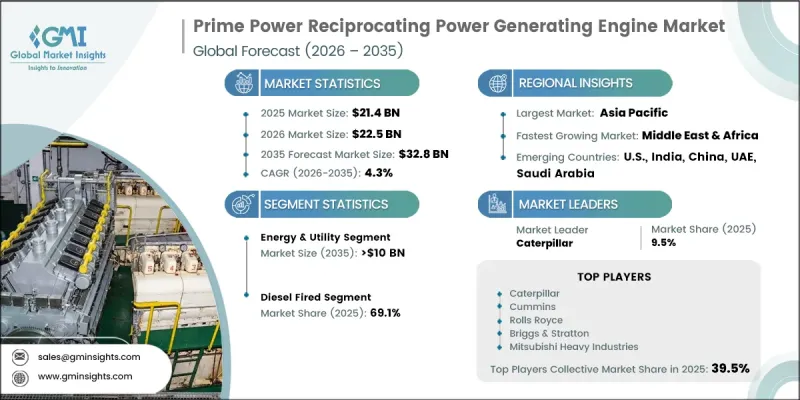
산업 시설, 데이터센터, 중요 인프라 전반에 걸쳐 신뢰성이 높고 지속적인 발전에 대한 수요가 증가하고 있는 것이 시장 확대를 뒷받침하고 있습니다. 산업 발전, 인프라 현대화 프로그램, 그리고 진행 중인 전기화 이니셔티브가 주전원용 왕복 발전 엔진의 도입에 유리한 환경을 조성하고 있습니다. 또한, 스마트 엔진 제어 기술, 디지털 모니터링 시스템 및 자동화 관리 솔루션의 발전으로 운영 효율이 향상되어 이러한 시스템의 보다 광범위한 도입이 촉진되고 있습니다. 송전망의 제약에 직면한 지역에서 안정적인 전력 공급 솔루션에 대한 수요가 증가하는 것도 시장 성장을 더욱 뒷받침하고 있습니다. 주전원용 왕복 발전 엔진은 비상 시 백업 용도로만 사용되는 시스템과 달리, 장기간에 걸친 연속 발전을 실현하기 위해 특별히 개발되었습니다. 이러한 엔진은 연료의 연소 에너지를 기계적 동력으로 변환하고, 이를 알터네이터나 발전기를 통해 전기 에너지로 변환함으로써 작동합니다. 최신 왕복 엔진에는 배기가스 성능 향상, 연료 적응성 향상, 그리고 지능형 모니터링 및 제어 기능을 실현하는 첨단 기술이 탑재되어 있습니다. 외딴 지역의 전력 접근성 확대 및 전기화 프로그램 가속화를 위한 노력이 활발해지고 있는 만큼, 이 시장은 꾸준한 성장을 이룰 것으로 예상됩니다.
| 시장 범위 | |
|---|---|
| 시작 연도 | 2025년 |
| 예측 기간 | 2026-2035년 |
| 초기 시장 규모 | 214억 달러 |
| 예측액 | 328억 달러 |
| CAGR | 4.3% |
에너지 및 공공사업 부문은 2035년까지 100억 달러에 달할 것으로 예상됩니다. 이 부문의 성장은 단일 사이클 운전 시 50%를 초과하고, 복합 사이클 구성에서는 최대 70%에 달하는 전기 효율을 실현할 수 있어, 이러한 엔진이 주요 발전 솔루션으로 채택이 확대되고 있는 데 힘입고 있습니다. 에너지 인프라에 대한 투자 확대와 더불어, 정부 주도의 전기화 프로그램으로 인해 공공사업 부문 전체의 수요가 더욱 강해질 것으로 예상됩니다. 이러한 엔진은 확대되는 전력망에서 증가하는 전력 수요를 충족시키기 위한 효율적이고 유연한 솔루션으로서 그 중요성을 계속해서 높여가고 있습니다.
2025년에는 디젤 연료 부문이 69.1%의 점유율을 차지했습니다. 신뢰할 수 있는 송전망 연결이 제한적이고, 중단 없는 전력 공급이 필수적인 지역에 기반을 둔 사업자들 사이에서는 디젤 기반 시스템에 대한 수요가 여전히 견조합니다. 외딴 지역이나 인프라가 미비한 지역에서 사업을 전개하는 기업들은 송전망의 안정성과 관계없이 성능을 유지할 수 있는 신뢰성 높은 전력 솔루션을 점점 더 우선시하고 있습니다. 동시에 각 제조사는 첨단 연료 관리 시스템, 지능형 자동화, 예측 유지보수 및 상태 기반 유지보수 기술을 통해 엔진 효율 향상에 주력하고 있습니다. 이러한 개발은 운영상의 신뢰성을 높일 뿐만 아니라 장기적인 시장 성장을 뒷받침하는 데에도 기여하고 있습니다.
미국 프라임 파워용 왕복 발전 엔진 시장은 2025년에 29억 달러에 달했습니다. 미국 내 시장 성장은 끊김 없는 전력 공급에 대한 수요 증가와 장기적인 정전을 유발할 가능성이 있는 기상 관련 현상의 영향 확대에 의해 주도되고 있습니다. 상업 시설 및 산업 시설 전반에 걸쳐 신뢰성 높은 에너지 솔루션에 대한 수요가 증가함에 따라, 주전원 발전 시스템의 도입이 더욱 촉진되고 있습니다. 또한, 데이터센터 운영사 및 기타 중요 인프라 이용자들의 전력 신뢰성에 대한 우려가 커짐에 따라, 첨단 왕복 엔진 기반 전력 시스템에 대한 수요 증가에도 기여하고 있습니다.
자주 묻는 질문
목차
제1장 조사 방법과 범위
제2장 주요 요약
제3장 업계 인사이트
제4장 경쟁 구도
제5장 시장 규모 및 예측 : 연료 유형별, 2022-2035년
제6장 시장 규모 및 예측 : 정격 출력별, 2022-2035년
제7장 시장 규모 및 예측 : 용도별, 2022-2035년
제8장 시장 규모 및 예측 : 지역별, 2022-2035년
제9장 기업 개요
KSM 26.08.05The Global Prime Power Reciprocating Power Generating Engine Market was valued at USD 21.4 billion in 2025 and is estimated to grow at a CAGR of 4.3% to reach USD 32.8 billion by 2035.
Increasing demand for dependable and continuous electricity generation across industrial facilities, data centers, and critical infrastructure is supporting market expansion. Rising industrial development, infrastructure modernization programs, and ongoing electrification initiatives are creating favorable conditions for the adoption of prime power reciprocating engines. In addition, advancements in smart engine control technologies, digital monitoring systems, and automated management solutions are improving operational efficiency and encouraging wider deployment of these systems. The growing requirement for stable power supply solutions in regions facing grid limitations is further strengthening market growth. Prime power reciprocating power generating engines are specifically developed to provide continuous electricity generation for extended operating periods, unlike systems designed only for emergency backup applications. These engines operate by converting fuel combustion energy into mechanical power, which is then transformed into electrical energy through an alternator or generator. Modern reciprocating engines incorporate advanced technologies that improve emissions performance, increase fuel adaptability, and enable intelligent monitoring and control capabilities. The market is expected to experience steady growth due to increasing efforts to expand electricity access in remote regions and accelerate electrification programs.
| Market Scope | |
|---|---|
| Start Year | 2025 |
| Forecast Year | 2026-2035 |
| Start Value | $21.4 Billion |
| Forecast Value | $32.8 Billion |
| CAGR | 4.3% |
The energy and utility segment is expected to reach USD 10 billion by 2035. The segment's expansion is supported by increasing adoption of these engines as primary power generation solutions due to their ability to deliver electrical efficiency exceeding 50% in single-cycle operations and reaching up to 70% in combined-cycle configurations. Growing investments in energy infrastructure, along with government-backed electrification programs, are expected to further strengthen demand across the utility sector. These engines continue to gain importance as efficient and flexible solutions for meeting rising electricity requirements across expanding power networks.
The diesel-fired segment accounted for 69.1% share in 2025. Demand for diesel-based systems remains strong among operators located in areas where reliable grid connectivity is limited and uninterrupted electricity supply is essential. Businesses operating in remote or infrastructure-intensive locations are increasingly prioritizing dependable power solutions that can maintain performance regardless of grid stability. At the same time, manufacturers are focusing on improving engine efficiency through advanced fuel management systems, intelligent automation, predictive diagnostics, and condition-based maintenance technologies. These developments are helping enhance operational reliability while supporting long-term market growth.
U.S. Prime Power Reciprocating Power Generating Engine Market reached USD 2.9 billion in 2025. Market growth in the country is being driven by increasing demand for uninterrupted electricity supply and the rising impact of weather-related events that can result in extended power interruptions. The growing requirement for dependable energy solutions across commercial and industrial facilities is encouraging greater adoption of prime power generation systems. Additionally, increased concerns regarding power reliability among data center operators and other critical infrastructure users are contributing to higher demand for advanced reciprocating engine-based power systems.
Major players operating in the global prime power reciprocating power generating engine industry are Caterpillar, AB Volvo Penta, Cummins, Kawasaki Heavy Industries, Wartsila, Briggs & Stratton, Rolls-Royce, Deere & Company, MITSUBISHI HEAVY INDUSTRIES, DEUTZ AG, YANMAR HOLDINGS, Everllence, KUBOTA Corporation, Perkins Engines Company, Scania, Kirloskar, IHI Corporation, Rehlko, Guascor Energy, and Yuchai International. Companies operating in the prime power reciprocating power generating engine market are strengthening their competitive position through continuous product development, technological upgrades, strategic collaborations, and expansion into emerging markets. Manufacturers are investing in advanced engine designs that improve fuel efficiency, reduce emissions, and enhance operational reliability. Companies are also integrating digital monitoring platforms, remote diagnostics, and smart control systems to provide improved asset management and predictive maintenance capabilities.
Table of Contents
Chapter 1 Methodology & Scope
- 1.1 Research approach
- 1.2 Quality commitments
- 1.2.1 GMI AI policy & data integrity commitment
- 1.2.1.1 Source consistency protocol
- 1.2.1 GMI AI policy & data integrity commitment
- 1.3 Research trail & confidence scoring
- 1.3.1 Research trail components
- 1.3.2 Scoring components
- 1.4 Data collection
- 1.4.1 Partial list of primary sources
- 1.5 Data mining sources
- 1.5.1 Paid sources
- 1.5.1.1 Sources, by region
- 1.5.1 Paid sources
- 1.6 Base estimates and calculations
- 1.6.1 Base year calculation for any one approach
- 1.7 Market estimates & forecasts parameters
- 1.8 Forecast model
- 1.8.1 Quantified market impact analysis
- 1.8.1.1 Mathematical impact of growth parameters on forecast
- 1.8.1 Quantified market impact analysis
- 1.9 Research transparency addendum
- 1.9.1 Source attribution framework
- 1.9.2 Quality assurance metrics
- 1.9.3 Our commitment to trust
- 1.10 Market definitions
Chapter 2 Executive Summary
- 2.1 Industry synopsis, 2022 - 2035
- 2.1.1 Business trends
- 2.1.2 Fuel type trends
- 2.1.3 Rated power trends
- 2.1.4 Application trends
- 2.1.5 Regional trends
Chapter 3 Industry Insights
- 3.1 Industry ecosystem analysis
- 3.1.1 Raw material availability & sourcing analysis
- 3.1.2 Manufacturing capacity assessment
- 3.1.3 Supply chain resilience & risk factors
- 3.1.4 Distribution network analysis
- 3.2 Industry impact forces
- 3.2.1 Growth drivers
- 3.2.2 Industry pitfalls & challenges
- 3.3 Regulatory landscape
- 3.4 Growth potential analysis
- 3.5 Porter's analysis
- 3.5.1 Bargaining power of suppliers
- 3.5.2 Bargaining power of buyers
- 3.5.3 Threat of new entrants
- 3.5.4 Threat of substitutes
- 3.6 PESTEL analysis
- 3.6.1 Political factors
- 3.6.2 Economic factors
- 3.6.3 Social factors
- 3.6.4 Technological factors
- 3.6.5 Legal factors
- 3.6.6 Environmental factors
- 3.7 Cost structure analysis of prime power reciprocating power generating engine
- 3.8 Emerging opportunities & trends
- 3.9 Growth in untapped markets & applications
- 3.10 Investment analysis & future prospects
- 3.11 Price trend analysis (USD/Unit) (Driven by Primary Research)
- 3.11.1 By region (Driven by Primary Research)
- 3.11.2 By fuel type (Driven by Primary Research)
- 3.12 Impact of AI & Generative AI on the market (Driven by Primary Research)
- 3.12.1 AI-Driven production optimization (Driven by Primary Research)
- 3.12.2 Predictive maintenance & fault detection (Driven by Primary Research)
Chapter 4 Competitive Landscape, 2026
- 4.1 Introduction
- 4.2 Company market share analysis, by region, 2025
- 4.2.1 North America
- 4.2.2 Europe
- 4.2.3 Asia Pacific
- 4.2.4 Middle East & Africa
- 4.2.5 Latin America
- 4.3 Competitive analysis of major market players
- 4.4 Competitive positioning matrix
- 4.5 Key developments
- 4.5.1 Mergers & acquisitions
- 4.5.2 Partnerships & collaborations
- 4.5.3 New product launches
- 4.5.4 Expansion plans & funding
- 4.6 Company tier benchmarking
- 4.6.1 Tier classification criteria & qualifying thresholds
- 4.6.2 Tier positioning matrix by revenue, geography & innovation
Chapter 5 Market Size and Forecast, By Fuel Type, 2022 - 2035 (USD Million, MW & Units)
- 5.1 Key trends
- 5.2 Gas-fired
- 5.3 Diesel-fired
- 5.4 Dual fuel
- 5.5 Others
Chapter 6 Market Size and Forecast, By Rated Power, 2022 - 2035 (USD Million, MW & Units)
- 6.1 Key trends
- 6.2 0.5 MW - 1 MW
- 6.3 > 1 MW - 2 MW
- 6.4 > 2 MW - 3.5 MW
- 6.5 > 3.5 MW - 5 MW
- 6.6 > 5 MW - 7.5 MW
- 6.7 > 7.5 MW
Chapter 7 Market Size and Forecast, By Application, 2022 - 2035 (USD Million, MW & Units)
- 7.1 Key trends
- 7.2 Industrial
- 7.3 CHP
- 7.4 Energy & utility
- 7.5 Landfill & biogas
- 7.6 Others
Chapter 8 Market Size and Forecast, By Region, 2022 - 2035 (USD Million, MW & Units)
- 8.1 Key trends
- 8.2 North America
- 8.2.1 U.S.
- 8.2.2 Canada
- 8.2.3 Mexico
- 8.3 Europe
- 8.3.1 UK
- 8.3.2 France
- 8.3.3 Germany
- 8.3.4 Russia
- 8.3.5 Italy
- 8.3.6 Spain
- 8.3.7 Netherlands
- 8.3.8 Denmark
- 8.3.9 Norway
- 8.4 Asia Pacific
- 8.4.1 China
- 8.4.2 India
- 8.4.3 Japan
- 8.4.4 South Korea
- 8.4.5 Australia
- 8.4.6 Thailand
- 8.4.7 Singapore
- 8.4.8 Indonesia
- 8.4.9 Malaysia
- 8.5 Middle East & Africa
- 8.5.1 UAE
- 8.5.2 Saudi Arabia
- 8.5.3 Qatar
- 8.5.4 Oman
- 8.5.5 Kuwait
- 8.5.6 Iran
- 8.5.7 Egypt
- 8.5.8 Turkey
- 8.5.9 Jordan
- 8.5.10 South Africa
- 8.6 Latin America
- 8.6.1 Brazil
- 8.6.2 Argentina
- 8.6.3 Chile
- 8.6.4 Peru
Chapter 9 Company Profiles
- 9.1 AB Volvo Penta
- 9.2 Briggs & Stratton
- 9.3 Caterpillar
- 9.4 Cummins
- 9.5 Deere & Company
- 9.6 DEUTZ AG
- 9.7 Everllence
- 9.8 Guascor Energy
- 9.9 IHI Corporation
- 9.10 Kawasaki Heavy Industries
- 9.11 Kirloskar
- 9.12 KUBOTA Corporation
- 9.13 MITSUBISHI HEAVY INDUSTRIES
- 9.14 Perkins Engines Company
- 9.15 Rehlko
- 9.16 Rolls-Royce
- 9.17 Scania
- 9.18 Wartsila
- 9.19 YANMAR HOLDINGS
- 9.20 Yuchai International


