|
시장보고서
상품코드
2109263
습식 스크러버 시장 : 시장 비즈니스 기회, 성장요인, 업계 동향 분석 및 예측(2026-2035년)Wet Scrubbers Market Opportunity, Growth Drivers, Industry Trend Analysis, and Forecast 2026 - 2035 |
||||||

세계의 습식 스크러버 시장은 2025년에 138억 달러 규모로 평가되었고, CAGR 5.5%로 성장할 전망이며, 2035년까지 237억 달러에 이를 것으로 추정되고 있습니다.
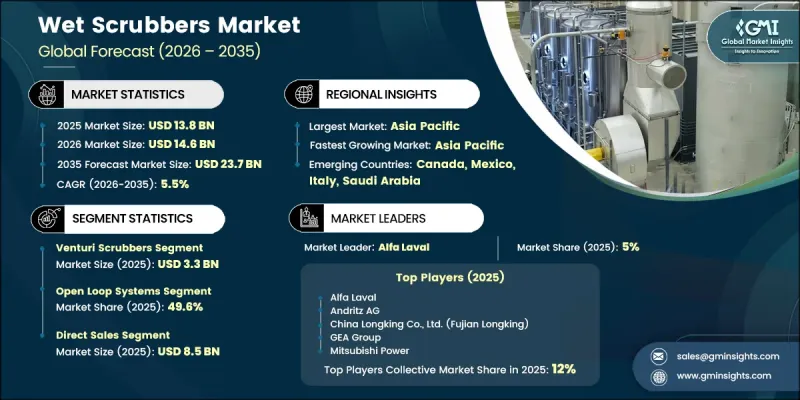
습식 스크러버 시장의 성장은 점점 더 엄격해지는 산업 배출 규제와 선진국 및 신흥국의 지속적인 산업 생산 능력 확대에 힘입고 있습니다. 습식 스크러버 시스템은 산업 배기가스에서 유해 가스와 부유 입자상 물질을 제거하기 위해 널리 사용되고 있으며, 현대 대기 오염 방지 전략에서 필수적인 요소로 자리 잡고 있습니다. 다양한 습식 스크러버 기술은 다양한 산업용 가스 처리 요건을 충족하는 동시에, 시설이 진화하는 환경 규제를 준수할 수 있도록 지원하도록 설계되었습니다. 산업계에서는 기존의 단일 용도 배출 제어 장치를 대체하여, 더 높은 운영 효율과 규제 준수를 유지하면서 여러 오염 물질을 동시에 처리할 수 있는 통합 시스템으로의 전환이 진행되고 있습니다. 또한, 기존 산업 시설의 지속적인 현대화와 가동 초기부터 고도의 배출 제어 솔루션이 필요한 신규 제조 공장 건설도 습식 스크러버 수요를 뒷받침하고 있습니다. 청정 생산 기술에 대한 투자 증가와 더불어 환경의 지속가능성과 운영 효율성에 대한 중요성이 높아짐에 따라, 전 세계 습식 스크러버 시장 전체의 장기적인 성장 기회는 계속해서 강화되고 있습니다.
| 시장 범위 | |
|---|---|
| 개시 연도 | 2025년 |
| 예측 기간 | 2026-2035년 |
| 초기 시장 규모 | 138억 달러 |
| 예측액 | 237억 달러 |
| CAGR | 5.5% |
2025년, 오픈 루프 시스템 부문은 49.6%의 점유율을 차지했습니다. 이 부문은 효율적인 가스 세정 및 비용 효율적인 운영이 여전히 중요한 우선순위인 산업용 분야에서 널리 도입되고 있어, 계속해서 주도적인 위치를 유지하고 있습니다. 오픈 루프 시스템은 대규모 산업 운영을 지속적으로 지원하면서 효과적인 배기가스 제어를 실현할 수 있다는 점에서 높이 평가받고 있습니다. 확립된 도입 실적과 운영상의 신뢰성은 여러 최종 이용 산업에서 수요를 지속적으로 견인하고 있습니다.
미국의 습식 스크러버 시장은 86.8%의 점유율을 차지했으며, 2025년에는 26억 달러 시장 규모를 기록했습니다. 지역별 수요는 신규 산업 시설 건설보다는 변화하는 환경 규제에 대응하기 위해 필요한 설비 교체 및 업그레이드에 주로 힘입고 있습니다. 미국은 광범위한 산업 인프라와 점점 더 엄격해지는 대기질 규제의 지속적인 시행을 통해 첨단 배기가스 제어 기술에 대한 투자를 지속적으로 촉진하고 있으며, 지역 시장을 선도하고 있습니다.
자주 묻는 질문
목차
제1장 조사 방법과 범위
제2장 주요 요약
제3장 업계 인사이트
제4장 경쟁 구도
제5장 시장 추산 및 예측 : 제품 유형별(2022-2035년)
제6장 시장 추산 및 예측 : 오염물질 유형별(2022-2035년)
제7장 시장 추산 및 예측 : 운영 형태별(2022-2035년)
제8장 시장 추산 및 예측 : 최종 이용 산업별(2022-2035년)
제9장 시장 추산 및 예측 : 유통 채널별(2022-2035년)
제10장 시장 추산 및 예측 : 지역별(2022-2035년)
제11장 기업 개요
AJY 26.08.18The Global Wet Scrubbers Market was valued at USD 13.8 billion in 2025 and is estimated to grow at a CAGR of 5.5% to reach USD 23.7 billion by 2035.
Growth in the wet scrubbers market is supported by increasingly stringent industrial emission regulations and continuous expansion of industrial production capacity across developed and emerging economies. Wet scrubber systems are widely utilized to remove harmful gases and airborne particulate matter from industrial exhaust streams, making them an essential component of modern air pollution control strategies. Various wet scrubbing technologies are designed to address diverse industrial gas treatment requirements while helping facilities comply with evolving environmental regulations. Industries are increasingly replacing conventional single-purpose emission control equipment with integrated systems capable of treating multiple pollutants simultaneously while maintaining higher operational efficiency and regulatory compliance. Demand for wet scrubbers is also being driven by ongoing modernization of existing industrial facilities and the construction of new manufacturing plants requiring advanced emission control solutions from the beginning of operations. Rising investments in cleaner production technologies, combined with greater emphasis on environmental sustainability and operational efficiency, continue to strengthen long-term growth opportunities across the global wet scrubbers market.
| Market Scope | |
|---|---|
| Start Year | 2025 |
| Forecast Year | 2026-2035 |
| Start Value | $13.8 Billion |
| Forecast Value | $23.7 Billion |
| CAGR | 5.5% |
The open loop systems segment held a 49.6% share in 2025. This segment continues to lead due to its widespread installation across industrial applications where efficient gas cleaning and cost-effective operation remain key priorities. Open loop systems are recognized for their ability to deliver effective emission control while supporting continuous large-scale industrial operations. Their established installation base and operational reliability continue to reinforce demand across multiple end-use industries.
U.S. Wet Scrubbers Market accounted for an 86.8% share, generating USD 2.6 billion in 2025. Regional demand is primarily supported by equipment replacement and upgrades required to meet evolving environmental regulations rather than by new industrial construction. The United States continues to lead the regional market due to its extensive industrial infrastructure and ongoing implementation of increasingly stringent air quality regulations, which continue to encourage investments in advanced emission control technologies.
Major companies operating in the global wet scrubbers market include CECO Environmental Corp, Andritz AG, Babcock & Wilcox (B&W), Durr AG (Megtec/Universal), GEA Group, Alfa Laval, Mitsubishi Power, Bionomic Industries, Ducon Technologies, Monroe Environmental, Tri-Mer Corporation, Korting Hannover GmbH, Thermax Limited, China Longking Co., Ltd. (Fujian Longking), Beltran Technologies, Wartsila (Exhaust Treatment), Biorem Technologies (BIOREM Inc.), Envitech Inc., Croll-Reynolds Company, Sly LLC (Sly Inc.), and CR Clean Air Group. Companies operating in the wet scrubbers market are strengthening their competitive position by investing in research and development to improve emission control efficiency, operational reliability, and system performance. Many manufacturers are expanding product portfolios with advanced multi-stage pollution control solutions that address evolving industrial and environmental requirements. Strategic collaborations with engineering firms, industrial operators, and technology providers are supporting broader market penetration and accelerating project execution. Businesses are also increasing manufacturing capabilities, enhancing customization options, and integrating digital monitoring technologies to improve equipment performance and maintenance efficiency.
Table of Contents
Chapter 1 Methodology and Scope
- 1.1 Market scope & definitions
- 1.2 Research design
- 1.2.1 Research approach
- 1.2.2 Data collection methods
- 1.3 Base estimates and calculations
- 1.3.1 Base year calculation
- 1.3.2 Market estimates & forecasts parameters
- 1.4 Forecast Model
- 1.4.1 Key trends for market estimates
- 1.4.2 Quantified market impact analysis
- 1.4.2.1 Mathematical impact of growth parameters on forecast
- 1.4.3 Scenario analysis framework
- 1.5 Primary research and validation
- 1.5.1 Some of the primary sources (but not limited to)
- 1.6 Data mining sources
- 1.6.1 Paid Sources
- 1.7 Primary research and validation
- 1.7.1 Primary sources
- 1.8 Research Trail & confidence scoring
- 1.8.1 Research trail components
- 1.8.2 Scoring components
- 1.9 Research transparency addendum
- 1.9.1 Source attribution framework
- 1.9.2 Quality assurance metrics
- 1.9.3 Our commitment to trust
Chapter 2 Executive Summary
- 2.1 Industry 360° synopsis
- 2.2 Key market trends
- 2.2.1 Regional
- 2.2.2 Product type
- 2.2.3 Pollutant type
- 2.2.4 Operation type
- 2.2.5 End use industry
- 2.2.6 Distribution channel
Chapter 3 Industry Insights
- 3.1 Industry ecosystem analysis
- 3.1.1 Supplier landscape
- 3.1.2 Profit margin
- 3.1.3 Value addition at each stage
- 3.1.4 Factor affecting the value chain
- 3.2 Industry impact forces
- 3.2.1 Growth drivers
- 3.2.1.1 Stringent air emission regulations
- 3.2.1.2 Growth of heavy industrial sectors
- 3.2.1.3 Rising focus on occupational health & safety
- 3.2.2 Industry pitfalls & challenges
- 3.2.2.1 High capital investment
- 3.2.2.2 High operating costs
- 3.2.3 Opportunities
- 3.2.3.1 Retrofit and modernization projects
- 3.2.3.2 Semiconductor and electronics manufacturing
- 3.2.1 Growth drivers
- 3.3 Growth potential analysis
- 3.4 Regulatory framework
- 3.4.1 U.S. EPA clean air act - MACT & NESHAP standards
- 3.4.2 EU Industrial Emissions Directive (IED) & BREF standards
- 3.4.3 IMO MARPOL Annex VI (Marine Sulfur Cap - 0.5% global sulfur limit)
- 3.4.4 Asia Pacific emission standards (China GB Standards, India CPCB, South Korea)
- 3.4.5 Emerging Markets Regulatory Landscape (MEA, Latin America)
- 3.5 Pricing analysis (driven by primary research)
- 3.5.1 Historical price trend analysis (2022-2025)
- 3.5.2 Pricing strategy by player type (premium / value / cost-plus)
- 3.6 Trade data analysis (driven by paid database)
- 3.6.1 Import/export volume & value trends (HS Code 842139 industrial air scrubbers)
- 3.6.2 Key trade corridors & tariff impact
- 3.7 Impact of AI & generative AI on the market
- 3.7.1 AI-driven disruption of existing scrubber business models (monitoring-as-a-service, remote diagnostics)
- 3.7.2 GenAI use cases & adoption roadmap by segment
- 3.7.3 Risks, limitations & regulatory considerations for AI in pet care
- 3.8 Capacity & production landscape (driven by primary research)
- 3.8.1 Installed manufacturing capacity by region & key producer
- 3.8.2 Capacity utilization rates & expansion pipelines
Chapter 4 Competitive Landscape, 2025
- 4.1 Introduction
- 4.2 Company market share analysis
- 4.2.1 By region
- 4.2.1.1 North America
- 4.2.1.2 Europe
- 4.2.1.3 Asia Pacific
- 4.2.1.4 Latin America
- 4.2.1.5 Middle East and Africa
- 4.2.1 By region
- 4.3 Company matrix analysis
- 4.4 Competitive analysis of major market players
- 4.5 Competitive positioning matrix
- 4.6 Key developments
- 4.6.1 Mergers & acquisitions
- 4.6.2 Partnerships & collaborations
- 4.6.3 New product launches
- 4.6.4 Expansion plans
Chapter 5 Market Estimates and Forecast, By Product Type, 2022 – 2035 (USD Billion) (Units)
- 5.1 Key trends
- 5.2 Packed bed scrubbers
- 5.3 Venturi scrubbers
- 5.4 Spray tower scrubbers
- 5.5 Cyclonic scrubbers
- 5.6 Impingement plate scrubbers
- 5.7 Others (eductor scrubbers, biological/bio scrubbers, wet electrostatic precipitators)
Chapter 6 Market Estimates and Forecast, By Pollutant Type, 2022 – 2035 (USD Billion) (Units)
- 6.1 Key trends
- 6.2 Particulate matter (PM) control
- 6.3 Acid gas control
- 6.4 Volatile organic compounds (VOC) control
- 6.5 Odor control
- 6.6 Toxic fumes & heavy metals control
- 6.7 Others (multi-pollutant control systems, CO₂ pre-treatment)
Chapter 7 Market Estimates and Forecast, By Operation Type, 2022 – 2035 (USD Billion) (Units)
- 7.1 Key trends
- 7.2 Open loop systems
- 7.3 Closed loop systems
- 7.4 Dry & wet hybrid systems
- 7.5 Others (semi-closed, hybrid-ready configurations)
Chapter 8 Market Estimates and Forecast, By End Use Industry, 2022 – 2035 (USD Billion) (Units)
- 8.1 Key trends
- 8.2 Chemical
- 8.3 Oil & gas
- 8.4 Refinery & petrochemicals
- 8.5 Mining & metallurgy
- 8.6 Pharmaceuticals
- 8.7 Others (marine, cement, power generation, Etc.)
Chapter 9 Market Estimates and Forecast, By Distribution Channel, 2022 – 2035 (USD Billion) (Units)
- 9.1 Key trends
- 9.2 Direct sales
- 9.3 Indirect sales
Chapter 10 Market Estimates and Forecast, By Region, 2022 – 2035 (USD Billion) (Units)
- 10.1 Key trends
- 10.2 North America
- 10.2.1 U.S.
- 10.2.2 Canada
- 10.3 Europe
- 10.3.1 Germany
- 10.3.2 UK
- 10.3.3 France
- 10.3.4 Italy
- 10.3.5 Spain
- 10.4 Asia Pacific
- 10.4.1 China
- 10.4.2 Japan
- 10.4.3 India
- 10.4.4 Australia
- 10.4.5 South Korea
- 10.5 Latin America
- 10.5.1 Brazil
- 10.5.2 Mexico
- 10.5.3 Argentina
- 10.6 Middle East and Africa
- 10.6.1 South Africa
- 10.6.2 Saudi Arabia
- 10.6.3 UAE
Chapter 11 Company Profiles
- 11.1 Global players
- 11.1.1 CECO Environmental Corp
- 11.1.2 Andritz AG
- 11.1.3 Babcock & Wilcox (B&W)
- 11.1.4 Durr AG (Megtec/Universal)
- 11.1.5 GEA Group
- 11.1.6 Alfa Laval
- 11.1.7 Mitsubishi Power
- 11.2 Regional players
- 11.2.1 Bionomic Industries
- 11.2.2 Ducon Technologies
- 11.2.3 Monroe Environmental
- 11.2.4 Tri-Mer Corporation
- 11.2.5 Korting Hannover GmbH
- 11.2.6 Thermax Limited
- 11.2.7 China Longking Co., Ltd. (Fujian Longking)
- 11.3 Emerging players
- 11.3.1 Beltran Technologies
- 11.3.2 Wartsila (Exhaust Treatment)
- 11.3.3 Biorem Technologies (BIOREM Inc.)
- 11.3.4 Envitech Inc.
- 11.3.5 Croll-Reynolds Company
- 11.3.6 Sly LLC (Sly Inc.)
- 11.3.7 CR Clean Air Group