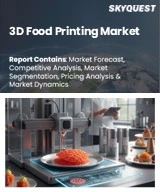
|
시장보고서
상품코드
2017542
3D 식품 프린팅 시장 : 컴포넌트별, 프린터 기술별, 최종 사용자 용도별, 식품 카테고리별 - 시장 예측(2026-2032년)3D Food Printing Market by Component, Printer Technology, End-User Application, Food Category - Global Forecast 2026-2032 |
||||||
 360iResearch
3D 식품 프린팅 시장은 2025년에 3억 586만 달러로 평가되었고, 2026년에는 3억 5,069만 달러로 성장하여, CAGR 14.52%로 성장을 지속할 전망이며, 2032년까지 7억 9,037만 달러에 이를 것으로 예측됩니다.
| 주요 시장 통계 | |
|---|---|
| 기준 연도 : 2025년 | 3억 586만 달러 |
| 추정 연도 : 2026년 | 3억 5,069만 달러 |
| 예측 연도 : 2032년 | 7억 9,037만 달러 |
| CAGR(%) | 14.52% |
식용 제품용 적층 가공이 요리의 창의성, 재료의 혁신, 생산의 실용성을 어떻게 융합하고 있는지에 대한 간략한 소개
식품에 특화된 적층 가공 기술의 등장은 주방, 제조 현장, 그리고 일반 가정에서 요리의 창의성, 영양 맞춤화, 생산 효율성이 어떻게 융합될 수 있는지를 재정의하고 있습니다. 지난 10년간 인쇄 가능한 식품 배합 기술 및 정밀 압출 메커니즘의 발전으로, 과거에는 틈새 실험 기술이었으나, 장인의 손으로 만든 과자부터 파일럿 규모의 단백질 제품 개발에 이르기까지 실용적인 이용 사례로 발전했습니다. 재료 과학의 발전과 디자인 소프트웨어의 직관적인 조작이 가능해짐에 따라 밸류체인 전반의 이해 관계자들은 전통적인 생산 패러다임을 재검토하고 주문형 정밀 식품 조립이 어떻게 독특한 감각적 경험과 공급망 유연성을 가져다 줄 수 있는지 탐구하고 있습니다.
기술 발전, 소비자 수요 변화, 서비스 모델 혁신이 융합되어 인쇄 가능한 식용 제품의 미래를 재정의하고 있습니다.
식용 적층제조(Additive Manufacturing) 분야는 기술 발전, 소비자 선호도 변화, 그리고 지속가능성에 대한 새로운 관심으로 인해 혁신적인 변화를 겪고 있습니다. 첫째, 프린터의 정확도 향상과 다층 적층 기술의 발전으로 이전에는 구현하기 어려웠던 질감과 맛의 레이어링이 가능해져 장식용 과자에서 특정 영양 프로파일을 가진 기능성 식품에 이르기까지 잠재적인 용도 범위가 넓어졌습니다. 둘째, 대체 단백질과 식물성 단백질에 대한 관심이 높아지면서 육류를 모방하거나 농축된 미량 영양소를 공급하는 인쇄 가능한 잉크와 젤에 대한 투자가 촉진되고 있으며, 이는 제품 차별화와 건강 지향적 제안을 위한 새로운 길을 열어주고 있습니다.
최근 관세 동향이 식용 적층 가공 생태계 전반에 걸쳐 전략적 공급망 탄력성, 니어쇼어링 및 모듈식 설계를 선택하도록 유도한 방법
2025년 무역 정책 동향과 관세 조정은 장비 제조업체, 부품 공급업체 및 식품 인쇄 기술 다운스트림 도입 기업에게 새로운 비즈니스 현실을 가져왔습니다. 수입 하드웨어, 정밀 부품 또는 특수 서브 어셈블리에 대한 관세가 인상되면, 조달팀은 공급업체 다변화, 재고 전략 재검토, 대체 공급원 인증 프로세스 가속화 등의 대응책을 마련합니다. 실제로, 이는 장비 제조업체와 최종 사용자 모두 니어쇼어링의 기회를 평가하고, 여러 공급망을 활용하고, 식품 안전 및 공정 관리를 손상시키지 않고 부품을 대체할 수 있는 모듈식 설계를 추구하도록 유도하고 있습니다.
부품, 인쇄 기술, 최종 사용 시나리오, 식품 카테고리가 각각 도입 경로와 기술 우선순위에 어떤 영향을 미치고 있는지 파악할 수 있는 부문별 인사이트를 제공합니다.
세분화에 초점을 맞춘 인사이트는 전체 기술 스택과 최종 사용자 스펙트럼에 걸쳐 차별화된 도입 패턴과 투자 우선순위를 파악할 수 있게 해줍니다. 구성요소를 기반으로 생태계는 3D 프린터, 서비스 및 지원, 소프트웨어 솔루션의 세 가지를 중심으로 구성됩니다. 3D 프린터 내에서도 신속한 프로토타이핑이나 장인정신이 필요한 용도에 적합한 데스크톱 프린터와 더 높은 처리량과 반복성을 추구하도록 설계된 산업용 프린터 사이에는 분명한 구분이 존재합니다. 서비스 지원은 단순한 정기 유지보수의 틀을 넘어 유지보수 지원과 교육 자문 서비스가 결합되어 운영 도입을 확대하기 위한 중요한 경로를 형성하고 있습니다. 현재 소프트웨어 솔루션은 강력한 제어 시스템, 재현 가능한 레시피, 추적성, 창의적 자유를 가능하게 하는 고급 설계 및 모델링 기능에 중점을 두고 있습니다.
세계 주요 시장에서 규제, 식문화, 제조 능력의 지역적 차이로 인해 독특한 상업화 전략이 주도하고 있습니다.
지역별 동향은 기술 개발자와 도입자가 투자, 파트너십, 시장 출시 전략의 우선순위를 정하는 데 큰 영향을 미치고 있습니다. 북미와 남미에서 혁신은 종종 호텔 및 식품 제조업체의 초기 상용화와 식품 제조업체 내 연구 주도형 파일럿 프로그램에 집중되어 있으며, 요리학교, 스타트업, 식재료 제조업체 간의 강력한 부문 간 협력이 이루어지고 있습니다. 이 지역에서는 빠른 반복 개발, 요리 실험, 그리고 소비자 대상 용도를 시연하는 상용화 파일럿과 파트너와 협력하여 제품을 출시하는 데 중점을 두고 있습니다.
하드웨어 혁신, 소프트웨어 제어, 전략적 파트너십의 융합이 식용 적층 가공 분야의 경쟁과 가치 창출을 어떻게 형성하고 있는가?
식용 적층 가공 분야의 경쟁 역학은 식품 특화 용도으로 사업을 확장하는 기존 장비 공급업체, 독자적인 배합에 집중하는 전문 스타트업, 그리고 확장 가능한 사용을 가능하게 하는 제어 및 설계 환경을 제공하는 소프트웨어 기업이 혼재되어 있습니다. 주요 장비 개발 업체들은 입증된 모션 제어, 압출 메커니즘 및 자재관리에 대한 전문 지식을 활용하여 산업용 플랫폼을 식품 등급 요구 사항에 맞게 조정하고 있습니다. 반면, 민첩한 신규 시장 진출기업들은 개인 맞춤형 영양 및 제품 개발을 위한 래피드 프로토타이핑과 같은 파괴적인 용도에 집중하고 있습니다. 동시에 레시피 관리, 폐쇄 루프 프로세스 제어, 직관적인 모델링 도구를 제공하는 소프트웨어 공급자의 중요성이 점점 더 커지고 있습니다. 그들은 요리의 의도를 품질 및 안전 프로토콜을 충족하는 재현 가능한 기계 지침으로 변환하는 역할을 담당합니다.
식품 프린팅 사업에서 상업화 가속화, 공급 탄력성 확보, 서비스 중심의 차별화를 위한 업계 경영진을 위한 실용적인 단계
업계 리더는 실용적이고 영향력 있는 일련의 노력을 우선시하여 기술적 잠재력을 재현 가능한 상업적 성과로 전환하기 위해 단호한 조치를 취해야 합니다. 첫째, 인쇄 가능한 원료의 제품화 및 표준화된 적격성 평가 프로토콜에 투자하여 편차를 줄이고 규제 당국의 승인을 앞당기는 것입니다. 배합 과학자와 장비 엔지니어가 직접 협력하여 검증 주기를 단축하고 재현성을 높일 수 있습니다. 둘째, 모듈식 하드웨어 아키텍처와 명확한 예비 부품 전략을 수립하여 공급망 의존도를 낮추고 유지보수를 간소화하여 부품 조달처가 변경되더라도 사업자가 비즈니스 연속성을 유지할 수 있도록 합니다.
업계와의 직접적 참여, 기술적 검증, 시나리오 분석을 결합한 엄격한 다각적 조사 프레임워크를 통해 견고하고 실행 가능한 인사이트를 보장합니다.
이 조사는 견고성과 실용적 관련성을 보장하기 위해 설계된 다각적인 접근 방식을 통해 수집된 정성적 및 정량적 정보를 통합합니다. 1차 조사에는 장비 제조업체, 셰프, 제법 과학자, 조달 책임자에 대한 구조화된 인터뷰가 포함되었으며, 파일럿 시설과 데모 키친에 대한 현장 방문을 통해 기계의 성능과 작업자의 워크플로우를 관찰했습니다. 2차 조사에서는 기술 문헌, 규제 지침, 특허 동향을 비판적으로 검토하여 재료과학 동향과 지적재산권 동향을 뒷받침했습니다. 이러한 정보들을 서로 대조하여 기술적 실현 가능성, 사용자 요구사항, 비즈니스 모델에 미치는 영향에 대해 상호 검증을 진행했습니다.
식용 적층 가공 기술의 상업적 확장을 위한 운영 전제조건, 규제 고려 사항 및 전략적 우선순위를 명확히 하는 요약
요약하면, 식용 적층 가공 기술은 단순한 실험적 호기심의 대상에서 요리 혁신, 전문 제조 및 개인 맞춤형 영양 공급과 같은 분야에서 구체적인 용도를 볼 수 있는 성숙한 기술 그룹으로 발전하고 있습니다. 적층 정확도, 자재관리 및 소프트웨어 제어 시스템의 기술적 진보가 새로운 감각적, 기능적 가능성을 열어주는 한편, 서비스 모델과 파트너십을 통해 상업적 사용자들의 도입 장벽을 낮추고 있습니다. 무역 정책의 변화와 지역별 규제 차이로 인해 복잡성이 증가하는 한편, 현지화, 모듈화 및 서비스 제공 확대를 위한 기회도 창출하고 있습니다. 가장 성공적인 조직은 식품 과학 전문성과 엄격한 엔지니어링을 통합하고, 소프트웨어 중심의 운영 반복성에 투자하며, 규제 당국 및 파트너 생태계와 적극적으로 협력하는 조직입니다.
자주 묻는 질문
목차
제1장 서문
제2장 조사 방법
제3장 주요 요약
제4장 시장 개요
제5장 시장 인사이트
제6장 미국 관세의 누적 영향(2025년)
제7장 AI의 누적 영향(2025년)
제8장 3D 식품 프린팅 시장 : 컴포넌트별
제9장 3D 식품 프린팅 시장 : 프린터 기술별
제10장 3D 식품 프린팅 시장 : 최종 사용자 용도별
제11장 3D 식품 프린팅 시장 : 식품 카테고리별
제12장 3D 식품 프린팅 시장 : 지역별
제13장 3D 식품 프린팅 시장 : 그룹별
제14장 3D 식품 프린팅 시장 : 국가별
제15장 미국의 3D 식품 프린팅 시장
제16장 중국의 3D 식품 프린팅 시장
제17장 경쟁 구도
AJYThe 3D Food Printing Market was valued at USD 305.86 million in 2025 and is projected to grow to USD 350.69 million in 2026, with a CAGR of 14.52%, reaching USD 790.37 million by 2032.
| KEY MARKET STATISTICS | |
|---|---|
| Base Year [2025] | USD 305.86 million |
| Estimated Year [2026] | USD 350.69 million |
| Forecast Year [2032] | USD 790.37 million |
| CAGR (%) | 14.52% |
A concise introduction to how additive manufacturing for edible products is converging culinary creativity, materials innovation, and production pragmatism
The advent of food-focused additive manufacturing is reshaping how culinary creativity, nutritional personalization, and production efficiency converge across kitchens, manufacturing floors, and consumer households. Over the past decade, advancements in printable food formulations and precision extrusion mechanics have brought a once-niche experimental capability into pragmatic use cases that range from artisan confectionery to pilot-scale protein product development. As materials science improves and design software becomes more intuitive, stakeholders across the value chain are reconsidering traditional production paradigms and exploring how on-demand, shape-accurate food assembly can deliver distinctive sensory experiences and supply chain flexibility.
Consequently, innovators and established players alike now face a landscape where technical feasibility is no longer the primary barrier; instead, the focus has shifted toward integration, safety, and consumer acceptance. Regulatory frameworks and food safety standards are evolving in parallel, and multidisciplinary collaboration among chefs, food scientists, and engineers is accelerating commercialization pathways. With that context, this executive summary synthesizes the technological, commercial, and policy dynamics that are influencing strategic decisions in the rapidly maturing field of 3D food printing.
How converging technological advancements, consumer demand shifts, and service model innovations are redefining the future of printed edible production
The landscape for edible additive manufacturing is undergoing transformative shifts driven by converging technological improvements, shifting consumer preferences, and a renewed focus on sustainability. First, improvements in printer precision and multi-material deposition are enabling textures and flavor layering that were previously impractical, which in turn has broadened potential applications from decorative confectionery to functional foods with targeted nutrient profiles. Second, traction in alternative proteins and plant-based formulations has motivated greater investment into printable inks and gels that mimic meat or deliver concentrated micronutrients, facilitating new routes for product differentiation and health-driven propositions.
At the same time, software and control systems are maturing to support repeatable processes and regulatory traceability, resulting in more robust integration with existing production lines and quality assurance regimes. Parallel to these advances, service models have evolved: equipment vendors now often bundle maintenance, training, and consultancy to reduce adoption friction for commercial kitchens and manufacturing facilities. Finally, consumer acceptance is being shaped by visible success stories and experiential demonstrations, particularly in premium foodservice and bespoke gifting sectors, which are expanding awareness and normalizing printed-food concepts. Together, these shifts are altering investment priorities, collaboration patterns, and the competitive calculus for both incumbent food manufacturers and emerging specialist suppliers.
How recent tariff developments have prompted strategic supply chain resilience, nearshoring, and modular design choices across the edible additive manufacturing ecosystem
Trade policy developments and tariff adjustments in 2025 have introduced new operational realities for equipment manufacturers, component suppliers, and downstream adopters of food printing technologies. When tariffs increase on imported hardware, precision components, or specialized subassemblies, procurement teams respond by diversifying supplier footprints, recalibrating inventory strategies, and accelerating qualification of alternative sources. In practice, this has encouraged both equipment makers and end users to evaluate nearshoring opportunities, engage with multiple supply chains, and pursue modular designs that can tolerate component substitutions without compromising food safety or process control.
Moreover, the cumulative effect of trade measures has prompted a reassessment of total landed cost and vendor relationships. Some manufacturers have begun to localize final assembly and calibration services to reduce exposure to cross-border tariff volatility, while others have sought partnerships with regional distributors that can absorb compliance complexity and provide timely service. For adopters in hospitality and food production, these adjustments have meant longer lead times for highly specialized subsystems in some cases, but also an increased emphasis on service contracts and spare-parts stocking to maintain operational continuity. Importantly, regulatory compliance and certification remain critical considerations; as supply chains shift, organizations must ensure that alternative components and service providers meet applicable food-grade and safety standards to avoid downstream contamination or noncompliance risks.
Consequently, strategic responses to tariff dynamics are less about short-term price negotiation and more about building resilient, flexible supply and service ecosystems that protect continuity of operations, preserve product integrity, and maintain predictable cost structures under changing trade conditions.
Segmented insights that reveal how components, printing technologies, end-use scenarios, and food categories each uniquely shape adoption pathways and technical priorities
Insights from a segmentation-focused lens reveal differentiated adoption patterns and investment priorities across the technology stack and end-user spectrum. Based on Component, the ecosystem is organized around 3D Printers, Services & Support, and Software Solutions; within 3D Printers a clear bifurcation exists between Desktop Printers that cater to rapid prototyping and artisanal applications and Industrial Printers engineered for higher throughput and repeatability; Services & Support has become more than routine maintenance, with Maintenance & Support combined with Training & Advisory Services forming critical pathways to scale operational adoption; Software Solutions now center on robust Control Systems and advanced Design & Modeling capabilities that enable repeatable recipes, traceability, and creative freedom.
When examined by Printer Technology, differences in material handling and process control lead to distinct application footprints: Binder Jetting, with its adhesive application and powder dispensing sub-processes, aligns well to particulate and confectionery blends that can be consolidated layer by layer, while Material Extrusion-split into Regenerative Material Extrusion and Thermoplastic Extrusion-drives the majority of edible paste and gel printing due to its gentle handling of protein-rich and hydrocolloid-based inks; Selective Laser Sintering, although less typical for mainstream edible formulation, finds niche usage where powder consolidation under controlled thermal profiles is applicable. From an End-User Application perspective, Commercial Kitchens adopt technologies for bespoke menu innovation and guest experience, Food Product Manufacturers explore scaleable pilot and niche production runs, and Household Users engage with compact desktop systems for personalization and experiential cooking. Finally, by Food Category, distinct formulation challenges and formulation opportunities define addressable use cases: Confectionery Ingredients require precise thermal control and rapid setting, Dough Materials demand rheological consistency for structure retention, Fruits and Vegetables often need stabilization for printability, and Meat Products pose both textural complexity and regulatory scrutiny. Taken together, this segmentation framework highlights where technical development, service models, and software maturity must align to unlock practical adoption across different commercial and consumer contexts.
Regional differences in regulation, culinary culture, and manufacturing strength that drive distinct commercialization strategies across major global markets
Regional dynamics significantly influence how technology developers and adopters prioritize investments, partnerships, and go-to-market strategies. In the Americas, innovation often concentrates around early commercial deployments in hospitality hubs and research-driven pilot programs within food manufacturers, with strong cross-sector collaboration among culinary institutes, start-ups, and ingredient companies. This region favors rapid iteration, culinary experimentation, and commercialization pilots that demonstrate consumer-facing applications and partner-integrated product launches.
Across Europe, Middle East & Africa, regulatory harmonization and strong food-safety protocols steer adoption in conservative but high-value segments such as luxury confectionery and nutritionally tailored institutional catering. Stakeholders in these markets typically emphasize traceability, provenance, and compliance, creating demand for robust control systems and validated materials. Conversely, Asia-Pacific exhibits a diverse pace of adoption driven by dense urban centers with high demand for experiential dining, robust manufacturing clusters, and significant investment in alternative protein R&D. Local supply chains and manufacturing ecosystems in this region often accelerate hardware localization and collaborative development between equipment makers and large food conglomerates. These regional contrasts underscore the importance of tailored commercialization strategies that respect regulatory environments, cultural preferences, and existing industrial capabilities.
How convergence of hardware innovation, software control, and strategic partnerships is shaping competition and value capture in the edible additive manufacturing sector
Competitive dynamics within the edible additive manufacturing sector reflect a mixture of heritage equipment vendors expanding into food-specific applications, specialized start-ups focused on unique formulations, and software firms delivering the control and design environments that enable scalable use. Leading equipment developers leverage proven motion control, extrusion mechanics, and material-handling expertise to adapt industrial platforms to food-grade requirements, while a cohort of agile newcomers focuses on disruptive uses such as personalized nutrition or rapid prototyping for product development. At the same time, software providers that deliver recipe management, closed-loop process control, and intuitive modeling tools are increasingly pivotal; they translate culinary intent into reproducible machine instructions that meet quality and safety protocols.
Partnerships and vertical integration are common strategies: ingredient companies collaborate with hardware and software suppliers to validate printable formulations, foodservice operators engage with training and advisory firms to embed printed food into menus, and contract manufacturers explore specialized pilot lines for co-manufacture. Intellectual property around printable inks, stabilization chemistries, and process parameters is becoming a competitive moat, while service excellence-rapid maintenance response, operator training, and regulatory support-differentiates market leaders from transactional vendors. Overall, success hinges on converging deep domain expertise in food science with disciplined engineering practices and service models that reduce adoption friction for commercial and consumer buyers alike.
Actionable steps for industry executives to accelerate commercialization, secure supply resilience, and build service-led differentiation in printed food operations
Industry leaders should act decisively to transform technical promise into repeatable commercial outcomes by prioritizing a set of pragmatic, high-impact initiatives. First, invest in productization of printable feedstocks and standardized qualification protocols to reduce variability and accelerate regulatory approvals; direct collaboration between formulation scientists and equipment engineers will shorten validation cycles and increase reproducibility. Second, develop modular hardware architectures and clear spare-parts strategies to mitigate supply-chain exposure and simplify maintenance, enabling operators to maintain continuity even when component sourcing shifts.
Third, expand service propositions beyond corrective maintenance to include structured training, digital recipe management, and advisory services that help customers embed printed-food capabilities into existing operations. Fourth, pursue software-driven differentiation by delivering interoperable control systems and intuitive design tools that enable nonexpert operators to execute complex print jobs reliably. Fifth, engage proactively with regulators and standards bodies to shape clear safety requirements and labeling guidance, thereby reducing ambiguity for commercial deployment. Finally, pilot commercial use cases with strategic partners across hospitality, ingredient manufacturing, and institutional food service to demonstrate ROI and consumer acceptance; use these pilots to gather sensory, operational, and compliance evidence that supports scaled rollouts. Taken together, these actions will accelerate adoption, de-risk transitions to new production models, and create defensible positions in a rapidly evolving market.
A rigorous multi-method research framework combining primary industry engagement, technical validation, and scenario analysis to ensure robust and actionable insights
This research synthesizes qualitative and quantitative intelligence gathered through a multi-method approach designed to ensure robustness and practical relevance. Primary research included structured interviews with equipment manufacturers, chefs, formulation scientists, and procurement leaders, supplemented by site visits to pilot facilities and demonstration kitchens to observe machine performance and operator workflows. Secondary research involved critical review of technical literature, regulatory guidance, and patent landscapes to validate material science trends and intellectual property trajectories. Triangulation of these inputs enabled cross-validation of technical feasibility, user requirements, and business-model implications.
Analytical methods incorporated process mapping to identify operational friction points, scenario analysis to test supply-chain resilience under varying trade conditions, and technology readiness assessments to classify components and subsystems by maturity and integration risk. Peer review by independent subject-matter experts ensured that assumptions regarding food safety, material compatibility, and production workflows aligned with industry best practices. Wherever possible, findings emphasize verifiable technical characteristics and observed market behaviors rather than speculative projections, providing a grounded basis for strategic decision-making and further due diligence.
A concluding synthesis that clarifies the operational prerequisites, regulatory considerations, and strategic priorities for scaling edible additive manufacturing commercially
In summary, edible additive manufacturing has moved from experimental curiosity to a maturing set of technologies with tangible applications across culinary innovation, specialized manufacturing, and personalized nutrition. Technological improvements in deposition precision, multi-material handling, and software control systems are unlocking new sensory and functional possibilities, while service models and partnerships reduce adoption friction for commercial users. Trade-policy fluctuations and regional regulatory differences add complexity but also create opportunities for localization, modular design, and enhanced service offerings. The most successful organizations will be those that integrate food-science expertise with disciplined engineering, invest in software-driven operational repeatability, and proactively engage with regulatory and partner ecosystems.
Ultimately, the pathway to widespread adoption rests on demonstrable operational reliability, validated food-grade materials, and clear use cases that deliver consumer value. Organizations that prioritize standardization, rigorous process control, and buyer-centric service models will be best positioned to translate technological capability into scalable commercial ventures and enduring competitive advantage.
Table of Contents
1. Preface
- 1.1. Objectives of the Study
- 1.2. Market Definition
- 1.3. Market Segmentation & Coverage
- 1.4. Years Considered for the Study
- 1.5. Currency Considered for the Study
- 1.6. Language Considered for the Study
- 1.7. Key Stakeholders
2. Research Methodology
- 2.1. Introduction
- 2.2. Research Design
- 2.2.1. Primary Research
- 2.2.2. Secondary Research
- 2.3. Research Framework
- 2.3.1. Qualitative Analysis
- 2.3.2. Quantitative Analysis
- 2.4. Market Size Estimation
- 2.4.1. Top-Down Approach
- 2.4.2. Bottom-Up Approach
- 2.5. Data Triangulation
- 2.6. Research Outcomes
- 2.7. Research Assumptions
- 2.8. Research Limitations
3. Executive Summary
- 3.1. Introduction
- 3.2. CXO Perspective
- 3.3. Market Size & Growth Trends
- 3.4. Market Share Analysis, 2025
- 3.5. FPNV Positioning Matrix, 2025
- 3.6. New Revenue Opportunities
- 3.7. Next-Generation Business Models
- 3.8. Industry Roadmap
4. Market Overview
- 4.1. Introduction
- 4.2. Industry Ecosystem & Value Chain Analysis
- 4.2.1. Supply-Side Analysis
- 4.2.2. Demand-Side Analysis
- 4.2.3. Stakeholder Analysis
- 4.3. Porter's Five Forces Analysis
- 4.4. PESTLE Analysis
- 4.5. Market Outlook
- 4.5.1. Near-Term Market Outlook (0-2 Years)
- 4.5.2. Medium-Term Market Outlook (3-5 Years)
- 4.5.3. Long-Term Market Outlook (5-10 Years)
- 4.6. Go-to-Market Strategy
5. Market Insights
- 5.1. Consumer Insights & End-User Perspective
- 5.2. Consumer Experience Benchmarking
- 5.3. Opportunity Mapping
- 5.4. Distribution Channel Analysis
- 5.5. Pricing Trend Analysis
- 5.6. Regulatory Compliance & Standards Framework
- 5.7. ESG & Sustainability Analysis
- 5.8. Disruption & Risk Scenarios
- 5.9. Return on Investment & Cost-Benefit Analysis
6. Cumulative Impact of United States Tariffs 2025
7. Cumulative Impact of Artificial Intelligence 2025
8. 3D Food Printing Market, by Component
- 8.1. 3D Printers
- 8.1.1. Desktop Printers
- 8.1.2. Industrial Printers
- 8.2. Services & Support
- 8.2.1. Maintenance & Support
- 8.2.2. Training & Advisory Services
- 8.3. Software Solutions
- 8.3.1. Control Systems
- 8.3.2. Design & Modeling
9. 3D Food Printing Market, by Printer Technology
- 9.1. Binder Jetting
- 9.1.1. Adhesive Application
- 9.1.2. Powder Dispensing
- 9.2. Material Extrusion
- 9.2.1. Regenerative Material Extrusion
- 9.2.2. Thermoplastic Extrusion
- 9.3. Selective Laser Sintering
10. 3D Food Printing Market, by End-User Application
- 10.1. Commercial Kitchens
- 10.2. Food Product Manufacturers
- 10.3. Household Users
11. 3D Food Printing Market, by Food Category
- 11.1. Confectionery Ingredients
- 11.2. Dough Materials
- 11.3. Fruits and Vegetables
- 11.4. Meat Products
12. 3D Food Printing Market, by Region
- 12.1. Americas
- 12.1.1. North America
- 12.1.2. Latin America
- 12.2. Europe, Middle East & Africa
- 12.2.1. Europe
- 12.2.2. Middle East
- 12.2.3. Africa
- 12.3. Asia-Pacific
13. 3D Food Printing Market, by Group
- 13.1. ASEAN
- 13.2. GCC
- 13.3. European Union
- 13.4. BRICS
- 13.5. G7
- 13.6. NATO
14. 3D Food Printing Market, by Country
- 14.1. United States
- 14.2. Canada
- 14.3. Mexico
- 14.4. Brazil
- 14.5. United Kingdom
- 14.6. Germany
- 14.7. France
- 14.8. Russia
- 14.9. Italy
- 14.10. Spain
- 14.11. China
- 14.12. India
- 14.13. Japan
- 14.14. Australia
- 14.15. South Korea
15. United States 3D Food Printing Market
16. China 3D Food Printing Market
17. Competitive Landscape
- 17.1. Market Concentration Analysis, 2025
- 17.1.1. Concentration Ratio (CR)
- 17.1.2. Herfindahl Hirschman Index (HHI)
- 17.2. Recent Developments & Impact Analysis, 2025
- 17.3. Product Portfolio Analysis, 2025
- 17.4. Benchmarking Analysis, 2025
- 17.5. Aether Inc.
- 17.6. Aleph Farms
- 17.7. Allevi, Inc.
- 17.8. Aniwaa Pte. Ltd.
- 17.9. Barilla Group
- 17.10. BeeHex, Inc.
- 17.11. byFlow B.V.
- 17.12. CandyFab
- 17.13. John Wiley & Sons, Inc.
- 17.14. Modern Meadow
- 17.15. Natural Machines
- 17.16. Nestle S.A.
- 17.17. Procusini
- 17.18. Redefine Meat Ltd.
- 17.19. Revo Foods GmbH
- 17.20. SavorEat
- 17.21. Steakholder Foods
- 17.22. Systems & Materials Research Corporation
- 17.23. Tracxn Technologies
- 17.24. WASP S.r.l.