|
시장보고서
상품코드
2003242
데이터센터용 액체 냉각 시장 : 구성요소별, 최종사용자별, 냉각 매체별, 데이터센터 유형별, 냉각 유형별, 기업별, 지역별 - 세계 예측(-2033년)Data Center Liquid Cooling Market By Component (Solution and Services), End User (Colocation Providers, Enterprises, and Hyperscale Data Centers), Cooling Medium, Data Center Type, Type of Cooling, Enterprise, and Region - Global Forecast to 2033 |
||||||

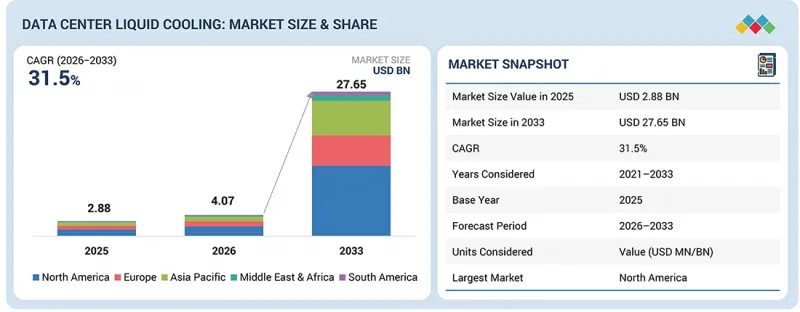
세계의 데이터센터용 액체 냉각 시장 규모는 2026년 40억 7,000만 달러에서 2033년까지 276억 5,000만 달러에 달할 것으로 예측되며, 2026-2033년에 CAGR로 31.5%의 성장이 전망됩니다.
GPU, CPU 등 고성능 컴퓨팅 디바이스의 전력 밀도가 높아지면서 효율적인 냉각 메커니즘이 필요해짐에 따라 시장이 확대되고 있습니다. 기존의 공랭식 냉각보다 고밀도 데이터센터의 문제를 해결하기 위해 직접 칩 냉각, 침지 냉각과 같은 액체 냉각 솔루션이 점점 더 많이 채택되고 있습니다. 엣지 컴퓨팅과 IoT의 성장은 컴팩트하고 효율적인 냉각 솔루션에 대한 수요를 더욱 자극하고 있습니다.
| 조사 범위 | |
|---|---|
| 조사 대상 기간 | 2021-2033년 |
| 기준 연도 | 2025년 |
| 예측 기간 | 2026-2033년 |
| 단위 | 10억 달러와 100만 달러 |
| 부문 | 구성요소, 데이터센터 유형, 냉각 유형, 최종사용자, 기업, 냉각 매체, 지역 |
| 대상 지역 | 아시아태평양, 북미, 유럽, 중동 및 아프리카, 남미 |
에너지와 수자원의 소비를 최소화하는 데에도 중점을 두고 있습니다. 전 세계 정부의 지원과 데이터센터에 대한 투자 확대도 효율성을 높이고 운영 비용을 절감하는 새로운 냉각 기술 채택을 가속화하고 있습니다.
"부품 카테고리 내 서비스 부문이 2026-2033년 가장 높은 CAGR을 기록할 것으로 예상됩니다."
데이터센터용 액체 냉각 시장의 서비스 부문은 전문적인 설치 및 유지보수가 필요한 복잡한 액체 냉각 시스템의 증가로 인해 예측 기간 동안 가장 높은 CAGR을 기록할 것으로 예상됩니다. 조직이 첨단 냉각 시스템을 도입함에 따라 성능 및 에너지 효율을 향상시킬 수 있는 컨설팅 서비스에 대한 수요가 증가하고 있습니다. 엣지 컴퓨팅에서도 전문가 지원을 통해 냉각 요구 사항을 충족시켜야 합니다. 또한, 컴플라이언스와 지속가능성을 유지하기 위해서는 지속적인 유지보수와 개발이 필수적입니다.
"중소형 데이터센터 부문이 2026-2033년 가장 높은 CAGR을 기록할 것으로 예상됩니다."
이러한 데이터센터는 공간 제약이 있는 경우가 많기 때문에 직접 칩 냉각 및 침지 냉각과 같은 액체 냉각 기술은 컴팩트한 아키텍처와 높은 냉각 효율로 인해 더욱 매력적인 선택이 될 수 있습니다. 또한, 에너지 효율과 지속가능성에 대한 관심이 높아지면서 에너지 비용 절감을 목표로 하는 중소규모 데이터센터의 성과 목표와도 일치하고 있습니다. 엣지 컴퓨팅 및 IoT 애플리케이션의 채택 확대는 혁신적인 냉각 솔루션이 필요하며, 이는 액체 냉각 기술의 보급을 촉진하고 있습니다.
"하이퍼스케일 데이터센터 부문이 2026-2033년 가장 높은 CAGR을 기록할 것으로 예측됩니다."
하이퍼스케일 데이터센터는 대량의 데이터를 처리할 수 있는 능력과 확장성 및 비용적 이점으로 인해 가장 높은 CAGR을 기록할 것으로 예상됩니다. 클라우드 서비스 및 빅데이터 분석에 대한 수요 증가는 소비자 수요를 충족시키기 위한 빠른 성장을 가능하게 하는 인프라 투자를 촉진하고 있습니다. 또한, 에너지 절약 기술과 최첨단 냉각 시스템의 발전으로 운영 효율이 향상되어 매력적인 투자 기회가 되고 있습니다. 클라우드로 전환하는 기업이 늘어나는 가운데, 하이퍼스케일 데이터센터는 까다로운 워크로드에 필요한 유연성과 확장성을 제공합니다. 이는 방대한 컴퓨팅 리소스를 필요로 하는 AI와 머신러닝의 발전으로 더욱 강화되고 있으며, 하이퍼스케일 비즈니스 모델은 현대의 데이터 인프라에 필수적인 요소로 자리 잡고 있습니다.
"IT 및 통신 부문이 2026-2033년 가장 높은 CAGR을 기록할 것으로 예상됩니다."
많은 분야에서 급속한 디지털 전환으로 인해 더 나은 데이터 처리 및 저장 기술에 대한 요구가 증가하고 있습니다. 클라우드 컴퓨팅, 빅데이터 분석, AI의 활용이 확대됨에 따라 증가하는 발열을 효과적으로 관리할 수 있는 인프라가 요구되고 있습니다. 또한, 5G 네트워크의 확산으로 대역폭에 대한 요구가 높아지면서 효율적인 냉각 기술을 채택한 데이터센터에 대한 수요가 증가하고 있습니다. IoT 기기의 보급과 함께 연결된 기기의 증가에 대응할 수 있는 확장 가능한 냉각 시스템이 필요하게 되었습니다. 이러한 발전은 IT 및 통신 분야에서 에너지 효율을 높이고 고성능을 구현할 수 있는 혁신적인 냉각 시스템의 필요성을 강조하고 있습니다.
세계의 데이터센터용 액체 냉각 시장에 대해 조사 분석했으며, 주요 촉진요인 및 저해요인, 제품 개발 및 혁신, 경쟁 구도 등의 정보를 전해드립니다.
자주 묻는 질문
목차
제1장 소개
제2장 주요 요약
제3장 중요한 인사이트
제4장 시장 개요
제5장 업계 동향
제6장 주요 신기술
제7장 지속가능성과 규제 상황
제8장 고객 상황과 구매 행동
제9장 데이터센터용 액체 냉각 시장 : 구성요소별
제10장 데이터센터용 액체 냉각 시장 : 냉각 매체별
제11장 데이터센터용 액체 냉각 시장 : 냉각 유형별
제12장 데이터센터용 액체 냉각 시장 : 데이터센터 유형별
제13장 데이터센터용 액체 냉각 시장 : 최종사용자별
제14장 데이터센터용 액체 냉각 시장 : 기업별
제15장 데이터센터용 액체 냉각 시장 : 지역별
제16장 경쟁 구도
제17장 기업 개요
제18장 조사 방법
제19장 부록
KSM 26.04.27The global data center liquid cooling market will rise from USD 4.07 billion in 2026 to USD 27.65 billion by 2033, at a CAGR of 31.5% from 2026 to 2033. The liquid cooling market for data centers is increasing owing to increased power densities of high-performance computing devices such as GPUs and CPUs, requiring efficient cooling mechanisms. Liquid solutions such as direct-to-chip and immersion cooling are being adopted increasingly to deal with high-density data center problems better than conventional air cooling. The growth in edge computing and IoT further stimulates demand for compact and efficient cooling solutions.
| Scope of the Report | |
|---|---|
| Years Considered for the Study | 2021-2033 |
| Base Year | 2025 |
| Forecast Period | 2026-2033 |
| Units Considered | Value (USD Billion and USD Million) |
| Segments | Component, Data Center Type, Type of Cooling, End User, Enterprise, Cooling Medium, and Region |
| Regions covered | Asia Pacific, North America, Europe, the Middle East & Africa, and South America |
There is also significant emphasis placed on minimizing energy and water consumption. Government support and rising data center investments around the world are also driving faster adoption of newer cooling technologies to boost efficiency and cut operational expenses.
"The services sector within the components category is projected to witness the fastest CAGR from 2026 to 2033."
The services segment in the data center liquid cooling market is anticipated to witness the highest CAGR during the forecast period due to the increasing complexity of liquid cooling systems, which require specialized installation and maintenance. As organizations proceed to embrace enhanced cooling systems, consulting services with the capacity to enhance performance and energy efficiency are in great demand. Edge computing also demands that cooling requirements be addressed through expert support. In addition, ongoing maintenance and development are critical for upholding compliance and sustainability.
"The small and mid-sized data center segment is expected to experience the highest CAGR from 2026 to 2033."
The small and mid-sized data centers segment is projected to register the highest CAGR during the forecast period. These data centers are often limited spatially, making liquid cooling technologies like direct-to-chip and immersion cooling more attractive because of their compact architecture and higher cooling effectiveness. Furthermore, increasing emphasis on energy efficiency and sustainability is compatible with the performance objectives of small data centers to lower energy expenditures. Increasing adoption of edge computing and IoT applications requires innovative cooling solutions, thus driving the use of liquid cooling technologies.
"The hyperscale data centers segment is expected to experience the highest CAGR from 2026 to 2033."
Hyperscale data centers are expected to register the highest CAGR due to their ability to handle large amounts of data, along with scalability and cost benefits. Increased demand for cloud services and big data analysis drives infrastructure investment to facilitate quick growth to meet consumer demands. Besides, advancements in energy-saving technology and state-of-the-art cooling systems make their operation more efficient, which makes them an attractive investment opportunity. As more businesses shift to the cloud, hyperscale data centers offer the flexibility and scalability needed for demanding workloads. This is further enhanced by advancements in artificial intelligence and machine learning, which require significant computational resources, making the hyperscale business model essential for modern data infrastructure.
"The IT and telecom sector is anticipated to register the fastest CAGR from 2026 to 2033."
The rapid digital transformation in many sectors is creating a need for better data processing and storage technologies. The increasing use of cloud computing, big data analytics, and artificial intelligence requires infrastructure capable of effectively managing increased thermal output. Furthermore, the deployment of 5G networks escalates bandwidth requirements, resulting in increased demand for data centers that employ efficient cooling techniques. The proliferation of IoT devices necessitates scalable cooling systems to support the growing number of linked devices. These advancements underscore the imperative for novel cooling systems that enhance energy efficiency and facilitate high-performance operations in the IT and Telecom sectors.
"The direct-to-chip cooling segment is expected to experience the fastest CAGR between 2026 and 2033."
The direct-to-chip cooling market is anticipated to experience the highest CAGR during the forecast period. Direct-to-chip cooling effectively cools high-power components such as CPUs and GPUs with great efficiency, addressing the increasing heat densities present in modern data centers. Furthermore, advancements in cold plate technology have improved thermal efficiency and heat dissipation compared to traditional air-cooling methods. The rising demand for high-performance computing and artificial intelligence applications necessitates more effective cooling systems, thereby boosting demand in this segment. Additionally, the energy efficiency benefits of direct-to-chip cooling align with global efforts to reduce environmental impact, making it an attractive option for data center operators seeking eco-friendly cooling solutions.
"North America is estimated to be the largest market during the forecast period."
The North American region is projected to experience the highest CAGR in the data center liquid cooling market. The rapid digital revolution and the increasing use of cloud services in countries like the US and Canada have resulted in high power densities within data centers. Additionally, the demand for efficient cooling technologies is further fueled by the growth of edge computing and Internet of Things (IoT) applications across the region.
Government policies that promote energy efficiency and sustainability also facilitate the implementation of advanced cooling solutions. Furthermore, significant investments in data center infrastructure, particularly from technology giants and emerging players, are driving the growth of liquid cooling systems in North America.
The distribution of the main participants in the report is as follows:
- By Company Type: Tier 1 - 20%, Tier 2 - 40%, and Tier 3 - 40%
- By Job Title: C-level Executives - 10%, Directors - 70%, and Other Roles - 20%
- By Region: North America - 45%, Asia Pacific - 25%, Europe - 20%, Middle East & Africa - 5%, and South America - 5%
Research Coverage:
The study categorizes and projects the liquid cooling market for data centers based on component, data center type, cooling method, end user, organization, and region. It offers a summary of the primary variables affecting market growth, including drivers, restraints, opportunities, and challenges pertinent to certain industries. It systematically profiles key providers of data center liquid cooling solutions and offers a comprehensive analysis of their market shares and core competencies; it also observes and evaluates competitive actions, including expansion initiatives, agreements, contracts, partnerships with other entities in this sector, as well as acquisitions or divestitures undertaken by them.
Reasons to Buy the Report:
Market leaders and new entrants are expected to benefit from the report, which will provide them with close estimates of revenue figures for the forthcoming data center liquid cooling market and its segments. The report is also expected to assist stakeholders in improving their understanding of the competitive landscape in the market, obtaining insights for enhancing their business position, and designing relevant go-to-market strategies. In addition, it allows them to comprehend the market's pulse and informs them about key drivers, restraints, challenges, and opportunities.
Insights from this report include:
- Analysis of key drivers (rising number of data centers and server density), restraints (high capital expenditure and maintenance), opportunities (emergence of AI, blockchain, and other advanced technologies) & challenges (lack of standardization) influencing growth in the liquid cooling solutions for the data center market.
- Product Development/Innovation: Detailed information on emerging technologies and research & development initiatives in liquid cooling within data centers.
- Market Development: Detailed analysis of the data center liquid cooling market across different areas for analyzing lucrative markets - comprehensive details included in the report.
- Market Diversification: Detailed information about innovative offerings and regions with no market penetration. We are considering investment opportunities as well as new products and services in the context of this cooling system.
- Competitive Assessment: A thorough estimation of the market share of key companies and their product offerings is provided. Rittal GmbH & Co. KG (Friedhelm Loh Group) (Germany), Vertiv Group Corp (US), Green Revolution Cooling Inc. (GRC) (US), Submer (Spain), Schneider Electric (France), Super Micro Computer, Inc. (US), LiquidStack Holding B.V. (Trane Technologies) (US), Iceotope Precision Liquid Cooling (UK), COOLIT SYSTEMS (Canada), Baltimore Aircoil Company Inc. (US), DCX Liquid Cooling Systems (Poland), Delta Power Solutions (Taiwan), Wiwynn Corporation (Taiwan), LiquidCool Solutions, Inc. (US), Midas Immersion Cooling (US), BOYD (US), Kaori Heat Treatment Co., Ltd. (Taiwan), Daikin Industries, Ltd. (Japan), Modine Manufacturing Company (US), Asperitas (Netherlands), Zutacore, Inc. (US), Flex Ltd. (US), Accelsius LLC (US), Refroid Technologies (India), nVent (UK) INSPUR Co., Ltd. (China), Sugon Information Industry Co., Ltd. (China), Lenovo (China), and STULZ GMBH (Germany) are the key players leading the market.
TABLE OF CONTENTS
1 INTRODUCTION
- 1.1 STUDY OBJECTIVES
- 1.2 MARKET DEFINITION
- 1.3 STUDY SCOPE
- 1.3.1 MARKET SEGMENTATION AND REGIONAL SCOPE
- 1.3.2 INCLUSIONS AND EXCLUSIONS
- 1.3.3 YEARS CONSIDERED
- 1.3.4 CURRENCY CONSIDERED
- 1.4 LIMITATIONS
- 1.5 STAKEHOLDERS
- 1.6 SUMMARY OF CHANGES
2 EXECUTIVE SUMMARY
- 2.1 KEY INSIGHTS AND MARKET HIGHLIGHTS
- 2.2 KEY MARKET PARTICIPANTS: SHARE INSIGHTS AND STRATEGIC DEVELOPMENTS
- 2.3 DISRUPTIVE TRENDS IN DATA CENTER LIQUID COOLING MARKET
- 2.4 HIGH-GROWTH SEGMENTS
- 2.5 REGIONAL SNAPSHOT: MARKET SIZE, GROWTH RATE, AND FORECAST
3 PREMIUM INSIGHTS
- 3.1 ATTRACTIVE OPPORTUNITIES FOR PLAYERS IN DATA CENTER LIQUID COOLING MARKET
- 3.2 DATA CENTER LIQUID COOLING MARKET, BY END USER
- 3.3 DATA CENTER LIQUID COOLING MARKET, BY ENTERPRISE
- 3.4 DATA CENTER LIQUID COOLING MARKET, BY REGION
- 3.5 DATA CENTER LIQUID COOLING MARKET, BY COUNTRY
4 MARKET OVERVIEW
- 4.1 INTRODUCTION
- 4.2 MARKET DYNAMICS
- 4.2.1 DRIVERS
- 4.2.1.1 Increasing server density and high number of data centers
- 4.2.1.2 Growing need for energy-efficient cooling solutions
- 4.2.1.3 Rising demand for compact and noise-free solutions
- 4.2.1.4 Surging need for better overclocking potential
- 4.2.1.5 Increasing requirement for eco-friendly data center cooling solutions
- 4.2.2 RESTRAINTS
- 4.2.2.1 High capital expenditure and maintenance requirements
- 4.2.2.2 Slow recognition from end users
- 4.2.3 OPPORTUNITIES
- 4.2.3.1 Emergence of artificial intelligence, blockchain, and other advanced technologies
- 4.2.3.2 Adoption of immersion cooling solutions in low-density data centers
- 4.2.4 CHALLENGES
- 4.2.4.1 Lack of standardization
- 4.2.4.2 High investments in existing data center infrastructure
- 4.2.1 DRIVERS
- 4.3 UNMET NEEDS AND WHITE SPACES
- 4.3.1 UNMET NEEDS IN DATA CENTER LIQUID COOLING MARKET
- 4.3.2 WHITE SPACE OPPORTUNITIES
- 4.4 INTERCONNECTED MARKETS AND CROSS-SECTOR OPPORTUNITIES
- 4.4.1 INTERCONNECTED MARKETS
- 4.4.2 CROSS-SECTOR OPPORTUNITIES
- 4.5 EMERGING BUSINESS MODELS AND ECOSYSTEM SHIFTS
- 4.5.1 EMERGING BUSINESS MODELS
- 4.5.2 ECOSYSTEM SHIFTS
- 4.6 STRATEGIC MOVES BY TIER 1/2/3 PLAYERS
- 4.6.1 KEY MOVES AND STRATEGIC FOCUS
5 INDUSTRY TRENDS
- 5.1 PORTER'S FIVE FORCES ANALYSIS
- 5.1.1 THREAT OF NEW ENTRANTS
- 5.1.2 THREAT OF SUBSTITUTES
- 5.1.3 BARGAINING POWER OF SUPPLIERS
- 5.1.4 BARGAINING POWER OF BUYERS
- 5.1.5 INTENSITY OF COMPETITIVE RIVALRY
- 5.2 MACROECONOMIC INDICATORS
- 5.2.1 INTRODUCTION
- 5.2.2 GDP TRENDS AND FORECAST
- 5.2.3 DATA CENTER INDUSTRY
- 5.2.4 TRENDS IN GLOBAL DATA CENTER COOLING INDUSTRY
- 5.2.5 MANUFACTURING INDUSTRY
- 5.2.6 TRENDS IN GLOBAL HYPERSCALE AND AI DATA CENTER INDUSTRY
- 5.3 VALUE CHAIN ANALYSIS
- 5.4 ECOSYSTEM ANALYSIS
- 5.5 SINGLE-PHASE VS. TWO-PHASE LIQUID COOLING: CHOOSING OPTIMAL SOLUTION FOR HIGH-PERFORMANCE DATA CENTERS
- 5.6 ENERGY SUSTAINABILITY FOR DATA CENTERS
- 5.6.1 SUSTAINABLE DATA CENTERS USING LIQUID COOLING
- 5.6.2 ISSUES IN DEVELOPING COUNTRIES
- 5.7 KEY CONFERENCES AND EVENTS, 2026-2027
- 5.8 TRENDS AND DISRUPTIONS IMPACTING CUSTOMER BUSINESS
- 5.9 INVESTMENT AND FUNDING SCENARIO
- 5.10 CASE STUDY ANALYSIS
- 5.10.1 CASE STUDY 1: ENHANCED DATA CENTER EFFICIENCY WITH DIRECT LIQUID COOLING
- 5.10.2 CASE STUDY 2: OPTIMIZED HYPERSCALE DATA CENTER EFFICIENCY WITH TWO-PHASE IMMERSION COOLING (2-PIC)
6 KEY EMERGING TECHNOLOGIES
- 6.1 OVERVIEW
- 6.1.1 KEY TECHNOLOGIES
- 6.1.1.1 Direct-to-liquid cooling in high-density data centers
- 6.1.1.2 Immersion cooling
- 6.1.2 ADJACENT TECHNOLOGIES
- 6.1.2.1 Microchannel liquid cooling
- 6.1.2.2 Microconvective liquid cooling
- 6.1.1 KEY TECHNOLOGIES
- 6.2 PATENT ANALYSIS
- 6.2.1 METHODOLOGY
- 6.2.2 INSIGHTS
- 6.2.3 LEGAL STATUS OF PATENTS
- 6.2.4 JURISDICTION ANALYSIS
- 6.2.5 TOP APPLICANTS
- 6.3 FUTURE APPLICATIONS
- 6.3.1 AI-OPTIMIZED HYPERSCALE DATA CENTERS: ULTRA-HIGH-DENSITY GPU & AI TRAINING CLUSTERS
- 6.3.2 EDGE & DISTRIBUTED DATA CENTERS: COMPACT, MODULAR, AND TELECOM-INTEGRATED DEPLOYMENTS
- 6.3.3 WASTE HEAT RECOVERY & DISTRICT ENERGY SYSTEMS: CIRCULAR ENERGY & SUSTAINABILITY INTEGRATION
- 6.3.4 IMMERSION COOLING FOR HIGH-PERFORMANCE INDUSTRIES: DEFENSE, RESEARCH, FINANCIAL TRADING, AND SCIENTIFIC HPC
- 6.3.5 SUSTAINABLE & WATERLESS COOLING TECHNOLOGIES: LOW-CARBON, LOW-WUE THERMAL ARCHITECTURES
- 6.4 IMPACT OF AI/GEN AI ON DATA CENTER LIQUID COOLING MARKET
- 6.4.1 TOP USE CASES AND MARKET POTENTIAL
- 6.4.2 BEST MARKET PRACTICES
- 6.4.3 CASE STUDIES OF AI IMPLEMENTATION IN DATA CENTER LIQUID COOLING MARKET
- 6.4.4 READINESS OF COMPANIES TO ADOPT GENERATIVE AI IN DATA CENTER LIQUID COOLING MARKET
- 6.5 SUCCESS STORIES AND REAL-WORLD APPLICATIONS
7 SUSTAINABILITY AND REGULATORY LANDSCAPE
- 7.1 REGIONAL REGULATIONS AND COMPLIANCE
- 7.1.1 REGULATORY BODIES, GOVERNMENT AGENCIES, AND OTHER ORGANIZATIONS
- 7.1.1.1 US
- 7.1.1.2 Europe
- 7.1.1.3 China
- 7.1.1.4 Japan
- 7.1.1.5 India
- 7.1.1.6 Singapore
- 7.1.2 OPEN COMPUTE PROJECT (OCP): A STANDARD FOR DATA CENTER BUILDINGS
- 7.1.1 REGULATORY BODIES, GOVERNMENT AGENCIES, AND OTHER ORGANIZATIONS
- 7.2 SUSTAINABILITY INITIATIVES
- 7.2.1 CARBON IMPACT AND ECO APPLICATIONS OF DATA CENTER LIQUID COOLING
- 7.3 SUSTAINABILITY IMPACT AND REGULATORY POLICY INITIATIVES
- 7.4 CERTIFICATIONS, LABELING, AND ECO STANDARDS
8 CUSTOMER LANDSCAPE & BUYER BEHAVIOR
- 8.1 DECISION-MAKING PROCESS
- 8.2 KEY STAKEHOLDERS AND BUYING CRITERIA
- 8.2.1 KEY STAKEHOLDERS IN BUYING PROCESS
- 8.2.2 BUYING CRITERIA
- 8.3 ADOPTION BARRIERS & INTERNAL CHALLENGES
- 8.4 UNMET NEEDS IN VARIOUS END-USE INDUSTRIES
- 8.5 MARKET PROFITABILITY
- 8.5.1 REVENUE POTENTIAL
- 8.5.2 COST DYNAMICS
- 8.5.3 MARGIN OPPORTUNITIES IN KEY APPLICATIONS
9 DATA CENTER LIQUID COOLING MARKET, BY COMPONENT
- 9.1 INTRODUCTION
- 9.2 SOLUTIONS
- 9.2.1 INDIRECT LIQUID COOLING SOLUTIONS
- 9.2.1.1 Growing demand for precision cooling to drive market
- 9.2.1.1.1 Single-phase indirect cooling
- 9.2.1.1.2 Two-phase indirect cooling
- 9.2.1.1 Growing demand for precision cooling to drive market
- 9.2.2 DIRECT LIQUID COOLING SOLUTIONS
- 9.2.2.1 Increasing demand for high-density cooling to fuel market growth
- 9.2.2.1.1 Single-phase direct cooling
- 9.2.2.1.2 Two-phase direct cooling
- 9.2.2.1 Increasing demand for high-density cooling to fuel market growth
- 9.2.1 INDIRECT LIQUID COOLING SOLUTIONS
- 9.3 SERVICES
- 9.3.1 DESIGN & CONSULTING
- 9.3.1.1 Rising demand for consulting services for liquid cooling systems to drive market
- 9.3.2 INSTALLATION & DEPLOYMENT
- 9.3.2.1 Integration of liquid cooling systems with traditional cooling devices to drive demand
- 9.3.3 SUPPORT & MAINTENANCE
- 9.3.3.1 Growing need for maintenance of coolants to drive market
- 9.3.1 DESIGN & CONSULTING
10 DATA CENTER LIQUID COOLING MARKET, BY COOLING MEDIUM
- 10.1 INTRODUCTION
- 10.2 WATER
- 10.3 DIELECTRIC
- 10.4 REFRIGERANTS
11 DATA CENTER LIQUID COOLING MARKET, BY COOLING TYPE
- 11.1 INTRODUCTION
- 11.2 DIRECT-TO-CHIP COOLING
- 11.2.1 INCREASING HIGH-DENSITY DATA CENTER INSTALLATIONS TO DRIVE DEMAND
- 11.3 IMMERSION LIQUID COOLING
- 11.3.1 ABILITY TO LOWER POWER CONSUMPTION AND CARBON FOOTPRINT TO DRIVE MARKET
- 11.4 SPRAY LIQUID COOLING
- 11.4.1 HIGH ENERGY SAVINGS, EXCELLENT HEAT-DISSIPATION EFFICIENCY, AND SILENT OPERATION TO DRIVE DEMAND
12 DATA CENTER LIQUID COOLING MARKET, BY DATA CENTER TYPE
- 12.1 INTRODUCTION
- 12.2 SMALL & MID-SIZED DATA CENTERS
- 12.2.1 GROWING NEED FOR INDIRECT LIQUID COOLING SOLUTIONS TO DRIVE MARKET
- 12.3 LARGE DATA CENTERS
- 12.3.1 INCREASING REQUIREMENT FOR DIRECT LIQUID COOLING IN LARGE DATA CENTERS TO DRIVE MARKET
13 DATA CENTER LIQUID COOLING MARKET, BY END USER
- 13.1 INTRODUCTION
- 13.2 COLOCATION PROVIDERS
- 13.2.1 USE OF COLOCATION DATA CENTERS FOR DISASTER RECOVERY TO DRIVE DEMAND
- 13.3 ENTERPRISES
- 13.3.1 RISING NEED FOR DATA MANAGEMENT AND DOWNTIME REDUCTION TO DRIVE MARKET
- 13.4 HYPERSCALE DATA CENTERS
- 13.4.1 SURGING REQUIREMENT FOR SCALABLE COOLING SOLUTIONS TO BOOST DEMAND
14 DATA CENTER LIQUID COOLING MARKET, BY ENTERPRISE
- 14.1 INTRODUCTION
- 14.2 BFSI
- 14.2.1 RISING FOCUS ON LOWERING ENERGY CONSUMPTION TO DRIVE DEMAND
- 14.3 IT & TELECOM
- 14.3.1 GROWING ADOPTION OF ADVANCED SERVERS TO DRIVE MARKET
- 14.4 MEDIA & ENTERTAINMENT
- 14.4.1 INCREASING REQUIREMENT FOR SCALE-OUT SOLUTIONS TO DRIVE DEMAND
- 14.5 HEALTHCARE
- 14.5.1 RISING DEMAND FOR CUSTOMIZED DATA CENTER COOLING SOLUTIONS TO DRIVE MARKET
- 14.6 GOVERNMENT & DEFENSE
- 14.6.1 GROWING DIGITALIZATION INITIATIVES TO FUEL DEMAND
- 14.7 RETAIL
- 14.7.1 INCREASED NEED FOR ROBUST COOLING TO DRIVE DEMAND
- 14.8 RESEARCH & ACADEMIA
- 14.8.1 ADOPTION OF HIGH-PERFORMANCE COMPUTING TO DRIVE MARKET
- 14.9 OTHER ENTERPRISES
15 DATA CENTER LIQUID COOLING MARKET, BY REGION
- 15.1 INTRODUCTION
- 15.2 NORTH AMERICA
- 15.2.1 US
- 15.2.1.1 Rising demand for immersion cooling solutions from cryptocurrency providers to drive market
- 15.2.2 CANADA
- 15.2.2.1 Surge in digitalization and data generation to drive demand
- 15.2.3 MEXICO
- 15.2.3.1 Increasing requirement for cloud, big data, and IoT to drive market
- 15.2.1 US
- 15.3 ASIA PACIFIC
- 15.3.1 CHINA
- 15.3.1.1 Increasing number of colocation facilities and rising data center revenues to drive demand
- 15.3.2 SOUTH KOREA
- 15.3.2.1 Rising adoption of AI and big data technologies to fuel demand
- 15.3.3 JAPAN
- 15.3.3.1 Increasing investments in making data centers greener and more efficient to drive adoption
- 15.3.4 INDIA
- 15.3.4.1 Rising data demand and capacity of data centers to drive adoption
- 15.3.5 MALAYSIA
- 15.3.5.1 Abundant availability of renewable resources and government initiatives to drive market
- 15.3.6 SINGAPORE
- 15.3.6.1 Thriving internet economy to drive demand
- 15.3.7 AUSTRALIA
- 15.3.7.1 Government-led initiatives for infrastructure development to drive adoption
- 15.3.8 REST OF ASIA PACIFIC
- 15.3.1 CHINA
- 15.4 EUROPE
- 15.4.1 UK
- 15.4.1.1 Eco-design requirements set by European Parliament for servers and data storage products to drive market
- 15.4.2 GERMANY
- 15.4.2.1 Substantial investment in data centers to drive demand
- 15.4.3 FRANCE
- 15.4.3.1 Growing adoption of colocation services and overloading and heat issues in data centers to drive demand
- 15.4.4 REST OF EUROPE
- 15.4.1 UK
- 15.5 SOUTH AMERICA
- 15.5.1 BRAZIL
- 15.5.1.1 Surge in IT spending across enterprises to fuel demand for data centers
- 15.5.2 REST OF SOUTH AMERICA
- 15.5.1 BRAZIL
- 15.6 MIDDLE EAST & AFRICA
- 15.6.1 GCC COUNTRIES
- 15.6.1.1 Saudi Arabia
- 15.6.1.1.1 Increasing demand for rugged data center solutions to drive market
- 15.6.1.2 Other GCC countries
- 15.6.1.2.1 Hyperscale investments and extreme climatic conditions to drive market
- 15.6.1.1 Saudi Arabia
- 15.6.2 SOUTH AFRICA
- 15.6.2.1 Developed telecommunication infrastructure to drive demand
- 15.6.3 REST OF MIDDLE EAST & AFRICA
- 15.6.1 GCC COUNTRIES
16 COMPETITIVE LANDSCAPE
- 16.1 OVERVIEW
- 16.2 KEY PLAYER STRATEGIES/RIGHT TO WIN
- 16.3 REVENUE ANALYSIS, 2024
- 16.3.1 TOP FOUR PLAYERS: REVENUE ANALYSIS
- 16.4 MARKET SHARE ANALYSIS, 2024
- 16.4.1 RANKING OF KEY MARKET PLAYERS, 2024
- 16.5 BRAND/PRODUCT COMPARISON
- 16.6 COMPANY EVALUATION MATRIX: KEY PLAYERS, 2024
- 16.6.1 STARS
- 16.6.2 EMERGING LEADERS
- 16.6.3 PERVASIVE PLAYERS
- 16.6.4 PARTICIPANTS
- 16.6.5 COMPANY FOOTPRINT: KEY PLAYERS, 2024
- 16.6.5.1 Company footprint
- 16.6.5.2 Region footprint
- 16.6.5.3 Component footprint
- 16.6.5.4 Enterprise footprint
- 16.6.5.5 Data center type footprint
- 16.6.5.6 Cooling type footprint
- 16.6.5.7 End user footprint
- 16.7 COMPANY EVALUATION MATRIX: STARTUPS/SMES, 2024
- 16.7.1 PROGRESSIVE COMPANIES
- 16.7.2 DYNAMIC COMPANIES
- 16.7.3 RESPONSIVE COMPANIES
- 16.7.4 STARTING BLOCKS
- 16.7.5 COMPETITIVE BENCHMARKING: KEY STARTUPS/SMES, 2024
- 16.7.5.1 Detailed list of key startups/SMEs
- 16.7.5.2 Competitive benchmarking of key startups/SMEs
- 16.8 COMPANY VALUATION AND FINANCIAL METRICS
- 16.9 COMPETITIVE SCENARIO
- 16.9.1 PRODUCT LAUNCHES
- 16.9.2 DEALS
- 16.9.3 EXPANSIONS
- 16.9.4 OTHER DEVELOPMENTS
17 COMPANY PROFILES
- 17.1 KEY PLAYERS
- 17.1.1 VERTIV GROUP CORP.
- 17.1.1.1 Business overview
- 17.1.1.2 Products offered
- 17.1.1.3 Recent developments
- 17.1.1.3.1 Product launches
- 17.1.1.3.2 Deals
- 17.1.1.3.3 Expansions
- 17.1.1.4 MnM view
- 17.1.1.4.1 Key strengths
- 17.1.1.4.2 Strategic choices
- 17.1.1.4.3 Weaknesses and competitive threats
- 17.1.2 SUPER MICRO COMPUTER, INC.
- 17.1.2.1 Business overview
- 17.1.2.2 Products offered
- 17.1.2.3 Recent developments
- 17.1.2.3.1 Deals
- 17.1.2.3.2 Expansions
- 17.1.2.4 MnM view
- 17.1.2.4.1 Key strengths
- 17.1.2.4.2 Strategic choices
- 17.1.2.4.3 Weaknesses and competitive threats
- 17.1.3 SCHNEIDER ELECTRIC
- 17.1.3.1 Business overview
- 17.1.3.2 Products offered
- 17.1.3.3 Recent developments
- 17.1.3.3.1 Product launches
- 17.1.3.3.2 Deals
- 17.1.3.3.3 Expansions
- 17.1.3.4 MnM view
- 17.1.3.4.1 Key strengths
- 17.1.3.4.2 Strategic choices
- 17.1.3.4.3 Weaknesses and competitive threats
- 17.1.4 DCX LIQUID COOLING SYSTEMS
- 17.1.4.1 Business overview
- 17.1.4.2 Products offered
- 17.1.4.3 Recent developments
- 17.1.4.3.1 Product launches
- 17.1.4.4 MnM view
- 17.1.4.4.1 Key strengths
- 17.1.4.4.2 Strategic choices
- 17.1.4.4.3 Weaknesses and competitive threats
- 17.1.5 MODINE MANUFACTURING COMPANY
- 17.1.5.1 Business overview
- 17.1.5.2 Products offered
- 17.1.5.3 Recent developments
- 17.1.5.3.1 Product launches
- 17.1.5.3.2 Deals
- 17.1.5.3.3 Expansions
- 17.1.5.4 MnM view
- 17.1.5.4.1 Key strengths
- 17.1.5.4.2 Strategic choices
- 17.1.5.4.3 Weaknesses and competitive threats
- 17.1.6 GREEN REVOLUTION COOLING, INC.
- 17.1.6.1 Business overview
- 17.1.6.2 Products offered
- 17.1.6.3 Recent developments
- 17.1.6.3.1 Product launches
- 17.1.6.3.2 Deals
- 17.1.6.3.3 Other developments
- 17.1.6.4 MnM view
- 17.1.6.4.1 Key strengths
- 17.1.6.4.2 Strategic choices
- 17.1.6.4.3 Weaknesses and competitive threats
- 17.1.7 SUBMER
- 17.1.7.1 Business overview
- 17.1.7.2 Products offered
- 17.1.7.3 Recent developments
- 17.1.7.3.1 Product launches
- 17.1.7.3.2 Deals
- 17.1.7.3.3 Expansions
- 17.1.7.3.4 Other developments
- 17.1.7.4 MnM view
- 17.1.7.4.1 Key strengths
- 17.1.7.4.2 Strategic choices
- 17.1.7.4.3 Weaknesses and competitive threats
- 17.1.8 ASPERITAS
- 17.1.8.1 Business overview
- 17.1.8.2 Products offered
- 17.1.8.3 Recent developments
- 17.1.8.3.1 Product launches
- 17.1.8.3.2 Deals
- 17.1.8.4 MnM view
- 17.1.8.4.1 Key strengths
- 17.1.8.4.2 Strategic choices
- 17.1.8.4.3 Weaknesses and competitive threats
- 17.1.9 COOLIT SYSTEMS
- 17.1.9.1 Business overview
- 17.1.9.2 Products offered
- 17.1.9.3 Recent developments
- 17.1.9.3.1 Product launches
- 17.1.9.3.2 Deals
- 17.1.9.3.3 Expansions
- 17.1.10 ICEOTOPE PRECISION LIQUID COOLING
- 17.1.10.1 Business overview
- 17.1.10.2 Products offered
- 17.1.10.3 Recent developments
- 17.1.10.3.1 Product launches
- 17.1.10.3.2 Deals
- 17.1.10.3.3 Expansions
- 17.1.11 RITTAL GMBH & CO. KG (FRIEDHELM LOH GROUP)
- 17.1.11.1 Business overview
- 17.1.11.2 Products offered
- 17.1.11.3 Recent developments
- 17.1.11.3.1 Product launches
- 17.1.11.3.2 Deals
- 17.1.12 MIDAS IMMERSION COOLING
- 17.1.12.1 Business overview
- 17.1.12.2 Products offered
- 17.1.12.3 Recent developments
- 17.1.12.3.1 Deals
- 17.1.13 LIQUIDSTACK HOLDING B.V. (TRANE TECHNOLOGIES)
- 17.1.13.1 Business overview
- 17.1.13.2 Products offered
- 17.1.13.3 Recent developments
- 17.1.13.3.1 Product launches
- 17.1.14 DAIKIN INDUSTRIES, LTD.
- 17.1.14.1 Business overview
- 17.1.14.2 Products offered
- 17.1.14.3 Recent developments
- 17.1.14.3.1 Deals
- 17.1.15 BALTIMORE AIRCOIL COMPANY, INC.
- 17.1.15.1 Business overview
- 17.1.15.2 Products offered
- 17.1.15.3 Recent developments
- 17.1.15.3.1 Product launches
- 17.1.15.3.2 Deals
- 17.1.16 LIQUIDCOOL SOLUTIONS
- 17.1.16.1 Business overview
- 17.1.16.2 Products offered
- 17.1.16.3 Recent developments
- 17.1.16.3.1 Deals
- 17.1.17 STULZ GMBH
- 17.1.17.1 Business overview
- 17.1.17.2 Products offered
- 17.1.17.3 Recent developments
- 17.1.17.3.1 Product launches
- 17.1.18 DELTA POWER SOLUTIONS
- 17.1.18.1 Business overview
- 17.1.18.2 Products offered
- 17.1.18.3 Recent developments
- 17.1.18.3.1 Deals
- 17.1.19 ZUTACORE, INC.
- 17.1.19.1 Business overview
- 17.1.19.2 Products offered
- 17.1.19.3 Recent developments
- 17.1.19.3.1 Product launches
- 17.1.19.3.2 Deals
- 17.1.20 WIWYNN CORPORATION
- 17.1.20.1 Business overview
- 17.1.20.2 Products offered
- 17.1.20.3 Recent developments
- 17.1.21 BOYD
- 17.1.21.1 Business overview
- 17.1.21.2 Products offered
- 17.1.21.3 Recent developments
- 17.1.22 KAORI HEAT TREATMENT CO., LTD.
- 17.1.22.1 Business overview
- 17.1.22.2 Products offered
- 17.1.22.3 Recent developments
- 17.1.23 FLEX LTD.
- 17.1.23.1 Business overview
- 17.1.23.2 Products offered
- 17.1.23.3 Recent developments
- 17.1.23.3.1 Deals
- 17.1.24 LENOVO
- 17.1.24.1 Business overview
- 17.1.24.2 Products offered
- 17.1.24.3 Recent developments
- 17.1.24.3.1 Product launches
- 17.1.24.3.2 Deals
- 17.1.25 SUGON INFORMATION INDUSTRY CO., LTD.
- 17.1.25.1 Business overview
- 17.1.25.2 Products offered
- 17.1.25.3 Recent developments
- 17.1.25.3.1 Deals
- 17.1.25.3.2 Other developments
- 17.1.26 INSPUR CO., LTD.
- 17.1.26.1 Business overview
- 17.1.26.2 Products offered
- 17.1.26.3 Recent developments
- 17.1.27 NVENT
- 17.1.27.1 Business overview
- 17.1.27.2 Products offered
- 17.1.27.3 Recent developments
- 17.1.27.3.1 Deals
- 17.1.27.3.2 Expansions
- 17.1.28 TAISOL ELECTRONICS CO., LTD.
- 17.1.28.1 Business overview
- 17.1.28.2 Products offered
- 17.1.28.3 Recent developments
- 17.1.29 ACCELSIUS LLC
- 17.1.29.1 Business overview
- 17.1.29.2 Recent developments
- 17.1.30 REFROID TECHNOLOGIES
- 17.1.30.1 Business overview
- 17.1.30.2 Recent developments
- 17.1.30.2.1 Deals
- 17.1.1 VERTIV GROUP CORP.
- 17.2 OTHER PLAYERS
- 17.2.1 TEIMMERS
- 17.2.2 KOOLANCE, INC.
- 17.2.3 GIGA-BYTE TECHNOLOGY CO., LTD.
- 17.2.4 PEZY COMPUTING
- 17.2.5 TAS
- 17.2.6 OPTICOOL TECHNOLOGIES
- 17.2.7 SEGUENTE INC.
18 RESEARCH METHODOLOGY
- 18.1 RESEARCH DATA
- 18.1.1 SECONDARY DATA
- 18.1.1.1 List of key secondary sources
- 18.1.1.2 Key data from secondary sources
- 18.1.2 PRIMARY DATA
- 18.1.2.1 Key data from primary sources
- 18.1.2.2 Key industry insights
- 18.1.2.3 List of primary participants
- 18.1.2.4 Breakdown of primary interviews
- 18.1.1 SECONDARY DATA
- 18.2 MARKET SIZE ESTIMATION
- 18.2.1 BOTTOM-UP APPROACH & TOP-DOWN APPROACH
- 18.3 DEMAND-SIDE ANALYSIS
- 18.4 SUPPLY-SIDE ANALYSIS
- 18.4.1 CALCULATIONS FOR SUPPLY-SIDE ANALYSIS
- 18.5 GROWTH FORECAST
- 18.6 DATA TRIANGULATION
- 18.7 RESEARCH ASSUMPTIONS
- 18.8 RESEARCH LIMITATIONS
- 18.9 RISK ASSESSMENT
- 18.10 FACTOR ANALYSIS
19 APPENDIX
- 19.1 DISCUSSION GUIDE
- 19.2 KNOWLEDGESTORE: MARKETSANDMARKETS' SUBSCRIPTION PORTAL
- 19.3 CUSTOMIZATION OPTIONS
- 19.4 RELATED REPORTS
- 19.5 AUTHOR DETAILS