

|
시장보고서
상품코드
2064090
점적 관개 시장 : 구성요소별(압력 펌프, 점적 메인라인/점적 튜브, 밸브, 이미터/드립퍼, 필터 및 비료 주입기, 피팅 및 부속품), 작물 품목별, 용도별, 지역별 - 세계 예측(-2031년)Drip Irrigation Market by Emitter/Dripper, Component (Pressure Pumps, Drip Mainlines/Drip Tubes, Valves, Emitters/Drippers, Filters & Fertilizer Injectors, Fittings & Accessories), Crop Type, Application, and Region - Global Forecast to 2031 |
||||||

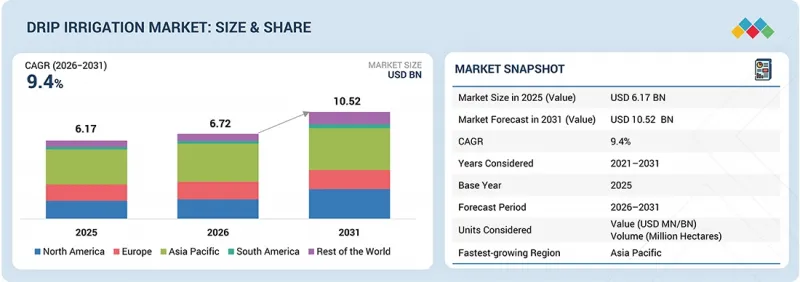
점적 관개 시장 규모는 2026년 672만 달러에서 2031년까지 1,052만 달러에 달할 것으로 예측되며, 2026년부터 2031년까지 CAGR은 9.4%를 기록할 전망입니다.
| 조사 범위 | |
|---|---|
| 조사 대상 기간 | 2026-2031년 |
| 기준 연도 | 2025년 |
| 예측 기간 | 2026-2031년 |
| 단위 | 금액(달러)·수량(헥타르) |
| 부문 | 드립퍼/이미터 유형, 작물 유형, 용도, 구성요소, 지역 |
| 대상 지역 | 북미, 유럽, 아시아태평양, 남미, 기타 지역 |
이 업계는 절수형 관개 시스템, 정밀 농업 기술, 지속가능한 농업에 대한 전 세계적인 수요 증가를 배경으로, 향후 10년 동안 강력한 성장이 예상됩니다. 스마트 관개 시스템, 자동화 기술, IoT 기반 농장 관리 소프트웨어, 비료 및 관개 기술, 기후 변화에 대응한 농업 인프라의 도입이 급속히 진행되고 있습니다.
Netafim이나 Rivulis와 같은 주요 기업을 비롯해 기타 업계 관계자들은 혁신적인 관개 자동화 제어, AI를 활용한 관개 스케줄링 시스템, 압력 보상형 점적 관개 시스템, 정밀 농업 용도에 최적화된 통합형 디지털 관개 관리 플랫폼에 주력하고 있습니다. 새로운 기술 혁신 및 제품 출시를 통해 물 이용 효율과 생산성을 높이기 위해 차세대 스마트 관개 컨트롤러, 클라우드 연동형 관개 관리 시스템, 지하 점적 관개 시스템, 원격 관개 모니터링 플랫폼, 태양광발전식 관개 시스템, 센서 통합형 비료 관개 제어 시스템의 개발이 진행되고 있습니다.
인프라 현대화, 여과 시스템, 첨단 방출기 기술, 정밀한 영양분 공급 플랫폼에 대한 투자 확대는 지속가능한 농업 생산의 확대, 자원 이용의 효율화, 기후를 고려한 농업을 촉진하고 있습니다. 지하수위 하락, 물 부족, 토양 침식 및 열화, 비효율적인 침수 관개 기술에 대한 우려는 앞으로도 첨단 점적 관개 시스템에 대한 수요를 지속적으로 견인할 것으로 보입니다.
점적 관개 시장의 기회와 변화:
전 세계 점적 관개 시장은 관개 장비 제조업체, 정밀 농업 솔루션 개발업체, 농업 기술 혁신 기업, 지속가능한 농업 솔루션 제공업체에게 큰 성장 기회를 제공하고 있습니다. 이 관계자들은 효율적인 물 관리 시스템에 대한 전 세계적인 수요 확대의 혜택을 누릴 수 있는 입장에 있습니다. 이 업계는 자동 관개, 비료 관개, 원격 감지, 빅데이터 분석, 실시간 농장 모니터링을 활용한 통합형 농장 관리 시스템의 개발을 뒷받침할 것으로 전망됩니다. 이를 통해 작물 수확량을 늘리고 물을 절약할 수 있습니다.
또한, 정밀 농업 기술 제공업체들은 관개 성능을 향상시키기 위해 고급 관개 자동화 하드웨어, 가변 비율 관개 구성요소, 기후 적응형 관개 인프라, 디지털 플랫폼 솔루션에 점점 더 집중하고 있습니다. 점적 관개 시장의 경쟁 구도는 정밀 농업 기술의 보급 확대, 물 이용 효율에 대한 정부의 중시, 기후 적응형 농업에 대한 관심 증가, 지속가능한 생산 인프라에 대한 투자 증가로 인해 향후 몇 년 동안 급속히 변화할 것으로 예상됩니다. 그 결과, 관개 자동화, 통합 농업 시스템, 빅데이터 분석, 고효율 관개 서비스에 투자하는 기업들은 지속적으로 성장하는 세계 점적 관개 업계에서 확고한 입지를 다지게 될 것입니다.
본 보고서에서는 전 세계 점적 관개 시장을 조사하여, 시장 개요, 시장 성장에 영향을 미치는 다양한 요인에 대한 분석, 기술 및 특허 동향, 법규제 환경, 사례 연구, 시장 규모 추정 및 전망, 각종 분류·지역/주요 국가별 상세 분석, 경쟁 구도, 주요 기업 개요 등을 정리하고 있습니다.
자주 묻는 질문
목차
제1장 소개
제2장 주요 요약
제3장 주요 인사이트
제4장 시장 개요
제5장 업계 동향
제6장 기술의 진보, AI의 영향, 특허, 혁신, 향후 응용
제7장 규제 상황과 지속가능성에 대한 대처
제8장 고객 상황과 구매 행동
제9장 점적 관개 시장 : 구성요소별
제10장 점적 관개 시장 : 작물 유형별
제11장 점적 관개 시장 : 이미터/드립퍼 유형별
제12장 점적 관개 시장 : 용도별
제13장 점적 관개 시장 : 지역별
제14장 경쟁 구도
제15장 기업 개요
제16장 조사 방법
제17장 인접 시장 및 관련 시장
제18장 부록
KSM 26.06.26The drip irrigation market is projected to reach USD 10.52 million by 2031 from USD 6.72 million in 2026, at a CAGR of 9.4% from 2026 to 2031.
| Scope of the Report | |
|---|---|
| Years Considered for the Study | 2026-2031 |
| Base Year | 2025 |
| Forecast Period | 2026-2031 |
| Units Considered | Value (USD) and Volume (Million Hectares) |
| Segments | Dripper/Emitter Type, Crop Type, Application, Component, and Region |
| Regions covered | North America, Europe, Asia Pacific, South America, RoW |
The industry is expected to experience strong growth over the next decade, driven by increasing global demand for water-efficient irrigation systems, precision farming technologies, and sustainable agricultural practices. There is a rapid adoption of smart irrigation systems, automation technologies, IoT-enabled farm management software, fertigation technologies, and climate-ready farming infrastructure.
Leading companies like Netafim and Rivulis, along with other industry participants, are focusing on innovative irrigation automation controls, AI-powered irrigation scheduling systems, pressure-compensated drip systems, and integrated digital irrigation management platforms tailored for precision farming applications. New innovations and product launches aim to develop next-generation smart irrigation controllers, cloud-connected irrigation management systems, subsurface drip irrigation systems, remote irrigation monitoring platforms, solar-powered irrigation systems, and sensor-integrated fertigation controls to enhance water-use efficiency and productivity.
The growing investments in infrastructure modernization, filtration systems, advanced emitter technology, and precision nutrient-delivery platforms are facilitating increased sustainable agricultural production, more efficient resource utilization, and climate-smart agricultural practices. Concerns about declining groundwater levels, water shortages, soil erosion and degradation, and inefficient flood irrigation techniques are likely to continue driving demand for advanced drip irrigation systems.
Opportunities and Disruptions in the Drip Irrigation Market:
The global market for drip irrigation presents significant growth opportunities for irrigation equipment manufacturers, precision agriculture solution developers, agri-tech innovators, and providers of sustainable farming solutions. These stakeholders are poised to benefit from the increasing global demand for efficient water management systems. This industry is poised to support the development of integrated farm management systems that employ automated irrigation, fertigation, remote sensing, big data analytics, and real-time farm monitoring to enhance crop yields and conserve water.
Moreover, providers of precision agriculture technologies are increasingly focusing on high-end irrigation automation hardware, variable-rate irrigation components, climate-adaptive irrigation infrastructure, and digital platform solutions to improve irrigation performance. The competitive landscape of the drip irrigation market is expected to evolve rapidly in the coming years due to the growing adoption of precision agriculture technologies, governmental emphasis on water efficiency, increased interest in climate-smart farming, and rising investments in sustainable production infrastructure. Consequently, companies that invest in irrigation automation, integrated farming systems, big data analytics, and high-efficiency irrigation services will establish strong positions in the expanding global drip irrigation industry.
- AI-driven Nutrient and Irrigation Management: The drip irrigation market is witnessing the integration of artificial intelligence (AI) and machine learning applications aimed at improving irrigation scheduling, water use efficiency, fertigation processes, and precision farming practices. These AI-driven systems analyze soil moisture, plant water demand, climate conditions, evapotranspiration, and field data to optimize irrigation operations while minimizing water waste. They facilitate predictive irrigation management, autonomous irrigation control, and remote farm management.
- Advanced Formulation Technologies: Recent technological advances in the drip irrigation sector focus on increasing system lifespan, enhancing irrigation accuracy, improving filtration, and automating water management across various agricultural fields. Research by Smarter Irrigation is exploring the impacts of pressure-discounting emitters, anti-watering drip lines, and both conventional and alternative subsurface drip irrigation systems. Additionally, automated water and nutrient management platforms and Internet of Things (IoT)-enabled irrigation management systems are being developed to significantly improve irrigation efficiency by tailoring irrigation to field configurations. A comprehensive smart irrigation environment, which includes an agriculture-specific network, a cloud-based monitoring platform, sensor-controlled water automation, sensor- and weather-based irrigation scheduling, and a connection platform between irrigation equipment and enterprise systems, is also being pioneered to simultaneously optimize water, fertilizer, and energy resources.
The drip mainlines/drip tubes segment held a significant market share in 2025.
The segment of drip mainlines/drip tubes is expected to hold a significant share of the global drip irrigation market. This growth is primarily driven by the extensive use of these components in the even distribution and transportation of water across agricultural fields. Drip mainlines and tubes serve as the backbone of drip irrigation systems and are widely used in applications such as field crops, orchards and vineyards, fruits and vegetables, plantation crops, and greenhouse cultivation.
The increasing adoption of precision irrigation technologies, the rising demand for durable drip irrigation infrastructure, and the growing investments in water-efficient farming practices are significantly driving the need for high-quality drip tubes and mainline systems worldwide. This segment is thriving due to the introduction of advanced technologies, including UV-resistant materials, pressure-compensating tubing, anti-clogging tubing, and multilayer polyethylene drip tubing systems. These innovations enhance durability, hydraulic performance, and efficiency during field operations.
Additionally, the growing popularity of automation and fertigation irrigation systems in commercial farming is further stimulating the increased adoption of innovative drip mainline and tubing systems.
In-depth interviews were conducted with chief executive officers (CEOs), directors, and other executives from various key organizations operating in the Biofertilizer Market:
- By Company Type: Tier 1 (25%), Tier 2 (45%), and Tier 3 (30%)
- By Designation: Directors (20%), Managers (50%), Executives (30%)
- By Region: North America (25%), Europe (30%), Asia Pacific (20%), South America (15%), and the Rest of the World (Middle East & Africa) (10%)
Prominent companies in the market include Netafim (Israel), Rivulis (Israel), The Toro Company (US), Hunter Industries (US), Valmont Industries Inc. (US), Rain Bird Corporation (US), Jain Irrigation Ltd (India), Chinadrip Irrigation Equipment (Xiamen) (China), Irriline Technologies (Canada), K-Rain Manufacturing (US), Shanghai Irrist Corp (China), Antelco (Australia), Microjet Irrigation System (India), Metzer (Israel), and Grupo Chamartin S.A. (Spain).
Research Coverage:
The global drip irrigation market is segmented by emitter/dripper type (inline emitters and online emitters), component (inline emitters, pressure pumps, drip mainlines/drip tubes, valves, emitters/drippers, filters & fertilizer injectors, and fittings & accessories), crop type (field crops, fruits & nuts, vegetable crops, and other crops), application (surface applications and subsurface applications), and region.
The scope of the report covers detailed information regarding the major factors, such as drivers, restraints, challenges, and opportunities, influencing the growth of the drip irrigation market. A detailed analysis of the key industry players has been done to provide insights into their business overview, solutions and services, key strategies, contracts, partnerships, and agreements. New product & service launches, mergers & acquisitions, and recent developments associated with the drip irrigation market. This report covers competitive analysis of upcoming startups in the global drip irrigation market ecosystem.
Reasons to buy this report:
The report will help market leaders and new entrants by providing the closest approximations of revenue figures for the overall drip irrigation market and its subsegments. This report will help stakeholders understand the competitive landscape and gain deeper insights to better position their businesses and plan suitable go-to-market strategies. The report also helps stakeholders understand the market pulse and provides information on key drivers, restraints, challenges, and opportunities.
The report provides insights into the following points:
1. The study examines key drivers (government subsidies accelerating drip irrigation adoption, rising demand for water-efficient irrigation systems, increasing focus on crop yield and input efficiency, and integration of precision agriculture and fertigation technologies), restraints (high initial installation costs, expensive maintenance and replacement requirements, and limited affordability among small-scale farmers), opportunities (expansion of precision farming practices, advancements in smart irrigation technologies, and untapped potential in emerging agricultural markets), and challenges (emitter clogging and soil salinity issues, environmental impact from equipment disposal, and limited technical awareness in rural farming regions)
2. Region-specific Insights with Focus on Emerging Markets: The report provides detailed country- and region-level analysis, highlighting growth opportunities across Asia Pacific, North America, Europe, Latin America, and the Middle East & Africa. It evaluates regional demand patterns, irrigation penetration, regulatory policies related to nutrient management, and investment trends in precision agriculture, offering strategic guidance for expansion and localization initiatives.
3. Competitive Intelligence and Innovation Landscape: Leading market participants include Netafim (Israel), Rivulis (Israel), The Toro Company (US), Hunter Industries (US), Valmont Industries Inc. (US), Rain Bird Corporation (US), Mahindra EPC Irrigation Ltd. (India), Chinadrip Irrigation Equipment (Xiamen) (China), Irriline Technologies (Canada), K-Rain Manufacturing (US), Shanghai Irrist Corp (China), Antelco (Australia), Microjet Irrigation System (India), Metzer (Israel), and Grupo Chamartin S.A. (Spain).
4. Demand Forecasts Backed by Data-driven Methodologies: Market sizing and growth projections through 2031 are developed using a combination of top-down and bottom-up approaches, validated by industry experts, trade associations, and official government data. These insights provide reliable guidance for investment planning and market opportunity assessment in the global sector.
TABLE OF CONTENTS
1 INTRODUCTION
- 1.1 STUDY OBJECTIVES
- 1.2 MARKET DEFINITION
- 1.2.1 INCLUSIONS AND EXCLUSIONS
- 1.3 STUDY SCOPE
- 1.3.1 YEARS CONSIDERED
- 1.4 CURRENCY CONSIDERED
- 1.5 UNITS CONSIDERED
- 1.6 STAKEHOLDERS
- 1.7 SUMMARY OF CHANGES
- 1.7.1 RECESSION IMPACT
2 EXECUTIVE SUMMARY
- 2.1 MARKET HIGHLIGHTS AND KEY INSIGHTS
- 2.2 KEY MARKET PARTICIPANTS: MAPPING OF STRATEGIC DEVELOPMENTS
- 2.3 DISRUPTIVE TRENDS IN DRIP IRRIGATION MARKET
- 2.4 HIGH-GROWTH SEGMENTS AND EMERGING FRONTIERS
- 2.5 REGIONAL SNAPSHOT: MARKET SIZE, GROWTH RATE, AND FORECAST
3 PREMIUM INSIGHTS
- 3.1 ATTRACTIVE OPPORTUNITIES FOR PLAYERS IN DRIP IRRIGATION MARKET
- 3.2 DRIP IRRIGATION MARKET, BY EMITTER/DRIPPER TYPE AND REGION
- 3.3 DRIP IRRIGATION MARKET, BY APPLICATION
- 3.4 DRIP IRRIGATION MARKET, BY COUNTRY/REGION
4 MARKET OVERVIEW
- 4.1 INTRODUCTION
- 4.2 MARKET DYNAMICS
- 4.2.1 DRIVERS
- 4.2.1.1 Government subsidies accelerating drip irrigation adoption
- 4.2.1.2 Rising demand for water-efficient irrigation systems
- 4.2.1.3 Increasing focus on crop yield and input efficiency
- 4.2.1.4 Integration of precision agriculture and fertigation technologies
- 4.2.2 RESTRAINTS
- 4.2.2.1 High initial installation costs
- 4.2.2.2 Expensive maintenance and replacement requirements
- 4.2.2.3 Limited affordability among small-scale farmers
- 4.2.3 OPPORTUNITIES
- 4.2.3.1 Expansion of precision farming practices
- 4.2.3.2 Advancements in smart irrigation technologies
- 4.2.3.3 Untapped potential in emerging agricultural markets
- 4.2.4 CHALLENGES
- 4.2.4.1 Emitter clogging and soil salinity issues
- 4.2.4.2 Environmental impact from equipment disposal
- 4.2.4.3 Limited technical awareness in rural farming regions
- 4.2.1 DRIVERS
- 4.3 UNMET NEEDS AND WHITE SPACES
- 4.3.1 UNMET NEEDS IN DRIP IRRIGATION MARKET
- 4.3.2 WHITE SPACE OPPORTUNITIES
- 4.4 INTERCONNECTED MARKETS AND CROSS-SECTOR OPPORTUNITIES
- 4.4.1 INTERCONNECTED MARKETS
- 4.4.2 CROSS-SECTOR OPPORTUNITIES
- 4.5 EMERGING BUSINESS MODELS AND ECOSYSTEM SHIFTS
- 4.5.1 EMERGING BUSINESS MODELS
- 4.5.2 ECOSYSTEM SHIFTS
- 4.6 STRATEGIC MOVES BY TIER-1/2/3 PLAYERS
- 4.6.1 KEY MOVES AND STRATEGIC FOCUS
5 INDUSTRY TRENDS
- 5.1 PORTER'S FIVE FORCES ANALYSIS
- 5.1.1 THREAT OF NEW ENTRANTS
- 5.1.2 THREAT OF SUBSTITUTES
- 5.1.3 BARGAINING POWER OF SUPPLIERS
- 5.1.4 BARGAINING POWER OF BUYERS
- 5.1.5 INTENSITY OF COMPETITIVE RIVALRY
- 5.2 MACROECONOMIC INDICATORS
- 5.2.1 ANNUAL FRESHWATER WITHDRAWALS FOR AGRICULTURE (%) OF TOTAL WATER WITHDRAWAL
- 5.2.2 AGRICULTURAL VALUE ADDED GROWTH AS MACROECONOMIC DRIVER OF DRIP IRRIGATION MARKET EXPANSION
- 5.3 VALUE CHAIN ANALYSIS
- 5.3.1 RAW MATERIAL SUPPLIERS
- 5.3.2 COMPONENT MANUFACTURING
- 5.3.3 SYSTEM DESIGN & PRODUCT MANUFACTURING
- 5.3.4 CUSTOMIZATION, BRANDING & PROJECT INTEGRATION
- 5.3.5 DISTRIBUTION & SUPPLY NETWORK
- 5.3.6 END USERS & POST-SALES SUPPORT
- 5.4 ECOSYSTEM ANALYSIS
- 5.4.1 DEMAND SIDE
- 5.4.2 SUPPLY SIDE
- 5.5 PRICING ANALYSIS
- 5.5.1 AVERAGE SELLING PRICE BY KEY PLAYERS FOR COMPONENTS
- 5.5.2 AVERAGE SELLING PRICE TREND, BY REGION
- 5.5.3 AVERAGE SELLING PRICE TREND, BY CROP TYPE
- 5.6 TRADE ANALYSIS
- 5.6.1 EXPORT SCENARIO OF HS CODE 8424
- 5.6.2 IMPORT SCENARIO OF HS CODE 8424
- 5.7 KEY CONFERENCES AND EVENTS, 2026
- 5.8 TRENDS/DISRUPTIONS IMPACTING CUSTOMER BUSINESS
- 5.9 CASE STUDY ANALYSIS
- 5.9.1 THE TORO COMPANY - AI-ENABLED SMART IRRIGATION SYSTEMS
- 5.9.2 JAIN IRRIGATION SYSTEMS - DIGITAL AGRICULTURE & IRRIGATION INTELLIGENCE
- 5.9.3 NETAFIM - PRECISION IRRIGATION WITH DIGITAL & AI-DRIVEN ADVISORY SYSTEMS
- 5.10 IMPACT OF 2026 US TARIFF - DRIP IRRIGATION MARKET
- 5.10.1 INTRODUCTION
- 5.10.2 KEY TARIFF RATES
- 5.10.3 PRICE IMPACT ANALYSIS
- 5.10.4 IMPACT ON COUNTRIES/REGIONS
- 5.10.4.1 China (Asia Pacific)
- 5.10.4.2 India
- 5.10.4.3 European Union
- 5.10.4.4 Brazil
- 5.10.5 IMPACT ON END-USE INDUSTRIES
6 TECHNOLOGICAL ADVANCEMENTS, AI-DRIVEN IMPACT, PATENTS, INNOVATIONS, AND FUTURE APPLICATIONS
- 6.1 KEY EMERGING TECHNOLOGIES
- 6.1.1 IOT-ENABLED SMART DRIP IRRIGATION SYSTEMS
- 6.1.2 PRESSURE-COMPENSATING AND SELF-REGULATING EMITTERS
- 6.1.3 AI-DRIVEN PRECISION IRRIGATION AND VARIABLE RATE SYSTEMS
- 6.2 COMPLEMENTARY TECHNOLOGIES
- 6.2.1 FERTIGATION AND NUTRIENT INJECTION SYSTEMS
- 6.2.2 SOIL MOISTURE MONITORING AND SENSOR NETWORKS
- 6.2.3 REMOTE SENSING AND SATELLITE-BASED CROP MONITORING
- 6.3 ADJACENT TECHNOLOGIES
- 6.3.1 AGRICULTURAL DRONES AND AERIAL CROP MONITORING
- 6.3.2 FARM MANAGEMENT SOFTWARE AND DIGITAL AGRICULTURE PLATFORMS
- 6.3.3 CONTROLLED ENVIRONMENT AGRICULTURE (CEA) AND GREENHOUSE AUTOMATION
- 6.4 TECHNOLOGY/PRODUCT ROADMAP
- 6.4.1 SHORT-TERM (2025-2027) | FOUNDATION & EARLY COMMERCIALIZATION
- 6.4.2 MID-TERM (2027-2030) | EXPANSION & STANDARDIZATION
- 6.4.3 LONG-TERM (2030-2035+) | MASS COMMERCIALIZATION & DISRUPTION
- 6.5 PATENT ANALYSIS
- 6.6 FUTURE APPLICATIONS
- 6.6.1 AI-DRIVEN AUTONOMOUS IRRIGATION
- 6.6.2 DIGITAL TWIN IRRIGATION MANAGEMENT
- 6.6.3 SMART SELF-REGULATING EMITTERS
- 6.6.4 INTEGRATED WATER AND NUTRIENT DELIVERY
- 6.6.5 CLIMATE-SMART IRRIGATION NETWORKS
- 6.7 IMPACT OF GENERATIVE AI ON DRIP IRRIGATION MARKET
- 6.7.1 INTRODUCTION
- 6.7.2 USE OF GENERATIVE AI ON DRIP IRRIGATION MARKET
- 6.7.3 TOP USE CASES AND MARKET POTENTIAL
- 6.7.4 BEST PRACTICES IN DRIP IRRIGATION INDUSTRY
- 6.7.5 CASE STUDIES OF AI IMPLEMENTATION IN DRIP IRRIGATION MARKET
- 6.7.6 INTERCONNECTED ADJACENT ECOSYSTEM AND IMPACT ON MARKET PLAYERS
- 6.7.7 CLIENTS' READINESS TO ADOPT GENERATIVE AI IN DRIP IRRIGATION MARKET
- 6.8 SUCCESS STORIES AND REAL-WORLD APPLICATIONS
7 REGULATORY LANDSCAPE AND SUSTAINABILITY INITIATIVES
- 7.1 REGIONAL REGULATIONS AND COMPLIANCE
- 7.1.1 INDUSTRY STANDARDS
- 7.2 SUSTAINABILITY INITIATIVES
- 7.3 IMPACT OF REGULATORY POLICIES ON SUSTAINABILITY INITIATIVES
- 7.4 CERTIFICATIONS, LABELING, ECO-STANDARDS
8 CUSTOMER LANDSCAPE AND BUYER BEHAVIOR
- 8.1 DECISION-MAKING PROCESS
- 8.2 KEY STAKEHOLDERS INVOLVED IN BUYING PROCESS AND THEIR EVALUATION CRITERIA
- 8.2.1 KEY STAKEHOLDERS IN BUYING PROCESS
- 8.2.2 BUYING CRITERIA
- 8.3 ADOPTION BARRIER AND INTERNAL CHALLENGES
- 8.4 UNMET NEEDS OF VARIOUS END USERS/END-USE INDUSTRIES
- 8.4.1 FIELD CROPS (CEREALS, PULSES, OILSEEDS)
- 8.4.2 FRUITS & NUTS
- 8.4.3 VEGETABLE CROPS
- 8.4.4 GREENHOUSE & PROTECTED CULTIVATION SECTOR
- 8.4.5 LANDSCAPE, TURF & COMMERCIAL APPLICATIONS
- 8.4.6 PLANTATION CROPS (COFFEE, TEA, SUGARCANE, COTTON, RUBBER)
- 8.5 MARKET PROFITABILITY
9 DRIP IRRIGATION MARKET, BY COMPONENT
- 9.1 INTRODUCTION
- 9.2 DRIP MAINLINES/DRIP TUBES
- 9.2.1 DURABLE WATER CONVEYANCE NETWORKS SUPPORTING EXPANSION OF PRECISION IRRIGATION SYSTEMS
- 9.3 FILTERS & FERTILIZER INJECTORS
- 9.3.1 ADVANCED FILTRATION AND NUTRIENT DELIVERY SYSTEMS SUPPORTING PRECISION IRRIGATION EFFICIENCY
- 9.4 FITTING & ACCESSORIES
- 9.4.1 MODULAR CONNECTION COMPONENTS ENHANCING FLEXIBILITY AND RELIABILITY OF DRIP IRRIGATION NETWORKS
- 9.5 EMITTERS/DRIPPERS
- 9.5.1 PRECISION WATER APPLICATION TECHNOLOGIES DRIVING ADOPTION OF EMITTERS AND DRIPPERS
- 9.6 PRESSURE PUMPS
- 9.6.1 ENERGY-EFFICIENT WATER PRESSURIZATION SYSTEMS ENHANCING DRIP IRRIGATION PERFORMANCE
- 9.7 VALVES
- 9.7.1 INTELLIGENT FLOW CONTROL SYSTEMS IMPROVING IRRIGATION ACCURACY AND RESOURCE EFFICIENCY
10 DRIP IRRIGATION MARKET, BY CROP TYPE
- 10.1 INTRODUCTION
- 10.2 FIELD CROPS
- 10.2.1 LARGE-SCALE WATER OPTIMIZATION PRACTICES ACCELERATING DRIP IRRIGATION ADOPTION IN FIELD CROPS
- 10.3 FRUITS & NUTS
- 10.3.1 PRECISION ORCHARD IRRIGATION SYSTEMS SUPPORTING YIELD QUALITY AND WATER EFFICIENCY IN FRUIT & NUT CULTIVATION
- 10.4 VEGETABLE CROPS
- 10.4.1 CONTROLLED MOISTURE MANAGEMENT SYSTEMS SUPPORTING HIGH PRODUCTIVITY IN VEGETABLE CROP CULTIVATION
- 10.5 OTHER CROP TYPES
11 DRIP IRRIGATION MARKET, BY EMITTER/DRIPPER TYPE
- 11.1 INTRODUCTION
- 11.2 INLINE EMITTERS
- 11.2.1 PRECISION WATER DISTRIBUTION EFFICIENCY STRENGTHENING ADOPTION OF INLINE EMITTERS
- 11.3 ONLINE EMITTERS
- 11.3.1 FLEXIBLE POINT-SOURCE IRRIGATION SOLUTIONS EXPANDING ADOPTION OF ONLINE EMITTERS
12 DRIP IRRIGATION MARKET, BY APPLICATION
- 12.1 INTRODUCTION
- 12.2 SURFACE APPLICATION
- 12.2.1 EFFICIENT ABOVE-GROUND WATER DELIVERY SYSTEMS DRIVING GROWTH OF SURFACE DRIP IRRIGATION APPLICATIONS
- 12.2.2 SUBSURFACE APPLICATION
- 12.2.2.1 Underground Precision Irrigation Systems Advancing Water Conservation and Crop Productivity
13 DRIP IRRIGATION MARKET, BY REGION
- 13.1 INTRODUCTION
- 13.2 NORTH AMERICA
- 13.2.1 US
- 13.2.1.1 Water Allocation Reform Accelerating Precision Irrigation Investment Across Commercial Agriculture
- 13.2.2 CANADA
- 13.2.2.1 Expansion of Greenhouses and Controlled-environment Agriculture Reshaping Irrigation Investment Priorities
- 13.2.3 MEXICO
- 13.2.3.1 Export Agriculture Modernization Driving Transition Toward Precision Water Management Systems
- 13.2.1 US
- 13.3 ASIA PACIFIC
- 13.3.1 CHINA
- 13.3.1.1 Water Security Priorities Accelerating Smart Irrigation Deployment Across Northern Agricultural Regions
- 13.3.2 INDIA
- 13.3.2.1 Micro-irrigation Subsidy Expansion and Water-stressed Agriculture Restructuring Farm Investment Priorities
- 13.3.3 JAPAN
- 13.3.3.1 Smart Agriculture Integration Accelerating Automation-centric Irrigation Infrastructure Development
- 13.3.4 AUSTRALIA
- 13.3.4.1 Drought Resilience Strategies and Precision Agriculture Integration Reshaping Irrigation Investments
- 13.3.5 REST OF ASIA PACIFIC
- 13.3.1 CHINA
- 13.4 EUROPE
- 13.4.1 TURKEY
- 13.4.1.1 Agricultural Water Modernization Programs Accelerating Precision Irrigation Deployment
- 13.4.2 FRANCE
- 13.4.2.1 Vineyard Water Optimization and Climate Adaptation Restructuring Irrigation Investments
- 13.4.3 GREECE
- 13.4.3.1 Water Scarcity Adaptation Strategies Reshaping Irrigation Investment Across Mediterranean Agriculture
- 13.4.4 ITALY
- 13.4.4.1 Mediterranean Water Stress Accelerating Transition Toward High-efficiency Irrigation Networks
- 13.4.5 SPAIN
- 13.4.5.1 Greenhouse Agriculture and Water Reuse Programs Restructuring Irrigation Infrastructure Priorities
- 13.4.6 REST OF EUROPE
- 13.4.1 TURKEY
- 13.5 SOUTH AMERICA
- 13.5.1 BRAZIL
- 13.5.1.1 Semi-arid Agricultural Transformation Accelerating Precision Irrigation Penetration
- 13.5.2 ARGENTINA
- 13.5.2.1 Vineyard Modernization and Water Allocation Pressure Reshaping Irrigation Priorities
- 13.5.3 REST OF SOUTH AMERICA
- 13.5.1 BRAZIL
- 13.6 REST OF THE WORLD (ROW)
- 13.6.1 AFRICA
- 13.6.1.1 Soil Restoration Initiatives and Fertilizer Accessibility Challenges Supporting Drip Irrigation Integration Across African Agriculture
- 13.6.2 MIDDLE EAST
- 13.6.2.1 Desalination-linked Agriculture and Water Efficiency Mandates Restructuring Irrigation Infrastructure Investment
- 13.6.1 AFRICA
14 COMPETITIVE LANDSCAPE
- 14.1 OVERVIEW
- 14.2 KEY PLAYER COMPETITIVE STRATEGIES/RIGHT TO WIN, 2020-2025
- 14.3 REVENUE ANALYSIS, 2020-2025
- 14.4 MARKET SHARE ANALYSIS, 2025
- 14.4.1 NETAFIM
- 14.4.2 RIVULIS
- 14.4.3 JAIN IRRIGATION SYSTEMS
- 14.4.4 THE TORO COMPANY
- 14.4.5 RAIN BIRD CORPORATION
- 14.5 PRODUCT COMPARISON
- 14.6 COMPANY EVALUATION MATRIX: KEY PLAYERS, 2025
- 14.6.1 STARS
- 14.6.2 EMERGING LEADERS
- 14.6.3 PERVASIVE PLAYERS
- 14.6.4 PARTICIPANTS
- 14.6.5 COMPANY FOOTPRINT: KEY PLAYERS, 2025
- 14.6.5.1 Company footprint
- 14.6.5.2 Component footprint
- 14.6.5.3 Application footprint
- 14.6.5.4 Crop type footprint
- 14.6.5.5 Emitter/Dripper type footprint
- 14.7 COMPANY VALUATION AND FINANCIAL METRICS
- 14.8 COMPANY EVALUATION MATRIX: STARTUPS/SMES, 2025
- 14.8.1 PROGRESSIVE COMPANIES
- 14.8.2 RESPONSIVE COMPANIES
- 14.8.3 DYNAMIC COMPANIES
- 14.8.4 STARTING BLOCKS
- 14.8.5 COMPETITIVE BENCHMARKING: STARTUPS/SMES, 2025
- 14.8.5.1 Detailed list of key startups/SMEs
- 14.8.5.2 Competitive benchmarking of key startups/SMEs
- 14.9 COMPETITIVE SCENARIO
- 14.9.1 PRODUCT LAUNCHES
- 14.9.2 DEALS
- 14.9.3 EXPANSIONS
15 COMPANY PROFILES
- 15.1 KEY PLAYERS
- 15.1.1 NETAFIM
- 15.1.1.1 Business overview
- 15.1.1.2 Products offered
- 15.1.1.3 Recent developments
- 15.1.1.3.1 Product launches
- 15.1.1.3.2 Deals
- 15.1.1.3.3 Expansions
- 15.1.1.4 MnM view
- 15.1.1.4.1 Right to win
- 15.1.1.4.2 Strategic choices
- 15.1.1.4.3 Weaknesses and competitive threats
- 15.1.2 RIVULIS
- 15.1.2.1 Business overview
- 15.1.2.2 Products offered
- 15.1.2.3 Recent developments
- 15.1.2.3.1 Product launches
- 15.1.2.3.2 Deals
- 15.1.2.3.3 Expansions
- 15.1.2.4 MnM view
- 15.1.2.4.1 Right to win
- 15.1.2.4.2 Strategic choices
- 15.1.2.4.3 Weaknesses and competitive threats
- 15.1.3 THE TORO COMPANY
- 15.1.3.1 Business overview
- 15.1.3.2 Products offered
- 15.1.3.3 Recent developments
- 15.1.3.3.1 Product launches
- 15.1.3.3.2 Expansions
- 15.1.3.4 MnM view
- 15.1.3.4.1 Right to win
- 15.1.3.4.2 Strategic choices
- 15.1.3.4.3 Weaknesses and competitive threats
- 15.1.4 HUNTER INDUSTRIES
- 15.1.4.1 Business overview
- 15.1.4.2 Products offered
- 15.1.4.3 Recent developments
- 15.1.4.3.1 Product launches
- 15.1.4.4 MnM view
- 15.1.4.4.1 Key strengths
- 15.1.4.4.2 Strategic choices
- 15.1.4.4.3 Weaknesses and competitive threats
- 15.1.5 JAIN IRRIGATION SYSTEMS LTD.
- 15.1.5.1 Business overview
- 15.1.5.2 Products/Services/Solutions offered
- 15.1.5.3 Recent developments
- 15.1.5.3.1 Product launches
- 15.1.5.3.2 Deals
- 15.1.5.4 MnM view
- 15.1.5.4.1 Right to win
- 15.1.5.4.2 Strategic choices
- 15.1.5.4.3 Weaknesses and competitive threats
- 15.1.6 VALMONT INDUSTRIES, INC
- 15.1.6.1 Business overview
- 15.1.6.2 Products offered
- 15.1.6.3 Recent developments
- 15.1.6.3.1 Product launches
- 15.1.6.4 MnM view
- 15.1.7 RAIN BIRD CORPORATION
- 15.1.7.1 Business overview
- 15.1.7.2 Products offered
- 15.1.7.3 Recent developments
- 15.1.7.3.1 Product launches
- 15.1.7.4 MnM view
- 15.1.8 CHINADRIP IRRIGATION EQUIPMENT CO., LTD.
- 15.1.8.1 Business overview
- 15.1.8.2 Products offered
- 15.1.8.3 Recent developments
- 15.1.8.3.1 Product launches
- 15.1.8.4 MnM view
- 15.1.9 IRRILINE TECHNOLOGIES CORP.
- 15.1.9.1 Business overview
- 15.1.9.2 Products offered
- 15.1.9.3 MnM view
- 15.1.10 K-RAIN MANUFACTURING
- 15.1.10.1 Business overview
- 15.1.10.2 Products offered
- 15.1.10.3 MnM view
- 15.1.11 SHANGHAI IRRIST CORP., LTD.
- 15.1.11.1 Business overview
- 15.1.11.2 Products/Services/Solutions offered
- 15.1.11.3 Recent developments
- 15.1.11.4 MnM view
- 15.1.12 ANTELCO
- 15.1.12.1 Business overview
- 15.1.12.2 Products offered
- 15.1.12.3 Recent developments
- 15.1.12.3.1 Deals
- 15.1.12.4 MnM view
- 15.1.13 MICROJET IRRIGATION SYSTEMS
- 15.1.13.1 Business overview
- 15.1.13.2 Products offered
- 15.1.13.3 MnM view
- 15.1.14 METZER
- 15.1.14.1 Business overview
- 15.1.14.2 Products offered
- 15.1.14.3 Recent developments
- 15.1.14.3.1 Expansions
- 15.1.14.4 MnM view
- 15.1.15 GRUPO CHAMARTIN S.A.
- 15.1.15.1 Business overview
- 15.1.15.2 Products offered
- 15.1.15.3 MnM view
- 15.1.1 NETAFIM
- 15.2 OTHER PLAYERS
- 15.2.1 AZUD
- 15.2.1.1 Business overview
- 15.2.1.2 Products offered
- 15.2.1.3 MnM view
- 15.2.2 DRIPWORKS
- 15.2.2.1 Business overview
- 15.2.2.2 Products offered
- 15.2.2.3 MnM view
- 15.2.3 IRRITEC S.P.A
- 15.2.3.1 Business overview
- 15.2.3.2 Products offered
- 15.2.3.3 Recent developments
- 15.2.3.3.1 Deals
- 15.2.3.3.2 Expansions
- 15.2.3.4 MnM view
- 15.2.4 KSNM DRIP
- 15.2.4.1 Business overview
- 15.2.4.2 Products offered
- 15.2.4.3 MnM view
- 15.2.5 GOLDEN KEY
- 15.2.5.1 Business overview
- 15.2.5.2 Products offered
- 15.2.5.3 MnM view
- 15.2.6 AGRODRIP
- 15.2.7 IRRIGATION DIRECT CANADA
- 15.2.8 SUJAY IRRIGATIONS PVT LTD.
- 15.2.9 BHARAT DRIP IRRIGATION AND AGRO
- 15.2.10 GLOBAL IRRIGATION, INC.
- 15.2.1 AZUD
16 RESEARCH METHODOLOGY
- 16.1 RESEARCH DATA
- 16.1.1 SECONDARY DATA
- 16.1.1.1 List of major secondary sources
- 16.1.1.2 Key data from secondary sources
- 16.1.2 PRIMARY DATA
- 16.1.2.1 Key data from primary sources
- 16.1.2.2 Key industry insights
- 16.1.2.3 Breakdown of primaries
- 16.1.1 SECONDARY DATA
- 16.2 MARKET SIZE ESTIMATION
- 16.2.1 BOTTOM-UP APPROACH
- 16.2.2 TOP-DOWN APPROACH
- 16.2.2.1 Approach to estimate market size using top-down analysis
- 16.3 DATA TRIANGULATION
- 16.4 RESEARCH ASSUMPTIONS
- 16.5 RESEARCH LIMITATIONS AND RISK ASSESSMENT
17 ADJACENT AND RELATED MARKETS
- 17.1 INTRODUCTION
- 17.2 LIMITATIONS
- 17.3 DRIPPERS MARKET
- 17.3.1 MARKET DEFINITION
- 17.3.2 MARKET OVERVIEW
- 17.4 IRRIGATION AUTOMATION MARKET
- 17.4.1 MARKET DEFINITION
- 17.4.2 MARKET OVERVIEW
18 APPENDIX
- 18.1 DISCUSSION GUIDE
- 18.2 KNOWLEDGESTORE: MARKETSANDMARKETS' SUBSCRIPTION PORTAL
- 18.3 CUSTOMIZATION OPTIONS
- 18.4 RELATED REPORTS
- 18.5 AUTHOR DETAILS


