

|
시장보고서
상품코드
2123500
점적 관개 시장 : 점유율 분석, 업계 동향과 통계, 성장 예측(2026-2031년)Drip Irrigation - Market Share Analysis, Industry Trends & Statistics, Growth Forecasts (2026 - 2031) |
||||||
 Mordor Intelligence
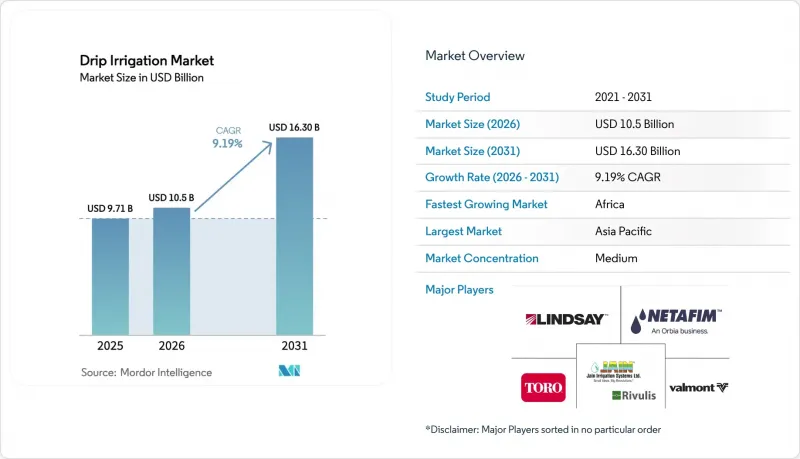
Mordor Intelligence에 의하면, 점적 관개 시장 규모는 2025년에 97억 1,000만 달러로 평가되었고 2026년에는 105억 달러에 이를 것으로 추정되고 있습니다.
또한 연평균 성장률(CAGR) 9.19%로 성장하여 2031년까지 163억 달러에 달할 것으로 예측되며, 이는 절수형 농업 시스템으로의 결정적인 전환을 여실히 보여주고 있습니다.

본 보고서는 용도별(지표 드립 관개 등), 구성 부품별(에미터/드리퍼 등), 작물별(밭작물 등), 최종 사용자별(상업 농장 등), 판매 채널별(직접 판매 등), 지역별(북미, 유럽 등)로 분류되어 있습니다. 시장 전망은 금액(달러) 및 수량(단위)으로 제시되어 있습니다.
세계 점적 관개 시장 동향 및 인사이트
촉진요인의 영향 분석
미세 관개에 대한 정부 보조금
세제상의 우대 조치로 인해 상업 농가의 자본 회수 기간이 단축되고 있습니다. 인도의 ‘프라단 만트리 크리시 신차이 요자나(Pradhan Mantri Krishi Sinchayee Yojana)’에서는 2016 회계연도부터 2025 회계연도에 걸쳐 2,196억 8,700만 루피(26억 달러)가 지급되어, 소규모 농가의 시스템 비용 중 최대 55%가 보조되었습니다. 미국에서는 ‘환경 품질 인센티브 프로그램(EQIP)’을 통해 연간 3억 달러가 배정되고 있으며, 2024년에는 지원 대상 프로젝트의 42%를 점적 관개가 차지했습니다. 이스라엘에서는 세액 공제를 통해 실질적인 자본 지출이 30% 감소한 반면, 사우디아라비아에서는 10헥타르를 초과하는 신규 농장에 점적 관개를 의무화하고 5억 달러의 보조금을 투입했습니다. 각 프로그램에서 채소나 과수원 등 고부가가치 작물의 경우 투자 회수 기간이 2.5년 미만으로 나타나고 있으며, 이것이 점적 관개 시장의 지속적인 성장을 견인하고 있습니다.
자금 면의 제약이 소규모 농가의 도입을 방해하고 있습니다.
헥타르당 1,200-1,800달러에 달하는 설치 비용은 많은 2헥타르 규모 농장의 연간 농업 소득을 초과합니다. 인도에서는 55%의 보조금이 지급되지만, 본인 부담금은 여전히 1헥타르당 540달러를 초과하여 무담보 대출 한도를 넘어섭니다. 방글라데시에서 시행된월15달러의 ‘사용량 기반 지불’ 방식 시범 사업에서는 72%의 상환률을 달성했으나, 여전히 소규모에 그치고 있습니다. 하드웨어 가격이 20%-30% 더 하락할 때까지는 자금 조달이 작물의 생육 주기에 맞추어 이루어지게 되겠지만, 세분화된 농지에서의 보급률은 점적 관개 시장 전체에 비해 뒤처지게 될 것입니다.
부문 분석
2025년, 시용 방법별 부문에서 지표면 점적 관개는 67.0%라는 최대 점유율을 유지했습니다. 이는 설치 비용이 낮고 일년생 작물에 적합하다는 점을 반영한 것입니다. 지하 점적 관개는 가장 빠르게 성장하는 하위 부문으로, 과수원 및 포도원 운영자들이 증발에 의한 물 손실과 잡초 피해 경감에 주력하고 있기 때문에 2031년까지 연평균 성장률(CAGR) 11.6%로 확대될 것으로 예측됩니다. 장기적인 물 스트레스 증가로 인해 고급 작물 이외의 분야에서도 지하 점적 관개 도입이 진행되고 있어, 예측 기간이 끝날 무렵에는 점적 관개 시장 내에서의 기여도가 높아질 것으로 전망됩니다.
부품 가격이 점차 하락하고 제어 기술이 향상됨에 따라, 생산자들은 지하 관개 라인에 토양 수분 센서를 결합하고 관개 일정을 미세 조정함으로써 고급 과수원의 물 이용 효율을 최대 90%까지 높이고 있습니다. 인도의 주 정부 보조금과 캘리포니아주의 ‘지속 가능한 지하수 관리법’에 따른 배수량 감축 조치 역시 매설형 시스템을 뒷받침하고 있으며, 투자 회수 기간을 4시즌 미만으로 단축시키고 있습니다. 지상형 시스템은 단주기 작물에서 계속해서 중요한 역할을 할 것입니다. 그러나 전기 요금 상승과 증발량 규제의 강화로 인해 자본은 점차 지하식 설비로 재분배될 전망입니다. 이러한 변화들이 맞물리면서 두 방식 모두 균형 잡힌 성장을 유지하겠지만, 지하식 기술의 더 빠른 보급이 점적 관개 시장의 장기적인 설비 갱신 기반이 될 것입니다.
2025년에는 정기적인 교체 주기와 광대한 재배 면적의 확대에 힘입어, 점적 튜브·라인이 구성 부품별 부문에서 30.0%라는 최대 점유율을 차지했습니다. 컨트롤러와 센서는 가장 빠르게 성장하는 하위 부문으로, 농장의 관개 자동화, 최대 30%의 인력 감축, 실시간 기상 데이터 통합이 진행됨에 따라 2031년까지 연평균 성장률(CAGR) 14.0%로 확대될 것으로 전망됩니다. 따라서 디지털 하드웨어와 연동되는 점적 관개 시장 규모는 센서 가격 하락과 투자 회수 기간을 3년 미만으로 단축하는 클라우드 기반 분석 기술에 힘입어, 시장 전체의 성장 속도를 크게 상회하는 추세를 보이고 있습니다.
고부가가치 전자기기의 성장 또한, 상품화된 급수 노즐 부문에서 경쟁이 치열해지는 가운데 기존 기업들이 이익률을 지키는 데 한몫하고 있습니다. 현재 중국산 압력 보정형 유닛은 개당 0.08달러에 판매되고 있습니다. 수질 문제와 Off-grid화 추세를 반영하여 필터와 펌프에 대한 수요는 꾸준히 증가하고 있지만, 성능 면에서 명확한 차별화 요소는 여전히 디지털 기기에 있습니다. 각 제조업체는 컨트롤러에 소프트웨어 구독 서비스를 번들로 제공함으로써 지속적인 수익을 창출하고, 향후 업그레이드를 위한 고객 기반을 확보하고 있습니다. 도입이 메가 팜에서 중규모 사업자로 확대됨에 따라 센서의 보급률은 더욱 가속화될 것이며, 컨트롤러와 센서는 부품 수준의 성장에서 계속해서 선두를 달릴 것입니다.
지역별 분석
아시아태평양은 가장 큰 시장 점유율을 차지하고 있으며, 2025년 점적 관개 시장의 전 세계 매출의 42%를 차지하고 있습니다. 인도의 유리한 보조금 제도와 중국의 광범위한 현대화 노력 덕분에 생산자들은 광대한 경작 면적을 전환하도록 장려받고 있으며, 이를 통해 판매업체들은 사업 규모를 신속하게 확대할 수 있게 되었습니다. 각국 정부는 자본 보조금과 수도 요금 개혁을 결합하여 중규모 농장에서도 자동화 시스템이 경제적으로 합리적인 선택이 되도록 하고 있습니다. 또한, 각 제조업체들은 인도와 호주에서 생산 현지화를 추진하고 있으며, 이를 통해 물류 비용이 절감되고 대규모 프로젝트의 납기 기간이 단축되고 있습니다. 토양 센서와 기상 데이터를 통합한 디지털 플랫폼은 신장의 대형 면화 농장과 일본·한국의 특산 작물 생산자들 사이에서 얼리 어답터들을 끌어모으고 있습니다.
아시아태평양의 확대는 인도 갠지스 평야 전역에 걸친 지속적인 지하수 고갈과 호주 머레이-달링 강 유역에서 반복되는 가뭄에 힘입고 있습니다. 각국의 기후 변화 대응 계획에는 적응 대책의 목표로 미세 관개가 포함되어 있어, 컨트롤러,필터, 점적 관개용 테이프에 대한 다년간의 확실한 수요가 창출되고 있습니다. 인도의 강력한 유통업체 네트워크와 정부의 마켓플레이스는 소규모 농가를 체계적인 조달 채널에 임베디드시키는 것을 촉진하고 있으며, 이곳에서는 설치 공사와 농업 기술 지원이 패키지로 제공되고 있습니다. 태국과 베트남의 수출 지향형 과수 재배 농가들은 고급 시장을 겨냥해 안정적인 품질을 확보하기 위해 지하 관개 라인을 도입하고 있습니다. 이에 대응하여 공급업체들은 구독형 원격 모니터링 서비스를 제공함으로써 중요한 생육 단계에서 시스템의 가동 시간을 보장하고 있습니다.
아프리카는 하드웨어와 농업 기술 교육을 결합한 개발은행의 대출에 힘입어 2031년까지 연평균 성장률(CAGR) 11.0%를 기록하며 가장 빠른 성장이 예상됩니다. 케냐에서는 반건조 지역 카운티에 점적 관개 키트를 도입하여, 불안정한 강우로 인한 작물 손실을 줄이고 식량 안보 성과를 향상시키고 있습니다. 이집트에서는 점적 관개 시스템을 활용하여 사막 농업을 추진하고 있으며, 지표수 자원이 제한적임에도 불구하고 감귤류와 포도 같은 고부가가치 작물의 수출을 실현하고 있습니다. 남아프리카공화국 웨스트케이프주 와인 산지에서는 센서 제어 방식의 점적 관개를 통해 물 부족 관개 전략을 채택하여, 장기적인 가뭄 상황에서도 포도나무를 보호하고 있습니다. 중동의 생산자, 유럽 지중해 연안의 재배자, 그리고 북미의 과수원 경영자들은 이러한 성공 사례에 주목하여 유사한 모델을 도입하고 있으며, 절수형 농업을 향한 전 세계적인 추세를 더욱 강화하고 있습니다.
기타 혜택:
- 엑셀 형식 시장 예측(ME) 시트
- 3개월간의 애널리스트 지원
자주 묻는 질문
목차
제1장 서론
제2장 조사 방법
제3장 주요 요약
제4장 시장 구도
제5장 시장 규모와 성장 예측
제6장 경쟁 구도
제7장 시장 기회와 향후 전망
JHS 26.09.09According to Mordor Intelligence, the drip irrigation market size was valued at USD 9.71 billion in 2025 and is estimated to reach USD 10.50 billion in 2026, further projected to grow at a CAGR of 9.19% to reach USD 16.30 billion by 2031, underscoring a decisive shift toward water-efficient farming systems.
This report is Segmented by Application (Surface Drip Irrigation and More), by Component (Emitters / Drippers, and More), by Crop Type (Field Crops, and More), by End-User (Commercial Farms, and More), by Sales Channel (Direct Sales, and More), and by Geography (North America, Europe, and More). The Market Forecasts are Provided in Terms of Value (USD) and Volume (Units).
Global Drip Irrigation Market Trends and Insights
Drivers Impact Analysis
Government subsidies for micro-irrigation
Fiscal incentives compress capital-recovery timelines for commercial growers. India's Pradhan Mantri Krishi Sinchayee Yojana disbursed INR 21,968.7 crore (USD 2.6 billion) between fiscal years 2016 and 2025, subsidizing up to 55% of the system cost for small farmers. The United States allocated USD 300 million annually through the Environmental Quality Incentives Program, with drip accounting for 42% of funded projects in 2024. Israel's tax credits trimmed effective capital outlay by 30%, while Saudi Arabia mandated drip on new farms larger than 10 hectares, channeling USD 500 million in grants. Across programs, payback now falls below 2.5 years for high-value crops, such as vegetables and orchards, driving sustained growth in the drip irrigation market.
Capital Constraints Limit Smallholder Adoption
Installation costs of USD 1,200-USD 1,800 per hectare exceed annual farm incomes in many two-hectare operations. Despite 55% subsidies in India, out-of-pocket spending still tops USD 540 per hectare, above collateral-free borrowing limits. Pay-as-you-go pilots in Bangladesh, priced at USD 15 per month, achieved a 72% repayment rate yet remain small-scale. Until hardware prices drop by another 20%-30%, financing will align with crop cycles, however, penetration in fragmented holdings will lag behind the broader drip irrigation market.
Other drivers and restraints analyzed in the detailed report include:
- Precision agriculture adoption
- Escalating water scarcity
- Internet of Things (IoT) Sensor Integration Unlocks Precision Water Management
- Clogging Escalates Operating Costs in Hard-Water Zones
For complete list of drivers and restraints, kindly check the Table Of Contents.
Segment Analysis
Surface drip irrigation retained the largest share at 67.0% of the by-application segment in 2025, reflecting its lower installation cost and suitability for annual crops. Subsurface drip irrigation is the fastest-growing sub-segment and is projected to expand at an 11.6% CAGR through 2031, as orchard and vineyard operators focus on reducing evaporative losses and weed pressure. Rising long-term water stress drives the adoption of subsurface irrigation beyond premium crops, increasing its contribution to the drip irrigation market by the end of the forecast window.
As component prices gradually decline and guidance technologies improve, growers are pairing subsurface lines with soil-moisture sensors that fine-tune scheduling, increasing water-use efficiency to up to 90% in premium orchards. State incentives in India and allocation cuts under the Sustainable Groundwater Management Act in California also favor buried systems, shortening payback periods to fewer than four seasons. Surface systems will remain influential for short-cycle crops. However, rising electricity tariffs and stricter evaporation caps will progressively reallocate capital toward subsurface installations. The combined shift sustains balanced growth across both formats, but the faster trajectory of subsurface technology underpins long-run upgrades in the drip irrigation market.
Drip tubes and lines held the largest share at 30.0% of the by-component segment in 2025, driven by regular replacement cycles and the expansion of broad acreage. Controllers and sensors represent the fastest-growing sub-segment, advancing at a 14.0% CAGR through 2031 as farms automate water delivery, trim labor by up to 30%, and integrate real-time weather data. The drip irrigation market size, linked to digital hardware, therefore tracks well above the overall market pace, buoyed by falling sensor prices and cloud-based analytics that compress the payback period to less than three years.
Growth in higher-value electronics also helps incumbents shield margins as price competition intensifies for commoditized emitters, where Chinese pressure-compensating units now sell for USD 0.08 each. Filters and pumps are rising steadily in response to water-quality and off-grid trends, yet digital devices remain the clear performance differentiator. Manufacturers bundle software subscriptions with controllers, generating recurring revenue and securing clients for future upgrades. As adoption spreads from mega-farms to mid-size operators, sensor penetration will continue to accelerate, keeping controllers and sensors at the forefront of component-level growth.
Complete Report Scope:
- By Application
- Surface Drip Irrigation
- Subsurface Drip Irrigation
- By Component
- Emitters and Drippers
- Drip Tubes and Lines
- Filters
- Pressure Pumps
- Valves and Fittings
- Controllers and Sensors
- Accessories (Stake, Joiners, and Plugs)
- By Crop Type
- Field Crops
- Vegetable Crops
- Orchard Crops
- Vineyards
- Other Crops (Commercial and Ornamental)
- By End-User
- Commercial Farms
- Greenhouses and Nurseries
- Residential Gardens and Landscapes
- Sports Fields and Golf Courses
- By Sales Channel
- Direct Sales
- Dealer and Distributor
- Online Retail
- By Geography
- North America
- United States
- Canada
- Mexico
- Rest of North America
- Europe
- Germany
- United Kingdom
- France
- Spain
- Italy
- Russia
- Rest of Europe
- Asia-Pacific
- India
- China
- Japan
- South Korea
- Australia
- Rest of Asia-Pacific
- South America
- Brazil
- Argentina
- Chile
- Rest of South America
- Middle East
- Israel
- Saudi Arabia
- United Arab Emirates
- Turkey
- Rest of Middle East
- Africa
- South Africa
- Egypt
- Kenya
- Rest of Africa
- North America
Geography Analysis
The Asia-Pacific region holds the largest market share, accounting for 42% of the global revenue in the drip irrigation market in 2025. Favorable subsidy programs in India and broad modernization efforts in China encourage growers to convert vast field-crop acreage, allowing distributors to scale quickly. Governments couple capital grants with water-pricing reforms, making automated systems economically sensible even for mid-size farms. Manufacturers also localize production in India and Australia, reducing logistics costs and shortening delivery times for high-volume projects. Digital platforms that integrate soil sensors and weather data are attracting early adopters among large cotton estates in Xinjiang and specialty crop producers in Japan and South Korea.
Asia-Pacific's expansion is underpinned by persistent groundwater depletion across the Indo-Gangetic Plain and by recurring drought in Australia's Murray-Darling Basin. National climate action plans incorporate micro-irrigation into adaptation targets, creating a dependable multi-year demand for controllers, filters, and drip tape. Strong dealer networks in India and government e-marketplaces facilitate the integration of smallholders into organized procurement channels, which bundle installation with agronomic support. Export-oriented fruit growers in Thailand and Vietnam adopt subsurface lines to secure consistent quality for premium markets. Suppliers respond by offering subscription-based remote monitoring, ensuring system uptime during critical growth stages.
Africa is projected to record the fastest growth, registering an 11.0% CAGR through 2031, propelled by development-bank financing that pairs hardware with agronomic training. Kenya deploys drip kits in semi-arid counties, reducing crop losses from erratic rainfall and improving food security outcomes. Egypt promotes desert agriculture with the use of drip systems, enabling the high-value export of citrus and grapes despite its limited surface water resources. South Africa's Western Cape wine region adopts deficit-irrigation strategies through sensor-guided drip irrigation, safeguarding vines during prolonged droughts. Middle East producers, Europe's Mediterranean growers, and North American orchardists observe these successes and adapt similar models, reinforcing global momentum toward water-efficient farming.
- Netafim Limited (Orbia Advance Corporation)
- Jain Irrigation Systems Ltd. (Rivulis Irrigation Ltd.)
- The Toro Company
- Rain Bird Corporation
- Valmont Industries Inc.
- Rivulis Irrigation Ltd.
- Lindsay Corporation
- Chinadrip Irrigation Equipment Co. Ltd.
- Antelco Pty Ltd.
- Sistema Azud S.A.
- Metzer Group Ltd.
- Mahindra EPC Irrigation Ltd.
- Irritec S.p.A.
- Hunter Industries Inc.
- Dayu Irrigation Group Co. Ltd.
Additional Benefits:
- The market estimate (ME) sheet in Excel format
- 3 months of analyst support
TABLE OF CONTENTS
1 Introduction
- 1.1 Study Assumptions and Market Definition
- 1.2 Scope of the Study
2 Research Methodology
3 Executive Summary
4 Market Landscape
- 4.1 Market Overview
- 4.2 Market Drivers
- 4.2.1 Government subsidies for micro-irrigation
- 4.2.2 Precision agriculture adoption
- 4.2.3 Escalating water scarcity
- 4.2.4 Proven 20%-40% yield gains
- 4.2.5 Internet of Things (IoT) Sensor Integration Unlocks Precision Water Management
- 4.2.6 Climate-resilient cropping mandates
- 4.3 Market Restraints
- 4.3.1 Capital Constraints Limit Smallholder Adoption
- 4.3.2 Clogging Escalates Operating Costs in Hard-Water Zones
- 4.3.3 Dealer Fragmentation Impedes Service Quality
- 4.3.4 Electricity Subsidies Distort Irrigation Choices
- 4.4 Regulatory Landscape
- 4.5 Technological Outlook
- 4.6 Porter's Five Forces Analysis
- 4.6.1 Threat of New Entrants
- 4.6.2 Bargaining Power of Buyers
- 4.6.3 Bargaining Power of Suppliers
- 4.6.4 Threat of Substitutes
- 4.6.5 Intensity of Competitive Rivalry
5 Market Size and Growth Forecasts (Value)
- 5.1 By Application
- 5.1.1 Surface Drip Irrigation
- 5.1.2 Subsurface Drip Irrigation
- 5.2 By Component
- 5.2.1 Emitters and Drippers
- 5.2.2 Drip Tubes and Lines
- 5.2.3 Filters
- 5.2.4 Pressure Pumps
- 5.2.5 Valves and Fittings
- 5.2.6 Controllers and Sensors
- 5.2.7 Accessories (Stake, Joiners, and Plugs)
- 5.3 By Crop Type
- 5.3.1 Field Crops
- 5.3.2 Vegetable Crops
- 5.3.3 Orchard Crops
- 5.3.4 Vineyards
- 5.3.5 Other Crops (Commercial and Ornamental)
- 5.4 By End-User
- 5.4.1 Commercial Farms
- 5.4.2 Greenhouses and Nurseries
- 5.4.3 Residential Gardens and Landscapes
- 5.4.4 Sports Fields and Golf Courses
- 5.5 By Sales Channel
- 5.5.1 Direct Sales
- 5.5.2 Dealer and Distributor
- 5.5.3 Online Retail
- 5.6 By Geography
- 5.6.1 North America
- 5.6.1.1 United States
- 5.6.1.2 Canada
- 5.6.1.3 Mexico
- 5.6.1.4 Rest of North America
- 5.6.2 Europe
- 5.6.2.1 Germany
- 5.6.2.2 United Kingdom
- 5.6.2.3 France
- 5.6.2.4 Spain
- 5.6.2.5 Italy
- 5.6.2.6 Russia
- 5.6.2.7 Rest of Europe
- 5.6.3 Asia-Pacific
- 5.6.3.1 India
- 5.6.3.2 China
- 5.6.3.3 Japan
- 5.6.3.4 South Korea
- 5.6.3.5 Australia
- 5.6.3.6 Rest of Asia-Pacific
- 5.6.4 South America
- 5.6.4.1 Brazil
- 5.6.4.2 Argentina
- 5.6.4.3 Chile
- 5.6.4.4 Rest of South America
- 5.6.5 Middle East
- 5.6.5.1 Israel
- 5.6.5.2 Saudi Arabia
- 5.6.5.3 United Arab Emirates
- 5.6.5.4 Turkey
- 5.6.5.5 Rest of Middle East
- 5.6.6 Africa
- 5.6.6.1 South Africa
- 5.6.6.2 Egypt
- 5.6.6.3 Kenya
- 5.6.6.4 Rest of Africa
- 5.6.1 North America
6 Competitive Landscape
- 6.1 Market Concentration
- 6.2 Strategic Moves
- 6.3 Market Share Analysis
- 6.4 Company Profiles (Includes Global level Overview, Market level overview, Core Segments, Financials as Available, Strategic Information, Market Rank/Share for key companies, Products and Services, and Recent Developments)
- 6.4.1 Netafim Limited (Orbia Advance Corporation)
- 6.4.2 Jain Irrigation Systems Ltd. (Rivulis Irrigation Ltd.)
- 6.4.3 The Toro Company
- 6.4.4 Rain Bird Corporation
- 6.4.5 Valmont Industries Inc.
- 6.4.6 Rivulis Irrigation Ltd.
- 6.4.7 Lindsay Corporation
- 6.4.8 Chinadrip Irrigation Equipment Co. Ltd.
- 6.4.9 Antelco Pty Ltd.
- 6.4.10 Sistema Azud S.A.
- 6.4.11 Metzer Group Ltd.
- 6.4.12 Mahindra EPC Irrigation Ltd.
- 6.4.13 Irritec S.p.A.
- 6.4.14 Hunter Industries Inc.
- 6.4.15 Dayu Irrigation Group Co. Ltd.


