
|
시장보고서
상품코드
2074456
대기질 모니터링 시스템 시장 : 오염물질별, 제품별, 최종사용자별, 샘플링 방법별, 지역별 - 예측(-2031년)Air Quality Monitoring Systems Market by Product, Pollutant, Sampling, End User - Global Forecast to 2031 |
||||||

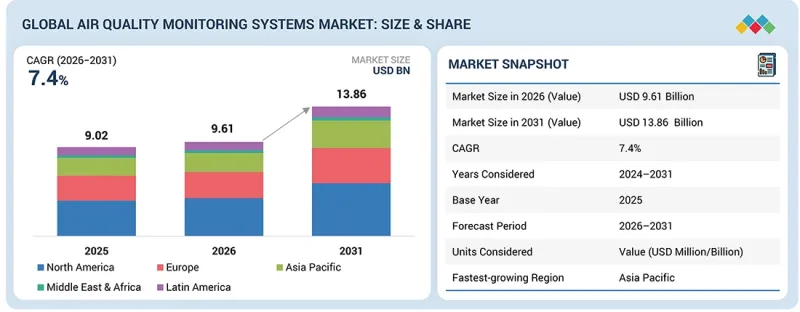
세계의 대기질 모니터링 시스템 시장 규모는 2026년 96억 1,000만 달러에서 2031년까지 138억 6,000만 달러에 이를 것으로 예측되며, 예측 기간에 CAGR 7.4%를 기록할 전망입니다.
공기질 모니터링 시스템의 기술 발전 가속화는 예측 기간 동안 시장 성장을 견인할 것으로 예상되는 주요 요인 중 하나입니다.
| 조사 범위 | |
|---|---|
| 조사 대상 기간 | 2026-2031년 |
| 기준연도 | 2025년 |
| 예측 기간 | 2026-2031년 |
| 산정 단위 | 금액(10억 달러) |
| 부문 | 오염물질별, 제품별, 최종사용자별, 샘플링 방법별, 지역별 |
| 대상 지역 | 북미, 유럽, 아시아태평양, 라틴아메리카, 중동 및 아프리카 |
“예측 기간 동안 공기질 모니터링 시스템 시장에서 실외용 모니터가 가장 높은 연평균 성장률(CAGR)을 보일 것으로 전망됩니다.”
제품별로 보면, 공기질 모니터링 시스템 시장은 실내용, 실외용 및 웨어러블형 모니터로 분류됩니다. 실외용 모니터 부문은 예측 기간 동안 가장 높은 연평균 성장률(CAGR)을 보일 것으로 전망됩니다. 스마트 시티 구상의 확산, 환경 모니터링 시스템에 대한 투자 확대, 그리고 교통 거점, 산업 단지, 건설 현장, 공공 장소에서의 실시간 모니터링 시스템 활용 확대 등이 시장 성장을 이끄는 요인 중 일부가 되고 있습니다. 또한, IoT 기반 센서, 무선 통신, 클라우드 컴퓨팅, 휴대용 실외 모니터 등의 기술 개발도 예측 기간 동안 해당 부문의 성장을 뒷받침하고 있습니다.
“정부 기관 및 학술 기관은 예측 기간(2026년-2031년) 동안 가장 높은 연평균 성장률(CAGR)을 보일 것으로 예측됩니다.”
최종 사용자별로 보면, 공기질 모니터링 시스템 시장은 정부 기관·학술 기관, 석유화학 산업, 상업·주거 사용자, 발전소, 제약 업계, 스마트시티 당국, 기타 최종 사용자로 구분됩니다. AQM 제품의 주요 최종 사용자는 정부 기관 및 학술 기관입니다. 이 최종 사용자 부문의 성장은 환경 안전 확보를 위한 정부의 개입이 강화되고 있는 데다, 대기 오염 모니터링 솔루션에 대한 지출 증가에 힘입어 견인되고 있습니다. 정부 기관과 환경 당국은 오염 수준 측정, 환경 기준 준수 확보, 적절한 정책 수립을 목적으로 전국적인 공기질 모니터링 솔루션을 도입하고 있습니다. 또한, 대학에서는 기후 변화, 대기 과학, 오염 방지, 그리고 대기 오염이 인간의 건강에 미치는 영향에 관한 다양한 연구 프로젝트가 진행되고 있습니다.
“지역별로 살펴보면, 아시아태평양 시장은 예측 기간(2026년-2031년) 동안 가장 높은 연평균 성장률(CAGR)을 보일 것으로 예측됩니다.”
지역별로 보면, 공기질 모니터링 시스템 시장은 북미, 유럽, 아시아태평양, 라틴아메리카, 중동 및 아프리카로 분류됩니다. 아시아태평양은 예측 기간 동안 가장 높은 연평균 성장률(CAGR)을 보일 것으로 예측됩니다. 오염 수준 감소를 지원하는 정부의 이니셔티브와 엄격한 배출 규제로 인해 시장 성장이 더욱 가속화되고 있습니다. 많은 국가들이 스마트시티 구축, 공기질 모니터링 시스템 및 실시간 모니터링 시스템 구축에 주력하고 있습니다. 또한, 해외 투자와 산업화에 따라 저비용 센서, 휴대용 모니터, IoT를 활용한 공기질 모니터링 시스템의 사용이 증가하고 있으며, 이는 아시아태평양의 공기질 모니터링 시스템 시장에 막대한 성장 기회를 제공합니다.
공기질 모니터링 시스템 시장의 주요 기업으로는 Thermo Fisher Scientific(미국), Emerson Electric(미국), GE Power(미국), Siemens AG(독일), Teledyne Technologies(미국), PerkinElmer, Inc.(미국), Agilent Technologies, Inc.(미국), Spectris plc(영국), 3M Company(미국), Honeywell International Inc(미국), HORIBA, Ltd.(일본), Merck KGaA(독일), TSI Incorporated(미국), Tisch Environmental(미국), Testo(독일) 등이 있습니다.
조사 범위
본 보고서에서는 샘플링 방법, 오염 물질, 제품, 최종 사용자 및 지역별로 공기질 모니터링 시스템 시장을 조사했습니다. 또한, 시장 성장에 영향을 미치는 요인을 종합적으로 다루고, 시장의 기회와 과제를 분석하는 한편, 시장을 선도하는 기업들 간경쟁 구도에 대한 상세한 정보를 제공합니다. 또한, 본 보고서에서는 개별 동향을 바탕으로 마이크로마켓을 분석하고, 5개 주요 지역(및 해당 지역 내 각국 시장)별 시장 부문의 매출 전망을 제시하고 있습니다.
이 보고서를 구매해야 하는 이유
본 보고서는 기존 기업뿐만 아니라 신규 진출기업 및 중소기업에게도 시장 동향을 파악하는 데 도움이 되며, 결과적으로 시장 점유율 확대로 이어질 것입니다. 본 보고서를 구매하신 기업은 다음 전략 중 하나 또는 여러 가지를 조합하여 활용함으로써 시장에서 입지를 강화할 수 있습니다.
본 보고서에서는 다음 사항에 대한 인사이트를 제공합니다.
- 주요 촉진요인(산업화 및 도시화 진전에 따른 대기질 관리(AQM)에 관한 정부의 이니셔티브, 환경 보전을 위한 민관 협력 노력) 분석, 제약 요인(고가 제품 가격 책정, 표준화된 규제 및 모니터링 체계의 부재), 기회(IoT 대응 및 AI 기반 모니터링 시스템 도입 확대, 스마트 시티 프로젝트 확대), 그리고 과제(대기오염 대책 개혁의 미흡한 이행, 신종 오염물질 규명과 관련된 과제) 등, 공기질 모니터링 시스템 시장의 성장에 영향을 미치는 요인에 대한 인사이트를 제공합니다.
- 시장 침투: 공기질 모니터링 시스템 시장에서 주요 기업들이 제공하는 제품 포트폴리오에 대한 종합적인 정보
- 제품 개발 및 혁신 : 공기질 모니터링 시스템 시장의 향후 동향, 연구개발 활동 및 신제품 출시에 관한 상세한 분석
- 시장 개발: 수익성이 높은 신흥 지역에 대한 종합적인 정보
- 시장의 다양화: 공기질 모니터링 시스템 시장의 신제품, 급성장 중인 지역 및 최근 동향에 관한 종합적인 정보
- 경쟁사 분석 : 시장 세분화, 성장 전략, 수익 분석 및 주요 시장 진출기업의 제품에 대한 상세한 평가
자주 묻는 질문
목차
제1장 서론
제2장 주요 요약
제3장 프리미엄 인사이트
제4장 시장 개요
제5장 업계 동향
제6장 기술, 특허, 디지털 기술, AI 도입에 의한 전략적 파괴
제7장 고객 현황과 구매 행동
제8장 대기질 모니터링 시스템 시장(오염물질 별)
제9장 대기질 모니터링 시스템 시장(제품별)
제10장 대기질 모니터링 시스템 시장(최종사용자별)
제11장 대기질 모니터링 시스템 시장(샘플링 방법별)
제12장 대기질 모니터링 시스템 시장(지역별)
제13장 경쟁 구도
제14장 기업 개요
제15장 조사 방법
제16장 부록
LSH 26.07.06The global air quality monitoring systems market is projected to reach USD 13.86 billion by 2031 from USD 9.61 billion in 2026, growing at a CAGR of 7.4% during the forecast period. The rise in technological advancements in air quality monitoring systems is one of the major factors anticipated to boost market growth over the forecast period.
| Scope of the Report | |
|---|---|
| Years Considered for the Study | 2026-2031 |
| Base Year | 2025 |
| Forecast Period | 2026-2031 |
| Units Considered | Value (USD billion) |
| Segments | Sampling Method, Pollutant, Product, End User, and Region |
| Regions covered | North America, Europe, Asia Pacific, Latin America, and the Middle East & Africa |
"Outdoor monitors to grow with the highest CAGR in the air quality monitoring systems market during the forecast period."
By product, the air quality monitoring systems market is segmented into indoor, outdoor, and wearable monitors. The outdoor monitors segment is expected to grow at the highest CAGR during the forecast period. The increasing use of smart city initiatives, growing investments in environmental monitoring systems, and increasing use of real-time monitoring systems at transportation nodes, industrial sites, construction sites, and open places are some of the factors driving the growth of the market. Technological developments, including IoT-based sensors, wireless communication, cloud computing, and portable outdoor monitors, are also aiding the segment's growth during the forecast period.
"Government agencies and academic institutes are expected to register the highest CAGR during the forecast period (2026-2031)."
Based on end users, the air quality monitoring systems market is segmented into government agencies & academic institutes, the petrochemical industry, commercial & residential users, power generation plants, the pharmaceutical industry, smart city authorities, and other end users. The major end users of AQM products are government agencies & academic institutes. The growth of this end-user segment is driven by the government's increasing participation in ensuring environmental safety, along with rising spending on air pollution monitoring solutions. Government bodies and environmental agencies are implementing national air quality monitoring solutions to measure pollution levels, ensure compliance with environmental norms, and formulate appropriate policy. In addition, universities are working on various research projects related to climate change, atmospheric science, pollution control, and the impact of air pollution on human health.
"The Asia Pacific market, by region, is expected to register the highest CAGR during the forecast period (2026-2031)."
By region, the air quality monitoring systems market is segmented into North America, Europe, Asia Pacific, Latin America, and the Middle East & Africa. Asia Pacific is expected to have the highest CAGR during the forecast period. With supportive government initiatives and strict emissions control regulations to help reduce pollution levels, growth in the market is being further propelled. Several nations are focusing on building smart cities, ambient air monitoring systems, and real-time monitoring systems. In addition, the use of low-cost sensors, portable monitors, and air quality monitoring systems that use IoT is rising due to foreign investments and industrialization, which provides immense growth opportunities in the Asia Pacific air quality monitoring systems market.
A breakdown of the primary participants referred to for this report is provided below:
- By Company Type: Tier 1-45%, Tier 2-25%, and Tier 3- 20%
- By Designation: C-level-50%, Director-level-30%, and Others-20%
- By Region: North America-36%, Europe-25%, Asia Pacific-27%, Latin America-9%, and the Middle East & Africa-3%
The prominent players in the air quality monitoring systems market are Thermo Fisher Scientific (US), Emerson Electric (US), GE Power (US), Siemens AG (Germany), Teledyne Technologies (US), PerkinElmer, Inc. (US), Agilent Technologies, Inc. (US), Spectris plc (UK), 3M Company (US), Honeywell International Inc (US), HORIBA, Ltd. (Japan), Merck KGaA (Germany), TSI Incorporated (US), Tisch Environmental (US), and Testo (Germany), among others.
Research Coverage
This report studies the air quality monitoring systems market by sampling method, pollutant, product, end user, and region. It also covers the factors affecting market growth, analyzes the opportunities and challenges in the market, and provides details on the competitive landscape among market leaders. Furthermore, the report analyzes micro-markets by their individual growth trends and forecasts market segment revenue across five main regions (and the respective countries within these regions).
Reasons to Buy the Report
The report will enable established firms, as well as entrants/smaller firms, to gauge the pulse of the market, which, in turn, will help them garner a larger market share. Firms purchasing the report could use one or a combination of the following strategies to strengthen their market presence.
This report provides insights into the following pointers:
- Analysis of key drivers (Government initiatives for AQM due to rising industrialization and urbanization, Favorable public-private initiatives for environmental conservation), restraints (Premium product pricing, Lack of standardized regulations and monitoring frameworks), opportunities (Rising adoption of IoT-enabled and AI-based monitoring systems, Expansion of smart city projects), and challenges (Inadequate implementation of air pollution control reforms, Challenges associated with identifying emerging pollutants) influencing the growth of air quality monitoring systems market
- Market Penetration: Comprehensive information on the product portfolios offered by the top players in the air quality monitoring systems market
- Product Development/Innovation: Detailed insights on the upcoming trends, R&D activities, and product launches in the air quality monitoring systems market
- Market Development: Comprehensive information on lucrative emerging regions
- Market Diversification: Exhaustive information about new products, growing geographies, and recent developments in the air quality monitoring systems market
- Competitive Assessment: In-depth assessment of market segments, growth strategies, revenue analysis, and products of the leading market players
TABLE OF CONTENTS
1 INTRODUCTION
- 1.1 STUDY OBJECTIVES
- 1.2 MARKET DEFINITION
- 1.3 MARKET SCOPE
- 1.3.1 MARKETS COVERED
- 1.3.2 INCLUSIONS AND EXCLUSIONS
- 1.3.3 YEARS CONSIDERED
- 1.4 CURRENCY CONSIDERED
- 1.5 STAKEHOLDERS
- 1.6 SUMMARY OF CHANGES
2 EXECUTIVE SUMMARY
- 2.1 MARKET HIGHLIGHTS AND KEY INSIGHTS
- 2.2 DISRUPTIVE TRENDS IN AIR QUALITY MONITORING SYSTEM MARKET
- 2.3 HIGH GROWTH SEGMENTS
- 2.4 REGIONAL SNAPSHOT: MARKET SIZE, GROWTH RATE, AND FORECAST
3 PREMIUM INSIGHTS
- 3.1 AIR QUALITY MONITORING SYSTEMS MARKET OVERVIEW
- 3.2 NORTH AMERICA: AIR QUALITY MONITORING SYSTEMS MARKET, BY POLLUTANT, 2025
- 3.3 GEOGRAPHIC SNAPSHOT OF AIR QUALITY MONITORING SYSTEMS MARKET
4 MARKET OVERVIEW
- 4.1 INTRODUCTION
- 4.2 MARKET DYNAMICS
- 4.2.1 DRIVERS
- 4.2.1.1 Increasingly stringent environmental regulations and air quality standards
- 4.2.1.2 Expanding smart city initiatives and government-funded monitoring infrastructure
- 4.2.1.3 Rising urbanization, industrialization, and associated air pollution burden
- 4.2.2 RESTRAINTS
- 4.2.2.1 Regulatory uncertainty and policy volatility
- 4.2.2.2 High installation, operational, and maintenance costs
- 4.2.3 OPPORTUNITIES
- 4.2.3.1 Growing adoption of portable, wearable, and consumer-grade air quality monitoring solutions
- 4.2.3.2 Cloud-based environmental analytics and air quality data platforms
- 4.2.4 CHALLENGES
- 4.2.4.1 Cybersecurity risks and data privacy in connected monitoring networks
- 4.2.4.2 Challenges associated with identifying emerging pollutants
- 4.2.1 DRIVERS
- 4.3 UNMET NEEDS
- 4.4 INTERCONNECTED MARKETS & CROSS-SECTOR OPPORTUNITIES
- 4.5 STRATEGIC MOVES BY TIER1/2/3 PLAYERS
5 INDUSTRY TRENDS
- 5.1 PORTER'S FIVE FORCES ANALYSIS
- 5.1.1 BARGAINING POWER OF BUYERS
- 5.1.2 BARGAINING POWER OF SUPPLIERS
- 5.1.3 THREAT OF NEW ENTRANTS
- 5.1.4 THREAT OF SUBSTITUTES
- 5.1.5 INTENSITY OF COMPETITIVE RIVALRY
- 5.2 MACROECONOMIC INDICATORS
- 5.2.1 GDP TRENDS AND FORECAST
- 5.2.2 TRENDS IN GLOBAL AIR QUALITY MONITORING INDUSTRY
- 5.3 SUPPLY CHAIN ANALYSIS
- 5.4 VALUE CHAIN ANALYSIS
- 5.5 ECOSYSTEM ANALYSIS
- 5.6 PRICING ANALYSIS
- 5.6.1 AVERAGE SELLING PRICE OF AIR QUALITY MONITORING SYSTEMS, BY KEY PLAYER, 2025
- 5.6.2 AVERAGE SELLING PRICE OF PRODUCT, BY KEY PLAYERS, 2023-2025 (USD)
- 5.6.3 AVERAGE SELLING PRICE TREND, BY REGION, 2025
- 5.7 TRADE ANALYSIS
- 5.7.1 IMPORT DATA FOR HS CODE 902710
- 5.7.2 IMPORT DATA FOR GAS OR SMOKE ANALYSIS APPARATUS (HS CODE 902710)
- 5.7.3 EXPORT DATA FOR SMOKE ANALYSIS APPARATUS (HS CODE 902710)
- 5.8 KEY CONFERENCES & EVENTS, 2026-2027
- 5.9 TRENDS/DISRUPTIONS IMPACTING CUSTOMER BUSINESS
- 5.9.1 AI-DRIVEN DIGITAL TRANSFORMATION AND EXPANDING APPLICATION LANDSCAPE IN AIR QUALITY MONITORING MARKET
- 5.10 INVESTMENT & FUNDING SCENARIO
- 5.11 CASE STUDY ANALYSIS
- 5.11.1 CASE STUDY
- 5.12 IMPACT OF 2025 US TARIFF ON AIR QUALITY MONITORING SYSTEM MARKET
- 5.12.1 INTRODUCTION
- 5.12.2 KEY TARIFF RATES
- 5.12.3 KEY TARIFF RATES
- 5.12.4 PRICE IMPACT ANALYSIS
- 5.12.5 IMPACT ON COUNTRY/REGION
- 5.12.5.1 US
- 5.12.5.2 Europe
- 5.12.5.3 Asia Pacific
- 5.12.6 IMPACT ON END-USE INDUSTRIES
6 STRATEGIC DISRUPTION THROUGH TECHNOLOGY, PATENTS, DIGITAL, AND AI ADOPTIONS
- 6.1 KEY EMERGING TECHNOLOGIES
- 6.1.1 ARTIFICIAL INTELLIGENCE (AI) AND MACHINE LEARNING (ML)
- 6.1.2 INTERNET OF THINGS (IOT)-ENABLED AIR QUALITY MONITORING
- 6.2 COMPLEMENTARY TECHNOLOGIES
- 6.2.1 SMART CITY AND DIGITAL INFRASTRUCTURE PLATFORMS
- 6.2.2 GEOGRAPHIC INFORMATION SYSTEMS
- 6.2.3 CONTINUOUS EMISSIONS MONITORING SYSTEMS
- 6.3 PATENT ANALYSIS
- 6.4 IMPACT OF AI/GEN AI ON AIR QUALITY MONITORING SYSTEM MARKET
- 6.4.1 TOP USE CASES AND MARKET POTENTIAL
- 6.4.2 BEST PRACTICES IN AIR QUALITY MONITORING SYSTEM
- 6.4.3 CASE STUDIES OF AI IMPLEMENTATION IN AIR QUALITY MONITORING SYSTEM MARKET
- 6.4.4 INTERCONNECTED ADJACENT ECOSYSTEMS AND IMPACT ON MARKET PLAYERS
- 6.4.5 CLIENTS' READINESS TO ADOPT GENERATIVE AI IN AIR QUALITY MONITORING SYSTEM MARKET
- 6.5 SUCCESS STORIES AND REAL-WORLD APPLICATIONS
- 6.5.1 REGULATORY ANALYSIS
- 6.5.2 KEY REGULATORY BODIES AND GOVERNMENT AGENCIES
- 6.6 KEY REGULATORY ORGANIZATIONS
- 6.6.1 NORTH AMERICA
- 6.6.2 EUROPE
- 6.6.3 ASIA PACIFIC
- 6.6.4 LATIN AMERICA
- 6.6.5 MIDDLE EAST & AFRICA
- 6.6.6 INDUSTRY STANDARDS
7 CUSTOMER LANDSCAPE AND BUYER BEHAVIOR
- 7.1 DECISION MAKING PROCESS
- 7.2 BUYER STAKEHOLDERS & BUYING EVALUATION CRITERIA
- 7.2.1 KEY STAKEHOLDERS IN BUYING PROCESS
- 7.2.2 KEY BUYING CRITERIA
- 7.3 ADOPTION BARRIERS AND INTERNAL CHALLENGES
- 7.4 UNMET NEEDS FROM VARIOUS END USE CUSTOMERS
8 AIR QUALITY MONITORING SYSTEMS MARKET, BY POLLUTANT
- 8.1 INTRODUCTION
- 8.2 CHEMICAL POLLUTANTS
- 8.2.1 NITROGEN OXIDES
- 8.2.1.1 Increase in refining and industrial combustion activities to drive market growth
- 8.2.2 SULFUR OXIDES
- 8.2.2.1 Growing focus on industrial air pollution control to propel market growth
- 8.2.3 CARBON OXIDES
- 8.2.3.1 Increasing urbanization and energy consumption to support market growth
- 8.2.4 VOLATILE ORGANIC COMPOUNDS
- 8.2.4.1 Indoor air quality awareness and industrial compliance requirements to support market growth
- 8.2.5 OTHER CHEMICAL POLLUTANTS
- 8.2.1 NITROGEN OXIDES
- 8.3 PHYSICAL POLLUTANTS
- 8.3.1 STRINGENT AIR QUALITY STANDARDS FOR PARTICULATE MATTER TO PROPEL MARKET GROWTH
- 8.3.2 PM 2.5
- 8.3.2.1 Growing evidence of health risks associated with fine particulate matter to support market growth
- 8.3.3 PM 10
- 8.3.3.1 Need to combat rising dust emissions from construction and industrial activities to propel market growth
- 8.4 BIOLOGICAL POLLUTANTS
- 8.4.1 GROWTH IN PHARMACEUTICAL AND BIOTECHNOLOGY MANUFACTURING ACTIVITIES TO DRIVE MARKET GROWTH
9 AIR QUALITY MONITORING SYSTEMS MARKET, BY PRODUCT
- 9.1 INTRODUCTION
- 9.2 INDOOR MONITORS
- 9.2.1 FIXED INDOOR MONITORS
- 9.2.1.1 Rising need to maintain controlled indoor environment to drive market
- 9.2.2 PORTABLE INDOOR MONITORS
- 9.2.2.1 Growing demand for flexible and on-demand air quality assessment to drive market
- 9.2.1 FIXED INDOOR MONITORS
- 9.3 OUTDOOR MONITORS
- 9.3.1 PORTABLE OUTDOOR MONITORS
- 9.3.1.1 Increasing investments in low-cost sensor networks and smart monitoring technologies to drive market
- 9.3.2 FIXED OUTDOOR MONITORS
- 9.3.2.1 Stringent environmental regulations and expanding regulatory monitoring networks to drive market
- 9.3.3 DUST & PARTICULATE MATTER MONITORS
- 9.3.3.1 Increasing focus on particulate pollution control and public health protection to drive market
- 9.3.4 AQM STATIONS
- 9.3.4.1 Increasing installation of AQM stations to propel market
- 9.3.1 PORTABLE OUTDOOR MONITORS
- 9.4 WEARABLE MONITORS
- 9.4.1 GROWING DEMAND FOR PERSONALIZED EXPOSURE MONITORING AND OCCUPATIONAL HEALTH PROTECTION TO DRIVE MARKET
- 9.5 SENSORS
- 9.5.1 GROWING ADOPTION OF CONNECTED AND REAL-TIME AIR QUALITY MONITORING SOLUTIONS TO DRIVE MARKET
- 9.6 SOFTWARE
- 9.6.1 INCREASING DEMAND FOR REAL-TIME ENVIRONMENTAL INTELLIGENCE AND REGULATORY COMPLIANCE TO DRIVE MARKET
10 AIR QUALITY MONITORING SYSTEMS MARKET, BY END USER
- 10.1 INTRODUCTION
- 10.2 GOVERNMENT AGENCIES AND ACADEMIC INSTITUTES
- 10.2.1 RISING GOVERNMENT INVESTMENTS IN AIR QUALITY MONITORING INFRASTRUCTURE TO DRIVE MARKET
- 10.3 COMMERCIAL & RESIDENTIAL USERS
- 10.3.1 ADOPTION OF SMART BUILDING TECHNOLOGIES AND INDOOR AIR QUALITY MONITORING SOLUTIONS TO DRIVE MARKET
- 10.4 PETROCHEMICAL INDUSTRY
- 10.4.1 STRINGENT EMISSION REGULATIONS AND GROWING FOCUS ON METHANE LEAK DETECTION TO DRIVE MARKET
- 10.5 POWER GENERATION PLANTS
- 10.5.1 STRINGENT EMISSION CONTROL REGULATIONS AND INVESTMENTS IN POWER PLANT MODERNIZATION TO PROPEL MARKET GROWTH
- 10.6 SMART CITY AUTHORITIES
- 10.6.1 INCREASING INTEGRATION OF AIR QUALITY MONITORING INTO SMART CITY PLATFORMS TO SUPPORT MARKET GROWTH
- 10.7 PHARMACEUTICAL INDUSTRY
- 10.7.1 INCREASING REGULATORY REQUIREMENTS FOR STERILE MANUFACTURING ENVIRONMENTS TO DRIVE MARKET
- 10.8 OTHER END USERS
11 AIR QUALITY MONITORING SYSTEMS MARKET, BY SAMPLING METHOD
- 11.1 INTRODUCTION
- 11.2 ACTIVE/CONTINUOUS MONITORING
- 11.2.1 REAL-TIME AIR QUALITY ASSESSMENT CAPABILITIES TO DRIVE MARKET
- 11.3 MANUAL MONITORING
- 11.3.1 COST-EFFECTIVE REGULATORY SAMPLING AND LABORATORY-BASED POLLUTANT ANALYSIS TO DRIVE MARKET GROWTH
- 11.4 PASSIVE MONITORING
- 11.4.1 EFFECTIVE AND LARGE-SCALE DEPLOYMENT TO SUPPORT MARKET GROWTH
- 11.5 INTERMITTENT MONITORING
- 11.5.1 COST-EFFECTIVE PERIODIC AIR QUALITY ASSESSMENTS TO DRIVE MARKET GROWTH
- 11.6 STACK MONITORING
- 11.6.1 ADOPTION DRIVEN BY STRINGENT ENVIRONMENTAL REGULATIONS
12 AIR QUALITY MONITORING SYSTEMS MARKET, BY REGION
- 12.1 INTRODUCTION
- 12.2 NORTH AMERICA
- 12.2.1 US
- 12.2.1.1 Regulatory enforcement, wildfire monitoring, and smart air quality networks driving market growth
- 12.2.2 CANADA
- 12.2.2.1 Government climate initiatives and wildfire-driven air quality concerns supporting market expansion
- 12.2.1 US
- 12.3 EUROPE
- 12.3.1 GERMANY
- 12.3.1.1 Strong regulatory enforcement and industrial decarbonization initiatives to drive air quality monitoring system adoption
- 12.3.2 UK
- 12.3.2.1 Rapid technology adoption and government initiatives to support market growth
- 12.3.3 FRANCE
- 12.3.3.1 Strong regulatory oversight and urban air pollution control programs to sustain demand for air quality monitoring systems
- 12.3.4 ITALY
- 12.3.4.1 Persistent air pollution challenges and regulatory compliance requirements driving air quality monitoring investments
- 12.3.5 SPAIN
- 12.3.5.1 Digital monitoring networks, smart-city programs, and satellite-based analytics emerging as key market trends
- 12.3.6 REST OF EUROPE
- 12.3.1 GERMANY
- 12.4 ASIA PACIFIC
- 12.4.1 JAPAN
- 12.4.1.1 Sustained public investment in environmental infrastructure to drive market growth
- 12.4.2 CHINA
- 12.4.2.1 Stringent government scrutiny on entry of private players to hamper market growth
- 12.4.3 INDIA
- 12.4.3.1 Active government involvement in air pollution monitoring and control to drive market
- 12.4.4 AUSTRALIA
- 12.4.4.1 Rising awareness of indoor air quality and public health impacts to drive market
- 12.4.5 SOUTH KOREA
- 12.4.5.1 Government-led fine dust reduction and air quality improvement programs to propel market growth
- 12.4.6 REST OF ASIA PACIFIC
- 12.4.1 JAPAN
- 12.5 LATIN AMERICA
- 12.5.1 BRAZIL
- 12.5.1.1 Expansion of industrial emissions monitoring and smart environmental infrastructure to fuel market growth
- 12.5.2 MEXICO
- 12.5.2.1 Growing urban air pollution, industrial expansion, and environmental regulations to drive growth
- 12.5.3 REST OF LATIN AMERICA
- 12.5.1 BRAZIL
- 12.6 MIDDLE EAST & AFRICA
- 12.6.1 GCC COUNTRIES
- 12.6.2 REST OF MIDDLE EAST & AFRICA
13 COMPETITIVE LANDSCAPE
- 13.1 OVERVIEW
- 13.2 KEY PLAYER STRATEGIES/RIGHT TO WIN
- 13.2.1 OVERVIEW OF STRATEGIES ADOPTED BY PLAYERS IN AIR QUALITY MONITORING SYSTEMS MARKET
- 13.3 REVENUE ANALYSIS
- 13.4 COMPANY EVALUATION MATRIX: KEY PLAYERS
- 13.4.1 STARS
- 13.4.2 EMERGING LEADERS
- 13.4.3 PERVASIVE PLAYERS
- 13.4.4 PARTICIPANTS
- 13.4.5 COMPANY FOOTPRINT ANALYSIS
- 13.5 COMPANY EVALUATION MATRIX: STARTUPS/SMES
- 13.5.1 PROGRESSIVE COMPANIES
- 13.5.2 RESPONSIVE COMPANIES
- 13.5.3 DYNAMIC COMPANIES
- 13.5.4 STARTING BLOCKS
- 13.5.5 COMPETITIVE BENCHMARKING
- 13.6 COMPANY VALUATION & FINANCIAL METRICS
- 13.7 BRAND/PRODUCT COMPARISON
- 13.8 COMPETITIVE SCENARIO
- 13.8.1 PRODUCT LAUNCHES
- 13.8.2 DEALS
- 13.8.3 EXPANSIONS
14 COMPANY PROFILES
- 14.1 KEY PLAYERS
- 14.1.1 THERMO FISHER SCIENTIFIC, INC.
- 14.1.1.1 Business overview
- 14.1.1.2 Products offered
- 14.1.1.3 Recent developments
- 14.1.1.3.1 Product launches and approvals
- 14.1.1.3.2 Deals
- 14.1.1.3.3 Expansions
- 14.1.1.4 MnM view
- 14.1.1.4.1 Key strengths
- 14.1.1.4.2 Strategic choices
- 14.1.1.4.3 Weaknesses and competitive threats
- 14.1.2 SIEMENS AG
- 14.1.2.1 Business overview
- 14.1.2.2 Products offered
- 14.1.2.3 Recent developments
- 14.1.2.3.1 Product launches and approvals
- 14.1.2.3.2 Other developments
- 14.1.2.4 MnM view
- 14.1.2.4.1 Key strengths
- 14.1.2.4.2 Strategic choices
- 14.1.2.4.3 Weaknesses and competitive threats
- 14.1.3 TELEDYNE TECHNOLOGIES INCORPORATED
- 14.1.3.1 Business overview
- 14.1.3.2 Products offered
- 14.1.3.3 MnM view
- 14.1.3.3.1 Key strengths
- 14.1.3.3.2 Strategic choices
- 14.1.3.3.3 Weaknesses and competitive threats
- 14.1.4 EMERSON ELECTRIC CO.
- 14.1.4.1 Business overview
- 14.1.4.2 Products offered
- 14.1.4.3 Recent developments
- 14.1.4.3.1 Product launches and approvals
- 14.1.4.3.2 Deals
- 14.1.4.4 MnM view
- 14.1.4.4.1 Key strengths
- 14.1.4.4.2 Strategic choices
- 14.1.4.4.3 Weaknesses and competitive threats
- 14.1.5 GE VERNOVA
- 14.1.5.1 Business overview
- 14.1.5.2 Products offered
- 14.1.6 3M
- 14.1.6.1 Business overview
- 14.1.6.2 Products offered
- 14.1.7 HORIBA, LTD.
- 14.1.7.1 Business overview
- 14.1.7.2 Products offered
- 14.1.7.3 Recent developments
- 14.1.7.3.1 Product launches and approvals
- 14.1.7.3.2 Expansions
- 14.1.8 MERCK KGAA
- 14.1.8.1 Business overview
- 14.1.8.2 Products offered
- 14.1.8.3 Recent developments
- 14.1.8.3.1 Expansions
- 14.1.9 SPECTRIS
- 14.1.9.1 Business overview
- 14.1.9.2 Products offered
- 14.1.9.3 Recent developments
- 14.1.9.3.1 Product launches and approvals
- 14.1.9.3.2 Deals
- 14.1.10 TSI
- 14.1.10.1 Business overview
- 14.1.10.2 Products offered
- 14.1.10.2.1 Product launches and approvals
- 14.1.10.2.2 Deals
- 14.1.11 TESTO SE & CO. KGAA
- 14.1.11.1 Business overview
- 14.1.11.2 Products offered
- 14.1.12 HONEYWELL INTERNATIONAL INC.
- 14.1.12.1 Business overview
- 14.1.12.2 Products offered
- 14.1.12.3 Recent developments
- 14.1.12.3.1 Product launches and approvals
- 14.1.12.3.2 Deals
- 14.1.13 AGILENT TECHNOLOGIES, INC.
- 14.1.13.1 Business overview
- 14.1.13.2 Products offered
- 14.1.13.3 Recent developments
- 14.1.13.3.1 Deals
- 14.1.13.3.2 Expansions
- 14.1.14 PERKINELMER INC.
- 14.1.14.1 Business overview
- 14.1.14.2 Products offered
- 14.1.15 TISCH ENVIRONMENTAL, INC.
- 14.1.15.1 Business overview
- 14.1.15.2 Products offered
- 14.1.1 THERMO FISHER SCIENTIFIC, INC.
- 14.2 OTHER PLAYERS
- 14.2.1 AEROQUAL
- 14.2.2 FORBES MARSHALL
- 14.2.3 ATMOTECH, INC.
- 14.2.4 HANGZHOU ZETIAN TECHNOLOGY
- 14.2.5 SERVOMEX GROUP LIMITED
- 14.2.6 VAISALA
- 14.2.7 AMBEE
- 14.2.8 OIZOM INSTRUMENTS PVT. LTD.
- 14.2.9 BALL CORPORATION
- 14.2.10 PLUME LABS
15 RESEARCH METHODOLOGY
- 15.1 RESEARCH DATA
- 15.1.1 SECONDARY RESEARCH
- 15.1.2 PRIMARY RESEARCH
- 15.1.2.1 Insights from primary experts
- 15.2 MARKET ESTIMATION METHODOLOGY
- 15.2.1 PRODUCT-BASED MARKET ESTIMATION
- 15.2.2 PRIMARY RESEARCH VALIDATION
- 15.3 DATA TRIANGULATION
- 15.4 RESEARCH ASSUMPTIONS
- 15.5 RESEARCH LIMITATIONS
16 APPENDIX
- 16.1 DISCUSSION GUIDE
- 16.2 KNOWLEDGESTORE: MARKETSANDMARKETS' SUBSCRIPTION PORTAL
- 16.3 CUSTOMIZATION OPTIONS
- 16.4 RELATED REPORTS
- 16.5 AUTHOR DETAILS