|
시장보고서
상품코드
2076880
MRI 시스템 시장 : 용도별, 아키텍처별, 설계별, 최종사용자별, 자계 강도별, 지역별 - 세계 예측(-2031년)MRI Systems Market by Architecture, Design, Field Strength, Application, End User, and Procedure Volume - Global Forecast to 2031 |
||||||

MRI 시스템 시장은 설계나 기능 면에서 변화하고 있어, 헬륨을 사용하지 않는, 혹은 헬륨 사용량을 절감 한 MRI 기술이, 중요한 성장 원동력으로서 대두하고 있습니다.
이러한 추세는 운영 비용의 증가, 헬륨 공급의 불안정성, 그리고 의료 분야에서 지속가능성에 대한 관심이 높아지는 데 크게 영향을 받고 있습니다.
| 조사 범위 | |
|---|---|
| 조사 대상 기간 | 2026-2031년 |
| 기준 연도 | 2025년 |
| 예측 기간 | 2026-2031년 |
| 산정 단위 | 금액(10억 달러) |
| 부문 | 용도별, 아키텍처별, 설계별, 최종사용자별, 자장 강도별, 지역별 |
| 대상 지역 | 북미, 유럽, 아시아태평양, 라틴아메리카, 중동 및 아프리카 |
기존의 MRI 시스템에서는 초전도 자석을 냉각하기 위해 보통 1,000리터 이상의 헬륨이 필요합니다. 그러나 Gasworld가 보도한 바에 따르면 '헬륨 부족 4.0'과 같은 전 세계적인 헬륨 부족으로 인해 가격이 최대 250%나 상승하여, 영상 진단 업무에 차질을 빚고 있으며, 유지보수 비용 증가로 이어지고 있습니다. 이러한 과제는 예산에 제약이 있는 중규모 병원이나 외래 진료 시설에 있어 특히 시급한 문제로 대두되고 있습니다. 이에 대응하여 Koninklijke Philips N.V.(네덜란드), Siemens Healthineers(독일), Shanghai United Imaging Healthcare(중국) 등의 제조사들은 헬륨 사용량을 대폭 줄이거나 완전히 밀폐된 MRI 시스템을 출시했습니다.
이러한 혁신 기술은 총 소유 비용을 절감하는 동시에, 지속가능성 및 탄소 중립과 같은 환경 목표 달성을 지원합니다.
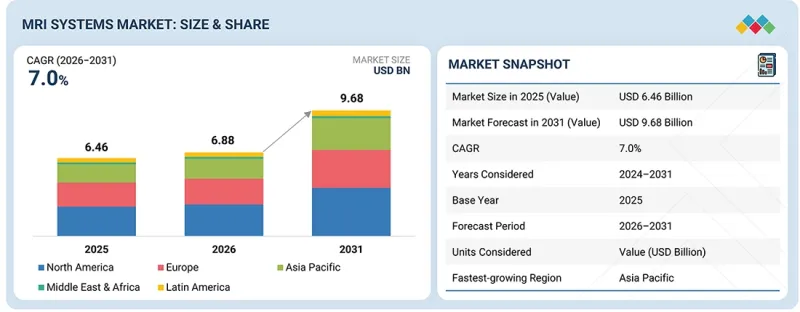
전 세계 MRI 시스템 시장은 2026년 68억 8,000만 달러에서 2026년부터 2031년까지 연평균 성장률(CAGR) 7.0%로 확대되어, 2031년에는 96억 8,000만 달러에 달할 것으로 전망됩니다.
이 시장의 성장은 특히 신경계 및 근골격계 질환의 질병 부담 증가에 기인하며, 향후 몇 년 동안 더욱 증가할 것으로 예상됩니다. 또한, 고령화가 진행됨에 따라 암 등 만성 질환의 유병률이 높아지면서 전 세계적으로 MRI 시스템에 대한 수요가 증가할 것으로 전망됩니다. 이러한 요인들은 모두 더 광범위한 차원에서 MRI 시스템 시장의 성장에 기여할 것입니다.
자기장 강도별로는 2025년 MRI 시스템 시장에서 고자기장 및 초고자기장 부문이 시장을 주도했습니다.
MRI 시스템 시장은 자기장 강도에 따라 저-중자기장 MRI 시스템, 고자기장 및 초고자기장 MRI 시스템, 그리고 초초고자기장 MRI 시스템으로 분류됩니다. 고자기장 및 초고자기장 MRI 시스템은 뛰어난 신호대잡음비(SNR)로 알려져 있으며, 이로 인해 임상적 유용성이 크게 향상됩니다. 이러한 시스템은 뇌, 근골격계, 혈관계의 영상 진단에 필수적일 뿐만 아니라, 정신의학, 신경학, 생의학 연구, 그리고 다발성 경화증과 같은 질환의 조기 발견과 같은 전문적인 용도에서도 뛰어난 성능을 발휘합니다. MRI를 PET나 초음파 검사 등의 보완적 검사법과 통합함으로써, 스캔 시간을 단축하고 영상 해상도를 향상시키는 동시에 운영 처리량을 더욱 최적화하여 헬륨 사용량을 줄일 수 있습니다. 고자기장 MRI 시스템, 특히 1.5T 및 3T에서 작동하는 시스템은 현저히 뛰어난 화질, 촬영 시간 단축, 그리고 폭넓은 임상 적용 범위 덕분에 저자기장 시스템(1T 미만)보다 더 선호되고 있습니다. 고자기장 시스템의 높은 신호대잡음비(SNR)는 신경 질환, 근골격계 손상, 심혈관계 이상과 같은 복잡한 질환의 진단에 필수적인, 더욱 선명하고 상세한 영상화를 가능하게 합니다. 고속 스캔 기능은 환자 처리 능력을 향상시킬 뿐만 아니라, 의료 시설 내 운영 효율도 높여줍니다. 이러한 요인들이 복합적으로 작용하여, 시장에서 고자기장 MRI 시스템의 도입 확대를 뒷받침하고 있습니다.
아키텍처별로는 2025년에 폐쇄형 MRI 시스템 부문이 시장에서 가장 큰 점유율을 차지했습니다.
밀폐형 MRI 스캐너는 작은 원통형 챔버를 이용하여 신체 구조를 매우 상세하게 영상화합니다. 대부분의 고자기장 초전도 자기공명영상 장비는 밀폐형으로 설계되어 있습니다. 자기장 강도가 높음에 따라 달성되는 높은 효율, 뛰어난 화질, 그리고 처리량 향상 덕분에 밀폐형 MRI 시스템은 업계 표준으로 간주되고 있습니다. 동등한 평가를 위해 최대 4-5회의 스캔이 필요한 경우가 있는 개방형 MRI 시스템과 달리, 폐쇄형 MRI 시스템은 일반적으로 단 1-2회의 스캔만으로 검사 과정을 완료합니다. 이러한 효율성 덕분에 검사 시간이 단축될 뿐만 아니라, 시술 및 치료의 임상적 유용성도 향상됩니다. 밀폐형 MRI는 스캔 시간이 짧기 때문에 움직임으로 인한 아티팩트를 줄이고 환자 처리 능력을 향상시키는 데 기여하며, 특히 환자 수가 많은 병원이나 진단 센터에 적합합니다. 또한, 기능적 MRI(fMRI), 확산 강조 영상(DWI), 심장 MRI 등 첨단 영상 진단 기술도 지원하고 있으며, 이들 모두 정확도를 높이기 위해 높은 자기장 강도가 필요합니다.
설계상, 2025년에는 고정식/설치형 MRI 시스템 부문이 가장 큰 점유율을 차지했습니다.
설계상, MRI 시스템 시장은 고정식/설치형 MRI 시스템과 휴대용 MRI 시스템으로 분류됩니다. 고정식 MRI 시스템은 여러 가지 이유로 일반적으로 휴대용 시스템보다 선호됩니다. 고정식 장비는 뛰어난 화질, 전신 스캔이 가능하다는 점, 워크플로우의 효율화, 그리고 장기적인 비용 대비 효과의 우수성 등의 장점이 있습니다. 일반적으로 고정식 MRI 장치는 자기장 환경에서 작동합니다. 고정식 MRI 시스템의 또 다른 큰 장점은 전신 영상 촬영이 가능하다는 점이며, 이것이 시장 성장을 더욱 촉진하고 있습니다.
용도별로는 뇌·신경계 MRI 부문이 예측 기간 동안 가장 높은 성장률을 기록할 것으로 예상됩니다.
용도별로 보면 MRI 시스템 시장은 뇌·신경계 MRI, 척추·근골격계 MRI, 골반·복부 MRI, 혈관 MRI, 유방 MRI, 심장 MRI, 소아 MRI 및 기타 용도로 분류됩니다. MRI 시스템 시장 내 뇌·신경계 MRI 부문은 예측 기간 동안 가장 높은 성장률을 기록할 것으로 예상됩니다. 이 부문의 급속한 성장에 기여하는 주요 요인으로는 첨단 AI 기술의 통합은 물론, 내장을 정확하게 표적으로 삼아 실시간 영상 진단을 가능하게 하는 혁신적인 기기의 도입 확대가 꼽힙니다.
최종사용자별로는 2025년에 병원 부문이 시장 점유율에서 가장 큰 비중을 차지했습니다.
최종사용자별로 보면 전 세계 MRI 시스템 시장은 병원, 영상 진단센터 및 기타 범주로 분류됩니다. 2025년에는 병원 부문이 가장 큰 시장 점유율을 차지했습니다. 이러한 우위는 주로 병원에서 첨단 MRI 시스템의 사용이 증가함에 따른 것으로, 이를 통해 정확한 진단이 촉진되고 조기 발견의 중요성에 대한 인식이 높아지고 있습니다. 또한, 신제품 출시, 환자 관리를 지원하는 기능 향상을 도모한 첨단 시스템의 도입 확대, 그리고 병원에서 이루어지는 영상 진단 건수의 증가와 같은 요인들도 시장 성장을 뒷받침하고 있습니다. 다양한 질환에 대한 신속하고 정확한 진단에 대한 수요가 높아짐에 따라, 많은 병원이 첨단 MRI 시스템 도입을 우선시하고 있습니다. 전용 영상 진단 부서를 갖춘 대규모 공립병원은 이러한 기술을 가장 먼저 도입해 왔지만, 민간 병원에서도 시간이 지남에 따라 첨단 영상 진단 솔루션의 도입이 점점 더 확대되고 있습니다. 영상 진단 워크플로우의 현대화를 향한 동향 또한 병원 내 MRI 시스템 도입을 더욱 촉진하고 있습니다.
아시아태평양은 MRI 시스템 시장에서 가장 높은 성장률을 보일 것으로 예상됩니다.
MRI 시스템 시장은 북미, 유럽, 아시아태평양, 라틴아메리카, 중동 및 아프리카 등 5개 주요 지역에 걸쳐 있습니다. 특히 아시아태평양에는, 첨단 기술 기능을 갖춘 다양한 MRI 모달리티를 경쟁력 있는 가격대로 제공하는 MRI 시스템 제조업체가 다수 존재합니다. 최종사용자, 특히 의료 기관의 경우 최근 관세 제재로 인해 더욱 심화된 예산 제약에 직면하는 사례가 증가하고 있으며, 이로 인해 중국 제조업체가 제공하는 비용 대비 효율이 더 높은 MRI 솔루션으로의 전환이 촉진되고 있습니다. 이 지역의 제조 환경은 낮은 인건비와 풍부한 자원의 이점을 누리고 있어, MRI 시스템의 효율적인 생산 공정을 가능하게 하고 있습니다. 이러한 추세에 힘입어 아시아태평양 시장은 현지 수요 증가와 전략적인 가격 책정이라는 두 가지 요인의 뒷받침을 받아 세계 시장 중 가장 높은 성장률을 기록할 것으로 전망됩니다.
MRI 시스템 시장의 주요 기업 개요로는 Siemens Healthineers(독일), GE HealthCare(미국), Koninklijke Philips N.V.(네덜란드), FUJIFILM Corporation(일본), Canon Inc.(일본), Fonar Corporation(미국), Esaote S.p.A(이탈리아), Shanghai United Imaging Healthcare(중국), Aspect Imaging Ltd.(미국), Time Medical Holding(홍콩)이 포함됩니다.
조사 범위
본 조사 보고서에서는 MRI 시스템 시장의 시장 규모, 아키텍처, 설계, 용도, 최종사용자 및 지역에 대해 분석하고 있습니다. 본 조사에서는 시장 확대를 주도하는 요인을 포괄적으로 다루고, 업계가 현재 직면하고 있는 전망과 여건을 분석하는 한편, 시장 선도 기업과 중소기업을 고려한 경쟁 구도에 관한 상세한 정보를 제공하고 있습니다. 또한, 5개 지역 및 마이크로마켓 분석을 바탕으로 각 시장 부문의 수익을 추산하고 있습니다.
이 보고서를 구매해야 하는 이유
본 보고서는 시장 선도 기업 및 신규 진입 기업을 대상으로, MRI 시스템 시장 전체 및 그 하위 부문의 시장 매출 추정과 관련된 귀중한 정보를 제공합니다. 이해관계자들이 경쟁 구도를 이해하고, 자사의 비즈니스를 보다 효과적으로 포지셔닝하며, 적절한 시장 진입 전략을 수립하는 데 도움이 됩니다. 또한, 본 보고서는 주요 시장 촉진요인과 과제를 포함한 시장 역학에 대한 인사이트를 제공합니다.
본 보고서에서는 다음 사항에 대한 통찰력 있는 데이터를 제공합니다:
- 주요 시장 촉진요인 분석(진단 영상 분야 확대를 위한 민관 협력, MRI 시스템 시장의 성장을 촉진하는 iMRI의 외과 수술 통합, MSD(근골격계 질환) 유병률 상승 및 고령 인구 증가에 따른 수요 확대), 제약요인(MRI 시스템의 복잡한 운영 및 유지보수, 전 세계적인 헬륨 부족), 기회(헬륨을 사용하지 않는 MRI 시스템의 등장, 소아용 MRI 활용 사례 확대, 프로세스 최적화를 위한 AI와 MRI 기술의 통합), 과제(제한된 자본 예산, 훈련을 받은 숙련된 전문가 부족)
- 시장 침투 : MRI 시스템 시장에서 주요 기업들이 제공하는 제품 포트폴리오에 대한 상세한 분석
- 제품 개발 및 혁신 : MRI 시스템 시장에서 주요 기업들이 제공하는 제품 포트폴리오에 대한 상세한 해설
- 시장 개발 : 수익성이 높은 성장 분야에 대한 통찰력 있는 데이터
- 시장의 다양화 : MRI 시스템 시장의 최근 동향 및 발전에 관한 상세 정보
- 경쟁사 평가 : 주요 경쟁사의 제품, 성장 전략, 수익 전망 및 시장 부문에 대한 종합적인 평가
자주 묻는 질문
목차
제1장 소개
제2장 주요 요약
제3장 주요 인사이트
제4장 시장 개요
제5장 업계 동향
제6장 기술 진보, AI에 의한 영향, 특허, 혁신, 그리고 향후 응용
제7장 고객 상황과 구매 행동
제8장 MRI 시스템 시장(용도별)
제9장 MRI 시스템 시장(아키텍처별)
제10장 MRI 시스템 시장(설계별)
제11장 MRI 시스템 시장(최종사용자별)
제12장 MRI 시스템 시장(자장 강도별)
제13장 MRI 시스템 시장(지역별)
제14장 경쟁 구도
제15장 기업 개요
제16장 조사 방법
제17장 부록
KSM 26.07.07The MRI systems market is shifting in terms of design and features, with helium-free and helium-light MRI technologies emerging as a significant growth driver. This development is largely influenced by increasing operational costs, helium supply instability, and the healthcare sector's growing focus on sustainability.
| Scope of the Report | |
|---|---|
| Years Considered for the Study | 2026-2031 |
| Base Year | 2025 |
| Forecast Period | 2026-2031 |
| Units Considered | Value (USD billion) |
| Segments | Field Strength, Architecture, Design, Application, End User, and Region |
| Regions covered | North America, Europe, the Asia Pacific, Latin America, and the Middle East & Africa |
Conventional MRI systems typically require over 1,000 liters of helium to cool superconducting magnets. However, global helium shortages-such as the Helium Shortage 4.0 reported by Gasworld-have led to price increases of up to 250%, disrupting imaging operations and increasing maintenance costs. Such challenges are particularly pressing for mid-sized hospitals and outpatient facilities with constrained budgets. In response, manufacturers like Koninklijke Philips N.V. (Netherlands), Siemens Healthineers (Germany), and Shanghai United Imaging Healthcare Co., Ltd. (China) have launched MRI systems that require significantly less helium or are completely sealed.
These innovations reduce the total cost of ownership and support environmental goals in terms of sustainability and zero carbon emissions.
The global MRI systems market is projected to reach USD 9.68 billion by 2031, growing from USD 6.88 billion in 2026 at a CAGR of 7.0% from 2026 to 2031.
The market's growth can be attributed to an increase in disease burden, specifically for neurological and musculoskeletal conditions, which is expected to increase in the coming years. Additionally, an increase in the aging population, with the rising prevalence of chronic diseases such as cancer, is anticipated to increase the need for MRI systems across the globe. All these factors, on a broader level, will help to grow the market for MRI systems.
By field strength, the high & very high field segment dominated the MRI systems market in 2025.
The MRI systems market is categorized, by field strength, into low-to-mid-field MRI systems, high and very high field MRI systems, and ultra-high-field MRI systems. High and very high field MRI systems are known for their superior signal-to-noise ratio (SNR), which enhances clinical utility significantly. These systems are not only instrumental in imaging the brain, musculoskeletal structures, and vascular systems but also excel in specialized applications within psychiatry, neurology, biomedical research, and the early identification of conditions such as multiple sclerosis. The integration of MRI with complementary modalities such as PET and ultrasound further optimizes operational throughput and decreases helium usage while also delivering faster scan times and enhanced image resolution. High-field MRI systems, specifically those operating at 1.5T and 3T, are favored over low-field systems (below 1T) due to their markedly superior image quality, reduced acquisition times, and extensive range of clinical applications. The elevated SNR in high-field systems translates to clearer, more detailed imaging essential for diagnosing complex conditions such as neurological disorders, musculoskeletal injuries, and cardiovascular abnormalities. The rapid scan capabilities not only improve patient throughput but also enhance operational efficiency within healthcare facilities. Collectively, these factors have driven the growing adoption of high-field MRI systems within the market.
By architecture, the closed MRI systems segment accounted for the largest share of the market in 2025.
A closed MRI scanner utilizes a small cylindrical chamber to produce highly detailed images of the body's structure. Most high-field superconducting magnetic resonance imaging scanners are designed in a closed format. Due to their higher efficiency, superior image quality, and increased throughput-all resulting from greater magnetic field strengths-closed MRI systems are considered the industry standard. In contrast to open MRI systems, which may require up to four or five scans for a comparable evaluation, closed MRI systems typically complete the scanning process in just one or two scans. This efficiency not only shortens examination times but also enhances the clinical utility of procedures and therapies. Closed MRI offers faster scan times, which helps reduce motion artifacts and improves patient throughput, making it particularly suitable for high-volume hospitals and diagnostic centers. Additionally, it supports advanced imaging techniques such as functional MRI (fMRI), diffusion-weighted imaging (DWI), and cardiac MRI, all of which rely on high-field strength for precision.
By design, the fixed/stationary MRI systems segment accounted for the largest share in 2025.
By design, the MRI systems market is divided into fixed/stationary MRI systems and portable MRI systems. Fixed MRI systems are generally preferred over portable ones for several reasons. They offer superior image quality, the ability to conduct full-body scans, improved workflow efficiency, and better long-term cost-effectiveness. Typically, fixed MRI units operate at a magnetic field. Another significant advantage of fixed MRI systems is their capability for full-body imaging, which further fuels market growth.
By application, the brain & neurological MRI segment is expected to register the highest growth rate during the forecast period.
By application, the MRI systems market is segmented into brain & neurological MRI, spine & musculoskeletal MRI, pelvic & abdominal MRI, vascular MRI, breast MRI, cardiac MRI, pediatric MRI, and other applications. The brain & neurological MRI segment of the MRI systems segment is expected to register the highest growth rate during the forecast period. Key drivers contributing to the rapid growth of this segment include the integration of sophisticated AI technologies as well as the increasing adoption of innovative devices that enable accurate targeting of internal organs, thereby facilitating real-time imaging capabilities.
By end user, the hospitals segment accounted for the largest share of the market in 2025.
By end user, the global MRI systems market is categorized into hospitals, diagnostic imaging centers, and other categories. In 2025, the hospitals segment accounted for the largest market share. This dominance is primarily due to the increased use of advanced MRI systems in hospitals, which enhance accurate diagnosis and raise awareness of the importance of early detection. Additionally, factors such as product launches, the growing adoption of advanced systems with improved features that support patient care, and a rising number of imaging procedures conducted in hospitals are also driving the growth of the market. As the demand for rapid and precise diagnoses of various medical conditions grows, many hospitals are prioritizing the installation of advanced MRI systems. Large government hospitals with dedicated imaging units have been early adopters of these technologies, while private hospitals are increasingly embracing advanced imaging solutions over time. The trend towards modernizing imaging workflows has further driven the adoption of MRI systems in hospitals.
Asia Pacific is expected to exhibit the highest growth rate in the MRI systems market.
The MRI systems market spans five primary regions: North America, Europe, the Asia Pacific, Latin America, and the Middle East & Africa. Notably, the Asia Pacific region houses a significant number of MRI systems manufacturers that deliver a comprehensive range of MRI modalities equipped with advanced technological features, all while maintaining competitive pricing. End users, particularly in healthcare institutions, are increasingly facing budget constraints exacerbated by recent tariff sanctions; this has prompted a shift towards more cost-effective MRI solutions offered by Chinese manufacturers. The region's manufacturing landscape benefits from low labor costs and abundant resources, facilitating efficient production processes for MRI systems. These dynamics position the Asia Pacific market to experience the highest growth rate within the global landscape, driven by both increased local demand and the strategic pricing of offerings.
A breakdown of the primary participants referred to for this report is provided below:
- By Company Type: Tier 1 - 30%; Tier 2 - 40%; and Tier 3 - 30%
- By Designation: Directors - 10%; Managers - 30%; and Others - 60%
- By Region: Asia Pacific - 45%; Europe - 22%; North America - 22%; RoW - 11%
The key players profiled in the MRI systems market include Siemens Healthineers (Germany), GE HealthCare (US), Koninklijke Philips N.V. (Netherlands), FUJIFILM Corporation (Japan), Canon Inc. (Japan), Fonar Corporation (US), Esaote S.p.A (Italy), Shanghai United Imaging Healthcare Co., Ltd (China), Aspect Imaging Ltd. (US), and Time Medical Holding (Hong Kong).
Research Coverage
The research report examines the MRI systems market field strength, architecture, design, application, end user, and region. This research covers factors that are driving market expansion, analyzes prospects and parameters faced by industries in the present time, and provides specifics on the competitive landscape, considering market leaders and small and medium enterprises. This research also estimates the revenue of different market segments by considering five regions and micro-market analysis
Reasons to Buy the Report
The report will provide market leaders and new entrants with valuable information regarding the revenue estimates for the overall MRI systems market and its subsegments. It will help stakeholders understand the competitive landscape, allowing them to position their businesses more effectively and develop appropriate go-to-market strategies. Additionally, the report offers insights into the market dynamics, including key drivers, restraints, challenges, and opportunities.
This report provides insightful data on the following pointers:
- Analysis of key drivers (Public-private partnerships to scale diagnostic imaging landscape, integration of iMRI into surgery to catalyze growth of MRI systems market, growing prevalence of MSDs and increasing geriatric population to increase demand), restraints (Complex operation and maintenance of MRI systems, global shortage of helium), opportunities (Emergence of helium-free MRI systems, expansion of pediatric MRI use cases, AI integration with MRI technology for process optimization), challenges (Limited capital budgets, dearth of trained and skilled professionals)
- Market Penetration: In-depth coverage of product portfolios offered by the top players in the MRI systems market
- Product Development/Innovation: In-depth coverage of product portfolios offered by the top players in the MRI systems market
- Market Development: Insightful data on profitable developing areas
- Market Diversification: Details about recent developments and advancements in the MRI systems market
- Competitive Assessment: Extensive assessment of the products, growth tactics, revenue projections, and market categories of the top competitors
TABLE OF CONTENTS
1 INTRODUCTION
- 1.1 STUDY OBJECTIVES
- 1.2 MARKET DEFINITION
- 1.3 STUDY SCOPE
- 1.3.1 MARKET SEGMENTATION AND REGIONAL SCOPE
- 1.3.2 INCLUSIONS & EXCLUSIONS
- 1.3.3 YEARS CONSIDERED
- 1.4 CURRENCY CONSIDERED
- 1.5 RESEARCH LIMITATIONS
- 1.6 STAKEHOLDERS
- 1.7 SUMMARY OF CHANGES
2 EXECUTIVE SUMMARY
- 2.1 MARKET HIGHLIGHTS & KEY INSIGHTS
- 2.2 KEY MARKET PARTICIPANTS: MAPPING OF STRATEGIC DEVELOPMENTS
- 2.3 DISRUPTIVE TRENDS IN MRI SYSTEMS MARKET
- 2.4 HIGH GROWTH SEGMENTS
- 2.5 REGIONAL SNAPSHOT: MARKET SIZE, GROWTH RATE, AND FORECAST
3 PREMIUM INSIGHTS
- 3.1 MRI SYSTEMS MARKET OVERVIEW
- 3.2 ASIA PACIFIC MRI SYSTEMS MARKET, BY END USER AND COUNTRY
- 3.3 MRI SYSTEMS MARKET: GEOGRAPHIC GROWTH OPPORTUNITIES
4 MARKET OVERVIEW
- 4.1 INTRODUCTION
- 4.2 MARKET DYNAMICS
- 4.2.1 DRIVERS
- 4.2.1.1 Public-private partnerships to scale diagnostic imaging landscape
- 4.2.1.2 Growing prevalence of MSDs and increasing geriatric population
- 4.2.1.3 Integration of iMRI into surgery
- 4.2.2 RESTRAINTS
- 4.2.2.1 Complex operation and maintenance of MRI systems
- 4.2.2.2 Global helium shortage
- 4.2.3 OPPORTUNITIES
- 4.2.3.1 Emergence of helium-free MRI systems
- 4.2.3.2 Expansion of pediatric MRI use cases
- 4.2.3.3 AI integration with MRI technology for process optimization
- 4.2.4 CHALLENGES
- 4.2.4.1 Limited capital budgets
- 4.2.4.2 Dearth of trained and skilled professionals
- 4.2.1 DRIVERS
- 4.3 UNMET NEEDS
- 4.4 INTERCONNECTED MARKETS AND CROSS-SECTOR OPPORTUNITIES
- 4.5 STRATEGIC MOVES BY TIER-1/2/3 PLAYERS
- 4.5.1 OVERVIEW OF STRATEGIES ADOPTED BY PLAYERS IN MRI SYSTEMS MARKET
5 INDUSTRY TRENDS
- 5.1 PORTER'S FIVE FORCES ANALYSIS
- 5.1.1 BARGAINING POWER OF BUYERS
- 5.1.2 BARGAINING POWER OF SUPPLIERS
- 5.1.3 THREAT OF NEW ENTRANTS
- 5.1.4 THREAT OF SUBSTITUTES
- 5.1.5 INTENSITY OF COMPETITIVE RIVALRY
- 5.2 MACROECONOMIC INDICATORS
- 5.2.1 INTRODUCTION
- 5.2.2 GDP TRENDS AND FORECAST
- 5.2.3 TRENDS IN DIAGNOSTIC IMAGING INDUSTRY
- 5.3 SUPPLY CHAIN ANALYSIS
- 5.3.1 PROMINENT COMPANIES
- 5.3.2 SMALL & MEDIUM-SIZED ENTERPRISES
- 5.3.3 DISTRIBUTION/DISTRIBUTOR
- 5.3.4 END USERS
- 5.4 VALUE CHAIN ANALYSIS
- 5.4.1 RESEARCH & PRODUCT DEVELOPMENT
- 5.4.2 RAW MATERIAL PROCUREMENT
- 5.4.3 MANUFACTURING
- 5.4.4 DISTRIBUTION, MARKETING & SALES, AND POST-SALES SERVICES
- 5.5 ECOSYSTEM ANALYSIS
- 5.6 PRICING ANALYSIS
- 5.6.1 AVERAGE SELLING PRICE TREND, BY KEY PLAYER, 2023-2025
- 5.6.2 AVERAGE SELLING PRICE TREND, BY REGION, 2023-2025
- 5.7 TRADE ANALYSIS
- 5.7.1 IMPORT DATA (HS CODE 901813)
- 5.7.2 EXPORT DATA (HS CODE 901813)
- 5.8 KEY CONFERENCES AND EVENTS, 2026-2027
- 5.9 TRENDS/DISRUPTIONS IMPACTING CUSTOMER BUSINESS
- 5.10 INVESTMENT AND FUNDING SCENARIO
- 5.11 CASE STUDY ANALYSIS
- 5.12 IMPACT OF 2025 US TARIFF - MRI SYSTEMS MARKET
- 5.12.1 INTRODUCTION
- 5.12.2 KEY TARIFF RATES
- 5.12.3 KEY TARIFF RATES
- 5.12.4 PRICE IMPACT ANALYSIS
- 5.12.5 IMPACT ON COUNTRIES/REGIONS
- 5.12.5.1 US
- 5.12.5.2 Europe
- 5.12.5.3 Asia Pacific
- 5.12.6 IMPACT ON END-USE INDUSTRIES
6 TECHNOLOGICAL ADVANCEMENTS, AI-DRIVEN IMPACT, PATENTS, INNOVATIONS, AND FUTURE APPLICATIONS
- 6.1 KEY EMERGING TECHNOLOGIES
- 6.1.1 ARTIFICIAL INTELLIGENCE-DRIVEN IMAGE RECONSTRUCTION AND DIAGNOSTIC ASSISTANCE
- 6.1.2 ULTRA-LOW-FIELD AND PORTABLE MRI PLATFORMS
- 6.2 COMPLEMENTARY TECHNOLOGIES
- 6.2.1 PICTURE ARCHIVING AND COMMUNICATION SYSTEMS (PACS) AND HEALTH INFORMATION SYSTEM INTEGRATION
- 6.2.2 SIMULTANEOUS MULTI-SLICE AND ADVANCED PARALLEL IMAGING ACCELERATION
- 6.3 ADJACENT TECHNOLOGIES
- 6.3.1 MRI-COMPATIBLE INTERVENTIONAL AND SURGICAL NAVIGATION TECHNOLOGIES
- 6.4 PATENT ANALYSIS
- 6.5 IMPACT OF AI ON MRI SYSTEMS MARKET
- 6.5.1 TOP USE CASES AND MARKET POTENTIAL
- 6.5.2 KEY COMPANIES IMPLEMENTING AI
- 6.5.3 BEST PRACTICES IN MRI SYSTEMS MARKET
- 6.5.4 INTERCONNECTED ADJACENT ECOSYSTEMS AND IMPACT ON MARKET PLAYERS
- 6.5.5 CLIENTS' READINESS TO ADOPT AI IN MRI SYSTEMS
- 6.6 SUCCESS STORIES AND REAL-WORLD APPLICATIONS
- 6.7 REGULATORY LANDSCAPE
- 6.7.1 REGULATORY BODIES, GOVERNMENT AGENCIES, AND OTHER ORGANIZATIONS
- 6.7.2 REGULATIONS, BY REGION
- 6.7.2.1 North America
- 6.7.2.1.1 US
- 6.7.2.1.2 Canada
- 6.7.2.2 Europe
- 6.7.2.3 Asia Pacific
- 6.7.2.3.1 Japan
- 6.7.2.3.2 China
- 6.7.2.3.3 India
- 6.7.2.1 North America
- 6.8 REIMBURSEMENT SCENARIO ANALYSIS
- 6.8.1 RELEVANT REIMBURSEMENT CODE, BY COUNTRY
- 6.8.2 REIMBURSEMENT TRENDS, BY REGION, 2023-2025
- 6.8.2.1 North America
- 6.8.2.2 Europe
- 6.8.2.3 Asia Pacific
- 6.8.2.4 Latin America
- 6.8.2.5 Middle East & Africa
7 CUSTOMER LANDSCAPE AND BUYER BEHAVIOR
- 7.1 DECISION-MAKING PROCESS
- 7.2 KEY STAKEHOLDERS INVOLVED IN BUYING PROCESS AND THEIR EVALUATION CRITERIA
- 7.2.1 KEY STAKEHOLDERS IN BUYING PROCESS
- 7.2.2 BUYING CRITERIA
- 7.3 ADOPTION BARRIERS AND INTERNAL CHALLENGES
- 7.4 UNMET NEEDS OF VARIOUS END-USE INDUSTRIES
- 7.5 MARKET PROFITABILITY
8 MRI SYSTEMS MARKET, BY APPLICATION
- 8.1 INTRODUCTION
- 8.2 BRAIN & NEUROLOGICAL MRI
- 8.2.1 NEW THERAPIES AND GUIDELINES TO ENHANCE DEMAND FOR MRI SYSTEMS
- 8.3 SPINE & MUSCULOSKELETAL MRI
- 8.3.1 GROWING PREVALENCE OF MUSCULOSKELETAL DISORDERS TO DRIVE MARKET
- 8.4 VASCULAR MRI
- 8.4.1 USE OF VASCULAR MRI AS ALTERNATIVE TO CT TO SUPPORT MARKET GROWTH
- 8.5 PELVIC & ABDOMINAL MRI
- 8.5.1 NEED FOR DETECTING PROSTATE AND CERVICAL CANCERS TO PROPEL MARKET
- 8.6 BREAST MRI
- 8.6.1 GROWING AWARENESS OF EARLY CANCER SCREENING TO DRIVE MARKET GROWTH
- 8.7 CARDIAC MRI
- 8.7.1 UPDATED MEDICAL GUIDELINES FOR CARDIAC THERAPY PLANNING TO DRIVE MARKET GROWTH
- 8.8 PEDIATRIC MRI
- 8.8.1 NEED FOR EFFICIENT DIAGNOSTIC ACCURACY AND EARLY DETECTION TO PROMOTE USE OF PEDIATRIC MRI
- 8.9 OTHER APPLICATIONS
9 MRI SYSTEMS MARKET, BY ARCHITECTURE
- 9.1 INTRODUCTION
- 9.2 CLOSED MRI SYSTEMS
- 9.2.1 STANDARD BORE MRI SYSTEMS
- 9.2.1.1 High accuracy and sensitivity of systems to propel market
- 9.2.2 WIDE-BORE MRI SYSTEMS
- 9.2.2.1 High-quality images and improved patient comfort to drive market
- 9.2.1 STANDARD BORE MRI SYSTEMS
- 9.3 OPEN MRI SYSTEMS
- 9.3.1 USE FOR CHILDREN AND OBESE PATIENTS TO DRIVE MARKET
10 MRI SYSTEMS MARKET, BY DESIGN
- 10.1 INTRODUCTION
- 10.2 FIXED/STATIONARY MRI SYSTEMS
- 10.2.1 FLOOR-FIXED MRI SYSTEMS
- 10.2.1.1 High flexibility and low initial installation costs to drive demand
- 10.2.2 CEILING-FIXED MRI SYSTEMS
- 10.2.2.1 Need for MRI systems with high stability and more space to drive market
- 10.2.1 FLOOR-FIXED MRI SYSTEMS
- 10.3 PORTABLE MRI SYSTEMS
- 10.3.1 PROTOCOLIZED ADOPTION OF PORTABLE MRI SYSTEMS TO DRIVE MARKET GROWTH
11 MRI SYSTEMS MARKET, BY END USER
- 11.1 INTRODUCTION
- 11.2 HOSPITALS
- 11.2.1 UPDATES IN DIAGNOSTIC IMAGING GUIDELINES TO PROPEL MARKET GROWTH
- 11.3 DIAGNOSTIC IMAGING CENTERS
- 11.3.1 INCREASED PRIVATE IMAGING CENTERS AND SHIFT TOWARD OUTPATIENT FACILITIES TO DRIVE MARKET GROWTH
- 11.4 OTHER END USERS
12 MRI SYSTEMS MARKET, BY FIELD STRENGTH
- 12.1 INTRODUCTION
- 12.2 HIGH-TO-VERY-HIGH-FIELD MRI SYSTEMS
- 12.2.1 1.5T
- 12.2.1.1 Rising use of 1.5T MRI systems for routine examinations to propel market
- 12.2.2 3T
- 12.2.2.1 Strong gradient profile and ease of use to drive market growth
- 12.2.1 1.5T
- 12.3 LOW-TO-MID-FIELD MRI SYSTEMS
- 12.3.1 INCREASING NEED FOR LUNG AND CARDIAC IMAGING TO DRIVE MARKET GROWTH
- 12.4 ULTRA-HIGH-FIELD MRI SYSTEMS
- 12.4.1 RISING INNOVATION AND DEEP RESEARCH TO DRIVE MARKET GROWTH
13 MRI SYSTEMS MARKET, BY REGION
- 13.1 INTRODUCTION
- 13.2 NORTH AMERICA
- 13.2.1 US
- 13.2.1.1 Increased diagnostic imaging utilization and strategic reimbursement reforms to drive market growth
- 13.2.2 CANADA
- 13.2.2.1 Progressive government policies and growing pulse of diagnostic imaging to spur market
- 13.2.1 US
- 13.3 EUROPE
- 13.3.1 GERMANY
- 13.3.1.1 Digital push in healthcare access and shift toward outpatient/clinic settings to drive market growth
- 13.3.2 UK
- 13.3.2.1 Strong policy push for community diagnostic centers and capacity expansion to drive market growth
- 13.3.3 FRANCE
- 13.3.3.1 Increasing patient population and reforms in MRI coverage policies to boost growth
- 13.3.4 ITALY
- 13.3.4.1 EU-funded hospital upgrades to increase capital expenditure ability
- 13.3.5 SPAIN
- 13.3.5.1 Strategic policy reforms and increased MRI scans from private hospital chains to grow market
- 13.3.6 REST OF EUROPE
- 13.3.1 GERMANY
- 13.4 ASIA PACIFIC
- 13.4.1 JAPAN
- 13.4.1.1 Nationwide diagnostic imaging coverage plans and supportive government reimbursement policies to boost growth
- 13.4.2 CHINA
- 13.4.2.1 Foreign collaborations and strong demand from public healthcare facilities to drive market growth
- 13.4.3 INDIA
- 13.4.3.1 Strong public-private partnerships to propel market
- 13.4.4 AUSTRALIA
- 13.4.4.1 New research initiatives and policy enhancements to promote growth
- 13.4.5 SOUTH KOREA
- 13.4.5.1 Supportive government policies to promote growth
- 13.4.6 REST OF ASIA PACIFIC
- 13.4.1 JAPAN
- 13.5 LATIN AMERICA
- 13.5.1 BRAZIL
- 13.5.1.1 Increasing disease burden and growing adoption of healthcare insurance to drive market
- 13.5.2 MEXICO
- 13.5.2.1 Industry partnerships to drive market growth
- 13.5.3 REST OF LATIN AMERICA
- 13.5.1 BRAZIL
- 13.6 MIDDLE EAST & AFRICA
- 13.6.1 GCC COUNTRIES
- 13.6.1.1 Favorable government initiatives to contribute to market growth
- 13.6.2 REST OF MIDDLE EAST & AFRICA
- 13.6.2.1 Increased adoption of MRI systems to contribute to growth
- 13.6.1 GCC COUNTRIES
14 COMPETITIVE LANDSCAPE
- 14.1 INTRODUCTION
- 14.2 KEY PLAYER COMPETITIVE STRATEGIES/RIGHT TO WIN, 2023-2026
- 14.2.1 OVERVIEW OF STRATEGIES ADOPTED BY KEY PLAYERS IN MRI SYSTEMS MARKET
- 14.3 REVENUE ANALYSIS, 2021-2025
- 14.4 MARKET SHARE ANALYSIS, 2025
- 14.4.1 MARKET RANKING OF KEY PLAYERS, 2025
- 14.5 COMPANY VALUATION AND FINANCIAL METRICS
- 14.5.1 FINANCIAL METRICS
- 14.5.2 COMPANY VALUATION
- 14.6 BRAND/PRODUCT COMPARISON
- 14.7 COMPANY EVALUATION MATRIX: KEY PLAYERS, 2025
- 14.7.1 STARS
- 14.7.2 EMERGING LEADERS
- 14.7.3 PERVASIVE PLAYERS
- 14.7.4 PARTICIPANTS
- 14.7.5 COMPANY FOOTPRINT: KEY PLAYERS, 2025
- 14.7.5.1 Company footprint
- 14.7.5.2 Region footprint
- 14.7.5.3 Field strength footprint
- 14.7.5.4 Application footprint
- 14.7.5.5 End user footprint
- 14.8 COMPANY EVALUATION MATRIX: STARTUPS/SMES, 2025
- 14.8.1 PROGRESSIVE COMPANIES
- 14.8.2 RESPONSIVE COMPANIES
- 14.8.3 DYNAMIC COMPANIES
- 14.8.4 STARTING BLOCKS
- 14.8.5 COMPETITIVE BENCHMARKING OF STARTUPS/SMES, 2025
- 14.8.5.1 Detailed list of key startups/SMEs
- 14.8.5.2 Competitive benchmarking of key startups/SMEs
- 14.9 COMPETITIVE SCENARIO
- 14.9.1 PRODUCT LAUNCHES
- 14.9.2 DEALS
- 14.9.3 EXPANSIONS
15 COMPANY PROFILES
- 15.1 KEY PLAYERS
- 15.1.1 SIEMENS HEALTHINEERS
- 15.1.1.1 Business overview
- 15.1.1.2 Products offered
- 15.1.1.3 Recent developments
- 15.1.1.3.1 Product launches
- 15.1.1.3.2 Deals
- 15.1.1.3.3 Expansions
- 15.1.1.4 MnM view
- 15.1.1.4.1 Right to win
- 15.1.1.4.2 Strategic choices
- 15.1.1.4.3 Weaknesses & competitive threats
- 15.1.2 KONINKLIJKE PHILIPS N.V.
- 15.1.2.1 Business overview
- 15.1.2.2 Products offered
- 15.1.2.3 Recent developments
- 15.1.2.3.1 Product launches
- 15.1.2.3.2 Deals
- 15.1.2.3.3 Expansions
- 15.1.2.4 MnM view
- 15.1.2.4.1 Right to win
- 15.1.2.4.2 Strategic choices
- 15.1.2.4.3 Weaknesses and competitive threats
- 15.1.3 GE HEALTHCARE
- 15.1.3.1 Business overview
- 15.1.3.2 Products offered
- 15.1.3.3 Recent developments
- 15.1.3.3.1 Product launches
- 15.1.3.3.2 Deals
- 15.1.3.3.3 Expansions
- 15.1.3.4 MnM view
- 15.1.3.4.1 Right to win
- 15.1.3.4.2 Strategic choices
- 15.1.3.4.3 Weaknesses & competitive threats
- 15.1.4 CANON MEDICAL SYSTEM
- 15.1.4.1 Business overview
- 15.1.4.2 Products offered
- 15.1.4.3 Recent developments
- 15.1.4.3.1 Product launches
- 15.1.4.3.2 Deals
- 15.1.4.4 MnM view
- 15.1.4.4.1 Right to win
- 15.1.4.4.2 Strategic choices
- 15.1.4.4.3 Weaknesses & competitive threats
- 15.1.5 FUJIFILM CORPORATION
- 15.1.5.1 Business overview
- 15.1.5.2 Products offered
- 15.1.5.3 Recent developments
- 15.1.5.3.1 Product launches
- 15.1.5.3.2 Deals
- 15.1.5.4 MnM view
- 15.1.5.4.1 Right to win
- 15.1.5.4.2 Strategic choices
- 15.1.5.4.3 Weaknesses & competitive threats
- 15.1.6 FONAR CORPORATION
- 15.1.6.1 Business overview
- 15.1.6.2 Products offered
- 15.1.6.3 Recent developments
- 15.1.6.3.1 Deals
- 15.1.7 ESAOTE S.P.A
- 15.1.7.1 Business overview
- 15.1.7.2 Products offered
- 15.1.7.3 Recent developments
- 15.1.7.3.1 Product launches
- 15.1.7.3.2 Deals
- 15.1.8 SHANGHAI UNITED IMAGING HEALTHCARE CO., LTD.
- 15.1.8.1 Business overview
- 15.1.8.2 Products offered
- 15.1.8.3 Recent developments
- 15.1.8.3.1 Product launches and approvals
- 15.1.8.3.2 Deals
- 15.1.8.3.3 Expansions
- 15.1.9 ASPECT IMAGING LTD.
- 15.1.9.1 Business overview
- 15.1.9.2 Products offered
- 15.1.10 TIME MEDICAL HOLDING
- 15.1.10.1 Business overview
- 15.1.10.2 Products offered
- 15.1.10.3 Recent developments
- 15.1.10.3.1 Product launches and approvals
- 15.1.10.3.2 Expansions
- 15.1.11 NEUSOFT MEDICAL SYSTEMS CO., LTD.
- 15.1.11.1 Business overview
- 15.1.11.2 Products offered
- 15.1.11.3 Recent developments
- 15.1.11.3.1 Deals
- 15.1.12 STERNMED GMBH
- 15.1.12.1 Business overview
- 15.1.12.2 Products offered
- 15.1.12.3 Recent developments
- 15.1.12.3.1 Deals
- 15.1.13 HYPERFINE, INC.
- 15.1.13.1 Business overview
- 15.1.13.2 Products offered
- 15.1.13.3 Recent developments
- 15.1.13.3.1 Product launches and approvals
- 15.1.13.3.2 Deals
- 15.1.14 SHENZHEN BASDA MEDICAL APPARATUS CO., LTD.
- 15.1.14.1 Business overview
- 15.1.14.2 Products offered
- 15.1.15 SHENZHEN ANKE HIGH-TECH., LTD.
- 15.1.15.1 Business overview
- 15.1.15.2 Products offered
- 15.1.1 SIEMENS HEALTHINEERS
- 15.2 OTHER PLAYERS
- 15.2.1 MAGNETICA LTD
- 15.2.2 AURORA HEALTHCARE US CORP
- 15.2.3 INNERVISION MRI LTD.
- 15.2.4 BEIJING WANDONG MEDICAL TECHNOLOGY CO., LTD.
- 15.2.5 MEDONICA CO., LTD
- 15.2.6 NEOSCAN SOLUTIONS GMBH
- 15.2.7 KANGDA INTERCONTINENTAL MEDICAL EQUIPMENT CO., LTD.
- 15.2.8 MINFOUND MEDICAL SYSTEMS CO., LTD.
- 15.2.9 SYNAPTIVE MEDICAL
- 15.2.10 XINGAOYI MEDICAL EQUIPMENT CO., LTD
16 RESEARCH METHODOLOGY
- 16.1 RESEARCH DATA
- 16.1.1 SECONDARY RESEARCH
- 16.1.1.1 Key secondary sources
- 16.1.1.2 Key data from secondary sources
- 16.1.1.3 Objectives of secondary research
- 16.1.2 PRIMARY RESEARCH
- 16.1.2.1 Key primary sources
- 16.1.2.2 Key supply- and demand-side participants
- 16.1.2.3 Breakdown of primary interviews
- 16.1.2.4 Objectives of primary research
- 16.1.2.5 Key primary insights
- 16.1.1 SECONDARY RESEARCH
- 16.2 MARKET SIZE ESTIMATION
- 16.2.1 BOTTOM-UP APPROACH
- 16.2.1.1 Company revenue estimation
- 16.2.1.2 Customer-based market estimation
- 16.2.1.3 Primary interviews
- 16.2.2 TOP-DOWN APPROACH
- 16.2.1 BOTTOM-UP APPROACH
- 16.3 GROWTH RATE ASSUMPTIONS
- 16.4 DATA TRIANGULATION
- 16.5 RESEARCH ASSUMPTIONS
- 16.6 RESEARCH LIMITATIONS
- 16.7 RISK ANALYSIS
17 APPENDIX
- 17.1 DISCUSSION GUIDE
- 17.2 KNOWLEDGESTORE: MARKETSANDMARKETS' SUBSCRIPTION PORTAL
- 17.3 CUSTOMIZATION OPTIONS
- 17.4 RELATED REPORTS
- 17.5 AUTHOR DETAILS