|
시장보고서
상품코드
2079665
품질관리 시스템(QMS) 소프트웨어 시장 예측(-2031년) : 솔루션(품질 분석 및 인텔리전스, CAPA 관리, 공급업체 품질관리, DCM, 기타), 배포 모드, 조직 규모, 업계, 지역별Quality Management System (QMS) Software Market by Solution (Quality Analytics & Intelligence, CAPA Management, Supplier Quality Management, DCM, Others), Deployment Mode, Organization Size, Vertical, and Region - Global Forecast to 2031 |
||||||

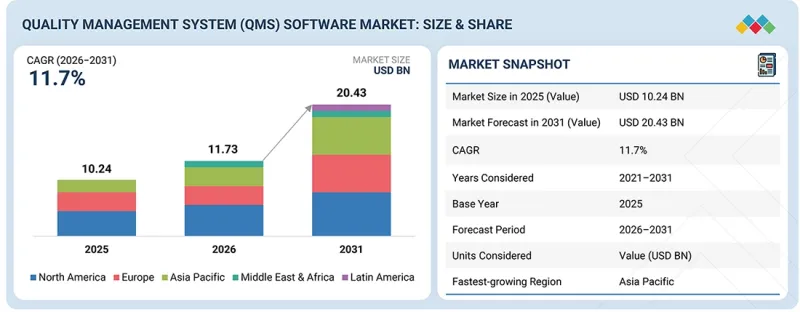
세계의 품질관리 시스템(QMS) 소프트웨어 시장 규모는 급속히 확대하고 있으며, 2026년 약 117억 3,000만 달러에서 2031년에는 204억 3,000만 달러 규모에 달하며, CAGR은 11.7%로 확대할 것으로 예측됩니다.
전 세계 QMS 소프트웨어 시장은 클라우드 기반 품질관리 플랫폼에 대한 수요 증가, 디지털 품질 혁신 노력, 규제가 엄격한 산업 분야의 전사적 규정 준수 관리가 원동력이 되어 꾸준히 성장하고 있습니다. 기업은 제품의 품질, 업무 효율, 규정 준수를 향상시키는 동시에, 문서 관리, CAPA 관리, 감사 관리, 공급업체 품질관리, 변경 관리 프로세스를 효율화하기 위해 QMS 소프트웨어 도입을 점점 더 확대하고 있습니다.
| 조사 범위 | |
|---|---|
| 조사 대상 기간 | 2020-2031년 |
| 기준연도 | 2025년 |
| 예측 기간 | 2026-2031년 |
| 단위 | 금액(달러) |
| 부문 | 제공, 조직 규모, 배포 모드, 업계 |
| 대상 지역 | 북미, 유럽, 아시아태평양, 중동 및 아프리카, 라틴아메리카 |
전 세계 공급망과 제조 업무가 점점 더 복잡해지는 가운데, 추적 가능성과 의사결정을 강화하기 위한 AI 기반 품질 분석, 품질 인텔리전스, 예측 위험 관리, 자동화된 품질 워크플로우에 대한 수요가 급증하고 있습니다. 또한 QMS 소프트웨어와 ERP, MES, PLM, 제조 시스템 간의 통합이 진행됨에 따라 연계된 품질 생태계와 폐쇄형 품질관리가 가능해졌습니다. 그러나 검증 요건, 레거시 시스템 전환에 따른 과제, 전 세계 사업 활동 전반에 걸친 데이터 일관성의 복잡성 등이 여전히 시장 성장을 저해하고 있습니다. 이러한 과제가 있음에도 불구하고 클라우드 네이티브 QMS 플랫폼, AI를 활용한 품질 자동화, 공급업체와의 연계, 실시간 품질 가시화에 대한 관심이 높아짐에 따라 현대 기업의 품질 및 규정 준수 생태계 전반에서 QMS 소프트웨어의 전략적 중요성은 계속해서 커지고 있습니다.
'조직 규모별로는 중소기업이 예측 기간 중 가장 빠른 성장세를 보일 것으로 전망된다'
품질 규정 준수 요건, 고객의 기대, 공급업체 인증 기준이 점점 더 엄격해지는 가운데, 중소기업은 QMS 소프트웨어를 빠르게 도입하고 있습니다. 대기업과 달리 중소기업은 신속한 도입, 합리적인 가격, 운영의 간편성, IT 측면의 복잡성을 최소화하는 것을 우선시하고 있습니다. 클라우드 네이티브 QMS 솔루션의 등장으로, 조직은 막대한 인프라 투자 없이도 기업급 품질관리 기능을 활용할 수 있게 되어 도입 장벽이 크게 낮아졌습니다. 최신 플랫폼은 중소기업의 운영 요구 사항에 맞춘 확장 가능한 구독형 제공 모델을 통해 문서 관리, CAPA 관리, 감사 관리, 교육 관리, 공급업체 품질관리 기능을 제공하고 있습니다. 시장의 큰 변화 중 하나로, 규제 대상 산업 및 글로벌 공급망에 중소기업의 진출이 증가하고 있다는 점을 들 수 있습니다. 이러한 분야에서는 고객, 감사인, 규제 당국으로부터 디지털 품질 시스템의 도입에 대한 요구가 점점 더 높아지고 있습니다. Qualio에 따르면 2025년 1월 기준으로 이 회사는 클라우드 기반 전자 품질관리 플랫폼을 통해 650개 이상의 생명과학 기업을 지원하고 있으며, 규제 환경에서 사업을 운영하는 신생 기업 및 성장 단계에 있는 기업 사이에서 이 플랫폼의 도입이 꾸준히 진행되고 있는 것으로 나타났습니다. 앞으로 이 부문의 성장은 로우코드 품질 플랫폼, AI 지원형 규정 준수 관리, 자동화 워크플로우, 산업별 맞춤형 QMS 솔루션에 의해 주도될 것으로 예상되며, 이를 통해 중소기업은 대규모 사내 품질관리 자원을 보유하지 않더라도 기업 수준의 품질 성숙도를 달성할 수 있게 될 전망입니다.
'솔루션별로는 문서 관리가 가장 큰 시장 점유율을 차지할 것으로 전망됩니다.'
문서 관리는 QMS 소프트웨어의 핵심 기능으로, 조직이 품질 관련 문서의 전체 수명 주기에 걸쳐 작성, 검토, 승인, 배포, 보관 및 추적을 수행할 수 있도록 합니다. 이 부문은 표준 작업 절차서(SOP), 작업 지시서, 품질 매뉴얼, 교육 기록, 사양서, 규제 관련 문서 등을 대상으로 하며, 버전 관리, 감사 추적, 전자 서명, ISO 9001, FDA 21 CFR Part 11, GxP 요건 등의 규격 준수를 보장합니다. 조직들이 디지털 품질관리와 종이 없는 업무 환경을 통한 규정 준수 대책에 점점 더 주력하고 있는 가운데, 문서 관리 소프트웨어는 클라우드 네이티브 아키텍처, 자동화된 워크플로우, 지능형 컨텐츠 분류, AI를 활용한 문서 처리 기능 등을 갖추며 진화하고 있습니다.
'북미는 엄격한 규제 요건, 첨단인 디지털 품질 혁신 프로그램, 규제 대상 산업 전반에 걸친 클라우드 기반 QMS 소프트웨어, 품질 분석, 협업형 품질 플랫폼의 적극적인 도입에 힘입어 QMS 소프트웨어 시장을 선도하고 있습니다. 한편, 아시아태평양은 급속한 산업화, 인더스트리 4.0 도입, 제조 능력 확대, 확장 가능한 품질관리 및 규정 준수 솔루션에 대한 수요 증가에 힘입어 가장 빠르게 성장하고 있습니다.'
북미의 QMS 소프트웨어 시장은 제조, 생명과학, 헬스케어, 항공우주, 식품 및 음료 산업 전반에 걸친 엄격한 규제 준수 요건, 첨단 디지털 품질 혁신 노력, 클라우드 기반 품질관리 플랫폼에 대한 강력한 수요에 힘입어 성장하고 있습니다. 미국 및 캐나다의 조직들은 문서 관리, CAPA 관리, 감사 관리, 공급업체 품질관리, 실시간 품질 분석이 필요한 복잡한 품질 및 규정 준수 환경을 관리하고 있습니다. 리스크 관리 및 워크플로우 자동화 기능이 통합된 AI 기반 QMS 소프트웨어에 대한 수요가 증가하고 있습니다.
기업은 연계된 품질 프로세스, 규제 대응, 전사적인 품질 가시성을 지원하기 위해 QMS 소프트웨어를 ERP, MES, PLM, 제조 시스템과 통합하는 움직임을 강화하고 있습니다. 이 지역은 주요 QMS 소프트웨어 공급업체와 산업 기술 기업의 강력한 입지, 그리고 지속적인 혁신을 촉진하는 엄격한 규제 환경 덕분에 혜택을 누리고 있습니다. 클라우드 네이티브 품질 플랫폼, 예측 품질 분석, 폐쇄형 품질관리의 도입 확대에도 불구하고 규정 준수, 제품 품질, 운영 우수성이 여전히 중요한 전략적 우선순위로 남아 있으며, 북미가 성숙한 혁신 주도형 품질관리 시스템 소프트웨어 시장으로서의 입지를 더욱 공고히 하고 있습니다.
이 보고서에서는 전 세계 품질관리 시스템(QMS) 소프트웨어 시장을 조사하여, 시장 개요, 시장 성장에 영향을 미치는 다양한 요인에 대한 분석, 기술 및 특허 동향, 법규제 환경, 사례 연구, 시장 규모 추이 및 전망, 각종 분류·지역/주요 국가별 상세 분석, 경쟁 현황, 주요 기업 개요 등을 정리하여 전해드립니다.
자주 묻는 질문
목차
제1장 서론
제2장 개요
제3장 주요 인사이트
제4장 시장 개요
제5장 업계 동향
제6장 기술, 특허, 디지털 기술, AI의 도입에 의한 전략적 디스럽션
제7장 규제 상황
제8장 고객 상황과 구매 행동
제9장 품질관리 시스템(QMS) 소프트웨어 시장 : 제공별
제10장 품질관리 시스템(QMS) 소프트웨어 시장 : 조직 규모별
제11장 품질관리 시스템(QMS) 소프트웨어 시장 : 배포 모드별
제12장 품질관리 시스템(QMS) 소프트웨어 시장 : 업계별
제13장 품질관리 시스템(QMS) 소프트웨어 시장 : 지역별
제14장 경쟁 구도
제15장 기업 개요
제16장 조사 방법
제17장 부록
KSA 26.07.10The global quality management system software market is expanding rapidly, with a projected market size rising from about USD 11.73 billion in 2026 to USD 20.43 billion by 2031, at a CAGR of 11.7%. The global Quality Management System (QMS) software market is expanding steadily, driven by rising demand for cloud-based quality management platforms, digital quality transformation initiatives, and enterprise-wide compliance management across highly regulated industries. Organizations are increasingly adopting quality management system software to streamline document control, CAPA management, audit management, supplier quality management, and change control processes while improving product quality, operational efficiency, and regulatory compliance.
| Scope of the Report | |
|---|---|
| Years Considered for the Study | 2020-2031 |
| Base Year | 2025 |
| Forecast Period | 2026-2031 |
| Units Considered | Value (USD Billion) |
| Segments | Offering, Organization Size, Deployment Mode, Vertical |
| Regions covered | North America, Europe, Asia Pacific, the Middle East & Africa, and Latin America |
The growing complexity of global supply chains and manufacturing operations is accelerating demand for AI-powered quality analytics, quality intelligence, predictive risk management, and automated quality workflows to enhance traceability and decision-making. Additionally, increasing integration of QMS software with ERP, MES, PLM, and manufacturing systems is enabling connected quality ecosystems and closed-loop quality management. However, validation requirements, legacy system migration challenges, and data harmonization complexities across global operations continue to restrain market growth. Despite these challenges, increasing focus on cloud-native QMS platforms, AI-enabled quality automation, supplier collaboration, and real-time quality visibility continues to strengthen the strategic importance of quality management system software across modern enterprise quality and compliance ecosystems.
"By organization size, small & medium-sized enterprises to account for the fastest growth during the forecast period"
SMEs are rapidly adopting QMS software as quality compliance requirements, customer expectations, and supplier qualification standards become increasingly demanding. Unlike large enterprises, SMEs prioritize rapid implementation, affordability, operational simplicity, and minimal IT complexity. The emergence of cloud-native QMS solutions has significantly reduced adoption barriers by enabling organizations to access enterprise-grade quality capabilities without substantial infrastructure investments. Modern platforms provide document control, CAPA management, audit management, training management, and supplier quality functions through scalable subscription-based delivery models that align with SME operational requirements. A major market shift is the growing participation of SMEs in regulated industries and global supply chains, where digital quality systems are increasingly required by customers, auditors, and regulatory authorities. According to Qualio, in January 2025, the company supported more than 650 life sciences organizations through its cloud-based electronic quality management platform, demonstrating strong adoption among emerging and growth-stage companies operating in regulated environments. Future growth in this segment will be driven by low-code quality platforms, AI-assisted compliance management, automated workflows, and industry-specific QMS solutions that allow SMEs to achieve enterprise-level quality maturity without extensive internal quality resources.
"By solution, document control & management to hold the largest market share."
Document control & management is a core component of QMS software that enables organizations to create, review, approve, distribute, archive, and track quality-related documents throughout their lifecycle. The segment covers standard operating procedures (SOPs), work instructions, quality manuals, training records, specifications, and regulatory documents while ensuring version control, audit trails, electronic signatures, and compliance with standards such as ISO 9001, FDA 21 CFR Part 11, and GxP requirements. As organizations increasingly pursue digital quality management and paperless compliance initiatives, document control software is evolving with cloud-native architectures, automated workflows, intelligent content classification, and AI-enabled document processing capabilities. In October 2025, Veeva Systems announced the rollout of Veeva AI Agents across its applications, extending AI-driven automation for regulated content and document-centric workflows within the Vault platform. In February 2025, MasterControl released an AI-powered Document Summarizer designed to strengthen documentation processes and help quality teams maintain regulatory compliance while reducing manual effort. The emergence of AI-assisted document review, automated metadata management, and intelligent compliance validation is strengthening the value proposition of enterprise QMS platforms. For emerging vendors and solution providers, success in this segment will depend on delivering cloud-based document control software with embedded AI, seamless regulatory compliance capabilities, collaborative authoring, and connected quality workflows that establish a single source of truth across global quality operations.
"North America leads the Quality Management System (QMS) software market, driven by stringent regulatory requirements, advanced digital quality transformation programs, and strong adoption of cloud-based QMS software, quality analytics, and connected quality platforms across regulated industries. Asia Pacific is the fastest-growing region, fueled by rapid industrialization, Industry 4.0 adoption, expanding manufacturing capacity, and increasing demand for scalable quality management and compliance solutions."
The QMS software market in North America is driven by stringent regulatory compliance requirements, advanced digital quality transformation initiatives, and strong demand for cloud-based quality management platforms across manufacturing, life sciences, healthcare, aerospace, and food & beverage industries. Organizations across the US and Canada manage complex quality and compliance environments that require document control, CAPA management, audit management, supplier quality management, and real-time quality analytics, increasing demand for AI-powered QMS software with integrated risk management and workflow automation capabilities. Enterprises are increasingly integrating quality management system software with ERP, MES, PLM, and manufacturing systems to support connected quality processes, regulatory readiness, and enterprise-wide quality visibility. The region benefits from the strong presence of leading QMS software providers, industrial technology companies, and highly regulated industries driving continuous innovation. Growing adoption of cloud-native quality platforms, predictive quality analytics, and closed-loop quality management further reinforces North America's position as a mature and innovation-driven quality management system software market where compliance, product quality, and operational excellence remain critical strategic priorities.
Breakdown of Primaries
In-depth interviews were conducted with Chief Executive Officers (CEOs), innovation and technology directors, system integrators, and executives from various key organizations operating in the quality management system software market.
- By Company: Tier I - 35%, Tier II - 45%, and Tier III - 20%
- By Designation: Directors - 35%, Managers - 25%, and others - 40%
- By Region: North America - 45%, Europe - 20%, Asia Pacific - 25%, Middle East & Africa - 5%, and Latin America - 5%
The report includes a study of key players in the quality management system software market. It profiles major vendors in the quality management system software market. The major market players include Hexagon (ETQ) (Sweden), Veeva Systems (US), Siemens (Germany), Honeywell (US), MasterControl (US), PTC (US), SAP (Germany), Oracle (US), Ideagen (US), QAD (US), ComplianceQuest (US), Cority (Canada), SoftExpert (US), Greenlight Guru (US), Fabasoft (Austria), AmpleLogic (India), Ennov (US), Qualio (US), ZenQMS (US), Omnex (US), Aras Innovator (US), Intellect (Singapore), AssurX (US), Propel (US), Caliber Technologies (US), EASE.io (US), Qualityze (US), Scilife (Belgium), Intelex Technologies (Canada), Momentum Systems (Australia), AlisQI (US), TraceGains (US), iso Tracker Solutions (London), and Effivity Technologies (US).
Research Coverage
This research report categorizes the quality management system software market based on offering (Solutions and Services), solution type (Document Control & Management, Corrective & Preventive Action (CAPA) Management, Non-conformance & Deviation Management, Audit Management, Training Management, Supplier Quality Management, Change Management/Change Control, Complaint Management, Quality Analytics & Intelligence, Quality Planning & Design), Organization Size (Large Enterprises, Small & Medium-sized Enterprises), Deployment Mode (On-premises, Cloud-based, Hybrid), Vertical (Industrial Manufacturing, Automotive & Transportation, Aerospace & Defense, Healthcare & Life Sciences, Semiconductor & Electronics, Retail & Consumer Goods, IT & Telecom, Energy & Utilities, Food & Beverages, Other Verticals [Chemicals & Materials, and Metals & Mining]), and Region (North America, Europe, Asia Pacific, Middle East & Africa, and Latin America). The report's scope covers detailed information regarding the major factors, such as drivers, restraints, challenges, and opportunities, influencing the growth of the quality management system software market. A detailed analysis of the key industry players was done to provide insights into their business overview, solutions, and services; key strategies; contracts, partnerships, agreements, product & service launches, and mergers and acquisitions; and recent developments associated with the quality management system software market. This report also covers the competitive analysis of upcoming startups in the quality management system software market ecosystem.
Reasons to Buy This Report
The report would provide market leaders and new entrants with information on the closest approximations of the revenue numbers for the overall quality management system software market and its subsegments. It would help stakeholders understand the competitive landscape and gain more insights to better position their businesses and plan suitable go-to-market strategies. It also helps stakeholders understand the market's pulse and provides them with information on key market drivers, restraints, challenges, and opportunities.
The report provides insights on the following pointers:
- Analysis of key drivers (FDA QMSR convergence is accelerating device-quality platform modernization, Agentic AI is reshaping CAPA, document review, and investigations, MES-linked quality workflows are tightening closed-loop manufacturing control, Increasing demand for quality data unification across enterprise applications), restraints (Validation burdens are slowing regulated AI-enabled QMS rollouts, Legacy migrations are raising implementation risk and switching costs), opportunities (Supplier portal ecosystems open recurring revenue beyond core licensing, Embedded quality inside ERP, MES, and PLM suites expands distribution, Partner-delivered validation services can monetize cloud migration demand, Emerging adoption of autonomous quality decision-support platforms), and challenges (Governing AI output quality remains difficult in regulated workflows, Harmonizing cross-plant quality data still slows global rollouts).
- Product Development/Innovation: Detailed insights on upcoming technologies, research & development activities, and product & service launches in the quality management system software market.
- Market Development: Comprehensive information about lucrative markets - the report analyzes the quality management system software market across varied regions.
- Market Diversification: Exhaustive information about new products & services, untapped geographies, recent developments, and investments in the quality management system software market.
- Competitive Assessment: In-depth assessment of market shares, growth strategies and service offerings of leading players such as Hexagon (ETQ) (Sweden), Veeva Systems (US), Siemens (Germany), Honeywell (US), MasterControl (US), PTC (US), SAP (Germany), Oracle (US), Ideagen (US), QAD (US), ComplianceQuest (US), Cority (Canada), SoftExpert (US), Greenlight Guru (US), Fabasoft (Austria), AmpleLogic (India), Ennov (US), Qualio (US), ZenQMS (US), Omnex (US), Aras Innovator (US), Intellect (Singapore), AssurX (US), Propel (US), Caliber Technologies (US), EASE.io (US), Qualityze (US), Scilife (Belgium), Intelex Technologies (Canada), Momentum Systems (Australia), AlisQI (US), TraceGains (US), iso Tracker Solutions (London), and Effivity Technologies (US). The report also helps stakeholders understand the quality management system software market's pulse and provides information on key market drivers, restraints, challenges, and opportunities.
TABLE OF CONTENTS
1 INTRODUCTION
- 1.1 STUDY OBJECTIVES
- 1.2 MARKET DEFINITION
- 1.3 MARKET SCOPE
- 1.3.1 MARKET SEGMENTATION AND REGIONAL SCOPE
- 1.3.2 INCLUSIONS AND EXCLUSIONS
- 1.3.3 YEARS CONSIDERED
- 1.4 CURRENCY CONSIDERED
- 1.5 LIMITATIONS
- 1.6 STAKEHOLDERS
- 1.7 SUMMARY OF CHANGES
2 EXECUTIVE SUMMARY
- 2.1 MARKET HIGHLIGHTS AND KEY INSIGHTS
- 2.2 KEY MARKET PARTICIPANTS: MAPPING OF STRATEGIC DEVELOPMENTS
- 2.3 DISRUPTIVE TRENDS IN QUALITY MANAGEMENT SYSTEM (QMS) SOFTWARE MARKET
- 2.4 HIGH-GROWTH SEGMENTS
- 2.5 REGIONAL SNAPSHOT: MARKET SIZE, GROWTH RATE, AND FORECAST
3 PREMIUM INSIGHTS
- 3.1 ATTRACTIVE OPPORTUNITIES FOR PLAYERS IN QUALITY MANAGEMENT SYSTEM (QMS) SOFTWARE MARKET
- 3.2 QUALITY MANAGEMENT SYSTEM (QMS) SOFTWARE MARKET, BY OFFERING
- 3.3 QUALITY MANAGEMENT SYSTEM (QMS) MARKET, BY SOLUTION TYPE
- 3.4 QUALITY MANAGEMENT SYSTEM (QMS) SOFTWARE MARKET, BY ORGANIZATION SIZE
- 3.5 QUALITY MANAGEMENT SYSTEM (QMS) SOFTWARE MARKET, BY DEPLOYMENT MODE
- 3.6 QUALITY MANAGEMENT SYSTEM (QMS) SOFTWARE MARKET, BY VERTICAL
- 3.7 QUALITY MANAGEMENT SYSTEM (QMS) SOFTWARE MARKET, BY REGION
4 MARKET OVERVIEW
- 4.1 INTRODUCTION
- 4.2 MARKET DYNAMICS
- 4.2.1 DRIVERS
- 4.2.1.1 FDA QMSR convergence to accelerate device-quality platform modernization
- 4.2.1.2 Agentic AI to reshape CAPA, document review, and investigations
- 4.2.1.3 MES-linked quality workflows tighten closed-loop manufacturing control
- 4.2.1.4 Increasing demand for quality data unification across enterprise applications
- 4.2.2 RESTRAINTS
- 4.2.2.1 Validation burdens slow regulated AI-enabled QMS rollouts
- 4.2.2.2 Legacy migrations raise implementation risk and switching costs
- 4.2.3 OPPORTUNITIES
- 4.2.3.1 Supplier portal ecosystems open recurring revenue beyond core licensing
- 4.2.3.2 Embedded quality inside ERP, MES, and PLM suites expands distribution
- 4.2.3.3 Partner-delivered validation services can monetize cloud migration demand
- 4.2.3.4 Emerging adoption of autonomous quality decision-support platforms
- 4.2.4 CHALLENGES
- 4.2.4.1 Governing AI output quality remains difficult in regulated workflows
- 4.2.4.2 Harmonizing cross-plant quality data still slows global rollouts
- 4.2.1 DRIVERS
- 4.3 UNMET NEEDS AND WHITE SPACES
- 4.3.1 UNMET NEEDS IN QUALITY MANAGEMENT SYSTEM (QMS) SOFTWARE MARKET
- 4.3.2 WHITE SPACE OPPORTUNITIES
- 4.4 INTERCONNECTED MARKETS AND CROSS-SECTOR OPPORTUNITIES
- 4.4.1 CROSS-SECTOR OPPORTUNITIES
- 4.5 EMERGING BUSINESS MODELS AND ECOSYSTEM SHIFTS
- 4.5.1 EMERGING BUSINESS MODELS
- 4.5.2 QUALITY MANAGEMENT SYSTEM (QMS) SOFTWARE BUSINESS MODELS
- 4.5.3 ECOSYSTEM SHIFTS
- 4.6 STRATEGIC MOVES BY TIER-1/2/3 PLAYERS
- 4.6.1 KEY MOVES AND STRATEGIC FOCUS
5 INDUSTRY TRENDS
- 5.1 PORTER'S FIVE FORCES ANALYSIS
- 5.1.1 THREAT OF NEW ENTRANTS
- 5.1.2 THREAT OF SUBSTITUTES
- 5.1.3 BARGAINING POWER OF SUPPLIERS
- 5.1.4 BARGAINING POWER OF BUYERS
- 5.1.5 INTENSITY OF COMPETITIVE RIVALRY
- 5.2 MACROECONOMIC INDICATORS
- 5.2.1 INTRODUCTION
- 5.2.2 GDP TRENDS & FORECASTS
- 5.2.3 TRENDS IN GLOBAL PRODUCT LIFECYCLE MANAGEMENT INDUSTRY
- 5.2.4 TRENDS IN GLOBAL HEALTHCARE QUALITY MANAGEMENT (QMS) INDUSTRY
- 5.3 VALUE CHAIN ANALYSIS
- 5.4 ECOSYSTEM ANALYSIS
- 5.5 PRICING ANALYSIS
- 5.5.1 AVERAGE SELLING PRICE TREND OF KEY PLAYERS, 2026
- 5.6 KEY CONFERENCES AND EVENTS, 2026-2027
- 5.7 TRENDS/DISRUPTIONS IMPACTING CUSTOMER BUSINESS
- 5.8 INVESTMENT AND FUNDING SCENARIO
- 5.9 CASE STUDY ANALYSIS
- 5.9.1 SIEMENS AND GEORG FISCHER AUTOMOTIVE TRANSFORM ENTERPRISE QUALITY MANAGEMENT THROUGH IBS QMS DEPLOYMENT
- 5.9.2 VEEVA SYSTEMS AND EMD SERONO ADVANCE PROACTIVE QUALITY RISK MANAGEMENT WITH VEEVA QMS
- 5.9.3 MASTERCONTROL AND THERMO FISHER SCIENTIFIC DRIVE GLOBAL QUALITY HARMONIZATION THROUGH ENTERPRISE QMS STANDARDIZATION
- 5.9.4 HONEYWELL AND SGS LIFE SCIENCES ACCELERATE GLOBAL DIGITAL QUALITY TRANSFORMATION WITH TRACKWISE DIGITAL
- 5.9.5 PTC ARENA AND EVERSANA STRENGTHEN LIFE SCIENCES QUALITY OPERATIONS THROUGH CLOUD-NATIVE QMS DEPLOYMENT
- 5.10 IMPACT OF 2025 US TARIFF - QUALITY MANAGEMENT SYSTEM (QMS) SOFTWARE MARKET
- 5.10.1 INTRODUCTION
- 5.10.2 KEY TARIFF RATES
- 5.10.3 PRICE IMPACT ANALYSIS
- 5.10.4 IMPACT ON REGIONS
- 5.10.4.1 North America
- 5.10.4.2 Europe
- 5.10.4.3 Asia Pacific
- 5.10.5 IMPACT ON VERTICALS
- 5.10.5.1 Industrial manufacturing
- 5.10.5.2 Automotive & transportation
- 5.10.5.3 Aerospace & defense
- 5.10.5.4 Healthcare & life sciences
- 5.10.5.5 Semiconductor & electronics
- 5.10.5.6 Retail & consumer goods
- 5.10.5.7 IT & telecom
- 5.10.5.8 Energy & utilities
6 STRATEGIC DISRUPTION THROUGH TECHNOLOGY, PATENTS, DIGITAL, AND AI ADOPTION
- 6.1 TECHNOLOGY ANALYSIS
- 6.1.1 KEY EMERGING TECHNOLOGIES
- 6.1.1.1 Quality 4.0 analytics platforms
- 6.1.1.2 Industrial internet of things (IIoT) quality monitoring
- 6.1.1.3 Digital twin-based quality validation
- 6.1.2 COMPLEMENTARY TECHNOLOGIES
- 6.1.2.1 Connected worker quality enablement
- 6.1.2.2 Low-code quality workflow automation
- 6.1.2.3 Regulatory intelligence and continuous compliance monitoring
- 6.1.3 ADJACENT TECHNOLOGIES
- 6.1.3.1 Product lifecycle management (PLM) integration technology
- 6.1.3.2 Manufacturing execution system (MES) integration technology
- 6.1.1 KEY EMERGING TECHNOLOGIES
- 6.2 TECHNOLOGY/PRODUCT ROADMAP
- 6.2.1 SHORT-TERM (2026-2028) | QUALITY 4.0 FOUNDATION & CLOUD QMS MODERNIZATION
- 6.2.2 MID-TERM (2028-2031) | CONNECTED QUALITY & PREDICTIVE QUALITY MANAGEMENT ECOSYSTEM
- 6.2.3 LONG-TERM (2031-2035+) | AUTONOMOUS QUALITY ORCHESTRATION & CONTINUOUS COMPLIANCE NETWORKS
- 6.3 PATENT ANALYSIS
- 6.4 FUTURE APPLICATIONS
- 6.4.1 AI-NATIVE CLOSED-LOOP QUALITY MANAGEMENT & AUTONOMOUS CAPA
- 6.4.2 DIGITAL THREAD-ENABLED QUALITY MANAGEMENT ACROSS PRODUCT LIFECYCLES
- 6.4.3 CONTINUOUS REGULATORY COMPLIANCE & DIGITAL VALIDATION QMS
- 6.4.4 SUPPLIER QUALITY ORCHESTRATION & MULTI-TIER QUALITY NETWORKS
- 6.4.5 QUALITY DIGITAL TWINS & REAL-TIME PREDICTIVE QUALITY CONTROL
- 6.5 IMPACT OF AI/GENERATIVE AI ON QUALITY MANAGEMENT SYSTEM (QMS) SOFTWARE MARKET
- 6.5.1 TOP USE CASES AND MARKET POTENTIAL
- 6.5.1.1 Top use cases and market potential
- 6.5.2 BEST PRACTICES IN QUALITY MANAGEMENT SYSTEM (QMS) SOFTWARE
- 6.5.2.1 Best practices: Companies implementing use cases
- 6.5.3 CASE STUDY OF AI IMPLEMENTATION IN QUALITY MANAGEMENT SYSTEM (QMS) SOFTWARE MARKET
- 6.5.3.1 Haleon advances predictive quality and risk management using AI-powered Veeva QMS
- 6.5.4 INTERCONNECTED ADJACENT ECOSYSTEMS AND IMPACT ON MARKET PLAYERS
- 6.5.4.1 Interconnected adjacent ecosystems and implications for market players
- 6.5.5 CLIENT READINESS TO ADOPT GENERATIVE AI IN QUALITY MANAGEMENT SYSTEM (QMS) SOFTWARE MARKET
- 6.5.1 TOP USE CASES AND MARKET POTENTIAL
- 6.6 SUCCESS STORIES AND REAL-WORLD APPLICATIONS
- 6.6.1 FABASOFT: FABASOFT APPROVE
- 6.6.2 FUSION CX: AI QMS
7 REGULATORY LANDSCAPE
- 7.1 REGULATORY LANDSCAPE
- 7.1.1 REGULATORY BODIES, GOVERNMENT AGENCIES, AND OTHER ORGANIZATIONS
- 7.1.2 INDUSTRY STANDARDS, BY REGION
- 7.1.2.1 North America
- 7.1.2.2 Europe
- 7.1.2.3 Asia Pacific
- 7.1.2.4 Middle East & South Africa
- 7.1.2.5 Latin America
8 CUSTOMER LANDSCAPE AND BUYER BEHAVIOR
- 8.1 DECISION-MAKING PROCESS
- 8.2 BUYER STAKEHOLDERS AND BUYING EVALUATION CRITERIA
- 8.2.1 KEY STAKEHOLDERS IN BUYING PROCESS
- 8.2.2 BUYING CRITERIA
- 8.3 ADOPTION BARRIERS AND INTERNAL CHALLENGES
- 8.4 UNMET NEEDS IN VARIOUS END-USER INDUSTRIES
- 8.5 MARKET PROFITABILITY
- 8.5.1 REVENUE POTENTIAL
- 8.5.2 COST DYNAMICS
- 8.5.3 MARGIN OPPORTUNITIES IN KEY APPLICATIONS
9 QUALITY MANAGEMENT SYSTEM (QMS) SOFTWARE MARKET, BY OFFERING
- 9.1 INTRODUCTION
- 9.1.1 OFFERING: QUALITY MANAGEMENT SYSTEM (QMS) SOFTWARE MARKET DRIVERS
- 9.2 SOLUTIONS
- 9.2.1 DOCUMENT CONTROL & MANAGEMENT
- 9.2.1.1 Growing regulatory documentation complexity accelerates adoption of digital QMS platforms
- 9.2.1.1.1 Document creation, review, and approval
- 9.2.1.1.2 Version control & records management
- 9.2.1.1.3 Electronic signatures & audit trail
- 9.2.1.1.4 Regulatory document management (SOPs, GxP)
- 9.2.1.1 Growing regulatory documentation complexity accelerates adoption of digital QMS platforms
- 9.2.2 CORRECTIVE & PREVENTIVE ACTION (CAPA) MANAGEMENT
- 9.2.2.1 Rising focus on closed-loop quality improvement drives CAPA adoption
- 9.2.2.1.1 Root cause analysis (RCA)
- 9.2.2.1.2 Corrective actions
- 9.2.2.1.3 Preventive actions
- 9.2.2.1.4 Effectiveness monitoring & verification
- 9.2.2.1 Rising focus on closed-loop quality improvement drives CAPA adoption
- 9.2.3 NON-CONFORMANCE & DEVIATION MANAGEMENT
- 9.2.3.1 Escalating quality event complexity drives intelligent deviation management
- 9.2.3.1.1 Non-conformance report (NCR) management
- 9.2.3.1.2 Deviation management
- 9.2.3.1.3 Out-of-specification (OOS) / Out-of-trend (OOT) management
- 9.2.3.1.4 Quality event investigation
- 9.2.3.1 Escalating quality event complexity drives intelligent deviation management
- 9.2.4 AUDIT MANAGEMENT
- 9.2.4.1 Increasing compliance scrutiny accelerates digital audit management adoption globally
- 9.2.4.1.1 Internal audit management
- 9.2.4.1.2 Audit findings & CAPA linkage
- 9.2.4.1.3 Audit scheduling & reporting
- 9.2.4.1.4 External & regulatory audit management
- 9.2.4.1 Increasing compliance scrutiny accelerates digital audit management adoption globally
- 9.2.5 TRAINING MANAGEMENT
- 9.2.5.1 Workforce compliance demands accelerate adoption of intelligent training management
- 9.2.5.1.1 Role-based training assignment & tracking
- 9.2.5.1.2 Training compliance & qualification records
- 9.2.5.1.3 Document-triggered training automation
- 9.2.5.1.4 Competency assessment & exam management
- 9.2.5.1 Workforce compliance demands accelerate adoption of intelligent training management
- 9.2.6 SUPPLIER QUALITY MANAGEMENT
- 9.2.6.1 Expanding global supply chains increase demand for supplier quality visibility
- 9.2.6.1.1 Supplier qualification & onboarding
- 9.2.6.1.2 Supplier audits
- 9.2.6.1.3 Supplier performance management
- 9.2.6.1.4 Supplier corrective action requests (SCARs)
- 9.2.6.1 Expanding global supply chains increase demand for supplier quality visibility
- 9.2.7 CHANGE MANAGEMENT/CHANGE CONTROL
- 9.2.7.1 Accelerating product innovation necessitates stronger digital change control governance
- 9.2.7.1.1 Change request & impact assessment
- 9.2.7.1.2 Change approval workflow
- 9.2.7.1.3 Engineering change orders (ECOs)
- 9.2.7.1.4 Regulatory change control
- 9.2.7.1 Accelerating product innovation necessitates stronger digital change control governance
- 9.2.8 COMPLAINT MANAGEMENT
- 9.2.8.1 Rising customer expectations drive digital complaint intelligence adoption
- 9.2.8.1.1 Customer complaint intake & tracking
- 9.2.8.1.2 Complaint investigation & root Cause
- 9.2.8.1.3 Regulatory reporting & MDR/adverse event filing
- 9.2.8.1.4 Post-market surveillance (PMS)
- 9.2.8.1 Rising customer expectations drive digital complaint intelligence adoption
- 9.2.9 QUALITY ANALYTICS & INTELLIGENCE
- 9.2.9.1 AI-driven quality intelligence transforms enterprise quality decision-making
- 9.2.9.1.1 Quality dashboards & KPI reporting
- 9.2.9.1.2 Statistical process control (SPC)
- 9.2.9.1.3 Predictive quality analytics
- 9.2.9.1.4 AI-Powered quality intelligence
- 9.2.9.1 AI-driven quality intelligence transforms enterprise quality decision-making
- 9.2.10 QUALITY PLANNING & DESIGN
- 9.2.10.1 Shift-left quality strategies drive demand for design-centric QMS platforms
- 9.2.10.1.1 Advanced product quality planning (APQP)
- 9.2.10.1.2 Failure mode and effects analysis (FMEA)
- 9.2.10.1.3 Design control platforms
- 9.2.10.1.4 Control plan management
- 9.2.10.1.5 Quality requirements management
- 9.2.10.1 Shift-left quality strategies drive demand for design-centric QMS platforms
- 9.2.1 DOCUMENT CONTROL & MANAGEMENT
- 9.3 SERVICES
- 9.3.1 PROFESSIONAL SERVICES
- 9.3.1.1 Increasing QMS complexity drives demand for specialized quality expertise
- 9.3.1.2 Implementation & integration services
- 9.3.1.3 Support & maintenance
- 9.3.1.4 Consulting & strategy
- 9.3.2 MANAGED SERVICES
- 9.3.2.1 Continuous quality operations drive demand for managed QMS services
- 9.3.1 PROFESSIONAL SERVICES
10 QUALITY MANAGEMENT SYSTEM (QMS) SOFTWARE MARKET, BY ORGANIZATION SIZE
- 10.1 INTRODUCTION
- 10.1.1 ORGANIZATION SIZE: QUALITY MANAGEMENT SYSTEM (QMS) SOFTWARE MARKET DRIVERS
- 10.2 LARGE ENTERPRISES
- 10.2.1 GLOBAL QUALITY STANDARDIZATION INITIATIVES ACCELERATE ENTERPRISE QMS INVESTMENTS
- 10.3 SMALL & MEDIUM-SIZED ENTERPRISES (SMES)
- 10.3.1 CLOUD-BASED QMS ACCESSIBILITY EXPANDS QUALITY DIGITIZATION AMONG SMES
11 QUALITY MANAGEMENT SYSTEM (QMS) SOFTWARE MARKET, BY DEPLOYMENT MODE
- 11.1 INTRODUCTION
- 11.1.1 DEPLOYMENT MODE: QUALITY MANAGEMENT SYSTEM (QMS) SOFTWARE MARKET DRIVERS
- 11.2 ON-PREMISES
- 11.2.1 CRITICAL COMPLIANCE REQUIREMENTS SUSTAIN DEMAND FOR ON-PREMISES DEPLOYMENTS
- 11.3 CLOUD-BASED
- 11.3.1 CLOUD-NATIVE QUALITY PLATFORMS ACCELERATE ENTERPRISE QUALITY TRANSFORMATION
- 11.4 HYBRID
- 11.4.1 FLEXIBLE QUALITY ARCHITECTURES DRIVE ADOPTION OF HYBRID DEPLOYMENT MODELS
12 QUALITY MANAGEMENT SYSTEM (QMS) SOFTWARE MARKET, BY VERTICAL
- 12.1 INTRODUCTION
- 12.1.1 VERTICAL: QUALITY MANAGEMENT SYSTEM (QMS) SOFTWARE MARKET DRIVERS
- 12.2 INDUSTRIAL MANUFACTURING
- 12.2.1 CONNECTED MANUFACTURING ECOSYSTEMS ACCELERATE ENTERPRISE QUALITY MODERNIZATION
- 12.3 AUTOMOTIVE & TRANSPORTATION
- 12.3.1 VEHICLE ELECTRIFICATION AND SUPPLIER COMPLEXITY ACCELERATE AUTOMOTIVE QUALITY DIGITIZATION
- 12.4 AEROSPACE & DEFENSE
- 12.4.1 CERTIFICATION-CENTRIC QUALITY REQUIREMENTS DRIVE AEROSPACE QMS INNOVATION
- 12.5 HEALTHCARE & LIFE SCIENCES
- 12.5.1 REGULATORY MODERNIZATION ACCELERATES DIGITAL QUALITY TRANSFORMATION ACROSS LIFE SCIENCES
- 12.6 SEMICONDUCTOR & ELECTRONICS
- 12.6.1 ADVANCED CHIP COMPLEXITY DRIVES ADOPTION OF CLOSED-LOOP QUALITY PLATFORMS
- 12.7 RETAIL & CONSUMER GOODS
- 12.7.1 SUPPLIER COMPLIANCE AND PRODUCT TRANSPARENCY STRENGTHEN RETAIL QUALITY INVESTMENTS
- 12.8 IT & TELECOM
- 12.8.1 AI-DRIVEN SOFTWARE QUALITY ENGINEERING RESHAPES DIGITAL SERVICE EXCELLENCE
- 12.9 ENERGY & UTILITIES
- 12.9.1 OPERATIONAL RISK GOVERNANCE STRENGTHENS QUALITY MANAGEMENT ACROSS UTILITIES
- 12.10 FOOD & BEVERAGES
- 12.10.1 FOOD SAFETY COMPLIANCE AND TRACEABILITY DRIVE DIGITAL QUALITY INVESTMENTS
- 12.11 OTHER VERTICALS
13 QUALITY MANAGEMENT SYSTEM (QMS) SOFTWARE MARKET, BY REGION
- 13.1 INTRODUCTION
- 13.2 NORTH AMERICA
- 13.2.1 US
- 13.2.1.1 US quality compliance modernization accelerates QMS adoption
- 13.2.2 CANADA
- 13.2.2.1 Regulated industries and MDSAP compliance create strong QMS opportunities in Canada
- 13.2.1 US
- 13.3 EUROPE
- 13.3.1 UK
- 13.3.1.1 Manufacturing digitalization and regulatory modernization accelerate QMS adoption in the UK
- 13.3.2 GERMANY
- 13.3.2.1 Industry 4.0 modernization and supply chain transparency drive QMS growth in Germany
- 13.3.3 FRANCE
- 13.3.3.1 Industrial sovereignty and smart manufacturing initiatives accelerate QMS adoption in France
- 13.3.4 ITALY
- 13.3.4.1 Italy's industrial modernization initiatives are strengthening enterprise quality management adoption
- 13.3.5 REST OF EUROPE
- 13.3.1 UK
- 13.4 ASIA PACIFIC
- 13.4.1 CHINA
- 13.4.1.1 China's smart manufacturing programs are accelerating enterprise quality digitalization
- 13.4.2 INDIA
- 13.4.2.1 India's quality infrastructure programs are accelerating digital quality adoption
- 13.4.3 JAPAN
- 13.4.3.1 Japan's smart manufacturing initiatives are elevating enterprise quality standards
- 13.4.4 AUSTRALIA & NEW ZEALAND
- 13.4.4.1 Australia and New Zealand organizations are transforming quality management into a strategic driver of operational resilience and regulatory excellence
- 13.4.5 SOUTH KOREA
- 13.4.5.1 South Korea is transitioning toward Ai-driven and predictive quality management
- 13.4.6 REST OF ASIA PACIFIC
- 13.4.1 CHINA
- 13.5 MIDDLE EAST & AFRICA
- 13.5.1 GCC COUNTRIES
- 13.5.1.1 Saudi Arabia
- 13.5.1.1.1 Saudi Arabia's industrial localization strategy is driving enterprise quality transformation
- 13.5.1.2 UAE
- 13.5.1.2.1 Industrial expansion and smart manufacturing initiatives are transforming quality management in UAE
- 13.5.1.3 Other GCC countries
- 13.5.1.1 Saudi Arabia
- 13.5.2 SOUTH AFRICA
- 13.5.2.1 Digital industrialization initiatives are advancing quality management across South Africa
- 13.5.3 REST OF MIDDLE EAST & AFRICA
- 13.5.1 GCC COUNTRIES
- 13.6 LATIN AMERICA
- 13.6.1 BRAZIL
- 13.6.1.1 Brazil's industrial digitalization programs are accelerating enterprise quality transformation
- 13.6.2 MEXICO
- 13.6.2.1 Nearshoring and advanced manufacturing investments are elevating quality management across Mexico
- 13.6.3 REST OF LATIN AMERICA
- 13.6.1 BRAZIL
14 COMPETITIVE LANDSCAPE
- 14.1 INTRODUCTION
- 14.2 KEY PLAYER STRATEGIES/RIGHT TO WIN, 2024-2026
- 14.3 REVENUE ANALYSIS, 2021-2025
- 14.4 MARKET SHARE ANALYSIS, 2025
- 14.5 PRODUCT COMPARISON
- 14.5.1 HEXAGON
- 14.5.2 VEEVA SYSTEMS
- 14.5.3 SIEMENS
- 14.5.4 HONEYWELL INTERNATIONAL
- 14.5.5 MASTERCONTROL SOLUTIONS
- 14.6 COMPANY EVALUATION MATRIX: KEY PLAYERS, 2025
- 14.6.1 STARS
- 14.6.2 EMERGING LEADERS
- 14.6.3 PERVASIVE PLAYERS
- 14.6.4 PARTICIPANTS
- 14.6.5 COMPANY FOOTPRINT: KEY PLAYERS, 2025
- 14.6.5.1 Company footprint
- 14.6.5.2 Regional footprint
- 14.6.5.3 Solution type footprint
- 14.6.5.4 Deployment mode footprint
- 14.7 COMPANY EVALUATION MATRIX: STARTUPS/SMES, 2025
- 14.7.1 PROGRESSIVE COMPANIES
- 14.7.2 RESPONSIVE COMPANIES
- 14.7.3 DYNAMIC COMPANIES
- 14.7.4 STARTING BLOCKS
- 14.7.5 COMPETITIVE BENCHMARKING: STARTUP/SMES, 2025
- 14.7.5.1 Detailed list of key startups/SMEs
- 14.7.5.2 Competitive benchmarking of key startups/SMEs
- 14.8 COMPANY VALUATION AND FINANCIAL METRICS
- 14.8.1 COMPANY VALUATION OF KEY VENDORS
- 14.8.2 FINANCIAL METRICS OF KEY VENDORS
- 14.9 COMPETITIVE SCENARIO
- 14.9.1 PRODUCT LAUNCHES/ENHANCEMENTS
- 14.9.2 DEALS
15 COMPANY PROFILES
- 15.1 INTRODUCTION
- 15.2 MAJOR PLAYERS
- 15.2.1 HEXAGON
- 15.2.1.1 Business overview
- 15.2.1.2 Products/Solutions/Services offered
- 15.2.1.3 Recent developments
- 15.2.1.3.1 Product launches/enhancements
- 15.2.1.3.2 Deals
- 15.2.1.4 MnM view
- 15.2.1.4.1 Right to win
- 15.2.1.4.2 Strategic choices
- 15.2.1.4.3 Weaknesses and competitive threats
- 15.2.2 VEEVA SYSTEMS
- 15.2.2.1 Business overview
- 15.2.2.2 Products/Solutions/Services offered
- 15.2.2.3 Recent developments
- 15.2.2.3.1 Product launches/enhancements
- 15.2.2.3.2 Deals
- 15.2.2.4 MnM view
- 15.2.2.4.1 Right to win
- 15.2.2.4.2 Strategic choices
- 15.2.2.4.3 Weaknesses and competitive threats
- 15.2.3 SIEMENS
- 15.2.3.1 Business overview
- 15.2.3.2 Products/Solutions/Services offered
- 15.2.3.3 Recent developments
- 15.2.3.3.1 Product launches/enhancements
- 15.2.3.3.2 Deals
- 15.2.3.4 MnM view
- 15.2.3.4.1 Right to win
- 15.2.3.4.2 Strategic choices
- 15.2.3.4.3 Weaknesses and competitive threats
- 15.2.4 HONEYWELL INTERNATIONAL
- 15.2.4.1 Business overview
- 15.2.4.2 Products/Solutions/Services offered
- 15.2.4.3 Recent developments
- 15.2.4.3.1 Product launches/enhancements
- 15.2.4.3.2 Deals
- 15.2.4.4 MnM view
- 15.2.4.4.1 Right to win
- 15.2.4.4.2 Strategic choices
- 15.2.4.4.3 Weaknesses and competitive threats
- 15.2.5 MASTERCONTROL SOLUTIONS
- 15.2.5.1 Business overview
- 15.2.5.2 Products/Solutions/Services offered
- 15.2.5.3 MnM view
- 15.2.5.3.1 Right to win
- 15.2.5.3.2 Strategic choices
- 15.2.5.3.3 Weaknesses and competitive threats
- 15.2.6 DASSAULT SYSTEMES
- 15.2.6.1 Business overview
- 15.2.6.2 Products/Solutions/Services offered
- 15.2.6.3 Recent developments
- 15.2.6.3.1 Deals
- 15.2.7 PTC
- 15.2.7.1 Business overview
- 15.2.7.2 Products/Solutions/Services offered
- 15.2.7.3 Recent developments
- 15.2.7.3.1 Product launches/enhancements
- 15.2.7.3.2 Deals
- 15.2.8 SAP
- 15.2.8.1 Business overview
- 15.2.8.2 Products/Solutions/Services offered
- 15.2.9 ORACLE
- 15.2.9.1 Business overview
- 15.2.9.2 Products/Solutions/Services offered
- 15.2.9.3 Recent developments
- 15.2.9.3.1 Deals
- 15.2.10 IDEAGEN
- 15.2.10.1 Business overview
- 15.2.10.2 Products/Solutions/Services offered
- 15.2.10.3 Recent developments
- 15.2.10.3.1 Deals
- 15.2.1 HEXAGON
- 15.3 OTHER PLAYERS
- 15.3.1 QAD
- 15.3.2 COMPLIANCEQUEST
- 15.3.3 ROCKWELL AUTOMATION
- 15.3.4 CORITY
- 15.3.5 SOFTEXPERT
- 15.3.6 GREENLIGHT GURU
- 15.3.7 FABASOFT
- 15.3.8 INTELEX TECHNOLOGIES
- 15.3.9 IBASE-T
- 15.3.10 AMPLELOGIC
- 15.3.11 ENNOV
- 15.3.12 QUALIO
- 15.3.13 INTELLECT
- 15.3.14 ARAS
- 15.3.15 TRACEGAINS
- 15.3.16 ASSURX
- 15.3.17 OMNEX
- 15.3.18 QUALITYZE
- 15.3.19 SCILIFE
- 15.3.20 EASE
- 15.3.21 PROPEL SOFTWARE
- 15.3.22 ZENQMS
- 15.3.23 ISOTRACKER SOLUTIONS
- 15.3.24 QUALITY FORWARD
- 15.3.25 TELANIA (ELEAP)
- 15.3.26 ALISQI
- 15.3.27 MOMENTUM SYSTEMS
- 15.3.28 CALIBER TECHNOLOGIES
16 RESEARCH METHODOLOGY
- 16.1 RESEARCH DATA
- 16.2 SECONDARY DATA
- 16.2.1 PRIMARY DATA
- 16.2.1.1 Breakdown of primary interviews
- 16.2.1.2 Key industry insights
- 16.2.2 MARKET SIZE ESTIMATION
- 16.2.3 DATA TRIANGULATION
- 16.2.4 FACTOR ANALYSIS
- 16.2.5 RESEARCH ASSUMPTIONS
- 16.2.1 PRIMARY DATA
17 APPENDIX
- 17.1 DISCUSSION GUIDE
- 17.2 KNOWLEDGESTORE: MARKETSANDMARKETS' SUBSCRIPTION PORTAL
- 17.3 CUSTOMIZATION OPTIONS
- 17.4 RELATED REPORTS
- 17.5 AUTHOR DETAILS