

|
시장보고서
상품코드
2081116
자동차용 LiDAR 시장 예측(-2033년) : 기술(기계식 LiDAR, 고체 LiDAR), 영상 유형, 내연기관차 유형(승용차, 소형 상용차, 대형 상용차), 설치 장소, EV, 항속거리, 레이저 파장, 측정 프로세스, 자율주행 레벨, 지역별Automotive LiDAR Market by Technology (Mechanical LiDAR, Solid state LiDAR), Image Type, ICE Vehicle Type (PC, LCV, HCV), Location, Electric Vehicle, Range, Laser Wavelength, Measurement Process, Level of Autonomy, and Region - Global Forecast to 2033 |
||||||

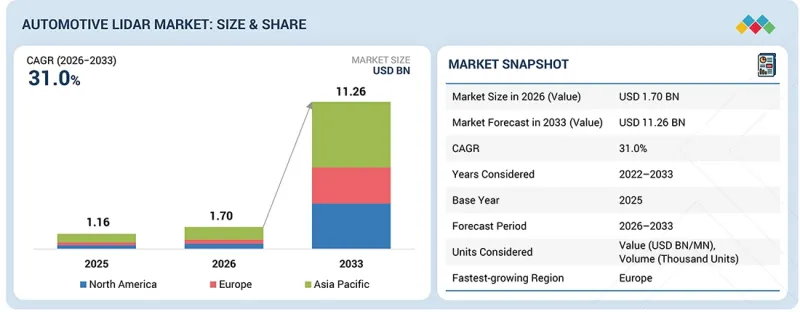
자동차용 LiDAR 시장 규모는 2026년 17억 달러에서 2033년에는 112억 6,000만 달러로, CAGR 31.0%로 확대할 것으로 예측됩니다.
| 조사 범위 | |
|---|---|
| 조사 대상 기간 | 2026-2033년 |
| 기준연도 | 2025년 |
| 예측 기간 | 2026-2033년 |
| 단위 | 달러 |
| 부문 | 기술, 영상 유형, ICE 유형, 설치 장소, EV, 항속거리, 레이저 파장, 측정 프로세스, 자율주행 레벨, 지역별 |
| 대상 지역 | 아시아태평양, 유럽, 북미 |
자동차용 LiDAR 시장은 자동차 제조사들이 지능형 주행 기능 도입을 가속화하고, 더 고성능의 센싱 기술을 양산차 플랫폼에 통합해 나가면서 확대되고 있습니다. 공급업체들은 반도체의 집적화와 소형 센서 설계에 주력하며, 다양한 차종의 프로그램에서 확장성을 높이기 위해 노력하고 있습니다.
특히 Hesai Group(중국)은 전면 유리 뒷면에 내장할 수 있는 자동차용 LiDAR 'ETX'를 발표했으며, RoboSense(중국)는 통합성과 인식 성능을 향상시키기 위해 자사의 EOCENE SPAD SoC 아키텍처를 기반으로 한 'Phoenix' 및 'Peacock' 칩셋을 출시했습니다. 아시아태평양은 견고한 스마트카 생산과 Hesai Group(중국), RoboSense(중국), Huawei Technologies(중국)를 비롯한 LiDAR 공급업체들의 집중에 힘입어 시장 도입에서 계속해서 주도적인 위치를 유지하고 있습니다. 예를 들어 2026년 4월, RoboSense(중국)는 EOCENE SPAD SoC 아키텍처를 기반으로 한 'Phoenix' 및 'Peacock' 칩셋을 출시하여, 이미지 품질 수준의 3D 인식 및 차세대 자율주행 애플리케이션을 지원했습니다. 양산차에 대한 적용이 확대되고 자율주행 기능이 발전함에 따라 자동차용 LiDAR는 차세대 차량 플랫폼 전반에 걸쳐 표준적인 센싱 기술이 될 것으로 예상됩니다.
'예측 기간 중 승용차 부문이 자동차용 LiDAR 시장을 주도할 것으로 예상됩니다.'
승용차 부문이 주도적인 위치를 차지하는 이유는 상용차에 비해 생산 대수가 많고, 자율주행 기능의 도입이 빠르게 진행되고 있기 때문입니다. 현재 자동차용 LiDAR의 적용은 승용차 프로그램, 특히 프리미엄 및 상위 중형 부문 모델에 집중되어 있으며, OEM은 레벨 2+ 및 레벨 3 주행 기능을 지원하기 위해 첨단 센싱 기술을 통합하고 있습니다.
이는 Innovusion(중국)의 LiDAR를 탑재한 NIO ET7, RoboSense(중국)의 LiDAR를 탑재한 XPENG G9, Valeo(프랑스)의 LiDAR를 탑재한 메르세데스-벤츠 S-클래스, Huawei Technologies(중국)의 LiDAR를 통합한 AITO M9와 같은 양산차 프로그램에도 반영되어 있으며, 승용차 플랫폼 전반에 걸쳐 LiDAR의 상용화가 더욱 진전되고 있음을 보여줍니다.
또한 승용차는 프리미엄 사양이나 소프트웨어 기반 ADAS 패키지를 통해 더욱 강력한 매출 창출 기회를 제공하고 있으며, 이는 LiDAR 공급업체에게 주요 상용화 경로가 되고 있습니다. 이러한 추세는 NIO Inc.(중국), XPENG Inc.(중국), Zeekr Intelligent Technology(중국), Volvo Cars(스웨덴), Seres Group(중국)이 추진하는 스마트카 프로그램 전반에 걸쳐 점점 더 두드러지고 있습니다. NIO ET7, XPENG G9, AITO M9, Volvo EX90, Zeekr 001 FR과 같은 차종들은 승용차 라인업 전반에 걸쳐 라이다(LiDAR) 탑재를 지속적으로 확대하고 있습니다. 2025년 8월, XPENG Inc.(중국)는 G9를 포함한 전체 승용차 라인업에 걸쳐 지능형 주행 기능을 업데이트하며, 양산 승용차에 LiDAR 기반 주행 지원 기능의 적용을 한층 더 강화했습니다.
'예측 기간 중, 범퍼&그릴 부문은 주도적인 위치를 차지할 것으로 예상됩니다.'
범퍼&그릴 부문은 광범위한 전방 감지 능력과 뛰어난 차량 패키징 및 생산 확장성을 모두 갖추고 있으며, 예측 기간 중 자동차용 LiDAR 시장에서 가장 큰 점유율을 차지할 것으로 예상됩니다. 루프&어퍼 필러, 헤드라이트&테일라이트 및 기타 설치 위치와 비교했을 때, 범퍼&그릴로의 통합은 공기역학적 영향을 줄이고 차량의 외관을 개선하며, 양산차 아키텍처에 쉽게 적용할 수 있게 해줍니다. OEM은 외부 루프 장착 모듈을 사용하지 않고도 자율주행 기능을 지원하기 위해, 전면 패널에 LiDAR를 탑재하는 작업을 더욱 적극적으로 추진하고 있습니다.
이러한 접근 방식은 NIO ET7, XPENG G9, AITO M9, Li Auto L9, 메르세데스-벤츠 S-클래스 등의 프리미엄 차량 및 스마트카 프로그램에서 점차 보편화되고 있으며, 이러한 차량에서는 양산형 차량 디자인을 유지하면서 인지 성능을 향상시키기 위해 LiDAR가 전면 구조에 통합되어 있습니다. 구체적인 예로는 Innovusion(중국)의 LiDAR를 채택한 NIO ET7, Huawei Technologies(중국)의 LiDAR를 통합한 AITO M9, RoboSense(중국)의 LiDAR를 채택한 XPENG G9 등을 들 수 있습니다. 이 차량들은 전면부에 통합된 센서 배치를 통해 차량 디자인을 유지하면서도 더 뛰어난 인식 성능을 실현하고 있습니다. 센서의 소형화가 진행되고 OEM 업체들이 임베디드형 센싱 아키텍처를 선호하는 경향이 강해지고 있는 것을 배경으로, 범퍼 및 그릴에 대한 설치는 시장에서 계속해서 주요 설치 부문으로 자리매김할 것으로 예상됩니다.
이 보고서에서는 전 세계 자동차용 LiDAR 시장을 조사하여, 시장 개요, 시장 성장에 영향을 미치는 다양한 요인에 대한 분석, 기술 및 특허 동향, 법규제 환경, 사례 연구, 시장 규모 추이 및 전망, 각종 분류·지역/주요 국가별 상세 분석, 경쟁 현황, 주요 기업 개요 등을 정리하여 전해드립니다.
자주 묻는 질문
목차
제1장 서론
제2장 개요
제3장 주요 인사이트
제4장 시장 개요
제5장 업계 동향
제6장 기술의 진보, AI의 영향, 특허, 혁신, 향후 응용
제7장 지속가능성과 규제 상황
제8장 고객 상황과 구매 행동
제9장 자동차용 LiDAR 시장 : ICE 유형별
제10장 자동차용 LiDAR 시장 : 추진 방식별
제11장 자동차용 LiDAR 시장 : 영상 유형별
제12장 자동차용 LiDAR 시장 : 레이저 파장별
제13장 자동차용 LiDAR 시장 : 자율주행 레벨별
제14장 자동차용 LiDAR 시장 : 설치 장소별
제15장 자동차용 LiDAR 시장 : 측정 프로세스별
제16장 자동차용 LiDAR 시장 : 기술별
제17장 자동차용 LiDAR 시장 : 측정 범위별
제18장 자동차용 LiDAR 시장 : 지역별
제19장 경쟁 구도
제20장 기업 개요
제21장 조사 방법
제22장 부록
KSA 26.07.14The automotive LiDAR market is projected to grow from USD 1.70 billion in 2026 to USD 11.26 billion by 2033 at a CAGR of 31.0%.
| Scope of the Report | |
|---|---|
| Years Considered for the Study | 2026-2033 |
| Base Year | 2025 |
| Forecast Period | 2026-2033 |
| Units Considered | USD Billion |
| Segments | by Technology, Image Type, ICE Vehicle Type, Location, Electric Vehicle, Range, Laser Wavelength, Measurement Process, Level of Autonomy, and Region |
| Regions covered | Asia Pacific, Europe, North America |
The automotive LiDAR market is expanding as vehicle manufacturers accelerate deployment of intelligent driving functions and integrate higher-performance sensing into production vehicle platforms. Suppliers are focusing on semiconductor integration and compact sensor designs to improve scalability across vehicle programs. Notably, Hesai Group (China) introduced the ETX automotive LiDAR with behind-the-windshield integration, while RoboSense (China) launched Phoenix and Peacock chipsets based on its EOCENE SPAD SoC architecture to improve integration and perception performance. Asia Pacific continues to lead market adoption, supported by strong intelligent vehicle production and concentration of LiDAR suppliers, including Hesai Group (China), RoboSense (China), and Huawei Technologies Co., Ltd. (China). For instance, in April 2026, RoboSense (China) launched Phoenix and Peacock chipsets based on its EOCENE SPAD SoC architecture to support image-grade 3D perception and next-generation intelligent driving applications. As production vehicle adoption increases and intelligent driving capabilities expand, automotive LiDAR is expected to become a standard sensing technology across next-generation vehicle platforms.
"The passenger car segment is expected to dominate the automotive LiDAR market during the forecast period."
The passenger car segment's dominance can be attributed to higher production volumes and faster deployment of intelligent driving features compared with commercial vehicles. Automotive LiDAR adoption is currently concentrated in passenger vehicle programs, particularly premium and upper mid-segment models, where OEMs are integrating advanced sensing to support Level 2+ and Level 3 driving functions. This is reflected in production vehicle programs such as NIO ET7 using LiDAR from Innovusion (China), XPENG G9 using LiDAR from RoboSense (China), Mercedes-Benz S Class using LiDAR from Valeo (France), and AITO M9 integrating LiDAR from Huawei Technologies Co., Ltd. (China), indicating stronger commercialization of LiDAR across passenger vehicle platforms. Passenger cars also provide stronger monetization opportunities through premium trims and software-enabled ADAS packages, making them the primary commercialization route for LiDAR suppliers. This trend is increasingly visible across intelligent vehicle programs from NIO Inc. (China), XPENG Inc. (China), Zeekr Intelligent Technology (China), Volvo Cars (Sweden), and Seres Group (China). Vehicle models such as NIO ET7, XPENG G9, AITO M9, Volvo EX90, and Zeekr 001 FR continue expanding LiDAR deployment across passenger vehicle portfolios. In August 2025, XPENG Inc. (China) introduced updated intelligent driving capabilities across its passenger vehicle lineup, including the G9, further strengthening the adoption of LiDAR-enabled assisted driving functions in production passenger cars.
"The bumper & grille segment is expected to secure a leading position in the automotive LiDAR market during the forecast period."
The bumper & grille segment is expected to account for the largest share of the automotive LiDAR market during the forecast period due to its ability to combine wide forward sensing coverage with better vehicle packaging and production scalability. Compared with the roof & upper pillar, headlight & taillight, and other locations, bumper & grille integration reduces aerodynamic impact, improves vehicle appearance, and allows easier integration into production vehicle architectures. OEMs are increasingly embedding LiDAR into the front fascia to support intelligent driving functions without external roof-mounted modules. This approach is becoming more common across premium and intelligent vehicle programs, such as NIO ET7, XPENG G9, AITO M9, Li Auto L9, and Mercedes-Benz S Class, where LiDAR is integrated into the front vehicle structure to improve perception performance while maintaining production-ready vehicle design. Examples include NIO ET7 using LiDAR supplied by Innovusion (China), AITO M9 integrating LiDAR from Huawei Technologies Co., Ltd. (China), and XPENG G9 using LiDAR supplied by RoboSense (China), where front-integrated sensing layouts support higher perception performance while maintaining vehicle design. Supported by continued sensor miniaturization and increased OEM preference for embedded sensing architectures, bumper & grille locations are expected to remain the leading installation segment in the automotive LiDAR market.
"Germany is projected to lead the European automotive LiDAR market during the forecast period."
Germany is expected to lead the European automotive LiDAR market during the forecast period due to its concentration of premium vehicle production, early commercialization of advanced driving functions, and strong automotive technology ecosystem. The country is home to several leading OEMs and Tier-1 suppliers, including Mercedes-Benz, BMW, Volkswagen, Continental, and ZF Friedrichshafen AG, that are actively integrating advanced sensing technologies into next-generation vehicle platforms. It has also emerged as one of the first markets globally to approve and commercialize Level 3 driving in production vehicles, increasing the adoption of LiDAR to support higher sensing accuracy and safer automated driving functions. In September 2025, Mercedes-Benz expanded the availability of DRIVE PILOT across additional European markets, extending deployment of its LiDAR-enabled Level 3 driving in production vehicle programs. Supported by early production deployment, strong OEM investment, and leadership in premium intelligent vehicles, Germany is expected to remain the largest revenue contributor to the European automotive LiDAR market.
In-depth interviews were conducted with CEOs, marketing directors, other innovation and technology directors, and executives from various key organizations operating in this market.
- By Company Type: OEMs - 30%, Tier 1 - 50%, and Tier 2 & 3 - 20%
- By Designation: CXOs - 25%, Managers - 55%, and Executives - 20%
- By Region: North America - 40%, Asia Pacific - 30%, and Europe - 30%
The automotive LiDAR market is dominated by major players, including Hesai Group (China), Huawei Technologies Co., Ltd. (China), RoboSense (China), Seyond (US), and Valeo (France). These companies are expanding their portfolios to strengthen their automotive LiDAR market position.
Research Coverage:
The report covers the automotive LiDAR market by Technology (Mechanical LiDAR and Solid-state LiDAR), Image Type (2D and 3D), ICE Vehicle Type (Passenger Car, Light Commercial Vehicle, and Heavy Commercial Vehicle), Location (Bumper & Grille, Headlight & Taillight, Roof & Upper Pillar, and Others), Electric Vehicle Type (BEV, PHEV, FCEV, and HEV), Range (Short & Mid-range (170 m and Below) and Long range (Above 170 m)), Laser Wavelength (Near Infrared, Short-wave Infrared, and Long-wave Infrared), Measurement Process (Frequency Modulated Continuous Wave and Time of Flight), Level of Autonomy (Semi-autonomous and Autonomous), and Region.
It covers the competitive landscape and company profiles of the significant automotive LiDAR market players.
The study also includes an in-depth competitive analysis of the key market players, their company profiles, key observations related to product and business offerings, recent developments, and key market strategies.
Key Benefits of Buying this Report:
- The report will help market leaders/new entrants with information on the closest approximations of revenue numbers for the automotive LiDAR market and its subsegments.
- This report will help stakeholders understand the competitive landscape and gain more insights to position their businesses better and plan suitable go-to-market strategies.
- The report also helps stakeholders understand the market pulse and provides information on key market drivers, restraints, challenges, and opportunities.
- The report also helps stakeholders understand the current and future pricing trends of the automotive LiDAR market.
- The report will help market leaders/new entrants with information on various trends in the automotive LiDAR market based on range, image type, technology, and other parameters.
The report provides insight into the following pointers:
- Analysis of key drivers (Expansion of Level 2+ and Level 3 automated driving systems, Shift toward solid-state and semiconductor-integrated LiDAR), restraints (Adoption of alternative sensing technologies, Competition from advanced camera and imaging radar systems), opportunities (Expansion of sensor fusion platforms, Premium ADAS feature monetization), and challenges (Sensor cost and vehicle integration complexity, Maintaining LiDAR performance across diverse operating conditions)
- Product Development/Innovation: Detailed insights on upcoming technologies, R&D activities, and product & service launches in the automotive LiDAR market.
- Market Development: Comprehensive information about lucrative markets - the report analyses the automotive LiDAR market across varied regions.
- Market Diversification: Exhaustive information about new products & services, untapped geographies, recent developments, and investments in the automotive LiDAR market.
- Competitive Assessment: In-depth assessment of market share, growth strategies, and service offerings of leading players like Hesai Group (China), Huawei Technologies Co., Ltd. (China), RoboSense (China), Seyond (US), Valeo (France), and Innoviz Technologies Ltd. (Israel), in the automotive LiDAR market.
TABLE OF CONTENTS
1 INTRODUCTION
- 1.1 STUDY OBJECTIVES
- 1.2 MARKET DEFINITION
- 1.3 STUDY SCOPE
- 1.3.1 MARKET SEGMENTATION
- 1.3.2 INCLUSIONS & EXCLUSIONS
- 1.4 YEARS CONSIDERED
- 1.5 CURRENCY CONSIDERED
- 1.6 UNIT CONSIDERED
- 1.7 STAKEHOLDERS
- 1.8 SUMMARY OF CHANGES
2 EXECUTIVE SUMMARY
- 2.1 KEY INSIGHTS AND MARKET HIGHLIGHTS
- 2.2 KEY MARKET PARTICIPANTS: INSIGHTS AND STRATEGIC DEVELOPMENTS
- 2.3 DISRUPTIVE TRENDS SHAPING AUTOMOTIVE LIDAR MARKET
- 2.4 HIGH-GROWTH SEGMENTS & EMERGING FRONTIERS
- 2.5 SNAPSHOT: GLOBAL MARKET SIZE, GROWTH RATE, AND FORECAST
3 PREMIUM INSIGHTS
- 3.1 ATTRACTIVE OPPORTUNITIES FOR PLAYERS IN AUTOMOTIVE LIDAR MARKET
- 3.2 AUTOMOTIVE LIDAR MARKET, BY TECHNOLOGY
- 3.3 AUTOMOTIVE LIDAR MARKET, BY IMAGE TYPE
- 3.4 AUTOMOTIVE LIDAR MARKET, BY ICE VEHICLE TYPE
- 3.5 AUTOMOTIVE LIDAR MARKET, BY LOCATION
- 3.6 AUTOMOTIVE LIDAR MARKET, BY PROPULSION
- 3.7 AUTOMOTIVE LIDAR MARKET, BY RANGE
- 3.8 AUTOMOTIVE LIDAR MARKET, BY LASER WAVELENGTH
- 3.9 AUTOMOTIVE LIDAR MARKET, BY MEASUREMENT PROCESS
- 3.10 AUTOMOTIVE LIDAR MARKET, BY LEVEL OF AUTONOMY
- 3.11 AUTOMOTIVE LIDAR MARKET, BY REGION
4 MARKET OVERVIEW
- 4.1 INTRODUCTION
- 4.2 MARKET DYNAMICS
- 4.2.1 DRIVERS
- 4.2.1.1 Technological innovation and diversification in LiDAR
- 4.2.1.2 Rising OEM investments in autonomous driving accelerating LiDAR integration
- 4.2.2 RESTRAINTS
- 4.2.2.1 High system costs limiting LiDAR adoption in mass-market vehicle segments
- 4.2.2.2 Growing competition from cameras and radar reshaping sensor strategies
- 4.2.3 OPPORTUNITIES
- 4.2.3.1 Growth of autonomous mobility services
- 4.2.3.2 Rising automation in commercial vehicles
- 4.2.4 CHALLENGES
- 4.2.4.1 Supply chain disruptions and geopolitical tensions affecting LiDAR manufacturing
- 4.2.4.2 Performance challenges in adverse weather conditions
- 4.2.1 DRIVERS
5 INDUSTRY TRENDS
- 5.1 MACROECONOMIC INDICATORS
- 5.1.1 INTRODUCTION
- 5.1.2 GDP TRENDS AND FORECAST
- 5.1.3 TRENDS IN GLOBAL AUTOMOTIVE LIDAR INDUSTRY
- 5.2 TRENDS & DISRUPTIONS IMPACTING CUSTOMER BUSINESS
- 5.3 PRICING ANALYSIS
- 5.3.1 AVERAGE SELLING PRICE, BY KEY PLAYER, 2025
- 5.3.2 AVERAGE SELLING PRICE, BY ICE VEHICLE TYPE
- 5.3.3 AVERAGE SELLING PRICE, BY REGION
- 5.4 ECOSYSTEM ANALYSIS
- 5.5 VALUE CHAIN ANALYSIS
- 5.6 CASE STUDY ANALYSIS
- 5.6.1 TATA ELXSI LEVERAGED AI-POWERED LIDAR TECHNOLOGY TO ENHANCE VEHICLE DETECTION CAPABILITY IN AUTONOMOUS DRIVING SYSTEMS
- 5.6.2 IMERIT PROVIDED EXPERT LIDAR DATA ANNOTATION SERVICES, ENABLING AUTONOMOUS VEHICLE COMPANY TO LABEL AND SEGMENT 3D POINT CLOUD DATA
- 5.6.3 FORTERRA DEPLOYED OUSTER'S DIGITAL LIDAR SENSORS TO ENHANCE VISIBILITY AND NAVIGATION CAPABILITIES OF ITS AUTODRIVE PLATFORM
- 5.6.4 AVANTIER HELPED AUTONOMOUS VEHICLE COMPANY DEVELOP COST-EFFICIENT AND HIGH-PERFORMANCE LIDAR SOLUTIONS
- 5.6.5 SICK ENHANCED REAL-TIME LIDAR DATA PROCESSING FOR ADVANCED SENSING APPLICATIONS
- 5.6.6 EXWAYZ ENABLED HIGH-ACCURACY LIDAR MAPPING AND LOCALIZATION FOR AUTONOMOUS MOBILITY APPLICATIONS
- 5.7 INVESTMENT AND FUNDING SCENARIO
- 5.8 HS CODE (901320)
- 5.8.1 IMPORT SCENARIO
- 5.8.2 EXPORT SCENARIO
- 5.9 OEM INTEGRATION AND DEPLOYMENT ANALYSIS
- 5.9.1 LIDAR TYPE ADOPTION MATRIX: MECHANICAL, HYBRID, AND FULLY SOLID-STATE
- 5.9.2 OPTIMIZING LIDAR INTEGRATION: SIZE, PLACEMENT, AND SUPPLIER FIT
- 5.9.3 TRACKING DESIGN WINS: STRATEGIC LIDAR-OEM ENGAGEMENTS
- 5.9.4 AUTOMOTIVE LIDAR MARKET: SUPPLIER ANALYSIS
- 5.9.4.1 Hesai Group
- 5.9.4.2 Huawei Technologies Co., Ltd.
- 5.9.4.3 Robosense
- 5.9.4.4 Seyond
- 5.9.4.5 Valeo
- 5.9.4.6 Innoviz Technologies
- 5.10 AUTOMOTIVE LIDAR - GROWTH HOTSPOTS, MONETIZATION MODELS, AND REGIONAL REVENUE POCKETS
- 5.10.1 GTM STRATEGIES: PRIORITIZING HIGH-GROWTH REGIONS AND OEM DEMOGRAPHICS
- 5.10.1.1 LIDAR proliferation by region
- 5.10.1.1.1 Lidar proliferation across China
- 5.10.1.1.2 Lidar proliferation across Europe
- 5.10.1.1.3 Lidar proliferation across North America
- 5.10.1.1.4 Lidar proliferation across Japan and South Korea
- 5.10.1.1 LIDAR proliferation by region
- 5.10.2 TARGET VEHICLE SEGMENTS AND LEADING OEMS IN LIDAR INTEGRATION
- 5.10.2.1 Target vehicle segments, leading OEMs - China
- 5.10.2.2 Target vehicle segments, leading OEMs - Europe
- 5.10.2.3 Target vehicle segments, leading OEMs - North America
- 5.10.2.4 Target vehicle segments, leading OEMs - Japan & South Korea
- 5.10.3 GTM STRATEGIES: EVOLVING PRICING APPROACHES FOR COMPETITIVE POSITIONING
- 5.10.4 NEW GROWTH CHANNELS: DATA MONETIZATION, SUBSCRIPTIONS, AND MOBILITY ECOSYSTEMS
- 5.10.4.1 Subscription-based monetization through autonomous driving features
- 5.10.4.2 LiDAR-as-a-Service for fleets and mobility platforms
- 5.10.4.3 Platform monetization via mapping, city infrastructure, and robotaxi data services
- 5.10.5 AUTOMOTIVE LIDAR SUPPLIER BENCHMARKING
- 5.10.6 LIDAR PRODUCT SPECIFICATIONS AND COMPETITIVE POSITIONING
- 5.10.6.1 Automotive lidar key product specs, by key players
- 5.10.6.2 Performance comparison of automotive lidar technologies
- 5.10.7 LONG-TERM DISRUPTION OUTLOOK: CAMERA & RADAR VS. LIDAR
- 5.10.7.1 Deployment scale vs. supply chain maturity for radar, camera, and lidar
- 5.10.7.2 Autonomous driving strategies, by key OEMS
- 5.10.8 FLEET AND COMMERCIAL VEHICLE LIDAR DEMAND POTENTIAL BEYOND PASSENGER CARS
- 5.10.9 EMERGING USE CASES FOR LIDAR BEYOND ADAS WITHIN AUTOMOTIVE ECOSYSTEM
- 5.10.1 GTM STRATEGIES: PRIORITIZING HIGH-GROWTH REGIONS AND OEM DEMOGRAPHICS
6 TECHNOLOGICAL ADVANCEMENTS, AI-DRIVEN IMPACT, PATENTS, INNOVATIONS, AND FUTURE APPLICATIONS
- 6.1 PATENT ANALYSIS
- 6.2 TECHNOLOGY ANALYSIS
- 6.2.1 KEY TECHNOLOGIES
- 6.2.1.1 Frequency-modulated continuous wave (FMCW) LiDAR
- 6.2.1.1.1 4D LiDAR
- 6.2.1.2 Solid-state LiDAR
- 6.2.1.1 Frequency-modulated continuous wave (FMCW) LiDAR
- 6.2.2 COMPLEMENTARY TECHNOLOGIES
- 6.2.2.1 Sensor suite
- 6.2.2.2 Flash LiDAR technology
- 6.2.2.3 AI-driven sensor fusion
- 6.2.3 ADJACENT TECHNOLOGIES
- 6.2.3.1 Perception software
- 6.2.3.2 Simultaneous localization and mapping (SLAM)
- 6.2.3.3 Optical beam-steering
- 6.2.1 KEY TECHNOLOGIES
- 6.3 IMPACT OF AI ON AUTOMOTIVE LIDAR MARKET
- 6.4 IMPACT OF 2026 ISRAEL-IRAN CONFLICT ON AUTOMOTIVE LIDAR MARKET
- 6.4.1 RAW MATERIAL AND COMPONENT PRICE VOLATILITY
- 6.4.2 SUPPLY CHAIN AND LOGISTICS DISRUPTIONS
- 6.4.3 PRODUCT DEVELOPMENT AND VEHICLE PROGRAM DELAYS
- 6.4.4 REGIONAL IMPACT
- 6.5 EU-INDIA FTA IMPACT ANALYSIS
- 6.5.1 EU TARIFFS
- 6.5.2 IMPORT TO INDIA
- 6.5.3 EXPORTS FROM INDIA
7 SUSTAINABILITY AND REGULATORY LANDSCAPE
- 7.1 REGULATORY LANDSCAPE
- 7.1.1 REGULATIONS PERTAINING TO USAGE OF AUTONOMOUS VEHICLES, BY KEY COUNTRY
- 7.1.1.1 Germany
- 7.1.1.2 Canada
- 7.1.1.3 China
- 7.1.1.4 Italy
- 7.1.1.5 UK
- 7.1.1.6 US
- 7.1.2 REGULATORY BODIES, GOVERNMENT AGENCIES, AND OTHER ORGANIZATIONS
- 7.1.2.1 North America
- 7.1.2.2 Europe
- 7.1.2.3 Asia Pacific
- 7.1.3 KEY ADAS AND VEHICLE SAFETY REGULATIONS AND INITIATIVES, BY COUNTRY/REGION
- 7.1.1 REGULATIONS PERTAINING TO USAGE OF AUTONOMOUS VEHICLES, BY KEY COUNTRY
- 7.2 KEY CONFERENCES & EVENTS, 2026-2027
8 CUSTOMER LANDSCAPE & BUYER BEHAVIOR
- 8.1 KEY STAKEHOLDERS AND BUYING CRITERIA
- 8.1.1 KEY STAKEHOLDERS IN BUYING PROCESS
- 8.1.2 BUYING CRITERIA
9 AUTOMOTIVE LIDAR MARKET, BY ICE VEHICLE TYPE
- 9.1 INTRODUCTION
- 9.2 PASSENGER CAR
- 9.2.1 INCREASING PUSH FOR L2+/L3 AUTONOMY TO DRIVE MARKET
- 9.2.1.1 L3/L4 Autonomous Passenger Car Development - OEMs, Tier-1s & Lidar Suppliers
- 9.2.1 INCREASING PUSH FOR L2+/L3 AUTONOMY TO DRIVE MARKET
- 9.3 LIGHT COMMERCIAL VEHICLE (LCV)
- 9.3.1 INCREASED FOCUS ON VEHICLE SAFETY THROUGH REAL-TIME OBSTACLE DETECTION TO BOOST MARKET
- 9.3.1.1 L3/L4 Autonomous Light Commercial Vehicle (LCV) Development - OEMs, Tier-1s & Lidar Suppliers
- 9.3.1 INCREASED FOCUS ON VEHICLE SAFETY THROUGH REAL-TIME OBSTACLE DETECTION TO BOOST MARKET
- 9.4 HEAVY COMMERCIAL VEHICLE (HCV)
- 9.4.1 LEVEL 4 AUTONOMOUS TRUCK DEVELOPMENT TO BOOST MARKET
- 9.4.1.1 L3/L4 Autonomous Truck Development - OEMs, Tier-1s & Lidar Suppliers
- 9.4.1 LEVEL 4 AUTONOMOUS TRUCK DEVELOPMENT TO BOOST MARKET
- 9.5 INSIGHTS FROM INDUSTRY EXPERTS
10 ELECTRIC VEHICLE LIDAR MARKET BY PROPULSION
- 10.1 INTRODUCTION
- 10.2 BATTERY ELECTRIC VEHICLE (BEV)
- 10.2.1 PUSH FOR L3 AUTONOMY DRIVING DEMAND FOR HIGH-PRECISION LIDAR
- 10.2.1.1 LIDAR SUPPLIERS FOR BEV, 2022-2025
- 10.2.1 PUSH FOR L3 AUTONOMY DRIVING DEMAND FOR HIGH-PRECISION LIDAR
- 10.3 FUEL CELL ELECTRIC VEHICLE (FCEV)
- 10.3.1 HYDROGEN-POWERED VEHICLES SUCH AS MIRAI INCORPORATING LIDAR FOR L2 AUTONOMY
- 10.4 PLUG-IN HYBRID ELECTRIC VEHICLE (PHEV)
- 10.4.1 PREMIUM PHEVS IN CHINA AND EUROPE INTEGRATING LIDAR FOR ADVANCED SAFETY FEATURES TO FUEL GROWTH
- 10.4.1.1 LIDAR SUPPLIERS FOR PHEVS, 2022-2025
- 10.4.1 PREMIUM PHEVS IN CHINA AND EUROPE INTEGRATING LIDAR FOR ADVANCED SAFETY FEATURES TO FUEL GROWTH
- 10.5 HYBRID ELECTRIC VEHICLE (HEV)
- 10.6 INSIGHTS FROM INDUSTRY EXPERTS
11 AUTOMOTIVE LIDAR MARKET, BY IMAGE TYPE
- 11.1 INTRODUCTION
- 11.2 2D
- 11.2.1 COST EFFECTIVENESS AND SIMPLER INTEGRATION TO DRIVE GROWTH
- 11.3 3D
- 11.3.1 RISING ADOPTION OF 3D SENSING FOR HIGH PRECISION MAPPING TO DRIVE MARKET
- 11.4 4D
- 11.5 INSIGHTS FROM INDUSTRY EXPERTS
12 AUTOMOTIVE LIDAR MARKET, BY LASER WAVELENGTH
- 12.1 INTRODUCTION
- 12.2 NEAR-INFRARED
- 12.2.1 COST-EFFECTIVE SENSOR ARCHITECTURE TO DRIVE GROWTH
- 12.3 SHORT-WAVE INFRARED
- 12.3.1 SUPERIOR PERFORMANCE IN LOW VISIBILITY CONDITIONS TO FUEL MARKET
- 12.4 LONG-WAVE INFRARED
- 12.4.1 ABILITY FOR HIGH-FIDELITY OBJECT RECOGNITION TO BOOST DEMAND
- 12.5 INSIGHTS FROM INDUSTRY EXPERTS
13 AUTOMOTIVE LIDAR MARKET, BY LEVEL OF AUTONOMY
- 13.1 INTRODUCTION
- 13.2 SEMI-AUTONOMOUS
- 13.2.1 REGULATORY PUSH DRIVING MANDATORY SAFETY FEATURES IN SEMI-AUTONOMOUS VEHICLES
- 13.3 AUTONOMOUS
- 13.3.1 GROWING NEED FOR HIGH-PRECISION MAPPING AND PERCEPTION TO BOOST MARKET
- 13.4 INSIGHTS FROM INDUSTRY EXPERTS
14 AUTOMOTIVE LIDAR MARKET, BY LOCATION
- 14.1 INTRODUCTION
- 14.2 BUMPER & GRILLE
- 14.2.1 BUMPER & GRILLE OFFERING OPTIMAL LOCATION FOR SENSOR FITMENT WITHOUT COMPROMISING DESIGN
- 14.3 HEADLIGHT & TAILLIGHT
- 14.3.1 OEMS EXPLORING DUAL-USE LIGHTING MODULES FOR LIDAR AND ILLUMINATION FUNCTIONALITY
- 14.4 ROOF & UPPER PILLAR
- 14.4.1 STRATEGIC MOUNTING ON ROOFLINES SUPPORTING MAXIMUM COVERAGE TO PROPEL MARKET
- 14.5 OTHER LOCATIONS
- 14.6 INSIGHTS FROM INDUSTRY EXPERTS
15 AUTOMOTIVE LIDAR MARKET, BY MEASUREMENT PROCESS
- 15.1 INTRODUCTION
- 15.2 TIME OF FLIGHT (TOF)
- 15.3 FREQUENCY-MEASUREMENT CONTINUOUS WAVE (FMCW)
- 15.4 INSIGHTS FROM INDUSTRY EXPERTS
16 AUTOMOTIVE LIDAR MARKET, BY TECHNOLOGY
- 16.1 INTRODUCTION
- 16.2 MECHANICAL LIDAR
- 16.2.1 PROVEN RELIABILITY AND ESTABLISHED USE IN PROVIDING HIGH-RESOLUTION IMAGES TO DRIVE MARKET
- 16.3 SOLID-STATE LIDAR
- 16.3.1 DEMAND FOR COMPACT, VIBRATION-RESISTANT SENSOR OPTIONS TO DRIVE MARKET
- 16.3.1.1 Microelectromechanical system (MEMS) LiDAR
- 16.3.1.2 Flash LiDAR
- 16.3.1.3 Optical phased array (OPA) LiDAR
- 16.3.1.4 Others
- 16.3.1 DEMAND FOR COMPACT, VIBRATION-RESISTANT SENSOR OPTIONS TO DRIVE MARKET
- 16.4 INSIGHTS FROM INDUSTRY EXPERTS
17 AUTOMOTIVE LIDAR MARKET, BY RANGE
- 17.1 INTRODUCTION
- 17.2 SHORT & MID-RANGE (170 METERS AND BELOW)
- 17.2.1 SHORT AND MID-RANGE LIDAR ENABLING PRECISE OBSTACLE DETECTION IMPROVING AUTOMATED PARKING AND BLIND-SPOT DETECTION FEATURES
- 17.3 LONG-RANGE (ABOVE 170 METERS)
- 17.3.1 LONG-RANGE LIDAR INTEGRATION SUPPORTING FEATURES SUCH AS ADAPTIVE CRUISE CONTROL AND HIGHWAY AUTOPILOT
- 17.4 INSIGHTS FROM INDUSTRY EXPERTS
18 AUTOMOTIVE LIDAR MARKET, BY REGION
- 18.1 INTRODUCTION
- 18.2 ASIA PACIFIC
- 18.2.1 CHINA
- 18.2.1.1 OEM-government-led L2+/L3 autonomy push fueling multi-segment LiDAR adoption
- 18.2.2 INDIA
- 18.2.2.1 Rising ADAS adoption in mass-market vehicles to drive early-stage LiDAR demand
- 18.2.3 JAPAN
- 18.2.3.1 OEM-led innovation in sensing technology accelerating LiDAR commercialization
- 18.2.4 SOUTH KOREA
- 18.2.4.1 OEM tech partnerships supporting scalable LiDAR integration to drive market
- 18.2.1 CHINA
- 18.3 EUROPE
- 18.3.1 GERMANY
- 18.3.1.1 Significant OEM-supplier ecosystem driving early adoption of high-performance LiDAR in luxury vehicles
- 18.3.2 FRANCE
- 18.3.2.1 Rise of Level 4 vehicle testing and OEM push toward autonomous mobility to drive market
- 18.3.3 ITALY
- 18.3.3.1 Growing focus on achieving higher autonomy in commercial vehicles to drive market
- 18.3.4 UK
- 18.3.4.1 Campus and last-mile shuttle projects expanding demand for LiDAR integration
- 18.3.5 SPAIN
- 18.3.5.1 OEM support for higher level of autonomy to drive market
- 18.3.1 GERMANY
- 18.4 NORTH AMERICA
- 18.4.1 US
- 18.4.1.1 Strong local vendor base and AV testing programs supporting LiDAR scale-up
- 18.4.2 CANADA
- 18.4.2.1 Surge in adoption of autonomous vehicles to drive market
- 18.4.3 MEXICO
- 18.4.1 US
19 COMPETITIVE LANDSCAPE
- 19.1 INTRODUCTION
- 19.2 KEY PLAYER STRATEGIES/RIGHT TO WIN, 2024 - 2026
- 19.3 REVENUE ANALYSIS
- 19.4 MARKET SHARE ANALYSIS
- 19.5 COMPANY VALUATION AND FINANCIAL METRICS
- 19.6 BRAND/PRODUCT COMPARISON
- 19.7 COMPANY EVALUATION MATRIX: KEY PLAYERS, 2026
- 19.7.1 STARS
- 19.7.2 EMERGING LEADERS
- 19.7.3 PERVASIVE PLAYERS
- 19.7.4 PARTICIPANTS
- 19.7.5 COMPANY FOOTPRINT
- 19.7.5.1 Company footprint
- 19.7.5.2 Region footprint
- 19.7.5.3 Technology footprint
- 19.7.5.4 Image type footprint
- 19.7.5.5 Range footprint
- 19.8 COMPANY EVALUATION MATRIX: STARTUPS/SMES, 2026
- 19.8.1 PROGRESSIVE COMPANIES
- 19.8.2 RESPONSIVE COMPANIES
- 19.8.3 DYNAMIC COMPANIES
- 19.8.4 STARTING BLOCKS
- 19.8.5 COMPETITIVE BENCHMARKING
- 19.8.5.1 List of startups/SMEs
- 19.8.5.2 Competitive benchmarking of startups/SMEs
- 19.9 COMPETITIVE SCENARIO
- 19.9.1 PRODUCT LAUNCHES
- 19.9.2 DEALS
- 19.9.3 EXPANSIONS
- 19.9.4 OTHER DEVELOPMENTS
20 COMPANY PROFILES
- 20.1 KEY PLAYERS
- 20.1.1 HESAI GROUP
- 20.1.1.1 Business overview
- 20.1.1.2 Products/Solutions offered
- 20.1.1.3 Recent developments
- 20.1.1.4 MnM view
- 20.1.1.4.1 Key strengths
- 20.1.1.4.2 Strategic choices
- 20.1.1.4.3 Weaknesses and competitive threats
- 20.1.2 HUAWEI TECHNOLOGIES CO., LTD.
- 20.1.2.1 Business overview
- 20.1.2.2 Products/Solutions offered
- 20.1.2.3 Recent developments
- 20.1.2.4 MnM view
- 20.1.2.4.1 Key strengths
- 20.1.2.4.2 Strategic choices
- 20.1.2.4.3 Weaknesses and competitive threats
- 20.1.3 ROBOSENSE
- 20.1.3.1 Business overview
- 20.1.3.2 Products/Solutions offered
- 20.1.3.3 Recent developments
- 20.1.3.4 MnM view
- 20.1.3.4.1 Key strengths
- 20.1.3.4.2 Strategic choices
- 20.1.3.4.3 Weaknesses and competitive threats
- 20.1.4 SEYOND
- 20.1.4.1 Business overview
- 20.1.4.2 Products/Solutions offered
- 20.1.4.3 Recent developments
- 20.1.4.4 MnM view
- 20.1.4.4.1 Key strengths
- 20.1.4.4.2 Strategic choices
- 20.1.4.4.3 Weaknesses and competitive threats
- 20.1.5 VALEO
- 20.1.5.1 Business overview
- 20.1.5.2 Products/Solutions offered
- 20.1.5.3 Recent developments
- 20.1.5.4 MnM view
- 20.1.5.4.1 Key strengths
- 20.1.5.4.2 Strategic choices
- 20.1.5.4.3 Weaknesses and competitive threats
- 20.1.6 INNOVIZ TECHNOLOGIES LTD
- 20.1.6.1 Business overview
- 20.1.6.2 Products/Solutions offered
- 20.1.6.3 Recent developments
- 20.1.7 OUSTER INC.
- 20.1.7.1 Business overview
- 20.1.7.2 Products/Solutions offered
- 20.1.7.3 Recent developments
- 20.1.8 DENSO CORPORATION
- 20.1.8.1 Business overview
- 20.1.8.2 Products/Solutions offered
- 20.1.8.3 Recent developments
- 20.1.9 ZF FRIEDRICHSHAFEN AG
- 20.1.9.1 Business overview
- 20.1.9.2 Products/Solutions offered
- 20.1.9.3 Products/Solutions offered
- 20.1.9.4 Recent developments
- 20.1.9.5 Recent developments
- 20.1.10 APTIV
- 20.1.10.1 Business overview
- 20.1.10.2 Products/Solutions offered
- 20.1.10.3 Recent developments
- 20.1.1 HESAI GROUP
- 20.2 OTHER PLAYERS
- 20.2.1 INFINEON TECHNOLOGIES AG
- 20.2.2 RENESAS ELECTRONICS CORPORATION
- 20.2.3 CEPTON, INC.
- 20.2.4 AEVA INC.
- 20.2.5 AEYE, INC.
- 20.2.6 LIVOX
- 20.2.7 LEISHEN INTELLIGENT SYSTEMS CO., LTD.
- 20.2.8 MICROVISION
- 20.2.9 VOYANT
- 20.2.10 BENEWAKE (BEIJING) CO., LTD.
- 20.2.11 PREACT TECHNOLOGIES, INC.
- 20.2.12 OPSYS-TECH
21 RESEARCH METHODOLOGY
- 21.1 RESEARCH DATA
- 21.1.1 SECONDARY DATA
- 21.1.1.1 Secondary sources
- 21.1.1.2 Key data from secondary sources
- 21.1.2 PRIMARY DATA
- 21.1.2.1 Primary interviewees from demand and supply sides
- 21.1.2.2 Breakdown of primary interviews
- 21.1.2.3 Primary participants
- 21.1.2.4 Objectives of primary research
- 21.1.1 SECONDARY DATA
- 21.2 MARKET SIZE ESTIMATION
- 21.2.1 BOTTOM-UP APPROACH
- 21.2.2 TOP-DOWN APPROACH
- 21.3 DATA TRIANGULATION
- 21.4 FACTOR ANALYSIS
- 21.5 RESEARCH ASSUMPTIONS
- 21.6 RESEARCH LIMITATIONS
- 21.7 RISK ASSESSMENT
22 APPENDIX
- 22.1 DISCUSSION GUIDE
- 22.2 KNOWLEDGESTORE: MARKETSANDMARKETS' SUBSCRIPTION PORTAL
- 22.3 CUSTOMIZATION OPTIONS
- 22.3.1 AUTOMOTIVE LIDAR MARKET, BY LEVEL OF AUTONOMY, AT COUNTRY LEVEL
- 22.3.2 AUTOMOTIVE LIDAR MARKET, BY PROPULSION, AT COUNTRY LEVEL
- 22.3.3 COMPANY INFORMATION
- 22.3.3.1 Profiling of additional market players (up to five)
- 22.4 RELATED REPORTS
- 22.5 AUTHOR DETAILS


