

|
시장보고서
상품코드
2066629
자동차용 LiDAR : 시장 점유율 분석, 업계 동향 및 통계, 성장 예측(2026-2031년)Automotive LiDAR - Market Share Analysis, Industry Trends & Statistics, Growth Forecasts (2026 - 2031) |
||||||
 Mordor Intelligence
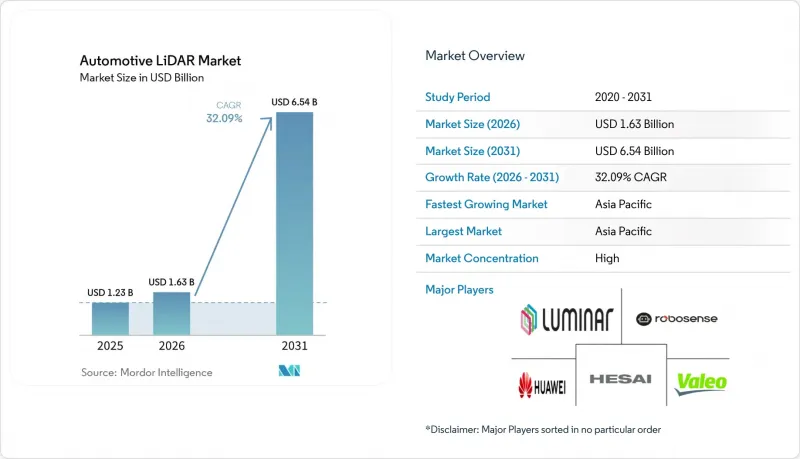
Mordor Intelligence에 의하면, 자동차용 LiDAR 시장 규모는 2025년에 12억 3,000만 달러로 평가되었습니다. 2026년 16억 3,000만 달러에서 2031년까지 65억 4,000만 달러에 이를 것으로 예상되며, 예측 기간(2026-2031년) CAGR은 32.09%를 나타낼 전망입니다.
본 보고서는 용도(자율주행차 및 ADAS(레벨 2+/2++ 이상)), 기술 유형(기계식/회전식 등), 차종(승용차 및 상용차), 감지 거리(단거리/중거리 및 장거리), 설치 위치(루프 마운트 등) 및 지역별로 분류되어 있습니다. 시장 전망은 금액(달러) 기준으로 제시되어 있습니다.
세계의 자동차용 LiDAR 시장 동향 및 인사이트
평균 판매 가격(ASP)의 급격한 하락이 중가대 차량에의 채택을 촉진
2023년부터 2025년에 걸쳐 솔리드 스테이트형 유닛의 평균 판매 가격(ASP)은 30% 이상 하락했으며, 자동차 용도에 완벽하게 적합한 플래시 센서의 가격은 400달러 아래로 떨어졌습니다. 비용 절감은 실리콘 포토닉스의 통합, 웨이퍼 레벨 광학 기술, 그리고 백엔드 테스트의 자동화를 통해 이루어졌으며, 이를 통해 고급 플래그십 차량은 물론 프리미엄 소형차에도 탑재할 수 있게 되었습니다. PreAct Technologies사와 여러 중국 팹은 월간 생산량이 6자리 수에 달한다고 보고하고 있으며, 규모의 경제 효과가 뚜렷하게 나타나고 있습니다. 가격 하락 추세에 따라 소비자용 1,500달러 미만의 가격대에서 옵션 패키지를 제공할 수 있게 되면서, 자동차용 LiDAR 시장의 총 잠재 규모가 확대되고 있습니다. 도입 대수가 증가하면 학습 효과가 더욱 높아지며, 중기적으로는 비용 절감으로 이어집니다.
초기 단계 FMCW 센서의 기술적 돌파구
FMCW 아키텍처는 연속적인 저출력 빛을 방출하며, 코히런트 검출을 이용하여 거리와 반경 방향 속도를 모두 측정합니다. Aurora Innovation사의 FirstLight 센서는 400미터 떨어진 곳에 있는 반사율 10%의 물체도 확실하게 감지할 수 있으며, 이는 고속도로 주행에 필수적인 요건입니다. FMCW는 각 유닛의 주파수 처프를 분리하기 때문에 교통량이 많은 상황에서도 크로스 토크가 사실상 제거되며, 태양광에 의한 간섭에 대한 내성이 높아짐에 따라 모든 기상 조건에서 가동률이 향상됩니다. 각 OEM 업체의 로드맵에 따르면, 북미 및 중국에서는 2027년형 프리미엄 차량에 FMCW가 탑재될 예정이며, 이미 여러 OSAT 파트너사에서 생산용 금형 제작이 진행되고 있습니다. 이러한 추세를 고려할 때, 예측 기간 동안 자동차용 LiDAR 시장의 증분 매출 성장에서 FMCW가 매우 큰 비중을 차지할 것으로 예측됩니다.
피크 출력에 대한 눈 안전 기준의 지속적인 제약
IEC 60825-1 클래스 1 규정에 따라 최대 허용 노출량이 제한되어 있으며, 장거리용 루프 유닛의 광 출력도 제한됩니다. 따라서 각 벤더사는 단순한 송신 출력이 아닌, 더 큰 수신 개구부, 애벌란시 포토다이오드 및 첨단 신호 처리 기술에 의존하고 있습니다. 안전 기준은 대중의 건강을 보호하지만, 설계의 자유도를 제한하여 정밀 광학 시스템 및 열 관리 비용의 상승을 초래하고 있습니다. 이러한 기술적 절충안으로 인해 초장거리 제품의 출시가 지연되면서, 자동차용 LiDAR 시장의 성장 전망이 다소 둔화되고 있습니다.
부문별 분석
2025년, ADAS는 자동차용 LiDAR 시장의 85.12%를 차지하며, 이는 ADAS가 주류로 자리 잡았음을 반영했습니다. 또한, ADAS는 도시 차원의 인가 및 차량 공유 사업자의 차량 발주에 힘입어 연평균 성장률(CAGR) 37.88%를 기록하며 가장 빠르게 성장하고 있는 부문입니다. ADAS 레벨 3 및 레벨 4 프로그램이 그 격차를 메우고 있습니다. 독일의 고급 자동차 제조업체는 이미 양산형 레벨 3 고속도로 자율주행 시스템을 출하하고 있으며, 중국의 모빌리티 기업들은 10개 이상의 대도시권에서 감독 하에 레벨 4 서비스를 운영하고 있습니다. 더 높은 수준의 자율주행에는 여러 개의 센서, 이중화 및 풀스택 검증이 필요하며, 이로 인해 차량당 평균 탑재량이 증가하면서 시장 규모 확대의 다음 물결을 주도하고 있습니다.
완전 자율주행으로의 확대에 따라, 가치의 중심은 하드웨어에서 지속적인 OTA 업그레이드로 이동하고 있습니다. 고속도로에서의 자율주행용 구독 모델은 센서 비용 상승을 정당화할 수 있는 새로운 수익원이 되며, 레벨 5 차량 군이 수집한 데이터는 지각 기능의 반복적인 개선에 활용됩니다. 이러한 플랫폼이 성숙해짐에 따라 선순환이 강화될 것입니다. 즉, 데이터 커버리지의 확대가 보다 안전한 알고리즘을 뒷받침하며, 이는 더 광범위한 운용을 위한 인가 획득으로 이어집니다. 이러한 선순환이, 현 단계에서는 출하 대수가 적음에도 불구하고, 장기적인 낙관적인 전망을 뒷받침하고 있습니다.
2025년, 자동차용 LiDAR 시장에서 기계식 회전 유닛은 매출 점유율의 62.15%를 차지했습니다. 이는 입증된 현장 성능, 종합적인 360도 커버리지, 그리고 확립된 생산 라인 덕분입니다. 그러나 가동 부품이 존재하기 때문에 자동차의 설계 수명인 10년 동안의 신뢰성에 대한 우려가 제기되고 있으며, 또한 폼 팩터의 제약으로 인해 디자인에 통합하는 과정이 복잡해지고 있습니다. MEMS 빔 스티어링, 광학 위상 배열, 플래시 토폴로지 등의 솔리드 스테이트 방식은 완전 밀폐형 모듈과 저비용화의 길을 제시하고 있습니다. 이 솔리드 스테이트 방식 그룹 중에서 FMCW는 급성장하고 있는 하위 범주로, 연평균 성장률(CAGR) 47.46%를 나타낼 것으로 전망되며, 2031년까지 두 자릿수 시장 점유율에 도달할 것으로 예측됩니다.
발레오(Valeo)는 2세대 ‘Scala’ 하이브리드 스캐너의 개선을 계속하고 있는 반면, 루미나르(Luminar)는 다중 채널 펄스 방식의 비행시간법(TOF)을 양산하고 있습니다. 화웨이(Huawei)와 헤사이(Hesai)는 905 nm 펄스 방식 및 1,550 nm FMCW 분야에 막대한 투자를 단행하며, 다양한 차종 등급에 걸쳐 기술적 위험을 분산시키려 하고 있습니다. 이러한 다양한 상황으로 인해, FMCW가 성능 면에서 주도권을 잡고 있다고는 하지만, 단일 아키텍처가 모든 이용 사례를 독점하지는 않을 것입니다.
지역별 분석
2025년, 자동차용 LiDAR 시장에서 아시아태평양은 매출 점유율 41.75%를 차지하며 압도적인 입지를 확립했고, 중국은 센서 도입의 중심지가 되었습니다. L3 자율주행 차량 1대당 최대 1만 위안 상당의 지방 정부 보조금이 2027년까지 연장됨에 따라, 배터리식 전기 SUV 및 세단의 보급이 확대되고 있습니다. 웨이퍼 제조부터 최종 조립에 이르는 국내 공급망을 통해 비용이 절감되고 리드타임이 단축되면서, 이 지역의 경쟁력이 더욱 강화되고 있습니다. 한국과 싱가포르에서는 실증 구역과 스마트 고속도로 프로젝트가 추가되면서 지역 내 수요가 더욱 확대되고 있습니다. 아시아태평양 시장은 연평균 성장률(CAGR) 25.9%를 나타낼 것으로 예측되며, 이는 모든 지역 중 가장 높은 수치입니다.
텍사스주, 애리조나주, 캘리포니아주를 연결하는 자율주행 트럭 전용 노선과 핸즈프리 고속도로 보조 기능에 대한 소비자 수요가 연평균 성장률(CAGR) 23.2%를 견인하고 있습니다. 오로라, 아우스터, 에이바는 국내 시설을 운영하며 수입 의존도를 낮추고 있습니다. 한편, 특정 1,550 nm VCSEL 에피택시 기술에 대한 미국의 수출 규제는 현지 대체 공급업체의 부상을 촉진하고 있습니다. 캐나다의 동계 시험장에서는 전천후형 FMCW 제품에 대한 틈새 수요가 발생하고 있습니다.
유럽은 연평균 성장률(CAGR) 20.4%로 그 뒤를 이었으며, 이는 선진적인 규제와 소비자들의 신중한 도입 태도를 반영한 것입니다. UNECE(유엔 유럽경제위원회)에 근거한 규정은 유럽에서 제정된 것이지만, 각국의 형식 인증 절차는 여전히 엄격하여 대량 납품에 걸림돌이 되고 있습니다. 그러나 독일, 스웨덴, 프랑스의 프리미엄 브랜드들은 L3 수준의 고속도로 자율주행 요건을 충족하기 위해 멀티 LiDAR 구성을 도입하고 있으며, 이 지역은 영향력 있는 기술 동향의 선구자 역할을 하고 있습니다. 규모는 작지만 주목할 만한 기회가 걸프협력회의(GCC) 지역에서 생겨나고 있습니다. 이 지역에서는 스마트시티 메가 프로젝트의 일환으로, 새로운 도시 설계에 자율주행 셔틀이 통합되어 있습니다. 아프리카와 라틴아메리카는 광업 운송 자동화 및 공공 부문 차량 현대화에 힘입어, 낮은 기저에서 각각 21.3%와 19.6%의 연평균 성장률(CAGR)을 기록하고 있습니다.
기타 혜택 :
- 엑셀 형식 시장 예측(ME) 시트
- 3개월간의 애널리스트 지원
자주 묻는 질문
목차
제1장 서론
제2장 조사 방법
제3장 주요 요약
제4장 시장 구도
제5장 시장 규모 및 성장 예측
제6장 경쟁 구도
제7장 시장 기회 및 향후 전망
KTH 26.06.29According to Mordor Intelligence, the automotive LiDAR market size was valued at USD 1.23 billion in 2025 and estimated to grow from USD 1.63 billion in 2026 to reach USD 6.54 billion by 2031, at a CAGR of 32.09% during the forecast period (2026-2031).
This report is Segmented by Application (Robotic Vehicles and ADAS [Level 2+ / 2++ and More]), Technology Type (Mechanical/Spinning and More), Vehicle Type (Passenger Cars and Commercial Vehicles), Range (Short/Mid-Range and Long-Range), Installation Position (Roof-Mounted and More), and Geography. The Market Forecasts are Provided in Terms of Value (USD).
Global Automotive LiDAR Market Trends and Insights
Rapid ASP Decline Unlocking Mid-Priced Vehicle Adoption
Average selling prices for solid-state units fell more than 30% between 2023 and 2025, bringing fully automotive-qualified flash sensors below USD 400. Cost reduction stems from silicon photonics integration, wafer-level optics, and back-end test automation, enabling installation on premium compact cars instead of only luxury flagships. PreAct Technologies and several Chinese fabs report six-figure monthly output volumes, illustrating economies of scale. The downward price curve broadens the total addressable automotive LiDAR market by enabling optional packages at sub-USD 1,500 price points for consumers. A greater installed base further drives learning effects that compress cost over the medium term.
Early-stage FMCW Sensor Breakthroughs
FMCW architectures emit continuous low-power light and use coherent detection to measure both distance and radial velocity. Aurora Innovation's FirstLight sensor shows reliable detection of 10% reflectivity objects at 400 meters, a critical requirement for highway speeds. Because FMCW separates each unit's frequency chirp, crosstalk is virtually eliminated in dense traffic, and immunity to solar interference improves all-weather uptime. OEM roadmaps indicate FMCW deployment on 2027-model premium vehicles in North America and China, with production tooling already underway at several OSAT partners. These advances suggest FMCW will command an outsized share of incremental revenue growth in the automotive LiDAR market through the forecast period.
Persistent Eye-Safety Limits on Peak Power
IEC 60825-1 Class 1 rules cap maximum permissible exposure, limiting optical power for long-range roof units. Vendors, therefore, rely on larger receiver apertures, avalanche photodiodes, and advanced signal processing rather than raw transmit power. While safety guarantees protect public health, design latitude narrows and drives up cost for precision optics and thermal management. These engineering trade-offs slow the rollout of ultra-long-range products and marginally dampen the automotive LiDAR market growth outlook.
Other drivers and restraints analyzed in the detailed report include:
- UNECE R157 and China NCAP 2026 Autonomy Mandates
- Mass-Production Deals Between Tier-1s and Cloud AV Stacks
- Radar/Camera Fusion Roadmaps
For complete list of drivers and restraints, kindly check the Table Of Contents.
Segment Analysis
In 2025, ADAS accounted for 85.12% of the Automotive LiDAR Market, reflecting its mainstream adoption. Additionally, ADAS is the fastest-growing segment, with a 37.88% CAGR, driven by city-level permits and ride-hailing fleet orders. ADAS Level 3 and Level 4 programs bridge the gap: German premium OEMs already ship production Level 3 highway pilots, and Chinese mobility companies operate supervised Level 4 services in over 10 metropolitan areas. Higher autonomy levels require multiple sensors, redundancy, and full-stack validation, raising average content per vehicle and powering the next wave of the market size expansion.
Scaling to full autonomy shifts value from hardware to continuous OTA upgrades. Subscription models for highway self-driving add revenue streams that justify higher sensor bills, and data collected by Level 5 fleets feeds iterative perception improvements. As these platforms mature, they reinforce a virtuous cycle: wider data coverage supports safer algorithms, in turn unlocking permits for broader operations. This flywheel underpins bullish long-range forecasts despite early-stage volumes.
In 2025, mechanical spinning units captured 62.15% of the revenue share in the Automotive LiDAR Market, due to their proven field performance, comprehensive 360-degree coverage, and established manufacturing lines. Yet their moving parts create reliability concerns for a 10-year automotive design life, and form-factor constraints complicate stylistic integration. Solid-state approaches, including MEMS beam steering, optical phased arrays, and flash topologies, step in with fully sealed modules and lower cost trajectories. Within this solid-state cohort, FMCW is the breakout sub-category, projected at 47.46% CAGR and expected to reach double-digit share before 2031.
Valeo continues to iterate its second-generation Scala hybrid scanner, while Luminar brings high-channel-count pulsed time-of-flight into series production. Huawei and Hesai invest heavily in 905-nm pulsed and 1,550-nm FMCW pipelines, seeking to hedge technology bets across different vehicle classes. This pluralistic landscape ensures that no single architecture dominates all use cases, even as FMCW captures the performance leadership narrative.
Geography Analysis
In 2025, the Automotive LiDAR Market saw Asia-Pacific commanding a dominant revenue share of 41.75%, with China as the epicenter of sensor deployment. Provincial subsidies worth up to CNY 10,000 per L3-ready vehicle, extended through 2027, increase penetration of battery electric SUVs and sedans. Domestic supply chains spanning wafer fab to final assembly compress cost and shorten lead times, reinforcing regional dominance. South Korea and Singapore add pilot zones and smart-highway projects, further expanding regional demand. The market in Asia-Pacific is forecast to grow at a 25.9% CAGR, the highest across all regions.
Autonomous trucking corridors linking Texas, Arizona, and California, and consumer appetite for hands-free highway assist, push a 23.2% CAGR. Aurora, Ouster, and Aeva operate domestic facilities that reduce import reliance, while U.S. export control on certain 1,550 nm VCSEL epitaxy encourages local alternative suppliers. Canada's winter testing grounds add niche demand for all-weather FMCW products.
Europe follows with a 20.4% CAGR, reflecting advanced regulation and conservative consumer uptake. UNECE-based rules originate in Europe, but national type-approval processes remain stringent, slowing high-volume delivery. However, German, Swedish, and French premium brands install multi-LiDAR configurations to meet L3 highway pilot requirements, making the region an influential technology trendsetter. Smaller yet notable opportunities arise in the Gulf Cooperation Council, where smart-city mega-projects embed autonomous shuttles into new urban designs. Africa and Latin America post CAGRs of 21.3% and 19.6% respectively on lower bases, driven by mining haulage automation and public-sector fleet modernization.
- Hesai Technology (Hesai Group)
- RoboSense Technology Co., Ltd.
- Huawei Technologies Co., Ltd.
- Valeo SA
- Luminar Technologies Inc.
- Continental AG
- ZF Friedrichshafen AG
- Innoviz Technologies Ltd.
- Ouster Inc.
- Velodyne LiDAR Inc.
- Aeva Inc.
- AEye Inc.
- LeddarTech Holdings Inc.
- Seyond
- LIVOX
- Blickfeld GmbH
- SiLC Technologies Inc.
- Insight LiDAR
Additional Benefits:
- The market estimate (ME) sheet in Excel format
- 3 months of analyst support
TABLE OF CONTENTS
1 Introduction
- 1.1 Study Assumptions and Market Definition
- 1.2 Scope of the Study
2 Research Methodology
3 Executive Summary
4 Market Landscape
- 4.1 Market Overview
- 4.2 Market Drivers
- 4.2.1 Rapid ASP decline unlocking mid-priced vehicle adoption
- 4.2.2 Early-stage FMCW LiDAR sensor breakthroughs extend detection range above 400 m
- 4.2.3 UNECE R157 and China NCAP 2026 autonomy ratings mandate higher-resolution perception
- 4.2.4 Mass-production deals between tier-1s and cloud AV stacks
- 4.2.5 Chinese provincial subsidies for L3-ready sensor suites
- 4.2.6 Automaker OTA business models monetising highway LiDAR subscriptions
- 4.3 Market Restraints
- 4.3.1 Persistent eye-safety rules limit peak power on long-range, roof-mounted units
- 4.3.2 Radar/Camera sensor fusion cost-down roadmap slows LiDAR attach-rate in sub-USD25k cars
- 4.3.3 Export-control scrutiny on 1,550 nm GaAs VCSELs restricts cross-border supply chains
- 4.3.4 Reliability concerns of dynamic beam-steering MEMS mirrors in above 10-year duty cycles
- 4.4 Value / Supply-Chain Analysis
- 4.5 Regulatory Landscape
- 4.6 Technological Outlook
- 4.7 LiDAR Component Ecosystem
- 4.8 Integration of LiDAR in ADAS Vehicles
- 4.9 Automotive LiDAR Technology Roadmap (2020-2030)
- 4.10 Pricing Trend Analysis
- 4.11 Porter's Five Forces
- 4.11.1 Threat of New Entrants
- 4.11.2 Bargaining Power of Buyers
- 4.11.3 Bargaining Power of Suppliers
- 4.11.4 Threat of Substitutes
- 4.11.5 Intensity of Competitive Rivalry
5 Market Size and Growth Forecasts
- 5.1 By Application
- 5.1.1 Robotic Vehicles
- 5.1.2 ADAS
- 5.1.2.1 Level 2+ / 2++
- 5.1.2.2 Level 3 / 4
- 5.1.2.3 Level 5
- 5.2 By Technology Type
- 5.2.1 Mechanical/Spinning
- 5.2.2 Solid-State (MEMS, Flash)
- 5.2.3 FMCW
- 5.3 By Vehicle Type
- 5.3.1 Passenger Cars
- 5.3.2 Commercial Vehicles
- 5.4 By Range
- 5.4.1 Short / Mid-Range (Up to 150 m)
- 5.4.2 Long-Range (Above 150 m)
- 5.5 By Installation Position
- 5.5.1 Roof-Mounted
- 5.5.2 Grille / Bumper
- 5.5.3 Headlamp-Integrated
- 5.6 By Geography
- 5.6.1 North America
- 5.6.1.1 United States
- 5.6.1.2 Canada
- 5.6.1.3 Rest of North America
- 5.6.2 South America
- 5.6.2.1 Brazil
- 5.6.2.2 Argentina
- 5.6.2.3 Rest of South America
- 5.6.3 Europe
- 5.6.3.1 Germany
- 5.6.3.2 France
- 5.6.3.3 United Kingdom
- 5.6.3.4 Italy
- 5.6.3.5 Spain
- 5.6.3.6 Russia
- 5.6.3.7 Rest of Europe
- 5.6.4 Asia-Pacific
- 5.6.4.1 China
- 5.6.4.2 Japan
- 5.6.4.3 South Korea
- 5.6.4.4 India
- 5.6.4.5 Rest of Asia-Pacific
- 5.6.5 Middle East and Africa
- 5.6.5.1 Saudi Arabia
- 5.6.5.2 United Arab Emirates
- 5.6.5.3 South Africa
- 5.6.5.4 Rest of Middle East and Africa
- 5.6.1 North America
6 Competitive Landscape
- 6.1 Market Concentration
- 6.2 Strategic Moves
- 6.3 Market Share Analysis
- 6.4 Company Profiles (includes Global Level Overview, Market Level Overview, Core Segments, Financials as Available, Strategic Information, Market Rank/Share for Key Companies, Products and Services, SWOT Analysis, and Recent Developments)
- 6.4.1 Hesai Technology (Hesai Group)
- 6.4.2 RoboSense Technology Co., Ltd.
- 6.4.3 Huawei Technologies Co., Ltd.
- 6.4.4 Valeo SA
- 6.4.5 Luminar Technologies Inc.
- 6.4.6 Continental AG
- 6.4.7 ZF Friedrichshafen AG
- 6.4.8 Innoviz Technologies Ltd.
- 6.4.9 Ouster Inc.
- 6.4.10 Velodyne LiDAR Inc.
- 6.4.11 Aeva Inc.
- 6.4.12 AEye Inc.
- 6.4.13 LeddarTech Holdings Inc.
- 6.4.14 Seyond
- 6.4.15 LIVOX
- 6.4.16 Blickfeld GmbH
- 6.4.17 SiLC Technologies Inc.
- 6.4.18 Insight LiDAR
7 Market Opportunities and Future Outlook
- 7.1 White-space and Unmet-Need Assessment


